(NEW YORK) — A public high school football coach in Washington state who famously lost his job for leading prayers on the field after games will be reinstated by the spring of next year, court documents show.
A joint stipulation filed in Washington state district court on Tuesday by attorneys representing Joseph Kennedy and lawyers for Bremerton School District stated that “Kennedy is to be reinstated to his previous position as assistant coach of the Bremerton High School football team on or before March 15, 2023.”
The United States Supreme Court sided with Kennedy in June, when justices ruled 6-3 that the coach was protected by the Constitution when he knelt and prayed aloud at the 50-yard-line post-game, sometimes with his players.
For years, lower courts had repeatedly sided with Bremerton School District in the case. The Supreme Court reversal in favor of Kennedy could soon expand the ability of government employees nationwide to practice their faiths more openly while on the job, according to legal experts.
“This is a right for everybody. It doesn’t matter if you’re this religion or that religion or have no faith whatsoever,” Kennedy told ABC News during an interview earlier this year. “Everybody has the same rights in America.”
The First Amendment protects free speech and free exercise of religion, but it also prohibits the establishment of religion by the government. Prior to the ruling in Kennedy v. Bremerton School District, the Supreme Court had long said that public school-sponsored prayer violates the Establishment Clause, even if the prayer is voluntary.
Kennedy and his attorneys at First Liberty Institute, a Texas-based Christian legal group, filed suit against the Bremerton School District after he was suspended seven years ago over the midfield prayers and his contract was not renewed. He insisted the prayers were brief, private individual acts of faith, while the school district argued that student participation breached constitutional prohibitions against the promotion of religion by government officials.
Kennedy had routinely prayed on the field after games for more than seven years, attracting varying levels of participation from students. He said the ritual typically lasted less than a minute.
“It was my covenant between me and God that after every game, win or lose, I’m going to do it right there on the field of battle,” he told ABC News.
It wasn’t until 2015 that the school district informed the coach of constitutional concerns. In a statement released at the time, the school district said Kennedy’s prayers violated “constitutionally-required directives that he refrain from engaging in overt, public religious displays on the football field while on duty.”
The school district said it “has a fundamental obligation to protect the rights of all of its students,” though the statement noted that no players had complained about the prayer sessions.
“It is very likely that over the years, players have joined in these activities,” the school district added, “because to do otherwise would mean potentially alienating themselves from their team, and possibly their coaches.”
The cause of death has been revealed for beloved Harry Potter series star Robbie Coltrane. According to U.K.’s Mirror, the Scottish actor’s death certificate reported he passed away last on October 14 from multiple organ failure. He was 72. The performer, born Anthony Robert McMillan, also reportedly suffered from obesity and diabetes, as well as sepsis and a lower respiratory infection…
Jules Bass, who along with Arthur Rankin Jr. produced the beloved stop-motion Christmas classics like Frosty the Snowman and Rudolph the Red-Nosed Reindeer, has died. Variety reports Bass’ daughter confirmed that her father passed away Tuesday at 87 years old, at an assisted living facility in Rye, New York. Rankin passed way in 2014…
Grey’s Anatomy alum Jesse Williams has been tapped for a role in season thre of Hulu’s Only Murders in the Building in a recurring role, according to Entertainment Weekly. He’ll play “a documentarian with a particular interest in the case,” per the streamer. Williams, who played Dr. Jackson Avery on Grey’s for 12 seasons, is returning to direct and appear in a season 19 episode. He’ll next be seen next in Your Place or Mine, alongside Reese Witherspoon, due out in 2023…
HBO has renewed the financial drama Industry for a third season, the cabler announced on Tuesday. The series, per HBO, gives “an insider’s view of the blackbox of ‘high finance’ through the eyes of an outsider, Harper Stern — played by Myha’la Herrold — a talented young woman from upstate New York. Following a group of young grads fueled by ambition, youth, romance and drugs.” Marisa Abela, Harry Lawtey, David Jonsson, Nabhaan Rizwan, Conor MacNeill, Freya Mavor, Will Tudor and Ken Leung also star. Industry wrapped up its second season on September 19. The first two seasons are currently available for streaming on HBO Max…
(WASHINGTON) — While a federal appeals court decision Friday opened the door to a potential setback for President Joe Biden’s student debt relief program, legal experts and advocates for loan forgiveness tell ABC News they’re not overly concerned, urging people to keep applying.
But borrowers are worried, regardless.
A stay granted by the 8th Circuit Court of Appeals put a temporary pause on discharging loan relief, expected to begin as soon as this week, until judges review a challenge by six GOP-led states to stop the program.
Another ruling, after more detailed hearings, expected later this week, could bring the program to a longer halt and be a big political loss for Biden just before the midterm elections. He’s campaigned on his plan that calls for between $10,000 and $20,000 in debt forgiveness for Americans who make below $125,000 a year, or $250,000 as a married couple.
Remaining optimistic, advocates for student debt relief point to other legal challenges thrown out by the courts — including that a lower court had dismissed this particular lawsuit just before the appeals court issued the temporary stay.
“The most important thing is that people apply for debt relief. Nothing has changed,” Mike Pierce, executive director and co-founder of the Student Borrower Protection Center, told ABC News.
“The fact that the application is open, it is simple, it works, it is easy, and the administration is putting the building blocks in place to be able to press the button and cancel everybody’s debts as soon as they’re able to do so? That was true a week ago. That was true on Friday, and that is true today,” he said.
And while Pierce and others are pushing people to apply because there’s a fast-approaching deadline of Dec. 31 when the current payment pause ends, it’s also a strategy: Advocates hope that the more people who display an interest in the program, the harder it will be for courts to take it away.
“I think it’s very important for people to take all the steps they’re able to because it does show that people are starting to rely on these promises that the president has made to be able to cancel their debts,” Pierce said.
John Brooks, a law professor at Fordham University who focuses on federal fiscal policy, called that more of a political strategy than a legal one, but said it could potentially sway judges.
Brooks predicts the appeals court will focus on whether the GOP-led states have legal standing to claim the harm they allege they’d suffer — and said the Republican argument on that point is weak.
Based on that, he said, he thinks the Friday stay was only a temporary win and downplays the possibility the appeals court will deal the Biden administration a blow.
Put simply, for opponents of the debt relief program, the stay was “the biggest win so far — but it’s still not much of a win,” Brooks said.
The Biden administration, for its part, is pushing full speed ahead. White House press secretary Karine Jean-Pierre wouldn’t entertain the idea that the administration might not be able to deliver on this promise, pushed by ABC News in a press briefing.
“It’s not going to stop our message. We know that there are opponents out there who don’t want us to help middle-class Americans. But it’s not going to stop us,” Jean-Pierre said.
That’s not to say there haven’t already been political implications, though.
The legal back-and-forth has made the process confusing and emotionally draining for hopeful borrowers who want their debt relieved, like Cleopatra Melton, a borrower with roughly $50,000 in student loan debt.
Melton could see 40% of that debt wiped out by the program, which cancels up to $20,000 in additional loan forgiveness for those who are also Pell Grant recipients. (Pell Grants themselves usually do not have to be repaid.)
But the stay imposed by the appeals court has poured cold water on her optimism.
“This was just too good to be true because it never has been done,” she told ABC News.
“As long as that lawsuit was out there, I didn’t want to get too celebratory about it. You know what I mean? So, I’m extremely worried that it’s not going to go through,” she said.
And though the current challenge was brought by Republicans, it still looks like a setback to Melton — who said it has political ramifications for Biden.
Melton said she voted for him in 2020 because of his campaign promise of $10,000 in student loan forgiveness for American borrowers, she said. Now, she sees this as yet another example of people of color — who make up a large percentage of borrowers — being left behind.
“I feel like no one is worthy of my vote. Honestly speaking, everyone makes all these campaign promises to the Black and the brown and I don’t feel like anyone has ever really did anything for me,” Melton said.
“I felt like finally someone’s doing something that will directly affect me and my children with their campaigning, with the laws, with the rules. And now for this to be blocked there’s just — it’s more of the same, to me,” she said.
Others, like Brea Govan, 29, feel more hopeful that the court will throw out the lawsuit, as other courts have done over the last few weeks.
Govan, who qualifies for $10,000 in debt relief, recently applied online so her remaining debt of $9,400 would be wiped completely.
“I wish that they wouldn’t block it,” Govan told ABC News.
“Twenty-two million people have already applied to this and that’s almost half of who needs the support. That says a lot,” she said.
Of course, even if the Biden administration is victorious, the lawsuit could also slow down the debt relief process, since the administration was expected to start doing so this week but has been put on pause.
That’s led advocates to challenge the Biden administration to be open to the idea of extending the moratorium on loan payments once more, past Jan. 1, in order to avoid a messy situation where people need to start making payments on debts again even though their debts should be forgiven.
On Monday, Jean-Pierre wouldn’t say whether that’s on the table, instead arguing that the Biden administration could still stay on schedule despite the current lawsuit.
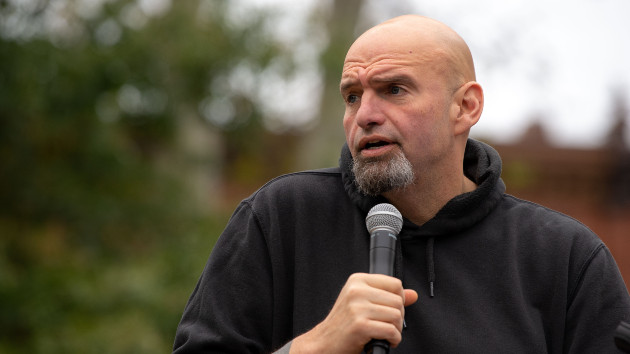
(HARRISBURG, Pa.) — The highly anticipated Pennsylvania Senate debate on Tuesday night was a fast-paced affair focused on policy questions interspersed with — and sometimes interrupted by — the candidates’ attacks, which have defined a key race for who controls Congress’ evenly split upper chamber.
The faceoff also put Democratic Lt. Gov. John Fetterman’s stroke symptoms back in the spotlight as well as what he said was his resilience and recovery from, as he put it, a notable but not disqualifying challenge.
Many eyes were on Fetterman’s health as he took the stage. He spoke haltingly and sometimes inconsistently throughout the debate, even more so than he has at campaign events since returning to the trail in August, three months after his stroke. At times he seemed to struggle to complete his answers.
Two monitors were hung above the heads of the moderators to transcribe both the questions and Republican Mehmet Oz’s answers in real time as an aid for Fetterman’s auditory processing issues, which outside neurologists have said are no indication of cognitive issues for stroke survivors.
Fetterman has worked with a speech therapist; his doctor said last week he was ready for “full duty” in office, though he has declined to release his medical records.
Several times on Tuesday, but not often, there was a pause before Fetterman answered a question as he read the transcription.
Soon after the debate began, he invoked his stroke and the sometimes-mocking criticism he has faced because of it from his rival’s campaign team.
“Let’s talk about the elephant in the room: I had a stroke. He’s never let me forget that,” Fetterman said in his opening remarks, teeing up a line he would repeat over the course of the hour. “It knocked me down, but I’m going to keep coming back up.”
Oz, a former surgeon and popular TV host who described himself as “a living embodiment of the American dream,” did not mention his opponent’s health on stage.
Both candidates were forced to answer for inconsistent views on policies: For example, each was presented with past comments on fracking that contradicted what they’ve said on the issue on the trail.
“I strongly support fracking,” said Oz when asked about comments he made in 2014 arguing against the industry, which employs thousands of Pennsylvanians but draws scrutiny over its environmental effects.
Fetterman, too, was asked by moderators to square his recent public support for fracking with comments he made in 2018 sharply criticizing it.
“I’ve always supported fracking,” he insisted.
Of the discrepancy, Fetterman said awkwardly: “I do support fracking … I do support fracking.”
He and Oz also tried to take advantage when asked about the issues on which they have hinged their candidacies.
“I want to look into the face of every woman in Pennsylvania,” said Fetterman when the debate shifted to abortion access.
“If you believe that the choice of your reproductive freedom belongs to Dr. Oz, then you have a choice,” Fetterman said, contrasting his views with his opponent, who opposes abortion except in cases of rape, incest or the mother’s health and has said he wants it restricted but not criminalized.
“Roe v. Wade, for me, should be the law,” Fetterman added, referring to the national guarantee to abortion rights that was overturned by the Supreme Court this summer.
Fetterman, however, dodged questions on whether he would support any restrictions on abortion, including in later trimesters.
The moderators continually followed up with Oz on whether he would support South Carolina Sen. Lindsey Graham’s proposal to institute a nationwide ban on abortion, with limited exceptions, after 15 weeks.
Oz, as he has done with reporters, declined to answer yes or no, instead saying he was against federal control of the issue and preferred it be left up to the states — to women, their doctors and local politicians, he said.
“Any bill that violates what I said, which is the federal government interfering with a state rule on abortion, I would vote against,” Oz eventually acknowledged.
On crime, meanwhile — an issue he has leveraged as he has closed his yawning polling gap — Oz touted his endorsements by multiple police unions in the state while Fetterman defended himself against soft-on-crime allegations. He claimed Oz, who said he had a lax record granting parole to convicts, had “no experience” with public safety.
Fetterman said that as a mayor of Braddock, Pennsylvania, he had successfully worked to curb gun violence and had a track record of addressing such problems.
“We should be talking about crime and inflation — the issues that are hurting Pennsylvanians,” said Oz, who at multiple points in the debate touted a plan to “unleash” the state’s energy industry to, as he envisioned, raise wages, bolster businesses and help lower high prices.
Oz cited one example of a woman who could no longer afford her groceries given the rising cost of living — a dismaying problem, he said.
Fetterman, he said, was a “radical” who wouldn’t be budget conscious and would raise taxes. On the other hand, he would promote “balance” in Washington.
“I’m a surgeon, not a politician. We take big problems, we focus on them and we fix them,” Oz said late into the debate. “And we do it by uniting, by coming together — not dividing — and by doing that, we get ahead.”
Fetterman said Oz — whom he frequently tried to paint as a liar — wouldn’t have voted for Democrats’ Inflation Reduction Act in Congress, which allows Medicare to negotiate some prescription drug prices, and he invoked Oz’s wealth and relative lack of roots in Pennsylvania. He repeatedly claimed Oz wanted to cut Social Security and Medicare, which Oz said was a baseless allegation. Oz said one of Fetterman’s ads had been pulled for being “dishonest.”
“He has 10 gigantic mansions,” Fetterman said. “We must push back against corporate greed. We must also make sure that we’re also pushing back against price gouging.”
When asked to explain his plan to attack price-gouging corporations, Fetterman did not answer, speaking more broadly about how “inflation is hurting Americans” and how Oz “has never been able to stand up for working families all across America.”
Elsewhere, Fetterman said he supported a law to raise the state minimum wage to $15 an hour, more than double its current rate. Oz said he wanted the minimum wage even higher than that but driven by market forces, not a law, via his plan for the state’s energy companies.
The two candidates split on the value of federal student loan forgiveness — which Fetterman supports — while Oz argued he had a more defined plan for lowering the price of college including offering online instruction.
The campaigns react post-debate
Tuesday was the only event Fetterman agreed to after Oz’s entreaties and criticism — “this is the only debate I could get you to come to talk to me on,” Oz said on stage — and ahead of it, Fetterman’s campaign attempted to lower expectations for his performance, with two top aides telling reporters in a memo on Monday that debating “isn’t John’s format” and citing Oz’s years on television.
In the minutes right after the faceoff ended Tuesday night, his campaign team mobilized to — in their words — tout how he had performed.
“We are thrilled with John’s performance,” spokesman Joe Calvello told reporters.
The campaign announced late Tuesday that it planned to run an ad targeting Oz for one of his answers on abortion access, in which he said policy should be democratically decided by states but more specifically involve “a woman, a doctor and local political leaders.”
The Oz camp, meanwhile, declared victory.
“We saw tonight a debate that was a complete disaster for John Fetterman,” adviser Barney Keller told reporters. “He wasn’t able to defend any of his radical positions, and it really showed.”
Both candidates will be back on the stump Wednesday, with Election Day in less than two weeks and early voting well underway.
Heading into Tuesday, Polls had narrowed considerably, with FiveThirtyEight’s average now showing Fetterman ahead by less than 3 points, down from nearly 11 points six weeks ago.
(NEW YORK) — A whopping $700 million is up for grabs in the next Powerball drawing on Wednesday night, lottery officials said.
The estimated jackpot increased from $680 million after no ticket matched all six numbers drawn on Monday night, the 35th consecutive drawing. Wednesday’s jackpot is Powerball’s largest prize so far this year, the fifth-largest in the American lottery game’s 30-year history and the eighth-largest U.S. lottery jackpot ever, according to a press release from Powerball.
If a player wins Wednesday’s grand prize, it will be the sixth Powerball jackpot won this year. Jackpot winners can either take the money as an immediate cash lump sum or in 30 annual payments over 29 years. The cash value of Wednesday’s $700 million jackpot is $335.7 million, Powerball said.
Tickets cost $2 and are sold in 45 U.S. states as well as Washington, D.C., Puerto Rico and the U.S. Virgin Islands. More than half of all proceeds remain in the jurisdiction where the ticket was purchased, according to Powerball.
The jackpot grows based on game sales and interest rates. But the odds of winning the big prize stays the same — 1 in 292.2 million, Powerball said.
Powerball drawings are broadcast live every Monday, Wednesday and Saturday at 10:59 p.m. ET from the Florida Lottery draw studio in Tallahassee. The drawings are also live streamed online at Powerball.com.
(NEW YORK) — More than half of Americans are considering taking on extra jobs to be able to pay for everyday expenses and meet the rising cost of living as inflation remains high.
Employees in the U.S. are combating the soaring prices of essentials like groceries, housing, and gas by looking for ways to increase their incomes and cut down on expenses, according to a new study by Qualtrics, a software technology company. The survey of more than 1,000 full-time employees found that 38% of workers have looked for a second job, while another 14% are planning to do so.
“With budgets tightening, workers are searching for ways to meet the rising cost of living, including finding new jobs,” said Qualtrics Chief Workplace Psychologist Dr. Benjamin Granger.
Working parents are especially pinched as nearly 70% said their pay isn’t keeping up with costs, the poll states. About 47% of employees with children have looked for a second job, higher than the rate of workers overall. The cost of raising a child through high school has surged to more than $300,000, up roughly $26,000 from two years ago, according to a recent Brookings Institution estimate.
It’s not unusual for American workers to have multiple jobs, especially with more people tapping into the gig economy and doing independently-managed work like freelancing or growing a side hustle. As of September, 7.8 million Americans are working more than one job, making up 4.9% of the total workforce, the Bureau of Labor Statistics reports. A record 440,000 Americans were working two full-time positions in August, compared to 308,000 in February 2020.
The holiday hiring season could offer job-seekers opportunities to boost their incomes. Searches for seasonal positions on Indeed are at the highest level since 2019. In contrast, demand for holiday workers has cooled down from last year as retailers anticipate weaker sales, but still remains above pre-pandemic levels. Walmart, the nation’s largest private employer, is one of several companies that have announced cuts to its holiday payroll in anticipation of weaker sales.
“High inflation and easing COVID-19 concerns may be prompting more people to look for seasonal work this winter. At the same time, employers are pulling back from 2021’s hot holiday hiring levels and offering fewer incentives to prospective workers — perhaps due to recession concerns,” Indeed’s statement reads.
Tiffany Perkins, a marketing professional at a Brooklyn private school, decided to take on a part-time job in September as a restaurant hostess. While she has always done side gigs like offering doula services, selling homemade beauty products, and participating in focus groups for extra money, it isn’t enough to cover her bills as the price of food and utilities rises.
“I budget to zero, I have a very tight paycheck to paycheck lifestyle. I’ve gotten used to it. I can do odd jobs, get a little extra money and be fine,” said Perkins. “Saving has always been difficult for me, I am a single mom so I’ve always been hand to mouth in prioritizing a certain lifestyle for my child and his future. As opposed to securing my immediate financial goals I always think more long term. I feel like I’ve always been in survival mode, but lately it’s survival times 10 because it just seems almost impossible.”
With the new commitment, she now works seven days a week and admits to being exhausted, but she’s glad to be able to catch up on necessary expenses and afford to buy her son a gift for his birthday.
“That weekly pay can really fill the gap for those weeks when I don’t get a paycheck from my full time job and is helping me to be able to stay afloat and really catch up on some things that have been backed up for so long,” said Perkins. “I may not be able to get ahead, but at least I can cover what needs to be covered without robbing Peter to pay Paul and make things stretch.”
(NEW YORK) — As summer ended and the United States headed into the fall and winter, doctors were worried Americans would see a “twindemic” — a situation in which both flu and COVID-19 spread at the same time.
But experts told ABC News the country may now be facing the threat of a “tripledemic” as doctors see an early rise in other pediatric respiratory viruses, particularly respiratory syncytial virus, or RSV.
According to the Centers for Disease Control and Prevention, respiratory illnesses are appearing earlier, and in more people, than in recent years.
The federal health agency says there has also been early increases in flu activity across most of the U.S. with indications that this season could be much more severe than the previous two seasons.
As of Monday afternoon, pediatric bed occupancy in the U.S. is the highest it’s been in two years with 75% of the estimated 40,000 beds filled with patients, according to an ABC News analysis.
COVID-19 infections have not yet begun to spike, CDC data shows. But in prior years, the virus has started to pick up around Thanksgiving.
Experts said a combination of waning immunity to COVID and lack of exposure to other viruses, combined with close gatherings indoors, is fueling a “perfect storm.”
“Mostly the issue is there’s low population immunity and kids are, once again, gathered again, and this is facilitating rapid spread of viruses like RSV,” said Dr. John Brownstein, an epidemiologist and chief innovation officer at Boston Children’s Hospital and an ABC News contributor. “And because of the sheer volume of infection, when you have that larger denominator, you have a situation where a portion of those kids are going to require hospital treatment. And because of that, our hospitals are spread thin, not only for bed capacity, but also for critical staffing, of those beds.”
He added, “So the combination of shortages, bed capacity and rising viral illness all make for an unfortunate perfect storm that we’re seeing happen everywhere right now.”
Resurgence of respiratory viruses
Over the last two years, there were more restrictions such as masking, social distancing, capacity limits and school closures. This meant fewer Americans were exposed to other viruses as well, including the flu and RSV.
Now, with few to no mitigation measures in cities and states across the country, this is leading to a resurgence of these viruses.
“That just leaves a lot of children, young children in particular, that have been born since March of 2020 who haven’t yet encountered RSV infections,” Dr. Larry Kociolek, medical director of Lurie Children’s Hospital in Chicago, told ABC News. “And so that will increase the ability of the virus to spread and increase the number of children who will get infected.”
According to the CDC, flu test positivity rates have increased from 1.27% for the week ending Sept. 24 to 4.38% for the week ending Oct. 15, higher than usual for this time of year, experts said.
Brownstein said another challenging issue for hospitals is staffing shortages.
“We have already an overworked and overstressed workforce, you have many that have left the health care industry because of burnout,” he said. “And then on top of that, you have infection among health care staff.”
Importance of vaccination
The doctors told ABC News it is vital for children to get vaccinated to prevent severe complications. Children can be hospitalized from any of these infections and those with underlying conditions are at the highest risk.
“If your child has not yet received the influenza vaccine, it is imperative that he or she [gets one] as soon as possible,” Dr. Federico Laham, medical director of pediatric infectious disease at Orlando Health Arnold Palmer Hospital for Children, told ABC News. “It takes, as we know, a few weeks to mount a response. With some children who, especially after these past two years with very little flu circulation, the immune system gets a little bit lazy and forgetful. So it’s important to ‘remind’ it.”
Laham went on, “The same thing applies to COVID vaccine. Some children developed COVID early on in the pandemic and then didn’t get the vaccine. We know that it works, we know that it’s extremely safe.”
In addition, experts say that parents may consider having their children wear masks and make sure they’re practicing good hand hygiene, washing hands thoroughly with soap and water.
“The other thing that schools can do, and kids can do, is make sure you bring hand sanitizer with you to school so you can clean your hands and wipes to wipe down surfaces,” Dr. Tom Murray, an associate professor of pediatrics in the section of infectious diseases at Yale University School of Medicine, told ABC News. “And again, common touch points, though the wiping down of contaminated surfaces is especially important with viruses like RSV.”
(NEW YORK) — Since the updated bivalent COVID-19 booster was rolled out at the beginning of September, only 19.4 million Americans have received it as of Oct. 19, according to data from the Centers for Disease Control and Prevention.
The booster is designed to protect against the omicron subvariants BA.4 and BA.5, the latter of which still makes up most virus cases in the United States.
Initially rolled out to those aged 12 and older for the Pfizer booster and those aged 18 and older for the Moderna booster, eligibility was expanded to ages 5 and older for Pfizer and 6 and older for Moderna, about two weeks ago.
However, there are still an additional 200-plus million Americans who are eligible but have not yet gotten the booster.
So why is booster uptake lagging, especially among the older population who were the first to get their primary vaccination series?
Experts told ABC News that COVID-19 is not currently top of mind for many Americans and that public health officials and community leaders need to meet people where they are.
Dr. Benjamin Rosenberg, an assistant professor of psychology at Dominican University of California and director of the Health and Motivation Lab, thinks one reason for the lagging rate is because U.S. public health officials have focused too much on “bench science” — work conducted in a laboratory — and not “social science,” which studies people’s behaviors, thoughts and beliefs.
“The absence of social science from the pandemic response has been really noteworthy,” he told ABC News. “Most folks have a very clear idea of how COVID is transmitted and a lot of what drives up surges is human behavior.”
He continued, “Obviously variants emerge and are more contagious, our immunity wanes, but a lot of what drives surges is human behavior and so to not be talking to folks who study this is I think really a big, big mistake.”
Rosenberg said this means to increase booster shots, it’s not just a matter of a vaccination campaigns to get people to schedule appointments, but rather booster opportunities need to be offered in everyday health care locales, such as a pharmacy.
The pharmacist then should not just describe the complications that could arise if someone doesn’t get the shot but highlight the benefits of getting it as well, he explained.
“Those are places that we frequent, everybody’s going to the pharmacy for something or other,” he said. “So, it could really begin there where you walk in and, particularly if you are there to pick up a prescription or talk to a pharmacist about something, they can immediately check to see if you are up to date on your shots, specifically if you’ve gotten this most recent bivalent booster.”
Rosenberg continued: “And if you haven’t, they can basically say, ‘Hey, do you want to get this right now?’ Give you that opportunity, sort of capitalize on the fact that they know you haven’t gotten it and with that provide you some accurate information about the benefits of getting it. You know, that protection will offer you the other benefits, like social things, that you could enjoy your holidays with your family a little bit more freely.”
Dr. William Schaffner, a professor of preventive medicine at the Vanderbilt University Medical Center, agreed and said people need to have trusted leaders also explain the benefits of the vaccine to communities that are more hesitant.
Rather than trying to get people to schedule an appointment at a pharmacy or a doctor’s office, this could involve setting up town halls or other community events.
“To have people coming from those communities, who are like them in every way to actually demonstrate they’re personally receiving the vaccine, they provide that level of comfort or assurance, that this is a good thing to do for themselves and their families and their communities,” Schaffner told ABC News. “So, we need many, many more ambassadors to reach wonderful diversity of populations that we have in this country.”
Schaffner continued, “It works better if there are leaders, medical leaders, religious leaders, political leaders, people who are thought to be older and wiser in those communities to just go out there.”
(SAN ANTONIO) — A Texas teenager remains on life support more than three weeks after he was shot by a now-former police officer who confronted the unarmed teen while he was eating a hamburger in his car, attorneys for his family said Tuesday.
Erik Cantu, 17, was shot at least four times during the encounter in a San Antonio McDonald’s parking lot on Oct. 2, his family said.
His mother, Victoria Casarez, said her son was shot in his diaphragm, lungs, liver and bicep — and that one of the bullets remains lodged near his heart.
“He’s just mutilated,” she said during a press briefing surrounded by their extended family and their attorneys. “It just hurts us to see our son that way.”
His father, Erik Cantu Sr., described his son’s condition as “very touch and go,” and that he developed pneumonia while in the hospital.
The family’s attorneys said they believe the teen will survive his injuries and referred to Cantu as a “fighter.”
“But what quality of life will he have once he gets through it?” civil rights attorney Ben Crump, an attorney for the family, said.
The San Antonio Police Department said on Oct. 5 that it fired the officer, James Brennand, while releasing body-camera footage that showed him shooting nearly a dozen times at the teen’s car as Cantu drove away. Brennand’s actions violated department tactics, training and procedures, according to San Antonio Police Chief William McManus.
The rookie officer, who had been on the force for seven months, was subsequently charged with two counts of aggravated assault by a public servant, according to the San Antonio Police Department Homicide Unit. He was booked on Oct. 11 and released from Bexar County Jail the following day after posting a $200,000 bond.
A hearing has been set for Nov. 23. ABC News has reached out to his attorney for comment. Neither Brennand nor his attorney, Jay Norton, have yet to release a statement or publicly comment on the case.
The San Antonio Police Officer’s Association said it is not representing Brennand because he had not completed his 1-year probationary period for new officers at the time of the shooting and was therefore not eligible for the benefit.
The family’s attorneys said they were grateful that charges were pressed, but that the family would like to see more. Casarez said she would like to see the former officer charged with two counts of attempted murder and “behind bars.”
“That being said, I pray for his family,” she said.
Crump called the use of force “excessive” and claimed that the former officer racially profiled the teen.
“He profiled this young Hispanic teenager. He profiled him, there’s no question about it,” Crump said. “If we don’t get justice for Erik Cantu, then it can happen to you.”
Crump said his office has reached out to the Department of Justice’s Civil Rights Division to review the case.
“What crime was being committed by two 17-year-old kids parked in a McDonald’s parking lot eating a cheeseburger?” Crump said.
According to police, Brennand was responding to a disturbance call when he noticed a vehicle he thought had fled from him the night before during an attempted stop. The car had no connection to the disturbance call, police said.
The footage shows the officer approaching the car and opening the door, when he sees Cantu eating a hamburger alongside a female passenger and orders him out.
Police said the officer reported the car door hit him as the unarmed teen started to reverse the car.
Body-camera footage shows the officer firing 10 times, including into the car and after Cantu started to drive away, before chasing after it on foot.
Police said that the passenger in the vehicle was not injured during the incident.
Cantu was initially charged by proxy with evading detention in a vehicle and assault on an officer, though the Bexar County Criminal District Attorney has since dismissed the charges.
(WASHINGTON) — Former Trump chief of staff Mark Meadows is fighting a subpoena from the Fulton County, Georgia, special grand jury investigating efforts to overturn the 2020 election.
Meadows’ lawyer argued in a filing Monday that Meadows cannot be compelled to testify because, although the grand jury is investigating alleged criminal conduct, it does not have the ability to return a criminal indictment and can only make recommendations concerning criminal prosecution.
Meadows was subpoenaed in August to appear for testimony on Sept. 27. Meadows says that the matter is now “moot” given that the deadline has now passed.
The Fulton County DA’s office said in a filing dated Oct. 7 and filed on Monday that Meadows had a “scheduling conflict” that prevented him from appearing for testimony on Sept. 27. The DA’s office has proposed that Meadows appear on either Nov. 9, Nov. 16, Nov. 23 or Nov 30.
Meadows was on the January 2021 phone call that then-President Donald Trump had with Georgia Secretary of State Brad Raffensperger in which Trump asked Raffensperger to “find” him enough votes to win the state.
“So look, all I want to do is this. I just want to find 11,780 votes, which is one more than we have because we won the state,” Trump said on the call.
Trump, who has denounced the Fulton County probe, has repeatedly defended his phone call to Raffensperger, calling it “perfect.”
Meadows is one of several Trump allies that the special grand jury has subpoenaed in recent months.
He was also subpoenaed in September 2021 by the House committee investigating the Jan. 6 attack on the U.S. Capitol. After briefly cooperating and selectively turning over more than 9,000 records and emails related to his activities surrounding the events of Jan. 6, Meadows stopped cooperating with that probe.
In December 2021, the committee voted to hold Meadows in contempt of Congress for not appearing before the panel, and a criminal referral was sent to the Department of Justice. However the DOJ ultimately declined to prosecute Meadows.