
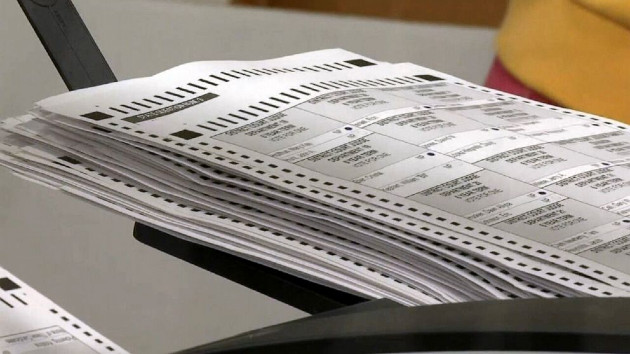
Ballot paper shortage could cause problems on Election Day

Ballot paper shortage could cause problems on Election Day
ABC News

(PHOENIX) — A paper supply crunch is testing the preparedness of U.S. election officials and exposing a key vulnerability in America’s democratic process as midterm voting gets underway.

The 2022 election cycle will use an estimated 30 million pounds of paper, according to industry experts. Soaring demand and a shortage of manufacturers during the pandemic have pinched national stockpiles, leaving little room for error.

“We’re all just collectively crossing our fingers and hoping that the supply chain works just fine,” said Ricky Hatch, county clerk and election administrator for Weber County, Utah.

The biggest concern is editing mistakes or last-minute changes to a local ballot requiring a large-scale reprint.

“That’s when the [shortage] could manifest itself,” Hatch said.

ABC News got an inside look at one of the nation’s largest ballot producers, Runbeck Election Systems in Phoenix, Arizona, which will deliver 50 million midterm ballots across 10 states — consuming more than 5 million pounds of paper, according to the company.

Runbeck CEO Jeff Ellington said Defense Production Authorization was granted with help from the Department of Homeland Security, Cybersecurity and Infrastructure Security Agency, and the Commerce Department has prioritized paper supply for the election.

“If we put an order in for paper and Amazon put an order in for paper, we’re going to take precedence,” Ellington said. “And that has helped just to make sure we would have what we need.”

The global transition to digital and virtual work has led to plunging demand for white paper, forcing many paper mills across North America to shut down or convert to more profitable products, such as cardboard.

“I don’t blame them for converting over, but it’s a very real threat,” Ellington said.

During the pandemic, many surviving paper mills stopped producing new paper and relied on their stockpiles to fulfill orders, experts said. Those have since dwindled. Mill workers and truck drivers have also been in short supply, adding strain on the paper supply chain.

Industry groups say paper production capacities are expected to remain tight potentially into 2023.

In a nationwide alert issued in January, the U.S. Election Assistance Commission warned state election officials of “unprecedented demand” for ballot paper, with “very long order lead times,” and a risk that some “urgent last-minute orders” this year may not be fulfilled.

“We need to make sure that we’re paying extra close attention to proofing of all materials, because if there was a typo or is a typo, your vendor might not be able to fill an emergency order in that way,” said Amy Cohen, executive director of the National Association of State Election Directors.

With early voting underway in at least 34 states, so far there have only been isolated reports of trouble. In Arizona last week, the secretary of state discovered that 6,000 mail-in ballots that had been sent out were printed with major errors, requiring a second print — and more paper.

In January, the paper shortage forced Texas officials to strictly limit printing of voter registration forms. And during Pennsylvania’s May primary, two thirds of mail in ballots in Lancaster County were unreadable by scanner machines because of a printing mistake and had to be processed by hand.

The Election Assistance Commission told ABC News in a statement this month that the paper crunch “should not impact voting in the general election,” so far.

“This is actually a good example of a success story,” said Amber McReynolds, former director of elections in Denver, Colorado. “Largely there has been avoidance of a major crisis because of that coordination and that communication.”

But experts caution, Election Day could still bring surprises, which may be especially consequential at a time when election integrity is already in the spotlight.

Hatch said “a definite risk” is underestimating voter turnout for mail-in and in-person voting when placing a ballot order.

“Trying to gauge turnout is actually quite difficult,” he said.

For states where voters have to file a request to get an absentee ballot, “election officials really don’t know until within 60 days of the election how many people are going to sign up to get that ballot,” McReynolds said.

“The operational predictability is not as good,” she continued.

Election officials really “have to kind of guess really at how many voters might vote that way, and then they have to place orders,” she said.

Although rare, underestimates have happened. During the 2022 Massachusetts primary, a town-wide ballot shortage in Marblehead forced election officials to photocopy ballots, which could not be run through voting machines and had to be counted by hand.

“It’s not realistic to think that the problem is solved. It’s not,” Cohen said. “The ballot printing vendors have already made it clear to us that this is going to be a persistent problem and something that we need to be thinking about for 2024.”

Copyright © 2022, ABC Audio. All rights reserved.

Poll workers and voting sites could be targets of extremists, NYPD warns, urging ‘vigilance’

Poll workers and voting sites could be targets of extremists, NYPD warns, urging ‘vigilance’
Bloomberg Creative/Getty Images

(NEW YORK) — With the midterms just 13 days away, the New York City Police Department is warning that amid a “complex” threat environment, both racially motivated and anti-government extremists could target poll workers, political rallies, political officials and voting sites, according to a Wednesday intelligence bulletin obtained by ABC News.

The bulletin urges that this assessment requires “elevated vigilance as the US midterm elections begin.”

The NYPD is not aware of any credible threats to polling sites in New York City or any candidates.

“However, hostile rhetoric and an abundance of generalized threats from likeminded [extremists] and malicious actors in chat groups, encrypted messaging channels, and other online forums may effectively create echo chambers that circulate and reinforce false narratives and establish a permissive environment for violent action against election-related infrastructure and personnel,” the bulletin states.

In one example of the rhetoric outlined in the document, the NYPD described how a user in an online community asked if there would be “gallows” for Senate Minority Leader Mitch McConnell.

And on Aug. 26, the bulletin states, a user on a pro-Donald Trump message board “encouraged individuals to ‘show up’ in ‘disguise’ at ‘one of these political rallies with a ghost gun and shoot your shot.'”

Two weeks earlier, according to the bulletin, an online user targeted the elections department in Arizona’s Maricopa County, writing in one message: “Fire the building. Execute the traitors trying to leave it.”

The NYPD also said that “recent online calls for violence have led to specific and credible threats, and at least one violent incident, resulting in the arrests and prosecutions of individuals who planned to or did target election officials and political figures.”

Due to a “smaller security footprint,” some local candidates might be easier to target, the bulletin advised, citing the attack this summer against Republican gubernatorial candidate Lee Zeldin.

Copyright © 2022, ABC Audio. All rights reserved.

Gun reform on the ballot after string of devastating mass shootings

Gun reform on the ballot after string of devastating mass shootings
Emily Fennick / EyeEm/Getty Images

(WASHINGTON) — Amid a disturbing uptick in gun violence across the country, the political power of gun reform will be put to the test this election cycle.

There have been more than 500 mass shootings in the U.S. so far this year, according to a tracker from the Gun Violence Archive. Two of those shootings — one at a grocery store in Buffalo, New York and the other at an elementary school in Uvalde, Texas — sparked nationwide outrage and debate about gun violence.

In fact, the tragedies prompted a response from Congress for the first time in decades. Lawmakers this summer passed a bipartisan gun safety package to fund the implementation of red flag laws, close the “boyfriend loophole” and enhance background checks for potential gun buyers under the age of 21.

But the legislation didn’t go as far as many gun control advocates wanted, and now some citizens are using the midterm elections as an opportunity to make more progress on the issue at the state level.

Take Oregon, for example, where voters will consider the country’s most comprehensive gun reform measure on the ballot this November.

“Everybody in the nation has been throwing their hands up saying, ‘Enough is enough. What can we do?’ And this is the one state in the country right now where real action can be taken,” said Rev. Mark Knutson, one of the chief petitioners behind Measure 114 and chair of the group Lift Every Voice.

“It’s been called the Oregon model,” Knutson said, adding, “I think it’ll give a lot of courage to state legislatures, if they can see a major victory come out of Oregon.”

The ballot measure, developed by a coalition of faith leaders, gun control advocates and others, would require permits to buy firearms and prohibit ammunition magazines capable of holding more than 10 rounds. It would also require those applying for a firearm permit to pass a criminal background check, attend safety training and pay a fee.

Knutson’s group started preparing for the ballot measure after the shooting at a high school in Parkland, Florida, in 2018. But he said the shootings in Uvalde and Buffalo prompted a “wave” of new volunteers to help gather signatures for the measure to be included on the ballot.

After Uvalde, where 19 children and two teachers were killed, one Oregon resident decided to turn in his AR-15 rifle and a 9mm handgun to local police.

Ben Beers went viral on TikTok for the move — which he said was emotional but also relieving.

“It’s like, why is this weapon, that’s [a] lethal weapon, here — that I’m seeing throughout these horrible tragedies,” Beers told ABC News. “Why is it in my house?”

Beers described the transformation of once being excited to customize an AR-15 after leaving the military to being horrified when that style weaponry was used to kill young children.

“I have personally done what I can as a U.S. citizen, as a former Marine,” he said. “I have a strong opinion on this. We need to do whatever we can do as citizens to change legislations for our future.”

A second state is also considering a ballot measure related to guns, but on the opposite spectrum. Iowa residents this election cycle will consider adding a gun rights amendment to the state constitution, which would further protect gun ownership.

But polling shows the issue of gun reform has dropped somewhat on voters’ list of concerns as the midterms draw closer, with the economy and abortion rights becoming the hot-button topics this cycle. One poll from Quinnipiac University conducted in June found 17% of Americans thought gun violence was the most urgent issue facing the nation, but as of late August that number dropped to 9%.

Copyright © 2022, ABC Audio. All rights reserved.
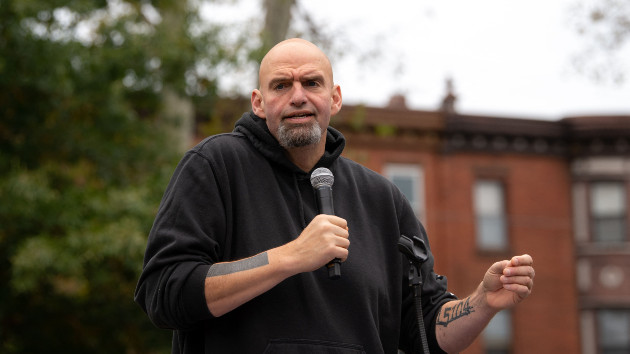
Does Fetterman’s rough debate against Oz matter in Pennsylvania?

Does Fetterman’s rough debate against Oz matter in Pennsylvania?
KRISTON JAE BETHEL/AFP via Getty Images

(WASHINGTON) — Republicans and Democrats are sifting through the aftermath of the first and only debate in Pennsylvania’s marquee Senate race to determine if Democrat John Fetterman’s performance — on his biggest stage some five months into his recovery from a stroke — will move the needle against him in an era when candidate faceoffs are becoming a moribund exercise.

A final answer will come soon enough, with Election Day less than two weeks out and more than 600,000 people having already cast early ballots.

But, operatives said, a widely seen development such as a poor debate performance can change race dynamics even in the closing stretch of a campaign: fueling new ads, driving up fundraising, drawing headlines and more.

Fetterman, Pennsylvania’s lieutenant governor, joined Republican Mehmet Oz, a cardiothoracic surgeon and former TV host, on Tuesday night in Harrisburg for the debate, which opened with heightened media attention because of Fetterman’s stroke in May.

Above the moderators hung two monitors to transcribe the questions and Oz’s answers in real time, to aid Fetterman. He has said the stroke affected his speech and ability to process spoken language — symptoms that outside neurologists said do not indicate cognitive issues for stroke survivors.

The two contenders, running in a race that could decide party control of the currently 50-50 upper chamber, fielded questions on policies ranging from fracking to abortion to crime during the hourlong debate.

On stage Fetterman was quick to acknowledge the “elephant in the room” — his stroke, which he said caused him to miss and sometimes “mush” words — and he said that overcoming a health challenge made him like so many other Pennsylvanians.

But while he touted his recovery and his resiliency, his halting, repetitive speech and auditory symptoms seemingly made it difficult for him to articulate his views and proposals, including on inflation, and he stumbled in responding to a follow-up question on fracking, for example.

Party experts split by partisanship on whether or not the public would be swayed, though.

“Never seen a more painful debate,” veteran Pennsylvania GOP strategist Chris Nicholas bluntly said. “It’s hard to imagine an undecided voter here moving toward Fetterman after that performance last night.”

“There’s no doubt that Fetterman struggled with his words at times, but I don’t think that’s what will move undecided voters,” Pennsylvania Democratic strategist Mike Mikus countered. “Undecided voters already had plenty of time to weigh whether he was capable to do the job. It’s going to come down to the issues they care about, and I still think Fetterman wins on November 8.”

The debate over the debate was sparked when Fetterman fumbled while answering several questions, including about his record on crime as mayor of Braddock and his reversal on fracking, a core if environmentally controversial part of Pennsylvania’s economy for which he once backed a moratorium.

“I was able to stop gun violence for five and a half years as mayor — ever accomplished before since my time as mayor because I’m the only person on this stage right now that is — can successful about pushing back against gun violence and being the community more safe,” Fetterman said.

“I do support fracking and I don’t, I don’t — I support fracking, and I stand, and I do support fracking,” he added in another remark that Republicans seized on.

Other comments were more fluid, but Fetterman consistently dropped words or spoke in a choppy cadence — leaving Republicans to pounce and Democrats to spin.

“It was really bad for Fetterman. Worse than I thought,” said Pennsylvania GOP consultant Josh Novotney.

“I watched the debate last night. It was hard to watch, frankly,” Sen. Chris Coons, D-Del., said on CNN Wednesday. “At the end of the day, they’ve got a pretty stark choice between John Fetterman, who looked uncomfortable in a suit and tie, whose answers were at times halting, but who is authentic and will fight for working families in Pennsylvania and who’s got a real and strong record as lieutenant governor and mayor to run on. And they will contrast that with Mehmet Oz, who looked very comfortable in a tailored suit, who’s very good on television.”

In a sign that Republicans smell blood in the water after the debate, Make America Great Again Inc., former President Donald Trump’s super PAC, rolled out a $870,000 ad buy in Pennsylvania highlighting worries around immigration and crime raising questions of Fetterman and President Joe Biden’s fitness for office.

“Biden is stumbling around, and Fetterman just isn’t right,” the narrator says in the ad, which was first reported by Fox News.

Among Democrats, the aftermath sparked questions over whether Fetterman should have even agreed to debate Oz in the first place.

“No,” one Pennsylvania party strategist, granted anonymity to discuss the race frankly, said when asked if Fetterman should have appeared. “No upside.”

“I think you have to put him out there and have him answer some questions,” Pennsylvania Democratic consultant Mustafa Rashed said, referencing concerns over Fetterman’s health after the stroke.

After the debate, his campaign almost immediately and forcefully insisted on their victory.

“For a guy who’s just been in the hospital months ago, he took it to Dr. Oz pretty f—— hard tonight,” Fetterman spokesperson Joe Calvello said Tuesday before later announcing that the campaign had raised more than $2 million in the day after the debate.

And Democrats were able to knock Oz on abortion after he said Tuesday that while the federal government shouldn’t have a role in restricting the procedure, “I want women, doctors, local political leaders, letting the democracy that’s always allowed our nation to thrive to put the best ideas forward so states can decide for themselves.”

Fetterman’s team swiftly cut video of the comment into an ad, which Biden later shared.

“If Dr. Oz gets his way, where does this end? Would he recommend local officials make decisions about cancer treatments? Colonoscopies? Or is this kind of scrutiny reserved just for women?” Biden tweeted.

Later Wednesday, when ABC News’ Cecilia Vega asked press secretary Karine Jean-Pierre if Biden had ever raised health concerns about Fetterman, Jean-Pierre said: “The president, in his personal conversations with the lieutenant governor, finds him to be an authentic, really brave individual.”

Outside disability advocates also described the scrutiny of Fetterman’s performance as ableism, a form of prejudice.

“Equating an auditory processing disorder, or what others might describe as aphasia, with a lack of intelligence or cognition is commonplace and bigotry,” said Luke Visconti, chairman of the National Organization on Disability. “This bullying is a key factor in preventing roughly half of the almost 200,000 Americans under 65 who have a stroke from returning to work.”

How permanently the debate may shift voter attitudes remains unclear.

Such events are becoming a vanishing breed, with candidates in states across the country increasingly opting out of something that can be hard to win but easy to lose, operatives said.

“It’s high risk, low reward. You spend a lot of time preparing for it, the [return on investment] isn’t really there,” Rashed, the Democratic consultant, said. “The high risk is that you make a gaffe and it turns into a social media meme or something else that’s untoward. And … I think candidates are viewing it as there’s just not a lot of upside in doing these things.”

The race between Fetterman and Oz was already tightening, with FiveThirtyEight’s polling average showing Fetterman’s lead dropping from 7 points a month ago to about 2.3 points as of Wednesday.

Democrats who spoke to ABC News disagreed on whether the debate would have an impact, with many saying not enough people would care or some suggesting Oz’s abortion remarks could turn voters off.

“Regular partisans will stay in their corners, as the reactions make clear,” the anonymous Democrat said.

Republicans, meanwhile, were bullish the sliver of undecided voters remaining would find Fetterman unappealing.

“In a close race,” said Keith Naughton, a GOP strategist with extensive experience in Pennsylvania politics, “a disastrous debate performance like John Fetterman had is enough to tip the scales against him and probably will.”

When asked about the debate, voters were torn.

“I’m not sure if Mr. Fetterman’s people should have him in this race. I feel bad for him,” said Tom Lawlor, a lawyer and a Democrat who said he’s still undecided on who to back. “If my decision had to be made today, I think I would lean for Dr. Oz.”

“Okay, he has a little bit of trouble talking. His mind is okay. I mean, if it affected his mind in some way, I could say okay, but he’s still a smart guy. Has nothing to do with his speech,” Richard Ferro, a retiree from Pittsburgh said of Fetterman’s performance.

Copyright © 2022, ABC Audio. All rights reserved.

Fetterman and Oz debate highlights ableism in politics, advocates say

Fetterman and Oz debate highlights ableism in politics, advocates say
BRANDEN EASTWOOD/AFP via Getty Images

(WASHINGTON) — In the Pennsylvania race for a seat in the U.S. Senate, Democratic candidate John Fetterman has had to continuously defend his ability to serve as he recovers from a life-threatening stroke.

“Again, my doctor believes that I’m fit to be serving, and that’s what I believe where I’m standing,” he said on the debate stage Tuesday night, citing a letter from his primary care doctor and declining to commit to releasing medical records.

According to Fetterman’s doctors, the candidate sometimes has difficulty speaking and experiences auditory processing issues five months after his stroke. This prompted criticism and speculation by some about his ability to take on a role in the Senate — however, neurologists have told ABC News that language issues do not indicate cognitive impairment for stroke survivors.

Still, disability advocacy groups say ableism has been continuously thrown at Fetterman throughout his campaign since his stroke by Republican candidate Dr. Mehmet Oz’s team, though the doctor himself has expressed empathy toward Fetterman’s condition.

Ableism refers to discrimination against people with disabilities.

“It’s been, frankly, a distraction,” said Seth Ginsberg, president and co-founder of disability advocacy groups Global Healthy Living Foundation and CreakyJoints.

Ginsberg continued, “We hear daily, from people with chronic diseases that they’ve experienced social prejudice and diminished opportunities based on people’s assumptions about how or what they can or cannot do with their conditions.”

Fetterman’s stroke has played an ongoing role in the political playbook of Oz’s team.

When Fetterman declined to debate Oz in September, Oz’s team released a seemingly mocking list of “concessions” they would make to get Fetterman on the debate stage, including: “We will pay for any additional medical personnel he might need to have on standby.”

After Fetterman’s social media team made fun of Oz for calling a “veggie tray,” “crudité,” Oz’s senior communications advisor Rachel Tripp responded by telling Insider: “If John Fetterman had ever eaten a vegetable in his life, then maybe he wouldn’t have had a major stroke and wouldn’t be in the position of having to lie about it constantly.”

In an interview with NBC News, Oz said he had “tremendous compassion” for what Fetterman is going through.

“Not only do I, as a doctor, appreciate the challenges, but I know his specific ailment, because it’s a specialty area of mine,” said Oz.

He added that he would not speak to a patient the way Tripp had spoken about Fetterman.

However, Oz has criticized Fetterman for not releasing his medical records, saying that voters deserve to know more about the health of a potential incoming politician. When the editorial boards of various news organizations urged both candidates to release their medical records, Oz obliged.

“In the interest of full transparency over my own health, I saw my doctor again to get the most current appraisal of my health status,” said Oz in a statement to City & State PA. “I agree that voters should have full transparency when it comes to the health status of candidates running for office.”

This, and other commentary, has prompted a wave of conversation and speculation about Fetterman’s abilities.

“I was completely ignorant about strokes and stroke recovery – until I had one at age 54,” said Luke Visconti, a chairman of the National Organization on Disability. “Many stroke survivors are able to recover – in my case and apparently with Lt. Governor Fetterman, it takes brutally hard work. People have told me that I’m a nicer person since my stroke. I certainly know I’m more perceptive and empathetic. Don’t we all need more empathy?”

Disabled activists say persistent, ongoing jabs about Fetterman’s condition despite his perseverance on the campaign trail highlight the ways in which ableism turns a condition someone is experiencing into a weapon to be used against them to make assumptions about their abilities.

“We all know Fetterman has this rough-and-tumble, strong, get-things-done persona,” said Sophie Poost, the program director at the advocacy group Disability EmpowHer Network. “He’s adjusting the way he communicates, how he works, how he campaigns, [so] there’s this ablest thinking that says that because these adjustments aren’t ‘normal,’ they’re ‘unnatural.’ Because they aren’t typical to non-disabled people, it’s seen as a weakness.”

In 2021, the Bureau of Labor Statistics found the unemployment rate for disabled people was 10.1% — which is about twice as high as the rate for those without a disability.

“Roughly a third of [Global Healthy Living Foundation] staff has a chronic disease that might otherwise prevent them from holding a job. And, frankly, these people absolutely excel at their jobs,” said Ginsberg.

Fetterman wouldn’t be the first politician to serve with a disability. President Joe Biden has been open about his experiences with speech impediment that causes him to stutter. Texas Gov. Greg Abbott is paralyzed from the waist down. Sen. Tammy Duckworth is a double amputee.

Former President Franklin Delano Roosevelt, who contracted polio in 1921, was paralyzed from the waist down.

According to the National Council on Independent Living, dozens of other politicians with some kind of disability — neurological, physical or otherwise — are currently running for or are currently in office on the federal, state and local level.

“Systems of oppression for individuals who are considered ‘the other,’ be it, disability, race, poverty and gender, need to be actively dismantled,” said Jane Dunhamn, the director of the National Black Disability Coalition. “At the same time when we are dismantling systems of oppression we need more intellectual, cultural and lived-experience humility.”

Copyright © 2022, ABC Audio. All rights reserved.

‘Rust’ investigation turned over to Santa Fe District Attorney’s Office

‘Rust’ investigation turned over to Santa Fe District Attorney’s Office

A year after the fatal Rust movie set shooting in New Mexico, the Santa Fe County Sheriff’s Office has handed the results of its exhaustive investigation to the district attorney.

On October 21, 2021, a live round discharged from a Colt-style revolver that Alec Baldwin had pointed at cinematographer Halyna Hutchins, fatally injuring her and wounding director Joel Souza.

Heather Brewer, spokesperson for New Mexico’s Office of the First Judicial District Attorney, noted in a statement, “Today, District Attorney Mary Carmack-Altwies received the Santa Fe County Sheriff’s investigative report on the Rust movie set incident. The District Attorney and her team of investigators and prosecutors will now begin a thorough review of the information and evidence to make a thoughtful, timely decision about whether to bring charges.”

The statement concluded, “As with all cases that the District Attorney handles, her focus will be on upholding the integrity of the process, enforcing the laws of the state of New Mexico, and pursuing justice.”

The producers of the Western were fined for violating safety protocols; investigators found a “mix” of harmless prop bullets, blanks and live ammunition on the set.

In an ABC News interview with George Stephanopoulos last December, Baldwin insisted he didn’t pull the trigger and that he was assured the weapon was “cold,” or safe to handle.

Copyright © 2022, ABC Audio. All rights reserved.
Music notes: Pink, Katy Perry, Taylor Swift, Rod Stewart, Maroon 5 and Carly Rae Jepsen

Music notes: Pink, Katy Perry, Taylor Swift, Rod Stewart, Maroon 5 and Carly Rae Jepsen

Pink‘s new song, “Never Gonna Not Dance Again,” arrives next Friday, so she’s rolled out a hilarious new promo encouraging fans to call 1-888-262-PINK. Callers are given three options: a chance to win a sample of her exclusive and super spicy “Vicious B****es Chips’es”; learn her tip of the day; hear a new clip of her song. By the way, her Thursday tip was, “If you find a toilet in your dream, don’t use it!”

Katy Perry is celebrating a new milestone because “Dark Horse” has become the newest member of Spotify’s Billions Club. She announced the good news on her Instagram Story, adding, “thanks to all the fans.”

Taylor Swift has released the Lyric Collection of her Midnights album, which are two instrumental versions and two digital singles of her songs “Question…?” and “Bejeweled.” When announcing the drop, she revealed that in “Question…?” the sound of people cheering is actually a group of her friends shouting in a recording studio.

Rod Stewart‘s eldest son, Sean, is on the mend after he was rear-ended by a pickup truck. Page Six confirms Sean is at home resting, where he “will make a full recovery.”

Maroon 5’s founding drummer, Ryan Dusick, has a memoir out next month. In Harder to Breathe, he reveals that artists citing “exhaustion” when calling off shows back in the day was for mental health reasons. Variety shared a snippet, where he applauds how young artists are more honest about their mental health.

Carly Rae Jepsen loved a fan’s design of her new album, The Loneliest Time, so much that she turned it into a limited-edition CD in the United Kingdom. Artist @Jaketheillustrator shared his design and announced the surprise partnership on his Instagram. Fans can preorder the limited edition album now.

Copyright © 2022, ABC Audio. All rights reserved.

Music notes: Pink, Lil Nas X, Katy Perry, Taylor Swift, Steve Lacy and Carly Rae Jepsen

Music notes: Pink, Lil Nas X, Katy Perry, Taylor Swift, Steve Lacy and Carly Rae Jepsen

Pink‘s new song, “Never Gonna Not Dance Again,” arrives next Friday, so she’s rolled out a hilarious new promo that gives fans a chance to win a bag of her exclusive and super spicy “Vicious B****es Chips’es.” They can enter to win, learn her tip of the day or hear a new clip of her song by dialing 1-888-262-PINK. Her Thursday tip was, “If you find a toilet in your dream, don’t use it!”

Lil Nas X promised to “avenge” Vincent van Gogh and did so by pretending to throw a “Sunflowers” painting at Andy Warhol’s Campbell’s soup can, sharing the edited pictures to Instagram. Last week, climate protesters threw soup on the iconic painting to protest oil.

Katy Perry is celebrating a new milestone because “Dark Horse” has become the newest member of Spotify’s Billions Club. She announced the good news on her Instagram Story, adding, “thanks to all the fans.”

Taylor Swift released the Lyric Collection of her Midnights album, which are two instrumental versions of the songs “Question…?” and “Bejeweled.” She also revealed that in “Question…?” the sound of people cheering is actually a group of her friends shouting in a recording studio.

Steve Lacy is heading to Saturday Night Live as its musical guest on November 5. He apologized to his West Coast fans on his Instagram Story, revealing he has to move around a few shows “to make it to SNL.” He vowed to quickly reschedule the dates.

Carly Rae Jepsen loved a fan’s design of her new album, The Loneliest Time, so much that she turned it into a limited-edition CD in the United Kingdom. Artist @Jaketheillustrator shared his design and announced the surprise partnership on his Instagram. Fans can preorder the album now.

Copyright © 2022, ABC Audio. All rights reserved.

Uber drivers will make fewer left turns, be able to video record for safety

Uber drivers will make fewer left turns, be able to video record for safety
Artur Widak/NurPhoto via Getty Images

(NEW YORK) — Uber drivers will take fewer left turns and soon be able to record rides through their smartphones as the ride-share company makes changes geared toward safety in the driver’s seat, officials said.

The company announced Thursday that it is launching a new pilot program in which certain drivers in three U.S. cities and in Brazil can use their phone’s front-facing camera to record audio and video during trips.

“Recording can just improve and make interactions on the Uber platform a little bit more comfortable because everyone knows that they’re going to be held accountable for their actions,” Rebecca Payne, group product manager on safety at Uber, said in an interview with ABC News.

The pilot is an expansion of the company’s already existing audio recording feature, in which drivers and passengers can both opt to record audio of trips.

Passengers will be notified after requesting a trip that their driver will be video-recording the ride, Uber said. If they don’t feel comfortable being recorded, passengers can cancel at no extra cost.

“We’ve seen many instances where this technology has helped us determine the best course of action after a safety incident, and the majority of riders and drivers in the pilot cities told us this feature helped them feel safer when using Uber,” the company said in a news release.

The new video recording technology will be available to select drivers in Cincinnati, Louisville and New York City as well as Santos and João Pessoa in Brazil, Uber said.

When asked about privacy concerns, Uber said the driver’s video recordings will be encrypted and stored directly on the driver’s device but inaccessible even to them.

“No one can access it … even Uber can’t access it,” Payne said. “If nothing bad happens on the trip, that recording will essentially just disappear after seven days.”

But should a safety incident occur during a trip, the driver could attach the encrypted video file to the safety report sent to Uber. Once the company had the report, the file would then be decrypted and a trained safety agent would review it to help determine what occurred, the Uber said.

The company also announced Thursday it will update its in-app navigation software to suggest drivers make fewer left turns. According to the National Highway Traffic Safety Administration (NHTSA), 22% of crashes involved a car making a left turn at an intersection.

“Essentially what it does is when a rider puts in the destination, our algorithm and our navigation will choose a routing to reduce those lectures as much as possible without adding any additional time or cost for the trip,” Kristin Smith, Uber’s head of road safety policy, told ABC News. “We’re hopeful that this will be one of those tech interventions that can help to really improve road safety.”

ABC News’ Sam Sweeney contributed to this report.

Copyright © 2022, ABC Audio. All rights reserved.

FINNEAS “on the other side” of surgery after electric bike accident

FINNEAS “on the other side” of surgery after electric bike accident
Scott Dudelson/Getty Images for Coachella

FINNEAS has revealed that he recently underwent surgery after getting into an accident while riding his electirc bike.

In an Instagram post, the “Let’s Fall in Love for the Night” artist writes, “Last Friday, I had the pleasure of crashing my electric bike, flying over the handlebars and absolutely demolishing my collarbone as well as sustaining a radial head fracture to my right elbow.”

FINNEAS shares that he’s now “on the other side” of the operation and is “feeling great.” He also thanks his doctors, family and girlfriend for their support, and notes that he’s working on recovering in time for his sister and collaborator Billie Eilish‘s three shows in Los Angeles this December.

“As foolish as I felt after the fall, my prevailing emotion is gratitude,” FINNEAS says. “You see, I was not wearing a helmet. Lesson forever learned.”

“I feel so lucky to still be here,” he adds, “Take care of yourselves, thank your bodies for all that they do for you.”

Copyright © 2022, ABC Audio. All rights reserved.