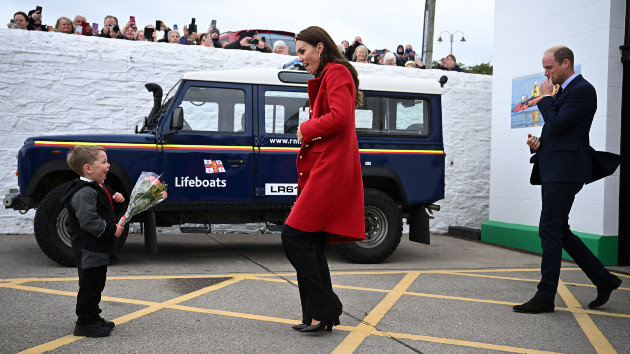
(LONDON) — Prince William and Kate, the prince and princess of Wales, traveled to Wales on Tuesday to meet with different communities across the nation and learn about the work of key charitable organizations.
The couple first traveled to Anglesey to meet with crew and volunteers at the RNLI Holyhead Lifeboat Station, one of the oldest lifeboat stations on the Welsh coast, then visited St. Thomas Church in Swansea, a redeveloped church supporting locals and serving as a hub in the community.
Their visit to Wales was the first to the nation since King Charles III announced earlier this month that their new titles would be the prince and princess of Wales, following the death of Queen Elizabeth II.
They are the first couple to use the titles since they were used by Charles and the late Princess Diana, who divorced in 1996.
William and Kate have a “deep affection for Wales,” according to Kensington Palace. The couple made their first family home in Anglesey, where they spent their first months as parents, making Wales the first home of Prince George. Wales was also where William undertook his first engagement as a young boy.
William graduated from the Search and Rescue Training Unit at RAF Valley in Anglesey when he was training to become a helicopter pilot with the Royal Air Force’s Search and Rescue Force.
The couple’s three children, Prince George, Princess Charlotte and Prince Louis, have also taken on the last name, Wales.
There’s good news for Jeopardy! fans. Deadline reports that on the heels of the Celebrity Jeopardy! revival, Executive Producer Michael Davies is considering expanding the franchise with other spinoffs, including a masters league featuring the show’s winningest players, and a possible version of the long-running game show focused solely on sports and pop culture trivia, he tells the New York Times. The franchise has already begun filming a Second Chance Tournament that will bring back promising contestants, as well as a revamped Tournament of Champions…
Following Netflix’s announcement at Tudum on Saturday that Good Will Hunting actress Minnie Driver will be joining The Witcher: Blood Origin, the streamer debuted a first-look photo and details about her character on Monday, according to Entertainment Weekly. Driver will play Seanchaí, who, per series creator Declan de Barra, is “a shapeshifting storyteller that can travel between worlds and times. She’s essentially a collector of stories that are forgotten. She believes this story needs to be told again in the modern Witcher world for progress to be made in the future.” Blood Origin will premiere December 25…
Hannah Gadsby has inked a multi-title deal at Netflix, which will include a new stand-up special, in addition to another multi-comic special featuring gender-diverse comedians, according to Variety. Gadsby’s new hour-long special will premiere in 2023 and comes from the comedian’s appearance at the Sydney Opera House. It will be Gadsby’s third stand-up comedy special for Netflix, following Nanette in 2018 and 2020’s Douglas. The comic special will be taped next year. The move is surprising considering Gadsby had slammed Dave Chappelle for offensive jokes about queer and trans people in his controversial Netflix special The Closer last year, and also criticized Netflix CEO Ted Sarandos for posting the specials…
(NEW YORK) — Most children in the United States have returned to school for the year as districts aim to bring kids back to a setting that resembles the pre-pandemic normal.
Masks are now optional in most classrooms and, last month, the Centers for Disease Control and Prevention said it was no longer recommending schools use test-to-stay, which allowed students who were close contacts of those who tested positive for COVID-19 to continue to attend in-person classes if they remained asymptomatic and continued to test negative.
Dr. Greta Massetti, chief of the field epidemiology and prevention branch at the CDC, told reporters at the time that because unvaccinated and vaccinated people were no longer being advised to quarantine, test-to-stay was no longer necessary.
Cases and hospitalizations do not appear to be dramatically rising and adults have the highest rate of weekly cases per 100,000, per CDC data.
But experts said testing data is not robust as it was during the last two school years, making it difficult to compare current data to previous seasons.
“There’s good reason to be cautiously optimistic,” Dr. Jim Versalovic, pathologist in chief at Texas Children’s Hospital, told ABC News. “It’s important to point out that we have seen over the past several weeks a steady decline in COVID positivity and in COVID hospitalizations at Texas Children’s.”
He continued, “There’s more at-home testing available and we don’t have all the testing data, but we have enough data now to say confidently that positivity is down for COVID less than 5% in our latest rolling seven-day average and we also are now at single-digit hospitalizations, which is a big deal.”
Adults still make up most COVID-19 cases
According to CDC data, weekly cases per 100,000 are higher in every adult age group compared to children. Children aged 5-11 have the lowest rate at 15.6 per 100,000 compared to those aged 75 and older at 41.6 per 100,000 with the highest rate.
What’s more, the weekly case rate has massively declined since the summer. Just two months earlier, the case rate among 5 to 11-year-olds was 114.6 per 100,000.
Versalovic and other experts point out there are several reasons why there is not a major increase of COVID-19 cases seen among children during the new school year.
This includes less community spread in general; schools having better filtering of air; children being able to play outside, which is less risky for spread, before it gets cold; and vaccination.
Currently, 60.7% of 12-to-17-year-oids are fully vaccinated, according to CDC data. This is in comparison with 47.7% fully vaccinated at the same time last year.
Meanwhile, 31.4% of 5-to-11-year-olds are fully vaccinated. While uptake in this age group has severely lagged older children, it’s a substantial increase from 0.4% this time last year.
“That was not the case a year ago,” Versalovic said. “One year ago, we were still trying to get vaccines to school-aged children. We’ve now had those vaccines available since last November and we’ve had boosters available throughout the summer.”
However, he said that vaccination rates, particularly among younger children have been lower than he’d like to see. Only 1.2% of children under age 2 and 2.3% of children aged 2 to 4 are fully vaccinated, according to CDC data.
“We cannot be complacent about it.” he said. “Vaccination rates have not been strong as we hoped. That gives us some pause as we look ahead to the winter.”
Testing is down from last year
Test is down because testing has dropped dramatically in health care settings and in schools, experts said. Schools are also no longer running test-to-stay programs, so cases could be circulating undetected. Additionally, many people do no report positive at-home tests to health officials.
“There are some important caveats,” Dr. John Brownstein, an epidemiologist at Boston Children’s Hospital and an ABC News contributor, told ABC News. “We know that overall testing, test volume is down. Incentives for testing have changed, we’ve seen that reduction in test-to-stay programs.”
“There is an argument to make that this could potentially be a calm before the storm as we approach colder months, more indoor activities, drier conditions that facilitate better transmission of respiratory viruses,” he added.
Low rates of testing could be hiding potential surges in classrooms or underreporting asymptomatic cases.
Brownstein said there is cause for optimism because a new variant has yet to emerge — the omicron variant and its subvariants have remained dominant for almost a year compared to 2021 when the dominant variant changed every few months.
“There’s a lot of room for optimism, even in the face of a surge, because of the availability of vaccines and treatments,” he said. “That being said, we’ve been surprised at every turn of the pandemic. And so, it absolutely makes sense for us to remain vigilant and utilize the best possible data to drive decisions.”
Experts stressed the importance of children getting vaccinated, especially in case COVID-19 infections do surge in the late fall and winter.
“The No. 1 tool that we have to prevent disease are vaccines,” Versalovic said. “These vaccines are safe and effective and, if anything, they’ve proven to be even more safe and effective than we ever could have imagined over the past year.”
Brownstein added that certain children, such as those who are immunocompromised or live with a family member at high risk of severe disease, may want to consider other prevention measures such as masking.
“Even if masks or testing isn’t required, these are tools that can still be used as needed, depending on your sort of risk tolerance and the risk of family members,” he said. “Generally, we are at a good point right now where transmission is lower and we’re not facing the threat of a new highly transmissible variant, but we have to remember that we have to be flexible as we continue this school year.”
(NEW YORK) — More than 32,000 young patients newly diagnosed with cancer now live in states that have imposed or have impending abortion restrictions, according to a new study published Monday in The Lancet Oncology.
Because many life-saving cancer treatments harm future fertility, many teens and young adults with cancer decide to freeze eggs, sperm or embryos in the hope of having a family later in life.
Now, in the wake of the Supreme Court’s overturning of Roe v. Wade, the American Cancer Society is warning that their fertility preservation options could be at risk in the future.
Possible ramifications for cancer patients could include potential restrictions on gene testing, storage and disposal of embryos, even those created in the laboratory, according to researchers from the American Cancer Society.
For now, these concerns are hypothetical. Recent legislation has focused primarily on restricting abortion, and laws regarding embryos or other fertility preservation methods are not explicit, according to the Guttmacher Institute, an abortion-rights research organization.
However, Guttmacher and other abortion-rights advocates have raised it as a possibility in the future. And they argue that some state legislation refers to protecting an “unborn child” without clearly defining whether that might include an embryo. That could make it difficult for health care providers to know when they’ve run afoul of the law, they say.
Researchers at the American Cancer Society studied more than 120,000 young patients between the ages of 15 and 44 who were diagnosed with cancer in 2018, finding that more than 68% needed fertility preservation.
Of those, more than 32,000 patients — including over 20,000 women — were from the 22 states where abortion bans exist or are expected to be implemented, the study found. Texas, Ohio and Georgia were the states with the largest number of newly diagnosed young cancer patients whose fertility preservation care could be compromised.
“Ongoing monitoring of the health effects of the Supreme Court decision on cancer patients and their families is warranted,” said Xuesong Han, Ph.D., the lead study author, scientific director and health services researcher at the American Cancer Society.
The anti-abortion group Charlotte Lozier Institute called the American Cancer Society’s warning misleading.
“A plain reading of state pro-life laws shows this study is nothing more than scaremongering, which is a huge disservice to the medical community and American women,” the institute’s Tara Sander Lee, Ph.D., said
Researchers found that patients from 22 states with abortion restrictions were more likely to be living in non-metropolitan areas, belonging to the poorest counties, and were of white or Black ethnicities, compared to the patients from 28 states where abortion remained legal.
“We have not yet begun to see exactly how the Dobbs ruling impacts fertility; however, it is clear that there will be a monumental impact,” said Dr. Eleonora Teplinsky, head of breast medical oncology at Valley Health System and a clinical assistant professor of medicine at the Icahn School of Medicine at Mount Sinai.
Fertility preservation, though possible in a less restrictive state, will create new barriers and could widen geographic and socioeconomic disparities, according to the study.
“Traveling to another state to get fertility care will put undue burden especially on the most vulnerable of these patients — medical, financial and psychological,” said Dr. Sunita Nasta, professor of clinical medicine at the Abramson Cancer Center at the University of Pennsylvania, adding that “compromised access to care leads to worse outcomes.”
“The treatment of aggressive cancers is usually urgent. Fertility preservation needs to be accomplished within a few days to weeks. If these procedures are limited by these bans, patients will face the burden of losing their fertility or delaying therapy,” Nasta said.
“Many patients make treatment decisions based on fertility concerns. If fertility preservation is further endangered as we suspect it will be, we likely will begin to see even more patients choosing not to go on life-saving cancer therapy,” Teplinsky said.
“The ability to protect their choices with appropriate fertility care gives these patients the freedom to be aggressive about choosing therapy for the best outcomes rather than what may affect their future fertility,” Nasta added.
(UVALDE, Texas) — Two Texas legislators held a listening session Monday to hear from Robb Elementary School victims’ families, who continue to voice how unheard they feel by their representatives as they plead for gun control statewide and nationally.
Their advocacy was spurred by the school shooting that took place on May 24, when 19 children and two teachers were killed.
Parents spoke about wanting commonsense gun legislation, accountability for police officers and transparency from local officials, as well as voiced their frustrations with overly complex and arduous application processes for relief funds.
“The fact that I have to sit here and tell y’all, the state and federal government, how to do your job, is evidence enough of the massive failure we’ve experienced,” Kimberly Rubio, mother of 10-year-old victim Lexi Rubio, told the legislators.
“This was not the first school shooting and will not be the last until we federally ban these weapons,” Rubio said. “You can’t help us. All we want is a federal ban on assault weapons.”
She also lamented about the process to receive donation funds, referencing the 20-page application document she said was sent by the National Compassion Fund only days after the shooting.
“We couldn’t even get out of bed. Four months later, I can’t even read a chapter of a book. When we finally filled it out, they sent it back with so many documents of things they needed,” Rubio told the legislators. “You know who I am, you know I lost my daughter. It should be easier.”
U.S. Rep. Sheila Jackson Lee, D-Texas, told ABC News she asked families to testify so that she could share the recording with fellow lawmakers in Washington, D.C., and said that after the meeting, she plans to find ways to make the federal compensation process more expeditious for families, which she recognized was a glaring issue.
When asked if she will share the footage directly with Republican senators who have come out against H.R. 1808, the upcoming bill in the Senate that proposes federally banning assault weapons — which many Uvalde families have asked for — she told ABC News, “Well, it is available and we’ll go back to Washington and determine how it can be best given.”
Brett Cross, 10-year-old victim Uziyah Garcia’s uncle and legal guardian, asked the legislators, “How many more damn kids need to die before the government does something?”
He, like others, said he feels Texas Gov. Greg Abbott doesn’t care.
“I spoke to Gov. Abbott when I asked him to call a special session to raise the minimum age to 21. He said that wouldn’t have made a difference,” Cross said tearfully, reminding the gathering that the shooter was only 18 years old at the time of the massacre.
U.S. Rep. Joaquin Castro, D-Texas, agreed.
“This community was not only failed on that day at Robb Elementary, but by every level of government so far, including the governor of the state of Texas, the Department of Public Safety and local elected officials who refuse to release basic information about what happened and why it happened,” Castro told the families Monday night. “And that is a second kind of assault on the community of Uvalde.”
“We just need something to change because if it doesn’t, we’ll feel like our kids died for nothing,” said Angel Garza, stepfather to victim Amerie Jo Garza.
Earlier Monday, Uvalde County commissioners voted unanimously to approve a letter to Texas House Speaker Dade Phelan, asking him to meet with victims’ families who seek to speak with him about raising the minimum age for purchasing assault-style weapons to 21.
This vote came after similar calls on Abbott to convene a special session have gone unanswered.
“It’s not going to happen,” Uvalde County Commissioner Mariano Pargas Jr., who seconded the motion, said of Uvalde’s pleas to Abbott to legislate the age requirement.
“We’re hoping we can do something that will make ’em change their minds,” he said of the intent behind the letter to the Texas State House speaker.
Getting families in front of legislators, he believes, is one way to do that.
(ELMORE, Ala.) — When twins Kassie and Kascie Vaughan visited their brother at the Staton Correctional Facility in Elmore, Alabama, on Sunday, they said he was unable to walk, had lost a significant amount of weight and was almost unrecognizable.
The family of 32-year-old Kastellio Vaughan, who was convicted on burglary and break-in charges in 2019, now fears for his life, saying the Alabama Department of Corrections is neglecting his health.
“He’s looking terrible. Just one word, terrible. He’s feeling weak in spirit. He’s really just, he’s really feeling low,” Kascie Vaughan told ABC News. “He doesn’t look like Kastellio, the brother that we know.”
Kassie Vaughan told ABC News she received harrowing photos of her older brother earlier this month along with a message to get him help. Photos depicting Kastellio Vaughan slumped over, emaciated, and with a large, undressed wound extending down his abdominal area were allegedly sent by an unidentified inmate at Elmore Correctional Center.
“He said, ‘Your brother’s not gonna make it until Monday. Please get him help.’…[He said] they brought him back to general population at the prison, they didn’t cover up his wounds, and the staples was bursting out of his abdomen,” Kassie Vaughan told ABC News.
The inmate who sent the photos claimed he saw Kastellio Vaughan vomiting and in a weakened state after being released to Elmore’s general population on Aug. 30. That was the same day Kastellio Vaughan had surgery to remove part of his small intestine due to complications from an old gunshot wound, according to his sisters.
They allege they were unaware their brother underwent a procedure until receiving the photos.
Kastellio Vaughan was transferred to Staton Correctional Facility’s Medical Observation Unit last Friday, according to the Alabama Department of Corrections.
Prison officials said Kastellio Vaughan had been in touch with his family and was observed walking and eating after his transfer to Staton Correctional.
“He has been in contact with his family to update them on his situation and ease their concerns,” the department said in a statement about Vaughan’s condition on Friday. “Inmate Vaughan has requested and received medical attention with the ADOC at least 11 times between July 30, 2022, and September 22, 2022. As a result, each time he received appropriate medical treatment and/or care.”
“The ADOC offers a constitutional level care to all inmates,” its statement continued. “However, inmates are not required to undergo care, just as citizens in the civilian world are afforded choice of whether to receive care.”
Following their visit on Sunday, the Vaughan’s said their brother’s appearance and condition have not appeared to improve “at all” since the photos were taken. They also said he was using a wheelchair and unable to walk while they were at the facility. He also now has to use absorbent briefs, which the sisters said another inmate has to help change or he’s forced to try and do it by himself.
The Alabama Department of Corrections has not responded to ABC News’ request for comment on these most recent allegations.
Kassie Vaughan said she shared these photos of her brother on Facebook last week to bring attention to his deteriorating health.
“Even after being incarcerated and us being away from him, it really hurts but it was better because we knew that his health was OK,” Kascie Vaughan said. “But after his health declined, we really just been feeling like we kind of losing our big brother. Like, we don’t have no hope. And he’s always protected us and now we feel like we are trying to protect him.”
Civil rights attorneys Lee Merritt, Harry Daniels, and Ben Crump, who are now representing Vaughan, allege this is a case of medical neglect that points to larger issues in the prison system. Kastellio Vaughan’s legal team alleges he’s lost 75 pounds in less than a month.
“This is horrific,” Crump said in a statement on Sunday. “Let’s be clear, the state of Alabama has tried to deflect any action or responsibility for Mr. Vaughan’s condition at every turn. If it wasn’t for these pictures, the media spotlight and the resulting uproar, we might never have known about the neglect and Mr. Vaughan would have died before the public knew anything was happening.”
Kastellio Vaughan’s legal team and family “are still deeply concerned about his safety in that prison,” Merritt told ABC News. He said they are now pushing for Vaughan to receive a professional medical evaluation, treatment and appropriate accommodations to restore his health.
“It shouldn’t have been prisoners sending emergency text messages and photographs to his family, but it should have been the medical staff who are responsible for the health and safety of everyone who is under their care,” Merritt said. “It is not as if Mr. Kastellio could have gone to see a doctor himself or scheduled an appointment. He is an inmate at that prison and the law requires that they honor their duty to provide for their prisoners’ wellbeing.”
“It doesn’t matter what Kastellio did, why he was in jail, doesn’t matter. As society as a whole, as human beings, we have a duty to one another. It doesn’t matter what that person is imprisoned for,” Daniels told ABC News. “We need this man to get well. Alright, we need him to get help. That’s not asking for a whole lot.”
(NEW YORK) — The more than 1,200 miles of shores in the southern U.S. that line the Gulf of Mexico are no stranger to strong storms — but that doesn’t make potential damage from an approaching cyclone any less likely.
As Hurricane Ian marches closer to the U.S., its aim toward the Gulf Coast is especially concerning considering how vulnerable the region is to storm surge, experts told ABC News.
The underwater geology of the Gulf of Mexico is what makes the Gulf Coast particularly unguarded against the massive influx of seawater. The shallow waters in the Gulf, combined with the symmetry of its shallow ocean floor, are what allow the storm surge to be pushed even higher onto land, Ryan Truchelut, chief meteorologist at Weather Tiger, a consulting and risk management firm, told ABC News.
The continental shelf of the Florida Gulf Coast extends quite far offshore — up to 200 miles in some spots, Truchelut said.
“The waters of the Gulf of Mexico just simply aren’t that deep, over a lot of the Florida coastal waters just offshore,” he said. “If there’s wind pushing water toward that direction, it’s shallow, it has nowhere to go. So it kind of amplifies and goes further inland.”
Meteorologists are most concerned about the west coast of Florida, starting in the Florida Keys and north to Tampa Bay, Michael Brennan, acting deputy director for the National Hurricane Center, told ABC News.
The Tampa Bay area is “extremely sensitive” to storm surge, Brennan said, adding that the region could experience 5 to 8 feet of inundation — meaning above ground-level flooding. The Fort Meyers and Charlotte Harbor areas could see 4 to 7 feet and regions farther south could see 3 to 5 feet of inundation, Brennan said.
Another reason why the Gulf of Mexico is especially vulnerable to hurricanes and storm surge is because of its unique U-shaped coastline, which essentially traps a storm system into a populated region, no matter which way it turns, Truchelut said.
“When a hurricane gets into the Gulf of Mexico, it’s hard for it not to hit somebody,” he said.
The same geography conundrum also applies on a smaller scale to Tampa Bay, which is almost shaped like a cul-de-sac and doesn’t have anywhere for the water that’s getting pushed around to go, Truchelut said.
“Right now, the way this storm is coming in, you’d have this sort of push of surge right into Tampa Bay and in regions along the Gulf, western Gulf Coast,” Marshall Shepherd, director of the Atmospheric Sciences Program at the University of Georgia and former president of the American Meteorological Society, told ABC News.
Although the models are still uncertain, Ian will almost certainly strike somewhere along the eastern Gulf Coast as a major hurricane, Shepherd said.
Oftentimes, if a hurricane trapped within the Gulf of Mexico changes directions, it exacerbates the threat even more, Truchelut said. The change in direction typically slows down the storm system, allowing more time for waves to get bigger and head toward the shallow continental shelf, he added. Ian will likely stall over the Tampa Bay region, Shepherd said.
Ian does not even need to directly impact the Tampa Bay region to do considerable damage, the experts said. Even without a direct hit, the slow movement at Ian’s intensity will bring intense storm surge, flooding rain and prolonged hurricane-force winds.
In November 2020, Tropical Storm Eta, which had downgraded to a weak tropical storm after making landfall in Central America as a Category 4 hurricane, caused widespread flooding in Tampa. The storm made direct impact about 90 miles north of Tampa, but the 70 mph winds and soaking rain still caused bay waters to top seawalls in the area.
“It’d be 1,000 times worse had it been an actual major hurricane that was well organized,” Truchelut said.
Because of the way Ian is moving, as well as its intensity and the fact that it may stall, it places the Tampa Bay region on what meteorologists call “the dirty side of the hurricane” — the right front quadrant of the storm, just to the right of the eye, that typically has the worst of the winds and storm surge due to the motion and circulation of the system, Shepherd said.
A large concern is that many of the areas that flooded in the Tampa Bay region more than 100 years ago will do so again and at a greater scale — and this time, populated by hundreds of thousands more people from the influx of development that has occurred since, Truchelut said. Much of the coastal infrastructure, including condos and homes along the coast, did not exist the last time a major hurricane directly impacted the region, Shepherd said.
Climate Central, a nonprofit news organization that analyzes and reports on climate science, has calculated the 100-year flood height in the Tampa Bay area at 6.5 feet. There are more than 125,000 homes in the region currently situated below that flood level.
The experts cautioned residents in Florida to heed evacuation warnings and not to be deterred by the category of the storm or “hurricane amnesia,” since it has been a century since the region experienced a major storm.
“We as a society have to get accustomed to or used to planning for the worst, and maybe it doesn’t happen,” Shepherd said. “As good as our weather predictive capability is, if not, it still has some uncertainty with it.”
(LONDON) — Royal Mail in the United Kingdom has revealed images of four new portrait stamps in memory of Her Late Majesty Queen Elizabeth II.
These are the first stamp images to be approved by King Charles III and all four stamps feature images that were used in the 2002 Golden Jubilee stamp issue.
The images of the stamps include a second class stamp featuring a photograph taken by Dorothy Wilding in 1952 to mark the queen’s accession and coronation, a first class stamp with a picture of the queen in in her admiral’s cloak snapped by Cecil Beaton taken in 1968, a £1.85 stamp displaying a portrait of the late queen taken in November 1984 by Yousuf Karsh, and a £2.55 stamp with the newest photograph in the collection that features a picture of the queen taken at Prague Castle in 1996 by Tim Graham.
A Presentation Pack of all four stamps will retail at £6.95 and are available to pre-order until they are released and go on general sale from Nov. 10.
The announcement comes as the official Royal Mourning period ends Tuesday — just over a week after her funeral was held — and the debut of King Charles III’s new cypher that was unveiled overnight.
Chosen by the new king, the cypher will replace the “E II R” on government buildings, state documents and some mailboxes around the country.
The cypher features the king’s initial of “C” intertwined with “R” which stands for Rex — Latin for “king” — along with the Roman numeral III.
The Royal Mint also confirmed that they will unveil what the new bank notes will look like before the end of the year with the new King Charles notes expected to be placed into circulation in 2024.
(NEW YORK) — Four people have died and two are missing after a tourist boat sunk near the Galápagos Islands on Sunday night, Santa Cruz officials confirmed to ABC News.
Officials said that 31 passengers were rescued and two are still missing.
An American-Israeli citizen, a Colombian and an Ecuadorian are among the dead, according to Santa Cruz officials.
The boat sunk close to Tortuga Bay and was traveling between Isla Isabella and Santa Cruz, officials said.
The boat’s three engines reportedly stopped working after running out of fuel, according to officials.
More than two dozen rescue personnel from Ecuador and the Galápagos National Park are searching for the two missing passengers, officials said.
Ecuador’s Galápagos Islands is an archipelago in the Pacific Ocean and includes Santa Cruz Island.
(NEW YORK) — Canada is lifting all of its COVID-19-related entry restrictions, effective Saturday, government officials announced.
Travelers, regardless if they’re Canadian citizens or not, will no longer have to submit public health information through an application the government launched for travelers before or after they enter the country, provide proof of vaccination, go through pre- or on-arrival testing, quarantine or isolate, or monitor and report if they’ve developed COVID-19 symptoms when arriving in Canada, the country’s public health agency said.
Additionally, the Canadian government said travelers will no longer be required to wear masks on planes and trains, adding that it strongly recommends people “wear high-quality and well-fitted masks during their journeys.”
At the start of the pandemic in 2020, Canada and the U.S. closed their respective borders to help stop the spread of COVID-19.
“Since the beginning of the pandemic, the Government of Canada has taken a layered approach to border management to protect the health and safety of Canadians,” the health agency said Monday in a press release. “As the pandemic situation has continued to evolve, adjustments to border measures have been informed by the latest evidence, available data, operational considerations and the epidemiological situation, both in Canada and internationally.”
“Thanks largely to Canadians who have rolled up their sleeves to get vaccinated, we have reached the point where we can safely lift the sanitary measures at the border,” Canadian Minister of Health Jean-Yves Duclos said. “However, we expect COVID-19 and other respiratory viruses will continue to circulate over the cold months, so I encourage everyone to stay up-to-date with their COVID-19 vaccination, including booster doses, and exercise individual public health measures.”
In June, the U.S. lifted its COVID-19 restrictions for international travelers, including no longer requiring a negative COVID-19 test one day before their flight into the country.
“We are able to take this step because of the tremendous progress we’ve made in our fight against the virus,” a senior White House official told ABC News at the time. “We have made lifesaving vaccines and treatments widely available and these tools are working to prevent serious illness and death, and are effective against the prevalent variants circulating in the U.S. and around the world.”