Blake Shelton is a staple in modern country music, but he appreciate all types of music, as evidenced by the music that shows up on his playlists.
When he has a date night with wife Gwen Stefani, Blake says the couple is likely listening to ’80s love songs by Phil Collins, R.E.M. and REO Speedwagon.
On a day of relaxation with Gwen and her sons, Kingston, Zuma and Apollo, the playlist spans generations — the boys repeatedly request the 1987 hit “Walk the Dinosaur,” while Blake and Gwen have introduced them to “Never Gonna Give You Up” singer Rick Astley.
“The kids are just now discovering Rick Astley,” Blake shares. “That’s pretty much it, back and forth those two songs.”
As for what gets him hyped up before hitting the stage, Blake blends his love for country and rock ‘n’ roll, listening to Hank Williams Jr.’s classic “A Country Boy Can Survive,” along with AC/DC and Guns N’ Roses. “Something that will really get me pumped up,” he says of the tone.
As for what he’s listening to while working out, the singer can’t help but chuckle at the thought.
“Did you just ask me if I’m exercising and working out?” he says laughing, adding that his “go-to” track is “Hot Hot Hot” by Caribbean singer Arrow.
According to BeatlesBible.com, the Fab Four had first recorded the song with original drummer Pete Best on June 6, 1962, at London’s EMI Studios — later Abbey Road Studios. Then, after Ringo Starr had replaced Best, the band took a second crack at the song at EMI on September 4 of that year.
Producer George Martin wasn’t happy with the quality of Ringo’s drumming on that version, so The Beatles reconvened once more time at EMI, on September 11, 1962, with session drummer Andy White sitting in and Starr on tambourine.
Initial copies of the “Love Me Do” single actually featured the version with Ringo, although the one with White was included on The Beatles’ debut U.K. album, Please Please Me, and The Beatles’ Hits EP, which were released in 1963 in March and September, respectively.
The “Love Me Do” single peaked at #17 on the U.K. chart. The version with White on drums also appeared on the Fab Four’s debut U.S. album, Introducing The Beatles, which was released in January 1964. Issued as a U.S. single in April ’64, it spent one week at #1 on the Billboard Hot 100 in May of that year.
As previously reported, The Beatles Story in Liverpool, U.K., is marking the 60th anniversary on Wednesday by inviting fans to bring their Beatles or Beatles-era memorabilia to the popular Fab Four-themed attraction, where experts from a specialist Beatles auction house will appraise the items for free.
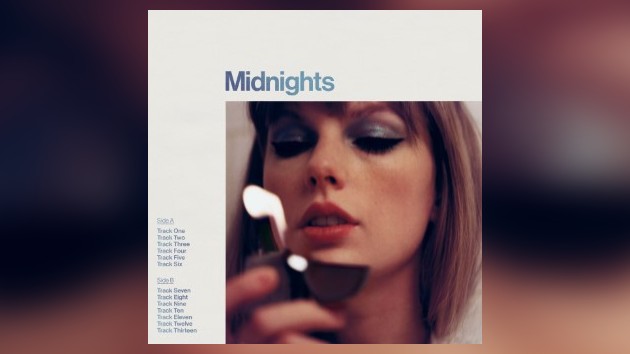
Another day, another one of Taylor Swift‘s Midnights Mayhem with Me. Thanks to this unique TikTok series, fans now know the title of the ninth track off her upcoming album, Midnights.
Taylor maintained her ’70s theme as she once again spun the bingo cage to pluck a brand new ball out of the pile. This time, fate told her to reveal the title for song number nine.
“Track nine is called… ‘Bejeweled,'” Taylor revealed while speaking into her signature red phone. Unfortunately, that was all the information she was willing to part with at this time.
The last track reveal yielded ball number three, so Taylor disclosed that “Anti-Hero” is the name of the third track. She also revealed a little bit about that particular number.
Taylor said on Instagram that “Anti-Hero” is one of the favorite songs she’s ever written and that it is about “delving into her insecurities.”
“I struggle a lot with the idea that my life has become unmanageably sized and, not to sound too dark, but I struggle with the idea of not feeling like a person,” she had explained. “This song really is a real guided tour throughout all of the things I tend to hate about myself.”
“I think it’s really honest,” she noted further.
Other previously revealed titles include track 13, “Mastermind”; track eight, “Vigilante S**t”; track seven, “Question…?”; track six, “Midnight Rain” and finally, track two, “Maroon.”
Midnights arrives in a little over two weeks — on Friday, October 21.
(WEST LAFAYETTE, Ind.) — A 20-year-old Purdue University student was killed in his dorm room early Wednesday and his roommate is in custody, school officials said.
Varun Manish Chheda, a senior majoring in data science, was found dead in his room at McCutcheon Hall, a residence hall on the school’s campus in West Lafayette, Indiana, after the suspect called 911 to report the incident at 12:44 a.m. local time, Purdue University Chief of Police Lesley Weite said at a news conference Wednesday.
The suspect, 22-year-old Gji Min Sha, a junior majoring in cyber security, is in custody on a charge of murder, Weite said. He is an international student from Korea, she said.
No other roommates lived with the victim and suspect, Weite said.
A university spokesperson said, with the suspect apprehended, “there is no threat to the community.”
“This is as tragic an event as we can imagine happening on our campus and our hearts and thoughts go out to all of those affected by this terrible event,” Purdue University President Mitch Daniels said in a statement Wednesday morning. “We do not have all the details yet. Our Purdue University Police Department is conducting a thorough investigation of this incident so that we all may learn more about what transpired.”
The August, 2020 death of Black Panther star Chadwick Boseman stunned friends and fans, who learned only then that he’d been suffering privately with terminal colon cancer.
One of these was Boseman’s friend and Black Panther director Ryan Coogler, who tells Entertainment Weekly the unexpected tragedy shook him to the core. The 36-year-old had begun working on what would become the forthcoming sequel Black Panther: Wakanda Forever when he learned of Boseman’s death.
“I was at a point when I was like, ‘I’m walking away from this business,'” the filmmaker admits. “I didn’t know if I could make another movie period, [let alone] another Black Panther movie, because it hurt a lot. I was like, ‘Man, how could I open myself up to feeling like this again?'”
Coogler reconsidered after watching old footage with his fallen friend in which Boseman advocated so passionately for 2018’s Black Panther, which became not just a blockbuster, but a cultural touchstone. “I was poring over a lot of our conversations that we had, towards what I realized was the end of his life. I decided that it made more sense to keep going,” said Coogler.
With Boseman gone, and Marvel Studios determined not to recast the character, who the actor portrayed since 2016’s Captain America: Civil War, the sequel itself became a tribute.
“The movie is very much about how you move forward while dealing with a tragic loss,” explains producer Nate Moore.
In Black Panther: Wakanda Forever, which opens November 11, the kingdom of Wakanda is mourning the death of Boseman’s King T’Challa, just as the cast and crew had to move on without their friend and leading man.
Marvel Studios is owned by Disney, the parent company of ABC News.
Jerritt Clark/Getty Images for Savage X Fenty Show Vol. 2 Presented by Amazon Prime Video
It seems Miguel and his wife, Nazanin Mandi‘s marriage has come to the end of the road.
Mandi filed to divorce from the “Sky Walker” singer on Tuesday after almost three years of marriage, according to documents obtained by TMZ. She apparently cited the reason as irreconcilable differences and noted that there is a prenup in place.
Miguel and Mandi, who were high school sweethearts, previously announced they were separating in September 2021. At the time, a representative for the couple confirmed the news to People, stating, “After 17 years together, Miguel and Nazanin Mandi have decided to separate and have been for some time now. The couple both wish each other well.”
It was not specified how long the pair had been apart or what led to the split.
Miguel and Mandi, both 35, dated for about a decade before getting engaged in 2016. They married in November 2018. They do not have any children together.
Kaley Cuoco and Johnny Galecki‘s chemistry was so off the charts during The Big Bang Theory that they took their on-screen romance into the real world.
The pair respectively played Penny and Leonard on the sitcom for 12 seasons, from 2007 until 2019. While their characters ultimately ended up together, Cuoco and Galecki quietly dated early in the show’s run.
“There was chemistry and we were crushing on each other. That was the whole first season until we actually got together for real,” Cuoco said in a book excerpt from The Big Bang Theory: The Definitive, Inside Story of the Epic Hit Series, shared by Vanity Fair.
The pair pointed to a scene they filmed together during that first season — one where they are close together in an elevator — as when they couldn’t deny the sparks.
“I think we fell a little in love in that elevator shaft,” The Flight Attendant star and producer said.
Galecki adds, “At that point, both she and I knew that something mutual was felt, and that it was going to be more of a distraction…to try and continue to ignore it than to actually…surrender to it.”
The duo then quietly dated from 2008 to 2010; Galecki admitted they “did consider marrying.” So why didn’t their relationship pan out?
“I think one of the things that created a chasm…was my strict policies of privacy, and Kaley being very, very open about her life,” the Roseanne alum said. “I was very uncomfortable with being public about it, and I think that hurt Kaley’s feelings a little bit, and I can understand that.”
No worries, though. Cuoco said she and Galecki have remained close friends throughout the years due to the bond they formed on the show.
Emily Watson, who stars in the upcoming film God’s Creatures, along with Harry Potter and the Chamber of Secrets and Harry Potter and the Goblet of Fire actress Shirley Henderson have been tapped for lead roles in the HBO Max Dune prequel series, Dune: The Sisterhood, according to Variety. The show, per its official logline, “follows the Harkonnen Sisters as they combat forces that threaten the future of humankind, and establish the fabled sect known as the Bene Gesserit.” Watson will play Valya Harkonnen and Henderson will play Tula Harkonnen, two sisters who have “risen to power in the Sisterhood, a secret organization of women who will go on to become the Bene Gesserit”…
Jonás Cuarón — the son of filmmaker Alfonso Cuarón — is set to direct Sony Pictures’ El Muerto, which will star Grammy-winning artist Bad Bunny. The film, per The Hollywood Reporter, is about “a wrestler with superpowers passed down from generation to generation in a single family.” It follows El Muerto, a character originally from the Spider-Man universe, an antihero and the son of a luchador, or Mexican wrestler, and next in line to inherit the ancestral power of El Muerto. El Muerto will mark the first live-action Marvel Comics-based film to be led by a Latino character. The project is still in development…
Eva Longoria and George Lopez are set to star in Alexander and the Terrible, Horrible, No Good, Very Bad Day, a new, Latino-centric adaptation of Judith Viorst‘s best-selling children’s book, according to The Hollywood Reporter. The new version “follows a Mexican American family who have recently lost their connection to each other and their roots, as they embark on an epic road trip that immediately goes hilariously wrong,” according to the outlet. Longoria will play Alexander’s mother, “a travel writer who has lost her passion for work,” while Lopez has been cast as “the family’s grandfather, a tough biker”…
(WASHINGTON) — The Supreme Court agreed this week to hear a challenge to a fundamental legal protection enjoyed by social media platforms like Facebook, Twitter and Tik Tok. The ruling could dramatically change how those platforms operate, even affecting search engines like Google, legal experts told ABC News.
The case concerns Section 230 of the 1996 Communications Decency Act, which protects social media platforms and other sites from legal liability that could result from content posted by users.
The law has drawn criticism from elected officials across the political spectrum. In a rare point of agreement, President Joe Biden and former President Donald Trump have both called for the repeal of Section 230 — but for different reasons.
Typically, Democrats argue that Section 230 allows platforms to evade accountability for permitting harmful or misleading content, claiming the rule lets platforms off the hook for policing too little speech.
While Republicans take issue with what they consider big tech censorship, saying the legal protection allows the platforms to police too much speech without facing consequences.
Some big tech companies, like Facebook and Google, have supported reform of Section 230 that would raise the standard that platforms would need to meet in order to qualify for immunity. But the companies largely support preserving the law in some form to protect them from legal liability tied to user-generated content.
The case, Gonzalez v. Google LLC, concerns a lawsuit brought by the family of Nohemi Gonzalez, an American woman who was killed in an ISIS terrorist attack in Paris in 2015. The lawsuit against Google, the parent company of YouTube, alleges that YouTube recommended ISIS recruitment videos to users.
The case centers on whether Section 230 protects online platforms from legal liability when it comes to their recommended content.
If the high court rules in favor of Google, it would formally extend legal immunity to the algorithms at the heart of many social media products and search engines; but if the Supreme Court rules in favor of the plaintiff, the decision could expose the platforms to a raft of new legal vulnerabilities and produce major changes, legal experts told ABC News.
“The Supreme Court could make Section 230 a little more speech friendly or it could functionally eliminate it as a defense for services, which would radically reshape the internet,” Eric Goldman, a Santa Clara University law professor who studies Section 230, told ABC News.
“The Supreme Court really does have the future of the internet in its hands,” he added.
Google has called on lower court judges to dismiss the case, saying its operations are protected under Section 230. In a response to the Supreme Court petition, Google noted that YouTube’s user rules prohibit material that promotes terrorism and that the platform employs moderators to review content around the clock. There is no evidence that any of the Paris attackers received recommendations for ISIS videos from YouTube, Google said in the brief.
Here are two major ways that social media platforms and other sites could change as a result of this case, according to experts:
Altered recommendation algorithms
The online tool at the heart of the case is the recommendation algorithm. Importantly, such algorithms are used not only by social media platforms like Facebook and Twitter but also video sites like YouTube and search engines like Google, Goldman said.
A high court decision that eliminates legal protection for recommended content could significantly alter the type of posts that appear before users on Facebook’s News Feed or Twitter’s timeline, said Eugene Volokh, a professor of law at the University of California, Los Angeles.
“Sites would be a lot more cautious about those types of recommendations,” Volokh told ABC News. “Whenever they see something that might be potentially dangerous for them, they’ll exclude it from recommendations.”
Posts that could concern social media sites after the ruling include libelous comments and instructions for committing criminal acts, not just the terrorist propaganda at issue in the Supreme Court case, he said.
For example, consider a post featuring a news story critical of the Church of Scientology, Volokh said. If the Church of Scientology writes a letter to a social media site warning that the news story is libelous, the site may stop recommending posts with the story out of caution, he added.
“The platforms might decide to recommend cat videos instead,” Volokh said.
While such decisions could provide an advantage for well-off or litigious actors, the moves could also benefit the public interest, he added.
“What if the story about Scientology really is libelous? It’s possible,” he said.
Online platforms may respond to the court’s decision by shifting their recommendation algorithms in a different direction, however, instead ceding greater control to users as a way to lessen their own liability, said Adam Candeub, a professor at the University of Michigan School of Law.
“If users could say that they’re making a conscious effort to seek out messages rather than Facebook forcing them onto you,” he told ABC News. “Facebook isn’t a speaker.”
More professionally-generated content
A more risk-averse recommendation algorithm, for fear of legal liability, could lead to the recommendation of a larger proportion of professionally-made content, some experts said.
“If a company is deciding what to include in its news feed or a recommendations feed, then including a traditional mainstream news article is a pretty safe bet,” said Volokh, of UCLA.
Goldman, of Santa Clara University, agreed. Twitter, he said, could prevent all users without blue verification checks from posting on the platform or prevent their posts from appearing on the timeline.
“It’s inevitable that services will move away from user-generated content and toward a model like Netflix,” he said. “It’ll be professionally produced, it won’t have the diversity it has, it won’t give speech platforms to as many people and to compensate professional producers, it’s more likely to be paywalled.”
Other experts contested the extent to which such a shift would take effect. User-generated content will still make its way into the recommendation algorithm and go viral, Volokh said. After a court decision that limits Section 230, however, that content will more likely be innocuous than controversial.
“People haven’t stopped selling cars just because they face liability for legal defects on cars,” Volokh said. “They may buy insurance for facing risks to liability or may adjust to it being the cost of doing business.”
Candeub, of the University of Michigan, said the court ruling wouldn’t affect the experience on social media for a typical user.
“I don’t think it would change much, actually,” he said. “Platforms already have tremendous ability to control how content is promoted. They will have to make wiser decisions and be held accountable for those decisions.”
One solution, Volokh said, would allow the social media platforms to preserve products centered on recommendations while policing them tightly: More employees.
“They may need to hire a lot more people,” he said.
(NEW YORK) — A New York City paramedic who responded to the terrorist attacks on Sept. 11, 2001, will be laid to rest on Wednesday, six days after she was stabbed to death.
Lt. Alison Russo-Elling, a nearly 25-year veteran of the New York City Fire Department, was stabbed approximately 19 times in the chest in an “unprovoked attack” while on duty in Queens on the afternoon of Sept. 29, authorities said. She was 61.
Peter Zisopoulos, 34, was subsequently arrested in connection with the slaying. He has been charged with murder and criminal possession of a weapon. He has no prior arrests and no known connection to Russo-Elling, according to authorities.
Authorities said Russo-Elling was in the vicinity of 20th Avenue and Steinway Street in Astoria, near her station’s quarters, when she was attacked. Authorities obtained surveillance footage that purportedly shows the incident. In the video, Russo-Elling is seen walking past Zisopoulos, who is standing in the doorway of a building. Suddenly, Zisopoulos appears to pull out a steak knife and “runs full speed” behind Russo-Elling, knocking her on her back and attacking her, authorities said.
An eyewitness is seen in the video apparently attempting to intervene, but Zisopoulos chases them away with the knife still in his hand. He then retreats to his apartment, where he barricaded himself before being taken into custody.
Russo-Elling was transported in critical condition to Mount Sinai Queens Hospital, where she died, according to authorities.
In the wake of her slaying, Russo-Elling’s colleagues described her as “the mother hen of the station” who “was always looking out for everybody.” She was the second emergency medical worker to be murdered on the city’s streets in the last five years and the 1,158th member of the FDNY to die in the line of duty, according to authorities.
In 2017, FDNY emergency medical technician Yadira Arroyo, 44, was struck and killed by her own ambulance after it was stolen in the Bronx.
Acting FDNY Commissioner Laura Kavanagh announced Tuesday that Russo-Elling will be posthumously promoted to captain at her funeral, which will take place Wednesday at 11 a.m. local time.
“Alison Russo was everything we look for in a leader in our Department,” Kavanagh said in a statement. “A dedicated and accomplished veteran of 25 years, she responded to thousands of emergencies, mentored many new EMTs and paramedics, cared deeply for the communities she served, and set an incredible example for others at Station 49 and at every station she called home throughout her outstanding career. This posthumous promotion is a sign of our deep respect and admiration for all the courageous and selfless work she did throughout her career. We will never forget her.”