If you ever wanted the Cadillac Snoop Dogg flaunts in 50 Cent’s “P.I.M.P. (Remix)” music video, now’s the time to try to get it. According to TMZ, the owner of the 1966 luxury car, Christian Bonilla, is selling it to the highest bidder.
Bonilla says the car is still up and running since he upgraded the speakers and replaced the engine. He has no asking price, but wants serious bidders to DM him on Instagram with their offers.
Snoop’s Cadillac, nicknamed Snoop Deville, rose to fame after being featured in 50’s 2003 music video, but it started collecting dust after he blew the engine out. Bonilla’s friend made an offer, which Snoop accepted, and shipped the car to Bonilla. He’s owned the vehicle since but is now ready to part ways.
(NEW YORK) — A Manhattan jury began deliberations Monday on whether to convict former President Donald Trump’s namesake real estate company of criminal tax fraud.
The deliberations began Monday morning following lengthy instructions on the law by Judge Juan Merchan, who reminded jurors that they pledged to set aside their personal opinions about Trump himself.
“You promised the attorneys for the defendants, the prosecution, and this court that you would set aside any personal opinions you may have about Donald Trump and his family,” Merchan said. “You also stated that you understood that Donald Trump and his family are not on trial here.”
Two entities of the Trump Organization — the Trump Corporation and the Trump Payroll Corporation — are on trial for paying the personal expenses of some executives without reporting them as income, and for compensating them as independent contractors instead of full-time employees.
The jury sent one note to the judge asking about the elements required to prove conspiracy, before deliberations ended for the day. The jury is scheduled to reconvene on Tuesday.
Although Trump is not a defendant, his name came up repeatedly during the trial, and the jury saw checks he signed and memos he endorsed. The former president has publicly denied any wrongdoing.
Defense attorneys asked witnesses roughly 60 times about Trump’s knowledge of the tax scheme that his company is charged with, as they sought to show that Trump was in the dark about the fraud being committed by his top executives, primarily Allen Weisselberg, the Trump Organization’s longtime chief financial officer who pleaded guilty in August to charges that he skirted taxes on nearly $2 million in company-provided perks that included the rent on his Manhattan apartment, the leases on cars for himself and his wife, and tuition for his grandchildren.
Defense attorney Michael van der Veen said in his closing statement Friday that jurors “heard no evidence in this case that Mr. Trump or any of his children were aware of anything improper.”
But prosecutors contended that Trump explicitly sanctioned tax fraud when he signed off on part of the scheme.
“This whole narrative that Donald Trump is blissfully ignorant is just not true,” assistant district attorney Josh Steinglass said during his closing statement.
Prosecutors believe the Trump Organization is guilty because the arrangements that Weisselberg and other company executives made to evade taxes included some intent to help the company pay less in salaries, bonuses and payroll taxes.
The defense argued the executives never intended to benefit the company and that the scheme the executives hatched was motivated solely by personal greed.
The distinction is important because the judge told jurors that the Trump Organization is only guilty if a high managerial agent of the company acted in behalf of the company and within the scope of his employment.
“An agent’s acts are not in behalf of the corporation if they were undertaken solely to advance the agent’s own interests,” Merchan said. “If the agent’s acts were taken merely for personal gain, they were not in behalf of the corporation.”
The Trump Corporation and the Trump Payroll Corporation are each charged with scheme to defraud, conspiracy, criminal tax fraud and falsifying business records.
A conviction would carry fines of up to $1.7 million. But collateral consequences of a conviction may be more significant to Trump, who is seeking a second term in the White House. Banks could call in loans and business partners could cancel contracts if their internal policies prevent them from doing business with felons.
Even absent a conviction, the trial revealed potentially embarrassing details about Trump, including that he reported nearly $1 billion in operating losses over a two-year period in 2009 and 2010.
Trump’s outside accountant also testified that Trump reported losses each year for eight years from 2009 to 2018, some of the same years Trump was touting his business acumen on reality television and on the campaign trail.
(WASHINGTON) — In the summer, Democrats were privately debating how to handle a jolt that had been sent to the more than 1 million U.S. households with same-sex couples.
The Supreme Court had just overturned its own rulings on abortion rights, and conservative Justice Clarence Thomas openly mused in his concurring opinion whether the court’s landmark 2015 decision on gay marriage — which he said was based on “legal fiction” — should be next.
According to several aides on Capitol Hill, a top staffer to New York Rep. Jerry Nadler, chairman of the House Judiciary Committee, approached the office of Wisconsin Sen. Tammy Baldwin, the first openly gay senator and a longtime LGBTQ rights advocate.
Should the House push through a party-line gay rights bill to send a political message ahead of the midterm elections? Nadler’s staff asked. Or was there a chance Democrats could peel off enough Republican support for a bill that would guarantee same-sex marriage?
According to several aides familiar with the account, Baldwin had already told her staff she thought such a bill was doable.
“Let’s do this for real,” responded Baldwin’s chief of staff, Ken Reidy, kicking off a monthslong negotiation on what would become the biggest civil rights deal to pass Congress in years.
On Tuesday, the House is expected to finalize the Respect for Marriage Act, approving the Senate version that passed last week by a 61-35 vote. An earlier House vote on the proposal drew 47 Republican yeses. President Joe Biden could sign the bill into law within days.
Douglas Laycock, a top religious liberty scholar who supports the legislation, said he never thought it would happen in his lifetime.
“This is the first significant compromise between gay rights groups and religious liberty groups,” said Laycock, a professor of constitutional law at the University of Virginia. “Both sides killed every previous attempted compromise.”
Laying down a ‘yellow brick road’
Onlookers have been quick to credit the bill’s success — drawing Republicans as well as Democrats — to changing public opinion. Indeed, according to a Gallup poll in May, 71% of Americans say they support legal same-sex marriage. That is more than 40 points higher than in 1996, when the question was first asked.
But people involved in the bill’s passage said it also was the product of a hard-fought negotiation years in the making.
“This shows there was a bipartisan way for LGBTQ freedom and religious freedom,” said Tim Schultz, president of the 1st Amendment Partnership, who worked on the bill representing faith-based groups.
“Lawmakers do want to find a way forward on these issues. And I hope that this breaks the ice for bigger things,” he added.
To understand that breakthrough, ABC News interviewed Hill staffers and lobbyists, several of whom spoke on condition of anonymity to be candid on how such a bill survived.
According to those involved, much of the compromise unfolded behind closed doors, including private phone calls by wealthy GOP donors who wanted Congress to resolve the issue.
Of particular concern, some Republicans said, was that any moves by the Supreme Court could alienate independent and moderate voters ahead of the 2024 election — much as the debate on abortion rights hurt Republicans in the midterms.
There also were unexpected alliances. The Church of Jesus Christ of Latter-day Saints, which considers same-sex relationships against God’s commandments, emerged as an early architect of the bill and worked closely with Arizona Sen. Kyrsten Sinema, the first openly bisexual member of the chamber, who grew up Mormon.
Under an amendment backed by the church, the Respect for Marriage Act guaranteed that faith-based groups wouldn’t lose their tax-exempt status or risk federal grant money because of their objections to same-sex marriages.
In exchange, the Mormon church publicly endorsed the proposal as one that protects “religious freedom,” paving the way for a dozen Senate Republicans to swing behind it.
“We knew who we could get to ‘yes,'” said one GOP lobbyist. “But we needed to lay down a yellow brick road they could walk on.”
What the marriage bill does and doesn’t do
The Respect for Marriage Act is intended as kind of an insurance policy in case the Supreme Court were to overturn its own landmark ruling Obergefell v. Hodges, which requires every state to allow same-sex marriage.
If that ruling is reversed by the court, as Justice Thomas suggested it could be, the Respect for Marriage Act would kick in to require that all states recognize unions legally performed elsewhere in the country.
The bill is narrow in scope, disappointing many progressives. It wouldn’t force states to issue same-sex marriage licenses, for example, as is required now under the Obergefell ruling.
The bill also doesn’t say whether businesses or faith-based organization can deny working with same-sex couples, citing either freedom of religion or speech. Such a case is being considered this week in the Supreme Court.
Still, LGTBQ advocates who worked on the bill said the compromise is a historic step forward that provides legal certainty to the 710,000 households in the U.S. with married same-sex couples.
“It’s not easy to sit down and actually have a conversation. I would say there is skepticism on both sides,” said Shannon Minter, legal director of the National Center for Lesbian Rights, who was involved in negotiations on the bill.
“But I think by the end of the process, there was a recognition that people were actually negotiating in good faith there,” Minter said.
Congressional aides said the legislation was closely negotiated by Democratic Sens. Baldwin and Sinema along with three Republicans: Susan Collins of Maine, who was known to cross party lines; Rob Portman of Ohio, who a decade ago changed his mind on same-sex marriage after learning his son was gay; and Thom Tillis of North Carolina, who had backed this year’s bipartisan package on gun safety.
Several people said the job fell to Tillis to convince enough Republican colleagues to vote in favor of the bill so no one person had to be the final deciding vote. Under Senate rules, 60 votes are needed to advance most legislation.
Other key moments included a decision by Democrats to hold off on a Senate vote until after the midterm elections were settled and a decision by Senate Republican leader Mitch McConnell and other prominent GOP senators not to speak out against the bill even though they personally voted against it.
The Catholic Church and several conservatives publicly criticized the legislation, including Sens. Mike Lee of Utah and James Lankford of Oklahoma, who contended it would set a national policy on gay marriage that uniquely exposes churches and organizations to lawsuits.
But after the Church of Jesus Christ and several religious liberty scholars publicly signed on, the dozen Senate Republicans joined in support and guaranteed its passage.
In the end, both LGBTQ rights groups and religious freedom advocates claimed victory — an achievement Sinema noted at a news conference celebrating the bill’s passage in the Senate.
“What could fundamentally be more American than balancing those two issues?” she asked.
ABC News’ Allison Pecorin and Trish Turner contributed to this report.
(NEW YORK) — A North Carolina couple are calling a state trooper their “angel” and a hero for helping save their daughter’s life when she stopped breathing due to RSV.
Victoria O’Neal told “Good Morning America” her 9-week-old triplet daughters first started to get sick last Sunday, and by Tuesday, her daughter Amelia’s condition had grown worse.
“At 1:00 when I went to feed them, she just sounded so weak and sick and it freaked me out,” O’Neal recounted. “So I called [my fiancé] Derrick, told him to come home, asked him to take her to the hospital.”
O’Neal said she asked her fiancé Derrick Stroud to take Amelia to the children’s hospital in Greenville, North Carolina, about 34 miles northeast of their home in Kinston. “It’s where they were born,” O’Neal said.
When Stroud got the call at work, he rushed home and wasted no time getting his daughter out the door. However, he was stopped on the way to the hospital after being pulled over for speeding.
Stroud described that moment as divine intervention.
“As I’m rushing to the hospital, it’s almost like God placed the trooper and the ambulance within 2 miles of us when we got pulled because as I was going to the hospital, the trooper pulled me at about 100 miles an hour,” Stroud told “GMA.” “When he pulled me over, I was frantically hanging out the window, letting him know that my baby was having problems at that time breathing.”
That person who pulled Stroud over was Trooper Matthew Brown of the North Carolina State Highway Patrol, who recounted the unusual sight to “GMA.”
“I had an SUV coming up behind me at a really high rate of speed, four-way flashers going, which I knew was kind of odd because most folks, if they’re gonna be speeding like that are trying not to get attention rather than having their four ways on,” Brown recalled. “When I got up to the driver … he was visibly distraught and upset. He said he was on his way to the hospital, which confused me because he had already passed the exit to go to the local hospital, which would be the hospital in Kinston. And when I asked him that, he said his daughter was having trouble breathing and he was taking her to the hospital in Greenville, which was about another 30 minutes away from where we were at.”
Brown, a state trooper since 2017 and a twin himself, told “GMA” he was previously a firefighter EMT and trained in emergency medical services.
“I opened the door and turned her towards me, I realized that she was having extreme difficulty breathing, had paradoxical breathing going on, which is basically where the chest and the stomach are actually going off each other. It’s just the obvious sign of infants struggling to breathe and her lips and face were starting to get some cyanosis, which is that blue color,” Brown said.
Brown said he got Amelia out of her car seat, started taking her vital signs and patting her on the back to wake her back up, which Stroud said he observed.
“I was just trying to get something out of her and she finally did come out and open her eyes and start interacting and I could tell whenever she started breathing more normally that she was still having some kind of, something going on with her lungs because her lung sounds weren’t very clear,” Brown said. “I knew RSV has been a really prevalent thing going on and actually told the father … ‘I would be surprised if she doesn’t have RSV.’ “
Brown then called in a medical unit backup and an ambulance quickly arrived on scene to transport Amelia to the local hospital in Kinston.
According to her parents, Amelia was later transferred to Maynard Children’s Hospital in Greenville. Doctors confirmed Amelia did have RSV and treated her with additional oxygen. After three days, Amelia was well enough to be discharged while her sisters took their turns getting checked out at the hospital for their RSV symptoms as well.
O’Neal and Stroud told “GMA” they’re grateful for Brown’s quick actions and help.
“It’s very crazy how everything works because like I say, for him to pull us over with triplets, and he’s a twin himself expecting twins and everybody was just in the right spot at the right time. It’s just really a blessing and I just wanted everybody to know that he is the reason that [we] still have Amelia,” Stroud said.
“He was an angel or a hero,” O’Neal added. “I don’t want to imagine the level of panic I would have had if that had been me, if I had been the trooper and I had pulled someone over and there was a little baby turning blue in the backseat, like to have been able to keep a level head and do what he needed to do to help her, it’s just amazing and I’m so grateful to him.”
Brown said he was just doing his job that day. “Part of the reason that I joined the highway patrol was so I would be able to be out there and have access to do this kind of stuff and help people,” he said.
“I’m a father myself and I can understand what he was trying to do. He was just not going about it necessarily the right way. But I mean, anybody who has a kid is going to do what they think they need to do to try to get it taken care of,” Brown added. “So I wasn’t going to penalize him for that. Plus, I wanted him to go to the hospital with the baby so I had him go with the medical unit.”
The man who shot Lady Gaga‘s dog walker and helped steal two of her French bulldogs has been sentenced to 21 years in prison.
Rolling Stonereports 20-year-old James Howard Jacksonpleaded no contest to the attempted murder with great bodily injury charge. He allegedly shot dog walker Ryan Fischer in the chest while stealing Lady Gaga’s dogs.
Jackson accepted a last-minute plea deal, which dropped the robbery and weapons charges against him.
Fischer was in court for the sentencing and provided a victim impact statement regarding the violent robbery. “You shot me and left me to die, and both of our lives have changed forever,” he told Jackson, adding the shooting resulted in the loss of his career and friendships, as well as mounting debt.
The dog walker added, “I do forgive you. With the attack, you completely altered my life. I know I can’t completely move on from the night you shot me until I said those words to you.” He also thanked Jackson for not harming the French bulldogs, adding, “I don’t think I could have lived with myself if they died.”
Jackson and two accomplices ambushed Fischer on February 24, 2021, in an attempt to steal Lady Gaga’s three French bulldogs: Gustav, Koji and Asia. Jackson shot Fischer at close range with a .40-caliber handgun after he refused to give Jackson the dogs.
Gustav and Koji were taken, but they were later reunited with Gaga.
Jaylin White, 24, was sentenced to four years in state prison earlier this year for the robbery, while Lafayette Whaley, 28, was sentenced to six years in jail.
Annie Leibovitz signs her Lennon/Ono ‘Rolling Stone’ cover in 2008; Logan Fazio/Getty Images
One of the best-known covers of Rolling Stone shows a naked John Lennon curled up next to his wife, Yoko Ono. The photo was taken by Annie Leibowitz on December 8, 1980 — just hours before Lennon was shot and killed by Mark David Chapman — and appeared on the cover of the magazine’s January 22, 1981, edition. Now, a rare copy of that issue is being sold for a good cause.
That issue is generally hard to find, but according to Rolling Stone, a stack of copies was recently discovered in the archives of the magazine’s parent company. One of them, signed by Rolling Stone founder Jann Wenner, is being auctioned off, with a starting bid of $1,000.
The auction runs through Friday, December 16, at 5 p.m. ET. The magazine says 100% of all proceeds will go to “gun violence prevention efforts,” though the exact charities aren’t detailed.
Lennon also appeared on the cover of the very first issue of Rolling Stone in 1967.
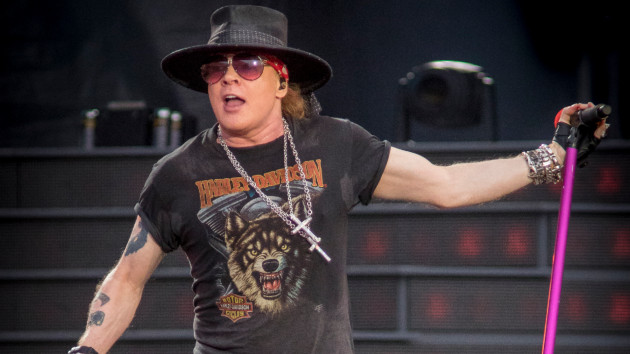
Guns N’ Roses is welcoming a Texas gun store to the legal jungle, where the fun and games have been replaced by lawsuits and alleged trademark infringement.
According to documents obtained by People, Axl Rose and company are suing Texas Guns and Roses, alleging that the firearms and ammo proprietor is copying the band’s name “for the purpose of confusing consumers into believing that it was connected or associated with, or licensed by, GNR.”
“This is particularly damaging to GNR given the nature of defendant’s business,” the suit reads. “GNR, quite reasonably, does not want to be associated with defendant, a firearms and weapons retailer.”
Neither Guns N’ Roses nor Texas Guns and Roses have responded to People‘s request for comment.
In 2019 Guns N’ Roses filed a trademark lawsuit against a brewery that was selling a beer called Guns ‘N’ Rosé.
Phoebe Bridgers is set to guest on R&B star SZA‘s upcoming album, SOS.
The 23-song track list, which was unveiled in full Monday, features the “Kyoto” artist on a cut titled “Ghost in the Machine.”
SOS, the highly anticipated sophomore follow-up to SZA’s 2017 debut Ctrl, arrives this Friday, December 9.
Bridgers’ other recent features include guest spots on Marcus Mumford‘s (self-titled) solo album and on Taylor Swift‘s Red (Taylor’s Version). Her most recent album is 2020’s Grammy-nominated Punisher.
Next year, Bridgers will be opening for select dates on Swift’s U.S. stadium tour.
Dove Cameron is readying the release of her new song “Girl Like Me,” which she says was inspired by Demi Moore‘s sizzling scene in Charlie’s Angels: Full Throttle.
Dove spoke to People about the movie’s sultry Roosevelt Hotel scene, where Moore’s character struts around in lingerie, heels and a fur coat as Edwyn Collin‘s “A Girl Like You” plays menacingly in the background. Dove revealed she “rewrote” the 1994 hit.
“That has been one of my favorite songs for, like, 15 years,” she said. “When I saw that scene in Charlie’s Angels, when she’s laying in front of a fire and you find out that she’s a villain and it’s playing ‘A Girl Like You,’ I was arrested. I was nailed to the floor as a 7-year-old, and I’ve always loved it.”
As for how that scene inspired Dove’s new song, the singer explained, “One day, we just had this idea. I was like, ‘Oh my God, it would be so fun to cover on tour.’ And we were like, ‘What if we just flip the narrative? What if we just said, “You’ve ever met a girl like me before”?'”
Added Dove, “We’ve been working on it for ages, but I’m really, really happy with it now.” She said she is excited for fans to hear it and teased, “It’s fun to do live.”
Charlie’s Angels: Full Throttle hit theaters in 2003. Moore starred as former Angel-turned-villain Madison Lee.
There’s a new addition to the 1 billion hours viewed club over on Netflix.
Dahmer – Monster: The Jeffrey Dahmer Story is now the third series to have passed the milestone in its first 60 days while on the streaming service, joining popular titles Squid Game and Stranger Things 4.
The series, from creator Ryan Murphy, stars Evan Peters as the titular serial killer. It spent seven weeks on the Netflix Global Top 10, appearing on the list in over 90 countries.
In November, Netflix renewedMonster for two more seasons, guaranteeing the franchise will return with two installments that will “tell the stories of other monstrous figures who have impacted society.”
Dahmer is second-most-popular English language Netflix series of all time, following only Stranger Things 4.