
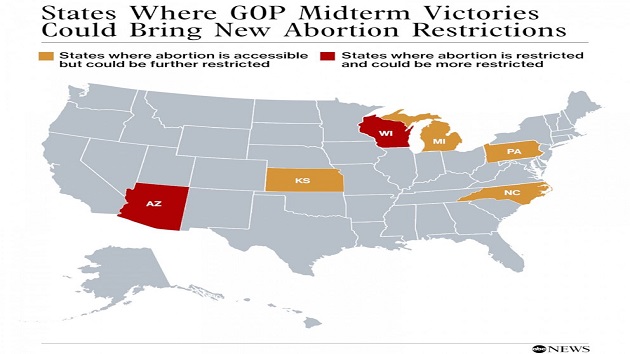
Midterm GOP victories could bring new abortion restrictions in six states

Midterm GOP victories could bring new abortion restrictions in six states
ABC News Photo Illustration

(NEW YORK) — GOP victories in the midterm elections could lead to more abortion restrictions in a handful of states.

The races range from gubernatorial seats to ballot measures, to eking out a veto-proof majority in the statehouse. In many states, it’s not just one race that will define the abortion rights outlook but a few different races coming together to form the new landscape for constituents.

Here’s are the six states where abortion laws could flip.

Pennsylvania

Pennsylvania might be the most straightforward example of how the gubernatorial race could flip a state’s abortion access on its head. If Democrat Josh Shapiro wins, abortion will stay accessible in Pennsylvania because he’s expected to veto any attempts at restrictions. If Republican Doug Mastriano wins, it would be a green light for the Republican-led state legislature to pass laws either severely restricting or outright banning abortion, with a nearly-guaranteed signoff from the governor’s office.

Kansas

Yes, Kansas passed a ballot initiative that made it clear the voters there support abortion rights in the state. But it didn’t enshrine protection for abortion — it only rejected the chance to chip away at it.

So all eyes are on the governor’s race, where a defeat of Democratic Gov. Laura Kelly would mean that the state legislature could pass restrictions and see them signed off by Republican challenger Derek Schmidt. But almost more importantly, a bunch of seats on the Kansas Supreme Court, which has been sympathetic to protecting abortion rights, are up for replacement. And new judges are chosen by the governor, which means Kansas could face a more conservative court that is far more open to allowing new abortion restrictions to stand.

Michigan

The governor’s race will actually have less influence over abortion rights in the state than a ballot measure that would enshrine abortion rights no matter who has political control.

If that ballot measure passes, it would keep abortion legal in the state and protect against future bans. But if the measure fails and Democratic Gov. Gretchen Whitmer is defeated by challenger Tudor Dixon, a Republican, the Republican-led statehouse could bring Dixon abortion restrictions or bans and see them quickly enacted. Two other races matter, though: the attorney general and the Michigan supreme court races, which Republicans would need to win to get rid of the Democrats currently protecting abortion rights from those perches.

North Carolina

It’s all about the statehouse in North Carolina. Republicans are very close to getting enough seats to override Democratic Gov. Roy Cooper’s veto power — and right now that’s all that’s standing in the way of state Republicans enacting a law that further restricts abortion in the state, where abortion is currently legal until 20 weeks. Republicans need to pick up two seats in the state Senate and three in the state House to have a veto-proof majority.

Arizona

Abortion is legal until 15 weeks of pregnancy in Arizona. If Republican Kari Lake wins the gubernatorial race, abortion could be restricted even further. If Democrat Katie Hobbs is elected, it will remain restricted at 15 weeks. (Hobbs wouldn’t have the votes in the statehouse to repeal that law, since it’s already in place). Of course, there’s still a near-total ban looming over the state in the form of a pre-Roe law that’s locked up in legal limbo.

Wisconsin

Even though Democrats control the governorship in Wisconsin, abortion is currently banned in the state by way of complete legal limbo that forced clinics to give up because of the confusion. But if incumbent Democrats Gov. Tony Evers and Attorney General Josh Kaul are defeated by Republicans in this election, abortion could be banned more concretely — regardless of the outcome of the current lawsuit — by the state legislature armed with a new Republican governor.

Copyright © 2022, ABC Audio. All rights reserved.
As voter intimidation concerns grow, election officials look to federal, state laws for protection

As voter intimidation concerns grow, election officials look to federal, state laws for protection
Bloomberg Creative/Getty Images/STOCK

(NEW YORK) — State officials seeking to combat a rise in voter intimidation during the midterm elections can find protection in a 57-year-old anti-discrimination law, according to voting rights experts.

The Voting Rights Act of 1965 is, along with the Ku Klux Klan Act of 1871, the strongest civil voting protection on the books, says Sean Morales-Doyle of the nonpartisan, nonprofit Brennan Center for Justice, which on Friday released a new multi-part guide outlining key anti-intimidation laws as a resource for states.

“The Voting Rights Act of 1965 doesn’t require intent to intimidate in order to prove violation of that law,” said Morales-Doyle, director of the Brennan Center’s voting rights and election program. “So the person who’s doing the intimidating doesn’t have to mean to be intimidating.”

The release of the guide comes as baseless claims of 2020 election fraud have led to an increase in threats against voters and election workers in several states. In the last week, 10 cases of alleged voter intimidation at drop box locations in Arizona were referred to the Justice Department for prosecution, after witnesses reported numerous individuals, some armed and in “camo-clad gear,” filming and photographing voters as they returned their ballots.

“Part of what makes what we’re seeing in Arizona that’s different than what we’ve seen is in the past is … usually in previous elections, when you hear about instances of voter intimidation it tends to be a lone actor behaving badly at a polling place. It’s not an organized recruitment campaign, and that’s what’s happening in Arizona,” Morales-Doyle told ABC News.

Even though the alleged intimidation in Arizona didn’t occur at a polling location, Morales-Doyle said the voters are still protected under the law.

“You can violate voter intimidation laws at the polling place, you can violate it nowhere near a polling place; if you’re intimidating people and scaring them away from exercising the right to vote, then you are violating federal law,” he said.

The new Brennan Center offering, which it calls “The Voter Intimidation and Election Worker Intimidation Resource Guide,” outlines the common federal and state legal protections for voters and voting, as well as an overview of applicable federal laws and information about laws specific to Arizona, Florida, Georgia, Michigan, Nevada, New Hampshire, North Carolina, Pennsylvania, Texas, and Wisconsin.

“While these are not new concerns, the sources and the targets of these threats have shifted in 2022,” Brennan Center counsel Jasleen Singh and fellow Katie Friel said in announcing the resource guide.

In the aftermath of the alleged voter intimidation in Arizona, the Arizona Alliance for Retired Americans and Voto Latino filed a lawsuit this week accusing the alleged perpetrators, as well as Clean Elections USA and the group’s founder, Melody Jennings, of conducting a “coordinated vigilante intimidation campaign” with the “express purpose of deterring voters … from depositing their ballots.”

“The people who are doing it are making references to this Clean Elections USA when they do it,” said Morales-Doyle. “I think it’s exactly why what we’re seeing is so concerning right now, that there is actually this organization going on.”

On Friday, a federal judge denied the advocacy groups’ motion for a temporary restraining order against CEUSA, Jennings, and the ten unnamed accused perpetrators — but did not close the case.

Neither Jennings nor Clean Elections USA immediately responded to ABC News’ request for comment.

Copyright © 2022, ABC Audio. All rights reserved.

Federal judge in Arizona declines restraining order to block group from surveilling voters

Federal judge in Arizona declines restraining order to block group from surveilling voters
Hill Street Studios/Getty Images/STOCK

(NEW YORK) — A federal judge in Arizona Friday declined to issue a temporary restraining order and preliminary injunction to keep several people accused of voter intimidation from gathering near ballot boxes and surveilling voters.

In the lawsuit, which was filed on Monday, the nonprofit advocacy groups Arizona Alliance for Retired Americans and Voto Latino accused ten unnamed individuals — as well as Clean Elections USA and the group’s founder, Melody Jennings — of carrying out surveillance in a “coordinated vigilante intimidation campaign” at ballot drop box locations, “with the express purpose of deterring voters … from depositing their ballots.”

The suit accused them of violating the Voting Rights Act of 1965 and the Ku Klux Klan Act of 1871.

In his ruling, the judge said he found that “defendants’ conduct does not fall into any traditionally recognized category of voter intimidation” and that the plaintiffs lacked “evidence that Defendants’ conduct constitutes a true threat.”

Voto Latino and Arizona Alliance also filed motions asking the court to grant a temporary restraining order and preliminary injunction to bar the defendants from “gathering within sight of drop boxes; from following, taking photos of, or otherwise recording voters or prospective voters, those assisting voters or prospective voters, or their vehicles at or around a drop box; and from training, organizing, or directing others to do the same.”

In his order denying both motions, U.S. District Court Judge Michael Liburdi said he “acknowledge[d] that Plaintiffs and many voters are legitimately alarmed by the observers,” but ultimately ruled that the requested preliminary injunctive relief “implicates serious First Amendment considerations.”

“An individual’s right to vote is fundamental. But so too is an individual’s right to engage in political speech, assemble peacefully, and associate with others,” Liburdi wrote, adding that the defendants were not acting with the intention of discouraging people from voting, but by a desire “to prevent what [the defendants] perceive to be widespread illegal voting and ballot harvesting” so “that persons who attempt to break Arizona’s anti-ballot harvesting law will be exposed.”

“On this record, therefore, the Court finds that a reasonable observer could interpret the conduct as conveying some sort of message, regardless of whether the message has any objective merit,” which falls under the protection of the First Amendment, the judge said.

Following the ruling, attorneys for the plaintiffs appealed the decision to the 9th U.S. Circuit Court of Appeals.

Neither Jennings nor Clean Elections USA immediately responded to ABC News’ request for comment.

Copyright © 2022, ABC Audio. All rights reserved.

Wisconsin man charged after allegedly grabbing Black man by the neck in video

Wisconsin man charged after allegedly grabbing Black man by the neck in video
olaser/Getty Images/Stock

(MILWAUKEE) — A Wisconsin man is facing a misdemeanor disorderly conduct charge after a video circulated online that appeared to show him grabbing a Black man around his neck after a dispute about an alleged bicycle theft, according to a criminal complaint filed in Milwaukee County Circuit Court.

The Milwaukee Police Department told ABC News on Friday that Robert Walczykowski, 62, was charged in connection with the altercation seen in the video.

In the video, Walczykowsk, who is white, accuses 24-year-old Trevon Burks, who is Black, of stealing a bike from his friend’s yard.

“I didn’t touch it,” Burks says in the video, denying Walczykowski’s accusations.

A bystander filmed the video of the incident which took place earlier this month. In the video, the bystander lets Walczykowski know that he’s recording.

“Go ahead, record me,” Walczykowski says in the video as he appears to hold Burks by the neck.

“Let go of his neck, he’s not going anywhere,” the bystander says in the video.

Walczykowski eventually let Burks go, and Burks left the scene before police officers arrived, the Milwaukee Journal Sentinel reported, citing the criminal complaint.

Milwaukee police did not comment on whether Burks is suspected of stealing the bicycle or whether he will face any charges in connection with the dispute.

Burks’ family told Milwaukee ABC affiliate WISN that he has developmental delays. “My son didn’t do anything wrong and, if I was to get justice, I would want [Walczykowsk] to pay for what he did,” Burks’ mother, Tracey, said during a news conference, according to WISN.

Walczykowski and his attorney did not immediately respond to ABC News for comment.

Outraged by the incident, community members have protested in front of Walczykowski’s house since the video appeared online, waving “Black Lives Matter” flags. Other videos show people donating bicycles and other gifts to Burks.

Walczykowski will make his first court appearance Nov. 2, according to court records.

The police department told ABC News that the Milwaukee County District Attorney’s office will handle the case from here. The district attorney’s office did not immediately respond to ABC News’ request for comment.

Copyright © 2022, ABC Audio. All rights reserved.

Transgender youth care ban moved forward by Florida medical board committee

Transgender youth care ban moved forward by Florida medical board committee
Vladimir Vladimirov/Getty Images/STOCK

(NEW YORK) — The Florida medical board committee on Friday approved a prospective rule that will ban medical or surgical gender affirming care for trans youth under the age of 18. The committee’s recommendation will be passed to the board, who will make the official ruling next Friday.

The meeting, open to the public, was met with boisterous and emotionally-charged commentary on both sides of the proposed rule. Uproar ensued when the opportunity to provide public testimony was cut short, with several attendees still awaiting a chance to address the committee.

“I wasn’t allowed to speak at all during the meeting today. And not to toot my own horn, but I do feel like I was one of the qualified people to speak in there as a transgender minor,” Jacob Wiley, a trans teenager, said afterwards at an Equality Florida press conference.

Prior to the ruling, the board heard testimony from those in support and opposition. A number of adults in different stages of de-transitioning spoke in support of the rule, citing multiple mental and physical complications they experienced as a result of gender affirming care. Oppositional testimony came from transgender individuals or trans youth advocates that cited the risk to a youth’s mental health, including increased risk of suicide, if gender affirming care were to be limited or prohibited.

If approved, the rule would limit care for the treatment of gender dysphoria in Florida. Gender dysphoria is when a person experiences emotional distress because because of misalignment between their biological sex and their gender identity.

The rule would prohibit puberty blockers, hormones, cross hormone therapy and gender affirming surgery for people under the age of 18, with an exception for individuals enrolled in IRB-approved, university-centered clinical research trials. There are currently no active clinical trials in Florida related to the provision of gender affirming care, and whether the length of these trials would be adequate to allow full transitory care cannot be guaranteed.

Concerns over irreversible consequences of care including hormonal therapy and gender affirming surgery were raised in the meeting; however, for those who have not yet gone through puberty or are undergoing puberty, the usage of “blockers” are often the first step in medical transition and according to the AAP, these are known to be safe, temporary, and reversible.

The board brought in several experts to talk about the research that has been done on the effects of gender affirming care on transgender youth.

Meredithe McNamara, a pediatrician and assistant professor at the Yale School of Medicine, criticized the Florida Agency for Health Care Administration for their recommendation in banning gender affirming care in June during her presentation, saying it contradicted the general medical consensus on the importance of care for trans people. Specifically, the Florida AHCA report stated that there was not enough research to prove gender affirming care was effective or safe.

However, McNamara pointed to the list of accredited medical institutions, including the American Academy of Pediatrics and the American Academy of Child and Adolescent Psychiatry, alongside the U.S. Department of Health and Human Services, that deem gender affirming care as safe and valuable for gender-diverse people.

“This consensus is based on a solid body of evidence with more than 16 studies confirming that standard medical treatments for gender dysphoria are safe and effective,” McNamara said.

Medical research on the transgender community is limited, but studies on transgender adults suggest gender affirming care, including surgery, results in significantly lower odds of psychological distress, tobacco smoking, and suicidal ideation.

Research shows that people who have gender-affirming surgery had significantly lower odds of psychological distress, tobacco smoking, and suicidal ideation compared with trans people with no history of gender-affirming surgery.

An endocrinologist, Michael Laidlaw, supports sole treatment with mental health care in lieu of this care in combination with pharmacological and/or surgical interventions for transgender youth. He told the board that some of the effects of gender affirming care are irreversible and can cause severe complications such as infertility. However, pediatricians and endocrinologists have told ABC News that puberty blockers only present real risks after puberty and are not a risk to youth. Additionally, hormone blockers alone do not impact future fertility, according to the AAP.

Prior to this ruling, transgender Floridian residents had already been barred from using Medicaid to pay for gender-affirming care starting on August 21.

The move comes as Florida legislators, backed by Gov. Ron DeSantis, continue to crack down on LGBTQ protections and identities. Studies have found that discrimination contributes to the high rates of mental health conditions, suicidal ideations and more among LGBTQ populations.

Alicia Zellmer, MD, is a resident physician in Internal Medicine, and a member of the ABC News Medical Unit.

Copyright © 2022, ABC Audio. All rights reserved.
Domestic extremists pose ‘heightened threat’ to 2022 midterms: Law enforcement

Domestic extremists pose ‘heightened threat’ to 2022 midterms: Law enforcement
Hill Street Studios/Getty Images/STOCK

(NEW YORK) — Domestic violent extremists across the ideological spectrum pose a “heightened threat” to the 2022 midterms, according to a joint intelligence bulletin obtained by ABC News.

The Department of Homeland Security, the FBI, the National Counterterrorism Center and the U.S. Capitol Police also warn that following the midterms, “perceptions” of election fraud could cause violence.

“We assess that election-related perceptions of fraud and DVE reactions to divisive topics will likely drive sporadic DVE plotting of violence and broader efforts to justify violence in the lead up to and following the 2022 midterm election cycle,” the bulletin dated Friday said. “Following the 2022 midterm election, perceptions of election-related fraud and dissatisfaction with electoral outcomes likely will result in heightened threats of violence against a broad range of targets―such as ideological opponents and election workers.”

Domestic violent extremism activity leading up and during the midterms are likely to focus on “election-related infrastructure, personnel, and voters involved in the election process as attractive targets—including at publicly accessible locations like polling places, ballot drop-box locations, voter registration sites, campaign events, and political party offices.”

“Potential targets of DVE violence include candidates running for public office, elected officials, election workers, political rallies, political party representatives, racial and religious minorities, or perceived ideological opponents.”

The hope, the law enforcement agencies say, is possibly to sway voter habits, undermine perceptions of legitimate elections or prompt a particular government reaction.

“Enduring” ideological grievances and the “perceptions” of election fraud are “likely” driving the potential for DVE violence.

Certain factors that are likely to increase a DVE attack during the election cycle are people urging violent action, threats related to perceived illegitimate elections, perceptions of voter suppression and attacks on one group or party.

The federal government bulletin comes as the NYPD warned this week that poll workers could be targets and urged vigilance.

“However, hostile rhetoric and an abundance of generalized threats from likeminded [extremists] and malicious actors in chat groups, encrypted messaging channels, and other online forums may effectively create echo chambers that circulate and reinforce false narratives and establish a permissive environment for violent action against election-related infrastructure and personnel,” the NYPD bulletin dated on Wednesday and was first reported by ABC News states.

The number of domestic terrorism investigations nearly doubled from 2020 to 2021, largely due to the Jan. 6 riot at the U.S. Capitol, according to a report released Friday by the FBI and DHS.

Copyright © 2022, ABC Audio. All rights reserved.

Flu-related hospitalizations highest in 10 years

Flu-related hospitalizations highest in 10 years
Elizabeth Fernandez/Getty Images/STOCK

(NEW YORK) — Flu season is making an early comeback as flu-related hospitalizations are the highest in over a decade for this point in the season, according to the Centers for Disease Control and Prevention.

There have been an estimated 880,000 cases of lab-confirmed influenza illnesses, 6,900 hospitalizations and 360 flu-related deaths nationally this season, according to data released on Friday.

Just this past week, there were 2,332 newly-admitted patients in hospitals, over a third of the total 6,900 flu hospitalizations this season already.

H3N2 is the predominant viral strain currently spreading. Previous seasons with mostly H3N2 viruses have been of higher severity, particularly for older adults and young children, the CDC says. It’s still too early to tell if this trend will continue.

The U.S. has not seen this high of a burden since the 2009 H1N1 swine flu pandemic. The national public health agency uses this as a metric to estimate a season’s severity based on laboratory-confirmed cases, doctor visits, hospitalizations and deaths.

Hospitalization rates are highest in adults over the age of 65 and young children, a level consistent with prior flu seasons for older adults, but a relatively new high for children.

This early flu season is additionally concerning with the pediatric surge of respiratory illnesses like RSV already filling up 75% of pediatric beds and surges of activity at the nation’s emergency departments.

“What worries me is the fact that we’re seeing flu [cases] increase. We have a lot of kids admitted right now with RSV…and you layer on a subset of kids who now are going to end up with flu,” said Dr. Melanie Kitagawa, medical director of the pediatric ICU at Texas Children’s Hospital.

Pediatric hospital beds in 9 states and Washington, D.C., are already above 80% capacity, with another five states over 90%, according to the Department of Health and Human Services.

Experts note that the pediatric surge is something that has been steadily growing over time with an already overtaxed healthcare system.

“This has been kind of a problem that’s been brewing for even several years. We know that hospital beds when it comes to the ability to care for children have decreased especially in our rural communities,” said Dr. Elizabeth Murray, a spokesperson for the American Academy of Pediatrics and pediatric emergency medicine physician at the Gaza Children’s Hospital in Rochester, New York.

The potential for a COVID-19 surge, which we have not seen yet, could compound the threat.

Currently, COVID-19 cases, hospitalizations and deaths have slightly increased over the past week. There are still nearly 400 deaths from the disease daily.

Experts say that vaccines and therapeutics are available for both the flu and COVID.

“Many doctors will prescribe an antiviral, such as Tamiflu. And that will reduce their likelihood of developing the complications of influenza and help keep them out of the hospital,” said Dr. William Schaffner, a professor of infectious diseases at Vanderbilt University Medical Center.

Flu vaccination coverage among children and pregnant people has decreased during the past two years. Lower coverage and little flu circulation during the pandemic may have reduced population immunity, especially in young kids, which could lead to more flu illnesses this season, and potentially more severe illness, the CDC says.

The flu vaccine is recommended for everyone 6 months and older and the COVID booster is recommended for anyone over the age of 5. The best time to get your shots is before Halloween – or as soon as possible, health officials say.

Copyright © 2022, ABC Audio. All rights reserved.

Ex-Capitol Police officer convicted of covering up efforts to help Jan. 6 rioter avoid prosecution

Ex-Capitol Police officer convicted of covering up efforts to help Jan. 6 rioter avoid prosecution
Drew Angerer/Getty Images)

(WASHINGTON) — A federal jury Friday returned a guilty verdict on one count of obstruction of justice against a former Capitol Police officer charged with aiding a rioter who participated in the Jan.6 attack on the U.S. Capitol.

Michael Riley, a 26-year veteran of the Capitol Police, was charged last year after he allegedly encouraged a participant in the attack to delete social media posts that showed the person joining the pro-Trump mob storming the Capitol.

Investigators said Riley reached out to the rioter, Jacob Hiles, over Facebook on Jan. 7, and encouraged him to delete posts that showed him inside the Capitol the day before.

“I’m a capitol police officer who agrees with your political stance,” Riley’s message said. “Take down the part about being in the building, they are currently investigating and everyone who was in the building is going to be charged. Just looking out!”

Riley was found guilty on one count of obstruction related to his attempts to cover up his messages with Hiles after news reports surfaced of Hiles’ arrest.

The jury failed to reach a verdict on a second count related to Riley’s communication with Hiles on Jan. 7.

He faces a maximum sentence of 20 years in prison.

Copyright © 2022, ABC Audio. All rights reserved.

New York City salary transparency law set to go into effect

New York City salary transparency law set to go into effect
Peter Dazeley/Getty Images/STOCK

(NEW YORK) — A New York City law will require companies with at least four employees to post salary ranges in job listings in an effort to increase pay transparency starting Tuesday.

Employers advertising jobs in the city who have at least one employee currently located there must include a “good faith salary range,” according to the New York City Commission on Human Rights, which is enforcing the law. Employers must include a minimum and maximum salary.

There is no fine for a first-time offense, though companies and employment agencies found to violate the law could face civil penalties of up to $250,000 if not corrected within 30 days of receiving notice of the violation.

Temporary staffing agencies are exempt from the law because they already disclose this information under the New York State Wage Theft Prevention Act.

The new law, which passed the New York City Council late last year, was set to go into effect in May, though the start date was delayed following criticism from business groups and companies who said they were not consulted about the legislation beforehand and that the language of the law was vague.

The law was also amended to waive a penalty for a first-time violation and clarify that it would not apply to jobs that cannot or will not be performed in New York City, among other changes.

The city follows other jurisdictions that have passed laws to increase pay transparency. Among them, Colorado, Connecticut and Nevada started mandating salary ranges on job postings last year, and similar salary requirement laws will go into effect in California, Rhode Island and Washington state in 2023.

Several companies have already started complying with the New York City law, including Amazon, American Express, Citigroup and Zillow.

Pay transparency advocates who were involved in the new law called it a “game changer for the city’s workers,” in particular those who face wage disparities, including Black and Latina women.

“With salary ranges out in the open, employers must think critically about how they set pay at the front end of their process before they insert unconscious biases. At the same time, women and people of color have more leverage to advocate for themselves and more information to make better decisions about jobs and industries to pursue, helping to combat occupational segregation,” Beverly Cooper Neufeld, president of PowHer New York, and Seher Khawaja, senior attorney for economic empowerment at Legal Momentum, wrote in an opinion piece published in the New York Daily News on Thursday.

The chambers of commerce in each borough and the Partnership for New York City, an organization that represents the city’s business leadership, had unsuccessfully pushed for the law to exempt industries with severe labor shortages, as well as only require minimum salary postings for highly compensated jobs.

“New York City is a highly competitive labor market, where most employers are committed to gender and racial pay parity,” they wrote in a joint letter in April, arguing that the inclusion of a salary range is “not necessarily the most appropriate tool for the New York labor market.”

Copyright © 2022, ABC Audio. All rights reserved.

Another UFO report comes out next week, some incidents still unexplained

Another UFO report comes out next week, some incidents still unexplained
U.S. Dept. of Defense

(NEW YORK) — The enduring debate about whether UFOs are caused by extraterrestrial beings will once again be front and center next week as U.S. intelligence agencies will provide Congress with an updated report on UFO incidents over the past year.

Meanwhile, it appears that other more recent incidents are being attributed to weather balloons, other airborne clutter, and foreign surveillance, according to a U.S. official.

Director of National Intelligence Avril Haines has until Monday to provide Congress with its first annual unclassified update on Unexplained Aerial Phenomena, the new term for UFOs, that includes all new UAP incidents over the past year and any previously unreported incidents.

The report was required by the 2022 Defense Bill that mandated that the DNI provide an annual declassified update and a classified annex by Oct. 31 of every year through 2026.

The update follows the DNI’s first-ever report released in June 2022 that listed 144 UAP incidents, only one of which could be explained. At a congressional hearing earlier this year Pentagon officials said that the number of UAP incidents under investigation had risen to more than 400.

While it is unclear how many new reports will be included in the upcoming update, a U.S. official told ABC News that the most recent UAP incidents can be explained as a mix of weather balloons, airborne clutter, and foreign surveillance. But the official stressed that other incidents still cannot be explained.

The official added that it cannot be determined who is behind the foreign surveillance but the most likely candidates would be China and Russia since they have the most interest in monitoring the U.S. military.

“There is no single explanation that addresses the majority of UAP reports,” Sue Gough, a Defense Department spokesperson, said in a statement. “We are collecting as much data as we can, following the data where it leads, and will share our findings whenever possible. We will not rush to conclusions in our analysis”

“In many cases, observed phenomena are classified as ‘unidentified’ simply because sensors were not able to collect enough information to make a positive attribution,” said Gough. “We are working to mitigate these shortfalls for the future and to ensure we have sufficient data for our analysis.”

Analysis of more recent UAP incidents is helped by the amount of information and data available as compared to older incidents.

The U.S. official told ABC News that two of the three videos declassified by the Pentagon in 2020 and recorded from the sensors aboard fighter aircraft now have plausible explanations.

In the “Go Fast” video Navy pilots are heard exclaiming how fast an object is moving above the water. According to the U.S. official, the leading assessment from experts is that what the pilots saw on their video screens was actually an optical illusion of an object that was not moving very fast at all. The illusion was created by the angle and height at which the object was viewed by the sensors as it moved above the water.

The “gimbal” video taken in 2015 by a jet fighter crew that shows an object rotating in the clouds. The official says it’s now believed that the object’s strange movements and observed spinning was caused by the sensor aboard the plane that captured that image.

There is no assessment for what is being seen in the third video commonly referred to as the “Flir” video that was taken in 2004.

The general public’s appetite for UFOs is sure to continue, and just last week NASA announced the 16 people who would serve on a new panel tasked with studying UAPs. Their report, based on unclassified information, is slated to be released in mid-2023.

Copyright © 2022, ABC Audio. All rights reserved.