
Russia-Ukraine live updates: Russia launches missile attack on New Year’s Eve

Russia-Ukraine live updates: Russia launches missile attack on New Year’s Eve
SAMEER AL-DOUMY/AFP via Getty Images

(NEW YORK) — More than 10 months after Russian President Vladimir Putin launched an invasion into neighboring Ukraine, the two countries are engaged in a struggle for control of areas throughout eastern and southern Ukraine.

Putin’s forces in November pulled out of key positions, retreating from Kherson as Ukrainian troops led a counteroffensive targeting the city. Russian drones have continued bombarding civilian targets throughout Ukraine, knocking out critical power infrastructure as winter sets in.

Here’s how the news is developing. All times Eastern:

Dec 31, 8:14 AM EST
1 dead, 7 injured after Russia launches missile strike against Kyiv

At least one person has been killed and seven people have been injured after Russia launched a barrage of missiles on Kyiv on New Year’s Eve.

Mayor Vitali Klitschko reported destruction across several districts with a luxury hotel, a bridge and police stations among the locations impacted.

It’s currently unclear how many locations have been destroyed as a result of direct hits and how many were from falling debris from intercepted rockets.

New Year’s Eve is one of Ukraine’s biggest holidays.

Dec 30, 10:28 AM EST
Putin expects China’s Xi to make state visit in spring

Russian President Vladimir Putin said on Friday that he’s expecting Chinese President Xi Jinping to make a state visit to Russia in the spring of 2023.

Putin said he’s looking to deepen military cooperation between the two nations.

Putin said the visit would “demonstrate to the world the closeness of Russian-Chinese relations.”

Dec 29, 5:08 PM EST
Zelenskyy praises Air Force for ‘repelling’ Russian missile barrage

Ukrainian President Volodymyr Zelenskyy is praising his country’s air defense, saying it “successfully repelled” a barrage of Russian missiles fired at Kyiv and other targets early Thursday.

Zelenskyy said the Ukrainian Air Force shot down 54 missiles and 11 attack drones.

“Our warriors all over Ukraine distinguished themselves and I thank all our Air Commands: Center, South, East and West,” Zelenskyy said.

He specifically cited the efforts of the 96th Kyiv, 160th Odesa and the 208th Kherson anti-aircraft missile brigades, saying their “results are the best today.”

Zelenskyy said several Russian missiles evaded Ukraine’s air defense and hit several infrastructure targets.

“Our power engineers and repair crews are doing everything to make Ukrainians feel the consequences of the terrorists’ strike as little as possible,” Zelenskyy said.

As of Thursday evening, he said there were power outages in most regions of Ukraine, including the capital city Kyiv as well as the Lviv, Odesa, Kherson, Vinnytsia and Zakarpattia regions.

“But this is nothing compared to what could have happened, if it was not for our heroic anti-aircraft troops and air defense,” Zelenskyy said.

Dec 29, 11:40 AM EST
Ukrainian missile shot down in Belarus: Defense ministry

Belarus’ defense ministry said its air defenses had downed a Ukrainian S-300 missile in a field on Thursday morning during one of Russia’s largest missile attacks against Ukraine since the start of the war.

The military commissar of the Brest region, Oleg Konovalov, played down the incident in a video message posted on social media by the state-run BelTA news agency, saying local residents had “absolutely nothing to worry about.”

“Unfortunately, these things happen,” Konovalov said.

He compared the incident to one in November when an S-300 believed to have strayed after being fired by Ukrainian air defenses landed in NATO member country Poland, and initial fears of an escalation in the war were rapidly defused.

Konovalov said the Ukrainian missile was shot down by the air defense forces around 10 a.m. local time Thursday. Fragments of the downed missile were found near the village of Gorbakha in the Brest region.

-ABC News’ William Gretsky

Dec 29, 10:32 AM EST
Russia continues ‘escalating’ missile campaign, US Embassy says

Moscow has been “cruelly” targeting Ukrainian civilians by launching attacks against utilities during the winter, the U.S. Embassy in Kyiv said on Thursday.

The rebuke came as Russia fired missiles at cities throughout the country on Thursday. The General Staff of the Ukrainian Army said 69 missiles were launched, fewer than the 100 missiles that officials had estimated earlier in the morning. Officials said 54 missiles were intercepted.

Two civilians were killed as a result of shelling in the Kharkiv area, according to the region’s governor.

“The Kremlin continues its escalating campaign of missile attacks, cruelly wielding cold & dark against” Ukrainians, U.S. Embassy officials said on Twitter. “Families are again hunkering down as critical infrastructure & other targets across the country are attacked.”

Air raid sirens started wailing before 6 a.m. local time across Ukraine, sending residents scrambling into underground shelters in several cities. Missiles landed in Kyiv, Kharkiv, Odesa, Lviv and Zhtomyr.

Ukraine’s defense systems intercepted some missiles, including 16 that were shot down near Kyiv, the capital, Mayor Vitali Klitschko said. Two homes in Kyiv were damaged by falling debris and three people were injured, he said.

Ukraine’s Ministry of Defense said Russia had been “saving one of the most massive missile attacks since the beginning of the full-scale invasion for the last days of the year.”

“They dream that Ukrainians will celebrate the New Year in darkness and cold,” officials said. “But they cannot defeat the Ukrainian people.”

-ABC News’ Britt Clennett and Joe Simonetti

Dec 29, 2:29 AM EST
More than 100 Russian missiles fired at Ukraine

Russian forces early on Thursday launched a missile strike on Ukraine.

More than 100 rockets were fired in several waves, Oleksiy Arestovych, an advisor to Ukrainian President Volodymyr Zelenskyy, said on Twitter. Some rockets were reportedly fired from carriers in the sea, while others were reportedly fired by at least a dozen fighter aircraft.

Another presidential advisor, Mykhailo Podolyak, said on Twitter that more than 120 missiles had been launched “by the ‘evil Russian world’ to destroy critical infrastructure & kill civilians en masse.”

At least one loud explosion was heard in Kyiv, where air raid sirens were ringing for several hours on Thursday morning.

Dec 28, 1:58 PM EST
Kremlin rejects Ukraine’s Feburary ‘peace summit’

Russia has rejected a proposal from Ukraine to hold a “peace summit” in February, according to a Kremlin official.

“There is no ‘peace plan’ for Ukraine for now, that’s for starters,” Kremlin spokesman Dmitry Peskov told reporters Wenderday. “Besides, there can be no ‘peace plan’ for Ukraine, which disregards today’s realities on Russian territory, the entry of new regions, four of them, into Russia.”

Peskov was apparently referring to recent Ukrainian drone attacks inside Russia, including one this week at the Engels Air Force Base in southern Russia that killed three Russian soldiers.

-ABC News’ William Gretsky

Dec 27, 1:13 PM EST
Putin bans sending Russian oil to countries imposing a price cap

Russian President Vladimir Putin signed a decree Tuesday that not only rejects a price cap on the country’s oil but bans sending crude and other petroleum products to any country that has endorsed the price cap.

The Group of Seven countries, including the United States, agreed on Dec. 3 to impose a $60 per barrel price cap on Russian oil in response to the Kremlin’s invasion of Ukraine. Australia and the European Union also agreed to impose the price cap.

The decree Putin signed goes into effect on Feb. 1 and is valid until July 1, 2023.

The decree bans the supply of oil and oil products from Russia to those countries that place a price ceiling on contracts. The decree also forbids the supply of oil to other foreign buyers whose contracts use a price cap mechanism.

The decree includes a clause allowing Putin to overrule the ban in special cases to be determined by the Russian leader.

The price cap on Russian oil implemented by G-7 nations disallows the world’s second-largest oil exporter from selling crude at a price above $60 per barrel.

Since the outset of its war with Ukraine, Russia has sold its oil at discounted prices. As of Tuesday, Russian Urals crude was trading at $57 per barrel — an amount slightly less than the cap. But the price cap aims to ensure that Russian oil sales remain well below global oil prices, which stand at about $80 per barrel.

-ABC News’ William Gretsky

Dec 26, 7:40 AM EST
Ukraine strikes bomber base in Russia, killing three

A Ukrainian drone attack on the Engels Air Force Base in southern Russia killed three, Russia’s Ministry of Defense said.

A spokesman for Ukrainian Air Force confirmed the attack, saying, “If the Russians thought the war would not touch them they were wrong.”

Russian air defence reportedly shot down a Ukrainian drone flying at low altitude, but falling debris caused the casualties in the overnight attack.

The Engels base lies just over 300 miles northeast of Ukraine’s border with Russia. The facility has been repeatedly used by Russia to carry out missile strikes on targets in Ukraine.

Ukrainian forces had attacked another Russian air base on Dec. 5, killing three and damaging two strategic bombers.

Copyright © 2022, ABC Audio. All rights reserved.

Will the US plan for testing travelers from China help stem the spread of COVID?

Will the US plan for testing travelers from China help stem the spread of COVID?
Anthony Kwan/Getty Images

(NEW YORK) — The Centers for Disease Control and Prevention announced this week it would require a negative COVID-19 test from all travelers arriving to the U.S. from China as well as those from Hong Kong and Macau.

It comes as China experiences a surge of COVID-19 cases and hospitalizations after dropping its so-called “zero COVID” policy.

“CDC is announcing this step to slow the spread of COVID-19 in the United States during the surge in COVID-19 cases in the People’s Republic of China given the lack of adequate and transparent epidemiological and viral genomic sequence data being reported from the PRC,” the CDC said in a statement.

What’s more, Italian officials said Wednesday that nearly half of passengers on two flights from China to Milan tested positive for the virus.

Public health experts told ABC News that while they understand why the U.S. announced the measure, it is not a viable long-term solution.

“Pre-departure testing is not a fool-proof method to limit the spread of COVID,” said Dr. John Brownstein, an epidemiologist and chief innovation officer at Boston Children’s Hospital and an ABC News contributor. “It’s hard to see a significant public health value.”

“The people that pre-departure testing will catch are overall drops in the bucket,” he added.

Brownstein and others said passengers testing before traveling may help protect other people on the plane by making sure they don’t contract the virus, but it won’t help the general public.

“One can imagine that the plane — if people are traveling and they have COVID, and they don’t know it — would be safer,” Dr. Peter Chin-Hong told ABC News. “So, I guess the fear, and the rationale for having this kind of travel restriction, is to prevent scary variants from coming in, or at least to delay it.”

He continued, “But at this point, the United States has seen so many waves of infection that probably the scariest variant wouldn’t do as much damage as if it were a naive population, like in March of 2020.”

Chin-Hong explained that this means because most of the U.S. population has antibodies either through natural infection or through vaccination, a new variant will likely not cause as much damage as it would have earlier in the pandemic when most Americans didn’t have antibodies.

The experts said another reason the U.S. instituted the rule is because there is little information coming out of China about the true scale of its COVID situation.

China has not reported any evidence of new variants, but has also been accused of underreporting case counts, hospitalizations and deaths.

For example, China’s National Health Commission says the country has only seen 5,241 COVID-19 deaths since the pandemic began, while data from Johns Hopkins suggests China has had over 16,000 deaths since the pandemic started.

Brownstein said it may be more effective to test passengers upon arrival in the United States, which is a rule recently implemented in Italy.

“I can imagine a situation where someone tests negative [before flying], but is incubating the virus and boards the plane,” he said. “But pre-departure testing is especially not valuable in a world where we already have intense transmission.”

Chin-Hong said China had strict testing measures in place too, but COVID-19 was still able to spread rapidly within the country, and travelers from China could circumvent the U.S. rule by flying to another country first.

He said what the U.S. should focus on is administering the updated bivalent booster to seniors aged 65 and older, because they are at the highest risk of serious disease, hospitalization and death. According to the CDC, only 37.5% of elderly people have been boosted.

“The main thing the U.S. should be doing is independent of China, is continue to invest in vaccinating older individuals, particularly those over 65 because that’s where most of the deaths are and that’s where the booster rate is still abysmally low,” Chin-Hong said. “If you can divert those resources to building up the immune defenses of the people who could get sick, that will have more longevity.”

Copyright © 2022, ABC Audio. All rights reserved.

Mother sues school district after 8th-grade daughter allegedly strip searched

Mother sues school district after 8th-grade daughter allegedly strip searched
halbergman/Getty Images/STOCK

(EASTLAKE, Ohio) — The mother of an Ohio middle schooler is suing her daughter’s school district, alleging a nurse’s aide strip searched the girl.

The federal lawsuit, filed on Dec. 28, names Willoughby-Eastlake Schools Board of Education and three Eastlake School Middle employees as defendants. The lawsuit alleges violations of the teen’s constitutional rights, failure to train school employees, and intentional infliction of emotional distress.

On Sept. 27, the unnamed middle schooler — a current eighth grade student at Eastlake Middle School — was approached by another student who asked to leave her vape pen in the teen’s gym locker, according to the lawsuit. The student “begrudgingly agreed,” the lawsuit states.

Just before lunch the same day, the school’s principal Colleen Blaurock pulled the eighth grader out of class and questioned her about the vape pen, according to the lawsuit.

The lawsuit states that the student told Blaurock the truth about “what occurred in the girls’ locker room that morning,” but insisted “the vape pen was not hers, that she did not have the vape pen and that she did not know where the vape pen was.”

According to the lawsuit, Blaurock then proceeded to search the student’s gym locker and hallway locker, but both searches turned up empty.

Then, the lawsuit says the teen was taken to the nurse’s office. There, a nurse’s aide Rosalyn Rubertino allegedly forced the middle schooler to strip down to only her underwear after the middle school’s assigned nurse Megan Kuhlman — who was not present at the time — allegedly instructed her to do so over the phone.

The lawsuit states that the body search also turned up empty. Following the search, the teen was suspended from the school.

James Macy, chair of the School Law section at von Briesen law firm, said the question of whether schools are justified in strip searching students rests on if they have “reasonable evidence” indicating the student has “contraband or illegal substances” that present safety concerns to the student or others.

“What’s the evidence? To what degree do we have any immediacy to health and safety issues? And then to what degree do we work with law enforcement and the parents to address the situation?” Macy told ABC News. “All of that comes into play before a decision is made.”

The plaintiff’s lawyer Jared Klebanow told ABC News Cleveland affiliate WEWS that in this student’s case, he believes the school went too far.

“A lot of people might say it was one day, move on. But this is an impressionable teenaged girl, and you can imagine the range of emotions. You have fear, humiliation, right?” Klebanow said. “It’s embarrassing she had to go through this and be all but naked in front of a stranger.”

Willoughby-Eastlake City Schools Board of Education, Blaurock, Kuhlman, and Rubertino did not immediately respond to ABC News’ requests for comment.

Copyright © 2022, ABC Audio. All rights reserved.

Apple’s value plunged nearly $1 trillion in 2022. Here’s what that says about the economy

Apple’s value plunged nearly  trillion in 2022. Here’s what that says about the economy
Gary Hershorn/Getty Images

(NEW YORK) — Apple marked a grim milestone this week, falling about $1 trillion below a peak reached in 2022.

The company’s shares rallied in recent days, but the massive loss in value reflects difficult economic times for companies across the tech industry and beyond.

The tech-heavy Nasdaq plummeted by about one-third in 2022 while the broader S&P 500 fell 19% over that period. Apple’s performance, meanwhile, fell right in between those two indexes, dropping 27% over the course of the year.

The decline of a longstanding stalwart like Apple highlights trends that thrust the U.S. economy into uncertainty in 2022, leaving it in a precarious position as the new year begins, analysts told ABC News.

The forces that have squeezed Apple and the wider economy include a shift from pandemic-era consumption that flipped the fortunes of companies large and small, a near-historic rise in inflation that triggered an aggressive response from the Federal Reserve and supply chain disruptions that eased but persisted with zero-COVID lockdowns in China, analysts said.

“You’re talking about $1 trillion wiped out from the economy in one stock – it’s a big number and it isn’t something that should be ignored,” Angelo Zino, senior industry analyst at CFRA Research, told ABC News.

Apple did not immediately respond to a request for comment.

Why Apple lost nearly $1 trillion in value in 2022 and what it says about the state of the U.S. economy.

Consumer tastes change as pandemic fears wane

Like many tech companies, Apple has suffered from a major consumer shift away from the pandemic-era focus on buying goods.

At the height of the pandemic, hundreds of millions across the globe facing lockdowns replaced restaurant expenditures with couches, exercise bikes and tech products. Over the first three months of 2021, for instance, Apple’s profits more than doubled compared to the same period a year prior.

“People were home buying computers, playing with gadgets and consumer electronics – all the things that Apple sells,” Mark Zandi, chief economist at Moody’s Analytics, told ABC News.

As pandemic fears have waned, however, consumers have prioritized spending on the experiences they missed out on while cooped up indoors. This fall, demand for personal computers plunged nearly 20% compared to the year prior, research firm Gartner found.

That change in taste has punished the bottom line of Apple and many tech firms, Zandi said.

“Since the pandemic has been winding down, people have been shifting spending away from consumer electronics to travel, restaurants and ball games,” he said.

Inflation rises and aggressive interest rate hikes follow

Apple has also faced challenges rooted in rapid price hikes and the Federal Reserve’s policy response, which has slowed some areas of the economy and pummeled the stock market.

At its peak, inflation reached 9.1% in June, a level last seen more than four decades ago. To dial back the rising costs, the Federal Reserve has undertaken an aggressive set of interest rate hikes.

An increase to the benchmark interest rate raises borrowing costs for consumers and businesses, which in theory should slash inflation by slowing the economy and eating away at demand. That means borrowers, whether businesses or individuals, have a harder time accessing loans, the lifeblood of economic activity.

Because interest rate hikes typically weigh on the economy and corporate earnings, investors flee. That pain is particularly acute for tech stocks like Apple because investors choose them in the first place for strong profit growth, which appears increasingly unlikely as interest rates jump, Zandi said.

“Investors are buying their stocks because of expected profit growth long into the future,” he said. “They get hit hard.”

High prices and rising borrowing costs can also weigh on consumers, eating away at savings and casting aside spending on items like iPhones or MacBooks.

Consumer spending proved resilient for much of the year due in part to savings from the pandemic, but the cushion appears to have dwindled in recent months. The personal savings rate fell to 2.3% in October, the lowest rate in nearly two decades, according to data from the Commerce Department.

“The state of the consumer is extremely important for a company like Apple,” said Zino, adding that the company could withstand a potential drop in consumer spending because products like the iPhone are treated by many as necessities.

Supply chain bottlenecks

Like a host of companies, Apple has struggled with pandemic-imposed supply chain disruptions that have hindered production and caused delivery delays.

While the worst of the global supply backup has eased, impediments remain, most notably in China.

The manufacturing behemoth’s “zero-COVID” policy has triggered intermittent shutdowns, forcing factories to close and production to halt.

“Apple has huge operations in China,” Zandi said.

At China’s biggest iPhone factory, in the central Chinese city of Zhengzhou, workers vanished over concerns that executives would impose a mandatory quarantine because of a recent COVID outbreak.

On the whole, China’s zero-COVID policy led to major iPhone shortages heading into the holidays, according to a report released by Wedbush Securities analyst Dan Ives last month. Shortages reached as low as 35% of typical holiday inventory in some stores, causing overall iPhone demand to outstrip supply by a ratio of 3 to 1, he found.

In recent weeks, China has relaxed its zero-COVID policy, offering a glimmer of hope for companies with major supply hubs in the country, like Apple, analysts said.

The China-related delays in the delivery of some iPhone models should be “largely resolved” by some point in January, Zino said.

While many expect a wave of coronavirus infections as the country reopens, manufacturing production could return to normal in the spring or summer of 2023, Zandi said.

Copyright © 2022, ABC Audio. All rights reserved.
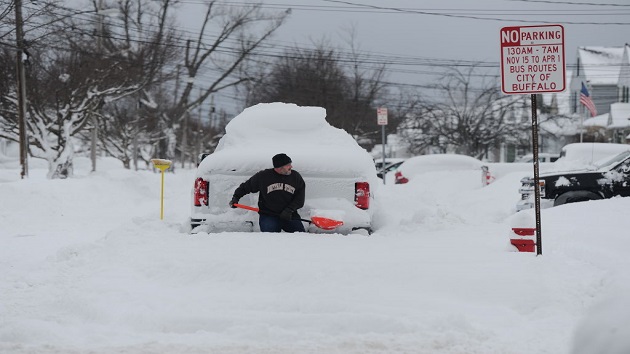
Buffalo’s deadly blizzard by the numbers: What made the storm so historic

Buffalo’s deadly blizzard by the numbers: What made the storm so historic
John Normile/Getty Images

(NEW YORK) — It was a once-in-a-generation event.

The major winter storm that impacted parts of the U.S. last week devastated Western New York. The Buffalo region, which is no stranger to snow, was walloped with prolonged whiteout conditions and freezing temperatures that contributed to dozens of fatalities.

New York Gov. Kathy Hochul has called the Christmas weekend storm the “blizzard of the century.”

“This will go down in history as the most devastating storm in Buffalo’s long storied history of having battled … many, many major storms,” Hochul, a Buffalo native, said during a Christmas morning news conference.

Heather Kenyon, a meteorologist with the National Weather Service’s Buffalo office, told ABC News it ranks as the “worst snow event I witnessed in this area.”

“We knew that this was going to be a significant high-impact storm,” Kenyon said. “We saw the combination of lake-effect snow and very strong winds, and so we were expecting blizzard conditions and really messaged that this was going to be a once-in-a-generation-type storm.”

The winter storm saw rain followed by plummeting temperatures, heavy lake-effect snow and high winds — dangerous conditions that developed very quickly on Dec. 23 across Western New York.

“It was a very strong cold front plowing through the area — temperatures plummeting, snow starting, winds gusting,” Kenyon said. “That quick onset I think caught a lot of people off-guard.”

Here’s a closer look at the blizzard by the numbers:

Minus 30-degree wind chills

The strong low-pressure area that moved across the country last week brought extremely cold air to the Buffalo region. Temperatures started plunging on Dec. 23, when sub-zero and single-temperatures combined with high winds for “dangerous wind chills,” the National Weather Service said. Wind chills — what the temperature outside feels like — were between minus 10 and minus 30 degrees for several days.

In those conditions, exposed skin can be affected in minutes, with frostbite and hypothermia as serious concerns, officials warned during the storm.

51.9 inches of snow

As the cold air moved over the warmer waters of the Great Lakes, it caused lake-effect snow.

Over 4 feet of snow accumulated in parts of Erie County over the course of five days ending Dec. 27. The highest total snowfall was reported at the Buffalo Airport, with 51.9 inches.

Record daily snowfall was recorded on Dec. 23 in Buffalo, with 22.3 inches.

Buffalo is significantly outpacing its typical seasonal snowfall. It has recorded over 100 inches so far this season, nearly 70 inches more than the normal amount for this time of year and several inches more than what it averages the entire season.

Nearly 80 mph winds

Meteorologists were expecting wind gusts up to 70 mph during the blizzard, “which were reached,” Kenyon said.

A 79 mph wind gust was recorded in Lackawanna and 72 mph at the Buffalo airport on Dec. 23, according to the National Weather Service.

“This storm was so significant because it brought those strong winds, which we don’t often see with the lake-effect snow,” Kenyon said. “Those strong winds just produced impossible travel and drifting snow where we’re getting this drift where people can’t even open their front door.”

Though the region is prone to lake-effect snow, blizzard warnings are not often issued, Kenyon said. Other areas in the Great Lakes region got lake-effect snow with the storm system, but not the high winds, she said.

The combination of lake-effect snow and high winds was “why it was so bad for us,” Kenyon said.

Zero visibility

The high winds during the snowstorm often made for zero visibility in the lake-effect band, making travel impossible in the Buffalo metro area as many were gearing up for the holiday weekend or trying to head home from work. A travel advisory was soon upgraded to a ban on traveling the morning of Dec. 23.

Cars got stranded as roadways became impassable. The storm marked the first time in history that the Buffalo Fire Department couldn’t respond to any calls, officials said.

At least 39 fatalities

At least 39 people have died due to the storm in Erie County, which includes the city of Buffalo, officials said, making it the deadliest in the region since the blizzard of 1977.

Many people died after getting stranded outside or in their cars, while others were found dead in their homes amid frigid conditions, officials said.

Nearly half of those who died — 17 — were found outside, 11 were in a house and four in a car. Others died due to snow-clearing cardiac events, while three were the result of a delayed EMS response, officials said.

Copyright © 2022, ABC Audio. All rights reserved.

Arkansas city enforces emergency curfew after ‘rampage of shootings’

Arkansas city enforces emergency curfew after ‘rampage of shootings’
Sheila Paras/Getty Images/STOCK

(EUDORA, Ark.) — Officials in the city of Eudora, Arkansas, said they are enforcing a mandatory emergency curfew after struggling to stop what the city’s mayor described as a “rampage of shootings.”

The city of fewer than 3,000 residents has recently experienced more than 10 shootings, according to Mayor Tomeka Butler, including one which killed a local resident on Dec. 24. Facing increased crime, few actionable leads, and limited police resources, Butler announced the “civil emergency curfew” on Dec. 27.

The curfew applies from 8 p.m. until 6 a.m. with exceptions for both employment and medical emergencies, officials said.

In a statement to ABC News, Butler said that the frequency of these shootings are unprecedented, adding “this is the first time these acts of this magnitude have taken place.”

“Should you be caught during curfew hours, you will be subject to being stopped and searched,” Butler said in a video posted to Facebook, in which four law enforcement officers stood behind her.

In the video and on other posts, Butler pleaded for community members to work together to stop the violence.

“Please help us bring these senseless acts of crime to a stop,” she said.

A Community Responds

Members of the community, local leaders, and law enforcement officials gathered for an meeting on Wednesday evening in a local church. They voted to extend the curfew until Jan. 3 and asked community members for their help in stopping the violence.

“We’re pleading for your help, we really need your help,” Butler said. “And the only way that is going to change is if we pull together and change our city.”

With dozens of community members sitting in wooden church pews, aldermen sitting behind a drum set and leadership addressing the anxious community from a lectern, the meeting was both a venue for public announcements and a community venting session.

“This is not people’s houses getting shot in anymore, we have people actually dead on the street,” one unidentified community member pleaded. “We need some extra help”

Others said they were worried about the severity of the problem compared to resources available in Eudora.

“It’s too big for you guys,” a community member told local officials.

The Arkansas State Police is investigating the Dec. 24 shooting that killed one resident and injured another but are not involved with any curfew enforcement, according to Arkansas State Police public information officer Bill Sadler. At the moment, no arrests have been made for the homicide and the investigation is ongoing.

Officials from the Eudora Police Department said their department faced some limitations, including limited staff, a budget best described as “pretty much peanuts,” outdated safety equipment and broken vehicles. As an illustration of those issues, Eudora Chief of Police Mike Pitts pointed to the bullet-proof vest he was wearing and said it was not even his own.

A sergeant with the police department also noted that officials have been unable to act on tips because members of the community fear coming forward with information.

“Prosecutors would turn me around the door if they don’t have anything supporting evidence to back up what I’m presenting to them,” he said. “That’s the problem that I’m having right now in putting these cases together. The community is afraid to come forward and say what’s going on out here in the streets who’s really involved with the shootings that’s going on.”

Despite these limitations and concerns, Pitts stood by the curfew.

“I know it’s an inconvenience for some, but it’s a comfort for others,” he said, noting that a family member of a victim told him that they could finally get sleep after learning about the curfew.

“This action was by no means taken to violate any constitutional rights of any citizen, any business owner, any religious believer, or anyone traveling through the city of Eudora,” Butler said.

Freedom from fear

In a country where gun violence stories have become common, the issues facing Eudora might seem minor, officials said. But in a small city like Eudora, an uptick in crime has been destabilizing.

“I know that in bigger cities, larger cities, that sounds like peanuts, but here in a small community of 2,500 people, that’s too many,” Pitts said. “That’s too many in any city, but that’s unfathomable.”

The “Catfish Capital of Arkansas,” Eudora stretches across a few square miles across a largely rural Arkansas. Its population, over 80 percent African American, shares a grocery store, dollar store and liquor store. With little crime overall, residents at the town hall could easily recall unsolved crime, like a drive-by shooting from three years ago.

The recent uptick in shootings appears to have driven community members and leadership into action to fight back against what the mayor described as a “few senseless citizens” and the police chief described plainly as “murderers.”

“This is home, and if you can’t feel safe at home, then what are you doing?” Butler asked during the town hall.

Law enforcement told community members that they will not rest until the crime stops.

“Until we get justice for that, until we get justice for the people whose homes have been violated by people shooting into them, then we are not going to rest,” Pitts said.

He added, “This is not how Eudora is supposed to be, this is now how it was when I was a kid in the area growing up, and it is not going to remain this way.”

Copyright © 2022, ABC Audio. All rights reserved.

E-bike batteries raise safety concerns amid rise in fires: ‘Very hard to examine’

E-bike batteries raise safety concerns amid rise in fires: ‘Very hard to examine’
ABC News

(NEW YORK) — The growing popularity of e-bikes in the United States in recent years has led to a rise in fires and other hazards, local and federal officials are warning.

At least 19 people died in the United States in 2022 because of fires or overheating incidents related to battery-powered products such as e-bikes, scooters and hoverboards, the U.S. Consumer Product Safety Commission said this week.

In New York City alone, fires caused by lithium-ion batteries powering these micro-mobility devices, also known as light electric vehicles (LEVs), have been responsible for at least 208 fires this year, resulting in 142 injuries and six deaths, a spokesperson for the New York Fire Department said.

In 2021, there were 104 fires caused by these batteries, 79 injuries and 4 deaths, according to city data. In 2020, there were 44 such fires, 23 injuries and zero deaths, the data shows.

Micro-mobility devices in 2022 caused four fires a week on average, based on data from the FDNY.

The Consumer Product Safety Commission (CPSC), in a letter last week, urged over 2,000 manufacturers, importers, distributors, and retailers of LEVs to sell products that use batteries built with standards set by Underwriters Laboratory, an industry safety organization, in order to reduce the risk of injuries and deaths.

Compliance with these standards should be demonstrated by certification from an accredited testing laboratory, the agency urged.

While many battery manufacturers like Bosch follow the standards, experts say the standards need to be industry-wide. The move to required UL standards in all these products would make them far safer overall, they say.

Some industry experts see the recent moves by the CPSC as evidence it lacks the necessary regulatory muscle to cause a change in the industry. This concern comes as more Americans are embracing LEVs, with many expected to purchase these around the holidays.

The CPSC has jurisdiction over these products. The U.S. Department of Transportation established in 2018 the Lithium Battery Working Safety Group which includes officials from CPSC, the U.S. Food and Drug Administration and the National Institute for Standard and Technology. The group advises Congress on additional ways to mitigate fire hazards from these batteries and ways to establish uniform regulations for these batteries.

When asked about why they were not seeking to make UL certification mandatory, instead of just encouraging companies to adopt those standards, a CPSC spokesperson said it is time consuming to adopt mandatory rules, making voluntary standards a more common course of action to get important safety information to industry and consumers as quickly as possible.

New York problem

Fatiumata Dialo has been delivering food on his e-bike in New York for the last year. An immigrant from Guinea, he said his e-bike, for which he paid $1750, is the most expensive purchase he has made since arriving in the U.S.

Dialo cycles between several batteries for the bike over the course of the day. He charges his batteries overnight at his apartment, and he also pays a monthly fee to charge a battery during the day at a e-bike shop in Brooklyn.

Delivery workers pay about $40 a month to charge batteries in one of these e-bike shops, according to a worker in one store. One location in New York’s Chinatown visited by ABC News contained over 80 batteries charging at roughly the same time.

According to FDNY Deputy Commissioner Frank Dwyer, charging stations where dozens or even hundreds of batteries are being charged at the same time could pose fire hazards.

“That’s actually covered in the fire code. And we have our fire prevention people out there doing inspections on those properties if they’re not abiding by the proper fire code,” Dwyer said.

ABC News reached out to the fire departments for the 25 largest cities in the United States. New York City leads its metropolitan competitors with the highest number of fires caused by these devices, according to a review of city data. It’s also the leading city actively tracking the fires and working with government officials to understand and regulate the issue, according to interviews with fire officials.

The Los Angeles Fire Department said it does not have any data about fires attributable to e-bikes, and the San Francisco Fire Department does not actively track fires from LEVs like New York does.

Despite concerns about charging safety, Dialo said he was less concerned about the risk of fire than getting into an accident or getting robbed, he said. Other delivery workers ABC News spoke to seemed to agree with this prioritization of concerns.

However, recent reports of fires due to charging e-bike batteries have raised calls for action by many New Yorkers. A Nov. 5 fire at a high-rise building in midtown Manhattan that sent 38 people to the hospital was caused by a lithium-ion battery connected to a micro-mobility device, fire officials determined.

“It’s not just that there are fires, it’s that there could be a fire in my building where I sleep and my children’s sleep,” New York City Council Member Gale Brewer told ABC News.

The FDNY is attempting to learn more about how the fires are started. Often, the bikes and the batteries are too damaged by the fires to learn about the cause of the fire, type of bike and battery involved, and whether the cause could have been a manufacturing defect.

“So, it’s very hard to examine the actual battery that fails due to the explosive nature of these fires, and the damage that they’re subjected to after the fire occurs,” Dwyer noted.

Brewer sponsored recent legislation focused on e-bikes. The bills currently under consideration by the city council, which the FDNY has voiced support for, include measures to increase education about fire risks from batteries, ban the sale of second-hand batteries that have been reconditioned or manipulated and which are sold on the secondary market, require UL standards for bikes and improve reporting measures.

Some activists say the move is too late.

“They pass a law to legalize [e-bikes], but they never thought about the batteries? I mean, they’re talking about the batteries three years later,” said Hildalyn Colon Hernandez, the director of policy and strategic partnerships for New York City advocacy group Los Deliveristas Unidos.

The rise of LEVs

Light electric vehicles gained popularity as many Americans rethought common methods of transportation during the pandemic. A projected 1 million LEVs are expected to be sold in the U.S. in 2022, compared to the 288,000 sold in 2019, according to Ed Benjamin, chairman of the LEV Association.

But most consumers have gravitated to affordable models.

One of the priciest e-bikes listed in Consumer Reports retails at nearly $4,000, with the cheapest recommendation at $1,300. Some budget bikes retail on sites like Amazon for under $500.

According to Mike Fritz, a chief technology officer for micromobility industry consulting firm Human Powered Solutions, the economics of the $500 e-bike points towards concerns with the quality of the bike’s battery. Just to buy a high-quality battery costs around $750. A complete bike that costs less than that amount raises questions about the quality of the battery and other components.

Some manufacturers have cut corners to lower manufacturing costs, according to Jack Hao of battery manufacturer Phylion. This includes reusing parts of used battery packs from electric cars, which can increase the likelihood of a fire hazard, he said.

Combined with a weak regulatory environment in the U.S., consumers are sometimes left with poor options, said Percy Chien, the executive chairman of the Taiwan-based Fairly Bike Manufacturing Company.

How lithium-ion batteries fail

A battery charges or releases energy by moving an electron-carrying ion between a node and a cathode, across a semipermeable barrier, Fritz said. If that barrier begins to fail and overheat because of a manufacturing defect or from an issue stemming from a faulty charger, an electrolyte liquid in the battery will begin to boil, trigger a pressure release valve, and push a gas out of the battery, which can then ignite when interacting with outside air.

An e-bike battery, which is made of dozens of small battery cells about the size of an AA battery, can cause a cascading chain reaction where one cell triggers other cells to fail, which can lead to a fire or an explosion in a worse-case scenario, he said.

A combination of cheap batteries, mismatched chargers, overuse, damage from weather, poor servicing, and other factors can combine to create deadly consequences, according to Fritz.

Keith Moravick, a vice president of engineering for Swiftmile, a manufacturer of charging systems for LEVs, noted factors that can cause battery deterioration include poor management system communicating between the battery and charger, a lack of weatherproofing for electric connectors, and the damage possibly done to a removable battery that is knocked around.

According to multiple industry experts, a move towards requiring UL standards for all batteries sold would reduce the risk of fires; however, the CPSC is only recommending such a standard at the moment.

Chris Nolte, founder of New York retailer Propel Electric Bikes, which only sells UL-certified Bosch batteries, said the issue has been mainly centralized in New York City in recent years, which is why the federal government has been slow to crackdown on the problem.

“I feel that the federal government likely will step in by 2024 and require a certification,” Nolte said.

Copyright © 2022, ABC Audio. All rights reserved.

Andrew Tate to be detained in Romania for 30 days on human trafficking, rape charges

Andrew Tate to be detained in Romania for 30 days on human trafficking, rape charges
omersukrugoksu/Getty Images/STOCK

(BUCHAREST, Romania) — Controversial internet personality Andrew Tate will be detained in Romania for 30 days on charges of human trafficking and rape, officials said.

Tate, his brother Tristan Tate and two Romanian women were put in 30-day, pre-trial detention in Bucharest on Friday, according to Ramona Bolla, a spokesperson for Romania’s Directorate for Investigating Organized Crime and Terrorism, or DIICOT.

The suspects have already appealed the court’s decision, which will be heard on Jan. 5, 2023, she said.

The extended detainment follows raids on the four suspects’ Romanian properties on Thursday. They were initially detained for 24 hours on suspicion of human trafficking, rape and forming an organized crime group, though prosecutors asked a Bucharest court to extend their detention amid the ongoing investigation, Bolla said.

DIICOT said it has identified six women — one American, two Moldovan and three Romanian citizens — who were allegedly sexually exploited by the organized criminal group.

Andrew Tate’s lawyer, Eugen Vidineac, told reporters Friday that the court would make a final decision after considering the appeal. From the defense’s perspective there were “no grounds” for the order, which he said was the most drastic preventative measure possible.

Prosecutors said the Tate brothers, who are British citizens, have been under criminal investigation since April.

A former professional kickboxer, Andrew Tate first came into the public eye when he was ejected from the U.K. reality show Big Brother in 2016.

The 36-year-old gained notoriety for misogynistic comments and hate speech and was banned from Facebook, Instagram, YouTube and TikTok in August following backlash over his comments about women.

He was banned from Twitter in 2017 after reportedly saying that victims of sexual assault must “bear some responsibility” in response to the rise of the #MeToo movement, though was recently allowed back on the platform.

Copyright © 2022, ABC Audio. All rights reserved.

Barbara Walters, trailblazing TV icon, dies at 93

Barbara Walters, trailblazing TV icon, dies at 93
Lou Rocco/Disney General Entertainment Content via Getty Images

Barbara Walters, the trailblazing television news broadcaster and longtime ABC News anchor and correspondent who shattered the glass ceiling and became a dominant force in an industry once dominated by men, has died. She was 93.

Walters joined ABC News in 1976, becoming the first female anchor on an evening news program. Three years later, she became a co-host of 20/20, and in 1997, she launched The View.

In a career that spanned five decades, Walters won 12 Emmy awards, 11 of those while at ABC News.

She made her final appearance as a co-host of The View in 2014, but remained an executive producer of the show and continued to do some interviews and specials for ABC News.

Barbara Jill Walters was born in Boston on Sept. 25, 1929, to Dena and Louis “Lou” Walters. After graduating from Sarah Lawrence College in Bronxville, New York in the 1950s, Walters found work as a publicist and television writer before landing a spot as a writer on NBC’s Today show in 1961. She would become the program’s first female co-host in 1974, and won her first Emmy award the following year for Outstanding Talk Show Host.

In 1976, Walters found a new home on ABC’s Evening News, making history as the first female co-anchor of an evening news program.

At ABC, her interviews were wide-ranging and her access to public figures unparalleled. She crossed the Bay of Pigs with Fidel Castro and conducted the first joint interview with Egypt’s Anwar Sadat and Israel’s Prime Minister Menachem Begin. She also developed a reputation for asking tough questions.

There were lighter interviews, too. For years, she hosted an annual Oscars special, in which she interviewed Academy Award nominees and was known for making a number of them reveal deeply personal information and even cry. In 1994, she launched the “Most Fascinating People” special, which aired every December and afforded her the opportunity to chat with the year’s top newsmakers.

With The View, she created a forum for women of different backgrounds and views to come together and discuss the latest hot topics in the news — a format that has since been widely imitated by other networks.

Walters was inducted into the Television Academy Hall of Fame in 1989 and received a Lifetime Achievement Award from the National Academy of Television Arts and Sciences in 2000.

Part of ABC News’ headquarters in New York was renamed “The Barbara Walters Building” in May 2014. During the ceremony, Walters accepted the honor by saying, “People ask me very often, ‘What is your legacy?’ And it’s not the interviews with presidents, or heads of state, nor celebrities.”

She continued, “If I have a legacy, and I’ve said this before and I mean it so sincerely, I hope that I played a small role in paving the way for so many of you fabulous women.”


Copyright © 2022, ABC Audio. All rights reserved.

Lady Gaga, The Weeknd and others whose songs reached 1 billion YouTube views this year

Lady Gaga, The Weeknd and others whose songs reached 1 billion YouTube views this year
Courtesy of YouTube Music

Music videos by Lady GagaThe Weeknd and more joined YouTube’s Billion Views Club this year. 

The Weeknd now has five videos with over 1 billion views after “Save Your Tears” and his Daft Punk collab “I Feel It Coming” crossed the milestone this year.

He isn’t the only artist with multiple entries in Youtube’s exclusive club. Lady Gaga scored her third entry with her 2008 hit “Poker Face” while Rihanna‘s scored her second entry with “Stay,” her 2013 collab with Mikky Ekko.

Marshmello upped his entries to 3 after his 2018 collabs — Anne-Marie “FRIENDS” and Bastille‘s “Happier” — both earned 1 billion views.

Pharrell Williams submitted two entries to the club this year: His 2014 song “Happy” from Despicable Me and “Safari,” his 2016 collab with J BalvinBIA and Sky.

Post Malone also scored two with 2015’s “White Iverson” and “rockstar,” his 21 Savage collab. 

Harry Styles did the same with his 2017 debut single, “Sign of the Times,” and “Drag Me Down,” his 2015 One Direction hit.

Two throwbacks also joined the club: Evanescence‘s 2003 hit “Bring Me to Life” and Aqua‘s 1997 song “Barbie Girl.”

We also had two Justins adding new club members: Justin Timberlake‘s “Mirrors” and Justin Bieber‘s “Beauty and a Beat,” his 2012 collab with Nicki Minaj.

Other songs joining the club were Lil Nas X and Billy Ray Cyrus‘ “Old Town Road,” Maroon 5‘s “One More Nightfun. and Janelle Monáe‘s “We Are Young,” Coldplay‘s “The Scientist,” BLACKPINK‘s “How You Like That,” Sean Kingston‘s “Beautiful GirlsImagine Dragons‘ “Demons” and Macklemore‘s “Can’t Hold Us” with Ryan Lewis and Ray Dalton.

More than 50 music videos joined the club this year, which started when Psy‘s “Gangnam Style” became the first song to amass that many views on the platform in 2012.

Copyright © 2022, ABC Audio. All rights reserved.