Foo Fighters have shared a statement reflecting on the past year, and hinting at the band’s future following the death of drummer Taylor Hawkins in March 2022.
In the statement, which was posted to the Foo Fighters Twitter, Dave Grohl and company deem 2022 “the most difficult and tragic year that our band has ever known.”
“We are reminded of how thankful we are for the people that we love and cherish most, and for the loved ones who are no longer with us,” the statement reads.
“Foo Fighters were formed 27 years ago to represent the healing power of music and a continuation of life,” the post continues, referencing Grohl’s launch of the project following the death of his Nirvana bandmate, Kurt Cobain. “For the past 27 years our fans have built a worldwide community, a devoted support system that has helped us all through the darkest of times together. A place to share our joy and our pain, our hopes and fears, and to join in a chorus of life together through music.”
The statement then seems to confirm that Foo Fighters plan to continue on without Hawkins.
“Without Taylor, we never would have become the band that we were,” the Foos write. “Without Taylor, we know that we’re going to be a different band going forward.”
The post concludes, “We also know that you, the fans, meant as much to Taylor as he meant to you. And we know that when we see you again — and we will soon — he’ll be there in spirit with us every night.”
Foo Fighters celebrated Hawkins with a pair of tribute concerts held in Los Angeles and London in September. The star-studded shows both ended with the Foos performing with a variety of guest drummers.
(NEW YORK) — A 28-year-old graduate student arrested in connection with the murders of four University of Idaho students is believed to be the only suspect in the high-profile case, authorities said.
“We believe we have our guy, the one that committed these murders,” Moscow Police Chief James Fry told ABC News Saturday.
Fry said he does not anticipate additional arrests in connection with the murders of roommates Kaylee Goncalves, Madison Mogen and Xana Kernodle, and Kernodle’s boyfriend, Ethan Chapin, who were all stabbed to death in the girls’ off-campus house on Nov. 13.
The suspect, Bryan Kohberger, was arrested early Friday in Pennsylvania’s Pocono Mountains, authorities said. He is a graduate student at Washington State University, located less than 10 miles away from the University of Idaho, police said.
Washington State University identifies Kohberger as a Ph.D. student in its department of criminal justice and criminology. He completed his first semester in its criminal justice program earlier this month, the university said.
White Hyundai Elantra found
A white Hyundai Elantra spotted near the victims’ house around the time of the crime is believed to be Kohberger’s, Fry said.
Police had previously said they believe the occupant had “critical” information in the case. Police do not believe anyone else was in the car at the time, Fry said.
Law enforcement personnel seized the car from Kohberger’s parents’ Pennsylvania home and it is being processed, according to Fry.
Law enforcement sources told ABC News that police identified Kohberger as a suspect, at least in part, by using DNA technology, and police then tracked the grad student to Pennsylvania through his car.
Moscow police’s only other prior interaction with Kohberger was a traffic citation for not wearing a seatbelt, which was issued while he was in the white Elantra, Fry said. The chief said he cannot release whether the suspect has any prior criminal history elsewhere.
No motive known but believed to be targeted attack
Police are still seeking the murder weapon — believed to be a fixed-blade knife — and do not have a motive, Fry said. The chief said police have evidence this was a targeted attack but cannot share more details at this time.
Within an hour of Kohberger being identified as the suspect, more than 400 calls came in to the Moscow Police Department’s tip line, Fry said.
Kohberger was arrested on four counts of first-degree murder and burglary and is being held without bond, Latah County Prosecutor Bill Thompson said. Kohberger is scheduled to appear in a Pennsylvania court on Tuesday to begin the extradition process, Thompson said.
Kohberger intends to waive his extradition hearing to “expedite his transport to Idaho” and is “eager to be exonerated of these charges,” Jason Allen LaBar, a public defender representing the suspect for the hearing, said Saturday.
“Mr. Kohberger has been accused of very serious crimes, but the American justice system cloaks him in a veil of innocence. He should be presumed innocent until proven otherwise — not tried in the court of public opinion,” LaBar said in a statement. “One should not pass judgment about the facts of the case unless and until a fair trial in court at which time all sides may be heard and inferences challenged.”
On lack of transparency
The probable cause affidavit, which details the reasons for Kohberger’s arrest, is sealed and cannot be released until he returns to Idaho, Thompson said.
Once it is unsealed, more information, such as Kohberger’s whereabouts over the past several weeks and what led police to the Hyundai Elantra, will be made public, Fry said.
Frustrations had been mounting among some of the victims’ family members in the wake of the murders and what was criticized as a lack of transparency from police.
Fry addressed those concerns Saturday.
“We did what we had to do professionally, and we will continue to do that,” he said. “We knew what we needed to do. I said from the very beginning — we will protect the integrity of this case. And we did that. I think a lot of people realize that.”
The victims’ families and the Moscow community expressed relief at the news of an arrest after being on edge for more than six weeks.
“I think there’s some closure there,” Fry said. “And it always feels good to give people closure and to help them heal a little bit.”
(NEW YORK) — The death of Barbara Walters, a trailblazing TV icon who broke down barriers during her illustrious five decades long career, has led to tributes from her peers and other prominent figures on her life and legacy.
Walters died Friday at her home in New York the age of 93.
The legendary anchor was the first female anchor in evening news in 1976 , won 12 Emmys awards, inducted into the Television Academy Hall of Fame in 1989 after 25 years and launched “The View” in 1997 and interviewed many presidents including Richard Nixon, Ronald Reagan and Barack Obama. She was admired for paving the way for so many journalists.
“So sad to hear of the passing of Barbara Walters. What an honor to share the set with the inimitable trailblazer when I joined @abc2020,” ABC News Senior National Affairs Correspondent Deborah Roberts tweeted.
“Will never forget the phone call when she asked me to join the groundbreaking program,” she added.
“Barbara Walters was a true trailblazer. Forever grateful for her stellar example and for her friendship. Sending condolences to her daughter and family,” “Good Morning America” co-anchor Robin Roberts tweeted.
David Muir, anchor of “ABC World News Tonight”, said that Walters defined what it meant to be an icon.
“So often we toss around the words – icon, legend, trailblazer – but Barbara Walters was all of these – and perhaps above all else, Barbara Walters was brave. She paved the way for so many – we learned from her – and remain in awe of her to this day. RIP, Barbara,” Muir wrote on Instagram.
Diane Sawyer, who formerly anchored “World New Tonight” and used to co-anchor “20/20” on Sundays with Walters shared memories of her time with Walters.
“Barbara was a trailblazer, a singular force who opened the door for every woman in television news,” she said in a statement. “She was also the history maker right down the hall — my friend and road buddy, eager to talk about the news world, the decades of passionate work — the curiosity and laughter that gets us all through. Sadness. Gratitude. And a salute from all of us who know what we owe her.”
Oprah Winfrey credited Walters for making it possible for her own celebrated career.
“Without Barbara Walters there wouldn’t have been me — nor any other woman you see on evening, morning, and daily news. She was indeed a Trailblazer. I did my very first television audition with her in mind the whole time. Grateful that she was such a powerful and gracious role model. Grateful to have known her. Grateful to have followed in her Light,” she wrote on Instagram.
Walters’ influence was felt beyond just the world of media as other figures such as President Joe Biden honored her.
“Barbara Walters has always been an example of bravery and truth — breaking barriers while driving our nation forward. Her legacy will continue as an inspiration for all journalists,” he tweeted, along with a photo of himself and Walters.
“Jill and I send our deepest condolences to her daughter, Jacqueline, and to those who loved her,” the tweet continued.
Barbara Walters has always been an example of bravery and truth — breaking barriers while driving our nation forward. Her legacy will continue as an inspiration for all journalists.
Jill and I send our deepest condolences to her daughter, Jacqueline, and to those who loved her. pic.twitter.com/e5Cl6bsyvA
Sports legends including NBA Hall of Famer Kareem Abdul-Jabbar remembered her as well.
“Barbara Walters never flinched when questioning the world’s most powerful people. She held them accountable. She cared about the truth and she made us care too. Fortunately, she inspired many other journalists to be just as unrelenting. We are all better off because of her,” Abdul-Jabbar tweeted.
SAG-AFTRA President Fran Drescher called Walters, who joined AFTRA in 1954 and SAG in 1991, a pioneer in her field.
“To be the first woman at anything speaks volumes to the strength and character of that woman, but to be the first woman in network news suggests a woman of intellect, tenacity and a fearless ability to uncover, confront and illuminate; in short, the one and only Barbara Walters. She blazed a trail for many other women to follow, who can pursue the possible because Barbara Walters did it first!” Drescher said in a statement Saturday.
Berry Gordy, the founder of Motown, said Walters was in a league of her own.
“Barbara Walters was in a class by herself – a trailblazer and journalist of the highest degree. She was also a dear, dear friend of mine for many years. I will miss her,” Gordy said in a statement Saturday.
(ROME) — Pope Emeritus Benedict XVI has died at his home in the Vatican at 95, Vatican officials announced.
“With sorrow I inform you that the Pope Emeritus, Benedict XVI, passed away today at 9:34 in the Ecclesiae Monastery in the Vatican. Further information will be provided as soon as possible,” said the Director of the Holy See press office Matteo Bruni’s statement.
The Vatican press office has said that Pope Emeritus Benedict XVI’s body will lie in state in St. Peter’s Basilica in the Vatican from Monday through Wednesday for the faithful to pay their respects.
His funeral is scheduled for Thursday at 9:30 a.m. local time in St. Peter’s Square on the parvis of St. Peter’s Basilica and will be presided over by Pope Francis, the Vatican press office said. Following the funeral mass, his coffin will be taken to the Vatican Grottoes, located below St. Peter’s Basilica, for burial.
After his surprise resignation in February 2013 at the age of 85, Benedict was only known to have left the tiny sovereign state briefly and was rarely seen in public.
Election and papacy
Cardinal Joseph Ratzinger was named the 265th pontiff of the Roman Catholic Church on April 19, 2005, at the age of 78, and chose the name of Benedict XVI. He was the first German pope in several centuries, the second consecutive non-Italian pope and the oldest pope elected since Clement XII in 1730, according to church records.
He was elected in four ballots, which is considered relatively quick for the Church.
During his nearly eight years as pope, the Catholic Church was the subject of several major scandals. A growing number of sexual abuse cases involving the clergy was perhaps the most damaging and revealed a repeat-pattern of how the church had dealt with these cases in the past; leaving the abusers and their superiors, who covered up for them, to go unpunished by law enforcement.
Some Vatican watchers considered the revelations to be the greatest crisis the church has faced since the Reformation. First as cardinal in his doctrinal post in the Vatican and later as Pope, Benedict acted to develop a unified church response to stop this increasingly public clerical sex abuse crisis.
Benedict reiterated the Church’s traditional conservative positions on important doctrinal issues like abortion, contraception, homosexuality, euthanasia and the priesthood.
He angered some Muslims with his 2006 speech in Regensburg, Germany, which was interpreted by some as anti-Islam. Afterwards, he worked to build more bridges between the two faiths.
Many Catholics loved and respected him until his death. His successor, Pope Francis, frequently spoke fondly of him and during his trip to Malta in April 2022 described him as a “prophet” for predicting that the Catholic church of the future would become “smaller” but more “spiritual, poorer and less political.”
Benedict’s snow-white hair, soft-spoken manner and love for cats and classical music — especially piano — helped endear him to many.
Although his papacy was relatively brief, Pope Benedict XVI made 24 foreign trips visiting every habitable continent. His first visit was in August 2005 to Cologne, in his native Germany, for the Church’s 20th World Youth Day. He made a trip to the U.S. in 2008, during which he delivered a speech to the U.N. General Assembly.
A prolific writer throughout his life, he penned speeches, encyclicals, exhortations and a three-book biography, “Jesus of Nazareth,” while pope.
He beatified 322 people and canonized 45, including two Americans: Kateri Tekakwitha, the first Native American saint, and Marianne Cope, who spent the last 30 years of her life ministering to the sick on the Hawaiian island of Molokai.
Bavarian boyhood and WWII
Joseph Ratzinger was born in Marktl am Inn, part of Germany’s southern region, on April 16, 1927. His father was a policeman and his mother was a former cook. He had a brother and sister.
He followed his older brother, Georg, into the seminary in 1939 at the age of 12, per his autobiography. When he was 14, Ratzinger was enrolled in Hitler’s Nazi youth movement; at the time, membership was compulsory. In 1943 he was drafted into a Nazi anti-aircraft unit, but his unit never saw combat.
At the end of WWII, in April 1945, he deserted and returned home. He was sent to a U.S. prisoner of war camp in May 1945, as a former soldier, but was released after a few months.
Following the war, which ended when he was 18, the two brothers returned to the seminary. Joseph and Georg were ordained priests and celebrated their first mass on June 29, 1951.
Before becoming pope
After being ordained, Ratzinger pursued a successful university career teaching a dogmatic and fundamental theology at a number of German universities. In 1977, Ratzinger was appointed archbishop of Munich and Freising. Three months later, he was elevated to cardinal by Pope Paul VI.
Three years after his election, Pope John Paul II called Cardinal Ratzinger to Rome to head the Congregation for the Doctrine of the Faith at the Vatican, in charge of all the Church’s doctrinal matters.
As John Paul II’s health declined, Ratzinger took on a more important role at the Vatican and in 2002, he became dean of the College of Cardinals. As dean, he had an important role in the period between the death of John Paul II and the election of the new pope, which included summoning the conclave to elect the new pope.
His long service to Pope John Paul II in the Vatican meant he was known and respected by most of the cardinals who elected him. His stature grew after he presided over John Paul’s funeral Mass in St. Peter’s Square.
Electing Benedict, the cardinals hoped he would clean up the church — which was still in the throes of the clerical sex abuse scandals — because of his deep knowledge of its workings after twenty-four years at his job at the Vatican, alongside his predecessor.
Retirement
Pope Benedict’s surprise retirement announcement was delivered in Latin to a roomful of cardinals in the Vatican on Feb. 11, 2013. With his retirement, many Vatican watchers suddenly saw him in a modern and revolutionary light, no longer a “conservative,” which is how he had been mostly labeled throughout his pontificate.
He was succeeded by Pope Francis, from Argentina, who was elected on March 13, 2013.
Only six other popes are believed to have resigned in 2,000 years of church history; the more recent was Gregory XII in 1415. Some speculated that scandals had led Benedict to resign, but he said in a 2016 interview it was his “duty” because his health was declining and he couldn’t keep up with the travel demanded in the job.
Although frail in his later years, Benedict continued to write, read, pray and take walks in the Vatican gardens, according to Vatican officials. He also had occasional visits from Pope Francis, cardinals, his brother and friends.
In 2020, at the age of 93, when already frail, Benedict returned to Bavaria, Germany for four days to visit Georg, who was seriously ill, and with whom he had been very close throughout his life. It was the first time since his resignation, more than seven years earlier, that Benedict was known to have left his residence at the Vatican — and Italy.
In 2022, the infirm, retired pope asked forgiveness in a written statement for any “grievous faults” in his past handling of sex abuse cases in the church but denied any personal or specific wrongdoing. He was responding to a German independent report on clerical sex abuse, issued in January of the same year, which had criticized how Benedict had dealt with four cases while he was archbishop of Munich, Germany from 1977 to 1982.
Victim groups and some experts said the report’s findings had tarnished the former pope’s legacy as one of the most renowned Catholic theologians, while other conservative supporters, critical of the present pope’s style, defended his actions.
Giovanna Chirri, the Vatican reporter, who scored a worldwide scoop as she immediately understood the Latin of Benedict’s surprise announcement, told ABC News “he was not very understood as pope and was a victim of rather radicalized prejudices which made him disliked by many.”
However, she added, “people’s perception of him changed with his resignation and his symbolic and dramatic temporary departure by helicopter from the Vatican on Feb. 28, 2013, the day of his resignation.”
The scene was broadcast live to millions around the world.
ABC News’ Bianca Seidman and Alexandra Svokos contributed to this report.
(NEW YORK) — More than 10 months after Russian President Vladimir Putin launched an invasion into neighboring Ukraine, the two countries are engaged in a struggle for control of areas throughout eastern and southern Ukraine.
Putin’s forces in November pulled out of key positions, retreating from Kherson as Ukrainian troops led a counteroffensive targeting the city. Russian drones have continued bombarding civilian targets throughout Ukraine, knocking out critical power infrastructure as winter sets in.
Here’s how the news is developing. All times Eastern:
Dec 31, 8:14 AM EST
1 dead, 7 injured after Russia launches missile strike against Kyiv
At least one person has been killed and seven people have been injured after Russia launched a barrage of missiles on Kyiv on New Year’s Eve.
Mayor Vitali Klitschko reported destruction across several districts with a luxury hotel, a bridge and police stations among the locations impacted.
It’s currently unclear how many locations have been destroyed as a result of direct hits and how many were from falling debris from intercepted rockets.
New Year’s Eve is one of Ukraine’s biggest holidays.
Dec 30, 10:28 AM EST
Putin expects China’s Xi to make state visit in spring
Russian President Vladimir Putin said on Friday that he’s expecting Chinese President Xi Jinping to make a state visit to Russia in the spring of 2023.
Putin said he’s looking to deepen military cooperation between the two nations.
Putin said the visit would “demonstrate to the world the closeness of Russian-Chinese relations.”
Dec 29, 5:08 PM EST
Zelenskyy praises Air Force for ‘repelling’ Russian missile barrage
Ukrainian President Volodymyr Zelenskyy is praising his country’s air defense, saying it “successfully repelled” a barrage of Russian missiles fired at Kyiv and other targets early Thursday.
Zelenskyy said the Ukrainian Air Force shot down 54 missiles and 11 attack drones.
“Our warriors all over Ukraine distinguished themselves and I thank all our Air Commands: Center, South, East and West,” Zelenskyy said.
He specifically cited the efforts of the 96th Kyiv, 160th Odesa and the 208th Kherson anti-aircraft missile brigades, saying their “results are the best today.”
Zelenskyy said several Russian missiles evaded Ukraine’s air defense and hit several infrastructure targets.
“Our power engineers and repair crews are doing everything to make Ukrainians feel the consequences of the terrorists’ strike as little as possible,” Zelenskyy said.
As of Thursday evening, he said there were power outages in most regions of Ukraine, including the capital city Kyiv as well as the Lviv, Odesa, Kherson, Vinnytsia and Zakarpattia regions.
“But this is nothing compared to what could have happened, if it was not for our heroic anti-aircraft troops and air defense,” Zelenskyy said.
Dec 29, 11:40 AM EST
Ukrainian missile shot down in Belarus: Defense ministry
Belarus’ defense ministry said its air defenses had downed a Ukrainian S-300 missile in a field on Thursday morning during one of Russia’s largest missile attacks against Ukraine since the start of the war.
The military commissar of the Brest region, Oleg Konovalov, played down the incident in a video message posted on social media by the state-run BelTA news agency, saying local residents had “absolutely nothing to worry about.”
“Unfortunately, these things happen,” Konovalov said.
He compared the incident to one in November when an S-300 believed to have strayed after being fired by Ukrainian air defenses landed in NATO member country Poland, and initial fears of an escalation in the war were rapidly defused.
Konovalov said the Ukrainian missile was shot down by the air defense forces around 10 a.m. local time Thursday. Fragments of the downed missile were found near the village of Gorbakha in the Brest region.
-ABC News’ William Gretsky
Dec 29, 10:32 AM EST
Russia continues ‘escalating’ missile campaign, US Embassy says
Moscow has been “cruelly” targeting Ukrainian civilians by launching attacks against utilities during the winter, the U.S. Embassy in Kyiv said on Thursday.
The rebuke came as Russia fired missiles at cities throughout the country on Thursday. The General Staff of the Ukrainian Army said 69 missiles were launched, fewer than the 100 missiles that officials had estimated earlier in the morning. Officials said 54 missiles were intercepted.
Two civilians were killed as a result of shelling in the Kharkiv area, according to the region’s governor.
“The Kremlin continues its escalating campaign of missile attacks, cruelly wielding cold & dark against” Ukrainians, U.S. Embassy officials said on Twitter. “Families are again hunkering down as critical infrastructure & other targets across the country are attacked.”
Air raid sirens started wailing before 6 a.m. local time across Ukraine, sending residents scrambling into underground shelters in several cities. Missiles landed in Kyiv, Kharkiv, Odesa, Lviv and Zhtomyr.
Ukraine’s defense systems intercepted some missiles, including 16 that were shot down near Kyiv, the capital, Mayor Vitali Klitschko said. Two homes in Kyiv were damaged by falling debris and three people were injured, he said.
Ukraine’s Ministry of Defense said Russia had been “saving one of the most massive missile attacks since the beginning of the full-scale invasion for the last days of the year.”
“They dream that Ukrainians will celebrate the New Year in darkness and cold,” officials said. “But they cannot defeat the Ukrainian people.”
-ABC News’ Britt Clennett and Joe Simonetti
Dec 29, 2:29 AM EST
More than 100 Russian missiles fired at Ukraine
Russian forces early on Thursday launched a missile strike on Ukraine.
More than 100 rockets were fired in several waves, Oleksiy Arestovych, an advisor to Ukrainian President Volodymyr Zelenskyy, said on Twitter. Some rockets were reportedly fired from carriers in the sea, while others were reportedly fired by at least a dozen fighter aircraft.
Another presidential advisor, Mykhailo Podolyak, said on Twitter that more than 120 missiles had been launched “by the ‘evil Russian world’ to destroy critical infrastructure & kill civilians en masse.”
At least one loud explosion was heard in Kyiv, where air raid sirens were ringing for several hours on Thursday morning.
Dec 28, 1:58 PM EST
Kremlin rejects Ukraine’s Feburary ‘peace summit’
Russia has rejected a proposal from Ukraine to hold a “peace summit” in February, according to a Kremlin official.
“There is no ‘peace plan’ for Ukraine for now, that’s for starters,” Kremlin spokesman Dmitry Peskov told reporters Wenderday. “Besides, there can be no ‘peace plan’ for Ukraine, which disregards today’s realities on Russian territory, the entry of new regions, four of them, into Russia.”
Peskov was apparently referring to recent Ukrainian drone attacks inside Russia, including one this week at the Engels Air Force Base in southern Russia that killed three Russian soldiers.
-ABC News’ William Gretsky
Dec 27, 1:13 PM EST
Putin bans sending Russian oil to countries imposing a price cap
Russian President Vladimir Putin signed a decree Tuesday that not only rejects a price cap on the country’s oil but bans sending crude and other petroleum products to any country that has endorsed the price cap.
The Group of Seven countries, including the United States, agreed on Dec. 3 to impose a $60 per barrel price cap on Russian oil in response to the Kremlin’s invasion of Ukraine. Australia and the European Union also agreed to impose the price cap.
The decree Putin signed goes into effect on Feb. 1 and is valid until July 1, 2023.
The decree bans the supply of oil and oil products from Russia to those countries that place a price ceiling on contracts. The decree also forbids the supply of oil to other foreign buyers whose contracts use a price cap mechanism.
The decree includes a clause allowing Putin to overrule the ban in special cases to be determined by the Russian leader.
The price cap on Russian oil implemented by G-7 nations disallows the world’s second-largest oil exporter from selling crude at a price above $60 per barrel.
Since the outset of its war with Ukraine, Russia has sold its oil at discounted prices. As of Tuesday, Russian Urals crude was trading at $57 per barrel — an amount slightly less than the cap. But the price cap aims to ensure that Russian oil sales remain well below global oil prices, which stand at about $80 per barrel.
-ABC News’ William Gretsky
Dec 26, 7:40 AM EST
Ukraine strikes bomber base in Russia, killing three
A Ukrainian drone attack on the Engels Air Force Base in southern Russia killed three, Russia’s Ministry of Defense said.
A spokesman for Ukrainian Air Force confirmed the attack, saying, “If the Russians thought the war would not touch them they were wrong.”
Russian air defence reportedly shot down a Ukrainian drone flying at low altitude, but falling debris caused the casualties in the overnight attack.
The Engels base lies just over 300 miles northeast of Ukraine’s border with Russia. The facility has been repeatedly used by Russia to carry out missile strikes on targets in Ukraine.
Ukrainian forces had attacked another Russian air base on Dec. 5, killing three and damaging two strategic bombers.
(NEW YORK) — The Centers for Disease Control and Prevention announced this week it would require a negative COVID-19 test from all travelers arriving to the U.S. from China as well as those from Hong Kong and Macau.
It comes as China experiences a surge of COVID-19 cases and hospitalizations after dropping its so-called “zero COVID” policy.
“CDC is announcing this step to slow the spread of COVID-19 in the United States during the surge in COVID-19 cases in the People’s Republic of China given the lack of adequate and transparent epidemiological and viral genomic sequence data being reported from the PRC,” the CDC said in a statement.
What’s more, Italian officials said Wednesday that nearly half of passengers on two flights from China to Milan tested positive for the virus.
Public health experts told ABC News that while they understand why the U.S. announced the measure, it is not a viable long-term solution.
“Pre-departure testing is not a fool-proof method to limit the spread of COVID,” said Dr. John Brownstein, an epidemiologist and chief innovation officer at Boston Children’s Hospital and an ABC News contributor. “It’s hard to see a significant public health value.”
“The people that pre-departure testing will catch are overall drops in the bucket,” he added.
Brownstein and others said passengers testing before traveling may help protect other people on the plane by making sure they don’t contract the virus, but it won’t help the general public.
“One can imagine that the plane — if people are traveling and they have COVID, and they don’t know it — would be safer,” Dr. Peter Chin-Hong told ABC News. “So, I guess the fear, and the rationale for having this kind of travel restriction, is to prevent scary variants from coming in, or at least to delay it.”
He continued, “But at this point, the United States has seen so many waves of infection that probably the scariest variant wouldn’t do as much damage as if it were a naive population, like in March of 2020.”
Chin-Hong explained that this means because most of the U.S. population has antibodies either through natural infection or through vaccination, a new variant will likely not cause as much damage as it would have earlier in the pandemic when most Americans didn’t have antibodies.
The experts said another reason the U.S. instituted the rule is because there is little information coming out of China about the true scale of its COVID situation.
China has not reported any evidence of new variants, but has also been accused of underreporting case counts, hospitalizations and deaths.
For example, China’s National Health Commission says the country has only seen 5,241 COVID-19 deaths since the pandemic began, while data from Johns Hopkins suggests China has had over 16,000 deaths since the pandemic started.
Brownstein said it may be more effective to test passengers upon arrival in the United States, which is a rule recently implemented in Italy.
“I can imagine a situation where someone tests negative [before flying], but is incubating the virus and boards the plane,” he said. “But pre-departure testing is especially not valuable in a world where we already have intense transmission.”
Chin-Hong said China had strict testing measures in place too, but COVID-19 was still able to spread rapidly within the country, and travelers from China could circumvent the U.S. rule by flying to another country first.
He said what the U.S. should focus on is administering the updated bivalent booster to seniors aged 65 and older, because they are at the highest risk of serious disease, hospitalization and death. According to the CDC, only 37.5% of elderly people have been boosted.
“The main thing the U.S. should be doing is independent of China, is continue to invest in vaccinating older individuals, particularly those over 65 because that’s where most of the deaths are and that’s where the booster rate is still abysmally low,” Chin-Hong said. “If you can divert those resources to building up the immune defenses of the people who could get sick, that will have more longevity.”
(EASTLAKE, Ohio) — The mother of an Ohio middle schooler is suing her daughter’s school district, alleging a nurse’s aide strip searched the girl.
The federal lawsuit, filed on Dec. 28, names Willoughby-Eastlake Schools Board of Education and three Eastlake School Middle employees as defendants. The lawsuit alleges violations of the teen’s constitutional rights, failure to train school employees, and intentional infliction of emotional distress.
On Sept. 27, the unnamed middle schooler — a current eighth grade student at Eastlake Middle School — was approached by another student who asked to leave her vape pen in the teen’s gym locker, according to the lawsuit. The student “begrudgingly agreed,” the lawsuit states.
Just before lunch the same day, the school’s principal Colleen Blaurock pulled the eighth grader out of class and questioned her about the vape pen, according to the lawsuit.
The lawsuit states that the student told Blaurock the truth about “what occurred in the girls’ locker room that morning,” but insisted “the vape pen was not hers, that she did not have the vape pen and that she did not know where the vape pen was.”
According to the lawsuit, Blaurock then proceeded to search the student’s gym locker and hallway locker, but both searches turned up empty.
Then, the lawsuit says the teen was taken to the nurse’s office. There, a nurse’s aide Rosalyn Rubertino allegedly forced the middle schooler to strip down to only her underwear after the middle school’s assigned nurse Megan Kuhlman — who was not present at the time — allegedly instructed her to do so over the phone.
The lawsuit states that the body search also turned up empty. Following the search, the teen was suspended from the school.
James Macy, chair of the School Law section at von Briesen law firm, said the question of whether schools are justified in strip searching students rests on if they have “reasonable evidence” indicating the student has “contraband or illegal substances” that present safety concerns to the student or others.
“What’s the evidence? To what degree do we have any immediacy to health and safety issues? And then to what degree do we work with law enforcement and the parents to address the situation?” Macy told ABC News. “All of that comes into play before a decision is made.”
The plaintiff’s lawyer Jared Klebanow told ABC News Cleveland affiliate WEWS that in this student’s case, he believes the school went too far.
“A lot of people might say it was one day, move on. But this is an impressionable teenaged girl, and you can imagine the range of emotions. You have fear, humiliation, right?” Klebanow said. “It’s embarrassing she had to go through this and be all but naked in front of a stranger.”
Willoughby-Eastlake City Schools Board of Education, Blaurock, Kuhlman, and Rubertino did not immediately respond to ABC News’ requests for comment.
(NEW YORK) — Apple marked a grim milestone this week, falling about $1 trillion below a peak reached in 2022.
The company’s shares rallied in recent days, but the massive loss in value reflects difficult economic times for companies across the tech industry and beyond.
The tech-heavy Nasdaq plummeted by about one-third in 2022 while the broader S&P 500 fell 19% over that period. Apple’s performance, meanwhile, fell right in between those two indexes, dropping 27% over the course of the year.
The decline of a longstanding stalwart like Apple highlights trends that thrust the U.S. economy into uncertainty in 2022, leaving it in a precarious position as the new year begins, analysts told ABC News.
The forces that have squeezed Apple and the wider economy include a shift from pandemic-era consumption that flipped the fortunes of companies large and small, a near-historic rise in inflation that triggered an aggressive response from the Federal Reserve and supply chain disruptions that eased but persisted with zero-COVID lockdowns in China, analysts said.
“You’re talking about $1 trillion wiped out from the economy in one stock – it’s a big number and it isn’t something that should be ignored,” Angelo Zino, senior industry analyst at CFRA Research, told ABC News.
Apple did not immediately respond to a request for comment.
Why Apple lost nearly $1 trillion in value in 2022 and what it says about the state of the U.S. economy.
Consumer tastes change as pandemic fears wane
Like many tech companies, Apple has suffered from a major consumer shift away from the pandemic-era focus on buying goods.
At the height of the pandemic, hundreds of millions across the globe facing lockdowns replaced restaurant expenditures with couches, exercise bikes and tech products. Over the first three months of 2021, for instance, Apple’s profits more than doubled compared to the same period a year prior.
“People were home buying computers, playing with gadgets and consumer electronics – all the things that Apple sells,” Mark Zandi, chief economist at Moody’s Analytics, told ABC News.
As pandemic fears have waned, however, consumers have prioritized spending on the experiences they missed out on while cooped up indoors. This fall, demand for personal computers plunged nearly 20% compared to the year prior, research firm Gartner found.
That change in taste has punished the bottom line of Apple and many tech firms, Zandi said.
“Since the pandemic has been winding down, people have been shifting spending away from consumer electronics to travel, restaurants and ball games,” he said.
Inflation rises and aggressive interest rate hikes follow
Apple has also faced challenges rooted in rapid price hikes and the Federal Reserve’s policy response, which has slowed some areas of the economy and pummeled the stock market.
At its peak, inflation reached 9.1% in June, a level last seen more than four decades ago. To dial back the rising costs, the Federal Reserve has undertaken an aggressive set of interest rate hikes.
An increase to the benchmark interest rate raises borrowing costs for consumers and businesses, which in theory should slash inflation by slowing the economy and eating away at demand. That means borrowers, whether businesses or individuals, have a harder time accessing loans, the lifeblood of economic activity.
Because interest rate hikes typically weigh on the economy and corporate earnings, investors flee. That pain is particularly acute for tech stocks like Apple because investors choose them in the first place for strong profit growth, which appears increasingly unlikely as interest rates jump, Zandi said.
“Investors are buying their stocks because of expected profit growth long into the future,” he said. “They get hit hard.”
High prices and rising borrowing costs can also weigh on consumers, eating away at savings and casting aside spending on items like iPhones or MacBooks.
Consumer spending proved resilient for much of the year due in part to savings from the pandemic, but the cushion appears to have dwindled in recent months. The personal savings rate fell to 2.3% in October, the lowest rate in nearly two decades, according to data from the Commerce Department.
“The state of the consumer is extremely important for a company like Apple,” said Zino, adding that the company could withstand a potential drop in consumer spending because products like the iPhone are treated by many as necessities.
Supply chain bottlenecks
Like a host of companies, Apple has struggled with pandemic-imposed supply chain disruptions that have hindered production and caused delivery delays.
While the worst of the global supply backup has eased, impediments remain, most notably in China.
The manufacturing behemoth’s “zero-COVID” policy has triggered intermittent shutdowns, forcing factories to close and production to halt.
“Apple has huge operations in China,” Zandi said.
At China’s biggest iPhone factory, in the central Chinese city of Zhengzhou, workers vanished over concerns that executives would impose a mandatory quarantine because of a recent COVID outbreak.
On the whole, China’s zero-COVID policy led to major iPhone shortages heading into the holidays, according to a report released by Wedbush Securities analyst Dan Ives last month. Shortages reached as low as 35% of typical holiday inventory in some stores, causing overall iPhone demand to outstrip supply by a ratio of 3 to 1, he found.
In recent weeks, China has relaxed its zero-COVID policy, offering a glimmer of hope for companies with major supply hubs in the country, like Apple, analysts said.
The China-related delays in the delivery of some iPhone models should be “largely resolved” by some point in January, Zino said.
While many expect a wave of coronavirus infections as the country reopens, manufacturing production could return to normal in the spring or summer of 2023, Zandi said.
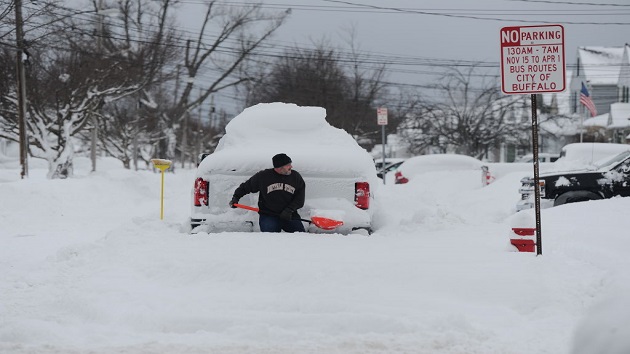
The major winter storm that impacted parts of the U.S. last week devastated Western New York. The Buffalo region, which is no stranger to snow, was walloped with prolonged whiteout conditions and freezing temperatures that contributed to dozens of fatalities.
New York Gov. Kathy Hochul has called the Christmas weekend storm the “blizzard of the century.”
“This will go down in history as the most devastating storm in Buffalo’s long storied history of having battled … many, many major storms,” Hochul, a Buffalo native, said during a Christmas morning news conference.
Heather Kenyon, a meteorologist with the National Weather Service’s Buffalo office, told ABC News it ranks as the “worst snow event I witnessed in this area.”
“We knew that this was going to be a significant high-impact storm,” Kenyon said. “We saw the combination of lake-effect snow and very strong winds, and so we were expecting blizzard conditions and really messaged that this was going to be a once-in-a-generation-type storm.”
The winter storm saw rain followed by plummeting temperatures, heavy lake-effect snow and high winds — dangerous conditions that developed very quickly on Dec. 23 across Western New York.
“It was a very strong cold front plowing through the area — temperatures plummeting, snow starting, winds gusting,” Kenyon said. “That quick onset I think caught a lot of people off-guard.”
Here’s a closer look at the blizzard by the numbers:
Minus 30-degree wind chills
The strong low-pressure area that moved across the country last week brought extremely cold air to the Buffalo region. Temperatures started plunging on Dec. 23, when sub-zero and single-temperatures combined with high winds for “dangerous wind chills,” the National Weather Service said. Wind chills — what the temperature outside feels like — were between minus 10 and minus 30 degrees for several days.
In those conditions, exposed skin can be affected in minutes, with frostbite and hypothermia as serious concerns, officials warned during the storm.
51.9 inches of snow
As the cold air moved over the warmer waters of the Great Lakes, it caused lake-effect snow.
Over 4 feet of snow accumulated in parts of Erie County over the course of five days ending Dec. 27. The highest total snowfall was reported at the Buffalo Airport, with 51.9 inches.
The lake band is still raging, but it’s now south of the airport. Here’s a view of our office with some rather impressive snow mounds in the foreground. Many (many) cars are still buried throughout the area. pic.twitter.com/owto22GbF6
Record daily snowfall was recorded on Dec. 23 in Buffalo, with 22.3 inches.
Buffalo is significantly outpacing its typical seasonal snowfall. It has recorded over 100 inches so far this season, nearly 70 inches more than the normal amount for this time of year and several inches more than what it averages the entire season.
Nearly 80 mph winds
Meteorologists were expecting wind gusts up to 70 mph during the blizzard, “which were reached,” Kenyon said.
A 79 mph wind gust was recorded in Lackawanna and 72 mph at the Buffalo airport on Dec. 23, according to the National Weather Service.
“This storm was so significant because it brought those strong winds, which we don’t often see with the lake-effect snow,” Kenyon said. “Those strong winds just produced impossible travel and drifting snow where we’re getting this drift where people can’t even open their front door.”
Though the region is prone to lake-effect snow, blizzard warnings are not often issued, Kenyon said. Other areas in the Great Lakes region got lake-effect snow with the storm system, but not the high winds, she said.
The combination of lake-effect snow and high winds was “why it was so bad for us,” Kenyon said.
Zero visibility
The high winds during the snowstorm often made for zero visibility in the lake-effect band, making travel impossible in the Buffalo metro area as many were gearing up for the holiday weekend or trying to head home from work. A travel advisory was soon upgraded to a ban on traveling the morning of Dec. 23.
Cars got stranded as roadways became impassable. The storm marked the first time in history that the Buffalo Fire Department couldn’t respond to any calls, officials said.
At least 39 fatalities
At least 39 people have died due to the storm in Erie County, which includes the city of Buffalo, officials said, making it the deadliest in the region since the blizzard of 1977.
Many people died after getting stranded outside or in their cars, while others were found dead in their homes amid frigid conditions, officials said.
Nearly half of those who died — 17 — were found outside, 11 were in a house and four in a car. Others died due to snow-clearing cardiac events, while three were the result of a delayed EMS response, officials said.
(EUDORA, Ark.) — Officials in the city of Eudora, Arkansas, said they are enforcing a mandatory emergency curfew after struggling to stop what the city’s mayor described as a “rampage of shootings.”
The city of fewer than 3,000 residents has recently experienced more than 10 shootings, according to Mayor Tomeka Butler, including one which killed a local resident on Dec. 24. Facing increased crime, few actionable leads, and limited police resources, Butler announced the “civil emergency curfew” on Dec. 27.
The curfew applies from 8 p.m. until 6 a.m. with exceptions for both employment and medical emergencies, officials said.
In a statement to ABC News, Butler said that the frequency of these shootings are unprecedented, adding “this is the first time these acts of this magnitude have taken place.”
“Should you be caught during curfew hours, you will be subject to being stopped and searched,” Butler said in a video posted to Facebook, in which four law enforcement officers stood behind her.
In the video and on other posts, Butler pleaded for community members to work together to stop the violence.
“Please help us bring these senseless acts of crime to a stop,” she said.
A Community Responds
Members of the community, local leaders, and law enforcement officials gathered for an meeting on Wednesday evening in a local church. They voted to extend the curfew until Jan. 3 and asked community members for their help in stopping the violence.
“We’re pleading for your help, we really need your help,” Butler said. “And the only way that is going to change is if we pull together and change our city.”
With dozens of community members sitting in wooden church pews, aldermen sitting behind a drum set and leadership addressing the anxious community from a lectern, the meeting was both a venue for public announcements and a community venting session.
“This is not people’s houses getting shot in anymore, we have people actually dead on the street,” one unidentified community member pleaded. “We need some extra help”
Others said they were worried about the severity of the problem compared to resources available in Eudora.
“It’s too big for you guys,” a community member told local officials.
The Arkansas State Police is investigating the Dec. 24 shooting that killed one resident and injured another but are not involved with any curfew enforcement, according to Arkansas State Police public information officer Bill Sadler. At the moment, no arrests have been made for the homicide and the investigation is ongoing.
Officials from the Eudora Police Department said their department faced some limitations, including limited staff, a budget best described as “pretty much peanuts,” outdated safety equipment and broken vehicles. As an illustration of those issues, Eudora Chief of Police Mike Pitts pointed to the bullet-proof vest he was wearing and said it was not even his own.
A sergeant with the police department also noted that officials have been unable to act on tips because members of the community fear coming forward with information.
“Prosecutors would turn me around the door if they don’t have anything supporting evidence to back up what I’m presenting to them,” he said. “That’s the problem that I’m having right now in putting these cases together. The community is afraid to come forward and say what’s going on out here in the streets who’s really involved with the shootings that’s going on.”
Despite these limitations and concerns, Pitts stood by the curfew.
“I know it’s an inconvenience for some, but it’s a comfort for others,” he said, noting that a family member of a victim told him that they could finally get sleep after learning about the curfew.
“This action was by no means taken to violate any constitutional rights of any citizen, any business owner, any religious believer, or anyone traveling through the city of Eudora,” Butler said.
Freedom from fear
In a country where gun violence stories have become common, the issues facing Eudora might seem minor, officials said. But in a small city like Eudora, an uptick in crime has been destabilizing.
“I know that in bigger cities, larger cities, that sounds like peanuts, but here in a small community of 2,500 people, that’s too many,” Pitts said. “That’s too many in any city, but that’s unfathomable.”
The “Catfish Capital of Arkansas,” Eudora stretches across a few square miles across a largely rural Arkansas. Its population, over 80 percent African American, shares a grocery store, dollar store and liquor store. With little crime overall, residents at the town hall could easily recall unsolved crime, like a drive-by shooting from three years ago.
The recent uptick in shootings appears to have driven community members and leadership into action to fight back against what the mayor described as a “few senseless citizens” and the police chief described plainly as “murderers.”
“This is home, and if you can’t feel safe at home, then what are you doing?” Butler asked during the town hall.
Law enforcement told community members that they will not rest until the crime stops.
“Until we get justice for that, until we get justice for the people whose homes have been violated by people shooting into them, then we are not going to rest,” Pitts said.
He added, “This is not how Eudora is supposed to be, this is now how it was when I was a kid in the area growing up, and it is not going to remain this way.”