The Talking Heads performed their final concert ever, at the Sweetwaters South Festival in Christchurch, New Zealand.
The 12-song set featured such classic songs as “Psycho Killer,” “Making Flippy Floppy,” “Swamp,” “Burning Down the House,” and more.
The show didn’t go off without a hitch, though, with drummer Chris Frantz revealing that frontman David Byrne walked off the stage mid-set and had to be dragged back.
Although the Talking Heads never toured again, they did go on to record three more albums. And while this was their final concert ever, they did briefly reunite to perform together for their induction into the Rock and Roll Hall of Fame in 2002, delivering “Psycho Killer,” “Life During Wartime,” and “Burning Down the House,” along with an all-star jam of “Take Me to the River.”
Taylor Swift wasn’t exaggerating when she sang “I can still make the whole place shimmer” in “Bejeweled”: she wore a whopping $3 million worth of jewels to the 2023 Grammy Awards.
Variety reports Taylor accessorized her deliberately midnight blue Roberto Cavalli dress — a nod to her new album Midnights – with a bunch of sparklers from jewelry designer Lorraine Schwartz.
Lots of eyes were on her earrings for pretty obvious reasons — the giant, diamond-shaped accessories were adorned in 136 carats of diamonds, paraibas and purple sapphires. Taylor’s sapphire and diamond rings complimented the chunky earrings.
Unfortunately for fans who might want to replicate Taylor’s Grammys look, the jewelry was seemingly custom made for the singer since the pieces cannot be found on the Lorraine Schwartz online store.
That wasn’t the only glimmering thing Taylor took home from the Grammys. Her “All Too Well: The Short Film” took home the golden gramophone for Best Music Video. Taylor, who directed the music video, is the first and only artist to win the award as the sole director.
(NEW YORK) — One sibling rivalry will be on full display at Super Bowl 57.
The Kansas City Chiefs’ Travis Kelce will face off against his older brother Jason Kelce of the Philadelphia Eagles, making NFL history as the first brothers to face off in a Super Bowl.
Ahead of the big game on Sunday, the pair sat down to record an episode of their joint podcast, “New Heights,” with their parents Ed and Donna Kelce as guests, who have had a front row seat to the matchup for decades.
“Who are you talking to first after the game? The winner or the loser?” Travis Kelce asked his dad.
“Probably the loser,” he answered.
When asked for the reason why, Ed Kelce said, “Somebody’s gonna feel pretty crummy and I wanna be with him — initially.”
“I will be on the field for you, Travis. Jason will have his family on the field. So, no, I won’t be on the field for Jason,” his mom said.
The parents are making NFL history with both sons on the gridiron for the championship game as a petition has been circulating for Donna to do the coin flip before kickoff.
“There are so many legends and people that have that have their blood, sweat and tears on their field and for a mom that’s never played football — I don’t think that’s the right place for her to be,” she said.
“I think you’re discounting moms right here,” Jason Kelce said.
“I don’t know if I would be a distraction. Would I be a distraction out there for you for you guys?” she asked.
Jason said, simply, “No.”
Internally, she will be beaming with maternal pride on Sunday, saying she rooted for this moment.
“Absolutely. I want both of you guys to get into the Super Bowl,” she said.
“Basically what it is, is I really wanted just pure joy. The first two Super Bowls, the ones that you [both] were in. It was like tense. We wanted you to win so badly. It meant so much to get that one under your belt,” Donna Kelce said of Jason Kelce’s 2017 win with the Eagles and Travis’ 2020 win with the Chiefs.
“This one is just going to be pure joy, pure fun,” she said. “How can it get any better than this? It’s going to be — the best day ever. Except for when … both you guys were born, it can’t get any better.”
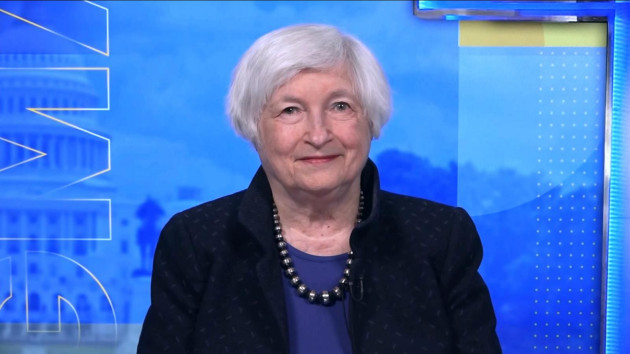
(NEW YORK) — Treasury Secretary Janet Yellen rejected recession fears in an interview with ABC News’ Good Morning America on Monday, saying the economy remains “strong and resilient.”
A blockbuster jobs report last week showed that the economy added 517,000 jobs in January, dropping the unemployment rate to a near-historic low.
“You don’t have a recession when you have 500,000 jobs and the lowest unemployment rate in more than 50 years,” Yellen said.
The remarks from Yellen came a day before President Joe Biden makes his State of the Union Address, when he will likely comment on the nation’s economic outlook amid ongoing inflation.
Four in 10 Americans say they’re worse off financially since Biden became president, according to an ABC News/Washington Post poll released on Sunday. The figure marks the highest share of discontented respondents since the outlets began conducting the poll 37 years ago.
When asked by ABC News’ George Stephanopoulos about persistent economic concern despite a strong jobs market, Yellen said, “The country has been through a lot.”
“With the COVID pandemic and all the stress that placed on the economy, and then Russia’s war in Ukraine that boosted food and energy prices, Americans are concerned about inflation and it’s been President Biden’s top priority to bring it down,” she added.
Consumer prices rose 6.5% over the yearlong period ending in December, which amounts to a significant slowdown from a summer peak but remains more than triple the Federal Reserve’s target of 2%.
Price hikes for some items stand well above the overall inflation rate. The price of eggs has risen 60% over the past year while the cost of flour has risen 23%, government data showed.
The Fed last week imposed the latest in an aggressive string of borrowing cost increases as it tries to slash price hikes by slowing the economy and choking off demand. The approach, however, risks tipping the U.S. economy into a recession.
Legislation enacted during the Biden administration, such as the $369 billion Inflation Reduction Act, has helped the central bank’s effort to slow price increases, Yellen said.
“While the Fed has primary responsibility here, legislation that has been passed in some cases on a bipartisan basis is strengthening our economy and lowering costs for Americans,” she said.
The Inflation Reduction Act will reduce the federal deficit by $238 billion over roughly the next decade, according to the nonpartisan Congressional Budget Office.
Speaking with GMA, Yellen also weighed in on a possible dispute in Congress over raising the nation’s debt limit before it is set to exceed the threshold this summer.
Each year, the U.S. enacts a law that increases the amount of money that the federal government can borrow for past expenditures, ensuring that the nation continues paying creditors what it owes. Failure to reach an agreement would all but ensure a recession, experts previously told ABC News.
Some Republicans in the House have resisted an increase of the debt limit unless Democrats agree to spending cuts. The Biden administration, however, has repeatedly said that it will not negotiate over the debt ceiling.
“America has paid all of its bills on time since 1789, and not to do so would produce an economic and financial catastrophe,” Yellen said. “Every responsible member of Congress must agree to raise the debt ceiling.”
She added, “It’s something that simply can’t be negotiable.”
Mick Fleetwood has some sad news for Fleetwood Mac fans. On the red carpet at Sunday’s Grammy Awards, Mick revealed that Fleetwood Mac is “done” following Christine McVie’s death
“I would say the band is done,” he told Access. “The thought of doing things without her right now seems to be very farfetched,” he went on, though he allowed “After a while of healing, who knows what may or may not happen but I would suspect that Fleetwood Mac is put to bed.”
Fleetwood was at the Grammys to take part in a tribute to McVie, with him, Sheryl Crow and Bonnie Raitt performing McVie’s classic “Songbird.”
Asked how McVie would feel about the tribute, Mick told Access, “I think she would be, ‘they’re making that much fuss over me,’” noting, “she was a North Country girl from England and very not glitzy at all so I think she would say ‘oh my god, why are they doing that?’”
He added, “But we are, and you’re going to have to put up with it, Chris.”
The Banshees of Inisherinand Tár were the big winners at the London Critics’ Circle Film Awards, reports Collider. Tár won three awards at the Sunday ceremony, including top prize Film of the Year and Director of the Year for Todd Field, while Cate Blanchett won Actress of the Year. Banshees took home five awards, including Actor of the Year for Colin Farrell, Best Supporting Actor for Barry Keoghan, Best Supporting Actress for Kerry Condon, Screenwriter of the Year for Martin McDonagh and The Attenborough Award for British/Irish Film of the Year…
NSYNC singer Lance Bassannounced that he and husband Michael Turchin will voice a married pair on the animated Nickelodeon show Bossy Bear. They will play dads Tyler and Greg, an anthropomorphic owl and red squirrel. “We’ve come a loooooong way from my Saturday morning cartoons. Thank you to Nickelodeon for allowing this type of representation on television. Small for some but HUGE for our community,” Bass wrote. The episode will air March 6…
Murphy Brown star Charles Kimbrough, who played co-anchor Jim Dial on the sitcom, has died. The Tony and Emmy-nominated actor was 86. Deadline reports no cause of death was provided but that he died on January 11 in Culver City, California. The late actor is also known for voicing the gargoyle Victor in the 1996 animated Disney movie The Hunchback of Notre Dame and its 2002 sequel. He also starred as Harry in the original production of Stephen Sondheim‘s Company as well as appearing in Sondheim’s Sunday in the Park with George…
Although Avatar: The Way of Water was dethroned in this week’s weekend box office, but it is now officially the third-biggest IMAX movie in history. Collider reports the film has amassed $247 million from global IMAX screens and $85.7 million when looking at just its domestic totals. In China, it’s the country’s second-highest-grossing IMAX film with a total of $52 million earned…
Star Wars actor Mark Hamill is selling signed posters to support Ukraine. He told Politico he signed “a limited amount” of Star Wars posters that would entice “real hardcore collectors — especially those that have disposable income.” Hamill added he hasn’t signed posters since 2017 for Star Wars: The Last Jedi. He said funds raised will support the fundraising platform United24, which will assist Ukraine in replenishing its drone supply. In September, Hamill was announced an ambassador for United24’s “Army of Drones” project. A date for when the posters go on sale was not revealed. February 24 will mark a full year since Russia invaded Ukraine…
Pandora has fallen and M. Night Shyamalan’s Knock at the Cabin has risen to the #1 spot in the weekend box office.
The horror-thriller earned $14.2 million in its opening week and bested Avatar: The Way of Water, which previously held the top spot for seven weeks. However, Knock at the Cabin‘s number is also the lowest debut of Shyamalan’s career. Previously, Old had held the record after making $16.8 on its opening weekend.
Knockat the Cabin wasn’t the only movie that eclipsed Avatar in the weekend box office. Paramount’s 80 for Brady — which features Rita Moreno, Jane Fonda, Sally Field and Lily Tomlin — claimed second place after collecting $12.5 million across 2,912 theaters in North America.
Avatar slipped to third place this week, earning an additional $10.8 million in its eighth week of release, pushing its North American box office total to $636 million. Globally, the movie has amassed a $2.174 billion fortune and is currently the fourth highest-grossing movie in the world.
Puss in Boots: The Last Wish finished in fourth place this week after collecting an additional $7.9 million in its seventh week of release, while BTS: Yet to Come in Cinemas rounded out the top five. The BTS concert film covers the band’s October concert in Busan, South Korea.
Chimére Smith, 40, from Baltimore, Maryland, during a function at the school where she was a teacher in Feb. 2020, before she contracted COVID-19. – Courtesy of Chimére Smith
(NEW YORK) — Throughout the pandemic, Black Americans have made up a disproportionate share of cases, hospitalizations and deaths compared to any other racial or ethnic group.
Now, doctors and advocates are warning the Black community is facing another barrier: access to long COVID care.
Long COVID occurs when patients who were infected with the COVID-19 virus have lingering symptoms for more than four weeks after recovering. In some cases, these symptoms can persist for months or even years.
It’s unclear what causes people to develop the condition, but research is ongoing.
According to data from the U.S. Census Bureau Household Pulse Survey, with the latest update conducted between Jan. 4 and Jan. 16, 28.7% of Black respondents said they currently have or have had long COVID.
By comparison, 27.6% of white adults reporting having or having had long COVID. Hispanic adults were the only racial/ethnic group with a higher percentage reporting long COVID at 31.7%.
However, when it came to adults currently with long COVID who are suffering from significant limitations, Black patients had the highest share of people reporting, the survey shows.
Data shows 34.6% of Black Americans with long COVID report severe limitations on their ability to perform day-to-day activities. Hispanics had the second highest rates of severe physical limitations at 32% and those who reported being multiple races or another race were 30.5%.
‘Nobody wanted to listen to me’
One of those people is Chimére Smith, a 40-year-old former middle school English teacher from Baltimore, Maryland.
Smith said she contracted COVID in late March 2020. Her symptoms started off with a scratchy throat and soon progressed to a myriad of symptoms including extreme fatigue, a persistent cough, fogginess, headaches, nausea, diarrhea and spinal pain.
“I remember trying to do some type of social media dance with my partner and after like two minutes, I had to sit down because the world was spinning,” she told ABC News. “And so, within those first few days, as I said to my partner, ‘I think I have COVID.'”
Smith said she went to two hospitals in the Baltimore area, both of which were familiar with her medical history, but doctors refused to test her for COVID-19.
“They told me that my symptoms were not profound enough to test,” she said. “They told me that they didn’t have enough tests. They told me that I was fine and that I was just being anxious because we were out of school for the unforeseeable future. I got a lot of doctors telling me I was anxious, and that I was okay.”
However, Smith’s symptoms continued for several weeks and even months, to the point where she lost vision in her left eye and was left unable to work or drive.
Smith said she paid more than a dozen visits to doctors and hospitals asking for help, but she said she was discharged after every visit with no treatment plan in place.
Smith said she had never been dismissed by a doctor before and felt discouraged.
“I felt extremely frustrated,” she said. “I was incredibly sad and depressed about that. I felt very despondent. I had several white male doctors sit at my bedside and ask me, ‘Are you sure there’s nothing personal going on in your life? Are you sure? Is it a relationship issue? Was it a job issue?'”
She continued, “But nobody wanted to listen to me. And so, it was infuriating. I felt powerless. The way that some of those doctors talk to me, I can tell they were talking to me that way because I was a Black female patient, who they assumed did not know anything about what was happening to her body.”
In April 2021, Smith testified before the U.S. House Energy and Commerce Subcommittee on Health on the lingering effects of COVID-19.
Implicit bias in the medical field
There is a history of distrust when it comes to the Black community and the health care system due to beliefs among patients that doctors won’t treat them as well as their white counterparts. A 2012 meta-analysis found Black patients were 22% less likely than white patients to receive any pain medication.
There is also a fear of being used as guinea pigs in clinical research or other studies as what occurred during the Tuskegee experiments from 1932 to 1971.
Black men were injected with syphilis to track progression of the sexually transmitted in infection, but the study was conducted without informed consent and patients never received treatment for the disease.
What’s more, eugenics movements in the 20th century saw many women across communities or of color forcibly sterilized.
Dr. Panagis Galiatsatos, an assistant professor and physician in pulmonary and critical care medicine at the Johns Hopkins University School of Medicine, told ABC News there is unconscious and implicit bias in the medical field that may lead to doctors dismissing Black patients compared to white patients.
“I can tell you, for a lot of affluent patients coming to our clinic or white patients, what got them to this clinic is that their doctor took their symptoms seriously and got him to our clinic,” Galiatsatos, a member of the Johns Hopkins Post-Acute COVID-19 Team, said. “Counter that with disadvantaged patients from a socioeconomic standpoint or Black/African-American patients, it took them several doctors to listen to what they’re experiencing before someone took them seriously.”
During the period when she thought no one was listening to her, Smith said she felt like she was going to die before anyone figured out what was wrong.
It wasn’t until a year and two months after Smith’s symptoms first began that she visited a doctor who told her she believed that Smith was suffering from long COVID.
“I had a doctor’s appointment on May 20, which was my 39th birthday, and on that day was when a physician, a Black woman said to me, for the very first time, ‘I believe you,'” she said. “And when she said that I cried like a baby. Because I could not believe somebody was actually telling me, ‘I believe you. Everything that you’re saying to me, convinces me that you had COVID.'”
Trouble accessing care
It’s not just a matter of getting doctors to believe Black patients. There’s also trouble accessing care among the Black community.
“So, with my own eyes, my colleagues and I have seen it in our own clinic, where those that are so economically disadvantaged, those of minority race, their persistence of symptoms by the time they get to our clinic have been going on for a little over a year,” Galiatsatos said. “When we counter that versus populations of higher socioeconomic status or the white race, for instance, those individuals usually catch us well within three to six months.”
There are several factors at play. Black Americans traditionally have less access to insurance – let alone quality insurance — allowing them allowing them to see a doctor at a post COVID clinic.
“So many of our patients that we’ve taken on have had to go through several insurance authorizations just to get a referral to come to us, and that’s what they will say is part of their delay,” Galiatsatos said.
Additionally, despite several clinics opening up across the country, Black patients are more likely to rely on public transportation, meaning less access to clinics. Galiatsatos said fewer than 10% of the patients he sees at the post-COVID clinic are Black.
Black households are also less likely to have internet. According to the Joint Center for Political and Economic Studies, 34% of Black adults in the U.S. do not have home broadband, meaning they may not have information about long COVID or know where to go to receive care.
What’s more, a 2022 study found Black Americans make up about 15% of the U.S. workforce, but are much more likely than white Americans to hold frontline or essential jobs, accounting for 30% of bus drivers and 20% of food service workers, for example.
“A day missed of work is a day missed of income,” Galiatsatos said. “If those patients have long COVID, they’re going to decide between a paycheck and their health every day and that’s not fair to them.”
To close the racial gap in long COVID care, Galiatsatos recommends more regular implicit bias training among doctors and more telemedicine so patients can access specialized clinics.
Smith, the long COVID patient, said school buildings, historically black colleges and universities, churches and other community organizations can be used to educate Black communities on the effects of COVID and long COVID.
While Smith is able to cook and drive again, she still is unable to work and experiences several symptoms including brain fog, short-term memory loss, joint pain, gastrointestinal inflammation and headaches.
She hopes her story will help educate others and convince them to be their own advocate if they get pushback from physicians.
“This has been my reality for three years,” she said. “I would rather be in a classroom with 40 kids, talking about how to write a great essay, than sitting here talking to you. Three years later, and I still get no comfort. I love telling my story to inspire other Black people and Black families, but I don’t get any joy.”
(WASHINGTON) — Americans expressed scant confidence in President Joe Biden and his party heading into the 2023 State of the Union address. Yet wide majorities also lack faith in their Republican counterparts, and a new ABC News/Washington Post poll finds the GOP at risk on two fronts, the debt ceiling debate and its inquiry into alleged federal bias against conservatives.
Biden faces deep challenges of his own, including record economic discontent and weak job approval. Few give him credit for a range of accomplishments he may try to claim in tomorrow’s address, from infrastructure to prescription drug prices.
The public takes Biden’s side in the debt ceiling debate, with broad support for handling debt payments and federal spending as separate issues, along with extensive worry about the impacts of a default. The GOP leadership also faces skepticism about its probe of anti-conservative bias in federal agencies; most see this as an attempt to score political points, not a legitimate inquiry.
Among other issues, while Biden is calling on Congress to renew the long-expired ban on assault weapons, the public now is divided on the question: Forty-seven percent support such a ban, 51% oppose it. That reflects a 9-point drop in support since 2019, surprising given recent gun violence but confirming other data.
Internationally, the survey, produced for ABC by Langer Research Associates, finds a substantial rise in the sense that the United States is doing “too much” to assist Ukraine in its war with Russia – 33% say so, up from 14% last spring. Still, that leaves about six in 10 saying the United States is doing the right amount (40%) or too little (19%, down from 37% as weapons shipments have soared).
Advertisement
The shift toward saying the U.S. is doing too much peaks among Republicans and conservatives, up 32 and 30 percentage points, respectively. Those compare with non-significant changes of +5 points among Democrats and +6 points among liberals.
There’s also the issue of confidence in the country’s leadership. As detailed below, it’s sorely lacking, with 68 to 72% of Americans expressing little or no confidence in Biden, newly elected Republican House Speaker Kevin McCarthy and both their parties in Congress.
Debt debate
Biden has a wide advantage on one urgent and contentious issue, the debt ceiling. Just 26% of Americans adopt McCarthy’s position that Congress should allow the government to pay its debts only if the administration agrees to cut federal spending. A broad 65% instead align with Biden’s view that the issues of debt payment and federal spending should be handled separately.
Even among Republicans, fewer than half – 48% – support coupling debt payment with cuts in federal spending. That drops to 22% among independents and 10% of Democrats.
Underlying these results is broad worry about the consequences of default: A vast 82% are very or somewhat worried that a government default would damage the economy. That includes a majority, 53%, at the top end of the scale, “very” concerned.
Notably, this concern is bipartisan – about eight in 10 adults across the political spectrum are concerned about the economic impacts of a default, and being very concerned peaks among Republicans, at 59%.
That said, about two-thirds of Americans favor separate discussion of the debt limit and federal spending regardless of whether they’re more or less worried about the impacts of nonpayment.
Confidence
Most broadly, the survey shows a now-common result: A public with deep economic dissatisfaction, sharp polarization and little faith in leaders on either side of the aisle. These attitudes are informed by the fact that, as reported Sunday, 41% say they’ve gotten worse off since the president took office, a high in polling back 37 years.
The public by an extensive 68-31% expresses just some or no confidence in Biden to make the right decisions for the country’s future. It’s a similar 70-28% for the Democrats in Congress. But it’s even worse for McCarthy – a vast 71-19% lack confidence in his leadership. And it’s 72-25% for his party.
Weaponization
In addition to the debt ceiling debate, the GOP faces headwinds in its inquiry into alleged anti-conservative bias in federal agencies by the newly created House Judiciary Select Subcommittee on the Weaponization of the Federal Government. Americans by a 20-point margin, 56-36%, see the probe as “an attempt to score political points” rather than a legitimate investigation.
Indeed, while views are highly partisan, even among Republicans, 34% see the weaponization inquiry as an attempt to score political points, and a tepid 57% think it’s a legitimate investigation. Results among conservatives are almost identical.
Part of the GOP’s problem is widespread doubt about its premise. Relatively few Americans, 28%, think federal agencies in fact are biased against conservatives. Eleven percent think they’re biased against liberals; an additional 11% volunteer that they’re biased against both. A plurality, 42%, think federal agencies are not biased against either group.
Among conservatives themselves, 55% think federal agencies are biased against them. That’s 47% among people who define themselves as somewhat conservative, rising to 66% of those who say they’re very conservative (15% of all adults).
Assault weapons
While Biden has undertaken a new push to ban assault weapons, public views on the issue are now closely divided: Forty-seven percent support a ban, 51% oppose it. That reflects a 9-point drop in support for an assault weapons ban, and a 10-point rise in opposition, since last measured in an ABC/Post poll in September 2019. (Results were roughly similar, 49-45%, in a Quinnipiac University poll last July.)
Support for an assault weapons ban was this low just once before, a 45-53% result in December 2015; that poll, and this one, are the only two in which more than 50% have opposed a ban. In most other polls since 1995, majorities have supported an assault weapons ban, peaking at 79% in May 1999. It was 62% as recently as April 2018.
The decline in support for an assault weapons ban since 2019 is broadly based across groups. It would take a study focused in more detail on the issue to assess its reasons, but other studies provide clues. In a Pew Research Center poll last year, the public divided on whether or not making it harder to get guns would reduce mass shootings. And in a Pew study only among parents of children under 18, fewer than half, 45%, thought an assault weapons ban would be extremely or very effective at preventing shootings in schools specifically.
Accomplishments
Presidents typically tout their accomplishments in a State of the Union address. It can be a tough sell: Just 36% of Americans think Biden has accomplished a great deal or good amount as president; 62% say he’s accomplished not very much or nothing. In an ABC/Post poll in January 2018, Trump was in a similar boat.
Nor does Biden get much credit for a disparate list of items he might raise in tomorrow’s address. Unemployment has dropped from 6.3% when Biden took office to 3.4% now (a low since 1969) and the economy added a robust 517,000 jobs last month – yet the public by 60-34% says he has not made progress “creating more good jobs in your community.”
Other efforts largely have yet to hit the ground, making it difficult for Biden to claim credit. Despite the huge infrastructure bill he signed into law in November 2021, the public by 60-32% says Biden has not made progress “improving roads and bridges in your community” – perhaps because much of the actual work is yet to be done.
Similarly, legislation Biden signed in August includes a tax credit up to $7,500 for buying an electric vehicle. But it took effect just this year; so far, the public by 56-26% says Biden has not made progress “making electric vehicles more affordable.” (A substantial 18% are undecided.)
Lastly, despite measures to lower prescription drug prices for people on Medicare, the public by a closer 47-30% says Biden has not made progress “lowering prescription drug costs,” with 23% unsure. Again, some of the bill’s provisions take effect this year; others are years off.
This ABC News/Washington Post poll was conducted by landline and cellular telephone Jan. 27-Feb. 1, 2023, in English and Spanish, among a random national sample of 1,003 adults. Results have a margin of sampling error of 3.5 percentage points, including the design effect. Partisan divisions are 26-25-40%, Democrats-Republicans-independents. See the PDF for full results, charts and tables.
The survey was produced for ABC News by Langer Research Associates, with sampling and data collection by Abt Associates of Rockville, Maryland. See details on the survey’s methodology here.