
Amid new report on COVID’s origins, investigation continues into 2 main theories

Amid new report on COVID’s origins, investigation continues into 2 main theories
Robert Nickelsberg/Getty Images

(WASHINGTON) — While no firm conclusion has yet been made among health and government officials as to where COVID-19 came from, the U.S. Energy Department has now reportedly indicated it believes the virus was most likely the result of a lab leak in China — one of two prevailing theories under investigation along with natural human exposure to an infected animal.

The view of the Energy Department, which oversees a network of national labs, some which conduct bioresearch, was reported Sunday by The Wall Street Journal based on a classified intelligence report but has not been confirmed by ABC News.

People who read the report said the assessment was made with “low confidence,” according to the Journal, referring to the lowest of three confidence intervals in the intelligence community.

It’s the latest development in the ongoing work, in the U.S. and internationally, to determine where COVID-19 came from: to both trace back the virus in order to hold any responsible parties to account and to understand its inception in order to prevent the next pandemic.

But with no “smoking gun” and limited access to raw data, discussion of the science has played out in a haze of circumstantial evidence.

At the same time, the virus’ origins have become a contentious wedge issue at home while the Chinese government vehemently denies COVID-19 could have come from one of its labs in Wuhan.

A spokesperson for the Energy Department did not comment Sunday on the Journal’s new article but said in a statement to ABC News that the department “continues to support the thorough, careful, and objective work of our intelligence professionals in investigating the origins of COVID-19, as the President directed.”

A spokesperson for the House Oversight Committee said in their own brief statement that the Office of the Director of National Intelligence had “provided a response to Oversight Committee Chairman James Comer and Select Subcommittee Chairman Brad Wenstrup’s February 13th letter requesting information about the origins of COVID-19 and we are reviewing the classified information provided.”

The White House’s national security adviser, Jake Sullivan, said in an appearance on CNN on Sunday that he could not confirm or deny the Journal report but that “right now there is not a definitive answer” from the intelligence community on where COVID-19 started.

“Some elements of the intelligence community have reached conclusions on one side, some on the other. A number of them have said they just don’t have enough information to be sure,” Sullivan said. “Here’s what I can tell you. President [Joe] Biden has directed, repeatedly, every element of our intelligence community to put effort and resources behind getting to the bottom of this question.”

“If we gain any further insight or information, we will share it with Congress, and we will share it with the American people,” Sullivan said.

The White House declined on Sunday to say if Biden had been briefed on the Energy Department’s view, referring to Sullivan’s comments.

In 2021, the president launched a 90-day push for the U.S. intelligence community to “redouble their efforts” to find a more definitive conclusion regarding the source of the virus.

In a declassified summary of that work, released in August 2021, U.S. intelligence agencies said they remained “divided on the most likely origins of COVID-19” but that the two key hypotheses remain possible: either natural exposure to an infected animal or an accidental lab leak.

Consensus among top officials in the Biden administration has similarly been that the pandemic originated in one of those ways.

Four elements of the U.S. intelligence community said in 2021 that they had “low confidence” COVID-19 was initially spread from an animal to a human, while one element assessed with “moderate confidence” that the first human infection was the result of a “laboratory-associated incident, probably involving experimentation, animal handling, or sampling by the Wuhan Institute of Virology,” and pointing to the “inherently risky nature of work on Coronaviruses.”

The agencies, however, generally agreed that the virus was most likely not developed as a biological weapon and that China’s leaders did not know about the virus before the start of the global pandemic.

This analysis marked something of an evolution from the earliest prevailing view after the pandemic began in early 2020 when, despite some fringe skepticism — often emanating from voices with a long record of criticizing China — the idea that COVID-19 jumped from animal to human somewhere in nature became the overwhelming consensus.

Political voices in favor of the lab-leak theory, particularly from former President Donald Trump, served to polarize the issue further and largely pushed the scientific community away from a willingness to consider that possibility.

The U.S. intelligence agencies said in their 2021 summary that baring new information, a more definitive explanation would not be possible without Beijing’s cooperation.

“Origins tracing is a matter of science,” Chinese Foreign Ministry Spokesperson Zhao Lijian said following the report’s release. “China always supports and will continue to participate in the science-based origins study.”

A joint World Health Organization-led team had presented a range of options in its own March 2021 report, calling a lab leak “extremely unlikely” but offering pathways for further investigation.

Team members voiced frustration with the lack of cooperation from the Chinese government — echoed in international criticism that politics had stymied science.

Since then, the WHO has become increasingly receptive to the possibility that the virus resulted from a lab leak. In July 2021, WHO Director-General Tedros Adhanom Ghebreyesus acknowledged that ruling out a lab leak theory was “premature” and recommended audits of the Wuhan labs in further studies.

China’s subsequent rebuff left the WHO to proceed without them as part of the U.N. agency’s recommended phase two study.

ABC News’ Will Steakin contributed to this report.

Copyright © 2023, ABC Audio. All rights reserved.

‘Gruesome’: Mayor describes boat wreck that killed at least 58 migrants

‘Gruesome’: Mayor describes boat wreck that killed at least 58 migrants
Antonino D’Urso/KONTROLAB/LightRocket via Getty Images

(CUTRO, Italy) — A least 58 migrants were killed and more than 81 were rescued Sunday when the human smuggling boat they were aboard slammed into the rocks off the coast of southern Italy and “disintegrated” just feet from the shoreline, officials said.

Up to 150 migrants reportedly from Iran, Iraq, Afghanistan, Pakistan and Syria — countries ravaged recently by poverty, natural disasters, conflicts and civil unrest — were crammed aboard the 66-foot-long wooden boat when it crashed into a rocky shore of eastern Calabria, which forms the tip of Italy’s boot shape, according to the Italian Coast Guard.

At least 20 migrants were hospitalized, one in need of intensive care, said Manuela Curra, a provincial government official. One survivor was taken into custody for questioning after migrants identified him to authorities as one of the human traffickers, RAI state television reported.

Antonio Ceraso, the mayor of the seaside resort city of Cutro, told Italian news media outlets that children, including a baby, are among the dead.

Bodies, covered in cloth, were being brought to a local sports stadium in the nearby Crotone that has been turned into a temporary morgue.

A priest was on hand to administer last rites over some some of the dead as bodies washed up on the beach.

Ceraso said the boat carrying the migrants hit rough seas and the rickety vessel “disintegrated” when it hit the rocks. He said wreckage is strewn across 1,000 feet of coastline. Describing what he saw at the scene of the crash, he said it was a “gruesome sight that stays with you for the rest of your life.”

The search for survivors is ongoing with coast guard crews combing the choppy waters in boats and with aircraft and local firefighters searching on jet skis.

At the Vatican, Pope Francis prayed for the survivors and the loved ones of those killed during his Sunday address in St. Peter’s Square.

Italian Prime Minister Giorgia Meloni, whose right-wing administration has taken a hard line on migration since her election in October, issued a statement expressing “deep sorrow for the many human lives torn away by human traffickers.”

Mediterranean from North Africa. At least 20,333 migrants have been killed or have gone missing while attempting the crossing, which experts describe as one of the most dangerous in the world since 2014, according to the International Organization for Migration’s Missing Migrants Project.

“It is a huge tragedy which shows the absolute need to act firmly against irregular migration channels,” Italian Interior Minister Matteo Piantedosi said in a statement, adding that Sunday’s tragedy highlights the urgency of cracking down on human smuggling sea crossings.

Copyright © 2023, ABC Audio. All rights reserved.

Death of former American swimming champion probed in Virgin Islands

Death of former American swimming champion probed in Virgin Islands
Todd Warshaw/Getty Images

(ST JOHN, US Virgin Islands)  — The sudden death of former American swimming champion Jamie Cail is under investigation by authorities in the U.S. Virgin Islands, authorities said.

The 42-year-old Cail was found unresponsive in a residence she shared with her boyfriend in St. John, the U.S. Virgin Islands Police Department said in a statement.

“This case is presently under investigation by the Criminal Investigation Bureau,” according to the police statement.

Cail’s boyfriend, whose name was withheld by police, told investigators he left a bar and went back to their residence to check on Cail just after midnight on Tuesday, according to police.

“Upon his arrival, he discovered his girlfriend on the floor,” police said.

The boyfriend and a friend took Cail in a private car to the Myrah Keating-Smith Clinic, where efforts to save her life failed, police said.

Police were notified of the death about 2:39 a.m. Tuesday, authorities said.

No additional information on Cail’s death was disclosed by police, who urged anyone with any information to contact the Criminal Investigation Bureau.

Cail was originally from Claremont, New Hampshire, and was a star swimmer for much of her youth, her family told ABC affiliate station WMUR in Manchester.

She was also a member of the University of Maine’s women’s swim team in the 2000-2001 academic year, according to the school’s alumni association.

As a teenager, Cail was a member of a relay team that won a gold medal at the 1997 Pan Pacific Championships, according to SwimSwam.com, an online swimming news site.

“She was just she was she was a very beautiful person,” a friend told WMUR. “She had a huge heart. She was really loving and kind and well-loved and popular on the island and everybody knows her.”

Copyright © 2023, ABC Audio. All rights reserved.

Marianne Williamson says she’ll run for president again, in long shot challenge to Biden

Marianne Williamson says she’ll run for president again, in long shot challenge to Biden
Jesse Grant/Getty Images for Project Angel Food

(WASHINGTON) — Self-help author Marianne Williamson told donors on Sunday that she will run for president as a Democrat in 2024, mounting what is likely to be a primary challenge to President Joe Biden from his left flank.

Williamson, who also sought the Democratic presidential nomination in 2020 but failed to make any primary, will likely challenge Biden from the left, should he ultimately run for reelection as expected. She is unlikely to get any institutional support, including from powerful progressives in Washington, as the Democratic Party appears to be coalescing around the president.

In the donor email, obtained by ABC News, Williamson suggested she will offer a clashing vision to Biden’s, arguing the country is fundamentally heading in the wrong direction while implicitly responding to concerns over her electability.

Williamson wrote that she will formally launch her bid during a speech this coming Saturday.

“My qualification is not that I’m experienced at running that system, but that I’m best qualified to help transform it. Washington is filled with good political car mechanics, but the problem is that we are on the wrong road,” she wrote.

Copyright © 2023, ABC Audio. All rights reserved.

Pickup truck driver arrested in Arizona crash that killed 2 cyclists, injured 11

Pickup truck driver arrested in Arizona crash that killed 2 cyclists, injured 11
Douglas Sacha/Getty Images

(GOODYEAR, Ariz.) — A pickup truck driver is facing manslaughter and aggravated assault charges after he crashed into a large group of cyclists Saturday in Arizona, killing two and injuring 11 others, police said Sunday.

The Goodyear Police Department said officers were called to the scene of a “very serious crash” shortly before 8 a.m. local time in Goodyear, a suburb west of Phoenix, after a male pickup truck driver collided with a group of adult cyclists on the Cotton Lane Bridge.

A woman died at the scene and a man died at a local hospital following the crash, Goodyear police said. Eleven other cyclists were transported to three different area hospitals with “various injuries,” police said.

The pickup truck driver, identified by police as 26-year-old Pedro Quintana-Lujan, remained at the scene following the crash, police said.

After being questioned, Quintana-Lujan was arrested on multiple charges and booked at the Maricopa County Jail, where he was being held Sunday on $250,000 bond pending a court hearing on Friday, according to online jail records.

Goodyear police said Quintana-Lujan was arrested on two counts of manslaughter, three counts of aggravated assault, 18 counts of endangerment and two counts of causing serious injury or death during a moving violation. Police did not disclose what the moving violation was.

One of the injured cyclists remained in life-threatening condition Sunday, police said.

At least one of the cyclists is from Goodyear and one was visiting from out of state, police said.

Copyright © 2023, ABC Audio. All rights reserved.
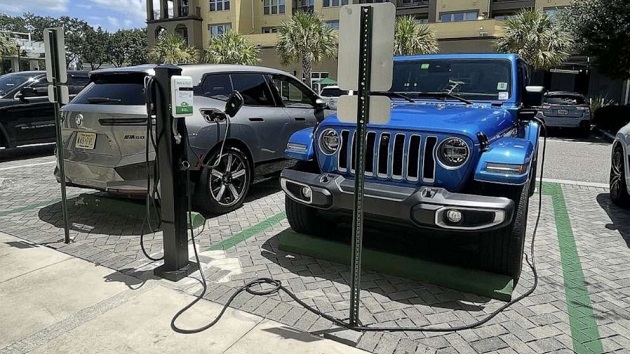
Electric vehicle drivers get candid about charging: ‘Logistical nightmare’

Electric vehicle drivers get candid about charging: ‘Logistical nightmare’
Courtesy of Jared Rosenholtz

(NEW YORK) — YouTube personality Steve Hammes leased a Hyundai Kona Electric sport utility vehicle for his 17-year-old daughter Maddie for three reasons: it was affordable, practical and allowed Maddie to put her cash toward college, not fuel. Now, the upstate New York resident has a dilemma many EV owners can relate to: finding available charging stations far away from home.

“We’re going through the planning process of how easily Maddie can get from Albany to Gettysburg [College] and where she can charge the car,” Hammes told ABC News. “It makes me a little nervous. We want fast chargers that take 30 to 40 minutes — it would not make sense to sit at a Level 2 charger for hours. There isn’t a good software tool that helps EV owners plan their trips.”

Last week the Biden administration said Tesla would open its Supercharger network to non-Tesla owners by the end of 2024. The plan includes 3,500 Tesla fast chargers and 4,000 of its slower, Level 2 chargers — a small number in Tesla’s sprawling network. Setting up an account on Tesla’s app is also required for access.

John Voelcker, an industry expert on EVs and the former editor of Green Car Reports, said this arrangement will allow Tesla to learn a lot about U.S. drivers — “how you charge, where you drive and what car you have.” He does not expect Tesla to commit to additional charging stations.

“Tesla does not want its highly reliable and tightly integrated charging network to be clogged with people whose cars can’t charge as fast as Teslas,” he told ABC News.

President Joe Biden prioritized emissions-free vehicles in the 2021 infrastructure law, vowing to increase the number of green vehicles on America’s highways and local roads. The president’s goals include installing 500,000 new chargers across the U.S. and dramatically boosting EV sales by 2030.

Voelcker said he’s seen little improvement in the nation’s charging infrastructure in the last four years and frequently hears complaints of dead chargers and sticky cables.

“The incentive right now is to get stations in the ground,” he said. “It’s not making sure they actually work.”

Tony Quiroga, editor-in-chief of Car and Driver, has been forced to wander the aisles of a Walmart in Burbank, California, while the EV he’s testing that day sits and charges. He’s become a familiar face at a Mexican restaurant in Mohave, California, where a Tesla charger is located. A coffee shop recently opened nearby that caters specifically to EV drivers.

“I imagine an ecosystem will be built around charging stations eventually,” he told ABC News. “Longer trips bring up flaws with EVs. People are leery of taking them on long trips — that’s why older EVs don’t have 40,000 miles on them.”

Sandwich chain Subway announced Wednesday it was partnering with GenZ EV Solutions to build “Oasis Parks” at select dining locations. EV customers can expect charging canopies with multiple ports, picnic tables, Wi-Fi, restrooms, green space and playgrounds to make the charging experience more “seamless,” Subway said.

Last March Swedish automaker Volvo and Starbucks said they were teaming up to install as many as 60 DC fast chargers at 15 Starbucks stores along a 1,350-mile route that spans from Seattle to Denver.

Quiroga’s sister, who lives in Northern California, takes her internal combustion car — not her Tesla Model S — when she needs to drive across the state. Even Quiroga’s team of reporters has to carefully plan and calculate how far EV charging stations are when they conduct comparison tests among manufacturers.

“These comparisons tests are a logistical nightmare. We plan meals around recharging the vehicles,” he said. “We need to have the battery at 100% or close to it to test a vehicle’s performance. We have to time everything — it requires more work.”

In December, Quiroga was in Florida driving BMW’s luxury i7 all-electric sedan. He watched as its range dropped from 240 miles to 220 as soon as he turned on the heat.

“You use the luxuries … and the range plummets,” he said.

Sharon Bragg of Clifton Park, New York, has to charge her Ford Mustang Mach-E GT more frequently in the winter months. The GT’s EPA rating is 270 miles on a full charge. Bragg said it’s closer to 200 in the colder weather. Last December a Level 2 charging plug got stuck in her Mach-E and would not budge. After multiple failed attempts by bystanders, she called an electrician, who blew hot air on the plug for 20 minutes to release it.

“The whole process took two hours,” she told ABC News. “I was in the parking lot from 5 p.m. to 7 p.m. It was a cold day.”

Bragg said her parents, who also bought a Mach-E, have complained of broken public chargers and endless lines. Sometimes they drive for miles before they can find a public charger that’s working properly, she said. Bragg, a former minivan owner, is still enamored with her electric SUV despite the winter challenges.

“I love the tech and the giant screen [inside] won me over,” she said. “The only time I go to a gas station now is to buy coffee.”

Quiroga of Car and Driver said the “teething pains” EV owners previously experienced have greatly improved.

“Where we are now versus 10 years ago — it’s radically different,” he said. “Range has tripled, even quintupled. Look at the Lucid Air — it gets over 500 miles of range in a single charge.”

Voelcker pointed out that the bulk of charging for EV owners takes place at home, not on the road. The majority of owners use public chargers two or three times a year, he said.

“The more you live with an EV, you don’t have to take every last opportunity to charge it,” he said. “It’s rare that you cover 250 miles in a day.”

Florida resident Jared Rosenholtz, editor at large at CarBuzz, has downloaded at least eight apps on his phone from companies like EVgo, Electrify America, ChargePoint and Shell Recharge so he can “juice up” the EVs he’s tasked with reviewing. The apps clutter his phone — and even worse — require an outstanding balance to use.

“It’s like having an E-ZPass account,” Rosenholtz, an apartment dweller, told ABC News. “If your account balance gets low, the app pulls from your credit card on file and charges another $10.”

He added, “I probably have $8 to $10 in each of these apps, just sitting there.”

Parking spots at EV chargers are sometimes occupied by gas-powered vehicles, Rosenholtz said. Or a charging cord is too short and won’t connect to the vehicle. Then there are times when the charger is dead … or the wait time is more than an hour. The bad experiences are frustrating, he said. The one upside? Meeting fellow EV drivers.

“I can meet a lot of cool people at these stations,” he said. “I always ask them how their EV experience has been. One Polestar owner helped me with a payment issue I had.”

Hammes said EV owners have also come up to him at public charging stations, knocking on the Kona’s window to say hello.

“It’s a social experience … EV owners love to talk about their cars and talk to other EV owners,” he noted. “It’s a new tech and everyone is learning at the same pace and sharing their experiences.”

Hammes, a first-time EV owner, said his experience overall with the Kona Electric has been positive. He installed a 240-volt Level 2 charger in his garage last December and has only praise for the Hyundai Home system. His one gripe? The sales associates at his local Hyundai dealership were unknowledgeable and poorly trained about the intricacies of EV ownership, he explained.

“The dealership experience is so far behind. I get solicitations for oil changes. The staff is so disconnected from the product they’re selling,” he said.

Hammes said he will likely choose another EV when his lease is up next spring — only this time he’s adding more range.

“For me personally the new threshold would be 300 [miles]. That number makes me feel more comfortable,” he said. “That’s what I am aiming for in our next EV.”

Copyright © 2023, ABC Audio. All rights reserved.

Massive winter storm that brought rare snow to parts of California now moving east

Massive winter storm that brought rare snow to parts of California now moving east
ABC News

(NEW YORK) — The massive winter storm that brought rare snowfall to parts of Californias is threatening to do the same on the East Coast as it moves furiously across the country.

Southern California will finally get a reprieve on Sunday from the intense rain and snow. The major storm system is now bringing damaging thunderstorms to the Great Plains.

Western Oklahoma will see the bulk of the severe weather on Sunday but a large swath from northern Texas through southeastern Kansas will experience storms with damaging winds, large hail and scattered tornadoes, forecasts show.

The line of storms will initiate in the Texas Panhandle during the late afternoon on Sunday before continuing with a damaging wind threat through the overnight hours in parts of Missouri.

By Sunday night, the Midwest will also be experiencing pouring rain that changes to a wintry mix by Monday morning, making for a challenging commute for those in the Chicago region.

The storm system is then expected to slingshot eastward after lingering on the West Coast and dumping several inches of rain and snow to some regions.

In the Great Lakes region, snow is expected in Wisconsin, Michigan and the Northeast. Hundreds of thousands of customers in Michigan are already without power. Utility companies DTE Energy and Consumers Energy said power would be restored before the upcoming storm hit.

On Monday evening and into Tuesday, a period of snow and wintry mix will likely bring accumulations to cities along the I-95 corridor.

The snow deficit in cities like New York City, New Haven, Connecticut, Providence, Rhode Island, and Boston will likely chip away with several inches of snow and slush expected from this storm system. Tuesday morning could be a messy commute across the Northeast.

A rare blizzard warning was issued for Southern California, bringing several feet of snow to the San Gabriel and San Bernardino mountains. A dusting of snow even reached the Hollywood Hills and the hills around San Francisco.

At one point over the weekend, snow was falling at rates of 2.5 inches in places like Lake Arrowhead, California. In the mountains outside of Los Angeles, anywhere from 2 to 6 feet of snow have fallen since Wednesday.

On Saturday, more than 126,000 customers were without power in California. More than 2,500 flights were canceled last week in anticipation of the storm.

Another storm system is also moving on shore in Northern California later on Sunday, bringing more gusty winds and incredible amounts of mountain snow.

Winter alerts are in effect on the West Coast from Seattle to Sacramento as the weather moves in.

Others parts of California will see more waves of rain and snow moving onshore on Monday morning.

Copyright © 2023, ABC Audio. All rights reserved.

China hasn’t yet provided weapons to Russia in Ukraine, but doing so would be ‘real mistake’: Sullivan

China hasn’t yet provided weapons to Russia in Ukraine, but doing so would be ‘real mistake’: Sullivan
ABC News

(WASHINGTON) — Following warnings from the Biden administration that China is weighing whether to provide Russia with lethal aid for their war in Ukraine, the White House’s national security adviser said Sunday that “at this point” they have “not seen them take the step of providing weapons” to Moscow.

“We are watching closely,” Jake Sullivan told ABC “This Week” co-anchor Martha Raddatz. “We know they haven’t taken it off the table. And we are sending a clear message, as are our European allies, that this would be a real mistake because those weapons would be used to bombard cities and kill civilians, and China should want no part of that.”

Sullivan said it was difficult to say whether China is “backing on, backing off” of the decision but that “what I can say is so far, we have not seen them do it.”

Chinese officials have defended their relationship with Russia as “built on the basis of non-alliance, non-confrontation and non-targeting of third countries.”

But President Joe Biden told ABC’s David Muir in an interview last week that the U.S. stood ready to respond if Beijing moved forward with sending weapons.

Biden has ruled out giving Ukraine F-16 fighter jets “for now,” despite repeated requests from President Volodymyr Zelenskyy, Sullivan said on “This Week.” He called it a “question for later.”

Sullivan said that the U.S. government’s focus right now is to help Ukrainians “retake territory on the ground” in its southern and eastern territories.

Asked if it’s possible the U.S. provides F-16s in the future, Sullivan reiterated that that the White House has been prioritizing the immediate needs of this war and will continue to do so.

“Every phase of this war, the president has tried to make sure that the Ukrainian military gets what they need. In the first phase, as they were defending Kyiv, that was Javelin anti-tank weapons and Stinger anti-air systems. And that worked. It helped Ukraine defend Kyiv. In the second phase, it was heavy artillery to help them hold against the Russians pushing in eastern Ukraine. In this phase, the critical element is ground maneuver capability. And that means tanks, armored personnel carriers, infantry fighting vehicles,” Sullivan said. “And so what the president is saying is he’s focused on those capabilities.”

Pressed further by Raddatz on the possibility the U.S. could eventually approve fighter jets — a move endorsed not just by Zelenskyy but some leading lawmakers like House Foreign Affairs Committee Chair Michael McCaul — Sullivan told her, “We will cross the bridge of future phases of this war when they come.”

Secretary of State Antony Blinken told Raddatz a week ago, on “This Week,” that one reason Biden is not supplying Ukraine with F-16s is because of the required training and maintenance.

“So why not teach them now? So if they need them, if you want to approve it in the future, they’ll have them ready to go,” Raddatz said to Sullivan.

“From our perspective, the most important thing that we can do is make sure that we maintain focus on what is the highest priority and honestly, Martha, the highest priority right now is to move as rapidly as possible to build up their capacity to de-occupy those portions of Ukraine that are still being occupied brutally and bloodily by Russian forces,” he said. “We expect that that will be the central focus of the Ukrainians as well as of our support for the Ukrainians in the weeks and months ahead.”

In January, Biden approved 31 Abrams tanks to be sent to Ukraine, but last week the Secretary of the Army Christine Wormuth said those vehicles may not even get to the country this year.

“How is that helpful if you don’t approve them in time and get the speed to get things like that over there?” Raddatz asked on “This Week.”

Sullivan defended the decision, saying the release of Abrams tanks was done in coordination with Germany as a precondition so they would send German-made Leopard tanks to the battlefield, which will arrive much more quickly.

He said this was “an example of Joe Biden rallying the global coalition to get Ukraine what it needs.”

“The president said, ‘OK, I’m going to be the leader of the free world, I will send Abrams down the road if you send Leopards now.'”

Separately, following the shoot-down of a suspected Chinese spy balloon over U.S. airspace and three unidentified flying objects over North America, there have been no other instances of the military downing any possible threats.

Raddatz asked if this was because radar has been recalculated once again, but Sullivan said the NORAD Commander “has not recalibrated our radar.”

“We continue to be vigilant for unidentified objects coming into U.S. territory,” he said. “What we did do at President Biden’s direction, Martha, is put in place a set of policy parameters for when we would take lethal action against an object, to shoot it down, as opposed to deal with it in other ways.”

A “leading explanation” for the three additional objects is that they were commercial or civilian balloons, government officials have said.

Copyright © 2023, ABC Audio. All rights reserved.

Some Republicans’ call to pick East Palestine over Ukraine is ‘false choice,’ McCaul says

Some Republicans’ call to pick East Palestine over Ukraine is ‘false choice,’ McCaul says
ABC News

(WASHINGTON) — Rep. Michael McCaul, the chair of the House Foreign Affairs Committee, said Sunday that the debate over whether the U.S. should prioritize domestic issues or support for Ukraine created a “false choice.”

McCaul, R-Texas, appeared on ABC’s “This Week” where he was asked to respond to some fellow Republican critics, like Missouri Sen. Josh Hawley, who said last week that Biden should not have visited Ukraine but instead should have traveled to East Palestine, Ohio, the site of a Feb. 3 derailment of a train that was carrying toxic chemicals.

The train incident compounded the burgeoning push inside the GOP to reevaluate how much aid to give Kyiv.

“I think that’s a false choice. I think the president should’ve gone to Palestine where we have this major chemical spill, but it doesn’t mean we disregard what’s happening in this struggle for the global balance of power that we’re facing right now,” McCaul, who just got back from his own trip to Ukraine shortly after Biden left the country, told “This Week” co-anchor Martha Raddatz.

“We haven’t seen anything like this since my father’s generation in World War II: largest invasion in Europe, the biggest threat to the Pacific since World War II. We can’t put our head in the sand and ignore this. Otherwise, the Russians will be on the Polish border and Chairman Xi will invade Taiwan,” McCaul added, referencing Chinese leader Xi Jinping. “I think we can do both. We’re a great nation.”

Raddatz cited an ABC News/Washington Post poll this month that found half of Republicans now believe the U.S. is sending too much aid to Ukraine. McCaul acknowledged that support was declining, which he argued was because the conflict had dragged on for “too long” and “we’re not giving them the weapons systems they need.”

And despite comments like those from Hawley, “I still think the majority in the Congress support this,” McCaul said of the U.S. backing Ukraine. “They also want to know — they want accountability to the taxpayer. … They want to know that their money is being spent wisely.”

McCaul cited ongoing audits by government watchdogs and an outside firm to ensure that accountability but emphasized the importance of continued support for Ukraine.

“What would Reagan do? I would ask my fellow colleagues, right? What would he do? He brought down the Soviet Union. I think he would stand for freedom and democracy,” McCaul said.

Pushing for F-16s

He also said he hopes Republicans and Democrats both pressure the White House to agree to send long-range missiles and F-16 fighter jets to Ukraine, particularly ahead of an expected offensive directed by Russian President Vladimir Putin.

The jets and other munitions could come at a crucial turning point in the conflict, he said.

“When we give them what they can really use and ask for, they win,” he said of the Ukrainians. “When we slow-walk and slow-pace this thing, it drags it out, and that’s precisely what Putin wants.”

Raddatz asked McCaul if the F-16s would be vulnerable to Russian air defenses, and he said they would. The Biden administration has said that fighter jets and long-range missiles are not what Ukraine needs right now — compared with “ground maneuver capability” to help “de-occupy” the southern and eastern territories, the White House’s national security adviser, Jake Sullivan, said in a separate appearance on “This Week” on Sunday.

McCaul pushed back on that assessment, citing his conversations with top Ukrainian and American military officials.

When pressed by Raddatz on what can be done legislatively to pressure Biden to send the weapons to Ukraine that he seeks, McCaul said, “We can certainly write into our appropriations bills prioritizing weapon systems, and we intend to do that.”

Worries about China

At the same time, the U.S. believes China is considering sending lethal military aid to Russia in support its invasion, including drones, McCaul said.

While Chinese officials have defended their relationship with Russia as non-aggressive, McCaul said Putin and Xi have an “unholy alliance” that includes key economic support in the form of the energy trade.

“The fact that they’re going to meet next week, Chairman Xi and Putin, to discuss this unholy alliance that they have to put weapons into Ukraine to me is very disturbing, because while [it is] maybe Ukraine today, it’s going to be Taiwan tomorrow. That’s why this is so important,” McCaul said.

On another topic, Raddatz asked him about Rep. Marjorie Taylor Greene, R-Ga., calling for a “national divorce” over policy disagreements between the GOP and Democrats.

“I don’t speak for her,” said McCaul, who previously said Greene had matured from earlier controversies as a lawmaker. “And the great thing about this country is we can have political dialogue, discourse. We are a democracy, we have differences of opinions. I will say divisive rhetoric, I think, polarizes this nation and I think it hurts this nation.”

Copyright © 2023, ABC Audio. All rights reserved.

‘Abbott Elementary,’ Angela Bassett and more win big at 54th NAACP Image Awards

‘Abbott Elementary,’ Angela Bassett and more win big at 54th NAACP Image Awards
Leon Bennett/Getty Images for BET

The 54th NAACP Image Awards, hosted by Queen Latifah, aired on BET Saturday night live from the Pasadena Civic Center Auditorium in Pasadena, CA.

The night’s big winners included Abbott Elementary, which picked up multiple awards including Outstanding Comedy Series; Black Panther: Wakanda Forever, which nabbed Outstanding Motion Picture; and Angela Bassett, who took the top honor of Entertainer of the Year as well as Outstanding Actress in a Drama Series for 9-1-1.

Other winners included Will Smith for Emancipation, Viola Davis for The Woman King, P-Valley and more.

Here are the winners in some of the major categories. For a full list, visit NAACPImageAwards.net.

Entertainer of the Year
Angela Bassett

Outstanding Actor in Drama Series
Nicco Annan, P-Valley

Outstanding Actress in Drama Series
Angela Bassett, 9-1-1

Chairman’s Award
Congressman Bennie Thompson

Outstanding Actress in a Comedy Series
Quinta Brunson, Abbott Elementary

Outstanding Actor in a Comedy Series
Cedric The Entertainer, The Neighborhood

Social Justice Impact Award
Attorney Ben Crump

Outstanding Comedy Series
Abbott Elementary

Outstanding Drama Series
P-Valley

President’s Award
Gabrielle Union-Wade and Dwyane Wade

Outstanding Actress in a Motion Picture
Viola Davis, The Woman King

Outstanding Actor in a Motion Picture
Will Smith, Emancipation

Outstanding Motion Picture
Black Panther: Wakanda Forever

Copyright © 2023, ABC Audio. All rights reserved.