(NEW YORK) — About one in five adults say they’ve been threatened with a gun at some point in their life, according to a new survey by the Kaiser Family Foundation.
The report, published Tuesday, looked at 1,271 Americans’ experiences with gun-related violence and incidents across the U.S. between March 14 and March 23 of this year.
About one in five say a family member has been killed by a gun (including death by suicide), and about one in six say they’ve witnessed someone being injured by a gun.
More than half of U.S. adults have been affected by guns in some way, reporting that they or a family member has been injured or killed by a gun, threatened with a gun or used a gun in self-defense.
“When you think about the complexity of this issue it cuts across all sorts of different sectors and disciplines…there’s no one person or one organization that’s going to solve this issue…by definition, this is a complex issue that’s happening in cities and states all across this country affecting millions of Americans” said Dr. Joseph Sakran, a trauma surgeon and associate professor at Johns Hopkins Hospital, who is a public health expert and nationally recognized advocate for gun violence prevention as a survivor of gun violence himself.
The survey highlighted racial disparities with Black adults being about twice as likely as white or Hispanic adults to say they’ve had a family member killed by a gun.
A third of Black and Hispanic adults say they worry “daily” or “almost daily” that someone in their family will become a victim of gun violence.
“Mass shootings are a small portion of the overall public health problem that we face…they are the tip of the iceberg, we have the responsibility to talk about the daily toll of gun violence… the disparities that exist in communities of color, and different demographics that are significantly impacting not just young people, but young brown and Black men, are in many of our cities and states,” Dr. Sakran said.
Many people buy guns for protection, as three in 10 adults (29%) have purchased a gun to protect themselves or their family from the possibility of gun violence. Yet, three in four adults surveyed said at least one of their guns is stored in a manner that doesn’t reflect common gun safety practices — like keeping guns in the same place as ammunition, storing a loaded gun, or keeping it unlocked.
“The best medical treatment is prevention… the work that we do beyond the bedside is just as important… engaging with different stakeholders, communities, policymakers, and so forth…where not just doctors, but nurses and techs and researchers kind of stood up and said, ‘No, we have the rights and both opportunity and the responsibility to be part of the solution. So, the next generation of healthcare leaders in America are starting to realize these non-traditional ways to be impactful,’” said Dr. Sakran.
The report showed that only 5% of adults say a doctor or healthcare provider has ever talked to them about gun safety.
Dr. Sakran added “the role of the healthcare professional, talking to their patients, about concepts and aspects of gun safety, like safe storage as an example… we traditionally have not done that.. we talked about other public health issues like obesity and smoking, and so forth.”
(WASHINGTON) — President Joe Biden will head across the pond on Tuesday for a long-awaited trip to Ireland, his ancestral homeland, that will feature a heavy emphasis on family in addition to diplomacy.
Biden’s visit will be his first to Ireland as president and mark only the second time an Irish-Catholic president has made a visit from the U.S. It also comes nearly 60 years after the first Irish-Catholic president, John F. Kennedy, became the first sitting commander-in-chief to visit Ireland.
The president will depart Washington on Tuesday for Belfast, Northern Ireland — the first stop of his four-day, two-country trip. There, Biden will mark the 25th anniversary of the Good Friday Agreement that brought an end to 30 years of sectarian violence on the island known as “the Troubles.”
“President Biden cares deeply about Northern Ireland and has a long history of supporting peace and prosperity. As a U.S. senator, Joe Biden was an advocate for how the United States can play a constructive role supporting peace,” White House spokesperson John Kirby said Monday, previewing the trip.
Biden’s visit to Northern Ireland will also focus on “the readiness of the United States to support Northern Ireland’s vast economic potential to the benefit of all communities,” according to the White House.
The economic focus of Biden’s visit is particularly notable as Ireland, a member of the European Union, and Northern Ireland, part of the U.K., are still dealing with the fallout from Brexit, when the U.K. left the EU.
Earlier this year, a trade deal called the Windsor Framework was struck to prevent a strict land border from being reinstated on the island and to address some of the outstanding trade concerns remaining from Brexit.
A so-called “hard border” between Ireland and Northern Ireland, some feared, could undermine the 1998 peace agreement and see tensions reignited between mostly Protestant “unionists” and mostly Catholic “nationalists” in Northern Ireland.
Biden previously praised the Windsor deal as “an essential step to ensuring that the hard-earned peace and progress of the Belfast/Good Friday Agreement is preserved and strengthened.”
After lowering the terrorism threat level to “substantial” last year, Northern Ireland has recently raised it back to “severe,” meaning an attack is highly likely, based off an MI5 intelligence assessment. But Kirby on Monday downplayed any concerns about security when asked about Biden’s travel.
“We don’t ever talk about security requirements of protecting the president, but the president is more than comfortable making this trip and he’s very excited to do it,” Kirby said.
Following his time in the U.K., Biden will head to the Republic of Ireland later this week, where he will meet with President Michael D. Higgins and Taoiseach Leo Varadkar as well as address a joint session of the Irish legislature.
“Today, one in 10 Americans claim Irish ancestry and Irish Americans are proudly represented in every facet of American life. Ireland’s a key economic partner of the United States, and the United States and Ireland are working closely together to make the global economy more fair,” Kirby said in his preview of the trip.
He also singled out Ireland’s contributions to Ukraine amid Russia’s invasion.
“The Irish government has been strong supporters of Ukraine, providing vital non-lethal assistance including medical supplies, body armor and support for Ukraine’s electric grid, as well as their agriculture,” he said.
“They have supported EU sanctions on Russia and the people of Ireland have generously welcomed nearly 80,000 Ukrainians, offering refuge to those who were forced to flee their homes in search of safety,” he said.
But perhaps the bigger focus of Biden’s trip will be tracing his connections back to Ireland, mainly through two families on his mother’s side: the Finnegans and Blewitts.
Biden is expected to meet with relatives and visit “places of significance to the Finnegans of County Louth and the Blewitts of County Mayo,” according to a White House official.
In County Louth on Wednesday afternoon, Biden will visit Carlingford Castle; on Friday in County Mayo, he will visit Our Lady of Knock and the North Mayo Heritage and Genealogical Center’s family history research unit. (He returns to Washington on Saturday.)
He is also expected to deliver remarks near St. Murdoch’s Cathedral in County Mayo that “celebrate the deep, historic ties that link our countries and people,” White House press secretary Karine Jean-Pierre said in a statement announcing the trip.
That cathedral has deep ties to Biden’s family — some relatives were baptized there, and his great-great-great grandfather Edward Blewitt sold 27,000 bricks to the cathedral that were used in its construction, which ultimately helped fund the family’s voyage to America.
Even the most casual observers of the president have likely heard him boast of his Irish heritage. In nearly all his remarks, he will often quote members of his Irish family or some of his favorite Irish poems and literature, like Seamus Heaney’s “The Cure at Troy.”
“My colleagues up in the United States Senate used to kid me because I was always quoting Irish poets on the floor. They thought I did it because I was Irish. That’s not the reason. I did it because they’re the best poets in the world,” Biden has joked.
In the past he has spoken about his Irish roots as “part of [his] soul” and “how [he] was raised.”
The focus of his political pitch of “dignity” for all Americans is also based on his heritage.
“[I]t gets back to a word that’s probably overused in my house — as my grandfather would say, ‘Maybe it’s the Irish of it.’ The word ‘dignity.’ The simple dignity,” Biden said in May of his policies focused on trying to improve the middle class.
During his time in Ireland, Biden will “discuss how a fierce pride in being Irish and a value system that says everyone is entitled to be treated with dignity and respect have been passed down to each generation,” the White House official said of the trip.
“He will also discuss how the Irish-American story — of enduring difficult times but marching forward towards a better tomorrow — speaks to our shared past, present and future,” the official added.
(NEW YORK) — Nearly three decades ago at the age of 17, the unexpected happened to Joseph Sakran after a football game. He was shot by a stray bullet.
“I remember seeing the flashes of light and realizing something quickly was wrong because … I was just soaked in blood,” Sakran said in an interview with ABC News.
Since Sakran’s injury, a growing number of kids have been impacted by gun violence. Sakran, who is now a trauma surgeon and gun control advocate, said there isn’t enough gun control legislation at the national level. But a group of researchers from the University of Washington think their community-based prevention program could help reduce the number of kids who die from gun violence. Their work can be implemented by community members — not lawmakers.
Their research suggests that prevention programs focusing on parent training and after-school programs could reduce youth gun carrying by nearly 30% over one year.
Margaret Kuklinski, a co-author of the research paper, said her group mainly focused on prevention programs in rural communities across seven states. About 24 communities reached out to Kuklinski’s group to be included in the study.
The researchers worked with each community to identify ways they could reduce gun violence. Interventions ranged from alcohol and drug misuse classes to mentorship programs for youth. Each community worked with the researchers to pick one to five measures that addressed its residents’ needs. They used data from students to drive their decisions.
Communities invested about $100 per child every year, and data from the group behind the report suggested an expected return of $11 per dollar invested. The classes took place over four years, and were held at schools and in community centers.
Kuklinski said the program is effective because it keeps kids involved in the community and away from guns.
“This is an approach that goes upstream,” Kuklinski said in an interview with ABC News. “It says that if we can strengthen the conditions in which young people are developing … we can see a range of positive effects.”
The authors of the study followed over 4,000 fifth graders for about eight years. Kuklinski said her team plans to implement a similar prevention program in urban communities.
Sakran said the study results are promising because they were maintained over the long term. He said the group’s approach to gun violence prevention works. Kuklinski added that community work is only one piece of the puzzle to solving gun violence.
Sakran agrees and said that while many state and local gun safety laws have passed, the solution is multifactorial and should include both community and policy-based work.
“If someone comes in with a shot in the head, there’s very little that I can do to save that person’s life … so you have to prevent those injuries,” Sakran said. “There is never any one solution. Tackling this problem requires a multifaceted approach.”
Many experts, including Sakran, argue that lawmakers on the federal level aren’t doing enough. While Congress passed bipartisan gun legislation last year, gun violence continues to impact many kids. And guns are now the leading cause of death among U.S. children.
Last week, two Black Tennessee legislators were ousted over a gun violence protest. Sakran pointed to this incident as evidence that the culture around gun legislation has changed over the years.
Sakran added that gun violence disproportionately affects Black individuals. To address the issue, he believes structural racism and inequities need to be addressed. While there is more work to be done, Sakran said he is hopeful change will come.
“The worst moment in my life also turned out to be the most impactful,” Sakran said. “It allowed me to really be inspired to go into medicine … to give other people the same second chance that I was given.”
(WASHINGTON) — The Biden administration plans on Tuesday to unveil a new initiative to combat the supply chain for fentanyl and other illicit synthetic drugs in the U.S. and abroad.
The effort will aim to “prevent illicit drug manufacturing, detect emerging drug threats, disrupt trafficking, address illicit finance, and respond to public safety and public health impacts,” the White House said.
The rollout includes cooperation with international governments, which were unnamed in a fact sheet released on Tuesday.
The initiative will also include a strengthening of the “coordination and information-sharing among U.S. intelligence and domestic law enforcement agencies” to break up drug trafficking networks, the administration said.
Synthetic opioids, including fentanyl, which have come to dominate the illicit drug market, will be the main target of the effort, the administration said in a fact sheet.
“The nature of these drugs, and their ease of access and potency, presents a national security, public safety, and public health threat,” the administration said.
Along with a “global coalition” of governmental partners, the administration also said it plans to work more closely with private sector companies in the U.S. and abroad to disrupt drug trafficking.
The White House plans to “strengthen cooperation with international and domestic express consignment carriers to interdict more illicit substances and production materials,” it said. It will also include education for companies to safeguard “against the sale and distribution of dual-use chemicals and equipment that could be used to produce illicit fentanyl.”
The administration also said it plans to “intensify” its engagement with private chemical industries around the world, increase financial sanctions against drug traffickers and call on Congress to permanently close a loophole for synthetic drugs, the White House said.
(WASHINGTON) — The posting on social media of what appears to be several highly classified U.S. intelligence documents might be just the beginning of what could turn out to be the most serious U.S. intelligence breach in more than a decade.
After last week’s seeming leak, an ABC News review found dozens more top-secret documents posted in early March in a hard-to-find corner of the internet shortly after the documents were drafted.
The content of those additional documents appears to be U.S. intelligence about the war in Ukraine and in other parts of the world. And the disclosure has raised diplomatic issues as it appears that U.S. intelligence has been spying not only with its adversaries, but on allies and partners.
The apparent leak has triggered a criminal investigation by the Justice Department that will try to find out who posted the documents on the internet and why.
Here’s what you need to know about what happened and what the documents contain:
What are the leaked documents?
What has been posted on the internet are dozens of photographs of printouts of what appear to be highly classified documents that show creases from having been folded.
ABC News has been able to review 38 of these apparently classified U.S. intelligence documents drafted in late February and on March 1 and March 2.
The documents are a mix of tactical statistics and maps of the battlefield in Ukraine apparently drafted by the Pentagon’s Joint Staff. Others appear to be more strategic-level U.S. intelligence analyses that touch on Ukraine’s fight with Russia and other regions of the world that seem to have been put together by the CIA and other U.S. intelligence agencies.
Almost all of the 38 documents are classified as top secret and contain specific information about whether they can be shared with foreign partners. They also include how the information was obtained, including signals intercepts.
More than a dozen documents apparently prepared by the Joint Staff describe the military situation in Ukraine on March 1 especially around the battlefields of Bakhmut, Kharkiv and the Donetsk region of eastern Ukraine.
They contain many statistics about Ukrainian troop levels, the training of Ukrainian forces, equipment provided to Ukraine by the U.S. and other countries and casualty numbers. One of these documents posted on social media last week was apparently altered from the previous version posted in early March to reflect lower fatality numbers for Russian forces.
The bulk of the remaining documents appear to have been produced by U.S. intelligence and are presented in paragraph form. They describe specific analytical intelligence for other parts of the world and include intelligence gathered from both adversaries and friendly nations.
There is also what appears to be a two-page CIA document summarizing the major intelligence analysis for March 2.
Who had access?
It is unclear how many U.S. government officials would have had access to any of the documents since they were not limited to only military personnel or those working only on issues related to Ukraine.
Because of their content, the documents, apparently produced by the Joint Staff, would presumably have been made available to hundreds of U.S. military personnel or U.S. officials involved in the situation in Ukraine, not just at the Pentagon but in other U.S. government departments as well.
But they would not be limited to just those officials — so those with access could conceivably include hundreds and possibly thousands of U.S. military or civilian officials based stateside or overseas.
In order to access the materials, these officials would need access to the secure classified servers where this information would be available to them.
What’s in the 38 pages of documents reviewed by ABC News?
The 38 documents reviewed by ABC News use different styles, formatting and cover varying topic areas.
They include the dozen or more slides about the battlefields of Ukraine that were apparently prepared by the Joint Staff.
Two of these documents appeared to note that Ukraine’s air defense systems are at risk of experiencing supply shortfalls in coming months. Another slide lays out scenarios under which the U.S. could apparently pressure Israel into providing Ukraine with lethal aid. Other slides contain information providing apparently specific casualty numbers for Ukraine and Russia, as well as what appears to be highly specific information about the number of tanks, armored vehicles, helicopters and aircraft that have been destroyed or are available for combat.
Also included in the documents is a two-page copy of what appears to be the CIA worldwide intelligence summary for March 2. The copy of this apparent CIA document includes analysis, among other things, about the Russian Defense Ministry’s views on supplying munitions to the Wagner Group, Iran readying for a space launch, South Korea’s National Security Council concerned about the U.S. request to provide artillery ammunition to Ukraine, an update on the Nigerian elections and North Korea preparing for an intercontinental ballistic missile launch.
Another set of presumably highly classified documents provides more strategic-level intelligence about America’s adversaries and partners. Among the details included in this apparent set of documents is information that a pro-Russia hacking group has gained access to Canadian gas infrastructure. There is also what appears to be an assessment that a Ukrainian military strike deep inside Russia or targeting Russia’s leaders could give China the opportunity to provide lethal aid to Russia. This set also contains what appears to be intelligence on North Korean preparations for an ICBM test flight and describes North Korea’s display of ICBM launchers at a recent parade as overselling their actual capabilities.
There is also what appears to be an eight-page strategic analysis document where most of the contents appear to have been gleaned from intercepted communications, including descriptions of South Korea’s National Security Council’s internal discussions about the U.S. request to push artillery ammunition to Ukraine via a third country.
Indicative of how U.S. intelligence appears to have been able to penetrate Russia’s internal communications, this set of documents includes specific information about Russia’s plans in Ukraine and elsewhere.
For example, there are what appear to be precise descriptions of Russian plans to carry out two separate aerial attacks in early March aimed at Ukrainian military targets and Ukrainian energy infrastructure and bridges. There is a description of what appears to be Russia’s plans for combatting the tanks being sent to Ukraine by NATO countries by setting up a layered defense and training Russian troops on the tank’s vulnerabilities. This set of documents also describes apparent plans by Russia’s intelligence agency to conduct an influencing campaign in Africa to promote Russia’s foreign policy.
The documents appear to show the U.S. has not only been spying on Russia, but also apparently on Ukraine: They describe what are said to be internal Ukrainian discussions about striking at Russian troop locations deployed to a region inside Russia.
Managing the diplomatic fallout
The State Department has not announced any plans to correct any potential misinformation contained in the documents.
Ukraine has publicly dismissed the leaked material as Russian disinformation and an attempt to sew distrust between Kyiv and Washington. But at least one report citing a source close to President Volodymyr Zelenskyy asserts that the leak has forced Ukraine to alter some of its military plans.
While the leak may temporarily complicate coordination between the U.S. and South Korea on support for Kyiv, lasting damage to the relationship appears unlikely. South Korea’s president said on Monday that the alliance was still strong, and his office has said that it will hold off on making demands of the Pentagon until the investigation wraps.
The Israeli government hasn’t commented on the claims about the Mossad or what it might take for Israel to provide lethal aid to Ukraine.
What’s next in the DOJ’s criminal investigation?
The Pentagon announced this week that the Justice Department is now carrying out a criminal probe into the documents and who posted them on the internet.
According to David Aaron, a former top national security lawyer for the Justice Department involved in past high-profile leak investigations, a first step at this juncture is determining the potential line of custody of who would have had access to the materials posted online.
“If it’s a lot of information, then sometimes that gives you an opportunity to narrow down your list because you’re making a matrix with it,” Aaron said. “If it’s at a relatively low level of classification or if it’s operational and needs to be kind of widely available, that gets harder to do. And it’s going into repositories that people don’t have to log into with certificates that identify them specifically, then that also gets obviously harder to do.”
“You wouldn’t even have to look at the document at the printout of the document, you’d have to look at records of who printed that document,” Aaron said.
He said once a potential suspect or suspects are identified, there will be a variety of factors for investigators to consider in moving towards charging and arresting the person or people.
“You’re probably going to not want to charge them until you have more than probable cause,” he said. “So you’ll watch them. You’ll watch them electronically. You’ll watch them physically. And if they do something that kind of forces your hand maybe you’ll arrest them sooner than you might otherwise — but as a general matter, and this is a little different, but as a general matter, you know, this is a slower burn than a terrorism case, for example.”
Another complicating factor for investigators, Aaron noted, could be that some of the documents appear to have been posted several months ago.
“Depending on how all of this was done there could be electronic evidence that has been lost,” he said. “If there was information that you could have gotten and followed up on, within days of the incident, have you lost either access to that initial information or other places it would take you with the passage of more time? That’s always a big impediment.”
(LONDON) — An Australian man has quite literally struck gold.
He discovered a rare gold nugget worth about 240,000 Australian dollars, or about $160,000, while scanning Victoria’s “Golden Triangle” with his metal detector.
The man, who did not wish to be named, was scanning the area between Ballart, Bendigo and St. Arnaud, which was popular during Victoria’s famous gold rush in the 1850s, when his Minelab Equinox 800 metal detector started to beep.
It was there that he unearthed a 4.6 kg rock, which contained 2.6 kg of gold.
Inquisitive about the rock’s worth, the man put it in his backpack to took it to Darren and Leanne Kamp at Lucky Strike Gold in Geelong, a city nearby, for appraisal.
Lucky Strike Gold told ABC News that in 43 years of working in the industry evaluating and prospecting gold, they have never encountered a gold nugget of this size.
“We are in a unique position to see lots of gold nuggets come through the door to be sold or shown off by prospectors,” Leanne Kamp told ABC News. “Darren, himself, has found gold nuggets weighing 24 oz, 16 oz, 10 oz, 8 oz, 6 oz, but nothing as big as this!”
She added, “The gold specimen was originally very dirty so the prospector broke it into two, thinking that there may be a solid nugget inside. However, it turned out that it was riddled with gold from the outside in.”
The prospector had thought the piece might be worth about 10,000 Australian dollars, but “when he placed it into Darren’s hand, it was immediately apparent due to its significant weight that it was worth more like 100,000,” Leanne said.
“Just on gold price alone, the valuation came in at 240,000 Australian dollars, however nuggets like these fetch a premium price because of their rarity,” she said.
Victoria’s “Golden Triangle” is known for producing some of the largest and purest gold nuggets in the world. It was there that the “Hand of Faith” — the biggest known golden nugget — was discovered in 1980, weighing 876 ozs. That nugget currently resides in Las Vegas’ Golden Nugget Casino.
Equipped with a more expensive detector, the man who found the $160,000 nugget said he’s going back to see if he can strike gold again.
Lainey Wilson recently celebrated her third career number one hit with “Heart Like A Truck.”
The autobiographical song, which Lainey co-wrote with Trannie Anderson and Dallas Wilson, is now an anthem of strength and perseverance. While it’s hard to imagine “Heart Like A Truck” with an “upbeat” tempo, Lainey reveals that was how it originally sounded and was the result of getting off on the “wrong foot.”
“At first, we kind of started with the wrong foot forward. We started writing the song in more kind of like a rock and upbeat way, like, ‘I got a heart, like a truck. Let me show you how tough I am,'” Lainey tells ABC Audio.
But after pausing and reflecting, Lainey, Trannie and Dallas knew they had to slow things down to be true to the song’s message and its future listeners.
“We kind of took a step back and we said, you know, ‘Are we being honest with ourselves? Are we being honest with the people who are going to be hearing the song?’ And the truth was, we weren’t,” Lainey says. “We had to check ourselves for a second. And so we just kind of pulled back the layers and talked about finding freedom and strength, and it really became a song of triumph.”
“Heart Like A Truck” is featured on Lainey’s latest album, Bell Bottom Country, which arrived in November 2022.
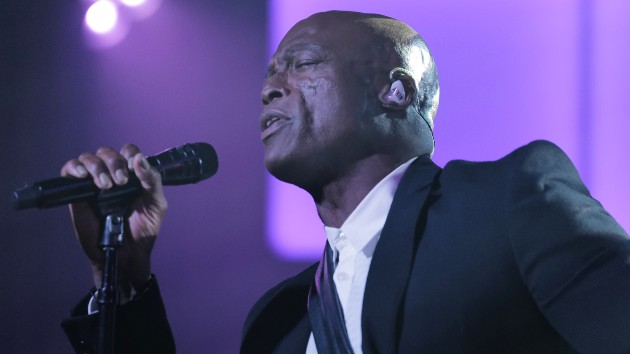
Seal‘s upcoming 30th anniversary tour, launching April 25, will feature him playing his first two albums, Seal and Seal II, in their entireties — and as a result, we may end up hearing his biggest hit not once but twice during the night.
Seal’s biggest hit is, of course, “Kiss from a Rose,” from 1994’s Seal II, but as he explains, if he plays the album in order, the song will end up in the middle of the show, and that would be weird.
“The exact tracks…whilst they work in an album format, they don’t necessarily work in a live format,” Seal tells ABC Audio. “For example… ‘Kiss from a Rose’… you would put towards the end of a set. Well, I think that was track six on album two because we didn’t know that it was going to be the song from that album.”
So what’s the solution?
“You have to get a bit more creative,” he teases. “[The song] could be placed twice — I don’t want to give too much away — but there is that possibility… in different forms.”
Seal didn’t know that “Kiss from a Rose” would be the song from the album because it flopped at first. Only after it was featured on the soundtrack of the movie Batman Forever did it become a global smash. The marketing helped, but as Seal notes, the song’s quality was never in doubt.
“Nothing changed with ‘Kiss from a Rose,'” he explains. “It’s not like somebody did a different edit. It was the same song that was a weird waltz…that was kind of English, Baroque-type medieval, that was singing about some tower on the gray.”
He laughs, “It was the same weird song! The difference was, it was always a good song.”
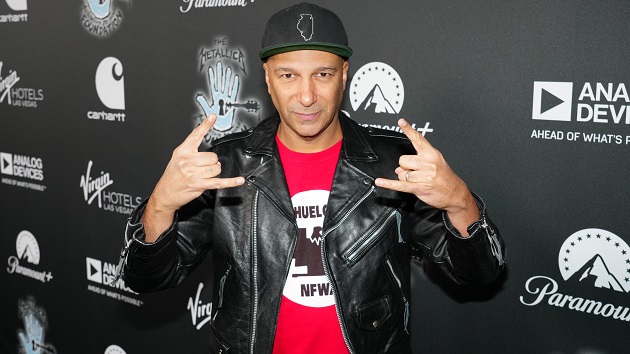
Rage Against the Machine guitarist Tom Morello will be honored at an upcoming benefit concert in support of the nonprofit music education program Music Will.
Formerly known as Little Kids Rock, Music Will works to provide “teacher training, diverse curriculum, and free musical instruments to students.” Morello is working with Music Will to launch programs in Los Angeles and Chicago.
The concert takes place May 2 in LA. Other honorees include Idina Menzel and Babyface.
The new movie Spinning Gold tells the story of Casablanca Records founder Neil Bogart, who launched the career of several artists in the ’70s, including KISS. And while Paul Stanley and Gene Simmons don’t appear in the film, they did play a part in making the movie look and feel as accurate as possible.
“They were very collaborative in making the film,” director Timothy Bogart, who is Neil’s son, tells ABC Audio. “You know, they were speaking to our costume designers, our makeup designers, our production designers.”
Timothy says they’ve had “great support over the years” from the artists his father worked with, noting, “I think the idea that he’s being celebrated finally is something that makes them all, you know, feel like that’s an appropriate thing to finally happen.”
And while Timothy doesn’t know if Gene and Paul have seen the film, he says former KISS guitarist Ace Frehley has reached out to him. “He actually went to the theater and was with a friend of his, and apparently the whole time going, ‘Yup, I remember that. I remember that.’”
Even though Ace’s relationship with Neil isn’t part of the film, Timothy says, “Just to hear his response was great. He really loved it.”