A paparazzi photographer, has filed a lawsuit against Ye, formerly known as Kanye West, for assault, battery, and negligence, Varietyreports.
Nichol Lechmanik alleges that Ye grabbed her phone and threw it into the street while she was capturing content of him, causing her fear and emotional distress.
The incident occurred on January 27, 2023, outside a sports academy in Ventura County where Ye was attending his daughter’s basketball game. Lechmanik had captured photos of Ye’s ex-wife, Kim Kardashian, entering the academy before noticing Ye confronting another photographer on the street. She began filming the altercation from her car when Ye allegedly approached her vehicle in an aggressive manner.
In the lawsuit, Lechmanik states that she was fearful for her safety due to the Yeezy founder’s reputation for violence against photographers and his threatening body language. Ye allegedly reached into her car, forcefully took her phone, and threw it onto the street before walking away.
Lechmanik, represented by attorney Gloria Allred, seeks damages for the emotional pain and lost earnings she has experienced as a result of the incident. Allred emphasizes that professional photographers have the right to perform their job without interference from celebrities and highlights the importance of privacy in one’s home versus public spaces.
The lawsuit aims to set a precedent for paparazzi photographers who face similar mistreatment while carrying out their professional duties.
(NEW YORK) — A breast cancer drug already on the market has been found to lower the chances of breast cancer recurring, an advancement that could open the drug to a broader range of patients.
The pharmaceutical company Novartis announced the findings Friday about its breast cancer treatment Kisqali, a drug already approved by the U.S. Food and Drug Administration for people with more advanced stages of breast cancer.
The vast majority of breast cancer patients are diagnosed in the early stages of disease. Right now, many are treated with chemotherapy and endocrine therapy.
The new data shows that adding Kisqali after primary treatment will reduce the risk of the cancer coming back.
This finding could be good news specifically for women who are diagnosed in the earlier stages of the disease and those who are hormone-receptor positive, and HER2 negative, who make up 70% of the breast cancer population, according to the National Cancer Institute.
“Women who have this subtype can have recurrences even 20 to 25 years after their initial diagnosis,” Dr. Dennis Slamon, director of the Revlon/UCLA Women’s Cancer Research Program and lead investigator of the Kisqali clinical trial, told ” Good Morning America.” “We found that adding this drug to the best available standard therapy will decrease the recurrence rate by as much as 25%.”
Suzanne Garner, 45, participated in the clinical trial for Kisqali after being diagnosed with Stage 2 cancer five years ago.
She said she was treated with chemotherapy and endocrine therapy, but the potential outcome of the treatments “didn’t feel right.”
“I felt that my risk of recurrence was still too high,” Garner told “GMA.” “I have a young daughter who needs her mom around for as long as possible and I would absolutely do anything to reduce my risk of recurrence so I can be her mom for as long as she needs me.”
Novartis announced the findings on Kisqali at the 2023 annual meeting of the American Society of Clinical Oncology.
The company said it plans to submit the data to “regulatory authorities in the U.S. and Europe before end of year.”
“Patients diagnosed with HR+/HER2- early breast cancer remain at risk of cancer recurrence, given that one-third of patients diagnosed with stage II and more than half of those diagnosed with stage III will unfortunately experience a return of their cancer,” Dr. Shreeram Aradhye, chief medical officer of Novartis, said in a statement. “The compelling data from NATALEE [the clinical trial] highlight the potential of Kisqali to reduce the risk of cancer recurrence in this at-risk population, including node-negative patients, while maintaining a favorable safety profile. These potentially practice-changing results reinforce the unique and well-established profile of Kisqali as a proven treatment in HR+/HER2- metastatic breast cancer.”
Former Wild ‘N Out star, Ms Jacky Oh!, also known as Jacklyn Smith, has died at the age of 32.
The entertainer and longtime partner of DC Young Fly died in Miami on Wednesday, although details surrounding the cause of her death remain undisclosed.
The Wild ‘N Out social media page posted the tragic news, sharing a picture of Smith alongside a statement from a BET Media Group Spokesperson.
“We are deeply saddened by the passing of Jacklyn Smith, known to the world as Jacky Oh, a talented Wild N’ Out family member whose impact will be forever treasured and missed,” the caption read. “Jacky Oh was a loving friend and beloved colleague of the Wild N’ Out cast throughout five seasons. More importantly, she was a tremendous mother to three beautiful children. The BET Media Group extends our sincere condolences to the Smith family, DC Young Fly, B Simone, Nick Cannon, and all friends who loved and cared for Jacky Oh during this difficult time.”
Jacky Oh! rose to fame as one of the Wild ‘N Out girls for five seasons and later ventured into entrepreneurship with her own lip gloss line, the J Nova Collection.
DC Young Fly, still a prominent figure on Wild ‘N Out, received the news while filming in Atlanta, according to TMZ. He and Jacky had been together since 2015 and shared three children: daughters Nova and Nala, and their son Prince, who was born just last year.
Amid rumors Oscar winner Jamie Foxx‘s “medical complication” that hospitalized him in April was actually a stroke, his pal Nick Cannon is trying to keep things positive.
To Extra‘s Billy Bush, Cannon said Thursday, “I believe when he’s ready, he’s going to address the awaiting fans in the world the way that only he can.”
Cannon, who subbed for Foxx on the summer session of the Fox show Beat Shazam, expressed, “One thing I’ve always respected about how Jamie’s moved throughout his entire career, if you’ve noticed, he’s always been somebody who is extremely professional and extremely private.”
He added, “I mean, you don’t ever really hear anything other than just the great work that he puts forth as a professional and…he’s handled this situation with the same manner, you only can respect that.”
When Bush pushed Cannon on the stroke rumors, The Masked Singer host allowed, “I’m probably in the same boat as you in that same sense of just knowing that, you know, as a friend, just being as respectful as I can. I don’t pry. I don’t ask any other questions.”
He added, “…And I think in this scenario…what I’ve always said is just like, ‘Hey, I’m here for you, whatever you would like me to say, whatever you would like me to do, I can be a mouthpiece.’ And I think they said, ‘We got it.'”
Further, Nick said, “The information that is out there is the information that they want to be out there… I was definitely one of those people initially with like the heavy-handed prayers… sending positive energy, love, and prayers. And they were like, ‘Yo, we appreciate all of that, but we got it.'”
(KYIV, Ukraine) — A group of friends in Kyiv, the Ukrainian capital, opened what they call the first military-meme art bar: Offensive.
On the walls of a new bar, there’s a piece of a Russian UAVs, a spent shell, the debris of the downed Russian jet and a few uniforms of captured Russian soldiers. There are a bunch of war trophies and war-related jokes.
The opening comes ahead of the Ukrainian army’s much anticipated counteroffensive against Russians forces on the front line, some Ukrainians have turned the current success of their Armed Forces into a brand.
“Most of these items were brought to us by our friends in the Army who participated in the Kharkiv counter-offensive,” said Borukh Feldman, the owner of the bar, whose name has been changed for security reasons.
He referred to a remarkable blitzkrieg of the Ukrainian forces in the east in early September last year when they managed to liberate a few hundred settlements in a few days.
“And I’m sure there will be even more new pieces from the future operations,” Borukh said.
The idea to open a military-style bar came to him back in 2015, he said, when the war in Ukraine was practically frozen — Russia annexed Crimea and parts of Donbas and there were only random shots fired on the front line.
“Then people almost forgot about the war, so I wanted to establish a place to remind of it,” Borukh recalled. He didn’t have enough money then to open a bar, but now it’s easier since the price of the rent dropped due to the full-scale invasion and power outages caused by Russian attack on the Ukrainian energy infrastructure in autumn and winter.
Now, the bar not just reminds people of the war, but it’s a way to go through this traumatic experience, praise the military and help the army, Borukh said.
One of the customers ABC News met at the bar was an American from the International Legion, who asked no to disclose his name. He said he was passing by, noticed the name, decided to pop up and found the place “very comfy.”
“I have friends for example in the Azov battalion and they said they feel like home here” Borukh said. “The military entourage is very familiar to them but they can relax here and be sure everyone understands them.”
The memes on the walls of Offensive are a fascinating mixture of very particular Ukrainian jokes, dark humor about the deceased Russian soldiers and propaganda posters with F-16 jets and Neptune destroying a Russian warship.
“The sense of humor helps us stay sane and be resilient,” Borukh said. “Some memes were created by our soldiers right in the trenches. They presented them to us and said this bar is blessed by the Armed Forces,” Borukh laughed. “And that is true. If not [for] our army we wouldn’t be even alive probably.”
That’s why fundraising is a must for the owners. The bar hosts regular concerts of some underground Ukrainian bands to raise money for certain needs Borukh’s military friends have on the frontline — from walkie-talkies to drones.
Not only the decor of the bar is unique, but, of course, the menu, too. It has some craft blackberry beer brewed locally and “fried Putin,” which is actually a variation of the Canadian poutine.
One could think it’s crazy to start a business during the war. But cafes, bars and restaurants are one of the most successful businesses in Ukraine and in particular in Kyiv, a vibrant megapolis, which both locals and foreigners love for the food, coffee and casual lively atmosphere.
Around a hundred establishments were opened in the city during the last year, many owned by internally displaced people, who lost property in the occupied areas of Ukraine or just preferred to move out of the occupation.
“It usually takes half a year or even a year to become profitable in the gastro sphere. After two months I feel like we’re doing very well,” Maksym, the administrator of the Offensive. said.
The bar already has its particular audience — the military, students and young professionals of the creative industries, some actors and painters — typical habitants of the Podil district of Kyiv, popular with its cultural places.
And war-related naming is not a rarity in Ukraine these days, too. There’s another restaurant named after Bayraktar, a type of Turkish drone, and cafe Javelin, named after an American anti-tank weapon. There are cocktails called Himars, another American game-changer that has helped the Ukrainian forces.
Such features set a patriotic mood at the establishment and attract customers, but most businesses that use such branding — from small to large companies — have pledged to donate to the Armed Forces of Ukraine.
HBO has renewed the comedy series Somebody Somewhere, starring and executive produced by Patti Cake$ star Bridget Everett, for a third season. The series, based on Everett’s own life, centers on a Kansas native struggling to fit in. Through singing, she discovers “finding your people, and finding your voice, is possible. Anywhere. Somewhere”…
Cruel Intentions, Amazon Freevee’s series adaptation of the 1999 cult film, has nailed down its main cast, according to Variety. Impeachment: American Crime Story‘s Sarah Catherine Hook, Totally Completely Fine‘s Zac Burgess, Yellowjackets‘ Khobe Clarke, South of Hell‘s Brooke Lena Johnson, American Horror Stories‘ Sara Silva, Sean Patrick Thomas — who starred in the original film, 9-1-1‘s John Harlan Kim and He’s All That‘s Myra Molloy star in the series, with Younger‘s Laura Benanti and Major Crimes‘ Jon Tenney appearing in recurring roles. Cruel Intentions follows “two ruthless siblings who will do anything to preserve their power and reputations after a brutal hazing incident at an elite Washington, D.C. college — even seduce the daughter of the Vice President of the United States.”…
Former Wild ‘N Out star Ms Jacky Oh! has died, according to a post on the show’s Instagram. She was 32. The post went on to call Jacky — who was born Jacklyn Smith — “a loving friend and beloved colleague of the Wild ‘N Out cast throughout five seasons,” adding. “More importantly, she was a tremendous mother to three beautiful children.” A cause of death was not revealed…
(SIOUX FALLS, S.D.) — A zoo in South Dakota has welcomed a litter of critically endangered red wolf pups — a litter vital to the existence of the species with only an estimated two dozen left existing in the wild.
The Great Plains Zoo in Sioux Falls, South Dakota, said that they were “thrilled to announce the births of six critically endangered red wolves” on Thursday in a statement on the zoo’s website.
The six pups — two females and four males — were born to first-time parents Camelia and Uyosi, who only arrived at the Great Plains Zoo in October of last year from facilities in Washington and Texas, respectively.
These six pups are vital to the existence of the species with an estimated 23 to 25 red wolves remaining in the wild and only an estimated 278 alive in captivity, according to the U.S. Fish and Wildlife Service’s Red Wolf Recovery Program.
“Camelia and Uyosi are amazing parents, I wouldn’t expect anything less from them,” said Joel Locke, the Animal Care Director of the Great Plains Zoo. “We are fortunate to have vet staff and animal care staff that have worked with red wolves for more than 15 years. We had our last litter from our previous pair of red wolves in 2016, so the team is well-versed in red wolf care.”
Red wolves are currently the most endangered canid species in the world, according to the zoo, and the red wolves at the facility are part of the Red Wolf Species Survival Plan, which aims to “breed pairs with the greatest possible genetic diversity, with the goal of bolstering the wild population.”
“We will soon see the pups wandering around the exhibit, as they get bigger and braver,” the Great Plains Zoo said in the birth announcement. “However, zookeepers request that everyone in the area continue to use low voices, as new wolf parents can be especially susceptible to environmental stressors.”
The pups are now under close observation by the zoo’s veterinary and animal care teams and are also being monitored very closely by camera as well as regular check-ups on their health and wellbeing.
(DAVENPORT, Iowa) — An elite task force with dogs trained to smell death is combing through a partially collapsed building in eastern Iowa as three people remain missing.
Iowa Task Force 1, a Cedar Rapids-based urban search and rescue team trained and equipped by the Federal Emergency Management Agency, arrived in the city of Davenport on Thursday, four days after a section of a six-story residential building collapsed. The team brought “live and cadaver canines,” or dogs trained to pick up the scent of humans both alive and dead, according to a press release from the city government.
The task force met with city officials and the Davenport Fire Department before entering the structure with the dogs. The team is now working to “re-verify and mark all rooms with standard FEMA markings,” the city said.
It’s become a race against time to find and rescue any survivors since part of The Davenport collapsed for unknown reasons on Sunday afternoon. The building, located in the heart of downtown Davenport, houses commercial space at the street level and residential units in the floors above. More than a dozen people evacuated at the time of the collapse, while eight others and several pets were rescued in the 24 hours that followed.
On Monday, officials said there was no credible information that anyone was missing and the city would move forward with plans to begin demolishing the remaining structure the next day. But that night, rescuers found a ninth person alive inside and pulled her out of a fourth-story window. It was unclear how the woman was not found earlier by crews using thermal imaging, drones and dogs. The development prompted protests from members of the community calling for the demolition to be delayed.
On Tuesday, the city’s demolition plans were put on hold as officials announced that five residents were still unaccounted for, including two — 42-year-old Branden Colvin and 51-year-old Ryan Hitchcock — who may be inside. Crews rescued several more animals from inside the structure that afternoon but no human activity was detected, according to officials.
Then, on Thursday, officials announced that only three residents remain missing — Colvin, Hitchcock and 60-year-old Daniel Prien. All three lived in apartments located in the collapse zone and were believed to be home at the time. However, officials have struggled to locate family for Prien to confirm his whereabouts. Officials called it a “recovery situation” for Colvin and Hitchcock, noting that they’re likely inside the structure in an area that’s “not sustainable for life.”
Officials have warned that the structure is unstable and continues to degrade. Crews are working with structural engineers on how to best search the building while avoiding the pile of debris, which is currently contributing to the stability and its “removal could jeopardize or accelerate the inevitable collapse of the building,” according to the city.
ABC News’ Jianna Cousin, Laryssa Demkiw, Alexandra Faul, Andy Fies, Jessica Gorman, Ahmad Hemingway, Alex Perez, Darren Reynolds and Emily Shapiro contributed to this report.
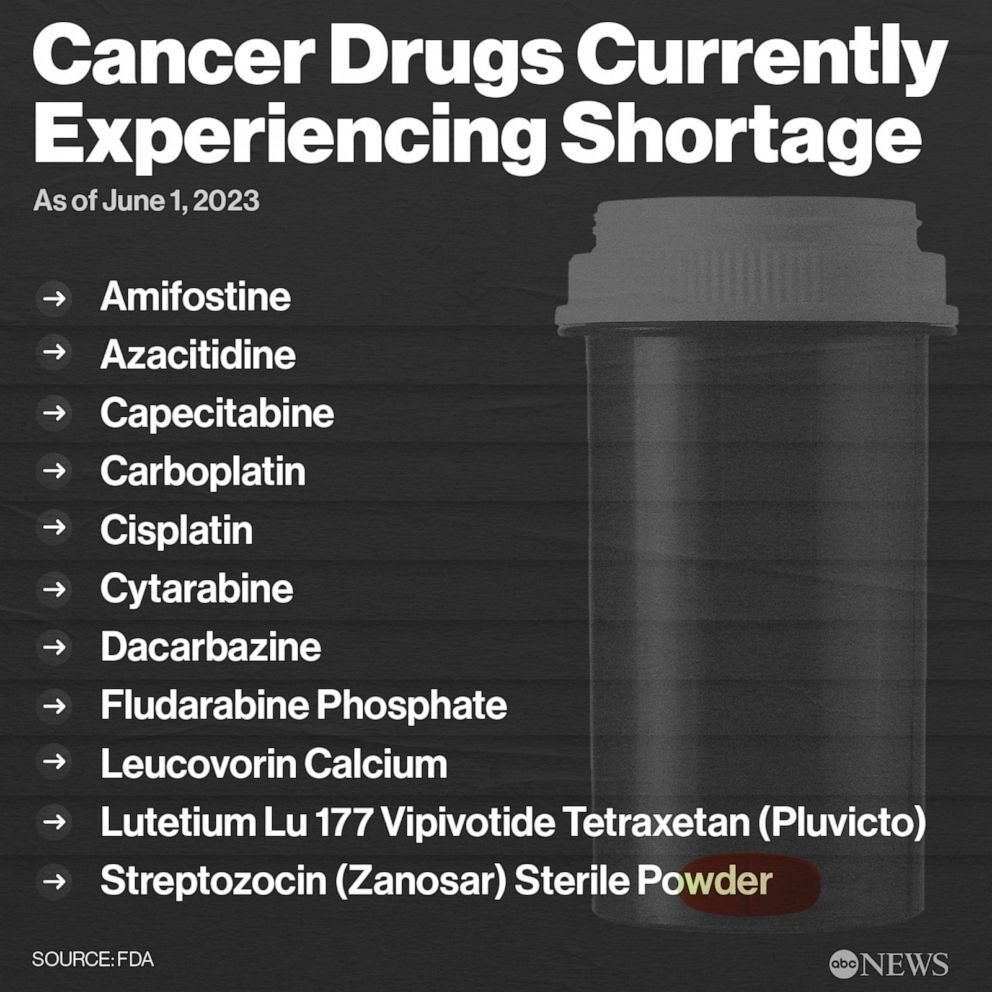
(NEW YORK) — Just six weeks ago, Greg DeStefano began a new chemotherapy combination. The 50-year-old, from Northbrook, Illinois, had recently been diagnosed with his fourth round of cancer and doctors were hopeful the medication would treat the tumors growing in his neck.
DeStefano was responding well, but then, in late May, he got a call from his doctor and was told one of the three drugs he was receiving — carboplatin — was under a global shortage and because of the way the hospital had to prioritize treatments, he wouldn’t be qualified to receive it anymore.
“We’re frustrated because not only are we dealing with cancer, now we have to deal with a drug shortage of a pretty critical drug,” DeStefano told ABC News.
DeStefano’s experience is similar to thousands across the United States of patients either having delayed treatment or being unable to receive treatment because of cancer drug shortages.
Among them are carboplatin, used to treat ovarian and head and neck cancer; azacytidine, which treats a form of leukemia; and dacarbazine, used to treat skin cancer.
“We’ve experienced drug shortages, intermittency, my entire career, it has always been a challenge,” Julie Kennerly-Shah, associate director of pharmacy at The Ohio State University Comprehensive Cancer Center, told ABC News. “The past six months have been the most challenging in my career for managing drug shortages in the cancer population.”
She continued, “As you can imagine, it’s extremely frustrating to know that you have a medication that can potentially cure a patient of cancer or extend their life and to know that you may not have enough to treat that patient.”
Last month, the American Cancer Society issued a warning that chemotherapy drugs had returned to the list of the top-five drug classes affected by shortages and warned this could have a devastating effect on patients.
Some hospitals and clinics are completely out of the medications. In others, doctors are being forced to either ration cancer drugs or triage which patients receive the drugs first.
“We’re sort of on life support, whether or not we’re going to have enough drugs and we have internally operationalized various ways to prioritize who gets which drugs,” Dr. Mark Einstein, a gynecologic oncologist at University Hospital in Newark, New Jersey, told ABC News. “Especially when there are limited or no other alternatives.”
DeStefano said this shortage means that unless he chooses a different course of treatment — which involves chemotherapy and then a resection or a removal of the tumor — he will be ineligible to receive the drug.
However, because he’s had multiple surgeries in the past due to previous bouts of cancer, surgery has more risks for him, his wife, Mindy DeStefano, told ABC News.
“This is the crux of our frustration, that he has a therapy and treatment that’s working and now because of the way they have to categorize and prioritize patients, he is now not able to access this drug any longer,” she said.
Doctors say there are a number of factors behind the nationwide shortage including low profit margins for generic versions of these drugs as well as labor and supply chain issues.
“All these drugs that we have shortages in, they’re all generic, old chemotherapy drugs that are fairly cheap as it relates to cancer drugs,” Dr. Hanna Sanoff, a gastrointestinal medical oncologist at the University of North Carolina’s Lineberger Comprehensive Cancer Center, told ABC News. “And so, the economic margin here is just much smaller for the drug manufacturers.”
She continued, “A lot of our supply comes from India and China, and there have been some recent shutdowns of a couple of major suppliers of generic drugs and so it was already sort of a tenuous supply chain that then got disrupted by plant closures.”
For short-term solutions, the Society of Gynecologic Oncology currently recommends minimizing ordering the drugs under shortage if there is another medication available with comparable efficacy and safety and using the lowest dose possible and the longest interval between doses that is acceptable.
Kennerly-Shah said at her center, patients have either been switched to alternative medications or there have been operational changes.
“Dose rounding is a frequent practice, so rounding to the nearest vial size, within typically a 10% range, so that we’re not wasting additional medication leftover by opening an additional vial,” she said.
For long-term solutions, doctors are calling for more transparency from companies on when additional shipments can be expected, potentially giving incentives for generic drugmakers or even seeing if the FDA can come up with ways to potentially extend the shelf life of critical medications.
Greg DeStefano and Mindy DeStefano said they have potentially found another local hospital in Chicago with supply of carboplatin, but need to have more conversations to see if he qualifies for treatment.
“This is life and death,” she said. “This not like symptom relief; it’s life and death. And it’s really frustrating that in this country, we have to be scrambling to try and find a drug that technically should be available. I mean, it is a life and death drug.”
(WASHINGTON) — The Senate on Thursday night passed legislation to lift the nation’s debt ceiling and stave off what would’ve been an economically disastrous default days before Monday’s deadline.
The final vote was 63-36.
The bill will now go to President Joe Biden’s desk for his signature.
Biden heralded the Senate vote passing the budget agreement as a “big win” for the economy.
Noting the bipartisan nature of the vote, Biden said, “Together, they demonstrated once more that America is a nation that pays its bills and meets its obligations — and always will be. I want to thank Leader [Chuck] Schumer and Leader [Mitch] McConnell for quickly passing the bill.”
“No one gets everything they want in a negotiation, but make no mistake: This bipartisan agreement is a big win for our economy and the American people,” the president added.
Biden said he looks forward to signing the bill as soon as possible, and that he will address the American people directly Friday.
Schumer painted the debt limit deal as a broad victory for Democrats late Thursday night during a press conference just after the legislation passed.
“Default was a giant sword hanging over America’s head,” Schumer said. “But because of the good work of President Biden, as well as Democrats in the House and Democrats in the Senate, we are not defaulting.”
Schumer’s comments come after an aggressive effort by House Speaker Kevin McCarthy to cast the bill as a GOP victory. But Schumer pointed to the vote margins in the House and Senate, noting that the bill enjoyed more support from Democrats than it did from Republicans in both chambers.
“We got more votes because the bill beat back the worst of the Republican agenda,” Schumer said. “This was an exercise in where the American people are at, and they are much closer to where we are than where they are.”
The Fiscal Responsibility Act, the product of weeks of contentious negotiation between Biden and McCarthy, will raise the $31.4 trillion debt limit through Jan. 1, 2025, while also implementing some caps on government spending and policy changes.
Republicans are touting its spending cuts while the White House argues it was able to protect major Democratic priorities like Medicare and Social Security, among other Biden-backed initiatives.
The compromise legislation was met with opposition from wings of both parties — hard-line Republicans and progressive Democrats — but has now passed both chambers with bipartisan support in the face of the alternative: an unprecedented default on the nation’s bills that would’ve likely cost millions of jobs and triggered a recession.
The House passed the bill on Wednesday in a 314-117 vote, a win for McCarthy in his first major test as speaker.
“I wanted to make history,” McCarthy said as he took a victory lap after the bill’s passage. “I wanted to do something no other Congress has done, that we would literally turn the ship, that for the first time in quite some time we’d spend less than we spent the year before.”
Lawmakers have raced to get the bill across the finish line ahead of Monday, the date Treasury Secretary Janet Yellen has warned the U.S. could run out of money to pay all its bills on time and in full.
The Senate avoided a filibuster and the passage of any amendments to get the bill across the finish line before the weekend.
Overall, the Fiscal Responsibility Act will keep non-defense spending flat in fiscal year 2024 and increase spending by 1% in 2025, which ultimately amounts to a cut in light of inflation, while slightly raising military spending.
It imposes new work requirements for older Americans using the Supplemental Nutrition Assistance Program, or food stamps, and other federal assistance, a key Republican demand, though the Congressional Budget Office estimated it could increase spending and the number of people who qualify for aid. Medicaid and Medicare programs were left untouched.
The legislation also paves the way for a natural gas pipeline from West Virginia to Virginia, claws back some funding for the Internal Revenue Service and ends the three-year pause on federal student loan payments.
According to the CBO, the bill will reduce the deficit by $1.5 trillion over the next decade.
ABC News’ Allison Pecorin and Molly Nagle contributed to this report.