DHS is using the CBP Home Mobile App to incentivize self-deportation. (Department of Homeland Security)
(WASHINGTON) — The Department of Homeland Security announced on Wednesday that it is increasing its stipend for those who are in the United States illegally and self-deport by $1,600.
Previously, DHS offered $1,000 to those who use the Customs and Border Protection (CBP) Home App to self-deport, but now, it’s raising that number to $2,600.
DHS claimed that since January 2025, 2.2 million people who are in the U.S. illegally have voluntarily self-deported — with “tens of thousands” using the CBP app. A report from the Brookings Institution released last week called DHS’ data into question, saying the department’s numbers “should not be considered a serious source.”
“To celebrate one year of this administration, the U.S. taxpayer is generously increasing the incentive to leave voluntarily for those in this country illegally- offering a $2,600 exit bonus,” Homeland Security Secretary Kristi Noem said in a release. “Illegal aliens should take advantage of this gift and self-deport because if they don’t, we will find them, we will arrest them, and they will never return.”
The increased amount is to mark to the first year of President Donald Trump’s term in office, and may only be temporary, DHS said in the release.
For months, the department has been pushing self-deportations — spending millions on advertisements that showcased it’s previous $1,000 payment and a plane ticket that people who register to self-deport are given.
It’s not clear how much money in total has been given to people who have self-deported.
DHS said in the first year of Trump’s term, there were 675,000 deportations. The authors of the Brookings Institution report estimated a figure much lower last week — saying there were between 310,000 and 315,000 removals in 2025.
Deporting migrants who are illegally in the U.S. was one of Trump’s key campaign promises, but advocates have said that Immigration and Customs Enforcement and Border Patrol tactics have gone too far in some cases.
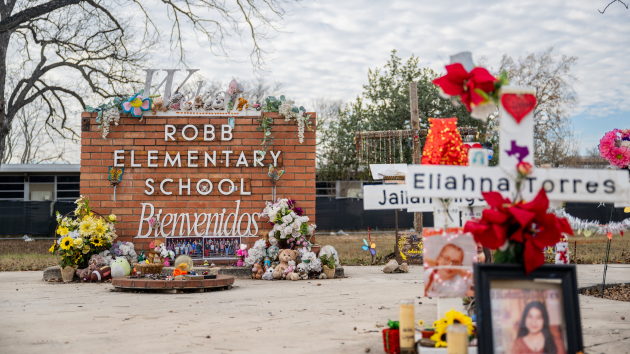
A memorial dedicated to the 19 children and two adults murdered on May 24, 2022 during a mass shooting at Robb Elementary School is seen on January 06, 2026 in Uvalde, Texas. (Brandon Bell/Getty Images)
(CORPUS CHRISTI, Texas) — Deliberations are underway in the trial of former Uvalde schools police officer Adrian Gonzales on Wednesday after prosecutors and defense lawyers delivered their closing arguments.
Before jurors were sent to deliberate, District Attorney Christina Mitchell gave an impassioned plea, saying, “I know this case is difficult, and it has been difficult. But we cannot continue to let children die in vain.”
“What happened to Uvalde on May 24 can happen anywhere, at any time,” she said. “If it’s going to happen, and if we have laws mandating what the responsibility of a law enforcement peace officer is for a school district, then we better be ready to back it up.”
At issue is whether Gonzales — one of the first officers to arrive at Robb Elementary on May 24, 2022 — ignored his training and endangered dozens of students when he responded to the shooting, which became one of the worst mass shootings in U.S. history.
Nineteen students and two teachers died, with police officers waiting 77 minutes to confront the gunman. While the shooting response has been the subject of hearings and investigations, the case against Gonzales marks the first criminal trial related to the shooting and the delayed police response.
Prosecution’s closing argument
The jury has an opportunity to “set the bar” for how officers should respond to school shootings, prosecutor Bill Turner said on Wednesday.
“If it’s appropriate to stand outside hearing [hundreds of] shots while children are being slaughtered, that is your decision to tell the state of Texas,” Turner said.
While teachers and students were sheltering in their classrooms — doing exactly what their training taught them to do in an active shooter scenario — the police officer trained to help them failed to act, Turner said. Turner argued that each gunshot fired at Robb Elementary was “notice to Adrian Gonzalez to advance toward the gunfire,” but he failed to follow his training and act in the crucial first minutes of the shooting.
“If you have a duty to act, you can’t stand by while the child is in imminent danger,” Turner said.
Turner pointed jurors to the testimony of teaching aide Melodye Flores, a key prosecution witness who said she pleaded with Gonzales to intervene. Turner argued that the warning from Flores and the clear sound of gunfire should have triggered Gonzales to act.
“The training is, you hear shots, you go to the gunfire. He heard shots, and Melodye Flores was pointing where to go to the gunfire. There’s nothing complicated about that,” Turner said.
Defense’s closing argument
Convicting Gonzales will send a clear message to officers who respond to this country’s next mass shooting, defense attorney Jason Goss said.
“What you tell police officers is, ‘Don’t go in. Don’t react. Don’t respond,'” Goss warned jurors. “We cannot have law enforcement feel that way.”
Goss argued that prosecutors tried to “massage the facts” of the case and “twist them all into a pretzel” to argue Gonzales failed to act. According to Goss, Gonzales did the best he could with the information he had when he arrived at Robb Elementary. While other officers arrived within the same timeframe, only Gonzales is being penalized for attempting to take action that day, he argued.
Goss attempted to empathize with the jurors and the families of victims, arguing he understood the desire for criminal accountability. But he reminded jurors, “The monster who hurt those kids is dead.”
But convicting Gonzales, Goss argued, would do “an injustice” for the victims of the shooting.
“You do not honor their memory by doing an injustice in their name,” he said.
What is he charged with?
Gonzales was charged with 29 felony counts of abandoning/endangering children — one count for each of the 19 students who died in the shooting and the 10 children who survived in classroom 112.
Each count carries a maximum penalty of two years in prison, and Gonzales could spend the rest of his life in prison if he is convicted. While juries in Texas sometimes determine criminal sentences, Gonzales has opted to be sentenced by Judge Sid Harle if he is convicted.
What happened to the police chief’s case?
Along with Gonzales, prosecutors also charged former Uvalde schools Police Chief Pete Arredondo, who was the scene commander during the Robb shooting. His case has been indefinitely delayed due to a pending civil lawsuit involving the tactical unit that ultimately breached the classroom and killed the shooter.
Are there any comparable cases?
According to Phil Stinson — a professor at Bowling Green State University in Ohio who maintains a database of police officers who have been arrested — the case against Gonzales is uncommon but not unprecedented.
Prosecutors in Florida attempted to similarly charge a law enforcement officer for his response to the 2018 shooting at Marjory Stoneman Douglas High School in Parkland, Florida. Seventeen were killed when a gunman opened fire that day, Feb. 14, 2018, in Parkland.
A jury in 2023 acquitted Scot Peterson, the former Broward County sheriff’s deputy, after he was charged with child neglect and culpable negligence for his alleged inaction following the shooting.
‘The Sky, the Earth & All Between’ album artwork. (Epitaph)
Architects have announced a U.S. tour in continued support of their latest album, 2025’s The Sky, the Earth & All Between.
The headlining dates span from April 28 in Reno, Nevada, to May 15 in Indianapolis. Presales begin Wednesday at 2 p.m. local time, and tickets go on sale to the general public Friday at 10 a.m. local time.
Architects’ upcoming live plans also include sets at the Welcome to Rockville and Sonic Temple festivals. For the full list of dates and all ticket info, visit ArchitectsOfficial.com.
Along with the tour news, Architects have premiered the video for the song “Broken Mirror,” a track off The Sky, the Earth & AllBetween.
“The narrative follows [vocalist Sam] Carter as he undergoes brutal militia-style training, building toward a tense and visceral firefight that mirrors the song’s emotional intensity,” a press release reads. “Gritty, moody, and visually arresting, the video balances raw vulnerability with explosive action, capturing the internal struggle at the heart of the track.”
You can watch the “Broken Mirror” video on YouTube.
The Sky, the Earth & All Between also includes the single “Everything Ends,” which hit #1 on the Billboard Mainstream Rock Airplay chart.
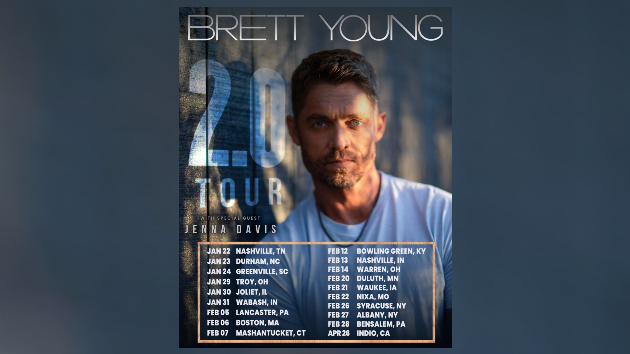
When Brett Young kicks off his 2.0 Tour Thursday at Nashville’s historic Ryman Auditorium, he’ll likely have lots of memories floating through his mind.
“My first experience at the Ryman was sneaking into a Keith Urban performance there,” he tells People. “I remember just thinking, ‘What would it be like one day to play in this room?’ I mean, I’ve gotten to do some pretty cool things there. I’ve gotten to jump up [onstage] with Darius [Rucker] for one of his shows and I got to perform in front of Tim McGraw, but I’ve not gotten to kick off a tour at the Ryman until now, so that’s going to be really special.”
The trek coincides with the 10th anniversary of Brett’s debut single, “Sleep Without You,” which was released in April 2016.
“What made me fall in love with country music is the storytelling,” he tells People. “And so, I feel like I’ve gotten to a place in my career where my fans are familiar with me enough that I can slow things down a little bit and dig in further than the three and a half minutes of the song. I always say it’s our job to pull back the curtain a little bit more every year.”
Brett will play 18 dates on this tour before wrapping Feb. 28 in Bensalem, Pennsylvania.
Restaurateur Dame Prue Leith poses for a portrait as she prepares to host a long table banquet during Wilderness Festival at Cornbury Park on Aug. 1, 2025, in Charlbury, Oxfordshire. (Jim Dyson/Getty Images)
This news may cause a soggy tissue, but at least that’s better than a soggy bottom.
Prue Leith, the longtime judge of The Great British Bake Off, has announced that she is leaving the show after nine years. The restauranteur shared the news on Instagram Wednesday.
“After nine series and judging more than 400 challenges, I have decided to step down as a judge on The Great British Bake Off,” Leith wrote. “Bake Off has been a fabulous part of my life for the last nine years, I have genuinely loved it and I’m sure I’ll miss working with my fellow judge Paul, Alison and Noel and the teams at Love Productions and Channel 4.”
The Great British Bake Off, which goes by the name The Great British Baking Show on Netflix, is also judged by Paul Hollywood. The program is hosted by Alison Hammond and Noel Fielding. Leith joined the show in 2017, replacing the original judge, Mary Berry.
Leith continued her goodbye announcement by explaining why she came to this decision.
“But now feels like the right time to step back (I’m 86 for goodness sake!), there’s so much I’d like to do, not least spend summers enjoying my garden,” Leith wrote. “Whoever joins the team, I’m sure they’ll love it as much as I have. I feel very lucky to have been part of it.”
Rahul Mandal, the season 9 Bake Off winner, took to the comments to share support for Leith.
“We will miss you so much. It was a joy and privilege to be in the tent [with] you. You are kind, funny, passionate and always inspired us,” Mandal wrote.
The most recent winner of the show, Jasmine Mitchell, also sent love Leith’s way in the comments.
“Awwwww, Prue you’re amazing and we will miss you so very much,” she wrote.
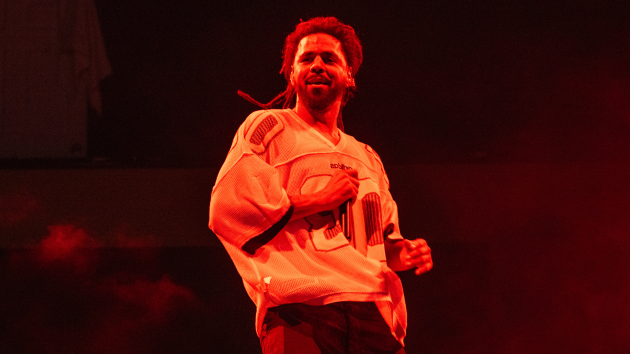
APRIL 6: J. Cole performs onstage during the 2025 Dreamville Music Festival at Dorothea Dix Park on April 6, 2025, in Raleigh, North Carolina. (Photo by Prince Williams/WireImage)
J. Cole raps about his life in reverse on his latest single, “Disc 2 Track 2” — an approach he admits was challenging for him. In a clip shared from an interview with Timmhotep Aku, he talks about the process of putting the song together.
“That was so much time spent downstairs in my crib in the studio while the kids are at school,” Cole explains. “Sitting in one spot, like putting a puzzle together. So enjoyable. Took so much time. I don’t say that to say it was, like, work. It was like putting a puzzle together to challenge myself.”
He tells Aku that when the song began to come together, he started to “get excited and scared simultaneously.”
“I get excited because I go, ‘What if? What if you could do this whole rhyme about your life story in reverse, but you gotta keep — I’m setting rules. You can’t cheat. You gotta keep four syllables minimum. What if?'” Cole recalls. “And I get excited, because I’m like, that would be so amazing. But then the fear comes in, almost a voice like, ‘Don’t try it, n****. Why? You know that’s not possible.'”
He says he gave himself an ultimatum to either stop or “take the mission,” and decided to go with the latter option.
Cole also talks about the happiness he felt as the lyrics came to him, the fear of wondering whether he’d be able to come up with enough rhymes and the joy that came when the record was complete.
“Those moments, writing it? That’s the #1 experience,” he says, adding the actual release pales in comparison to the recording process. “The reactions are at the bottom of the pole … because no fulfillment comes from that.”
“Disc 2 Track 2” was released following the announcement of The Fall-Off, which is set to arrive on Feb. 6.
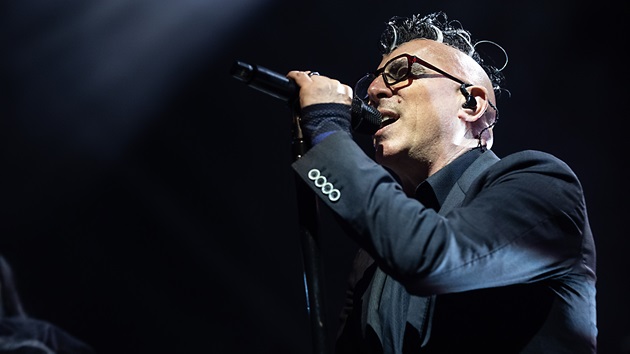
Maynard James Keenan of Puscifer performs at PNC Music Pavilion on May 10, 2025 in Charlotte, North Carolina. (Jeff Hahne/Getty Images)
Puscifer has announced a new concert film called Normal Isn’t: Puscifer Live at the Pacific Stock Exchange.
The set was recorded during a performance at the former Los Angeles Stock Exchange Building, and features renditions of songs of Maynard James Keenan and company’s upcoming album, Normal Isn’t.
Normal Isn’t: Puscifer Live at the Pacific Stock Exchange will screen in select independent record stores across the U.S. Feb. 6-8. It will then be available to purchase via Puscifer.com on Feb. 9.
“Brick and mortar vinyl shops are the lifeblood of independent bands,” Keenan says. “There is a symbiotic relationship that was almost obliterated by the age of digital downloads and streaming. Thankfully we survived by working together.”
The album Normal Isn’t is due out Feb. 6. It’s the follow-up to 2020’s Existential Reckoning.
Cover of The Beach Boys set ‘We Gotta Groove: The Brother Studio Years’ (Capitol/UMe)
The Beach Boys‘ mid-1970s era is being explored in a new box set.
We Gotta Groove: The Brother Studio Years, dropping Feb. 13, is a three-CD, three-LP box set highlighting music recorded between 1976 and 1977. It’s made up of 73 tracks, 35 of which are previously unreleased, along with 22 newly mixed tracks. All were recorded at Brother Studio in Santa Monica, California.
According to the press release, the set “reframes 1976–77 as one of the most revealing and creatively restless chapters of the band’s evolution — a moment when all five Beach Boys were navigating change, rediscovering their creative identities, and shaping a deeply human turning point in the continuing story of The Beach Boys.”
We Gotta Groove includes a newly remastered version of the band’s 1977 album The Beach Boys Love You, plus 10 session outtakes, as well as the first-ever official release of the shelved album Adult/Child, which was recorded in 1977, and previously only available through collector’s tapes and bootlegs. The set also includes outtakes and alternative recordings from the sessions for their 1976 album 15 Big Ones.
One of those Love You outtakes is “We Gotta Groove,” which is out now.
Along with the music, there’s a 40-page booklet with extensive liner notes, plus rare photos and more.
To mark the release of We Gotta Groove, the Grammy Museum in Los Angeles is hosting a special evening on Feb. 12 featuring the set’s producer James Saez and Beach Boys historian Howie Edelson, along with Brother Studio engineers Stephen Moffitt, Earle Mankey and John Hanlon, reuniting for the first time since the Beach Boys sessions 50 years ago.
A large vinyl decal displaying the official circular logo of the European Parliament, along with the full blue and yellow starred flag of the European Union, is affixed to the glass curtain wall of the institution’s building in Brussels, Belgium, on December 16, 2025. Michael Nguyen/NurPhoto via Getty Images
(NEW YORK) — European lawmakers on Wednesday suspended a trade agreement with the United States over tariff threats issued by President Donald Trump as part of his push to acquire Greenland.
The announcement came minutes after President Donald Trump reasserted his call for U.S. ownership of Greenland during a speech at the World Economic Forum in Davos, Switzerland.
The speech followed tariff threats issued by Trump days earlier against seven European Union countries, plus the U.K., over the issue.
European leaders, meanwhile, have pushed back on Trump’s ambitions. Greenland is a self-governing territory of the Kingdom of Denmark, a member of the EU.
Members of the Committee on International Trade (INTA) – a body within the European Parliament – hold “unshakable commitment to the sovereignty and territorial integrity of Denmark and Greenland,” European Parliament member Bernd Lange, an INTA chair on EU-US trade relations, said in a statement on Wednesday.
“By threatening the territorial integrity and sovereignty of an E.U. member state and by using tariffs as a coercive instrument, the U.S. is undermining the stability and predictability of EU-US trade relations,” Lange added.
The EU and US struck the trade agreement in July, moving to ratchet down tariffs on European goods and restore stability to the commercial relationship. At the time, European Commission President Ursula von der Leyen said the agreement “creates certainty in uncertain times.”
On Wednesday, Lange said the E.U. would pause the ratification process in response to Trump’s proposed tariffs. Under Trump’s plan, eight European nations – including Denmark, France, Germany and the United Kingdom – will be slapped with 10% tariffs beginning on Feb. 1. Those levies are set to escalate to 25% on June 1, Trump said.
In his speech on Wednesday, Trump ruled out use of the military in his push for Greenland. “We probably won’t get anything unless I decide to use excessive strength and force where we would be, frankly, unstoppable. But I won’t do that,” Trump said.
U.S. stocks slumped on Tuesday in response to the tariffs, with the Dow closing down 870 points, but recovered roughly half of those losses in a rally on Wednesday morning. In Europe, the pan-continental STOXX 600 index ticked slightly lower on Wednesday.
ABC News’ David Brennan contributed to this report.
A memorial dedicated to the 19 children and two adults murdered on May 24, 2022 during a mass shooting at Robb Elementary School is seen on January 06, 2026 in Uvalde, Texas. (Brandon Bell/Getty Images)
(CORPUS CHRISTI, Texas) — As soon as Wednesday afternoon, a Texas jury will begin deliberating whether a law enforcement officer should be held criminally responsible for failing to act in the face of one of the worst mass shootings in U.S. history.
At issue is whether Gonzales — one of the first officers to arrive at Robb Elementary on May 24, 2022 — ignored his training and endangered dozens of students when he responded to the shooting.
Nineteen students and two teachers died, with police officers waiting 77 minutes to confront the gunman. While the shooting response has been the subject of hearings and investigations, the case against Gonzales marks the first criminal trial related to the shooting and the delayed police response.
Prosecution’s closing argument
The jury has an opportunity to “set the bar” for how officers should respond to school shootings, prosecutor Bill Turner said on Wednesday.
“If it’s appropriate to stand outside hearing [hundreds of] shots while children are being slaughtered, that is your decision to tell the state of Texas,” Turner said.
While teachers and students were sheltering in their classrooms — doing exactly what their training taught them to do in an active shooter scenario — the police officer trained to help them failed to act, Turner said. Turner argued that each gunshot fired at Robb Elementary was “notice to Adrian Gonzalez to advance toward the gunfire,” but he failed to follow his training and act in the crucial first minutes of the shooting.
“If you have a duty to act, you can’t stand by while the child is in imminent danger,” Turner said.
Turner pointed jurors to the testimony of teaching aide Melodye Flores, a key prosecution witness who said she pleaded with Gonzales to intervene. Turner argued that the warning from Flores and the clear sound of gunfire should have triggered Gonzales to act.
“The training is, you hear shots, you go to the gunfire. He heard shots, and Melodye Flores was pointing where to go to the gunfire. There’s nothing complicated about that,” Turner said.
Defense’s closing argument
Convicting Gonzales will send a clear message to officers who respond to this country’s next mass shooting, defense attorney Jason Goss said.
“What you tell police officers is, ‘Don’t go in. Don’t react. Don’t respond,'” Goss warned jurors. “We cannot have law enforcement feel that way.”
Goss argued that prosecutors tried to “massage the facts” of the case and “twist them all into a pretzel” to argue Gonzales failed to act. According to Goss, Gonzales did the best he could with the information he had when he arrived at Robb Elementary. While other officers arrived within the same timeframe, only Gonzales is being penalized for attempting to take action that day, he argued.
Goss attempted to empathize with the jurors and the families of victims, arguing he understood the desire for criminal accountability. But he reminded jurors, “The monster who hurt those kids is dead.”
But convicting Gonzales, Goss argued, would do “an injustice” for the victims of the shooting.
“You do not honor their memory by doing an injustice in their name,” he said.
What is he charged with?
Gonzales was charged with 29 felony counts of abandoning/endangering children — one count for each of the 19 students who died in the shooting and the 10 children who survived in classroom 112.
Each count carries a maximum penalty of two years in prison, and Gonzales could spend the rest of his life in prison if he is convicted. While juries in Texas sometimes determine criminal sentences, Gonzales has opted to be sentenced by Judge Sid Harle if he is convicted.
What happened to the police chief’s case?
Along with Gonzales, prosecutors also charged former Uvalde schools Police Chief Pete Arredondo, who was the scene commander during the Robb shooting. His case has been indefinitely delayed due to a pending civil lawsuit involving the tactical unit that ultimately breached the classroom and killed the shooter.
Are there any comparable cases?
According to Phil Stinson — a professor at Bowling Green State University in Ohio who maintains a database of police officers who have been arrested — the case against Gonzales is uncommon but not unprecedented.
Prosecutors in Florida attempted to similarly charge a law enforcement officer for his response to the 2018 shooting at Marjory Stoneman Douglas High School in Parkland, Florida. Seventeen were killed when a gunman opened fire that day, Feb. 14, 2018, in Parkland.
A jury in 2023 acquitted Scot Peterson, the former Broward County sheriff’s deputy, after he was charged with child neglect and culpable negligence for his alleged inaction following the shooting.