“Afraid of the Dark” single artwork. (Roadrunner Records)
Motionless in White has premiered a new single called “Afraid of the Dark.”
The track reflects on the band’s 20th anniversary as frontman Chris Motionless sings, “Every scar is a badge of a lesson I’ve learned/ That took me twenty f****** years to earn.”
“I want the story of MIW to inspire anyone listening to not fear the unknown, but to run head first into it with everything they’ve got,” Chris says. “This song is about taking control of your destiny and writing the script of your own future without any doubt or apprehension.”
“For those of you who have been with us for any part of the last 20 years, this one is for you,” he adds. “If you mean it, you will make it.”
“Afraid of the Dark” follows Motionless in White’s 2022 album, Scoring the End of the World.
Motionless in White will be touring North America alongside Bring Me the Horizon starting in April.
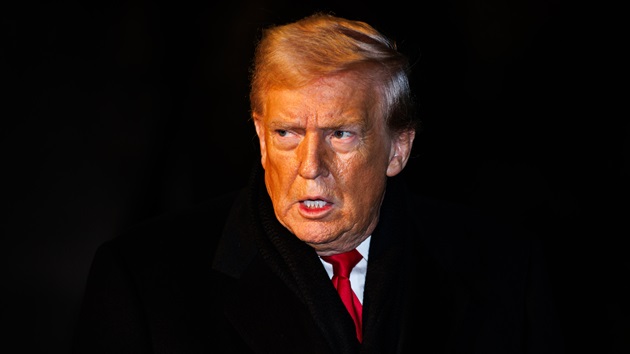
U.S. President Donald Trump walks over to reporters to make a brief statement before departing from the South Lawn of the White House in Marine One on January 20, 2026 in Washington, DC. Samuel Corum/Getty Images
(WASHINGTON) — President Donald Trump on Wednesday said a “massive Armada” was heading toward Iran and warned Tehran to make a nuclear deal or the attack will be “far worse.”
“A massive Armada is heading to Iran. It is moving quickly, with great power, enthusiasm, and purpose. It is a larger fleet, headed by the great Aircraft Carrier Abraham Lincoln, than that sent to Venezuela. Like with Venezuela, it is, ready, willing, and able to rapidly fulfill its mission, with speed and violence, if necessary,” Trump wrote in a social media post.
“Hopefully Iran will quickly ‘Come to the Table’ and negotiate a fair and equitable deal – NO NUCLEAR WEAPONS – one that is good for all parties. Time is running out, it is truly of the essence! As I told Iran once before, MAKE A DEAL! They didn’t, and there was ‘Operation Midnight Hammer,’ a major destruction of Iran. The next attack will be far worse!” Trump added.
This is a developing story. Please check back for updates.
George Strait: Four Nights in Austin, Texas (Messina Touring)
What started out as two nights at Moody Center in Austin for George Strait has turned into four.
On Monday, King George announced he will play in-the-round with newcomer William Beckmann on April 9 and 11. Due to overwhelming demand, he’s now added two more shows on May 15 and 16 with Carter Faith.
The new concerts also come with a note that these will be Strait’s final additions of 2026, rounding out his previously scheduled dates of April 24 and 25 in Lubbock, Texas, and May 2 in Clemson, South Carolina.
Presales are underway now. You can sign up for a code at GeorgeStrait.com.
George Strait: Four Nights in Austin, Texas (Messina Touring)
What started out as two nights at Moody Center in Austin for George Strait has turned into four.
On Monday, King George announced he will play in-the-round with newcomer William Beckmann on April 9 and 11. Due to overwhelming demand, he’s now added two more shows on May 15 and 16 with Carter Faith.
The new concerts also come with a note that these will be Strait’s final additions of 2026, rounding out his previously scheduled dates of April 24 and 25 in Lubbock, Texas, and May 2 in Clemson, South Carolina.
Presales are underway now. You can sign up for a code at GeorgeStrait.com.
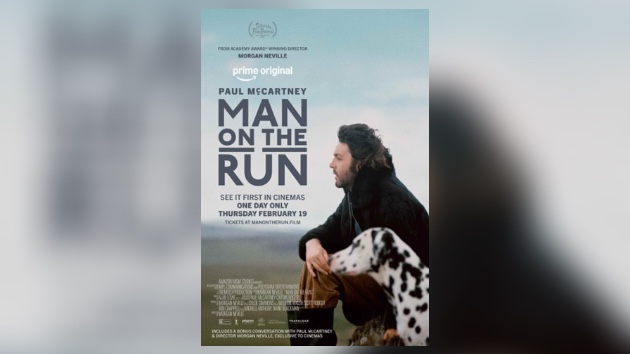
Poster for Paul McCartney documentary ‘Man on the Run’ theatrical release (Courtesy of Trafalgar Releasing))
The new Paul McCartney documentary Man on the Run is set to premiere Feb. 27 on Prime Video, but fans will now get a chance to see it early — and on the big screen.
The film, directed by Morgan Neville, will be released in theaters for one day only on Feb. 19
Man on the Run chronicles McCartney’s life after The Beatles breakup, including the formation of his band Wings.
The film, which premiered at the Telluride Film Festival in August, features interviews with Paul, his late wife Linda McCartney and daughter Stella McCartney, as well as Wings’ Denny Laine, Rolling Stones frontman Mick Jagger, Sean Lennon and The Pretenders‘ Chrissie Hynde.
McCartney has recently been revisiting his Wings career. In November, he released the book Wings: The Story of a Band on the Run as well as an anthology titled Wings, featuring remastered versions of Wings classics including “Band on the Run,” “Live and Let Die,” “Jet,” “Silly Love Songs” and “Let ‘Em In.”
“Wake Up Calling” single artwork. (New Noize Records)
Papa Roach has premiered a new single called “Wake Up Calling.”
“‘Wake Up Calling’ is a song about standing on the edge of disaster – being pulled back from the brink, and ultimately choosing love over self destruction,” the “Last Resort” outfit says.
You can watch the “Wake Up Calling” lyric video streaming now on YouTube.
“Wake Up Calling” follows Papa Roach’s 2025 singles “Even If It Kills Me” and “BRAINDEAD.” The band plans to put out a new album later in 2026.
The most recent Papa Roach album is 2022’s Ego Trip.
You can catch Papa Roach live at the upcoming Inkcarceration and Upheaval festivals.
Actor and filmmaker Ben Stiller stars alongside multi-platinum recording artist Benson Boone in Instacart’s Big Game spot titled ‘Bananas’ (Courtesy Instacart)
Benson Boone is doing everything for the Super Bowl — except headlining the halftime show.
As previously reported, Benson will perform on Feb. 5 at a charity concert organized by the Bay Area Host Committee and take part in the YouTube Super Bowl LX Flag Football game on Feb. 7. Now, it’s been announced he’ll star in a Super Bowl commercial with Ben Stiller that will air on Feb. 8, the day of the game.
The ad, which is for Instacart, features Ben and Benson as a retro Euro-disco-pop duo of brothers, singing about how Instacart’s new Preference Picker product feature allows them to pick the perfect bananas.
In the director’s cut version of the ad, the song gradually escalates into a sibling rivalry showdown. After Benson nails one of his signature flips, Ben tries to copy him and wipes out. He then makes a second attempt, only to crash into the on-stage speakers.
Benson pleads with Ben to stop, but he won’t listen. Instead, he climbs higher up on a piece of the stage set and attempts the flip again, this time crashing into the drumkit.
“I did the flip!” Ben declares, staggering to his feet and falling off the stage.
“Working on a Super Bowl commercial for Instacart blew my mind,” Benson says in a statement. “However, adding Ben Stiller to the equation… diabolical.”
Benson has got his eye on the prize for the future. He tells Billboard, “I think down the line — like, far down the line — I could really rip a Super Bowl halftime show.”
He also shared his Instacart order with Billboard. “Fruit snacks …. When I’m in the studio, I’ll eat, like, 20 a day , and Martinelli’s apple juice,” he says, acknowledging that it sounds like “a 5-year-old’s diet.”
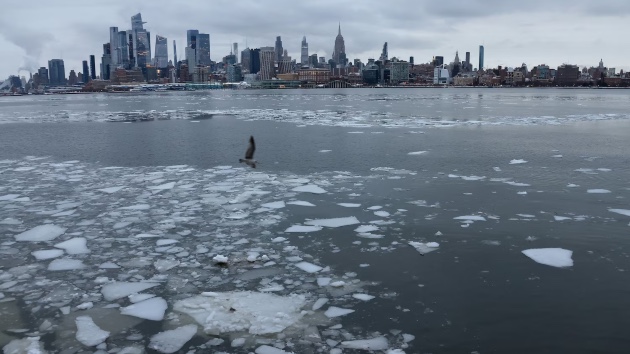
Ice chunks float in the Hudson River in front of the skyline of midtown Manhattan and the Empire State Building in New York City as seen from Hoboken, New Jersey, Jan. 26, 2026. (Gary Hershorn/ABC News)
The details are not yet clear, but here is what the forecast shows so far:
On Friday afternoon and night, a low-pressure system may bring snow to parts of Tennessee and Kentucky.
On Saturday, snow is expected from Georgia to Maryland. Snow totals are not yet clear, but everyone along the coast from Atlanta to Baltimore should be prepared for heavy snow.
Major travel impacts are possible on Saturday at Charlotte Douglas International Airport in North Carolina.
Strong, potentially damaging winds are also possible in Alabama, Georgia, and Florida.
On Sunday, the storm could take two paths.
If it heads out to sea, Sunday will be mostly dry for the East Coast, though gusty winds and coastal erosion will still be possible.
If the system hugs the coast, a nor’easter will bring snow to coastal areas of the Mid-Atlantic and Northeast. The snow would hit most of Sunday and end overnight into Monday.
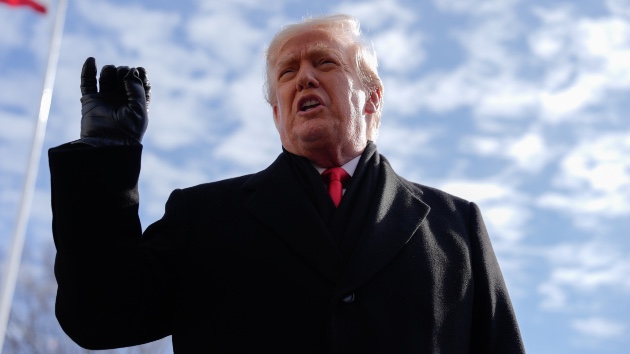
US President Donald Trump speaks to members of the media on the South Lawn of the White House before boarding Marine One in Washington, DC, US, on Tuesday, Jan. 27, 2026. (Photographer: Kent Nishimura/Bloomberg via Getty Images)
(WASHINGTON) — President Donald Trump previewed a “more relaxed” approach from federal agents operating in Minnesota following two deadly shootings in Minneapolis in recent weeks, during an exclusive interview with ABC News’ Senior Political Correspondent Rachel Scott on Tuesday.
Trump has assigned White House “border czar” Tom Homan to lead the operation in Minnesota following fierce local and national backlash to violent incidents involving federal agents there.
Asked what would change with Homan now in charge, the president said “we can start doing maybe a little bit more relaxed” and “we’d like to finish the job and finish it well, and I think we can do it in a de-escalated form.”
The remarks appear to signal a shift in tone for Trump, who said just months ago that Immigration and Customs Enforcement (ICE) raids “haven’t gone far enough.” Trump and members of his administration had previously criticized both of the protesters who were killed — with the White House describing one as a “‘would-be assassin” — while also expressing sympathy for their families.
Those deaths came amid Operation Metro Surge, which has seen thousands of federal agents arrive in Minneapolis, where they’ve been tasked in part with detaining undocumented immigrants. That ongoing operation has been decried by local leaders, including the governor and mayor.
“Minnesota is a state that believes in the rule of law and in the dignity of all people,” Minnesota Gov. Tim Walz wrote in an Op-Ed published in the Wall Street Journal earlier this week. “We know that true public safety comes from trust, respect and shared purpose, not from intimidation or political theater.”
In response to a legal challenge from state officials, who are seeking a temporary halt to the operation, a federal judge on Monday ordered the Trump administration to address the motives behind ICE’s immigration enforcement effort in the state. The judge ordered the government to file the supplemental brief by Wednesday at 6 p.m. ET.
The president said conversations with Walz, who he has lambasted repeatedly for his leadership, were going “very well,” before he turned to praise Homan as “a great guy. He’s a different type. He’s a strong guy, but he gets along with people.”
Walz said on Monday he had spoken on the phone with Trump, a conversation the governor characterized as “productive.” Walz said he “told him we need impartial investigations of the Minneapolis shootings involving federal agents, and that we need to reduce the number of federal agents in Minnesota.” He said Trump had “agreed to look into” reducing the number of agents in the state.
Asked to clarify what a de-escalation in Minnesota might look like, Trump said in the interview that he wanted “people to appreciate the fact that we’ve taken thousands of criminals out, and because of that, their crime rate has gone down, which is a great thing.”
“A lot of the hardest work is already done,” he continued. “You know, we’ve taken out thousands of stone-cold criminals, including murderers. And I think that’s what the people of Minnesota want. That’s what the people of the country want. That’s why I got elected.”
Minneapolis Mayor Jacob Frey, a Democrat, has repeatedly said that he and his constituents want the federal agents to leave.
“Minneapolis will continue to cooperate with state and federal law enforcement on real criminal investigations — but we will not participate in unconstitutional arrests of our neighbors or enforce federal immigration law,” Frey said on Monday after a phone call with Trump.
Homan on Tuesday met separately with Walz and with Frey. The mayor said he had “shared with Mr. Homan the serious negative impacts this operation has had on Minneapolis and surrounding communities, as well as the strain it has placed on our local police officers.”
As to when federal agents might leave Minnesota, Trump said, “I don’t know about soon but at some point, when we have all the criminals out, they’re going to leave. It’s a positive thing, not a negative thing.”
Referring to what he called “very bad and dangerous people” in Minnesota, Trump continued, “We know where a lot of them are. And what we’re asking the governor to do is hand over the criminals that they have. It’ll make the job much easier and faster.”
The president also hinted at further federal operations elsewhere. “There will be a time coming in the not too distant future, then we go on to something else,” he said, also claiming successes in ongoing operations in Memphis, Chicago, Louisiana and Washington, D.C.
“We always continue,” Trump said. “I don’t think you can just go cold turkey and go out. I think there’s a continuation.”
“We have a lot of cities and areas that want us very badly,” the president said. “So we’re going to be choosing some new ones. We have a very — we have an unlimited appetite for fixing crime in cities. They seem to be all Democrat-run.”
The president’s focus on what he has called a “migrant crime epidemic” has focused on Democratic-run major cities. Local mayors, governors and other politicians have disputed Trump’s assertion that the deployment of federal agents or the National Guard is necessary to curb supposed criminality there.
Trump dismissed criticism of federal operations in Minneapolis related to Saturday’s deadly shooting of 37-year-old nurse Alex Pretti, which sparked nationwide protests and demands for a full investigation. Pretti was carrying a pistol in a waist-level holster and was disarmed by federal agents before being shot multiple times.
The National Rifle Association was one of several gun-rights organizations that issued statements appearing to condemn comments made by officials, including Trump, after the shooting. Trump following the second deadly shooting in Minnesota described it as an “unfortunate incident,” but also said, “You can’t have guns. You can’t walk in with guns.” The NRA said it “unequivocally believes that all law-abiding citizens have a right to keep and bear arms anywhere they have a legal right to be.”
Minnesota officials confirmed Pretti had a license to carry a concealed weapon. Video evidence so far has not shown that he drew or reached for his weapon during the altercation with federal agents.
Asked about the backlash from gun-rights groups, Trump said, “Well, I haven’t seen the statements but I think when you have a fully loaded gun and two magazines, that’s not great.”
Trump has championed gun rights for years, including the right of people to protest while carrying weapons. But he also repeatedly criticized Pretti for being armed.
Gun Owners of America, another gun-rights group, responded by saying, “Peaceful protests while armed isn’t radical — it’s American. The First and Second Amendments protect those rights, and they always have.”
Trump also praised Department of Homeland Security Secretary Kristi Noem, who is facing calls to resign after the series of violent incidents involving DHS personnel. “I think she’s done a fantastic job, she’s strong,” the president said.
Sens. Thom Tillis, R-N.C., and Lisa Murkowski, R-Ark., on Tuesday became the first Republican senators to call for Noem to lose her job.
In response, Trump branded both senators “losers.”
“They’re terrible senators. One is gone and the other should be gone,” Trump said in the interview. “What Murkowski says — she’s always against the Republicans anyway. And Tillis decided to drop out. So you know, he lost his voice once he did that.”
Among Trump’s most vociferous Minnesota opponents is Rep. Ilhan Omar, a Democrat who since 2019 has represented a district of Minneapolis. The president has repeatedly criticized Omar publicly.
During a town hall in Minneapolis on Tuesday, a man charged the podium Omar was giving remarks, appeared to squirt a liquid at her and was then tackled to the ground by a security guard after a brief struggle.
The man, identified as 55-year-old Anthony Kazmierczak, was arrested and booked into Hennepin County Jail on suspicion of third-degree assault, Minneapolis police said.
In his first comments on the attack, Trump told ABC News’ Scott of Omar, “I don’t think about her. I think she’s a fraud. I really don’t think about that.”
And, without providing evidence, Trump went on to accuse Omar of staging the attack, saying, “She probably had herself sprayed, knowing her.”
Asked if he had seen the video, the president said, “I haven’t seen it. No, no. I hope I don’t have to bother.”
In a post on X regarding Tuesday’s incident, Omar said, “I’m ok. I’m a survivor so this small agitator isn’t going to intimidate me from doing my work. I don’t let bullies win. Grateful to my incredible constituents who rallied behind me. Minnesota strong.”
ABC News’ John Parkinson contributed to this report.
(NEW YORK) — Murat Mayor has no need for an associate’s degree. The 58-year-old business analyst already has a Ph.D. But when he and his son, a high school senior, attempted last fall to apply for federal student financial aid, they learned that an account associated with both of their identities already existed.
Those accounts showed applications to multiple community colleges — and much more.
“We noticed that there [was] a lot of activity” on accounts created in their names, Mayor said in an interview with ABC News. “There are a lot of applications, loan applications, grant applications … then we panicked.”
Mayor knew immediately that something was amiss. He assumed his identity had been stolen. But he had no concept of the breadth of the scheme that had ensnared his and his son’s identity, and he had certainly never heard of the army of digital fraudsters perpetrating the crime.
‘A huge issue’ They are known as “ghost students,” and for thousands of colleges across the country, these sophisticated thieves have a become a scourge. The scammers will use stolen or fake identities to enroll in classes online and sign up for Pell grants and loans, then disappear once they get the money — robbing the federal government of hundreds of millions of dollars and leaving an untold number of victims like Mayor and his son in their wake.
“It’s a huge issue,” said Jason Williams, the assistant inspector general for investigations at the U.S. Department of Education’s Office of Inspector General. “As they’re stealing identities … these loans are not being repaid. They’re being assigned to people [who] don’t even know they have a debt with U.S. Department of Education … [until] the Internal Revenue Service says you owe the Department of Education money.”
Fraudsters have attempted to steal student financial aid for decades, Williams said. But “when the pandemic [hit], everybody went to online learning. Well, by doing that, it really did open the door” for more widespread fraud, said Williams.
Scammers have realized that the move to remote learning at community colleges provides an opportunity to leverage the power of artificial intelligence to expand their reach and circumvent identity verification controls. Almost overnight, experts said, the fraud grew exponentially.
Over the past five years, the federal government has investigated more than $350 million in fraud perpetrated by “ghost student” schemes, Williams said. “And that’s only in the universe of what we know, and what we have adjudicated,” he added. “There’s a lot of stuff that we don’t know that’s out there.”
Williams said his office has more than 200 investigations open nationwide, with some schemes suspected of racking up more than a billion dollars in ill-gotten gains.
Open season on open enrollment The federal government is on the hook for tuition aid lost to scammers. But it is the community colleges, which accept almost all applicants through open enrollment, that often carry the burden of sniffing out fake applications. And doing so requires the resources, technology and expertise that many institutions do not possess.
Experts say the scope of the fraud is enormous. In California alone, nearly a third of all community college applicants in 2024 were identified as fraudulent, according to the California Community Colleges, the state’s administrative body for the community college system.
Similar figures exist across the country. ABC News and its nationwide network of owned and operated stations investigated the rise of “ghost students” and found that almost no community college has been spared.
Gina Macklin, a senior administrator at Delaware County Community College, told WPVI-TV in Philadelphia that the school found more than 500 fake students enrolled in its classes in 2023, which she described as “a terrible year” for the school, not least of which because those fraudsters “had taken seats from legitimate students.”
Dr. Beatriz Chaidez, the chancellor of the San Jose Evergreen Community College District, told KGO-TV in San Francisco that at one point, a 50-person online class was booked in minutes and had 100 individuals on its waitlist. The school later learned that just six of those “students” were real people trying to get an education.
“The rest were fraudulent accounts,” she said. “Ghost students.”
Software solutions The Trump administration last year implemented enhanced fraud controls and identity verification requirements for schools, which experts say helped schools combat fake applicants. But to help root out the fraud, many community colleges have turned to a growing marketplace of identity verification software vendors.
Maurice Simpkins, a retired NFL linebacker, operates one such business. His software is called Student Application Fraudulent Examination, or S.A.F.E.
The platform acts as a firewall for the schools, Simpkins said. “From a football term,” he likes to say, “it’s an offensive line.” He says it catches around 95% of fake applications instantaneously and refers more to the school for additional scrutiny. After just two years on the market, S.A.F.E. is in use in more than 150 schools nationwide, he said.
Administrators at more than a dozen community colleges characterized the rise of “ghost students” as a true crisis. The fraudsters, those administrators say, are taking advantage of a vulnerability created by the degree to which these schools are accessible to students.
Officials say the scammers’ schemes range from the savvy to the sloppy — and all are brazen. One school administrator at a midwestern community college who asked not to be identified shared a “business proposal” he said he received last year from an alleged scammer.
In an email, the alleged scammer, who identified themselves as “Ken from Tanzania,” offered to pay the administrator a share of the proceeds for his help in perpetrating the fraud. “I would really like us to partner and work for 3semesters [sic] and we get something good for us and our families.”
Scammers who operate from overseas present a special challenge, according to investigators. But many of the “ghost students” operate within U.S. borders.
Before their arrests in 2018 and 2019, a father and son in Arizona made off with more than $7 million from ghost student scams, and both served 12-month prison sentences after pleading guilty. And a Maryland man who used the identities of 60 people to take in more than $6.7 million in fraudulent financial aid was sentenced in 2023 to four years in prison.
Murat Mayor, the 58-year-old business analyst, believes he and his son had their identities stolen as part of a massive hack of their health care provider in 2024. After months of back-and-forth with law enforcement and administrators at community colleges in Maryland and Utah, he finally cleared himself and his son from enrollment records earlier this month.
“He’s a straight-A student, has been very successful — an honor student, so he’s doing well,” Mayor told ABC News regarding his son.
Mayor’s son has applied to study business finance in the fall. And this time, it will really be him.