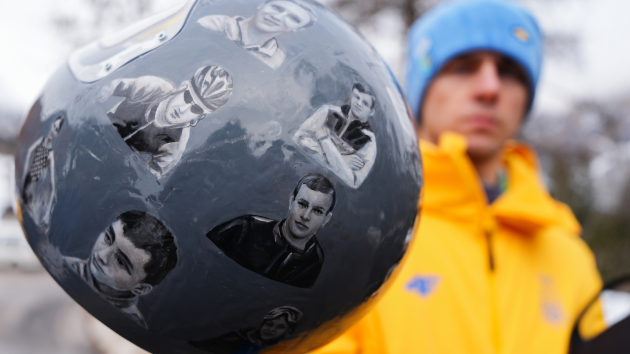
Ukraine’s Vladyslav Heraskevych, with his helmet, which features pictures of people killed in the war with Russia. Heraskevych was ruled out of the Men’s Skeleton event by the International Olympic Committee just over an hour before competition began, pictured at the Cortina Sliding Centre, on day six of the Milano Cortina 2026 Winter Olympics, Italy. Picture date: Thursday February 12, 2026. (Andrew Milligan/PA Images via Getty Images)
(LONDON) — A Ukrainian athlete has been disqualified and had his accreditation withdrawn at the Winter Olympics after insisting on wearing a “helmet of remembrance” as a tribute to people killed in his country’s ongoing war with Russia, officials said.
Vladyslav Heraskevych, a medal hopeful in skeleton and the Ukrainian flag bearer in the opening ceremonies last Friday, learned of the decision shortly before he was supposed to compete in the men’s skeleton competition on Thursday morning.
The International Olympic Committee said that it had “decided with regret to withdraw his accreditation for the Milano Cortina 2026 Games” after meeting with Heraskevych. The committee cited his refusal to compromise on wearing the helmet that he said honored those pictured on his helmet.
“I am disqualified from the race,” Heraskevych said following his disqualification. “Certainly we didn’t find common ground in this regard (with the International Olympic Committee).
The IOC said that they were “very keen” for the athlete to compete and made multiple and repeated attempts to reach a compromise with Heraskevych.
“The IOC was very keen for Mr Heraskevych to compete. This is why the IOC sat down with him to look for the most respectful way to address his desire to remember his fellow athletes who have lost their lives following Russia’s invasion of Ukraine,” the IOC said in their statement on Thursday morning.
“The essence of this case is not about the message,” said the IOC. “It is about where he wanted to express it.”
Olympic organizers said Heraskevych was able to display his helmet in all training runs and that they offered him the option of “displaying it immediately after the competition when going through the mixed zone.”
“It’s not about the messaging, it’s literally about the rules and the regulations,” said IOC President Kirsty Coventry. “In this case, the field of play, we have to be able to keep a safe environment for everyone, and sadly that means no messaging is allowed.”
The IOC said that it informed Heraskevych on Tuesday that his helmet was “not compliant with the Olympic Charter … in particular the IOC’s Guidelines on Athlete Expression.”
The alternative the IOC offered was to allow him to wear a black armband or black ribbon as an alternative solution to the use of the helmet, but Heraskevych refused.
“I believe we didn’t violate any rules,” Heraskevych said. “I see big inconsistencies in decisions, in the wording, in the press conferences of the IOC, and I believe it’s the biggest problem that it’s inconsistent.”
Heraskevych went further and said that this incident “looks like discrimination because athletes were already expressing themselves.”
“[A] U.S. figure skater, Canadian freeskier [and] Israeli skeleton athlete who is also here today, they didn’t face the same things,” Heraskevych claimed. “So suddenly just a Ukrainian athlete in this Olympic Games will be disqualified for this helmet which is not violating any rules.”
Ukraine’s Minister of Foreign Affairs Amdrii Sybiha issued a statement on Thursday saying that “future generations will recall this as a moment of shame.”
“He simply wanted to commemorate fellow athletes killed in war,” Sybiha said. “There is nothing wrong with that under any rules or ethics. The IOC intimidated, disrespected, and even lectured our athlete and other Ukrainians on how they should keep quiet about ‘one of 130 conflicts in the world.’”
The final decision was made Thursday morning, according to the IOC, when Heraskevych met with Coventry who subsequently explained to him “one final time, the IOC position.”
“As in the personal meetings before, he refused to change his position,” the IOC said.
Heraskevych, meanwhile, said that his fight for justice is not over even if he won’t be competing in the Milano Cortina Olympic Games.
“I believe we need to continue to fight for our rights,” Heraskevych said. “I told you from day one that I do not agree with what the IOC says to us, so probably we will prepare a CAS (Court of Arbitration for Sport) case and we will defend our rights in CAS.”
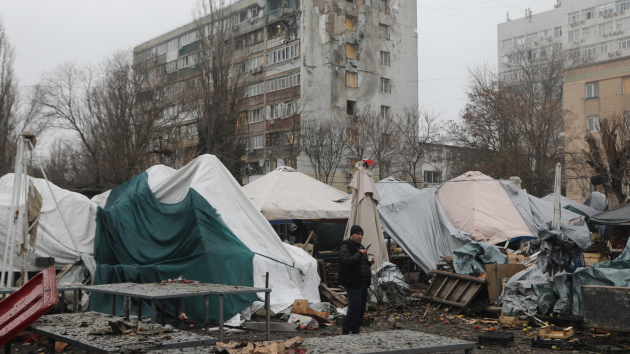
A view of the destruction in the area following Russia’s drone attack in the city of Odessa, Ukraine on February 12, 2026. (Artur Shvits/Anadolu via Getty Images)
(LONDON) — Ukrainian President Volodymyr Zelenskyy said on Wednesday that Russia is yet to respond to a U.S.-backed energy truce, as the two combatants continue to exchange long-range drone and missile strikes amid American-led peace talks.
Recent trilateral U.S.-Ukraine-Russia talks in the United Arab Emirates were described by all sides as constructive, though appear to have failed to find a breakthrough on several contentious points or secure a new truce covering critical energy infrastructure.
After the most recent round of talks last week, Zelenskyy said that U.S. officials proposed a temporary pause in attacks on energy targets, which would have mirrored the brief pause on such attacks that occurred at the end of January.
Zelenskyy said on Thursday that Kyiv is yet to receive a response from Moscow on the purported offer. “On the contrary, we’ve received a response in the form of drone and missile attacks. This suggests that they are not yet ready for the energy ceasefire proposed in Abu Dhabi by the American side,” he said.
Ukraine’s air force said Russia launched 25 missiles and 219 drones into the country overnight, of which 16 missiles and 197 drones were shot down or suppressed.
The impacts of nine missiles and 19 drones were reported across 13 locations, the air force said. “The main targets are Kyiv, Kharkiv, Dnipro and Odesa,” the air force wrote on Telegram.
Four people, including two children, were also injured in strikes on the central city of Dnipro, Ukraine’s Interior Ministry said. An earlier strike on the Synelnykove city just outside of Dnipro killed four people and injured three others, the regional administration said in posts to Telegram.
The Interior Ministry said that at least 13 people were injured in a series of drone strikes in the city of Barvinkove in the northeastern Kharkiv region.
The regional military administration in Odesa said one person was also injured there by Russian strikes.
The Interior Ministry reported damage to several areas of the capital. At least two people were injured by the attacks on Kyiv, according to the head of the city’s military administration, Tymur Tkachenko.
Kyiv Mayor Vitali Klitschko said that almost 2,600 residential buildings were left without heating due to “damage to critical infrastructure targeted by the enemy.”
In total, approximately more than 1 million people without heating in the Ukrainian capital, according to Klitschko and Deputy Prime Minister Oleksiy Kuleba.
DTEK — Ukraine’s top private energy firm — reported major damage to its energy infrastructure in Odesa, plus an attack on a thermal power plant.
Ukrenergo, the state energy transmission operator, reported power outages in Kyiv, Odesa and Dnipropetrovsk.
Ukrainian Foreign Minister Andrii Sybiha described the attacks as “Russian terror” in a post to X. “Each such strike is a blow to peace efforts aimed at ending the war. Russia must be forced to take diplomacy seriously and deescalate,” he said.
Zelenskyy said in a post to Telegram, “There needs to be more protection against these attacks.”
“The most effective defense against Russian ballistic missiles is the ‘Patriot’ system, and the supply of missiles for these systems is needed every day,” he added, referring to the U.S.-made surface-to-air missile platform.
“Everything currently available in the air defense program should arrive faster,” he said.
Ukraine continued its own drone strike campaign overnight. The Russian Defense Ministry said its forces shot down 106 Ukrainian drones overnight into Thursday morning.
Belgorod Gov. Vyacheslav Gladkov reported that two people were killed in drone attacks. At least 15 other people were injured across the region by Ukrainian attacks, the governor said. Gladkov also said Ukrainian forces fired several missiles into the region.
Local officials in the Volgograd, Tambov and Voronezh reported damage to industrial sites and falling drone debris in or close to residential areas.
Russia’s federal air transport agency, Rosaviatsiya, reported temporary flight restrictions for airports in Kaluga, Volgograd, Saratov, Yaroslavl, Kotlas, Ukhta, Perm and Kirov.
Ukraine’s General Staff said in a statement posted to social media that among the targets of the strikes were the main arsenal of Russia’s missile and artillery forces in the Volgograd region. “This arsenal is one of the largest ammunition storage sites of the Russian army,” the General Staff said.
The ongoing peace talks have seen no easing of long-range strikes by either side, as the fourth anniversary of Moscow’s February 2022 full-scale invasion approaches.
As yet, no next round of talks have been scheduled. Zelenskyy said the U.S. had proposed a new trilateral meeting to be held in Miami, but that, “So far, as I understand it, Russia is hesitating.”
“We are ready. It doesn’t matter to us whether the meeting will be in Miami or Abu Dhabi. The main thing is that there should be a result,” the Ukrainian president said.
Kremlin spokesperson Dmitry Peskov told journalists on Thursday that Moscow had “a certain understanding” regarding the next round of talks. “We expect the next round to take place soon. We’ll also give you directions on the location,” he added, as quoted by the state-run Tass news agency.
Russian Foreign Ministry officials have this week been critical of the ongoing peace push.
Foreign Minister Sergey Lavrov this week suggested that the U.S. side had drifted from the understandings reached between Moscow and Washington at the August meeting between Presidents Donald Trump and Vladimir Putin in Alaska.
Lavrov also said Trump’s administration had failed to roll back former President Joe Biden-era sanctions against Moscow.
Lavrov and Foreign Ministry spokesperson Maria Zakharova framed the lack of progress as the fault of Kyiv and its European backers.
“At the current stage, it is the European Union that is preventing the Kyiv regime from making any compromises in exchange for promises to provide everything necessary to continue military operations,” Zakharova said in a briefing on Thursday, as quoted by Tass.
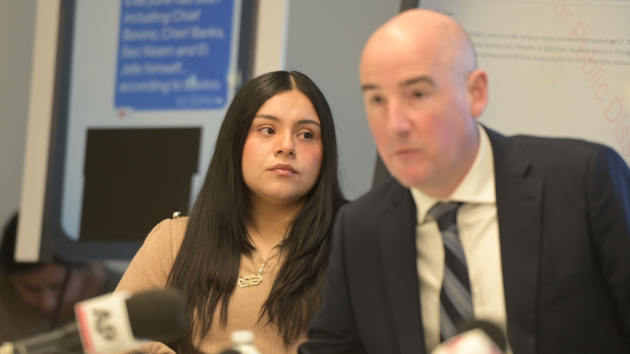
Marimar Martinez, a Chicago teacher’s assistant who survived being shot five times by a U.S. Border Patrol agent in October 2025, attends a press conference with her lawyers at the law offices of Cheronis & Parente LLC and Gallagher & Kosner Law LLC on February 11, 2026, in Chicago, Illinois, United States. (Jacek Boczarski/Anadolu via Getty Images)
(CHICAGO) — Last October, the Department of Homeland Security claimed that federal agents in Chicago were “forced to deploy their weapons and fire defensive shots at an armed US citizen” after their SUV was “rammed by vehicles and boxed in by 10 cars.”
But analysis of recently released body-camera footage of the shooting of Marimar Martinez and videos verified by nearby businesses and bystanders suggests that those claims were exaggerated — and that federal agents, knowing their actions were being recorded, appeared to coordinate with one another to explain their conduct that day.
Body camera footage and other evidence was released Tuesday after a federal judge last week granted a motion to permit the public release of the materials in the case.
The video shows that in the minute before the shooting, agents were being followed by two, not 10 vehicles. Agents stated they were “boxed in,” but at no time was their vehicle blocked from the front.
At no point in footage from an agent’s body-worn camera or from multiple surveillance cameras is a driver seen ramming the agents’ vehicle; instead, the video shows an agent appearing to steer toward the vehicle driven by Martinez, crashing into her, and then rapidly firing toward her.
Martinez, a U.S. citizen and teacher’s assistant, was shot five times during the incident. She’s now planning to sue DHS and the agent for allegedly making false claims about her following the shooting and labeling her a domestic terrorist.
While prosecutors originally alleged that Martinez “aggressively and erratically” pursued officers that day, a judge dismissed the criminal case against her with prejudice after a reversal by the Department of Justice, which sought to dismiss the case.
A U.S. Customs and Border Protection spokesperson said in a statement that the officer who shot Martinez was placed on administrative leave following the incident. The statement did not indicate the length of the administrative leave or when it began.
“CBP is committed to the highest standards of conduct, transparency, and accountability. All significant use-of-force incidents are thoroughly investigated, reviewed, and presented to the National Use of Force Review Board (NUFRB), an independent body comprised of senior CBP officials and representatives from DHS and DOJ, including the DOJ Civil Rights Division,” the statement said.
Below is a timeline of the incident based on the body camera footage and bystander video leading up to and after the shooting.
The lead-up 10:27:02 a.m.
Three federal agents are riding in an SUV in the first moments of video from an agent’s body-worn camera. Later, the video will reveal an Uber placard on the front of their SUV. One agent is seen speaking into the voice chat app on a nearby phone.
At the time, the Trump administration had surged federal resources for immigration enforcement in Chicago as part of “Operation Midway Blitz.”
According to a court filing, the agents were part of a protective detail assisting a nearby operation in Oaklawn. An FBI agent originally attested that the officers were being followed by multiple civilian vehicles.
10:28:17 a.m.
The agent’s body camera begins recording audio.
“Camera’s on,” the agent says.
The agent readies an assault rifle. With his finger on the trigger, one of the agents can be heard saying what sounds like either “do something, b—-,” or “hit something, b—-.”
10:28:35 a.m.
Another agent is seen pointing his handgun toward the right of the SUV.
A nearby driver repeatedly honks their horn, prompting one of the officers to remark, “Honk all you want.”
The agents’ vehicle is captured on a security camera on Kedzie Avenue. The SUV is flanked by Martinez, in a gray Nissan Rogue, to the agents’ left.
To their right is a GMC SUV, adorned with a Mexican flag on its hood, driven by Anthony Ruiz. Ahead of them are two cars: a sedan and a red pickup truck.
10:28:47 a.m.
Seconds later, the agent with the active body-worn camera says, “Alright, it’s time to get aggressive, get the f—- out. Because they’re trying to box us in.”
“If she hits us, it’s … ,” another agent can be heard saying.
10:28:57 a.m.
Charles Exum, the driver, appears to be the agent who says, “We’re going to make contact, we’re boxed in … we have got to get [inaudible] out of here. “
“We are boxed in,” the agent with the active body-worn camera repeats.
10:28:58 a.m.
The three vehicles briefly enter the frame of a security camera looking over a gas station parking lot.
Martinez, in the Nissan Rogue, is parallel with the agents to their left. Ruiz is behind them and to their right.
The pickup truck and the sedan, previously observed ahead of the agents’ vehicle, are also observed traveling several car lengths ahead of the agents.
10:29:01 a.m.
Exum appears to turn the car’s wheel to the left. A loud crash is heard, and the agents visibly react.
By this time, the two cars ahead of the agents have driven into the path of another security camera. The cars do not stop and drive out of view.
The shooting 10:29:04 a.m.
The agents’ vehicle comes to a stop. Their vehicle and Ruiz’s are seen stopped at the rightmost edge of the gas station security footage. The view of Martinez’s vehicle is blocked, and we do not see the agents’ vehicle make contact with hers.
Exum is seen holding a handgun in his right hand.
10:29:06 a.m.
“Out of the car,” the driver says, as he exits the car with his handgun drawn.
“Be advised, we’ve been struck, we’ve been struck,” the agent with the body-worn camera says.
A second later, five gunshots can be heard in rapid succession.
The agents’ SUV enters the field of view of another security camera. A drawing of the scene — made by one of the agents during their interview with the FBI, according to Martinez’s lawyers — indicated three vehicles were ahead of the agents’ SUV, but the footage shows that at the moment of the shooting, the agents’ vehicle has an unobstructed path forward.
10:29:09 a.m.
Martinez’s vehicle enters the frame of the security camera. She drives north, away from the scene.
10:29:11 a.m.
The agent with the body-worn camera points his rifle toward Ruiz’s vehicle, as it reverses and crashes into a parked car before turning to the left to drive away. Ruiz is later arrested at a gas station a half block away.
“Don’t you f—— move,” the officer says.
10:29:18 a.m.
As the agent turns around, his body camera shows that the SUV is not being blocked in front of it.
The aftermath 10:32:49 a.m.
Exum’s body-worn camera turns on about three minutes after firing his weapon.
10:39:19 a.m.
Exum tells a responding officer that he fired “five to seven shots” at Martinez.
“I don’t know if I hit her or not,” he says. “I [was] angled at the driver, I got five to seven rounds off at her.”
“It was a woman shooting?” the officer asked.
“No, I was shooting,” Exum said.
10:39:38 a.m.
Exum tells a responding officer that he “did the shooting” after Martinez hit his SUV.
“She already hit my vehicle, we got out to defend, she came forward, and that’s when I opened up on her,” he said. “We did not get shot at; we did the shooting.”
10:45:04 a.m.
As more officers arrive at the scene, Exum and the other agents begin to recount the incident and to ask whether his camera was on.
“We were getting out to defend because they already tried to box us in,” he said. “She was moving forward into me.”
“Camera on or no?” an officer said.
“No, I didn’t have it because we were [inaudible],” he said.
“That’s good, as long as you can justify it, bro,” the officer responds.
10:48:14 a.m.
As Exum prepares to light a cigarette, another officer acknowledges that their conversation is being recorded and advises him to “keep everything out.”
“So she hit you guys … You got boxed in?” an officer asked.
“We [were] getting boxed in, and I had to push left. She came in, she pulled over, stopped. I got out so we could defend,” Exum said.
“Hey, hey, just real quick though, since we’re recording, keep it [inaudible],” another officer says. “Keep everything out, you’re good man.”
10:50:30 a.m.
Another officer tells Exum to “keep [his] mouth shut” about the incident.
“Just so you know, you don’t give statements to anybody,” the officer says. “Absolutely no statements at all … You keep your mouth shut.”
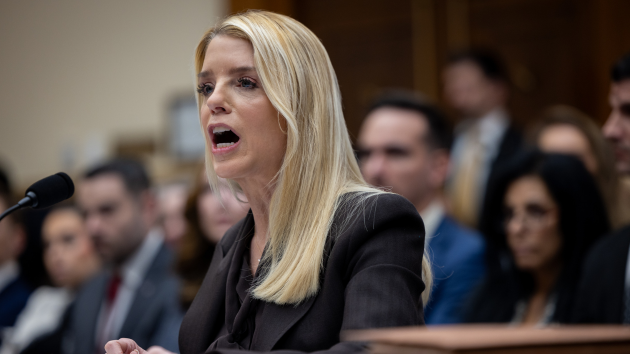
Attorney General Pam Bondi testifies before the House Committee on the Judiciary during an oversight hearing, at the Rayburn House Office Building in Washington, DC on February 11, 2026. (Nathan Posner/Anadolu via Getty Images)
(WASHINGTON) — Attorney General Pam Bondi told members of Congress on Tuesday that Ghislaine Maxwell “will hopefully die in prison,” after she was pressed on the allegations that Jeffrey Epstein’s co-conspirator was getting special treatment from the administration, including a controversial transfer to a minimum security prison.
Maxwell, who is 64, has been incarcerated since her arrest in July 2020 and would be in her mid-to-late 70s when her sentence ends.
Bondi, who clashed with Democratic members of the House Judiciary Committee when asked questions related to the Epstein investigation, however, said she could not say who ordered Maxwell’s transfer to a lower security prison and tried to change the subject.
Rep. Deborah Ross, D-N.C., brought up the transfer during the heated hearing and sought out answers, specifically who signed off on the move.
Maxwell was moved from FCI Tallahassee in Florida, a “low security” prison for men and women, to FPC Bryan in Texas, a “minimum security” camp just for women, two weeks after she had a private meeting with Deputy Attorney General Todd Blanche.
Trump has been asked about possibly pardoning Maxwell, but the president has said no one had approached him, though he reiterated his power to grant one.
Blanche, Trump’s former personal attorney, has not responded to letters from Democrats in Congress seeking more details about the move.
“She should not be in that prison,” Ross said. “She needs to be moved back to a maximum security prison as soon as possible.”
The congresswoman noted that Maxwell, who is challenging her 2021 conviction and 20-year sentence for child sex trafficking and other offenses, told another congressional committee she won’t cooperate unless she gets clemency from the president.
Ross asked Bondi if Blanche or one of her other subordinates approved the transfer, but the attorney general didn’t directly answer.
“I learned after the fact,” Bondi said of the transfer. “That is a question for the Bureau of Prisons. I was not involved at that at all,” she added.
Bondi then scolded Ross and changed the subject, bringing up a September homicide of a woman in Charlotte, North Carolina, in the congresswoman’s home state.
“You know instead of talking about Ghislaine Maxwell, who will hopefully die in prison, hopefully will die in prison, you should be talking about Iryna Zarutska,” she said.
Ross asked again if the president should pardon or commute Maxwell’s sentence.
“Should she be released from prison, yes or no? You said she should die in prison, so I’m hoping the answer is no,” the congresswoman said.
“I already answered the question,” Bondi responded, before scolding Ross again for not discussing Zarutska’s murder.
Bondi delivered several angry retorts at the members of the committee over the Epstein investigation.
Early on in the hearing, she did not look at Epstein survivors and their families when they were introduced by committee ranking member Jamie Raskin and Democratic Rep. Pramila Jayapal.
Survivors were seen shaking their heads several times during the hearing as Bondi attacked the congress members.
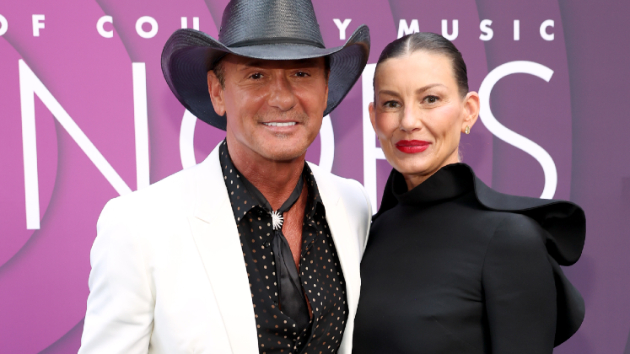
Tim McGraw & Faith Hill (Terry Wyatt/Getty Images for ACM)
If you have a crush on Tim McGraw, it’s probably about to get a little worse.
Even after three decades with Faith Hill, he still works to keep it romantic on occasions like Valentine’s Day.
“I try to feel like it’s more of an all-year-round thing, but I try to do something,” he says. “Sometimes they’re better than others. It depends on how much time that I have or how lazy I’m being. But I do pretty well most of the time. Sometimes they’re bigger than others, sometimes they’re just very simple.”
Instead of sending flowers, however, Tim’s found an inventive option.
“Faith has a rose garden,” he explains, “so she loves being around a rose garden and cutting roses and stuff. So, I’ve been finding these antique vases to give her for several occasions. So those have been pretty cool.”
The “It’s Your Love” superstars will celebrate their 30th wedding anniversary on Oct. 6.
When Taylor Swift mentions a particular place in one of her songs, it often becomes a site of pilgrimage for Swifties. Now, the location where she filmed her latest video has become a gathering place, too.
A large part of Taylor’s “Opalite” video was filmed at the Whitgift Shopping Centre in Croydon, a town in South London. The U.K. paper The Evening Standardreports that fans have been showing up at the center to take selfies of themselves riding the escalator while eating pretzels, which Taylor and co-star Domhnall Gleeson do in the video.
The shopping center, which was completed in 1970, has fallen on hard times like many malls, with more closed stores than open ones. It was supposed to have been redeveloped by 2017, but work never started on the project.
In the video, the store where Graham Norton is seen selling the “Opalite” reverse formula, “Nopalite,” was actually the mall’s Clarks shoe store. The manager toldMy London, “I think it was a real boost for Croydon. People have come to take pictures of the escalators.”
“Obviously, it was all secret, so it was a relief when it all came out,” she said of the filming, adding, “It was great. It looked like there was some soul and life in here.”
A former mall employee told My London, “If she’s putting Croydon on the map, I am now her biggest fan … I used to enjoy coming to Croydon, but now it’s sad and empty.”
As previously reported, Taylor cast every guest who was with her on the couch last year on The Graham Norton Show in the video, including Graham, Domhnall, Lewis Capaldi, Cillian Murphy, Jodie Turner-Smith and Greta Lee. Since hitting YouTube on Sunday, it’s racked up nearly 8 million views.
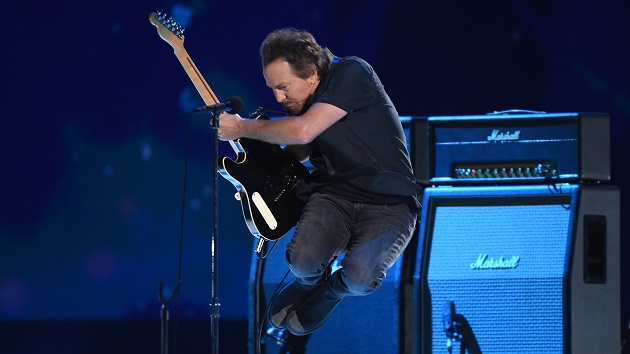
Eddie Vedder has given an update on the status of Pearl Jam following the departure of drummer Matt Cameron in 2025.
Vedder tells Rolling Stone that he came across an article describing the “Even Flow” rocks as being “between eras at the moment,” which he thought “was actually pretty concise.”
As for any further details, Vedder says, “If I were to say anything, I think we’d wanna have a band discussion about what we’d wanna say or who would be the messenger or whatever.”
Still, Vedder assures that the Pearl Jam train continues to roll on.
“We’re in the lab, we’re woodshedding, excited,” Vedder says. “It’s cool to think of change. As much as we’d like to have done it the way we did it forever — and we’ll still be able to do that thing — I think we’re all just excited for the future.”
Cameron, who’d drummed in Pearl Jam for 27 years, announced he was leaving the band in July. He finished his final tour with Vedder and company in May in support of their latest album, 2024’s Dark Matter.
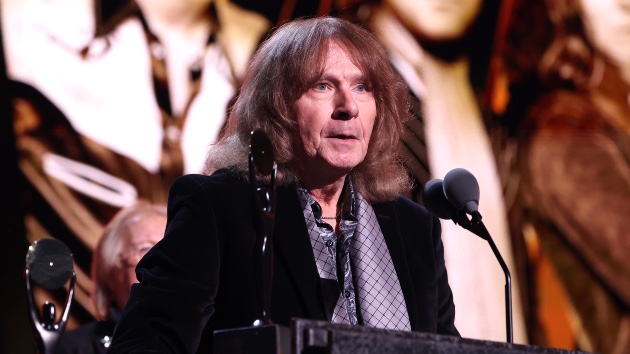
Inductee, Al Greenwood of Foreigner speaks onstage during the 2024 Rock & Roll Hall Of Fame Induction Ceremony streaming on Disney+ at Rocket Mortgage Fieldhouse on October 19, 2024 in Cleveland, Ohio. (Photo by Kevin Mazur/Getty Images for The Rock and Roll Hall of Fame)
These days it’s not uncommon for classic rock bands to be out on tour despite having no original members still in the band. In fact, this summer Foreigner and Lynyrd Skynyrd are co-headlining the Double Trouble Double Vision tour, despite neither band containing any original members.
New YorkMagazine explores the idea of these tours in the new article “When Is a Band Not the Same Band Anymore?” in which Foreigner co-founder Al Greenwood argues in favor of such bands continuing.
Greenwood notes that despite a lack of original members in the current touring iteration of Foreigner, the band’s co-founder Mick Jones is still heavily involved in selecting new members for a tour.
“They’re very respectful of the band’s sound,” he says of the new players. “They ask a lot of questions: ‘How did we do this? How did you play that? What sounds did you get?’ They want to get it right.”
He notes, “We call it the Foreigner family.”
Greenwood, like original frontman Lou Gramm, turns up for occasional shows and says that there’s a good reason to “pass the baton” to new musicians: “We’re in our mid-70s or early 80s, so it’s hard for us to go out anymore.”
“I hope it goes on forever,” he says of the Foreigner name. “Let’s face it: The music really stood the test of time.”
And Greenwood is so behind the idea that he says he’d even want to see Mick Jagger and Keith Richards replaced rather than The Rolling Stones being gone for good.
“They have to go on forever,” Greenwood says. “If they could find people who can fill those shoes, that would be incredible because the music is brilliant. I wouldn’t like to not be able to see that music being played.”
Sarah Pidgeon as Carolyn Bessette Kennedy and Paul Kelly as John F. Kennedy Jr. in ‘Love Story: John F. Kennedy Jr. & Carolyn Bessette.’ (FX)
The celebrity romance that took the country by storm in the ’90s plays out in the new limited seriesLove Story: John F. Kennedy Jr. & Carolyn Bessette.
This first season, which arrives to FX and Hulu on Thursday, marks the debut of Ryan Murphy’s brand-new Love Story anthology series. It stars relative newcomers Paul Anthony Kelly and Sarah Pidgeon as the titular couple.
On the red carpet at the show’s New York premiere, Pidgeon spoke about what it was like to bring this story to life.
“We understood the sensitivities … of trying to portray real people. But I think we always tried to lead with integrity and the truth of what might have happened behind closed doors,” Pidgeon said.
What was happening behind closed doors “was sort of the focus of this show,” Pidgeon continued. “We know the reality that they were dealing with and what might have been those discussions that the public wasn’t always privy to.”
Erich Bergen stars as Anthony Radziwill, the nephew of former first lady Jacqueline Kennedy Onassis and cousin of John F. Kennedy Jr.
He says that John F. Kennedy Jr. and Bessette were the perfect couple to start this new Love Story anthology series off with.
“I think when you look at a photo of John and Carolyn, especially in those years before they got married and on their wedding day, and even after their wedding day, these photos are filled with this tangible energy of excitement, and it was all still right in front of them,” Bergen said. “It was falling in love in New York City, which is the greatest city to fall in love in, and it’s very different than falling in love in other places. The energy here, the excitement. You fall in love with each other and fall in love with the city at the same time.”
Disney is the parent company of ABC News, FX Networks and Hulu.