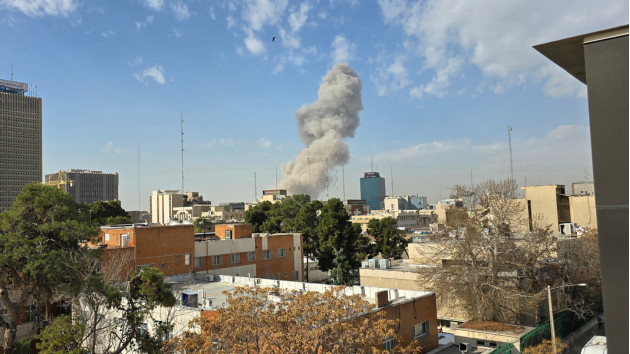
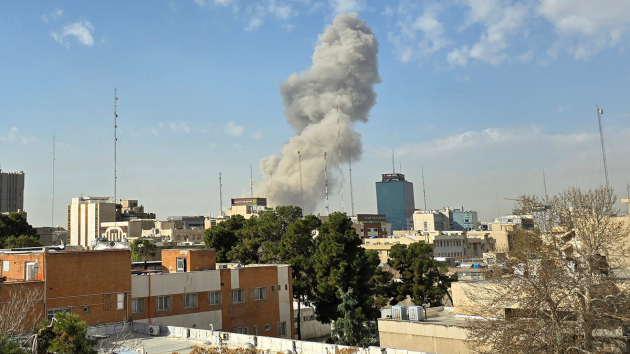
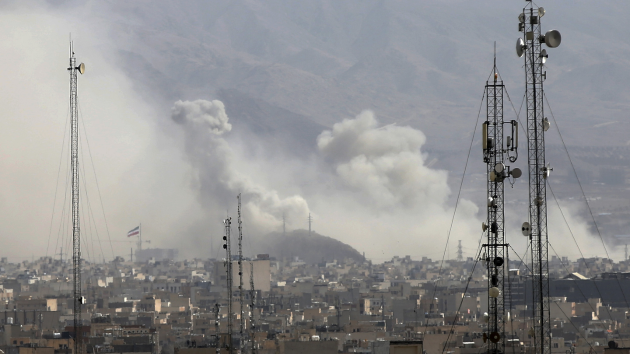
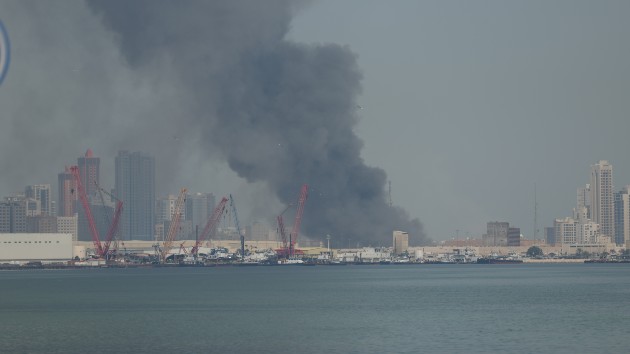
A plume of smoke rises after an explosion on February 28, 2026 in Tehran, Iran. (Photo by Majid Saeedi/Getty Images)
(NEW YORK) — The U.S. and Israel’s large-scale strikes on Iran Saturday are expected to rattle oil markets when trading resumes Sunday evening, with analysts anticipating an immediate price reaction and impact on gas prices.
The central concern isn’t just Iran’s oil production, but its influence over the Strait of Hormuz, one of the world’s most important checkpoints for oil.
According to the U.S. Energy Information Administration, roughly 20% of the world’s oil passes through the strait, making Iran’s threats to close the waterway a significant risk. The U.S. is trying to control for this situation by vowing to “annihilate” Iran’s navy.
Saudi Arabia and the United Arab Emirates have limited infrastructure in place that can bypass the Strait of Hormuz, which has the potential to mitigate any transit disruptions, but not offset them entirely.
While Iran has never followed through on these threats in the past, the perception of risk is still enough to move markets.
GasBuddy’s Patrick DeHaan expects crude oil to jump 5-10% as markets reopen, pushing oil above $70 a barrel.
While this would be much less dramatic than the response to the start of the Russia-Ukraine war in 2022, which drove prices above $100 a barrel, it would still move the average price of gas to above $3 a gallon for the first time this year.
DeHaan noted that gasoline and diesel prices in the U.S will not skyrocket overnight, and the actual impact will depend on the intensity and duration of the conflict.
Thomas Rhett & Lauren Akinds (Daniel Boczarski/Getty Images for Churchill Downs)
Thomas Rhett and Lauren Akins are now the parents of a baby boy, the two revealed on Instagram Friday evening.
“Oh. my. goodness. Our hearts are just in a big ole puddle with this precious baby BOY,” Lauren begins, leading with a photo of the little one, who has a full head of dark hair, with his arms wrapped around a stuffed duck.
“Brave Elijah Akins was born last week at almost 10 pounds and almost 2 weeks early-thank you Jesus this big boy didn’t wait another 2 weeks to be born,” she says. “Thomas Rhett was my biggest champion in labor & delivery.”
“He helped deliver him,” she continues, adding a crying emoji, “was the first one to see and *tearfully*, mixed with a bit of shock announce to us all in the room ‘It’s a BOY.’”
“We are so grateful God chose us to have YOU cutie pie,” she closes. “Your four sisters are smitten and we are completely over the moon in love with you big Brave boy.”
The post includes a full carousel of photos of the whole family, including his sisters, Willa Gray, Ada James, Lennon Love and Lillie Carolina, who range in age from 10 to 4.
A plume of smoke rises after an explosion on February 28, 2026 in Tehran, Iran. (Majid Saeedi/Getty Images)
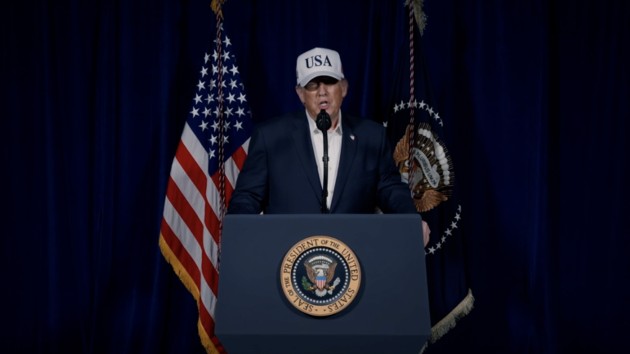
(NEW YORK) — President Donald Trump threatened “certain death” to elite forces in the Iranian regime and advised the country’s military to lay down their weapons as the United States and Israel launched attacks on the country early Saturday.
Announcing the “massive and ongoing operation” against Iran and its Middle East proxies, Trump promised immunity to members of “the Islamic Revolutionary Guard, the armed forces and all of the police if they “lay down” their weapons now.
“So, lay down your arms. You will be treated fairly with total immunity, or you will face certain death,” Trump said in a video address released overnight.
To the people of Iran, Trump said, “The hour of your freedom is at hand.”
“When we are finished, take over your government. It will be yours to take,” he added. “This will probably be your only chance for generations.”
Trump explained that among the reasons for launching the military operation is that the Iranian regime has failed to negotiate in good faith a deal in which they would agree to stop pursuing nuclear weapons.
Iran has stated numerous times that it doesn’t want nuclear weapons, but believes it has the right to use nuclear power for civilian purpose. It had also been part of a nuclear deal with the U.S., which Trump withdrew from during his first term.
Trump said Iran’s “menacing activities directly endanger the United States, our troops, our bases overseas and our allies throughout the world.”
Iranian Foreign Minister Abbas Araghchi said the U.S.-Israel strikes on Saturday were “wholly unprovoked, illegal, and illegitimate.”
Trump did not specifically say what led his administration to believe the U.S. was in imminent danger.
In a sobering message to the American people, Trump said, “The lives of courageous American heroes may be lost and we may have casualties.”
“That often happens in war. But we’re doing this not for now, we’re doing this for the future, and it is a noble mission,” Trump said.
He said that after the U.S. targeted Iran’s nuclear facilities last year in limited strikes, the regime continued to rebuild its nuclear program.
“They rejected every opportunity to remove their nuclear ambitions and we can’t take it anymore,” Trump said.
He said Iran was developing long-range missiles with the capability of threatening U.S. allies in Europe and U.S. troops stationed overseas and “could soon reach the American homeland.”
Trump said the operation intends to “prevent this very wicked, radical dictatorship from threatening America and our core national security interests.”
“We are going to destroy their missiles and raise their missile industry to the ground. It will be totally, again, obliterated,” Trump said. “We are going to annihilate their Navy. We’re going to ensure that the region’s terror proxies can no longer destabilize the region or the world and attack our forces.”
ABC News contributor Steve Ganyard, a retired U.S. Marine Corps colonel and former deputy assistant secretary of state, said it appears the U.S. operation in Iran will be a “dayslong” effort.
“I think the real point here in what the president is saying, this could be a long-term effort,” Ganyard said. “This isn’t just a pinprick. They are going after missile sites. They’re going after nuclear sites. The president did mention naval sites.”
Ganyard said that it appears the U.S. military has a list of widespread targets not seen in previous attacks, such as “Operation Midnight Hammer” that targeted Iran’s nuclear facilities in June 2025.
“The U.S. is hitting things that Iran could do to effect the rest of the world, which include nuclear sites, missile sites, the [Iranian] Navy that may be able to close the very strategic waters that could effect the global economy,” Ganyard said.
Smoke rises over the city center after an Israeli army launches 2nd wave of airstrikes on Iran on February 28, 2026. (Photo by Fatemeh Bahrami/Anadolu via Getty Images)
(NEW YORK) — Last summer, the United States struck several nuclear weapons facilities in Iran.
In the wake of the strikes, carried out by the highly advanced American B-2 bombers, President Donald Trump declared that the Iranian regime’s nuclear capabilities had been “obliterated.”
However, questions arose in the wake of the strikes about what was actually destroyed.
In the intervening months, the U.S. has tried to negotiate with the Iranian regime to reach a nuclear deal and Trump has repeatedly threatened the regime.
Recently, the administration began to float a potential strike, while maintaining that the nuclear program had been “obliterated,” leaving the justification for doing so unclear. In his address after Saturday’s strikes, Trump mentioned “imminent threats from the Iranian regime,” missile and nuclear capabilities as well as regime change.
Iran has stated numerous times that it doesn’t want nuclear weapons but believes it has the right to use nuclear power for civilian purpose.
A recent Defense Intelligence Agency memo suggested Iran was looking to develop an intercontinental ballistic missile by 2035, but Trump suggested missiles could be capable of reaching the U.S. “soon.”
Here’s how the events have unfolded.
June 12, 2025: Israel launches a series of preemptive strikes against Iran, hitting military targets including the nuclear program. A dayslong conflict erupts.
June 22, 2025: U.S. launches Operation Midnight Hammer, with more than 100 planes, including seven B-2 stealth bombers, targeting three nuclear sites in Iran. In the wake of the strike, Defense Secretary Pete Hegseth said the country’s nuclear ambitions were “obliterated.”
Hegseth said at the time that the scope of the operation was “intentionally limited” to give the Iranians a chance to negotiate and the attack was not about “regime change.” At the same time, Israel said that it struck “dozens of military sites” in Iran.
Trump floated the idea of regime change at the time writing on Truth Social – “It’s not politically correct to use the term, “Regime Change,” but if the current Iranian Regime is unable to MAKE IRAN GREAT AGAIN, why wouldn’t there be a Regime change???”
December 2025-January 2026: Protests break out in Iran that become widespread. The protests turn deadly, with the Human Rights Activists News Agency (HRANA) saying that thousands were killed. Trump threated to hit the regime “hard” if protesters were killed.
Jan. 26, 2026: Trump tells Axios that Iran “wants to make a deal.” “They were going to hang 837 people, and I told them, if you do it, you’re going to pay a price like nobody’s ever paid before. They pulled back. I appreciated that, but a lot of people have been killed. So, we’ll see what happens. I can say this. They do want to make a deal,” he said.
Jan. 28, 2026: Trump says on Truth Social that a “massive armada is heading to Iran” and “Hopefully Iran will quickly “Come to the Table” and negotiate a fair and equitable deal – NO NUCLEAR WEAPONS.” He further warned that “he next attack will be far worse” than Midnight Hammer.
Jan. 30: Trump says Iran wants to make a deal.
Feb. 3: A U.S. official confirms talks are tentatively scheduled to take place in Turkey.
Feb. 4: Secretary of State Marco Rubio says the U.S. is ready for Iran talks but “they will have to include certain things, and that includes the range of their ballistic missiles, that includes their sponsorship of terrorist organizations across the region, that includes a nuclear program, and that includes the treatment of their own people.”
Feb. 6: U.S. and Iran engage in indirect talks in Oman. After the talks, Iranian Foreign Minister Abbas Araghchi called them a “good start” according to state media.
Feb. 11: Vice President JD Vance says he wants a deal with Iran, but “if we can’t cut that deal, then there’s another option on the table.” He said regime change was “up to the Iranian people.”
Feb. 13: Trump says regime change is the “best thing that could happen.” He urged Iran to make a deal. “I will say they wanted to talk, but so far, they do a lot of talking, and no action,” he said.
Feb. 19: Trump gives Iran 15 days “maximum” to make a deal. “We’re either going to get a deal or it’s going to be unfortunate for them,” he said.
Feb. 24: During the State of the Union speech, Trump issued a stark warning to the Iranian regime. “They’ve already developed missiles that can threaten Europe and our bases overseas, and they’re working to build missiles that will soon reach the United States of America,” Trump said. Trump insisted that Iran would not agree to not pursue a nuclear weapon. He said “no nation should ever doubt America’s resolve.”
Feb. 26: The U.S. and Iran hold high stakes talks in Geneva. The administration said that it wanted a full stop to Iranian uranium enrichment. Secretary of State Marco Rubio said the regime posed a “threat” and “you can see them always trying to rebuild elements of” the nuclear program. Vance says there is “no chance” of a drawn out war.
Feb. 27: Trump says he is “not happy” with negotiations with Iran. “I’m not happy with the fact that they’re not willing to give us what we have to have.” But he said a final decision had not been made as to whether to strike. Earlier in the day, it was announced that Rubio would travel to Israel on Monday and Tuesday.
Feb. 28: The U.S. launches Operation Epic Fury, which Trump called “major combat operations” alongside Israel. Trump justified the attacks to “defend the American people by eliminating imminent threats from the Iranian regime.” He also called on the Iranian people to rise up and depose the regime. Trump has not provided evidence of the threats posed by Iran and did not seek the approval of Congress.
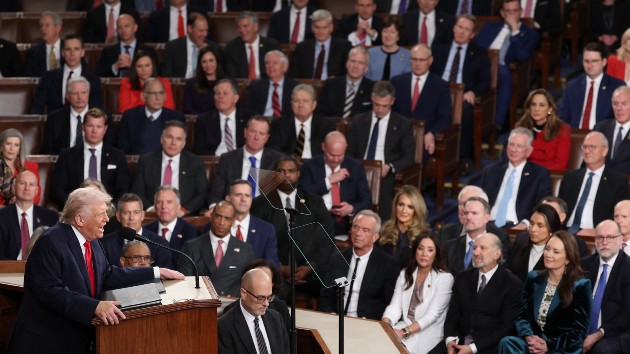
U.S. President Donald Trump delivers his State of the Union address during a Joint Session of Congress at the U.S. Capitol on February 24, 2026, in Washington, DC. Trump delivered his address days after the Supreme Court struck down the administration’s tariff strategy and amid a U.S. military buildup in the Persian Gulf threatening Iran. (Photo by Win McNamee/Getty Images)
(WASHINGTON) — In the wake of the “massive” strikes on Iran by the U.S. and Israel Saturday, members of Congress have begun weighing in — with Democrats demanding answers — and some calling for lawmakers to return to Washington to vote on resolutions that would check President Donald Trump’s power to wage war.
Republicans have so far praised President Donald Trump’s decision to undertake “massive combat operations” against Iran, with an eye towards liberating the Iranian people.
Sen. Lindsey Graham, R-S.C., one of Trump’s most ardent supporters, said in a post on X “the end of the largest state sponsor of terrorism is upon us” and celebrated “freedom” for the Iranian people.
“My mind is racing with the thought that the murderous ayatollah’s regime in Iran will soon be no more,” he said in another post. “The biggest change in the Middle East in a thousand years is upon us.”
Secretary of State Marco Rubio reached out to some members of the so-called Gang of 8 to notify them of the operation in Iran before it was underway, multiple congressional offices confirmed to ABC News.
Members of the Gang of 8 include the top bipartisan House and Senate leaders and the chairs and ranking members of the House and Senate intelligence committees.
On Tuesday of this week, hours ahead of the president’s State of the Union address, Rubio and CIA Director John Ratcliffe virtually briefed the Gang of 8 on Capitol Hill on Iran.
Immediately following the briefing, Senate Minority Leader Chuck Schumer told reporters: “This is serious, and the administration has to make its case to the American people.”
House Intelligence Committee Chairman Rick Crawford, an Arkansas Republican briefed ahead of the strikes in Iran, issued a statement providing a sense of why the president moved forward with the operation.
“Prior to the initiation of this action, in earnest diplomatic engagements with Iran, President Trump was very clear about his red line from the start and his expectations of Iran during these negotiations. Iran absolutely cannot be allowed to maintain a nuclear weapon or capabilities,” he said in a statement posted on X. “The safety and security of Americans and our allies are on the line.”
The top Democrat on the House Intelligence Committee, Rep. Jim Himes of Connecticut, said he is praying for U.S. service members but emphasizes, “everything I have heard from the Administration before and after these strikes on Iran confirms this is a war of choice with no strategic endgame.”
Democratic Sen. Tim Kaine of Virginia is calling on the Senate to return to Washington immediately to vote on a war powers resolution to check the president’s authority to wage war with Iran.
“Has President Trump learned nothing from decades of U.S. meddling in Iran and forever wars in the Middle East?” Kaine said in a statement.
“These strikes are a colossal mistake, and I pray they do not cost our sons and daughters in uniform and at embassies throughout the region their lives,” he added.
“The Senate should immediately return to session and vote on my War Powers Resolution to block the use of U.S. forces in hostilities against Iran. Every single Senator needs to go on the record about this dangerous, unnecessary, and idiotic action,” he said.
It’s very unlikely Republican leadership will heed Kaine’s call to action.
Kaine’s war powers resolution is co-sponsored by Republican Sen. Rand Paul of Kentucky and Senate Minority Leader Schumer. Earlier in the week, Kaine said he would push for a vote in the Senate as soon as next week.
Congressional Democrats announced they too will compel a vote on a war powers resolution relating to Iran next week. House Democratic leadership is expected to force a vote on the bipartisan war powers resolution.
Both efforts in the House and Senate will receive some bipartisan support, but it’s unclear if they will have enough votes to actually pass both chambers.
As strikes were underway on Saturday, Rep. Nancy Mace, R-S.C., said that after the “Iranian regime has slaughtered thousands of its own people in recent days,” the attack on Iran should be a warning to despotic regimes.
“Tyrants and terrorists everywhere should take note: the world is watching. History is watching,” Mace wrote on X.
Notably Sen. John Fetterman, D.-Pa., said he believed Trump was making the right move.
“President Trump has been willing to do what’s right and necessary to produce real peace in the region. God bless the United States, our great military, and Israel,” Fetterman wrote in an X post.
But other Democrats demanded an explanation for the strikes, like Sen. Ruben Gallego, D-Ariz., a veteran, who lamented the action.
“I lost friends in Iraq to an illegal war. Young working-class kids should not pay the ultimate price for regime change and a war that hasn’t been explained or justified to the American people,” he wrote on X.
Others called for a full briefing and a vote on a proposed war powers resolution that would limit Trump’s power.Rep. Jared Moskowitz demanded a briefing.
“This is a serious moment that demands full transparency and congressional oversight,” Moskowitz, D-Fla., wrote on X.
Smoke rises after Iran carried out a missile strike on the main headquarters of the U.S. Navyâs 5th Fleet in Manama in retaliation against US-Israeli attacks, in Bahrain February 28, 2026. (Photo by Stringer/Anadolu via Getty Images)
(LONDON) — The massive strikes conducted by the U.S. and Israel on Saturday — dubbed “Operation Epic Fury” by American forces — have been in the works over the past several “months leading up to the attack,” according to Israel officials.
In the first IDF statement following the attack on Iran, an Israel Defense Forces spokesperson said that “the strike included an attack on dozens of military targets.”
The statement also highlighted what appears to be the IDF’s close cooperation with United States across months of planning. The United States has not yet mentioned anything about the planning of the operation or how long it has been in the works for.
“In the months leading up to the attack, close joint planning was carried out between the IDF and the U.S. Army, which enabled the broad attack to be carried out with maximum synchronization and coordination between the armies,” the IDF said.
“The Iranian regime has not abandoned its plan to destroy Israel,” the statement continued. “The IDF has recognized that the regime has continued its attempts to fortify, protect, and conceal its nuclear programs, along with restoring the missile production process.
“The regime has continued to finance, train, and arm its proxies based within the borders of the State of Israel,” the IDF said. “These are actions that constitute an existential threat to the State of Israel, and threaten the Middle East and the entire world.”
The strikes involved a mix of U.S. aircraft and Tomahawk cruise missiles fired by U.S. Navy ships in the region, according to a U.S. official.
There are currently an estimated 35,000 U.S. military personnel stationed in the Middle East at the moment.
The U.S. already has large military bases in the region, with Al Udeid in Qatar being the largest with around 10,000 personnel. Close by in Bahrain, there are about 3,200 personnel and dependents stationed at the Navy’s Fifth Fleet headquarters.
There are also an estimated 1,000 U.S. troops in Syria, even as they prepare to draw down and leave the country, as well as another 2,500 troops in Iraq now mostly located in Erbil to the north.
The U.S. also has dozens more fighter jets in the Middle East than there were in mid-January.
An aircraft carrier — the USS Gerald R. Ford — along with up to four destroyers may soon join the 12 Navy ships already in the region, that includes the USS Abraham Lincoln.
In response, Iran immediately accused the U.S. of violating “all international laws and during negotiations.”
“Now is the time to defend the homeland and confront the enemy’s military aggression,” a statement released from the Iranian Ministry of Foreign Affairs said on Saturday. “Just as we were ready for negotiations, we have been more prepared than ever for defense. The armed forces of the Islamic Republic of Iran will respond to the aggressors with authority.”
A screen grab from a video released on U.S. President Donald Trump’s Truth Social account shows Donald Trump making statements regarding combat operations on Iran on February 28, 2026 in Pal Beach, Florida, United States. (Photo by US President Trump Via Truth Social/Anadolu via Getty Images)
(LONDON and NEW YORK) — President Donald Trump said that the U.S. military has begun “major combat operations” in Iran and calling on the Iranian people to rise up and seize the opportunity for regime change.
“Our objective is to defend the American people by eliminating imminent threats from the Iranian regime, a vicious group of very hard, terrible people,” Trump said in a video statement on Truth Social early Saturday morning.
The “massive” operation comes as the U.S. has been trying to negotiate with Iran over its nuclear and missile programs and hours after Trump said he was “not happy with the negotiation.”
And it comes amid questions about the potential justification for a U.S. strike on Iran since Trump has said the Iranian nuclear weapons program was “obliterated” in a U.S. strike last year.
“Its menacing activities directly endanger the United States, our troops, our bases overseas and our allies throughout the world. For 47 years, the Iranian regime has chanted “death to America” and waged an unending campaign of bloodshed and mass murder targeting the United States, our troops and the innocent people in many, many countries,” Trump said.
The military operation against Iran was a preemptive joint attack by the United States and Israel and could last several days, U.S. officials said, with potential targets including Islamic Revolutionary Guard Corps military sites, government buildings, Iranian intelligence assets and defense installations.
“Iran is the world’s number one state sponsor of terror and just recently killed tens of thousands of its own citizens on the street as they protested,” Trump said. “It has always been the policy of the United States, in particular my administration, that this terrorist regime can never have a nuclear weapon. I will say it again. They can never have a nuclear weapon.”
Trump, who campaigned on a message of keeping the U.S. out of foreign entanglements, gravely suggested that “the lives of courageous American heroes may be lost, and we may have casualties.”
“That often happens in war. But we are doing this not for now, we are doing this for the future and it is a noble mission,” Trump continued.
At the end of his message, Trump called on the Iranian people to seize this opportunity for regime change.
“Finally, to the great, proud people of Iran, I say tonight that the hour of your freedom is at hand,” Trump said.
He added, “When we are finished, take over your government. It will be yours to take. This will be probably your only chance for generations.”
Appearing to speak to the Iranian people, Trump said: “No president was willing to do what I am willing to do tonight. Now you have a president who is giving you what you want, so let’s see how you respond. America is backing you with overwhelming strength and devastating force. Now is the time to seize control of your destiny and to unleash the prosperous and glorious future that is close within your reach.”
Meanwhile, some Democratic members of Congress have begun demanding answers.
Rep. Jared Moskowitz (D.-FL) said on social media that he is “formally requesting” that the State Department and Department of War “fully brief Congress on the rapidly evolving situation in Iran.”
Senator Ruben Gallego (D.-Ariz.), a Marine veteran, also posted on X, saying “I lost friends in Iraq to an illegal war. Young working-class kids should not pay the ultimate price for regime change and a war that hasn’t been explained or justified to the American people.”
Alex Warren’s video for his new song “Fever Dream” lives up to its name.
The video starts with Alex as the driver on one of those buses that take you around to stars’ homes in Hollywood. As he passes by the houses, calling out the names of the stars who live there, he spots a mysterious woman looking through a window. He runs into the house to find her and instead stumbles across a horror movie set, with his wife, Kouvr Annon, playing the victim who’s getting stabbed. Alex ends up covered in blood.
He runs into another room in the house and finds himself in the back of a limo with two mysterious figures and some balloons. He then exits the limo and fights his way through a horde of paparazzi, only to wake up lying on a street being revived with defibrillator paddles.
Alex then finds himself in front of a sorority house and dances around with the girls there. Suddenly, he’s back in the limo, then he’s fighting off the paparazzi again. Finally, he’s in a field with the tour bus, and his customers are yelling at him. Suddenly, he sees the girl he’s been chasing in the field and runs up to her. When she turns around, we see it’s Paris Hilton.
“Paris?” he asks. “Yeah?” she responds. “It’s been you the whole time?” he asks. “Duh,” she replies. “Is this even real?” he asks. “It’s time to wake up, Alex,” says Paris, and then slaps him.
Next thing you know, he’s waking up on Hollywood Boulevard wearing different clothes. We see that he’s actually a musician busking on the street for money, and none of any of what we’ve just seen was real. Or was it?
Neil Sedaka performs, Chicago, Illinois, November 25, 1978. (Photo by Paul Natkin/Getty Images)
Singer/songwriter Neil Sedaka died Friday at the age of 86, ABC News has confirmed.
“Our family is devastated by the sudden passing of our beloved husband, father and grandfather, Neil Sedaka,” read a statement from the musician’s family. “A true rock and roll legend, an inspiration to millions, but most importantly, at least to those of us who were lucky enough to know him, an incredible human being who will be deeply missed.”
Sedaka rose to fame in the late ’50s and early ’60s, thanks to popular hits like “Calendar Girl,” “Happy Birthday Sweet Sixteen,” “Oh! Carol,” and what became his signature song, “Breaking Up Is Hard to Do,” which went to #1 in 1962. In 1975, he released a slowed-down version of the same song, which became a top 10 hit in 1976 and earned him a Grammy nomination.
Sedaka’s career as an artist saw a decline in the mid-’60s, due to the popularity of The Beatles and the so-called British Invasion, although he had continued success writing songs for other artists like Frank Sinatra, The Monkees and others. He also remained a successful performer in the U.K. where he released a trio of popular albums: Emergence, Solitaire and The Tra-La Days Are Over. Those albums prompted Elton John to signed Sedaka to his Rocket Records label, and helped reintroduce him to American audiences.
Sedaka saw a renewed popularity as a performer in the mid-’70s, thanks to the albums released on John’s label. One, Sedaka’s Back, featured the #1 song the “Laughter in the Rain,” while The Hungry Years included another #1 hit, “Bad Blood,” with an uncredited Elton John on backing vocals.
Sedaka also maintained a successful songwriting career, writing tunes for other artists, including the Captain and Tennille song “Love Will Keep Us Together,” which went to #1 and earned Sedaka and co-writer Howard Greenfield a Grammy for record of the year.
Sedaka was inducted into the Songwriters Hall of Fame in 1983, which also gave him the Sammy Cahn Lifetime Achievement Award in 2004.
Grateful Dead fans attend the Bob Weir memorial at Civic Center Plaza in San Francisco, Calif., (Jane Tyska/Digital First Media/East Bay Times via Getty Images)
The Grateful Dead have a loyal fan base, and a new movie about them is set to hit theaters this summer.
Summer Tour, directed by Mischa Richter and co-produced by actress Chloe Sevigny, focuses on the Deadhead community as they follow Dead & Company on the band’s final tour in 2023.
The film debuted at the 2025 Telluride Film Festival and was just acquired by Utopia. As a shout out to Deadheads, the company plans to roll out the film this summer with a multi-city tour across America that will include screenings and performances by Dead-inspired bands.
“We are so happy that Summer Tour has found a home with Utopia,” says Richter. “We can’t think of a better fit for our film due to Utopia’s experience with and love for music documentaries.”
“Summer Tour is a lovingly crafted hang-out documentary that roadtrips alongside such an iconic music fandom,” Utopia’s Charlie Sextro notes. “There’s a timeless quality to Mischa’s film. It’s a love-letter to community, music, alternative lifestyles and gathering together irl.”