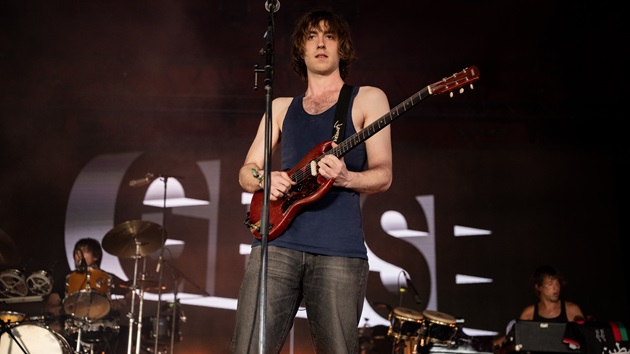
Bruce Johnston of The Beach Boys performs during Riot Fest at Douglass Park on September 20, 2025 in Chicago, Illinois. (Photo by Barry Brecheisen/Getty Images)
The Beach Boys’ Bruce Johnston is leaving the band.
The 83-year-old Johnston joined the group in 1965 as a fill-in for Brian Wilson during live performances. In a statement to Rolling Stonehesays he’s leaving the group in order to spend more time in the studio.
“It’s time for Part Three of my lengthy musical career!” he tells the mag. “I can write songs forever and wait until you hear what’s coming!!! As my major talent beyond singing is songwriting, now is the time to get serious again.”
He adds that he’ll be embarking on a speaking engagement career, along with personal appearances and events. He also plans to join The Beach Boys for special performances, including their July 3 and 4 shows at The Hollywood Bowl in Los Angeles.
“This isn’t goodbye, it’s see you soon,” he adds. “I am forever grateful to be a part of the Beach Boys musical legacy.”
Mike Love, who’s the only original Beach Boys member still in the band, tells the mag in a statement that Johnston “is one of the greatest songwriters, vocalist[s], and keyboardist[s] of our time.”
“We’ve had the honor of his performance and participation for many many years with The Beach Boys,” he adds. “Change is always promised in life, today we find ourselves in a chapter of change, but not an end.”
“I am very supportive of Bruce and I have every confidence that he will produce great music,” he notes.
After joining The Beach Boys on tour in 1965, Johnston appeared on many of their albums, starting with 1965’s Summer Days (And Summer Nights!!). He also wrote several Beach Boys songs. He left the group in 1972, but returned in 1978 and has been touring with them ever since.
HBO Max released the first trailer for its upcoming DC Studios superhero TV series on Wednesday, one day earlier than originally planned.
Kyle Chandler, Aaron Pierre and Kelly Macdonald star in the upcoming show, which will make its debut in August.
Lanterns follows a new recruit named John Stewart (Pierre) and Hal Jordan (Chandler). The two intergalactic cops are “drawn into a dark, earth-based mystery as they investigate a murder in the American heartland,” according to the show’s official logline.
“With all due respect, we’ve been training for, what, two months? And I haven’t even worn the ring yet,” Pierre’s Stewart says in the teaser trailer.
“Don’t get hung up on the jewelry, junior,” Chandler’s Hal Jordan says in response. “You’re just a f****** substitute teacher. You’re not ready to get up in front of the class until the ring says you are.”
Hal then shrugs and says, “But alright,” before leaving the ring on the dashboard and jumping out of the driver’s seat of the car he was driving.
Later in the trailer, Hal calls this instance “training.”
True Detective: Night Country‘s Chris Mundy is the showrunner for Lanterns. He writes the program alongside Watchmen‘s Damon Lindelof and DC comic creator Tom King.
An F/A-18E Super Hornet, attached to Strike Fighter Squadron 151, prepares to make an arrested landing on the flight deck of Nimitz-class aircraft carrier USS Abraham Lincoln in support of Operation Epic Fury, March 2, 2026. (U.S. Navy)
President Donald Trump’s special envoy Steve Witkoff revealed in an interview this week that Iranian negotiators told him in the lead-up to the U.S.-Israeli military operation in Iran that they had enough enriched uranium to “make 11 nuclear bombs.”
But since the major combat operations were launched on Saturday with the intent of crushing Iran’s nuclear ambitions, the administration has yet to publicly produce any concrete evidence on the whereabouts of the nuclear material or who is in control of it. The Israel Defense Forces claimed that at least 40 top military commanders were killed in the opening strikes of the conflict.
In an interview on Fox News, Witkoff told host Sean Hannity that as soon as he and Trump’s son-in-law, Jared Kushner, sat down with the Iranian negotiators for denuclearization talks last month, their counterparts spoke of their stockpile of enriched uranium.
“Jared and I opened up with the Iranian negotiators telling us they had the inalienable right to enrich all the nuclear fuel they possessed,” Witkoff said. “We, of course, responded that the president feels we have the inalienable right to stop you in your tracks.”
Witkoff claimed the Iranian negotiators openly shared details about their supply of nuclear material.
“In that first meeting, both the Iranian negotiators said to us directly with, you know, no shame, that they controlled 460 kilograms of 60% [enriched uranium] and they’re aware that that could make 11 nuclear bombs,” Witkoff said.
Witkoff said the 60% enriched uranium can be brought to weapons-grade in about a week and that the 20% enriched uranium can be brought to weapons-grade in three to four weeks.
“They manufacture their own centrifuges to enrich this material,” Witkoff said. “So, there’s almost no stopping them. They have an endless supply of it.”
The statement appears to contradict what the Pentagon said last summer about Iran’s ability to develop weapons-grade uranium following U.S. strikes on its nuclear facilities.
In July 2025, Sean Parnell, the Pentagon’s chief spokesperson, said at a news conference that that the strikes on Iran’s nuclear facilities in June set back Iran’s capability to develop a nuclear weapon by “closer to two years.”
“It’s not just … enriched uranium or centrifuges or things like that. We destroyed the components that they would need to build a bomb,” Parnell said at the time.
But on Tuesday, that assessment fell to the wayside as the administration defended the U.S. military operation by insisting Iran posed an imminent threat to Americans. A senior administration official told reporters in a briefing that among the factors in the operation was that Iran had the ability to rebuild those components destroyed in the bombing, including its own centrifuges.
The official said a lot of the enriched uranium remained mostly in Isfahan with some still at Natanz and Fordo.
“It can be a long and cumbersome process in extracting it and covering it up,” the official said. “I think the first question is, where is it? The second question is, how do we get to it, and how do we get physical control? And then after that, it would be a decision of the president and department, the Department of War, CIA, as to whether we wanted to physically transport it or dilute it on premises.”
Iran has stated numerous times that it doesn’t want nuclear weapons, but believes it has the right to use nuclear power for civilian purpose. It had also been part of a nuclear deal with the U.S., which Trump withdrew from during his first term.
Iranian Foreign Minister Abbas Araghchi told ABC’s “This Week” anchor George Stephanopoulos on Sunday that the attack on his country was “unprovoked and unwarranted.” He said Iran was negotiating with the United States in good faith prior to the attacks.
“A deal was at our reach, and we left Geneva happily with the understanding that we can reach a deal next time we meet,” Araghchi said.
In their two public briefings on “Operation Epic Fury” in Iran, Secretary of Defense Pete Hegseth and Gen. Dan Caine, chairman of the Joint Chiefs of Staff, did not address what has become of Iran’s nuclear material since the widespread military strikes began on Saturday.
In several speeches since the attacks commenced, Trump has also not been specific about the status of Iran’s nuclear material.
Hegseth, Caine, CIA Director John Ratcliffe and Secretary of State Marco Rubio conducted a closed-door briefing with members of the U.S. Senate and House on the Iran operation on Tuesday afternoon.
In a letter sent on Monday to the administration’s briefers, five top House Democrats — including Rep. Gregory Meeks of New York, ranking member of the House Foreign Affairs Committee, and Rep. Adam Smith, ranking member of the House Armed Services Committee — asked for information on nuclear security in Iran.
“Who currently controls Iran’s nuclear facilities and materials, and what safeguards are in place to prevent diversion or proliferation, or complete loss of control?” the Democratic lawmakers asked in their letter.
But following the briefing, Meeks said the briefers offered few answers.
“Here we are again without answers. Here we are again without complete transparency,” Meeks said. “Here we are again trying to go around Congress.”
Pramila Jayapal, D-Wash., said the briefers provided “no additional” information on the imminent threat that prompted the military operation, adding, “There’s nothing that we got that you don’t have.”
House Speaker Mike Johnson, R-La., challenged any suggestion that the Trump administration was unclear during their briefing with House members about their objectives in Iran.
“This is really a very simple matter. It’s about the building of ballistic missiles. That’s what Iran was engaged in, and they were doing it at a speed and in a scale that was exceeding the ability of our regional allies to respond appropriately,” Johnson said. “This created an imminent and serious threat. It also gave them cover to continue with their nuclear ambitions.”
Johnson added, “As you know, we tried very hard to negotiate with them about that nuclear enrichment of uranium … and the buildup of their missiles was so important and so serious that the President of the United States, this president, thought that it was a great enough threat that we needed to act.”
The International Atomic Energy Agency (IAEA), the United Nations’ nuclear watchdog, said in a social media post on Tuesday that, based on the latest available satellite imagery, it “can now confirm some recent damage to entrance buildings of Iran’s underground Natanz Fuel Enrichment Plant [FEP].”
“No radiological consequence expected and no additional impact detected at FEP itself, which was severely damaged in the June conflict,” the IAEA said in the post.
In June 2025, the U.S. and Israeli militaries launched “Operation Midnight Hammer,” targeting three of Iran’s nuclear facilities — Natanz, Fordo and Isfahan — with “bunker-buster” bombs, according to the White House.
At the time, Trump said the operation “completely and totally obliterated” Iran’s key uranium enrichment sites.
In a speech on Monday at the White House, Trump said that after “Operation Midnight Hammer,” Iran attempted to rebuild its nuclear facilities in another location, “because they were unable to use the ones we so powerfully blew up.”
“In addition, the regime’s conventional ballistic missile program was growing rapidly and dramatically, and this posed a very clear, colossal threat to America and our forces stationed overseas,” Trump said. “The purpose of this fast-growing missile program was to shield their nuclear weapon development and make it extraordinarily difficult for anyone to stop them from making these highly forbidden, by us, nuclear weapons.”
The Institute for Science and International Security said in a statement on Tuesday that its analysis of satellite imagery indicates the Natanz nuclear complex, Iran’s main uranium enrichment site, was struck twice during Saturday’s joint U.S.-Israeli attack.
Neither the Trump administration nor the Israeli government have confirmed the alleged strikes on the Natanz complex.
Meanwhile, Israel targeted a compound near Tehran linked to the regime’s nuclear weapons “capabilities,” the Israel Defense Forces (IDF) said in statement Tuesday.
After the U.S. targeted Iran’s nuclear facilities last year, Israel, which participated in the operation under the code-name “Rising Lion,” continued to track scientists connected to the Iran’s nuclear weapons program “and located their new location at this site in a manner that enabled a precise strike on the covert underground compound,” the statement said.
“The strike removes a key component in the Iranian regime’s capability to develop nuclear weapons and joins a series of strikes conducted during Operation ‘Rising Lion’ that were essential to eliminate the Iranian nuclear threat,” the IDF said.
-ABC News’ Mary Kekatos and Jordana Miller contributed to this report.
Charlie Puth joins Moises as chief music officer (Courtesy Moises)
Charlie Puth has just picked up a side gig: He’s now the chief music officer of AI platform Moises.
Moises was designed by musicians and is used by more than 70 million musicians worldwide, according to a press release. It lets artists do things like isolate vocals and instruments, identify chords and come up with new arrangements. What it doesn’t do is create an entirely new song out of nowhere — it’s more of a creative tool.
“I’ve been using Moises in my own creative process for years, as have many of my friends,” Charlie says in a statement. “It opens up possibilities that used to take hours or expensive studio setups.”
“AI, when done right, isn’t here to replace musicians,” he adds. “It’s here to help artists learn, explore, and bring their ideas to life.”
In his new role Charlie will “collaborate on artist-focused features, help shape creative direction, and ensure the platform continues to reflect how musicians actually work,” according to the release.
Now through March 31, Charlie and Moises are running a global remix competition, where you can create your own remix or cover of Charlie’s song “Beat Yourself Up” from his new album, Whatever’s Clever! Charlie will select the winners, who will receive $100,000 in cash and prizes, as well as a meet-and-greet at Charlie’s New York City show on May 29. You can enter now at Moises.ai.
This image provided by the FBI Feb. 5, 2026, shows a missing person Nancy Guthrie. (FBI)
(ARIZONA) — As the search for Nancy Guthrie continues into its second month, one lead that hasn’t panned out for investigators is the glove recovered about 2 miles from Guthrie’s home.
The DNA on that glove traced back to a person who works at a nearby restaurant and “has nothing to do with the case,” according to Pima County Sheriff Chris Nanos.
“We feel the love and prayers from our neighbors, from the Tucson community and from around the country,” Savannah Guthrie wrote on Instagram this week. “please don’t stop praying and hoping with us.bring her home.”
Anyone with information is urged to call 911, the FBI at 1-800-CALL-FBI, or the Pima County Sheriff’s Department at 520-351-4900.
Singer Ray J (R) and his mother Sonja Bates-Norwood attend WE tv’s premiere of “Kendra On Top” and “Driven To Love” at Estrella Sunset on March 31, 2016, in West Hollywood, California. (Photo by Jonathan Leibson/Getty Images for WE tv)
Ray J’s mother, Sonja Norwood, is setting the record straight about his health following speculation that his heart condition was a hoax.
She addressed the rumors in a recent Instagram Live. “It’s just really gotten out of hand when someone thinks that my son is faking his health, or that it’s a hoax or a joke,” she said. “To everyone who has genuinely been concerned and prayed for him, I want to thank you. It takes a lot of prayers and positive thoughts for things to change.”
Sonja shared details about Ray J’s diagnosis, which came after he was hospitalized in January.
Sonja said she and her husband traveled to Las Vegas after getting a call from his friend, where they found Ray suffering from chest pain and bundled up in a hoodie because he was cold.
Doctors later performed an angiogram, which Sonja said revealed he had a serious heart disease. He was later diagnosed with cardiomyopathy and given medications to help increase blood flow to his heart.
Ray J, who doctors said could’ve suffered a heart attack if he hadn’t checked himself into the hospital, was discharged after a week and advised to follow up with a local cardiologist, according to Sonja.
He was told he can work, stream and remain active with limitations, though she worries he may push himself too hard.
Sonja then asked for more prayers from his fans, before reiterating that her son’s condition is not a joke.
“This isn’t fake. It’s not a hoax, and it’s not about attention,” she said. “This is a serious situation. He is better. He will improve.”
Billy Idol at the 2024 Rock & Roll Hall of Fame induction (Disney/Eric McCandless)
Billy Idol is subject of the new documentary Billy Idol Should Be Dead, and during a recent appearance on Bill Maher’s Club Random podcast, he detailed a drug-filled night when he almost wound up that way.
He said it occurred when he returned to England after the success of 1983’s Rebel Yell and met up with some friends who had “a bunch of heroin on them.”
“So, of course, somehow everybody else in the room passed out, except for me and the other guy, you know, who was chopping the lines out,” he said, noting he was the last person to pass out.
“When people, other people in the room came to, I was going blue,” he said. “If you’re dying, you’re going to start turning blue.” The friends were able to revive him by putting him in a bath, with Idol simply stating, “I survived.”
Idol did eventually get off heroin, but not before dabbling with another drug first.
“Once you’re trying to get off heroin, what do you go to? You go to something else. I started smoking crack to get off heroin,” he said, adding with a laugh, “It worked. It worked.”
Billy Idol at the 2024 Rock & Roll Hall of Fame induction (Disney/Eric McCandless)
Billy Idol is subject of the new documentary Billy Idol Should Be Dead, and during a recent appearance on Bill Maher’s Club Random podcast, he detailed a drug-filled night when he almost wound up that way.
He said it occurred when he returned to England after the success of 1983’s Rebel Yell and met up with some friends who had “a bunch of heroin on them.”
“So, of course, somehow everybody else in the room passed out, except for me and the other guy, you know, who was chopping the lines out,” he said, noting he was the last person to pass out.
“When people, other people in the room came to, I was going blue,” he said. “If you’re dying, you’re going to start turning blue.” The friends were able to revive him by putting him in a bath, with Idol simply stating, “I survived.”
Idol did eventually get off heroin, but not before dabbling with another drug first.
“Once you’re trying to get off heroin, what do you go to? You go to something else. I started smoking crack to get off heroin,” he said, adding with a laugh, “It worked. It worked.”
U.S. President Donald Trump arrives for a Medal of Honor Ceremony in the East Room of the White House on March 02, 2026, in Washington, DC. (Photo by Win McNamee/Getty Images)
(WASHINGTON) — President Donald Trump on Wednesday said he will soon make an endorsement in the heated Texas Senate Republican primary, as Sen. John Cornyn and Texas Attorney General Ken Paxton head toward a runoff election in May.
Trump also expressed his desire for the non-endorsed candidate to concede.
“The Republican Primary Race for the United States Senate in the Great State of Texas, a State I LOVE and won 3 times in Record Numbers (the HIGHEST vote ever recorded, by far!!!), cannot, for the good of the Party, and our Country, itself, be allowed to go on any longer. IT MUST STOP NOW!” Trump wrote on his social media platform.
“I will be making my Endorsement soon, and will be asking the candidate that I don’t Endorse to immediately DROP OUT OF THE RACE! Is that fair? We must win in November!!!” Trump wrote.
The president’s post came hours after Senate Republican leadership urged Trump to back Cornyn, a four-term Republican senator, over Paxton, a conservative firebrand who has become popular among Trump’s MAGA base despite being involved in several scandals.
Neither Cornyn nor Paxton captured 50% of the vote on Tuesday night’s primary. Republican Rep. Wesley Hunt, who was also running in the primary, has conceded.
The winner of the GOP primary will face Democrat James Talarico, a 36-year-old Presbyterian seminarian and former teacher who defeated Rep. Jasmine Crockett on Tuesday night.
At stake in this year’s midterm cycle is Trump’s hold on Congress, where Republicans have narrow majorities in both the House and Senate.
“We need to hold that seat, which means we need to nominate somebody that’s going to win in November. And to me, that’s only one of those two that’s going to make it to the runoff: and that is John Cornyn,” Republican Whip John Barrasso said on Wednesday. “I would encourage the president to endorse him. The president will make his on his own time.”
Barrasso noted higher turnout on Tuesday night among Democratic voters, which he said “shows that the energy and enthusiasm is there on the Democrat side.
“We need to nominate somebody who attracts voters across the state of Texas, and that’s John Cornyn,” Barrasso said.
Senate Majority Leader John Thune said he’s hopeful that Trump will endorse Cornyn and save the GOP’s campaign arm from continuing to have to spend heavily to help Cornyn defeat Paxton. Cornyn and his allies already spent more than $70 million on ad spending, according to tracking firm AdImpact.
“Cornyn had, in my view — had a great night. And you know, wins. He’s positioned to win the runoff,” Thune said. “And if the president endorses early, it saves everybody a lot of money and lot of just, 10 weeks of spirited campaign on our side that keeps us from spending time focusing on the Democrats.”
Thune said that a hard-fought primary runoff between two Republican candidates is “not helpful.”
“Which is why, if the president can weigh in, it would be enormously helpful,” Thune said.
Thune later told Fox News that he spoke with Trump on Wednesday and reiterated his support for Cornyn, though he said Trump “makes his own decisions.”
Throughout the course of the primary election, Trump’s avoided making an endorsement, claiming that Cornyn, Paxton and Hunt were all “excellent” candidates and his “friends.”
Trump, in his social media post on Wednesday, praised Cornyn and Paxton for running “good races” but said they were “not good enough.”
“We have an easy to beat, Radical Left Opponent, and we have to TOTALLY FOCUS on putting him away, quickly and decisively! Both John and Ken ran great races, but not good enough. Now, this one, must be PERFECT!” Trump wrote.
ABC News’ Diana Paulsen contributed to this report.
Republican congressional candidate Brandon Herrera speaks during a campaign rally at the Constantino S Pizza restaurant on February 26, 2026, in Somerset, Texas. Brandon Bell/Getty Images
(TEXAS) — The Texas 23rd Congressional District race is projected to head to a runoff, as incumbent Rep. Tony Gonzales, who was accused of having an affair with a staffer who later died by suicide, and conservative activist Brandon Herrera both failed to receive more than 50% of the vote.
With 94% of the expected vote reporting Wednesday morning, Herrera holds just about a 1-point advantage over Gonzales (roughly 43% to 42%).
Gonzales and Herrera previously went head-to-head in the 2024 Republican primary and similarly advanced to a runoff. Gonzales ultimately won by just 400 votes.
Tuesday’s primary election came as Gonzales battles calls from some House Republicans to resign amid allegations that he engaged in an extramarital affair with a congressional aide who died by suicide last fall. Gonzales has denied the allegations of the affair with the aide, Regina Santos-Aviles.
Asked recently if he had an extramarital affair with Santos-Aviles, Gonzales said “what you have seen is not all the facts.”
Text messages, provided to ABC News by Santos-Aviles’ widower, appear to show Gonzales pursuing a relationship with the former staffer. ABC News has reached out to Gonzales for a request for comment on the text messages.
In February, Gonzales told ABC News that “Ms. Santos-Aviles was a kind soul who devoted her life to making the community a better place.”
ABC News has also confirmed that Gonzales has been under investigation by the Office of Congressional Conduct, which has already completed its probe. Due to its rules, the OCC can’t transmit a report against a member of Congress 60 days prior to an election.
The runoff election is scheduled for May 26, which is more than 60 days away from the primary election.
On Wednesday, the House Ethics Committee announced that it started an investigative subcommittee to look into the allegations against Gonzales.
Gonzales has notably lost many endorsements in his bid for reelection as calls for his resignation continue. He said last month that he is “not going to resign.”
President Donald Trump had endorsed Gonzales prior to the allegations. Since then, the White House has not responded to ABC News’ questions about whether the president still supports Gonzales.
In a post on X reacting to the news of a runoff, Gonzales began by thanking the president and looking forward to a “victorious May.”
In a reply to Gonzales post, Herrera retorted: “Are you seriously congratulating yourself for not winning your primary?”
Herrera, a Second Amendment activist and social media personality, has also faced his share of controversy, including accusations that his YouTube videos allegedly featured Nazi-related imagery. In response, Herrera wrote in a social media post that “I am not, nor have I never been a neo-Nazi.”
Both candidates have sought to align themselves closely with the president.
ABC News’ Lauren Peller contributed to this report.