In this handout photograph taken on Feb. 24, 2025 and released by the Ukrainian Presidential Press Service on Feb. 25, 2025, allied leaders visit an exhibition of the latest drones in Kyiv, Ukraine. Handout/UKRAINIAN PRESIDENTIAL PRESS SER
(LONDON) — Russia’s Defense Ministry claimed to have shot down 130 Ukrainian drones on Tuesday night into Wednesday morning, in what appears to be among Kyiv’s largest ever long-range strike into Russian territory.
Moscow said that 85 Ukrainian drones were shot down over the southern Russian region of Krasnodar Krai, with 30 more over Crimea. Another eight drones were downed over the Sea of Azov, five over the Black Sea and one each over Bryansk and Kursk regions, the ministry said.
The drones over Krasnodar appeared to mass around the Black Sea port of Tuapse, which sits between the resort city of Sochi and the Russian naval base at Novorossiysk.
Gov. Veniamin Kondratyev said several houses in the Krasnodar Krai region were damaged by drone strikes or falling debris.
Andriy Kovalenko, the head of the Counter-Disinformation Center operating as part of Ukraine’s National Security and Defense Council, said on Telegram that Russian authorities “reported an attack on the seaport in Tuapse,” which he described as “one of the key cargo ports of the Russian Federation on the Black Sea.”
“There is an oil terminal there — one of the largest in Russia,” Kovalenko added. “Oil and oil products are transported through the port, which makes it important for the Russian energy industry.”
Kovalenko said the port processes significant volumes of coal, mineral fertilizers, metal products and grain, plus serves as a rail and logistics hub for Russia’s central and southern regions.
“The port plays an important role in supporting military logistics,” Kovalenko wrote. “It is used to transport equipment, ammunition and fuel for military needs. It provides logistical support to the ships of the Russian Black Sea Fleet, in particular those involved in the war against Ukraine.”
Ukraine’s air force, meanwhile, reported another night of Russian cross-border attacks on Tuesday night. The air force said Russia fired 177 drones into Ukraine, of which 110 were shot down and 66 were lost in flight.
The air force reported engagements in Kyiv, Kharkiv, Kirovohrad and Sumy regions.
(ROME) — The pope spent another ‘quiet night’ in Rome’s Gemelli Hospital, where he has been recovering from a bout with bronchitis since Feb. 14, the Vatican said early Wednesday.
Pope Francis’ condition remains “critical but stable,” Vatican officials said in a brief update on Tuesday.
“There have been no acute respiratory episodes and hemodynamic parameters continue to be stable. In the evening, he underwent a scheduled CT scan for radiological monitoring of the bilateral pneumonia. The prognosis remains uncertain,” the Vatican said Tuesday.
Vatican officials said Sunday he remained in critical condition but officials said that he had shown a “slight improvement” on Monday.
Further updates on the pontiff’s condition are expected on Wednesday.
(LONDON) — Israel confirmed it is conducting strikes in southern Syria, as the new Syrian government calls for the full withdrawal of Israeli forces from Syrian territory.
“We will not allow southern Syria to become southern Lebanon,” Israeli Defense Minister Israel Katz said regarding the strikes. “Any attempt by the Syrian regime forces and the country’s terrorist organizations to establish themselves in the security zone in southern Syria will be met with fire.”
This is a developing story. Please check back for updates.
(BELIZE) — Police in Belize are investigating after three young American women were found dead in their hotel room at a luxury beachfront resort last weekend.
The women — identified as 23-year-old Koutar Naqqad, 24-year-old Imane Mallah and 26-year-old Wafae El-Arar — were found dead at the Royal Kahal Beach Resort in San Pedro on Saturday morning.
The investigation into the cause of their deaths is underway, but Belize’s police commissioner said on Tuesday that carbon monoxide poisoning and possible overdoses are being considered.
Officials noted that alcohol and gummies were found in the hotel room. “We’ve had issues with gummies in the past being resold and sending people to the hospital,” the commissioner said in a statement.
An autopsy is being conducted Tuesday, according to police.
The commissioner said authorities reviewed surveillance footage from the resort that showed the women entering the hotel Thursday evening and they were not seen leaving the room again.
Additionally, nobody was seen entering the women’s room in the footage, according to the police.
The hotel told authorities that nobody answered the door when housekeeping arrived on Friday, so they left.
Police said the women could have been dead in the hotel for approximately 20 hours before they were found.
The women, originally from Morrocco, lived in Revere, Massachusetts.
“The City of Revere extends our heartfelt condolences to the family and friends of the three local women who tragically and unexpectedly passed away in Belize,” the city wrote on Facebook on Monday.
(ROME and LONDON) — Pope Francis’s condition remains “critical but stable,” Vatican officials said in a brief update on Tuesday.
“There have been no acute respiratory episodes and hemodynamic parameters continue to be stable. In the evening, he underwent a scheduled CT scan for radiological monitoring of the bilateral pneumonia. The prognosis remains uncertain,” the Vatican said Tuesday.
The pope resumed his work activities after receiving the Eucharist.
The pope “rested well, all night long,” sleeping without interruption, Vatican sources told ABC News. He woke up on Tuesday and continued his usual therapies, the sources said.
Francis, 88, has been hospitalized at Rome’s Gemelli Hospital since Feb. 14 following a bout with bronchitis.
Vatican officials said Sunday he remained in critical condition. Officials said on Monday that he had shown a “slight improvement.”
The pontiff, who has led the Catholic Church since 2013, was diagnosed with pneumonia last Tuesday, according to the Vatican.
This is a developing story. Please check back for updates.
(LONDON) — When she left her home in Gaza City 16 months ago, Tala Herzallah didn’t think she was seeing it for the last time.
Now, walking in the rubble of what used to be her house, the 22-year-old Palestinian can barely recognize the place where she spent most of her life.
“It pains me to say it, but I only can recognize a wall from my home. Just one wall,” she told ABC News. “Otherwise, everything just disappeared as if it wasn’t there.”
Herzallah, an English student at the Islamic University of Gaza, packed her school bag and a few of her most treasured belongings as she evacuated after incessant bombing hit her neighborhood, Tel Al-Hawa.
The northern part of Gaza was the first target of Israel’s retaliatory strikes following the Hamas-led October 2023 terror attack and remained the scene of some of the fiercest fighting. Multiple ground operations and relentless airstrikes damaged or destroyed most of the buildings.
Its residents were forced to evacuate. The lack of aid, medical care and basic resources made life impossible for those who stayed behind.
Still, as soon as a ceasefire between Israel and Hamas was announced in January, hundreds of thousands made their way back north.
Those that have returned have been shocked by the devastation: their houses and belongings were mostly reduced to rubble and the signs of a humanitarian crisis are apparent on every corner.
But when Herzallah looked behind from her car, as bombs fell across the road that was taking her and her parents to a safer place in the south, she still hoped to return to north Gaza as she always knew it: colorful, vibrant and full of life.
That hope never faded, but with every month of war that went by, Herzallah said she knew there would be nothing waiting for her in Tel Al-Hawa.
“I know that it was destroyed. But until the last moment, I had this tiny hope that no, it won’t be destroyed. The pictures they showed me, I didn’t trust them,” she told ABC News. “I told myself, when I will reach it, it will be good.”
But it was not. As for millions of Palestinians in Gaza, Israel’s war changed everything for Herzallah.
Her house was reduced to rubble. Her education was paused as her university was destroyed and her beloved professor, Dr. Refaat Alareer, killed in an Israeli airstrike.
She was separated from her family, with her brothers in different parts of Gaza and her nephews abroad. She lost all her privacy, having to share a bathroom with more than 20 people for months.
“I don’t want to remember these days. I don’t want to remember how much I suffered because each time I remember these details, I feel that we’re not human beings,” she said. “No human being can tolerate and bear this much of pain and suffering.”
More than 48,000 Palestinians have been killed in the conflict, the Hamas-run Health Ministry reported, and 1.9 million people have been displaced, according to the United Nations.
Unable to process her present, Herzallah said she sometimes struggles to envision her future. Especially when the future she thought she would have had, if the war had not happened, gets in the way of planning anything else.
Entering her school’s campus for the first time since the war began, Herzallah found it changed to a shocking degree.
The Islamic University of Gaza, where she studied English Literature and Translation for the past three years, was hit by an Israeli airstrike on Oct. 10, 2023, as seen in a video shared by the Israeli military. They claimed Hamas used it as a base.
“It was always colorful. Colored with smiles, laughs,” Herzallah said, surrounded by burnt seats and a damaged stage. “I’ve never imagined to enter this place and see it as black as darkness. Pain is everywhere.”
Holding a graduation hat covered in dust, Herzallah said she felt all her losses.
“The first time I came to university, I dreamed of graduation day, of taking photos here with my family, siblings and professors,” she said. “Now I am graduating with nothing.”
Still, Herzallah said her dreams are “stuck between and among this rubble,” in her education. She received a scholarship to pursue her master’s degree in the U.S., which she sees as a second chance to make up for lost time and opportunities.
But she needs to leave Gaza first. Ceasefire talks are ongoing, but a permanent end to the war has yet to be agreed and Gaza’s borders remain closed.
Surrounded by unpredictability and hardship, one certainty remains for Herzallah: that if help is given, Palestinians can rebuild.
“We are strong enough to build it again. But the point is that we need a lot of things to help us. We need a lot of machines and other stuff,” she said.
To President Donald Trump’s proposal that the U.S. take over Gaza, Herzallah has a clear answer: provide the tools and then leave Gaza to Palestinians. She added his comments felt like a slap on her face after everything her people experienced.
“The relationship between Palestinians and their land is like the relationship between any mother and her sons,” Herzallah said. “Even if they leave their mother for a period of time, they will return at last to her hug and her embrace.”
(LONDON) — Ukrainian President Volodymyr Zelenskyy and his leadership team spent much of 2024 cautiously courting both sides of America’s widening political divide — well aware that repelling Russia’s ongoing invasion relied, in large part, on U.S. largesse.
Kyiv appeared hopeful it could weather President Donald Trump’s dramatic return to the White House, assuring itself and the world that his campaign trail alignment with Russia’s narrative would be tempered by the geopolitical realities of the world’s most powerful office.
But the first month of Trump’s second term has already delivered a radical American pivot. The opening of U.S.-Russia talks in Saudi Arabia — intended to secure peace in Ukraine, but conducted without Kyiv’s involvement — and subsequent fraying of U.S.-Ukrainian ties, poses a new crisis for a nation that has grown used to living with existential peril.
Volodymyr Fesenko, a political scientist and the СEO of the Center for Political Studies “Penta” in Kyiv, told ABC News that recent developments represent “the most acute crisis in relations between the U.S. and Ukraine in their entire history.”
“In the worst case, this is a strategic turn of the U.S. towards Russia, rapprochement with Putin and weakening — or even the destruction — of previous partnership relations with Europe and Ukraine,” Fesenko said. “I am afraid that this is the scenario that will gradually be realized.”
“With Trump’s businesslike approach to bilateral relations, and with his interest in restoring relations with Russia, the previous special partnership relations between the U.S. and Ukraine will no longer exist,” Fesenko said.
Former President Joe Biden’s commitment to involving Kyiv in any talks to end the war was embodied by the “nothing about Ukraine without Ukraine” motto. That approach appears to have been replaced with Trumpian transactionalism.
The White House now appears to be strongarming Kyiv into economic, territorial and political concessions, with Trump himself berating Zelenskyy — celebrated by many Americans for his stoic wartime stewardship — as a “dictator without elections” who “better move fast or he is not going to have a country left.”
Zelenskyy and his top officials have pushed back, noting that Ukraine is unable to hold new elections while under martial law. Kyiv has said it is happy to work with the new administration on mutually beneficial economic and security deals, while urging American partners to treat Moscow’s narrative with skepticism. Ukraine’s parliament on Tuesday voted to affirm Zelenskyy’s legitimacy and agree that no elections can be held while the war continues.
The situation is “beyond disturbing” for Kyiv, a source close to the Ukrainian government told ABC News. “It’s hard to imagine that it can be pulled back.”
Ukraine’s leadership is trying to chart a course through the minefield of Trump’s second term, the source added. “They feel that they’re striking this balance of not being impolite or disrespectful when it comes to countering some of the things that, again, at the end of the day, no Ukrainian leader can accept,” the source said.
“They feel that they’re managing it well, which doesn’t mean that they don’t have anxiety,” they added. “They do, because it is a fact that they rely on U.S. support, it is a fact that Europe cannot totally compensate for that support.”
“They’re striking this balance of pushing back, but not in a way where they’re coming off as totally obstructionist and obstinate,” the source continued.
This month’s historic U.S.-Russia meeting in Riyadh laid bare the new administration’s approach to Moscow. The two sides agreed to normalize diplomatic relations and continue talks aimed at ending Russia’s war, all without Ukraine’s involvement.
Meanwhile, Trump’s bid to win access to hundreds of billions of dollars worth of Ukrainian mineral resources further unsettled Kyiv. “We’re going to get our money back,” the president said of the would-be deal, the first draft of which Zelenskyy rejected, declaring, “I can’t sell our state.”
But after a week of intense negotiations, both sides now suggest they have all but reached a deal, with Trump saying Monday he expects to see Zelenskyy in Washington next week.
The reversal of the U.S. approach is striking. Where once Biden and his team refused to engage with Moscow outside of an unprecedented sanctions campaign, Trump and his top officials are now lauding a revival in bilateral ties.
Where Biden once led the “ironclad” commitment to defending Ukraine against Kremlin aggression “for as long as it takes,” Trump falsely suggested Ukraine “should have never started” the war.
The Biden administration’s steady flow of vital military and economic aid, meanwhile, has been replaced with Trump’s push to recoup what he sees as poorly invested American money. “I want them to give us something for all of the money that we put up,” Trump told CPAC on Saturday. The president has focused in on the value of American aid to Kyiv, which he claims is as high as $500 billion. Zelenskyy disputed the figure and said American aid was given as grants, not loans. The Kiel Institute for the World Economy — a research institute in Germany that tracks foreign aid to Ukraine — said the U.S. has contributed around $119 billion to Ukraine over three years of war. The majority — $67 billion — was in the form of military equipment.
America’s rising Ukraine-skepticism is being expressed on all fronts. In an extraordinary illustration of the re-alignment on Ukraine, the U.S. sided with Russia in a vote against a United Nations General Assembly resolution condemning Russia, which passed on Monday with the support of the U.S.’ traditional Western allies. The UN Security Council passed a U.S.-drafted resolution which called for an end to the conflict without criticizing Russia. France and the U.K. abstained on the UNSC vote.
Zelenskyy has said Ukraine will not agree to any peace deal that does not protect it against renewed Russian aggression. The Trump administration’s rapid policy shift has pushed European allies to mobilize to provide their own long-term support — and protection — of Ukraine. Britain, France and others are discussing deploying European troops to Ukraine to guard any peace deal.
Though financially and logistically dependent on foreign partners, Ukraine’s armed forces are among the world’s most potent and experienced. Zelenskyy said in January that 980,000 Ukrainians are now under arms, dwarfing any other European military.
Despite Trump’s unproven claims to the contrary, well-respected polling organizations in Ukraine have found that Zelenskyy retains the trust of the majority of Ukrainians. His compatriots want the war to end on what they consider fair terms, but a December survey by the Kyiv International Institute of Sociology poll indicates that 57% are prepared to carry the conflict’s burden for as long as necessary, despite heavy casualties, ongoing attacks on infrastructure and severe economic strain.
There are more testing days to come. Moscow has said that the U.S. and Russian negotiating teams will meet for a second round of talks within the next two weeks.
“It should not look like Americans and Russians are trying to reach a deal about Ukraine’s fate behind our backs,” Oleksandr Merezhko, a member of the Ukrainian parliament representing Zelenskyy’s party, told ABC News.
“But what is really important for us is that such communication between Americans and Russians should not lead to the decisions concerning Ukraine,” said Merezhko, who is also the chair of the parliament’s foreign affairs committee.
“I hope that it might be a part of a political game on the part of Trump, who is trying to lure Putin into negotiations to demonstrate to his voters that he is at least trying to deliver on his promise,” Merezhko added.
“That’s why we need constant communication with Trump and his team — if there is a vacuum, it can be filled by pro-Russian narratives.”
Yuriy Boyechko, the founder and CEO of the Hope for Ukraine charity, told ABC News he believes Trump “is taking a side of the aggressor.”
“Ukrainians won’t sign a surrender,” he added. “We will keep on fighting to preserve a free and democratic Ukraine even if our top ally — the U.S. — walks away. We have no other choice.”
ABC News’ Patrick Reevell contributed to this report.
(KYIV, UKRAINE) — Ukraine’s parliament has passed a resolution affirming the legitimacy of Volodymyr Zelenskyy as president and confirming that elections are not possible until after the war ends.
The resolution is a rebuff to U.S. President Donald Trump and Russian President Vladimir Putin, who have both suggested Zelenskyy is illegitimate because he has not held elections during the war with Russia.
Zelenskyy said on Sunday he would step down if it meant peace for his country, adding he would also do so if it meant Ukraine would be granted NATO membership.
The parliament noted on Tuesday that Zelenskyy was elected in legitimate elections and his mandate is not in doubt. It also said that no elections can be held until the lifting of martial law after the coming of a “just and lasting peace.”
Zelenskyy was elected in a landslide in 2019, but his term expired last May. Ukraine is under martial law which under its constitution forbids the holding of elections.
Most Ukrainians, including major opposition parties, agree that holding credible elections now amidst the war is not possible because millions are abroad as refugees, hundreds of thousands are fighting.
An election could also be an opportunity for Russia to divide the country while it is trying to defend itself.
Members of parliament passed the resolution on Tuesday in a second attempt, after an initial vote on Monday failed to achieve sufficient support.
Oleksandr Merezhko, a member of the Ukrainian parliament representing Zelenskyy’s party, told ABC News that Monday’s vote failed because too few of the president’s faction were present.
“It was Monday, when many members of parliament hadn’t come from their districts yet,” he said. By Tuesday, enough MPs were in attendance for the vote to pass comfortably.
ABC News’ David Brennan contributed to this report.
Jabin Botsford/The Washington Post via Getty Images
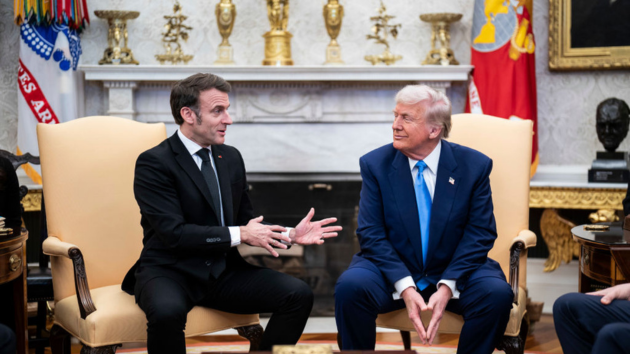
(WASHINGTON) — French President Emmanuel Macron used his visit to the U.S. to publicly push back on President Donald Trump’s repeated attacks on Ukraine, fact-checking his American counterpart in real-time and urging caution in talks with Russian President Vladimir Putin.
During their joint Oval Office appearance on Monday, Macron interrupted Trump when the latter said that Europe was being paid back 60% of the aid it contributed to Kyiv over the last three years of war.
Touching Trump’s arm to interject, Macron said, “No, in fact, to be frank, we paid. We paid 60% of the total effort: it was through, like the U.S., loans, guarantees, grants,” Macron said. “And we provided real money, to be clear.”
After Macron’s comments, Trump smiled and replied, “If you believe that, it’s okay with me.”
In a Fox News interview that also aired on Monday, Macron warned Trump to “be careful” in the nascent U.S.-Russia talks intended to end Moscow’s 3-year-old war, without the direct involvement of Ukraine or European allies.
“I think the arrival of President Trump is a game-changer,” Macron said. “And I think he has the deterrence capacity of the U.S. to reengage with Russia.”
“We want peace,” the French president continued. “And I think the initiative of President Trump is a very positive one. But my message was to say be careful because we need something substantial for Ukraine.”
Trump’s repeated demands that Kyiv repay U.S. aid given since the beginning of Russia’s invasion have strained American ties with Ukraine and with its European allies.
The White House has framed its proposed deal to secure access to hundreds of billions of dollars worth of Ukrainian resources as part of Trump’s push to recoup American wartime investment. Ukrainian officials said Monday that the deal is close to being finalized.
Trump said Monday he will soon meet with Zelenskyy, signaling the U.S. and Ukraine were “close” to a deal giving the U.S. access to profits from Ukraine’s valuable mineral resources and that Zelenskyy would come to Washington to sign it.
“I will be meeting with President Zelenskyy. In fact, he may come this week or next week to sign the agreement,” Trump said.
The president continued to focus on what he considers Ukraine’s unfair approach to U.S. and American aid during Russia’s war.
Trump again falsely claimed the U.S. has given Ukraine $350 billion during this period — a figure publicly disputed by Zelenskyy. The Kiel Institute for the World Economy estimates that the U.S. has committed about $119 billion. The majority — $67 billion — was in the form of military equipment.
The institute says that European nations — meaning the European Union, the U.K., Iceland, Norway and Switzerland — have collectively contributed around $138 billion to Ukraine, $65 billion of which was military equipment.
ABC News’ Alexandra Hutzler and Ellie Kaufman contributed to this report.