
US talks pose ‘conundrum’ for Greenland, Denmark: Analysts

US talks pose ‘conundrum’ for Greenland, Denmark: Analysts
The flag of Greenland, known locally as “Erfalasorput” flies next to the Church of Our Saviour on March 30, 2025 in Nuuk, Greenland. (Leon Neal/Getty Images)

(LONDON) — U.S. officials are expected to meet with Danish and Greenlandic counterparts in Washington, D.C., on Wednesday, amid President Donald Trump’s continued expressions of intent to acquire the semi-autonomous Arctic territory despite collective opposition in both Copenhagen and Nuuk.

Danish Foreign Minister Lars Lokke Rasmussen and Greenlandic Foreign Minister Vivian Motzfeldt are set to lead the delegation to meet with Secretary of State Marco Rubio and Vice President JD Vance. Greenland is a self-governing territory within the Kingdom of Denmark.

In Denmark, “this is the big national news,” Jonas Parello-Plesner, a Danish political analyst and former diplomat, told ABC News. “If in the first Trump period the saying was, ‘You should take him seriously, but not literally,’ I think the saying this time around is, ‘You should both take him seriously and literally.'”

Trump first raised the prospect of acquiring the territory during his first term, when Danish Prime Minister Mette Frederiksen dismissed the idea as “absurd.” Trump’s second term has seen the president speak more aggressively about the proposal.

“Even from a year ago, I see a quite stark difference in both Greenlandic and Danish attitudes that this is actually potentially really serious and life changing for the Kingdom of Denmark,” said Parello-Plesner, who is now the executive director at the Copenhagen-based nonprofit Alliance of Democracies Foundation.

Mikkel Runge Olesen, a senior researcher at the Danish Institute for International Studies, told ABC News that the furor is prompting deeper questions among Danes and Greenlanders about their long-standing ties to the U.S.

“Is this who the U.S. is now? A superpower going around, invading its small democratic allies?” he asked. “That’s scary to think of.”

“Just think of what it will do for the American alliance system worldwide,” he added. “What kind of signal it sends — if you’re allied with the U.S., you may be invaded whenever it suits the U.S.”

‘You need ownership’
Trump has repeatedly suggested that U.S. sovereignty over the world’s largest island is necessary to ensure American security and blunt Chinese and Russian influence in the Arctic region.

As a part of the Kingdom of Denmark, Greenland is covered by NATO’s collective defense clause. Greenland hosts the U.S. Pituffik Space Base and around 150 American troops, the U.S. having significantly downgraded its footprint from its high point during the Cold War.

A 1951 defense agreement grants the U.S. military access to Greenland, and Danish politicians have repeatedly expressed willingness to work with Washington to expand the American and NATO presence there.

Danish officials have also sought to head off concerns about the supposed vulnerability of the Arctic. Last year, Copenhagen announced a $6.5 billion Arctic defense package in response to U.S. criticism that it had failed to adequately protect Greenland.

But Trump and his administration appear undeterred. “One way or the other, we’re going to have Greenland,” the president told reporters aboard Air Force One this weekend.

“If we don’t take Greenland, Russia or China will and I’m not letting that happen,” Trump said, before deriding Denmark’s military strength on the island.

“Basically, their defense is two dog sleds,” Trump said. “In the meantime, you have Russian destroyers and submarines and China destroyers and submarines all over the place.”

Asked if there was a deal to be done to avoid further tensions, Trump said he would “love to” because “it would be easier.”

But when pressed, the president said, “I could put a lot of soldiers there right now if I want. But you need more than that. You need ownership.”

Ahead of this week’s meeting, Danish and Greenlandic politicians issued statements again rebuffing any suggestion of a U.S. acquisition of the island, statements which were backed by other European leaders.

“If the United States decides to attack another NATO country, then everything would stop — that includes NATO and therefore post-World War II security,” Frederiksen said in a statement.

“Greenland is part of the Kingdom of Denmark. Greenland is a member of NATO through the Commonwealth and therefore the defense of Greenland is through NATO,” the government in Nuuk said in a statement.

On Wednesday, Greenlandic Prime Minister Jens-Frederik Nielsen posted a photo to social media showing a message sent to him by Frederiksen.

“Greenland will not be owned by the United States,” the message — written in Greenlandic — said. “Greenland does not want to be ruled by the United States. Greenland does not want to be a part of the United States. We want Greenland to continue to function as part of the Kingdom.”

The leaders of all five political parties holding seats in Greenland’s parliament also released a joint statement. “We do not want to be Americans, we do not want to be Danes, we want to be Greenlanders,” they said.

Before heading to the U.S. on Tuesday, Rasmussen — the Danish foreign minister — told reporters in Copenhagen, “Our reason for seeking the meeting we have now been given was to move this whole discussion, which has not become less tense since we last met, into a meeting room where we can look each other in the eye and talk about these things.”

Appealing to ‘the deal-maker’
Olesen, of the Danish Institute for International Studies, said Trump’s most recent comments “should worry Danish politicians.” His apparent dismissal of Copenhagen’s efforts to bolster its Arctic readiness “means that either he hasn’t noticed” or “he doesn’t care. And either way, it’s pretty bad.”

Trump told The New York Times he believed U.S. ownership of Greenland “is what I feel is psychologically necessary for success.” That, too, is “problematic” for Copenhagen, Olesen said. “How do you deal with that?” he asked.

“That’s the conundrum for the Danish and the Greenlandic politicians,” Olesen said, “trying not to provoke Trump too much and trying to give him something.”

“It will be difficult to offer a compromise if all he wants is ownership,” he added.

Parello-Plesner, the former Danish diplomat, said the experiences of other nations during Trump’s second term may offer models.

Trump’s focus on Panama and perceived Chinese overreach produced a proposed deal for a U.S. firm to take control of two ports there owned by a Hong Kong conglomerate. The president described the deal as “reclaiming the Panama Canal.”

José Raúl Mulino, the president of Panama, addressed Trump’s comments about the Panama Canal in a post on X last March, saying in part: “President Trump is lying again. The Panama Canal is not in the process of being recovered, and this was certainly not a topic of discussion in our conversations with Secretary Rubio or anyone else. On behalf of Panama and all Panamanians, I reject this new affront to the truth and to our dignity as a nation.”

In Ukraine, Kyiv alleviated U.S. pressure by agreeing to a rare earth minerals sharing deal as part of the U.S.-Ukraine Reconstruction Investment Fund.

“There’s also a very pragmatic side to Trump — the deal maker,” Parello-Plesner said. “I think our side needs to give him something to work with,” he added.

That could mean fresh commitments on American military deployments in Greenland, a deal related to the territory’s untapped mineral wealth or a pledge to do more to block autocratic states from asserting their Arctic ambitions, Parello-Plesner said.

It is unclear what might appeal to the U.S. side, he continued. “We’ve seen for 30 years that the U.S. has just wanted to cut down on the presence up there and only uses it for limited missile defense purposes,” he said.

Regarding Greenland’s believed mineral wealth, Parello-Plesner said the U.S. government and private companies have been largely uninterested given the territory’s inhospitable weather and terrain, extraction challenges and global market forces.

A symbolic win might be enough to take the heat out of Trump’s push, Olesen said.

“It’s going to be interesting to see how far Danish and Greenlandic politicians feel they can go in order to avoid being humiliated, in order to avoid handing over the Greenlandic underground to a bully,” Olesen continued.

“But then again, the stakes are so high, so I wouldn’t rule it out, and I wouldn’t rule out that if this is something that could solve the crisis.”

In the meantime, both analysts said Copenhagen and Nuuk are likely to focus on bolstering the image of domestic unity, European solidarity, backing from the U.S. Congress and NATO-led Arctic security.

“The Trump policy line is not invulnerable,” Olesen said, noting pushback from U.S. voters and members of Congress — including prominent Republicans.

“At some point, Trump may decide that it’s not worth the bother anymore, and in that case, it would probably be wise to offer him some way to save face and get out of it,” he said.

But months of back and forth over Greenland have already done significant damage to transatlantic sentiment in Denmark, Parello-Plesner said, in a country he said has long prided itself on broad support for NATO and for close relations with the U.S. Danish forces, for example, sustained a comparable per capita casualty rate as the U.S. in the invasion and occupation of Afghanistan.

That strength of feeling, he said, “has dropped tremendously.”

Copyright © 2026, ABC Audio. All rights reserved.
Vance, Rubio set to meet Danish officials amid Trump’s threats to ‘acquire’ Greenland

Vance, Rubio set to meet Danish officials amid Trump’s threats to ‘acquire’ Greenland
Greenland residents and political leaders have publicly rejected suggestions by U.S. President Donald Trump that the Arctic island could become part of the United States. Greenland, an autonomous territory within the Kingdom of Denmark, has emphasized that its future will be decided by its own people, with officials stating that the island is not for sale and does not wish to become American. (Lokman Vural Elibol/Anadolu via Getty Images)

(NEW YORK) — Vice President JD Vance and Secretary of State Marco Rubio were expected to meet Wednesday at the White House with top diplomats from the Kingdom of Denmark and Greenland, its semiautonomous territory, U.S. officials said, as tensions escalate amid President Donald Trump’s threats to “acquire” the island — possibly even by military force.

When asked about his strong personal interest in the world’s largest island, Trump repeatedly cites its rare earth minerals and other natural resources he says are critical to U.S. national security.

“One way or the other, we are going to have Greenland,” Trump told reporters on Air Force One on Sunday. He told the New York Times last week that his desire to take over the territory is “what I feel is psychologically needed for success.”

At the same time, Danish Prime Minister Mette Frederiksen argues Trump using the U.S. military to seize Greenland would mark “the end of NATO” because Denmark, a NATO ally, like the U.S., is obligated to come to the island’s defense, as are other European NATO allies.

The European Union’s defense commissioner, Andrius Kubilius, echoed her grave hypothetical scenario, contending Europe would be forced to confront the U.S. if Greenland’s NATO allies had to protect it from an American takeover attempt.

NATO Secretary-General Mark Rutte has downplayed the diplomatic alarms, saying the alliance is “not at all” in crisis and offered assurances it was focused on securing the Arctic from inroads by China and Russia, something Trump has said Greenland, and Denmark, have failed to do.

Denmark’s Foreign Minister Lars Løkke Rasmussen said Wednesday’s meeting was aimed at understanding the U.S. position after weeks of heated rhetoric from Trump and his deputy chief of staff, Stephen Miller, who has said the U.S. has a “right” to Greenland and has notably declined to rule out military force to secure it.

“Our reason for seeking the meeting we have now been given,” Rasmussen said, “was to move this whole discussion, which has not become less tense since we last met, into a meeting room where we can look each other in the eye and talk about these things.”

But Greenland’s prime minister, Jens-Frederik Nielsen, was more direct ahead of the Washington meeting.

“We are now facing a geopolitical crisis,” he said. “If we have to choose between the U.S. and Denmark here and now, we choose Denmark, NATO, and the EU.”

On Tuesday, when was asked about the prime minister’s comments, Trump told reporters, “That’s their problem. I disagree with them. I don’t know who he is. Don’t know anything about him, but that’s going to be a big problem for him.”

Danes shocked by US rhetoric toward Greenland
Danish and Greenlandic officials have said consistently that Greenland is not for sale, even as Rubio appeared to try to temper Trump’s strong rhetoric — and defuse congressional opposition to using force — by floating the idea of the U.S. buying the island, saying Trump has talked about doing so since his first term.

A source familiar with the emerging rift said the policy pronouncement came as a shock, and that the U.S. goal to buy the island was never communicated to Copenhagen — which the source said had never received an offer of any kind.

State Department officials under Rubio had never driven a Greenland policy aimed at acquiring it, the source said, and Copenhagen had been satisfied with bilateral relations through most of 2025.

That changed in December, when Trump appointed Louisiana GOP Gov. Jeff Landry to be his special envoy to Greenland, a move designed to steer policy from the White House instead of through the State Department, the source said.

Vance, who traveled to Greenland last March, said last Thursday, “I guess my advice to European leaders and anybody else would be to take the president of the United States seriously.”

Following some of Trump’s comments that he wanted Greenland to be part of the U.S., which came days after he ordered the American military to attack Venezuela, Danish and Greenlandic officials in Washington went to Capitol Hill to voice concerns to lawmakers.

A source familiar with those meetings said there was a tone shift among Republicans, who said they took the president’s threats seriously – not as a laughing matter.

The top Republican on the Senate Armed Services Committee emerged from his meeting with the Danish envoys foreclosing any suggestion the future of Greenland was in dispute.

“I think it has been made clear from our Danish friends and our friends in Greenland that that future does not include a negotiation,” Sen. Roger Wicker said.

Meanwhile, a bipartisan group of American lawmakers was crossing the Atlantic for meetings in Copenhagen at the end of this week.

Arctic security as a central argument
Trump has said the U.S. would demand sovereignty over the island for its own national security purposes, suggesting China and Russia could pose a threat to America by taking the island themselves.

“Basically, their defense is two dog sleds,” Trump said of Greenland, where the U.S. has a military base and 150 troops stationed. “In the meantime, you have Russian destroyers and submarines and China destroyers and submarines all over the place.”

Danish officials have pointed to new investments there and a willingness to work with NATO and the U.S. on protecting the island. The kingdom announced a $6.5 billion Arctic defense package last year.

Denmark’s top lawmaker overseeing defense said the threat to the island did not come from the east, but instead from the U.S., its NATO ally across the Atlantic.

“It is my job to be on top of security in Greenland and I get all relevant information about it,” Rasmus Jarlov wrote in a post on X. “I can assure you that your fantasies about a big threat from China and Russia against Greenland are delusional. You are the threat,” he wrote of the U.S. “Not them.”

Provocations from China and Russia have been more concentrated near Alaska than Greenland, said Connor McPartland, who noted China has minimal commercial interests on the island and there’s been no uptick in Russian or Chinese naval activity near the island.

McPartland, who was the deputy director of the Pentagon’s Office for Arctic and Global Security until September, said Trump’s attention to Arctic security comes as a needed focus on an overlooked region.

“Caring about the Arctic is not just caring about the Arctic,” he said. “It has ramifications for our global security, not just in this one little sliver of at the top of the world.”

“In my office, we’d like to say that the Arctic is the front door to the homeland, because most of the really existential threats to the United States that we think about [like a] nuclear missile … are going to fly over the pole to get to the continental United States,” said McPartland, who is now an an assistant director with the Atlantic Council’s Transatlantic Security Initiative.

“It’s the fastest way to get to the United States, from Russia, from North Korea, from Iran, from China.”

A 1951 treaty between the U.S. and Greenland allows the American military, which has downsized its presence to only one base in Greenland, to upscale its footprint as it wants. During the Cold War, the U.S. had 17 military installations there.

“There aren’t really problems to be solved by the United States controlling Greenland,” said McPartland. “We can build infrastructure, we can station troops, we can operate from Greenland almost at will, as long as we recognize the sovereignty of Denmark and Greenland.”

Copyright © 2026, ABC Audio. All rights reserved.
Iran protests: Trump says ‘HELP IS ON ITS WAY’ as death toll hits 2,000

Iran protests: Trump says ‘HELP IS ON ITS WAY’ as death toll hits 2,000
Iranian protesters participate in a pro-Government rally in Tehran, Iran, on January 12, 2026. The rally takes place in Tehran against the recent anti-government unrest, opposition to the U.S. and Israel in Iran, and in support of Supreme Leader Ayatollah Ali Khamenei. (Photo by Morteza Nikoubazl/NurPhoto via Getty Images)

(LONDON) — The death toll from major anti-government protests in Iran reached at least 2,000 as of Tuesday, according to data published by the U.S.-based Human Rights Activists News Agency (HRANA), over 16 days of unrest.

U.S. President Donald Trump wrote on social media on Tuesday, “Iranian Patriots, KEEP PROTESTING – TAKE OVER YOUR INSTITUTIONS!!! Save the names of the killers and abusers. They will pay a big price.”

“I have cancelled all meetings with Iranian Officials until the senseless killing of protesters STOPS. HELP IS ON ITS WAY,” Trump added.

At least 10,721 people have been arrested, HRANA said in an earlier update on Tuesday, in protests that have been recorded in 606 locations in 187 cities across all 31 Iranian provinces. Among the dead are at least nine children, the group reported.

The HRANA data relies on the work of activists inside and outside the country. ABC News cannot independently verify these numbers. The group earlier on Tuesday said 646 people had been killed. The Iranian government has not provided any death tolls during the ongoing protests.

Iranian state-aligned media, meanwhile, has reported that more than 100 members of the security forces have been killed in the unrest. HRANA said that 133 military and security personnel were among those killed in the protest wave to date, along with one prosecutor.

Trump on Monday announced a 25% tariff on any country doing business with Iran, after repeatedly warning Tehran against the use of force to suppress the ongoing protests.

“Effective immediately, any Country doing business with the Islamic Republic of Iran will pay a Tariff of 25% on any and all business being done with the United States of America,” Trump said in a social media post on Monday. “This Order is final and conclusive.”

In response to the announcement, Chinese Foreign Ministry spokesperson Mao Ning said the position of Beijing — which is a key trading partner for Tehran — “is very clear — there are no winners in a tariff war. China will firmly safeguard its legitimate rights and interests.”

China “supports Iran in maintaining national stability,” she added. “We have always opposed interference in other countries’ internal affairs and the use or threat of force in international relations.”

Members of Trump’s national security team — including Secretary of State Marco Rubio, Defense Secretary Pete Hegseth and CIA Director John Ratcliffe — met Tuesday morning to discuss Iran, according to White House press secretary Karoline Leavitt. Trump did not attend the meeting, nor was he scheduled to, she said.

One U.S. official told ABC News that among the options under consideration regarding Iran are new sanctions against key regime figures or against Iran’s energy or banking sectors.

Leavitt suggested to reporters on Monday that military options remain open to Trump.

The president, she said, “is always keeping all of his options on the table and air strikes would be one of the many, many options on the table for the commander in chief. Diplomacy is always the first option for the president.”

Citing “escalating” protests and increased security measures, the State Department also urged Americans to leave Iran.

U.S. citizens should expect continued internet outages, plan alternative means of communication, and, if safe to do so, consider departing Iran by land to Armenia or Türkiye,” a new security alert posted on the U.S. “virtual” Embassy Tehran website on Monday stated.

Protests have been spreading across the country since late December. The first marches took place in downtown Tehran, with participants demonstrating against rising inflation and the falling value of the national currency, the rial.

As the protests spread, some have taken on a more explicitly anti-government tone.

The theocratic government in Tehran — headed by Supreme Leader Ayatollah Ali Khamenei — moved to tame the protests, with security forces reportedly using tear gas and live ammunition to disperse gatherings.

A sustained national internet outage has been in place across the country for several days. Online monitoring group NetBlocks said on Tuesday that the “nationwide internet shutdown” had been ongoing for 108 hours.

The United Nations’ High Commissioner for Human Rights Volker Turk said in a statement on Tuesday that hundreds of people had been killed and thousands arrested.

Turk said he was “horrified by the mounting violence against protesters” and urged Iranian authorities to immediately halt all forms of violence and repression, and restore full access to internet and telecommunications.

Khamenei and top Iranian officials have said they are willing to engage with the economic grievances of protesters, though have framed the unrest as driven by “rioters” and “terrorists” sponsored by foreign nations — prime among them the U.S. and Israel — and supported by foreign infiltrators.

On Monday, Foreign Minister Abbas Araghchi described the wave of protests as a “terrorist war” while speaking to foreign diplomats in Tehran.

Also on Monday, state television broadcast footage of pro-government rallies organized in other major cities.

The footage showed crowds waving Iranian flags in Tehran’s Revolution Square. State television described the Tehran demonstration as an “Iranian uprising against American-Zionist terrorism.”

Dissident figures abroad, meanwhile, have urged Iranians to take to the street and overthrow the government.

Iran’s exiled Crown Prince Reza Pahlavi — who from his base in the U.S. has become a prominent critic of the Iranian government — on Monday appealed to Trump to act in support of the protesters.

“I have called the people to the streets to fight for their freedom and to overwhelm the security forces with sheer numbers,” Pahlavi wrote on X. “Last night they did that. Your threat to this criminal regime has also kept the regime’s thugs at bay. But time is of the essence.”

“Please be prepared to intervene to help the people of Iran,” Pahlavi added.

ABC News’ Somayeh Malekian, Morgan Winsor, Meredith Deliso, Anne Flaherty, Mariam Khan, Othon Leyva, Britt Clennett, Joseph Simonetti and Lalee Ibssa contributed to this report.

Copyright © 2026, ABC Audio. All rights reserved.
Trump says ‘HELP IS ON ITS WAY’ for Iran as protest death toll tops 2,000

Iran protests: Trump says ‘HELP IS ON ITS WAY’ as death toll hits 2,000
Iranian protesters participate in a pro-Government rally in Tehran, Iran, on January 12, 2026. The rally takes place in Tehran against the recent anti-government unrest, opposition to the U.S. and Israel in Iran, and in support of Supreme Leader Ayatollah Ali Khamenei. (Photo by Morteza Nikoubazl/NurPhoto via Getty Images)

(LONDON) — The death toll from major anti-government protests in Iran reached at least 2,000 as of Tuesday, according to data published by the the U.S.-based Human Rights Activists News Agency (HRANA), over 16 days of unrest.

U.S. President Donald Trump wrote on social media on Tuesday, “Iranian Patriots, KEEP PROTESTING – TAKE OVER YOUR INSTITUTIONS!!! Save the names of the killers and abusers. They will pay a big price.”

“I have cancelled all meetings with Iranian Officials until the senseless killing of protesters STOPS. HELP IS ON ITS WAY,” Trump added.

At least 10,721 people have been arrested, HRANA said in an earlier update on Tuesday, in protests that have been recorded in 606 locations in 187 cities across all 31 Iranian provinces. Among the dead are at least nine children, the group reported.

The HRANA data relies on the work of activists inside and outside the country. ABC News cannot independently verify these numbers. The group earlier on Tuesday said 646 people had been killed. The Iranian government has not provided any death tolls during the ongoing protests.

Iranian state-aligned media, meanwhile, has reported that more than 100 members of the security forces have been killed in the unrest. HRANA said that 133 military and security personnel were among those killed in the protest wave to date, along with one prosecutor.

Trump on Monday announced a 25% tariff on any country doing business with Iran, after repeatedly warning Tehran against the use of force to suppress the ongoing protests.

“Effective immediately, any Country doing business with the Islamic Republic of Iran will pay a Tariff of 25% on any and all business being done with the United States of America,” Trump said in a social media post on Monday. “This Order is final and conclusive.”

In response to the announcement, Chinese Foreign Ministry spokesperson Mao Ning said the position of Beijing — which is a key trading partner for Tehran — “is very clear — there are no winners in a tariff war. China will firmly safeguard its legitimate rights and interests.”

China “supports Iran in maintaining national stability,” she added. “We have always opposed interference in other countries’ internal affairs and the use or threat of force in international relations.”

Trump’s national security team are expected to meet at the White House on Tuesday to discuss his options for intervention in the Islamic Republic.

One U.S. official told ABC News that among the options under consideration are new sanctions against key regime figures or against Iran’s energy or banking sectors.

White House press secretary Karoline Leavitt suggested reporters on Monday that military options remain open to Trump.

The president, she said, “is always keeping all of his options on the table and air strikes would be one of the many, many options on the table for the commander in chief. Diplomacy is always the first option for the president.”

Citing “escalating” protests and increased security measures, the State Department also urged Americans to leave Iran.

“U.S. citizens should expect continued internet outages, plan alternative means of communication, and, if safe to do so, consider departing Iran by land to Armenia or Türkiye,” a new security alert posted on the U.S. “virtual” Embassy Tehran website on Monday stated.

Protests have been spreading across the country since late December. The first marches took place in downtown Tehran, with participants demonstrating against rising inflation and the falling value of the national currency, the rial. 

As the protests spread, some have taken on a more explicitly anti-government tone.

The theocratic government in Tehran — headed by Supreme Leader Ayatollah Ali Khamenei — moved to tame the protests, with security forces reportedly using tear gas and live ammunition to disperse gatherings.

A sustained national internet outage has been in place across the country for several days. Online monitoring group NetBlocks said on Tuesday that the “nationwide internet shutdown” had been ongoing for 108 hours.

The United Nations’ High Commissioner for Human Rights Volker Turk said in a statement on Tuesday that hundreds of people had been killed and thousands arrested.

Turk said he was “horrified by the mounting violence against protesters” and urged Iranian authorities to immediately halt all forms of violence and repression, and restore full access to internet and telecommunications.

Khamenei and top Iranian officials have said they are willing to engage with the economic grievances of protesters, though have framed the unrest as driven by “rioters” and “terrorists” sponsored by foreign nations — prime among them the U.S. and Israel — and supported by foreign infiltrators.

On Monday, Foreign Minister Abbas Araghchi described the wave of protests as a “terrorist war” while speaking to foreign diplomats in Tehran.

Also on Monday, state television broadcast footage of pro-government rallies organized in other major cities.

The footage showed crowds waving Iranian flags in Tehran’s Revolution Square. State television described the Tehran demonstration as an “Iranian uprising against American-Zionist terrorism.”

Dissident figures abroad, meanwhile, have urged Iranians to take to the street and overthrow the government. 

Iran’s exiled Crown Prince Reza Pahlavi — who from his base in the U.S. has become a prominent critic of the Iranian government — on Monday appealed to Trump to act in support of the protesters.

“I have called the people to the streets to fight for their freedom and to overwhelm the security forces with sheer numbers,” Pahlavi wrote on X. “Last night they did that. Your threat to this criminal regime has also kept the regime’s thugs at bay. But time is of the essence.”

“Please be prepared to intervene to help the people of Iran,” Pahlavi added.

ABC News’ Somayeh Malekian, Morgan Winsor, Meredith Deliso, Anne Flaherty, Mariam Khan, Othon Leyva, Britt Clennett, Joseph Simonetti and Lalee Ibssa contributed to this report.

Copyright © 2026, ABC Audio. All rights reserved.
Iran protests: 2,000 killed, activists say, as Trump weighs military action

Iran protests: Trump says ‘HELP IS ON ITS WAY’ as death toll hits 2,000
Iranian protesters participate in a pro-Government rally in Tehran, Iran, on January 12, 2026. The rally takes place in Tehran against the recent anti-government unrest, opposition to the U.S. and Israel in Iran, and in support of Supreme Leader Ayatollah Ali Khamenei. (Photo by Morteza Nikoubazl/NurPhoto via Getty Images)

(LONDON) — The death toll from major anti-government protests in Iran reached at least 2,000 as of Tuesday, according to data published by the the U.S.-based Human Rights Activists News Agency (HRANA), over 16 days of unrest.

At least 10,721 people have been arrested, HRANA said, in protests that have been recorded in 606 locations in 187 cities across all 31 Iranian provinces. Among the dead are nine children, the group reported.

The HRANA data relies on the work of activists inside and outside the country. ABC News cannot independently verify these numbers. The group earlier on Tuesday said 646 people had been killed. The Iranian government has not provided any death tolls during the ongoing protests.

Iranian state-aligned media, meanwhile, has reported that more than 100 members of the security forces have been killed in the unrest. HRANA said that 133 military and security personnel were among those killed in the protest wave to date, along with one prosecutor.

U.S. President Donald Trump on Monday announced a 25% tariff on any country doing business with Iran, after repeatedly warning Tehran against the use of force to suppress the ongoing protests.

“Effective immediately, any Country doing business with the Islamic Republic of Iran will pay a Tariff of 25% on any and all business being done with the United States of America,” Trump said in a social media post on Monday. “This Order is final and conclusive.”

In response to the announcement, Chinese Foreign Ministry spokesperson Mao Ning said the position of Beijing — which is a key trading partner for Tehran — “is very clear — there are no winners in a tariff war. China will firmly safeguard its legitimate rights and interests.”

China “supports Iran in maintaining national stability,” she added. “We have always opposed interference in other countries’ internal affairs and the use or threat of force in international relations.”

Trump’s national security team are expected to meet at the White House on Tuesday to discuss his options for intervention in the Islamic Republic.

One U.S. official told ABC News that among the options under consideration are new sanctions against key regime figures or against Iran’s energy or banking sectors.

White House press secretary Karoline Leavitt suggested reporters on Monday that military options remain open to Trump.

The president, she said, “is always keeping all of his options on the table and air strikes would be one of the many, many options on the table for the commander in chief. Diplomacy is always the first option for the president.”

Citing “escalating” protests and increased security measures, the State Department also urged Americans to leave Iran.

“U.S. citizens should expect continued internet outages, plan alternative means of communication, and, if safe to do so, consider departing Iran by land to Armenia or Türkiye,” a new security alert posted on the U.S. “virtual” Embassy Tehran website on Monday stated.

Protests have been spreading across the country since late December. The first marches took place in downtown Tehran, with participants demonstrating against rising inflation and the falling value of the national currency, the rial. 

As the protests spread, some have taken on a more explicitly anti-government tone.

The theocratic government in Tehran — headed by Supreme Leader Ayatollah Ali Khamenei — moved to tame the protests, with security forces reportedly using tear gas and live ammunition to disperse gatherings.

A sustained national internet outage has been in place across the country for several days. Online monitoring group NetBlocks said on Tuesday that the “nationwide internet shutdown” had been ongoing for 108 hours.

The United Nations’ High Commissioner for Human Rights Volker Turk said in a statement on Tuesday that hundreds of people had been killed and thousands arrested.

Turk said he was “horrified by the mounting violence against protesters” and urged Iranian authorities to immediately halt all forms of violence and repression, and restore full access to internet and telecommunications.

Khamenei and top Iranian officials have said they are willing to engage with the economic grievances of protesters, though have framed the unrest as driven by “rioters” and “terrorists” sponsored by foreign nations — prime among them the U.S. and Israel — and supported by foreign infiltrators.

On Monday, Foreign Minister Abbas Araghchi described the wave of protests as a “terrorist war” while speaking to foreign diplomats in Tehran.

Also on Monday, state television broadcast footage of pro-government rallies organized in other major cities.

The footage showed crowds waving Iranian flags in Tehran’s Revolution Square. State television described the Tehran demonstration as an “Iranian uprising against American-Zionist terrorism.”

Dissident figures abroad, meanwhile, have urged Iranians to take to the street and overthrow the government. 

Iran’s exiled Crown Prince Reza Pahlavi — who from his base in the U.S. has become a prominent critic of the Iranian government — on Monday appealed to Trump to act in support of the protesters.

“I have called the people to the streets to fight for their freedom and to overwhelm the security forces with sheer numbers,” Pahlavi wrote on X. “Last night they did that. Your threat to this criminal regime has also kept the regime’s thugs at bay. But time is of the essence.”

“Please be prepared to intervene to help the people of Iran,” Pahlavi added.

ABC News’ Somayeh Malekian, Morgan Winsor, Meredith Deliso, Anne Flaherty, Mariam Khan, Othon Leyva, Britt Clennett and Joseph Simonetti contributed to this report.

Copyright © 2026, ABC Audio. All rights reserved.
Authorities announce major bust in Canada’s biggest gold heist ever

Authorities announce major bust in Canada’s biggest gold heist ever
Peel Regional Police and the Alcohol, Tobacco and Firearms Bureau will announce details and arrests made concerning the theft of gold from Pearson International Airport in Toronto, April 17, 2024. Peel Regional Police

(TORONTO) — Authorities arrested one of the alleged masterminds in the biggest gold heist in Canadian history Monday morning as he landed at the same airport where the caper occurred in April 2023.

Arsalan Chaudhary was taken into custody at Toronto’s Pearson International Airport as he arrived on a flight from Dubai, police in Peel told ABC News. He is charged with theft over $5,000, two counts of possession of property obtained by crime and conspiracy to commit an indictable offense.

Chaudhary is one of the final suspects to be captured in the wide-ranging probe – dubbed “Project 24 Carat” — stemming from the theft of 6,600 gold bars worth nearly $15 million.

Peel investigators believe that Chaudhary was responsible for helping to move the gold after it was stolen. The precious metal has not been recovered and is thought to have been melted and moved to various buyers.

The theft is believed to have been an inside job, officials said. Still wanted is a former Air Canada employee thought to have played a critical role in the caper.

One of the suspects was arrested in 2024 in Pennsylvania.

In 2024, police seized $312,000 worth of cash, which they believe is some of the profits suspects made after selling the gold. Police also seized smelting pots, casts and molds, which they believe were used to change the composition of the gold bars, Peel Regional Police Detective Sgt. Mike Mavity said at an April 2024 press conference.

The gold and foreign currency stolen in the heist were ordered from a refinery in Zurich. They had been transported on an Air Canada flight to Toronto.

Shortly after the plane landed on April 17, 2023, the gold and cargo were transported from the plane to a cargo facility, Mavity said.

A suspect driving a five-ton truck arrived at the facility later that evening, providing a fraudulent airway bill to a cargo warehouse attendant and receiving the shipment. The airway bill was a duplicate of one used the previous day to pick up a shipment of seafood, Mavity said.

The container containing the gold and foreign currency was then loaded onto the truck and the suspect drove away. The container was discovered missing later that night after Brink’s Canada employees arrived to pick up the container, Mavity said.

Copyright © 2026, ABC Audio. All rights reserved.
Iranian leader, Trump trade threats as activists say protest deaths rising

Iranian leader, Trump trade threats as activists say protest deaths rising
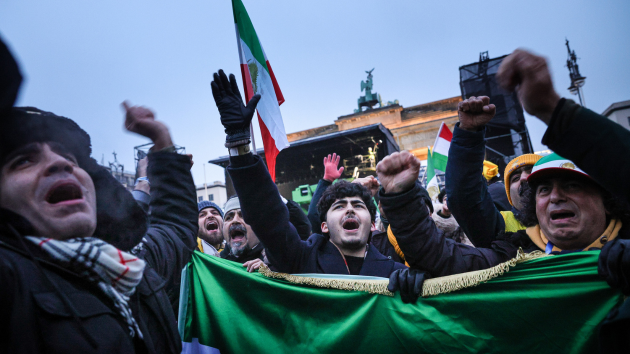
Hundreds joined a public rally in London in support of the protestors in Iran, calling for regime change from clerical rule and for Ayatollah Ali Khamenei to step down. (Lab Ky Mo/SOPA Images/LightRocket via Getty Images)

(LONDON) — Iranian Supreme Leader Ayatollah Ali Khamenei on Sunday hit back against U.S. President Donald Trump’s threats of military action in Iran in support of anti-government protests there, shortly before Trump told reporters that Tehran wants “to negotiate” with the U.S.

In a message on his official Farsi-language X account on Sunday, Khamenei posted an image of a crumbling statue with Trump’s likeness.

“That father figure who sits there with arrogance and pride, passing judgment on the entire world, he too should know that usually the tyrants and oppressors of the world, such as Pharaoh and Nimrod and Reza Khan and Mohammad Reza and the likes of them, when they were at the peak of their pride, were overthrown,” Khamenei wrote.

“This one too will be overthrown,” the ayatollah added.

Khamenei’s post came shortly before Trump spoke with reporters aboard Air Force One, first suggesting he may follow through on his threats of new strikes on Iran before revealing that fresh negotiations with Tehran may soon be underway.

Trump said it “looks like” Iran may have crossed the administration’s red line of killing protesters, adding that the U.S. military has “strong options” at its disposal. “We’ll make a determination,” he said.

Trump has repeatedly warned Tehran against the use of force to suppress the protests. On Saturday, Trump wrote on social media, “Iran is looking at FREEDOM, perhaps like never before. The USA stands ready to help!!!”

According to a U.S. official, the president will be briefed Tuesday to review possible U.S. responses to the situation in Iran.

Trump also said Sunday that Iranian leaders contacted him on Saturday and that a meeting is being set up between them. The president cautioned that the U.S. may take action before a meeting takes place. 

“They do. They called,” Trump said when asked if he thinks Iran wants to engage diplomatically.

“Iran called to negotiate yesterday — the leaders of Iran called yesterday. They want to negotiate. I think they’re tired of being beat up by the United States,” he said.

“We may meet with them,” he added. “A meeting is being set up, but we may have to act — because of what’s happening — before the meeting, but a meeting is being set up,” Trump said.

Protests have been spreading across the country since late December. The first marches took place in downtown Tehran, with participants demonstrating against rising inflation and the falling value of the national currency, the rial. As the protests spread to cities across the nation, they took on a more explicitly anti-government tone.

The death toll from the protests had risen to 544 as of Sunday, according to data compiled by the U.S.-based Human Rights Activists News Agency (HRANA).

At least 10,681 people have been arrested, according to HRANA. Protests have taken place at 585 locations across the country, in 186 cities, spanning all 31 provinces, according to activists.

The HRANA data relies on the work of activists inside and outside the country. ABC News cannot independently verify the figures provided by the group.

The Iranian government has not provided any casualty figures for protesters related to the ongoing protests. State television has broadcast images of people attending morgues to identify bodies of friends and relatives.

The state-aligned Tasnim news agency reported on Sunday that 109 security personnel had been killed in the protests.

Widespread and sustained internet outages have been reported across the country amid the deepening protests and reported government crackdown. Online monitoring group NetBlocks said early on Monday that Iran’s “national internet blackout” had surpassed 84 hours.

Khamenei and top Iranian officials have said they are willing to engage with the economic grievances of protesters, though have also framed the unrest as driven by “rioters” and sponsored by foreign nations, prime among them the U.S. and Israel.

Iranian Foreign Minister Abbas Araghchi on Monday described the wave of protests as a “terrorist war” while speaking to foreign diplomats in Tehran.

Araghchi said that the situation is “under control” and that internet access would be restored.

The foreign minister also claimed that Tehran had gathered extensive evidence showing U.S. and Israeli involvement in the protests over recent days. “We believe what took place after 8th of January was infiltration,” he said, suggesting that “Mossad agents” are leading the demonstrations.

Araghchi also criticized Western nations for failing to condemn what he called “terrorists.”

On Monday, state television broadcast footage of pro-government rallies organized in Tehran and other major cities.

The footage showed crowds waving Iranian flags in the capital’s Revolution Square, shouting slogans including “death to America,” “death to Israel,” and “I’d sacrifice my life for the leader.”

State television described the Tehran demonstration as an “Iranian uprising against American-Zionist terrorism.”

Dissident voices abroad, meanwhile, have encouraged further demonstrations. On Sunday, Iran’s exiled Crown Prince Reza Pahlavi addressed protesters in a post to X, announcing what he said was “a new phase of the national uprising to overthrow the Islamic Republic and reclaim our beloved Iran.”

“In addition to taking and holding the central streets of our cities, all institutions and apparatuses responsible for the regime’s propaganda and for cutting communications are to be regarded as legitimate targets,” Pahlavi wrote.

“Employees of state institutions, as well as members of the armed and security forces, have a choice: stand with the people and become allies of the nation, or choose complicity with the murderers of the people — and bear the nation’s lasting shame and condemnation,” he added.

“We are not alone. International support will soon arrive,” Pahlavi wrote.

Copyright © 2026, ABC Audio. All rights reserved.
Iran protests continue with 538 people killed, activists say

Iran protests continue with 538 people killed, activists say
People take part in a rally in solidarity with protesters in Iran, on January 11, 2026 in London, England. (Alishia Abodunde/Getty Images)

(LONDON) — The death toll from mass protests in Iran has risen to 538, according to data compiled by the U.S.-based Human Rights Activists News Agency (HRANA) on Sunday.

The group says it has confirmed the deaths of 490 protesters and 48 members of security forces. 10,600 people also are recorded as having been arrested, according to HRANA.

The HRANA data relies on the work of activists inside and outside the country.

ABC News cannot independently verify these numbers. The Iranian government has not provided any death tolls during the ongoing protests.

Video footage shot by locals and posted to social media appeared to show thousands of people protesting in Tehran’s Punak Square on Saturday night despite reported efforts by government security forces to disperse crowds. Elsewhere, videos showed large crowds gathered in the northeastern city of Mashhad.

HRANA said in its Saturday update that it had recorded 574 protest locations across 185 cities and all 31 provinces of the country. Saturday marked the fourteenth day of protests, HRANA said.

The Iranian government has not released detailed statistics on casualties sustained among protesters. The state-aligned Tasnim news agency reported on Sunday that 109 security personnel had been killed in the protests.

HRANA and other human rights groups reported widespread and sustained internet outages across the country as the protests spread. Online monitoring group NetBlocks said early on Sunday that Iran’s “internet blackout” had surpassed 60 hours.

Protests have been spreading across the country since late December. The first marches took place in downtown Tehran, with participants demonstrating against rising inflation and the falling value of the national currency, the rial.

As the protests spread, some have taken on a more explicitly anti-government tone, with some protesters chanting slogans including “student, be the voice of your people,” and “death to Islamic Republic.”

The theocratic government in Tehran — headed by Supreme Leader Ayatollah Ali Khamenei — moved to tame the protests, with security forces reportedly using tear gas and live ammunition to disperse gatherings.

Khamenei and top Iranian officials have said they are willing to engage with the economic grievances of protesters, though have also framed the unrest as driven by “rioters” and sponsored by foreign nations, prime among them the U.S. and Israel.

In comments carried by Iranian state media, President Masoud Pezeshkian on Sunday blamed foreign “terrorists” for the protests but also addressed some of the issues that originally brought protesters out onto the streets.

“We are determined, and have decided, to resolve economic problems by any means possible,” Pezeshkian said.

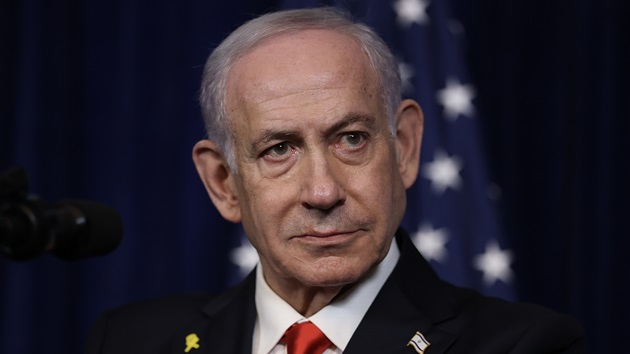
Israeli Prime Minister Benjamin Netanyahu said at the start of his weekly cabinet meeting Sunday that “Israel is closely following what is happening in Iran” and the ongoing “demonstrations for freedom” there.

“Israel supports their struggle for freedom and strongly condemns the mass massacres of innocent civilians,” Netanyahu further said. “We all hope that the Persian nation will soon be freed from the yoke of tyranny, and when that day comes, Israel and Iran will once again be loyal partners in building a future of prosperity and peace for both peoples.”

Dissident figures abroad, meanwhile, have urged Iranians to take to the street and overthrow the government. On Sunday, Iran’s exiled Crown Prince Reza Pahlavi addressed protesters in a post to X, saying, “Do not abandon the streets. My heart is with you. I know that I will soon be by your side.”

U.S. President Donald Trump has repeatedly warned Tehran against the use of force to suppress the protests. On Saturday, Trump wrote on social media, “Iran is looking at FREEDOM, perhaps like never before. The USA stands ready to help!!!”

An Israeli official told ABC News on Sunday that Israeli Prime Minister Benjamin Netanyahu and Secretary of State Marco Rubio spoke on Saturday about events unfolding in Iran.

Tehran, meanwhile, has warned against outside intervention. On Sunday, Mohammad Bagher Qalibaf — the speaker of the Iranian parliament — said that the U.S. military and Israel will be “legitimate targets” in the event of American strikes on Iran.

Copyright © 2026, ABC Audio. All rights reserved.

Owner of Swiss bar where deadly New Year’s fire killed 40 detained by prosecutors: Officials

Owner of Swiss bar where deadly New Year’s fire killed 40 detained by prosecutors: Officials
A general view of Le Constellation wine bar after a memorial ceremony in tribute to victims of the Crans-Montana bar fire on January 09, 2026 in Crans-Montana, Switzerland. Harold Cunningham/Getty Images

(LONDON) — Prosecutors on Friday detained the owner of a Swiss bar where a deadly New Year’s Day fire killed 40 people and injured 116 others, according to officials.

Jacques Moretti was placed in pre-trial detention after a meeting with prosecutors in Sion, the prosecutor’s office for Switzerland’s Valais region said.

The blaze ripped through Le Constellation, a popular bar in the resort town of Crans-Montana in the Swiss Alps, early on Jan. 1.

Moretti’s wife and business partner Jessica Moretti also attended the meeting but was not detained, according to the office. She was present at the bar during the fire and was burned on her arm. 

“My constant thoughts are with the victims and those who are fighting today. This is an unimaginable tragedy,” Moretti told reporters outside the prosecutor’s office.

The bar had not had any inspections in the last five years, Swiss officials said at a press conference on Tuesday.

“There was a culture of reckless risk-taking”, Nicolas Féraud, the municipal chief of Crans-Montana, said at a press conference earlier this week. “This endangered customers and staff,” he said.

Féraud said that the municipal government had “never received any alerts” about problems in the bar. He also confirmed that there was an emergency exit in the basement, but could not say whether it was open, closed or blocked.

The blaze of “undetermined origin” broke out at the bar at about 1:30 a.m. local time on Jan. 1, the Cantonal Police of Valais said in a statement at the time of the fire.

On Jan. 2, the Valais attorney general told reporters that investigators are “pursuing several hypotheses” based on evidence they’ve gathered.

“We currently assume that the fire was caused by sparklers attached to champagne bottles that came too close to the ceiling,” she said at a news conference.

Copyright © 2026, ABC Audio. All rights reserved.

Russia uses nuclear-capable missile in ‘massive strike’ on Ukraine

Russia uses nuclear-capable missile in ‘massive strike’ on Ukraine
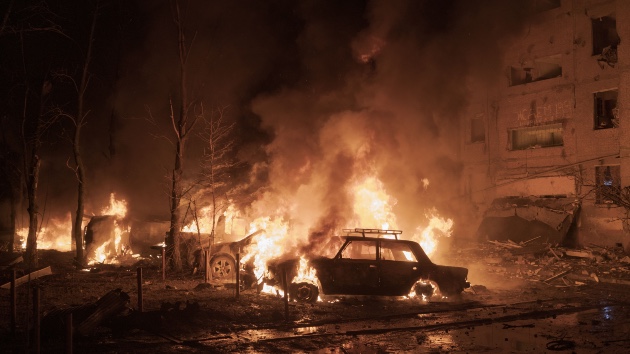
A multi-storey apartment block in the Darnytskyi district is damaged by a Russian drone strike during a massive overnight attack on the capital, in Kyiv, Ukraine, on January 9, 2026. (Photo by Danylo Antoniuk/Ukrinform/NurPhoto via Getty Images)NO USE RUSSIA. NO USE BELARUS. (Photo by Ukrinform/NurPhoto via Getty Images)

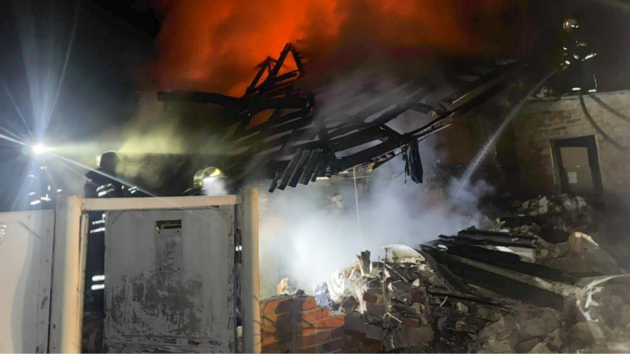
(KYIV, Ukraine) — Russia attacked Ukraine overnight with a massive barrage of 242 drones and 36 missiles, including one that was nuclear-capable, the Ukrainian Air Force said Friday morning.

The missile types used in the attack, which began Thursday night, included 22 cruise, 13 ballistic and one medium-range ballistic, according to the country’s air force.

Ukraine’s air defense system destroyed or suppressed 226 drones, 10 cruise missiles and 8 ballistic missiles. However, strikes from 18 missiles and 16 drones were recorded at 19 locations across the country, the air force said.

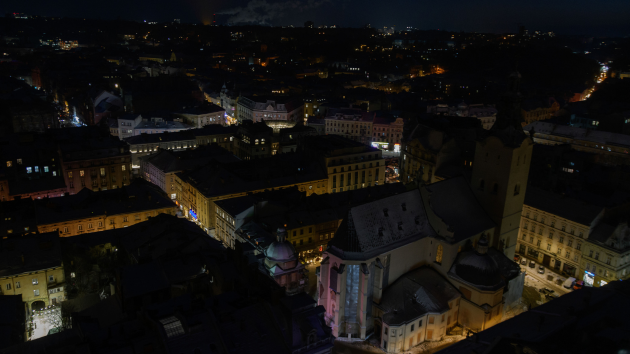
The capital, Kyiv, was among the hardest-hit areas, where 40 facilities were damaged, including 20 residential buildings, officials said. At least four people were killed and 25 others were injured there, according to the State Emergency Service of Ukraine, which said rescues were ongoing. The wider Kyiv region as well as the regions of Lviv, Kirovohrad and Cherkasy were also targeted.

The Russian Ministry of Defense confirmed that the Oreshnik intermediate-range ground missile system was used in the “massive strike” on Ukraine’s “critical facilities” overnight.

The Oreshnik, used only for the second time by Russia, is capable of flying at hypersonic speeds and delivering multiple warheads.

The ministry said this was in response to an alleged Ukrainian drone attack on Russian President Vladimir Putin’s state residence in the Novgorod region of northwestern Russia last month, which Ukraine has denied.

Ukrainian Foreign Minister Andrii Sybiha said Russia used the intermediate-range ballistic missile (IRBM) on the Lviv region in western Ukraine.

“Such a strike close to EU and NATO border is a grave threat to the security on the European continent and a test for the transatlantic community. We demand strong responses to Russia’s reckless actions,” Sybiha wrote in a post on X “We are informing the United States, European partners, and all countries and international organizations about the details of this dangerous strike through diplomatic channels.”

Sybiha called it “absurd” that Moscow justified the strike as a response to “the fake ‘Putin residence attack’ that never happened.”

“Another proof that Moscow does not need any real reasons for its terror and war,” he added. “Putin uses an IRBM near EU and NATO border in response to his own hallucinations — this is truly a global threat. And it demands global responses.”

Copyright © 2026, ABC Audio. All rights reserved.