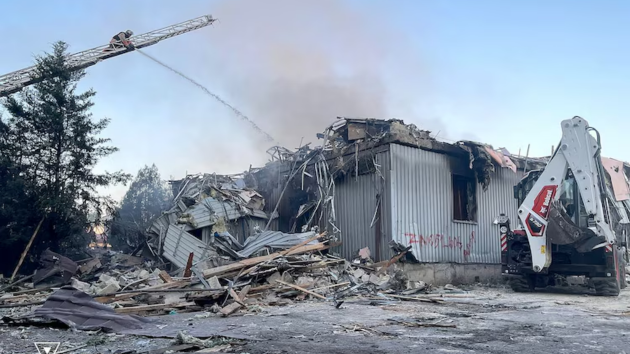
(LONDON) — Russia’s Defense Ministry said its forces shot down at least 126 Ukrainian drones overnight into Thursday morning, with at least three craft intercepted over the capital Moscow region.
The attack was Ukraine’s largest drone barrage into Russia since it launched 167 craft into the country on July 11, according to data published by Russia’s Defense Ministry and analyzed by ABC News.
The latest attack saw drones downed over 11 Russian regions plus annexed Crimea, the ministry said on Thursday.
Temporary flight restrictions were introduced at Moscow’s Vnukovo Airport, Kaluga Grabtsevo Airport to the southwest of the capital and Pulkovo Airport in St. Petersburg, according to Telegram posts by Artem Korenyako, a spokesperson for Russia’s federal aviation agency Rosaviatsiya.
Moscow Mayor Sergei Sobyanin said on Telegram that at least three drones were shot down on approach to the city. “Emergency services specialists are working at the site of the wreckage,” he wrote.
In the southwestern Voronezh region, a drone crashed into a residential building and injured three people, according to a statement published by local Gov. Alexander Gusev on Telegram.
In the western Belgorod region, Gov. Vyacheslav Gladkov said three people were killed and 17 injured by drone attacks from Wednesday afternoon through into Thursday morning.
Another person was injured by a drone in the Smolensk region, which sits to the west of Moscow and borders Belarus, Gov. Vasily Anokhin said.
In the Kaluga region to Moscow’s southwest, a drone hit a two-story house and a 14-year-old girl was injured by glass fragments, local Gov. Vladislav Shapsha said on Telegram.
Ukraine’s air force, meanwhile, said Russia launched 64 drones into the country overnight, of which 41 were shot down or neutralized in flight. The air force said 23 drones impacted in five locations.
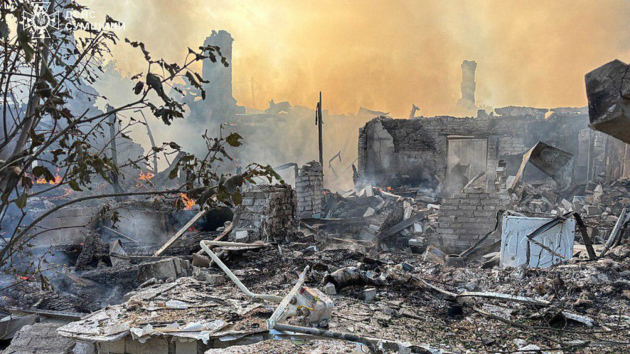
As of Thursday, the death toll from a Russian airstrike on the Donetsk city of Dobropillia rose to four, according to local Gov. Vadym Filashkin. Another 27 people were injured in the strike, Filashkin said, which targeted a shopping center in the eastern city.
July has marked an uptick in drone attacks launched by both Russia and Ukraine amid stalled U.S.-led efforts to secure a ceasefire deal to end Russia’s 3-year-old full-scale invasion of its neighbor. On Monday, President Donald Trump set Moscow a 50-day ultimatum to agree to a ceasefire, threatening sanctions if it failed to do so.
In June, Russia’s Defense Ministry reported downing a total of 2,368 Ukrainian drones, with an average of almost 79 drones per day across the month.
Thus far in July, the Defense Ministry said it has downed 1,516 Ukrainian drones, with a daily average of 89 drones.
The scale of Russian drone and missile strikes on Ukraine have been increasing since May, according to figures published by the Ukrainian air force and analyzed by ABC News.
In May, Russia launched a total of 3,835 drones and 117 missiles, for an average of around 124 drones and nearly four missiles each day.
June saw 5,438 drones and 239 missiles fired into Ukraine, with a daily average of 181 drones and nearly eight missiles.
Already in the first half of July, Ukraine has reported facing 4,067 drones and 89 missiles, for a daily average of 239 drones and more than five missiles.
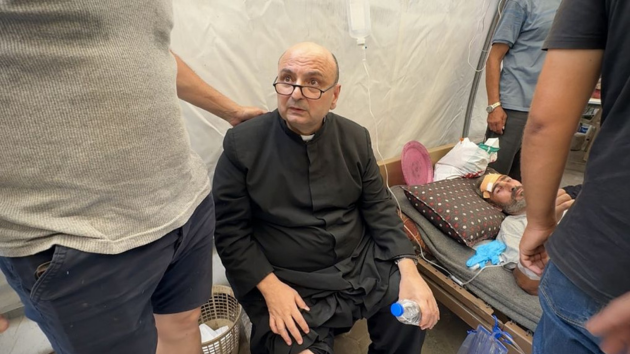
(LONDON) — The Holy Family Church, a Catholic church in Gaza, was damaged on Thursday and its priest was injured along with several others, the parish said.
“Currently there are no fatalities confirmed,” the parish said in a press release. “The church sustained damage.”
Father Gabriel Romanelli was injured, said the church, which is the only Catholic parish in Gaza.
“The IDF is aware of reports regarding damage caused to the Holy Family Church in Gaza City and casualties at the scene,” the Israel Defense Forces said in a statement. “The circumstances of the incident are under review.”
The IDF statement added, “The IDF makes every feasible effort to mitigate harm to civilians and civilian structures, including religious sites, and regrets any damage caused to them.”
This is a developing story. Please check back for updates.
ABC News’ Joe Simonetti and Helena Skinner contributed to this report.
(LONDON) — Law enforcement officials in Europe said they had coordinated the dismantling of an international pro-Russian cybercrime network, arresting two members, issuing warrants for others in Russia and disrupting the group’s main infrastructure.
The network, known as NoName057(16), was alleged to have targeted Ukraine and countries that supported Kyiv in its fight against the Russian invasion, Europol said in a statement Wednesday. The group was alleged to have recruited volunteers via “pro-Russian channels, forums, and even niche chat groups on social media and messaging apps.”
“Individuals acting for NoName057(16) are mainly Russian-speaking sympathisers who use automated tools to carry out distributed denial-of-service (DDoS) attacks,” Europol said in a statement.
Two people were arrested, one in France and one in Spain, officials said of the 3-day operation. Seven other arrest warrants were issued, including six by Germany for alleged hackers living in Russia, Europol said.
“The group, which professed support for the Russian Federation since the start of the war of aggression against Ukraine, executed multiple DDoS attacks during high-level political events in Europe,” the European Union Agency for Criminal Justice Cooperation, or Eurojust, said in a statement posted to social media.
The FBI in the United States was among the law enforcement agencies who took action against the group, Europol said. Europol and Eurojust, the European Union’s top law-enforcement agencies, coordinated the operation, which they called “Eastwood.” They were joined by authorities from Czechia, France, Finland, Germany, Italy, Lithuania, Poland, Spain, Sweden, Switzerland and the Netherlands.
The hacking group was estimated to have mobilized some 4,000 users to support their operations, Eurojust said. Europol and other law enforcement agencies sent some 1,000 alleged supporters messages notifying them of “their legal liability,” Europol said.
Investigators said they disrupted more than 100 servers used by the group, along with a “major part” of the group’s main infrastructure. Law enforcement officers searched two dozen houses throughout Europe and questioned people in Germany, France, Italy, Poland and Spain, according to Europol.
The pro-Russian group was accused of a series of hacks, including attacking banks and government offices in Sweden, along with perpetrating waves of cyber attacks in Germany and elsewhere. The attacks in Germany targeted some 230 organizations and businesses, including “arms factories, power suppliers and government organizations,” according to Eurojust.
“In Switzerland, multiple attacks were also carried out in June 2023, during a Ukrainian video-message addressed to the Joint Parliament, and in June 2024, during the Peace Summit for Ukraine at Bürgenstock,” Europol said.
The group was most recently alleged in June to have attacked the NATO summit in the Netherlands.
Ramez Habboub / GocherImagery/Future Publishing via Getty Images
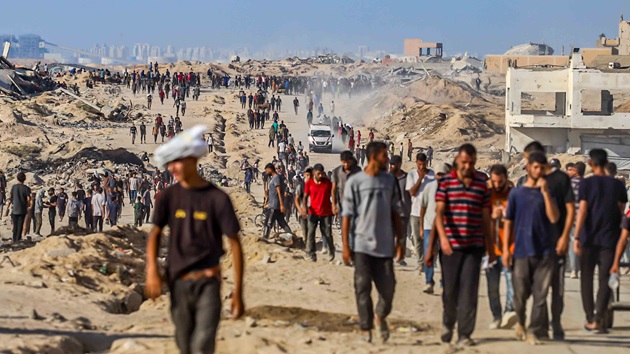
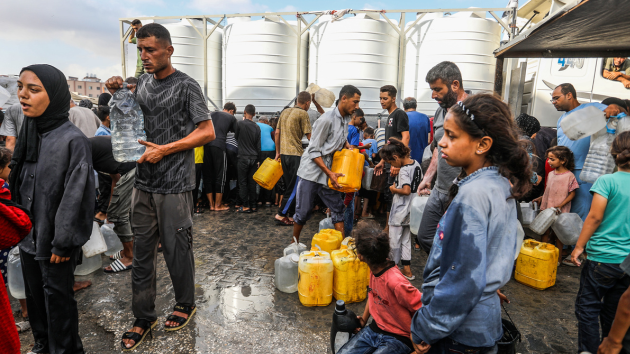
(LONDON) — At least 20 people were killed in an incident at one of the Gaza Humanitarian Foundation aid distribution sites in the southern Gaza Strip, the U.S.-backed group said in a statement on Wednesday.
The GHF said in a post to X that 19 of the dead were “trampled” and another was stabbed, in what it described as a “chaotic and dangerous surge.” The GHF blamed “agitators in the crowd” for the stampede.
The Hamas-run Ministry of Health in Gaza said that 15 of those killed “died of suffocation as a result of tear gas fired at the starving people and the subsequent stampede.” The ministry said at least 21 people were killed in the incident. The GHF denied using tear gas, saying instead that there was a “limited use” of pepper spray.
Video filmed by local journalist Abdallah Alattar and verified by ABC News appeared to show lifeless bodies being unloaded from a cart outside Nasser Hospital in Khan Younis.
A man could be seen holding a boy whose head appears to be limp and telling the cameraman, “They died by suffocation. There was a stampede.”
Marwan Al Hams, director-general of field hospitals in Gaza, told ABC News that victims arriving there showed signs of bruising on the face and body, injuries that the source said were consistent with intense crowding. Victims also showed notable indications of “oxygen deprivation,” the source said.
As of July 13, at least 875 people have been killed in recent weeks while trying to get food in Gaza, according to Thameen Al-Kheetan, a spokesperson for the U.N.’s Office of the High Commissioner for Human Rights. Of those, 674 were killed “in the vicinity of GHF sites,” Al-Kheetan said.
The GHF is backed by the U.S. and Israeli governments, with the U.N. and other aid organizations refusing to collaborate with the group, citing concerns about its transparency and political impartiality.
The GHF has consistently rejected criticisms by the U.N. and other aid groups of its aid distribution operations and multiple deadly incidents occurring among groups of Palestinians on their way to collect food.
In its statement on Wednesday’s deadly stampede, the GHF said it had “credible reason to believe that elements within the crowd — armed and affiliated with Hamas — deliberately fomented the unrest.”
“For the first time since operations began, GHF personnel identified multiple firearms in the crowd, one of which was confiscated,” the group alleged. “An American worker was also threatened with a firearm by a member of the crowd during the incident.”
“We mourn the lives lost today, and we remain committed to providing humanitarian aid as safely and responsibly as possible,” it added. “GHF exists to serve the people of Gaza with compassion and integrity, and our mission has never been more urgent or more challenged.”
The Hamas-run Government Media Office in Gaza issued a statement rejecting the GHF allegations.
This week, the GHF unveiled a new “flag system” to indicate the status of its sites to Palestinians seeking aid. A red flag will be flown to signify that the site is closed, while a green flag will indicate it is open, the group said in a Monday post to social media.
The Israeli government says the GHF is required to prevent Hamas fighters from seizing humanitarian aid, which Israel has accused the terror group of throughout the war in Gaza. Hamas has denied such thefts.
On Saturday, the Israel Defense Forces told ABC News in a statement that it “allows the American civilian organization (GHF) to distribute aid to Gaza residents independently, and operates in proximity to the new distribution zones to enable the distribution alongside the continuation of IDF operational activities in the Gaza Strip.”
Previous deadly incidents attributed to Israeli military action at or near the GHF sites, the IDF said, “are under review by the competent authorities in the IDF.”
Hungry Palestinians say they have to go to the sites to collect aid, with few other options.
“How can I go and buy 1 kg of flour for 70 shekels ($20) when I don’t have that kind of money?” Mohanned Al Tifi, awaiting treatment inside Nasser Hospital, told ABC News on Wednesday morning. “This is what forced me to go there, the hunger.”
Al Tifi said he suffered a pelvic fracture in the morning’s chaos. He had to wait for 3 hours before he was helped to safety at the aid site by a “good Samaritan,” he said.
“Let me tell you if I could bring 5 kg of flour I will go home happy,” he said.
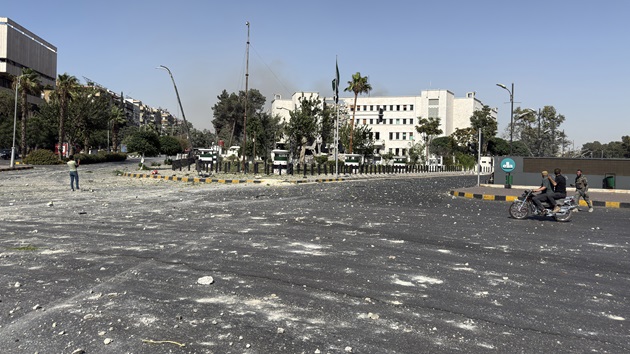
(LONDON) — The Israel Defense Forces said it struck “the entrance” of Syria‘s military headquarters in Damascus on Wednesday.
Syria’s Ministry of Health told the state-run Syrian Arab News Agency that at least one person was killed and 18 others were injured Wednesday in the Israeli airstrikes on the capital, Damascus.
The high-profile strike came amid a wave of sectarian violence in the southern Syrian city of Sweida, where the Druze population has clashed with local Bedouin Sunni tribes and the recently installed Syrian government, headed by Interim President Ahmed Al-Sharaa who toppled former President Bashar Al-Assad in December.
The Druze are an offshoot of a branch of Shiite Islam. Around 1 million Druze are spread across Syria, Israel and Lebanon. The majority live in Syria, concentrated in the south of the country.
“The IDF continues to monitor developments and the regime’s actions against Druze civilians in southern Syria,” the IDF said in a statement. “In accordance with directives from the political echelon, the IDF is striking in the area and remains prepared for various scenarios.”
In a post to X, Israeli Defense Minister Israel Katz said: “The warnings in Damascus have ended — now painful blows will come.”
“The IDF will continue to operate forcefully in Sweida to destroy the forces that attacked the Druze until their complete withdrawal,” Katz added.
More than 250 people have been killed in Sweida province as of Wednesday morning since the violence erupted on Sunday, according to the Syrian Observatory for Human Rights, a U.K.-based war monitoring group. Those deaths included 21 people who were killed in “field executions” by local groups in Sweida, the organization said.
Syrian government forces were deployed to the Sweida region — home to the largest population of the Druze religious minority in Syria — on Monday in an effort to restore order but ultimately clashed with the Druze militias themselves. On Tuesday, Syrian Defense Minister Murhaf Abu Qasra announced a ceasefire agreement in Sweida, saying government forces would “respond only to the sources of fire and deal with any targeting by outlaw groups.” But clashes continued.
As that sectarian violence has grown, the Israeli military has taken action against the Syrian government, the IDF said.
Over the past day, the IDF has struck and continues to strike tanks, rocket launchers, weapons, and pickup trucks loaded with heavy machine guns on their way to the As Suwayda area in southern Syria,” the IDF said in a statement Wednesday, using another common spelling for Sweida.
The IDF said it has “decided to reinforce its forces in the area of the Syrian border” and “will continue to operate, both in defense and offense, to ensure the security of Israeli civilians.”
The office of Syria’s interim president said in a statement Wednesday that it “has followed with great concern the unfortunate violations that have recently occurred in some areas of Sweida Governorate.”
“These acts, which fall within the category of criminal and illegal behavior, are unacceptable under any circumstances and completely contradict the principles upon which the Syrian state is based,” the presidency added. “We, in the Syrian government, strongly condemn these shameful acts and affirm our full commitment to investigating all related incidents and holding accountable all those proven to be involved.”
Israeli Prime Minister Benjamin Netanyahu also urged Israeli Druze groups not to cross into Syria to join the fighting.
“We are working to save our Druze brothers and to eliminate the regime’s gangs,” he said in a statement posted to X on Wednesday.
Addressing those crossing the border or attempting to, Netanyahu added: “You are citizens of Israel. Do not cross the border. You are risking your lives; you could be murdered, you could be kidnapped, and you are harming the efforts of the IDF. Therefore, I ask you — return to your homes, let the IDF act.”
(WASHINGTON) — After President Donald Trump threatened to impose “very severe” economic penalties against Vladimir Putin’s Russia if he doesn’t agree to a ceasefire in Ukraine within 50 days, the Trump administration has so far declined to provide many additional details about the consequences Russia will face or why he picked the deadline he chose.
“Well, at the end of 50 days, if we don’t have a deal, it’s going to be too bad,” Trump told reporters at the White House on Tuesday.
When asked why he decided to give the Russian leader nearly two months to comply with his demand, President Trump deflected.
“I don’t think 50 days is very long. It could be sooner than that,” Trump said.
“You should have asked that same question to Biden. Why did he get us into this war?” he continued. “You know why he got us in? Because he’s a dummy, that’s why.”
Despite pledging additional U.S. made weapons for Ukraine, Trump also said he didn’t support Ukraine’s President Zelenskyy ordering strikes on the Russian capital.
“He shouldn’t target Moscow,” he said. “No, we’re not looking to do that.”
On Monday, Trump said that Russia’s failure to reach a negotiated settlement with Ukraine within 50 days would lead to his administration imposing a 100% tariff rate on Russian imports as well as what he called “secondary tariffs” on countries that have continued to do business with Moscow.
“We’re very, very unhappy with him,” Trump said of Putin on Monday. “We’re going to be doing very severe tariffs if we don’t have a deal in 50 days.”
U.S. imports from Russia, which totaled around $3 billion in 2024 according to the Office of the U.S. Trade Representative, account for a small share of Moscow’s revenue, meaning Trump’s threat to hike tariffs on Russian goods likely wouldn’t pack much punch.
However, the president’s promise to raise tariffs on imports from third-party countries could carry more weight.
Some secondary sanctions aimed at weakening Russia’s war economy are already in place. The Biden administration steadily ramped up its use of the penalties throughout the conflict, primarily targeting foreign financial institutions accused of supporting Moscow’s military industrial complex and the so-called “shadow fleet” of tanker operators working to circumvent Western sanctions and price caps on Russian oil.
But going after countries that import oil and other resources from Russia would be a significant escalation.
Through much of the war, the Biden administration avoided taking direct aim at Russian energy exporters out of concern that doing so would cause global fuel prices to rise. Instead, the former administration worked with other members of the G7 to cap the price of Russian oil products, cutting into Moscow’s profits while allowing the exports to remain on the market.
Trump, on the other hand, has previously promised to go after Russia’s customers.
In March, Trump threatened to put “secondary tariffs on oil, on all oil coming out of Russia” during an interview with NBC News — adding “if you buy oil from Russia, you can’t do business in the United States.”
What countries would feel the impact?
The White House has yet to release specific details on Trump’s secondary tariffs, but his ambassador to NATO, Matthew Whitaker, said on Monday the top importers of Russian oil would be in the administration’s crosshairs.
“It’s about tariffs on countries like India and China that are buying their oil. And it really is going to I think dramatically impact the Russian economy,” he said during an interview with CNN.
But whether the secondary tariffs would stop at countries like China and India is an open question.
Despite the web of sanctions in place against Russia, the country still has many meaningful trade relationships, including ones with European allies.
Since Russia’s invasion of Ukraine, the EU has significantly dropped its share of Russian oil and gas imports and its plan to fully phase out those imports isn’t expected to fully come to fruition until the end of 2027 at the earliest.
Some Eastern European and Central Asian countries also have economies that rely on doing business with Russia, meaning they would almost certainly be unable to significantly scale back trade with Russia and would have the face the consequences of secondary tariffs.
The next 50 days
If the president sticks to his 50-day window, Russia can continue to carry out its summertime campaign against Ukraine until early September without facing additional consequences.
In his interview with CNN, Whitaker was also asked about how Trump made the decision on the timeline but didn’t give a clear answer.
“The time to end the slaughter is now. The time to end the killing is now. And so 50 days is the appropriate amount of time because it needs to happen now,” he responded.
Currently, Russia is making modest gains against Ukraine and may soon seek to leverage those advances to launch additional offenses in the eastern reach of the country, according to a recent assessment from the Institute of the Study of War.
Many officials and experts have long predicted that the Kremlin would push off serious talks on ending the war until the cooler months set in because it hopes to strengthen its position at the negotiating table by claiming as much territory as possible during the summer season.
In an interview with the BBC on Monday, Trump indicated he still wanted to pursue diplomacy with Russia, but that his patience with Putin was wearing thin.
“I’m not done with him, but I’m disappointed with him,” he said.
Kremlin spokesperson Dmitry Peskov responded to Trump’s threats on Monday, saying Moscow needed “time to analyze” the comments.
“The U.S. president’s statements are very serious,” Peskov said.
State Emergency Service of Ukraine/Anadolu via Getty Images
(LONDON) — This week marked a possible pivot by President Donald Trump regarding Russia’s ongoing full-scale invasion of Ukraine, with his Monday announcement of a “really big” deal to provide Kyiv with new weapons and threats to impose further sanctions on Russia if it fails to agree a ceasefire within 50 days.
Though Trump’s decision was welcomed by leaders in Kyiv, Ukrainians and their supporters abroad also raised concerns that the 50-day window may offer Russian President Vladimir Putin an opportunity to intensify his long-range strikes against Ukrainian cities and ongoing summer frontline offensive.
Oleksandr Merezhko, a member of the Ukrainian parliament representing Zelenskyy’s party and the chair of the body’s foreign affairs committee, told ABC News he was “cautiously optimistic,” hoping Trump’s announcement may signal a new “maximum pressure” campaign on Putin.
“However, the 50-day deadline is of some concern, because Putin might take it as a green light to intensify offensive operations,” he said.
The Russian attacks over the two nights since Trump’s announcement suggest Moscow remains unmoved.
Monday night and Tuesday night saw a cumulative 667 attack and decoy drones of various types, plus one missile, launched into Ukraine by Russia, according to figures published by the Ukrainian air force and analyzed by ABC News.
The previous 50 days before Trump’s announcement saw a total of 9,618 drones and 349 missiles launched into Ukraine — an average of around 192 drones and seven missiles each day.
The pattern of Russian long-range strikes suggest the next 50 days might be even more difficult for Ukrainians. Since May, the scale of Russian attacks has been steadily increasing despite Trump’s efforts to force a ceasefire and eventual peace deal.
In May, Russia launched a total of 3,835 drones and 117 missiles, for an average of around 124 drones and nearly four missiles each day.
June saw 5,438 drones and 239 missiles fired into Ukraine, with a daily average of 181 drones and nearly eight missiles.
Already in the first half of July, Ukraine has reported facing 4,003 drones and 89 missiles, for a daily average of 250 drones and more than five missiles.
“Russia is not changing its strategy,” Zelenskyy wrote on Telegram after Tuesday night’s attacks, in which the president said at least 16 people were injured.
“To effectively counter this terror, we need a systematic strengthening of defense: more air defense, more interceptors, more determination so that Russia feels our response,” he added.
Ukraine says many of those Russian drones have been aimed at non-military targets, including residential areas and city centers across Ukraine. Russia has maintained that it targets military and infrastructure sites.
Trump defended his decision to give Moscow 50 days to act, telling reporters at the White House on Tuesday, “I don’t think it’s a long time. I think really the question should be asked, why did [former President Joe] Biden get us into that ridiculous war? Why did Biden bring us there?”
Asked why he believes Putin’s opinion will change in 50 days, Trump said, “a lot of opinions change very rapidly.” He added, “It might not be 50 days, he might be much sooner than 50 days.”
But Russian officials gave a cold response to Trump’s announcement on Tuesday.
Kremlin spokesperson Dmitry Peskov said Trump’s “statements are very serious,” telling reporters at a daily briefing, “Some of them are addressed personally to President Putin. We definitely need time to analyze what was said in Washington.”
Deputy Foreign Minister Sergei Ryabkov, meanwhile, told the state-run Tass news agency that making any demands of Russia is “unacceptable,” and that the Kremlin’s position is “unshakable.”
Russian Foreign Minister Sergei Lavrov suggested that Trump is “under enormous, frankly indecent pressure from the EU and NATO’s current leadership.”
Responding directly to Trump’s timeline, Lavrov said Moscow wants “to understand what this 50-day reference means. There were earlier mentions of 24 hours, then 100 days. We’ve seen this pattern before and genuinely want to comprehend the U.S. president’s reasoning.”
As to the threat of new tariffs or sanctions, the foreign minister said, “We’re already dealing with an unprecedented number of sanctions and managing well. I have no doubt we’ll handle these new measures too.”
Perhaps most forthright was Dmitry Medvedev — the former Russian president and prime minister now serving as the deputy chairman of the country’s Security Council — who wrote on social media that the Kremlin was unmoved by Trump’s “theatrical ultimatum.”
“The world shuddered, expecting the consequences,” wrote Medvedev, who, during Moscow’s full-scale war on Ukraine, has become known as a particularly hawkish voice within Putin’s security establishment. “Belligerent Europe was disappointed. Russia didn’t care.”
ABC News’ Hannah Demissie contributed to this report.
(LONDON) — Russia continued its nightly bombardment of Ukraine overnight into Tuesday, shortly after President Donald Trump announced his decision to supply Ukraine with new military equipment and White House threats of further economic measures against Moscow.
Ukraine’s air force said Russia targeted several regions overnight with 267 drones, of which around 200 were Shahed attack drones and the rest decoys. The air force said it shot down or otherwise suppressed 244 drones. Twenty-three drones impacted across seven locations, with falling debris reported in nine locations, the air force said.
Russia’s Defense Ministry, meanwhile, said its forces downed at least 70 Ukrainian drones overnight into Tuesday morning. Among the areas targeted was the southwestern Voronezh region which borders northeastern Ukraine. At least 24 people were injured there, Gov. Aleksandr Gusev said on Telegram.
Kremlin spokesperson Dmitry Peskov said Tuesday that Russian President Vladimir Putin would make a decision about how to respond to Trump.
“The U.S. president’s statements are very serious,” Peskov told reporters during a daily briefing. “Some of them are addressed personally to President Putin. We definitely need time to analyze what was said in Washington.”
Dmitry Medvedev — — the former Russian president and prime minister now serving as the deputy chairman of the country’s Security Council — was more forthright, writing on social media that the Kremlin was unmoved by what he called Trump’s “theatrical ultimatum.”
“The world shuddered, expecting the consequences,” wrote Medvedev, who during Moscow’s full-scale war on Ukraine has become known as a particularly hawkish voice within Putin’s security establishment. “Belligerent Europe was disappointed. Russia didn’t care.”
The Kremlin also on Tuesday dismissed reports — first published by The Washington Post and Financial Times — that Trump asked Ukrainian President Volodymyr Zelenskyy if Ukrainian forces could strike Moscow and St. Petersburg.
The White House, though, confirmed to ABC News that the matter was discussed.
“President Trump was merely asking a question, not encouraging further killing,” White House Press Secretary Karoline Leavitt said in a statement. “He’s working tirelessly to stop the killing and end this war.”
Leavitt said the reports took the discussion “wildly out of context.”
Trump said during an Oval Office meeting with NATO Secretary-General Mark Rutte on Monday that he would impose “severe tariffs” — though it was not entirely clear if the president was referring to tariffs, sanctions or both — against Russia and its trading partners if a ceasefire deal is not reached in 50 days.
Trump also said he had approved a new tranche of weapons to Ukraine worth “billions of dollars.” But details of what Trump called a “very big deal” remain unclear. Two U.S. defense officials told ABC News on Monday that the Pentagon was still working on exactly what military aid could be sent to Ukraine.
The defense officials said 17 Patriot surface-to-air missile systems that Trump mentioned would come entirely from European allies, who would then purchase new replacement systems from the U.S.
The Patriot systems — of which Ukraine currently has at least six, two of which were provided by the U.S. and four by other NATO allies — have become a key in Ukraine’s defense against Russian drone, missile and airstrikes since they arrived in the country in 2023.
“We’re going to have some come very soon, within days,” Trump said when asked how long the new batch of American weapons would take to arrive. On Patriots specifically, the president said, “They’re going to start arriving very soon.”
Trump’s announcement came after months of rising frustration in the White House over Russia’s intensifying bombardments of Ukraine and its failure to commit to a full ceasefire.
Speaking on Sunday, Trump said of Russian Putin, “He talks nice and then he bombs everybody in the evening. There’s a little bit of a problem there.”
But questions remain about Trump’s threat to impose 100% “secondary tariffs” on nations doing business with Russia. The US has negligible imports from Russia, which account for around 0.2% of U.S. imports, according to Census Bureau data.
The threat of secondary tariffs or sanctions on Russia’s trading partners appears more significant, though may prompt retaliatory measures against the U.S. China and India, for example, are among Moscow’s customers for its fossil fuel exports.
Despite the open questions, Ukrainian President Volodymyr Zelenskyy said he had a “very good conversation” with Trump on Monday. “Thank you for your willingness to support Ukraine and continue to work together to stop the killings and establish a lasting and just peace,” he wrote on social media.
“We discussed with the president the necessary means and solutions to provide more protection for people from Russian attacks and strengthen our positions,” Zelenskyy continued. “We are ready to work as productively as possible to achieve peace.”
Oleksandr Merezhko, a member of the Ukrainian parliament representing Zelenskyy’s party and the chair of the body’s foreign affairs committee, told ABC News he was “cautiously optimistic,” hoping that Monday’s news indicated the beginning of a “maximum pressure” campaign on Putin by Trump.
“The whole situation is a win-win-win situation for Trump, Ukraine and Europe,” he said. “However, the 50-day deadline is of some concern, because Putin might take it as a green light to intensify offensive operations.”
Russia’s summer offensive is already underway, according to the Ukrainian military, with Moscow’s forces pushing for more territory all across the front. Russian efforts are particularly concentrated in the eastern Donetsk and Sumy regions, Kyiv has said.
“To prevent it from happening it is crucially important to provide Ukraine without delay, now, with the maximum military assistance,” Merezhko said, “including offensive weaponry like long-range missiles, for instance Tomahawks.” Ukrainian backers also in the Senate urged Trump to build on Monday’s announcement.
“This announcement, by itself, will not be enough to bring Putin to the negotiating table and finally end this war,” Senate Foreign Relations Ranking Member Jeanne Shaheen, D-N.H., said in a statement sent to ABC News.
“President Trump needs to commit to a sustained flow of security assistance to Ukraine over the long-term,” she added. “And we must move immediately on the tough sanctions package in the Senate, which has overwhelming bipartisan support and will make it harder and harder for Putin to prop up his economy and sustain his illegal war.”
That bipartisan Senate proposal — fronted by Sens. Lindsey Graham, R-S.C., and Richard Blumenthal, D-Conn. — proposed secondary sanctions of up to 500% on nations doing business with Russia, though according to Graham it will include an option allowing Trump to waive sanctions on individual nations.
In a post to X, Graham said Trump “put the countries who fund Putin’s war machine on notice: stop financially supporting the war in Ukraine or face 100% tariffs. If I were them, I would take President Trump at his word.”
Asked on Monday whether he would adopt the Senate’s blueprint, Trump told reporters, “We could do secondary tariffs without the Senate, without the House. But what they’re crafting also could be very good.”
ABC News’ Luis Martinez, Anne Flaherty, Zunaira Zaki, Soo Youn and Shannon K. Kingston contributed to this report.
LONDON — The U.S.-backed Gaza Humanitarian Foundation (GHF) announced some changes at its Khan Younis aid distribution center on Monday, as Palestinians continue to report mass killings and chaos near aid distribution sites in the Gaza Strip.
The center will now use “a flag system” in place to indicate the status of the site, with the red flag signifying the site is closed and the green flag showing it is open, according to a social media post from GHF.
The announcement comes after major controversies around GHF’s operations since it took over most of the humanitarian aid distribution in the Gaza Strip on May 27 after Israel had blockaded supplies getting into the strip for more than two months.
Since the end of May, at least 798 people have been killed near and around food aid sites, according to a United Nations statement on Thursday. Among them, 615 people were killed on their way to GHF sites and 183 near other aid convoys, the UN statement added.
Reacting to the new GHF flag system, Ibrahiem Mohammed Abdul Raouf Al Qatrawi, a 22-year-old Palestinian, called for the total cancellation of the GHF aid system, telling ABC News on Monday that “respect and dignity” should be restored.
“The humiliation we live is really difficult at the American aid centers, not to mention the fear, I even feel sorry for myself, going through this,” Al Qatrawi said.
“It’s a death trap, it’s very dangerous over there,” Hazem Al Taweel, a Palestinian who had recently returned from getting aid at one GHF center, told ABC News on Sunday. “You can go there to bring a bag [of food] but you get brought back in a bag.”
“You see snipers, quadcopters and tanks. You feel the whole world is fighting you over your food. It’s very difficult, even those who get minor injuries bleed to death while no one can help them,” Al Taweel added. As he went to collect aid recently, he said he was surrounded by dead bodies. Ambulances were not allowed to reach the injured, he said.
Responding to ABC News on the hundreds killed near the aid site, the Israel Defense Forces (IDF) said Saturday in a statement it “allows the American civilian organization (GHF) to distribute aid to Gaza residents independently, and operates in proximity to the new distribution zones to enable the distribution alongside the continuation of IDF operational activities in the Gaza Strip.
The IDF added, “The aforementioned incidents are under review by the competent authorities in the IDF.”
Israel says it implemented the distribution system built around GHF to keep Hamas from stealing aid and using it to support its militants. Israeli officials have long accused Hamas of seizing humanitarian goods and selling them to fund militant activity. Hamas denies those claims. A State Department spokesperson issued a statement to the Wall Street Journal that said the Trump administration supports GHF, because it is “the only pipeline that denies Hamas resources and control.”
The GHF called the UN report “false and misleading” in a statement, accusing the UN of using numbers from the Hamas-run Gaza Ministry of Health. The organization added, “The UN’s reliance and coordination with a terrorist organization to falsely smear our effort is not only disturbing but should be investigated by the international community.”
Nonetheless, the risk is mounting for hungry Palestinians as they try to get food and water.
On Sunday, 12-year-old Siraj Khaled Ibrahim was waiting in line to collect water for his family in Nuseirat Camp, in the center of the Gaza Strip, when he was killed in an airstrike, his family told ABC News. Siraj and at least nine other Palestinians, including five other children, were killed in the IDF airstrike near the water distribution point, according to Al-Awda hospital, where the deceased were taken.
ABC News has verified video of Siraj’s father carrying his son’s blood-covered body in the aftermath of the attack. The video was widely shared online. In the video, Siraj’s father can be heard saying, “Oh my boy, why did you go to fetch water? We didn’t need water.”
“He had the most beautiful heart in the world,” Hamza Ibrahim, a relative of Siraj, told ABC News. “He would memorize Quran and was a football fan,” he added.
The IDF told ABC News on Sunday that the strike near the water distribution was “a technical error with the munition,” and the main target was “an Islamic Jihad terrorist” in the central Gaza Strip. “The IDF is aware of the claim regarding casualties in the area as a result, and the details of the incident continue to be examined,” the statement added.