Following peace talks, Zelenskyy says Ukraine will continue attacks unless Russia halts offensive

Following peace talks, Zelenskyy says Ukraine will continue attacks unless Russia halts offensive
Turkish Ministry of Foreign Affairs viaGetty Images

(LONDON) — Ukrainian President Volodymyr Zelenskyy said the surprise drone operation over the weekend against Russia was a success that will “continue” if Moscow doesn’t halt its offensive.

Zelenskyy addressed reporters following the next round of U.S.-brokered peace talks between Ukrainian and Russian delegations in Istanbul on Monday, intended to end Russia’s 3-year-old invasion of its neighbor. The talks came just one day after Ukraine launched an audacious drone attack on Russia’s strategic bomber fleet.

Asked by ABC News’ Chief Global Affairs Correspondent Martha Raddatz on whether the attacks changed the dynamics of the war or at the negotiating table — and whether they might enrage Russia — Zelenskyy responded, “Russia’s being enraged or not enraged — this is something we’re not interested in,” citing Russia’s attack on Ukraine a day before “at night with over 480 drones.”

“This is happening on [a] daily basis,” the president said.

Zelenskyy called Ukraine’s drone attack a “strategic operation” that “is definitely reducing Russia’s potential, and demonstrates that Ukraine is working on certain steps.”

“Unless they will stop, we will continue,” he said.

Asked whether he was satisfied with President Donald Trump’s administration’s involvement, Zelenskyy told Raddatz, “We are looking for very strong steps on the part of President Trump to support the sanctions and to force President Putin to stop this war, or at least proceed with the first stage of putting an end to this war — that is the ceasefire.”

Monday’s revived talks so far have failed to reach a peace deal, or even achieve a sustained ceasefire, despite pressure on both sides by Trump’s administration. The last meeting between Russian and Ukrainian delegations in Istanbul in mid-May was the first direct contact between the two sides since spring 2022.

The Ukrainian Defense Ministry confirmed to ABC News on Monday morning that talks resumed at Istanbul’s Ciragan Palace, ending just over an hour later. Ukrainian Defense Minister Rustem Umerov said the two sides agreed to swap all severely wounded and ill prisoners of war and to exchange the bodies of thousands of fallen soldiers.

They also discussed a meeting between Zelenskyy and Russian President Vladimir Putin, according to Umerov.

Ukraine is calling for a full 30-day ceasefire during which time peace negotiations can take place. Russia has refused the request, with Putin and his top officials retaining maximalist war goals dating back to the opening days of the Russian invasion.

Vladimir Medinsky, a Putin aide and long-time member of Russia’s negotiating team, said Russia has proposed a ceasefire lasting two to three days, on separate sections of the front, to retrieve the bodies of fallen soldiers.

Among the Kremlin’s demands are the annexation of four Ukrainian regions — plus the retention of Crimea, which Russia seized in 2014 — Ukrainian demilitarization and a permanent block on the country’s accession to NATO.

Zelenskyy said in a Sunday social media post that Kyiv’s delegation would be led by Umerov.

The president set out Ukraine’s goals for the meeting. “First — a full and unconditional ceasefire,” he wrote. “Second — the release of prisoners. Third — the return of abducted children. And in order to establish a reliable and lasting peace and ensure security, preparation of the meeting at the highest level.”

Zelenskyy and his government have repeatedly accused Putin of intentionally sabotaging peace talks since Trump returned to office in January, having promised on the campaign trail to end the war within 24 hours. Trump’s threat of further sanctions on Russia does not appear to have softened the Kremlin’s war goals.

Zelenskyy and his European backers have pushed Trump to increase pressure on Putin by introducing new sanctions on Russia and providing Ukraine with more military support. Keith Kellogg, Trump’s Ukraine-Russia envoy, hinted at the president’s growing frustration with Moscow, telling ABC News last week that the president has “seen a level of unreasonableness that really frustrates him.”

In a phone conversation with Trump in May, Putin said Russia would provide a “peace memorandum” outlining a possible settlement. Moscow provided the document on Monday, according to Umerov. Medinsky said Sunday that the Russian team had received Ukraine’s version of the peace memorandum.

Umerov said Monday they will take a week to study the documents before deciding on next steps.

Since the last round of talks in Istanbul, Trump has hit out at Putin — calling him “absolutely crazy” — and again criticized Zelenskyy, saying of the Ukrainian leader, “Everything out of his mouth causes problems, I don’t like it, and it better stop.”

Oleksandr Merezhko, a member of the Ukrainian parliament representing Zelenskyy’s party and the chair of the body’s foreign affairs committee, told ABC News, “Russia’s primary goal is to avoid sanctions by pretending that it negotiates.”

“Putin is not interested in negotiations and ceasefire, because he hopes to start an offensive during summer,” Merezhko added.

“On the one hand, he imitates negotiations to avoid Trump’s sanctions and simultaneously to demonstrate that Russia is not politically isolated. Yet, on the other hand, Putin hopes that if Trump will decide to withdraw from the negotiations, he will leave Ukraine without military support, one-on-one with Russia.”

The talks come a day after Ukraine launched one of the most stunning attacks of the war. In what a source in the Security Service of Ukraine (SBU) told ABC News was an operation one and a half years in the making, operatives used attack drones concealed in containers carried by trucks to attack strategic bomber bases deep inside Russian territory.

Moscow has used long-range bombers and their cruise missile armaments to attack Ukrainian cities throughout the full-scale invasion. The SBU claimed to have hit more than 40 military aircraft in the attacks, which targeted multiple air bases thousands of miles from Ukrainian-controlled territory. Zelenskyy said that 34% of Russia’s cruise missile-carrying aircraft were hit.

Speaking at a summit of the Bucharest Nine and Nordic countries in Lithuania on Monday, Zelenskyy said of Sunday’s drone attack, “Russia must realize what it means to suffer losses. That is what will push it toward diplomacy.”

“This is a special moment,” Zelenskyy added. “On the one hand, Russia has started its summer offensive. But on the other, it is forced to participate in diplomacy. And this is at once a challenge and also a real opportunity for all of us. It is a chance to end this war.”

Russia’s Defense Ministry framed the operation as “a terrorist attack,” claiming that the strikes were “repelled” in three regions, but noting that several aircraft caught fire at airfields during the attacks in Irkutsk and Murmansk — videos of which the SBU published.

Also on Sunday, Russian authorities reported the collapse of two railway bridges and derailment of two trains in regions bordering Ukraine, which they blamed on “explosions.” At least seven people were killed, authorities said.

In an address on Sunday, Zelenskyy called the Ukrainian drone attack a “brilliant operation” and said Russia “suffered truly significant losses.” The president framed the attack as a defensive measure.

“We will defend ourselves by all means available to us,” Zelenskyy said. “Not for a single second did we want this war. We offered the Russians a ceasefire. Since March 11, the U.S. proposal for a full and unconditional ceasefire has been on the table. It was the Russians who chose to continue the war.”

“Pressure is truly needed — pressure on Russia that should bring it back to reality,” Zelenskyy added. “Pressure through sanctions. Pressure from our forces. Pressure through diplomacy. All of it must work together.”

Ivan Stupak, a former officer in the SBU, told ABC News that Ukrainians expect a significant Russian response — “probably mass drone attacks on civilians or using Oreshnik ballistic missiles.”

“I think there will be zero impact on peace negotiations,” Stupak added, citing the ongoing Russian ground offensives grinding forward and capturing — even if at great cost — more territory in eastern Ukraine, which the Kremlin will hope to leverage.

Meanwhile, long-range drone and missile attacks continued overnight into Monday morning.

Ukraine’s air force said Russia launched 80 drones and four missiles into the country overnight, of which 52 were shot down or neutralized. The air force reported impacts in 12 locations.

Russia’s Defense Ministry said it shot down 162 Ukrainian drones over nine Russian regions overnight.

ABC News’ Christopher Boccia, Ellie Kaufman and Patrick Reevell contributed to this report.

Copyright © 2025, ABC Audio. All rights reserved.

Ukraine-Russia peace talks resume in Istanbul after surprise drone attack

Following peace talks, Zelenskyy says Ukraine will continue attacks unless Russia halts offensive
Turkish Ministry of Foreign Affairs viaGetty Images

(LONDON) — Ukrainian and Russian delegations met again in Istanbul, Turkey, on Monday to take part in the next round of U.S.-brokered peace talks intended to end Russia’s 3-year-old invasion of its neighbor. The talks come just one day after Ukraine launched an audacious drone attack on Russia’s strategic bomber fleet.

Revived talks so far have failed to reach a peace deal, or even achieve a sustained ceasefire, despite pressure on both sides by President Donald Trump’s administration. The last meeting between Russian and Ukrainian delegations in Istanbul in mid-May was the first direct contact between the two sides since spring 2022.

The Ukrainian Defense Ministry confirmed to ABC News on Monday morning that talks had resumed at Istanbul’s Ciragan Palace.

Secretary of State Marco Rubio spoke with Russian Foreign Minister Sergei Lavrov on Sunday, according to a readout published by the State Department — which said the call took place “at Russia’s request.”

“Secretary Rubio reiterated President Trump’s call for continued direct talks between Russia and Ukraine to achieve a lasting peace,” the State Department said.

The Russian Foreign Ministry said in a statement that the two men “exchanged views on various initiatives concerning the political settlement of the Ukrainian crisis.”
Ukraine is calling for a full 30-day ceasefire during which time peace negotiations can take place. Russia has refused the request, with President Vladimir Putin and his top officials retaining maximalist war goals dating back to the opening days of the Russian invasion.

Among the Kremlin’s demands are the annexation of four Ukrainian regions — plus the retention of Crimea, which Russia seized in 2014 — Ukrainian demilitarization and a permanent block on the country’s accession to NATO.

Ukrainian President Volodymyr Zelenskyy said in a Sunday social media post that Kyiv’s delegation will be led by Defense Minister Rustem Umerov.

The president set out Ukraine’s goals for the meeting. “First — a full and unconditional ceasefire,” he wrote. “Second — the release of prisoners. Third — the return of abducted children. And in order to establish a reliable and lasting peace and ensure security, preparation of the meeting at the highest level.”

Zelenskyy and his government have repeatedly accused Putin of intentionally sabotaging peace talks since Trump returned to office in January, having promised on the campaign trail to end the war within 24 hours. Trump’s threat of further sanctions on Russia do not appear to have softened the Kremlin’s war goals.

Zelenskyy and his European backers have pushed Trump to increase pressure on Putin by introducing new sanctions on Russia and providing Ukraine with more military support. Keith Kellogg, Trump’s Ukraine-Russia envoy, hinted at the president’s growing frustration with Moscow, telling ABC News last week that the president has “seen a level of unreasonableness that really frustrates him.”

In a phone conversation with Trump in May, Putin said Russia would provide a “peace memorandum” outlining a possible settlement. Moscow is yet to provide the document. Vladimir Medinsky — a Putin aide and long-time member of Russia’s negotiating team — said Sunday that the Russian team had received Ukraine’s version of the peace memorandum.

Since the last round of talks in Istanbul, Trump has hit out at Putin — calling him “absolutely crazy” — and again criticized Zelenskyy, saying of the Ukrainian leader, “Everything out of his mouth causes problems, I don’t like it, and it better stop.”

Oleksandr Merezhko, a member of the Ukrainian parliament representing Zelenskyy’s party and the chair of the body’s foreign affairs committee, told ABC News, “Russia’s primary goal is to avoid sanctions by pretending that it negotiates.”

“Putin is not interested in negotiations and ceasefire, because he hopes to start an offensive during summer,” Merezhko added.

“On the one hand, he imitates negotiations to avoid Trump’s sanctions and simultaneously to demonstrate that Russia is not politically isolated. Yet, on the other hand, Putin hopes that if Trump will decide to withdraw from the negotiations, he will leave Ukraine without military support, one-on-one with Russia.”

The talks come a day after Ukraine launched one of the most stunning attacks of the war. In what a source in the Security Service of Ukraine (SBU) told ABC News was an operation one and a half years in the making, operatives used attack drones concealed in containers carried by trucks to attack strategic bomber bases deep inside Russian territory.

Moscow has used long-range bombers and their cruise missile armaments to attack Ukrainian cities throughout the full-scale invasion. The SBU claimed to have hit more than 40 military aircraft in the attacks, which targeted multiple air bases thousands of miles from Ukrainian-controlled territory. Zelenskyy said that 34% of Russia’s cruise missile-carrying aircraft were hit.

Speaking at a summit of the Bucharest Nine and Nordic countries in Lithuania on Monday, Zelenskyy said of Sunday’s drone attack, “Russia must realize what it means to suffer losses. That is what will push it toward diplomacy.”

“This is a special moment,” Zelenskyy added. “On the one hand, Russia has started its summer offensive. But on the other, it is forced to participate in diplomacy. And this is at once a challenge and also a real opportunity for all of us. It is a chance to end this war.”

Russia’s Defense Ministry framed the operation as “a terrorist attack,” claiming that the strikes were “repelled” in three regions, but noting that several aircraft caught fire at airfields during the attacks in Irkutsk and Murmansk — videos of which the SBU published.

Also on Sunday, Russian authorities reported the collapse of two railway bridges and derailment of two trains in regions bordering Ukraine, which they blamed on “explosions.” At least seven people were killed, authorities said.

In an address on Sunday, Zelenskyy called the Ukrainian drone attack a “brilliant operation” and said Russia “suffered truly significant losses.” The president framed the attack as a defensive measure.

“We will defend ourselves by all means available to us,” Zelenskyy said. “Not for a single second did we want this war. We offered the Russians a ceasefire. Since March 11, the U.S. proposal for a full and unconditional ceasefire has been on the table. It was the Russians who chose to continue the war.”

“Pressure is truly needed — pressure on Russia that should bring it back to reality,” Zelenskyy added. “Pressure through sanctions. Pressure from our forces. Pressure through diplomacy. All of it must work together.”

Ivan Stupak, a former officer in the SBU, told ABC News that Ukrainians expect a significant Russian response — “probably mass drone attacks on civilians or using Oreshnik ballistic missiles.”

“I think there will be zero impact on peace negotiations,” Stupak added, citing the ongoing Russian ground offensives grinding forward and capturing — even if at great cost — more territory in eastern Ukraine, which the Kremlin will hope to leverage.

Meanwhile, long-range drone and missile attacks continued overnight into Monday morning.

Ukraine’s air force said Russia launched 80 drones and four missiles into the country overnight, of which 52 were shot down or neutralized. The air force reported impacts in 12 locations.

Russia’s Defense Ministry said it shot down 162 Ukrainian drones over nine Russian regions overnight.

ABC News’ Ellie Kaufman and Patrick Reevell contributed to this report.

Copyright © 2025, ABC Audio. All rights reserved.

At least 10 killed, 33 injured in Russian attacks across Ukraine overnight, officials say

At least 10 killed, 33 injured in Russian attacks across Ukraine overnight, officials say
Jose Colon/Anadolu via Getty Images

(KYIV and LONDON) — The Ukrainian Air Force said Saturday morning that Russia had carried out 114 aerial attacks on Ukraine overnight with drones and missiles.

At least 10 people were killed and 33 others were injured across Ukraine as a result of Russia’s aerial attacks as well as from laser-guided bombs, artillery and smaller drone strikes, according to regional and local authorities.

In the Zaporizhzhia region, one person — a 9-year-old girl — was killed and two people — a 16-year-old boy and an elderly man — were injured, according to a statement from the Zaporizhzhia Regional Military Administration.

In the Kharkiv region, five people were injured, according to statements from the Kharkiv city mayor, the Kharkiv Regional Military Administration and the Kharkiv Regional Prosecutor’s Office.

In the Kherson region, three people were killed and 12 others were injured, according to statements from the Kherson Regional Military Administration.

In the Donetsk region, five people were killed and nine others were injured, according to a statement from the Donetsk Regional Military Administration, and ,in the Sumy region, one person was killed and five were injured, according to statements from the Sumy Regional Military Administration.

Earlier this week, Ukrainian President Volodymyr Zelenskyy again appealed to the U.S. to apply more pressure on Russian President Vladimir Putin in pursuit of peace talks to end Moscow’s 3-year-old invasion of its neighbor.

“Russian strikes are becoming increasingly brazen and large-scale every night,” Zelenskyy wrote in an evening message to Telegram, after consecutive days of intense Russian strikes involving more than 900 attack drones and missiles. “There is no military logic in this, but it is a clear political choice — the choice of Putin, the choice of Russia — the choice to keep waging war and destroying lives.”

“New and strong sanctions against Russia — from the United States, from Europe, and from all those around the world who seek peace — will serve as a guaranteed means of forcing Russia not only to cease fire, but also to show respect,” Zelenskyy said.

The Ukrainian president is seeking to frame Putin as the key impediment to a peace deal, as Kyiv navigates a fractious bilateral relationship with President Donald Trump’s administration.

Months of U.S.-brokered peace talks have failed to produce a lasting ceasefire or a clear framework for a peace deal.

Trump’s building frustration has been evident, with Trump saying last weekend that Putin had gone “absolutely crazy,” while also rebuking Zelenskyy for causing “problems” with his public statements.

ABC News’ David Brennan contributed to this report.

Copyright © 2025, ABC Audio. All rights reserved.

Hamas responds to ceasefire proposal, reiterates demands

Hamas responds to ceasefire proposal, reiterates demands

(LONDON) — Hamas said it has submitted a response to the latest ceasefire proposal by U.S. Middle East Envoy Steve Witkoff to mediators on Saturday, reiterating its key demands.

Hamas’ key demands are “to achieve a permanent ceasefire, a complete withdrawal from the Gaza Strip, and ensure the continuous flow of humanitarian aid,” according to the group.

The group’s demands remain the same as in previous ceasefire negotiations.

Hamas said its hostage exchange proposal would involve the release of 10 living hostages and the bodies of 18 dead hostages, in exchange for Palestinian prisoners.

This is a developing story. Please check back for updates.

Copyright © 2025, ABC Audio. All rights reserved.

Gazans rush for humanitarian aid as Israeli strikes continue

Gazans rush for humanitarian aid as Israeli strikes continue
/AFP via Getty Images

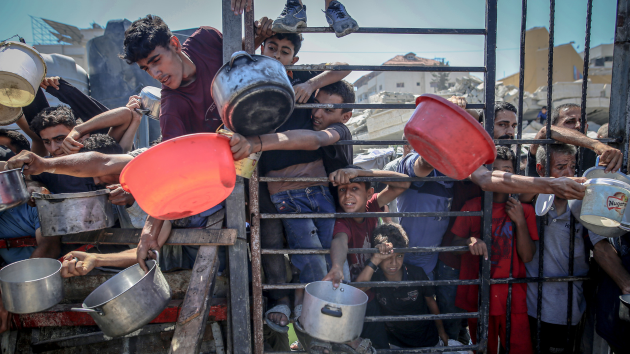
(LONDON) — Gazans camped out close to a humanitarian aid distribution site near the city of Rafah on Wednesday night, as a controversial U.S.- and Israel-backed project to distribute food in the devastated Palestinian territory expanded.

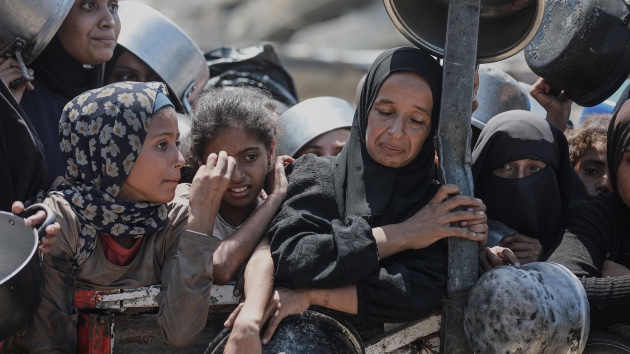
Local journalists told ABC News that thousands of people gathered at the site northeast of Rafah in the hope of receiving food aid, but there was not enough to satisfy demand when distribution began on Thursday.

The site is located close to the Morag corridor — a strip of land controlled by the Israel Defense Forces separating the Gazan cities of Rafah and Khan Younis.

Videos from the site showed large crowds of Gazans rushing to collect aid, carrying boxes stamped with the mark of the Gaza Humanitarian Foundation, or GHF — which is directing the aid distribution in collaboration with the American and Israeli governments.

“It is very difficult, we want to eat, we want to live — what should we do?” one man said when speaking with Reuters.

Another man left the site empty-handed, telling Reuters, “Every time I go, I hold a box, a hundred people crowd over me, 300. I could not take anything.”

Meanwhile, Israeli strikes continued across the strip. The Hamas-run Gaza Health Ministry said Thursday that 67 people were killed and 184 people injured by Israeli action over the previous 24 hours.

The latest casualties bring the total toll in Gaza since Oct. 7, 2023, to 54,249 people killed and 123,492 injured, the ministry said.

The Israeli government had been implementing a blockade on all humanitarian aid being sent into Gaza since March 2. The blockade was instituted to pressure Hamas to release the remaining hostages, Israel said. Hamas still holds 58 hostages, with about one-third of them believed to be alive, according to The Associated Press.

The blockade has caused widespread malnutrition and conditions likely to lead to famine, according to the U.N. and other international aid organizations. Two million people in the Gaza Strip face “extreme hunger and famine without immediate action,” the U.N.’s World Food Programme, or WFP, said last week.

Last week, Israel began allowing small amounts of humanitarian aid to enter Gaza, approving GHF’s responsibility for distribution. Israel had demanded a new aid distribution system, having accused Hamas of previously siphoning off aid.

GHF — launched earlier this year and run by U.S. security contractors, former military officers and humanitarian workers — has set up a handful of hubs protected by armed contractors close to IDF positions. Gazans have been told to travel to the hubs to collect aid.

The United Nations and other humanitarian aid groups have refused to take part in the new effort, citing concerns that it will allow Israel to control — and weaponize — aid supply.

WFP, for example, said it “cannot safely operate under a distribution system that limits the number of bakeries and sites where Gaza’s population can access food. WFP and its partners must also be allowed to distribute food parcels directly to families — the most effective way to prevent widespread starvation.”

GHF Executive Director Jake Wood resigned earlier this week, saying in a statement it had become “clear that it is not possible to implement this plan while also strictly adhering to the humanitarian principles of humanity, neutrality, impartiality, and independence, which I will not abandon.”

GHF on Wednesday denied reports that it was forced to pause operations after thousands of Palestinians overran one of its aid distribution sites in Gaza on Tuesday.

The group said its “operations will continue to scale up” on Thursday, having distributed a total of eight trucks worth of aid — enough for 378,262 meals — on Wednesday.

GHF later said that three of its sites were operational on Thursday, distributing around 997,920 meals. That brought the total number of meals distributed to approximately 1,838,182, GHF’s statement said.

However, multiple aid organizations and nongovernmental organizations have said the aid distributed so far is just a drop in the bucket compared to what is needed.

ABC News’ Helena Skinner, Diaa Ostaz, Joe Simonetti, Nadine El-Bawab, Camilla Alcini and Will Gretsky contributed to this report.

Copyright © 2025, ABC Audio. All rights reserved.

MAGA roadshow comes to Europe as trade war looms

MAGA roadshow comes to Europe as trade war looms
ABC News

LONDON — The “Make America Great Again” roadshow arrived in Europe this week with events in two nations where American conservatives see prime opportunities for a new transatlantic political culture — one molded by President Donald Trump’s right-wing populism and imbued with grand “clash of civilizations” rhetoric.

The Conservative Political Action Conference — CPAC — opened its week of European events on Tuesday in Jasionka, Poland, where Department of Homeland Security Secretary Kristi Noem was among the speakers, urging Poles to vote for right-wing presidential candidate Karol Nawrocki in this weekend’s runoff election.

Noem eschewed the diplomatic norm of non-alignment in elections in allied nations, as have other administration officials including Vice President JD Vance. “You will be the leaders that will turn Europe back to conservative values,” she told attendees in Jasionka.

“We need you to elect the right leader,” Noem said, dismissing Nawrocki’s rival — liberal Warsaw Mayor Rafal Trzaskowski — as “an absolute train wreck of a leader.”

“Donald Trump is a strong leader for us, but you have an opportunity that you have just as strong of a leader in Karol if you make him the leader of this country,” Noem said.

CPAC’s next stop will be in Budapest, Hungary, on Thursday, hosted by populist Prime Minister Viktor Orban — a totem of the European anti-establishment right wing who has long enjoyed cozy relations with Trump.

Peter Kreko, the director of the Political Capital Institute in Budapest, said Orban is positioning himself as “another recipient of the MAGA soft power export.”

“Orban is still positioning himself as someone who is exporting his campaign tactics, who can help others in terms of campaign consultancy and provide help from the United States,” Kreko said. “He’s trading off of his good partnership with Donald Trump.”

On the web page promoting CPAC’s Hungary event, the organization hit out at “corrupt elites” who it said “betray all that once made us great: patriotic virtue has been replaced by internationalism, common sense by bureaucracy and tradition by woke madness.”

“People on both sides of the Atlantic have risen up against this repackaged version of socialism, but success can only be complete when the tides of change converge and the age of patriotism begins at both poles of the West,” CPAC wrote.

Internationalism is front and center in the CPAC event agendas. Among the speakers in Budapest will be American conservative commentator Ben Shapiro, Yair Netanyahu — the son of Israeli Prime Minister Benjamin Netanyahu and Santiago Abascal, the leader of Spain’s far-right Vox party.

Also attending will be a host of other European conservative politicians from Poland, Austria, the Czech Republic, Croatia, Denmark, France, Estonia and Greece — among others.

“With the triumph of Donald Trump and the rise of the European Right, the Age of the Patriots of Western Civilization has begun — CPAC Hungary 2025 will be the hub of this movement,” the organizing website said.

But the CPAC events come at a moment of peril for transatlantic relations. Trump’s “Liberation Day” tariffs threaten to touch off a costly trade war with the European Union.

Trump has made no secret of his disdain for the bloc. “Now we’re going to charge the European Union,” Trump said when unveiling his tariff plans in April. “They’re very tough. Very, very tough traders. You know, you think of the European Union, very friendly. They rip us off. It’s so sad to see. It’s so pathetic.”

Trump announced last weekend that his planned 50% tariffs on EU goods would be delayed into July. But the bloc remains on a collision course with the Trump administration.

The economic and political aspirations of all EU leaders rely heavily on the bloc’s own fortunes, even for those populist leaders like Orban who so often define themselves in opposition to the grand European project.

The president’s European offensive could yet sour budding ties between the MAGA movement and its foreign allies, if the latter’s “core interests appear directly threatened by Trumpism,” Celia Belin, a senior policy fellow at the European Council on Foreign Relations and head of its Paris office, told ABC News.

Kati Piri, Hungarian-born member of the Dutch parliament and the Labour Party’s spokesperson for foreign affairs, migration and asylum, told ABC News in a statement that “Trump’s unilateralist policies are designed to hurt all Europeans, and that so-called allies will not be spared.”

“Trump’s continued threats of tariffs on EU products and global trade wars are making him an unpopular friend to have — and this is fragmenting the unity of the global right,” Piri suggested.

The glitz and glamour of CPAC’s Budapest event will be welcome for Orban, Kreko said, as the prime minister grapples with his own domestic challenges — not least the meteoric rise of liberal opposition leader Peter Magyar.

Around 10,000 people rallied in Budapest earlier this month to protest government plans to restrict the rights of independent media organizations — the latest in a wave of large protests against Orban and his Fidesz party government.

Kreko said Orban’s popularity is flagging after 15 years of uninterrupted power, even as he positions himself at the forefront of the nascent right-wing “illiberal international.”

“Orban is nowhere as popular as he was, let’s say in 2022, when he won the last elections,” Kreko said. “His popularity is waning, he is having a hard time getting it back and he also uses increasingly authoritarian tools to be able to keep power.”

“He has a hard time at home persuading his own constituency that the regime he is promoting all over the world is as powerful, as beautiful, as successful as it is seen by the MAGA camp in the United States,” Kreko added.

Trump’s America has become the center of gravity of the global right-wing movement — with the weight of the federal government and the broader national conservative movement behind it.

This week Samuel Samson — a senior advisor for the State Department’s Bureau for Democracy, Human Rights, and Labor — gave an indication of the prevailing winds in American transatlantic policy, publishing an article setting out “the need for civilizational allies in Europe.”

Claiming the existence of “an aggressive campaign against Western civilization itself,” Samson accused European governments of having “devolved into a hotbed of digital censorship, mass migration, restrictions on religious freedom and numerous other assaults on democratic self-governance.”

Opening the CPAC event in Poland on Tuesday, chairman Matt Schlapp told attendees, “The globalists intend to take each one of us out one by one — to shame us, to silence us, to bankrupt us, to ruin us, to make our kids turn against us.”

That is why, he said, it was important to “win all these elections, including in Poland, that are so important to the freedom of people everywhere.”

For now, Kreko suggested the transatlantic MAGA project is incomplete, as did recent election results in Romania, Portugal and the first round of Poland’s presidential vote in which conservative and far-right candidates did not win power.

“What is common between Trump, Orban and many others in central and eastern Europe is that they really want to build this illiberal international,” Kreko said.

“But at the same time, we also have to be careful about overestimating its impact,” he said.

Copyright © 2025, ABC Audio. All rights reserved.

Gazan children wait for food in long lines as starvation looms

Gazan children wait for food in long lines as starvation looms
Majdi Fathi/NurPhoto via Getty Images

(GAZA) — As the humanitarian crisis in Gaza continues to unfold, video showed children sitting in lines waiting for food on the side of the road on Tuesday.

Two million people in the Gaza Strip face “extreme hunger and famine without immediate action,” the World Food Programme said last week.

The children gathered by a community kitchen, waiting with their empty pots, according to the video verified by ABC News.

In the scramble for hot food, a child was scalded after hot soup was spilled on him, the video shows. The child is seen crying in pain as someone pours water on him. Another video showed a child scooping up flour spilled on the ground mixed with dirt.

“The children of Gaza need protection,” UNICEF, the U.N. agency for children, said in a statement on Tuesday. “They need food, water, and medicine. They need a ceasefire. But more than anything, they need immediate, collective action to stop this once and for all.”

Last week, more than a dozen World Food Programme trucks were looted in southern Gaza while en route to WFP supported bakeries.

“These trucks were transporting critical food supplies for hungry populations waiting anxiously for assistance. Hunger, desperation, and anxiety over whether more food aid is coming, is contributing to rising insecurity,” the WFP said in a statement.

The Israeli government had been implementing a blockade on all humanitarian aid being sent into Gaza since March 2. The blockade was instituted to pressure Hamas to release the remaining hostages, Israel said.

Humanitarian groups and the United Nations have distanced themselves from the new plan to distribute aid into Gaza that began last week. Aid trucks started slowly re-entering Gaza last week, according to the U.N. and the Gaza Government Media Office.

“WFP cannot safely operate under a distribution system that limits the number of bakeries and sites where Gaza’s population can access food. WFP and its partners must also be allowed to distribute food parcels directly to families — the most effective way to prevent widespread starvation,” the WFP said last week.

The Israeli blockade on humanitarian aid entering the Gaza Strip has caused widespread malnutrition and conditions likely to lead to famine, according to the U.N. and other international aid organizations.

One in five people in Gaza, about 500,000 people, faces starvation, the Integrated Food Security Phase Classification platform said on May 12, according to the U.N. Of those, 71,000 children need treatment for acute malnutrition, according to the report.

Dr. Feroze Sidhwa, an American physician who volunteered in Gaza in 2024 and last month, spoke at the U.N. on Wednesday, describing the day Israel broke the ceasefire in March as the day he “witnessed the most extreme casualty event of my career.” He said he had 221 trauma patients in his care.

Sidhwa also criticized the controversial new aid plan for Gaza, which he said constitutes a “weaponization and politicization of aid.”

“If this continues, there will be no Palestinian doctors left — no one to care for the sick and wounded,” Sidwha said. “No Palestinians left to rebuild the health care system. We are losing a generation before our eyes, condemning patients to die from hunger, disease and despair — deaths that could have been prevented.”

Copyright © 2025, ABC Audio. All rights reserved.

Russia says Trump ‘does not fully understand’ after criticism of Putin

Russia says Trump ‘does not fully understand’ after criticism of Putin
Ukrinform/NurPhoto via Getty Images

(LONDON) — A top aide to Russian President Vladimir Putin suggested that President Donald Trump “is not getting enough information” about Moscow’s war on Ukraine, after Trump criticized Putin for his apparent reluctance to pursue a peace deal and warned that the Kremlin was “playing with fire.”

“There is a lot that Trump says, we read it all, track it, but in many ways we come to the conclusion that Trump is not getting enough information about what is really happening in the context of the Ukrainian-Russian confrontation,” Yuri Ushakov said in an interview with Russian propagandist Pavel Zarubin published on Wednesday.

“In particular, he is not being informed enough about what massive terrorist attacks are being carried out by Ukraine against peaceful Russian cities,” Ushakov said. “Trump only knows what countermeasures we are taking, and he does not fully understand that we are attacking military institutions or military industrial complexes.”

Trump told reporters in the Oval Office on Wednesday that he was “disappointed” by Russia’s barrage of strikes in recent days.

Asked if he believed the Russians are being disrespectful and if Putin actually wants to end the war, Trump responded, “I can’t tell you that. But I’ll let you know in about two weeks.”

“Within two weeks. We’re going to find out very soon,” he continued. “We’re going to find out whether or not he’s tapping us along or not. And if he is, we’ll respond a little bit differently. But it will take about a week and a half, two weeks.”

He said he hasn’t imposed new sanctions on Russia because “I think I’m close to getting a deal.”

“I don’t want to screw it up by doing that,” he said. “This isn’t my war. This is Biden’s war, Zelenskyy’s war and Putin’s war. This isn’t Trump’s war. I’m only here for one thing to see if I can end it.”

The comments came after hundreds of Ukrainian drones crossed into Russia overnight into Wednesday morning, dozens of which targeted Moscow and again caused disruption to flights in and out of the capital, according to officials there.

Russia’s Defense Ministry said its forces shot down 296 Ukrainian drones over 12 regions — including the capital Moscow — during the latest round of long-range strikes.

Moscow Gov. Andrei Vorobyov said on Telegram that at least 42 drones were downed over the region. Vorobyov reported damage to three homes in the town of Chekhov around 40 miles south of the capital.

Moscow’s Sheremetyevo International Airport — one of four international airports in the capital — also warned travelers of delays due to flight restrictions imposed during the latest drone attack. Recent weeks have seen regular disruptions to Moscow’s airports during such strikes.

Andriy Kovalenko, the head of the Counter-Disinformation Center operating as part of Ukraine’s National Security and Defense Council, said on Telegram there were “some pretty good hits” during Tuesday night’s attack.

Among the targets were the Dubna Machine-Building Plant — involved in the production of aviation, missile and drone technology, Kovalenko said — in the city of Dubna, around 70 miles north of Moscow.

Kovalenko said the Technopark ELMA-Zelenograd facility — which hosts the development of microelectronics, IT, robotics and medical equipment — was also targeted. The facility “is one of the centers where import substitution of critical components previously imported from the West takes place,” Kovalenko said.

ABC News could not immediately verify Kovalenko’s claim of successful strikes on the facilities.

Russia continued its own long-range attacks on Ukraine overnight. Ukraine’s air force said Moscow launched six missiles and 88 strike drones into the country, of which 71 drones were shot down or otherwise neutralized. The air force said it recorded impacts in eight locations.

The intensity of strikes by both sides has only increased since Trump’s return to office in January, the president having promised to end Russia’s war on its neighbor in 24 hours. Trump has not delivered on that promise, and his frustration appears to have been building in recent weeks with the continued failure of U.S.-led ceasefire efforts.

Trump called Putin “absolutely crazy” in a Sunday social media post, then on Tuesday said Putin doesn’t realize “that if it weren’t for me, lots of really bad things would have already happened to Russia, and I mean REALLY BAD. He’s playing with fire!”

The U.S. and Ukraine are now waiting for Russia to deliver its peace memorandum — a document promised by Putin to Trump during a phone call between the two leaders earlier this month.

Russian Foreign Minister Sergey Lavrov said Wednesday that Russia is ready to present its memorandum to Ukraine and proposed holding a second round of talks with Kyiv in Istanbul on June 2.

Ukrainian President Volodymyr Zelenskyy earlier Wednesday floated the idea of a trilateral meeting with Putin and Trump.

“If Putin is uncomfortable with a bilateral meeting, or if everyone wants it to be a trilateral meeting — I don’t care. I’m ready for any format,” he said.

Trump, meanwhile, said Wednesday he would sit down with Putin and Zelenskyy “if it’s necessary.”

“At this point, we’re working on President Putin, and we’ll see where we are,” he told reporters.

Zelenskyy has cast doubt on the Russian proposal. “They’ve already spent over a week on this,” he wrote on social media on Tuesday. “They talk a lot about diplomacy. But when, in the midst of all that, there are constant Russian strikes, constant killings, relentless assaults, and even preparations for new offensives.”

On Wednesday, Andriy Yermak — the head of Zelenskyy’s presidential office — wrote on Telegram, “Russians are masters of empty words.”

Copyright © 2025, ABC Audio. All rights reserved.

Israeli airstrikes target Yemen airport as Netanyahu warns Houthis, Iran

Israeli airstrikes target Yemen airport as Netanyahu warns Houthis, Iran
Kevin Dietsch/Getty Images

(LONDON) — Israel launched airstrikes on Sana’a International Airport in the Yemeni capital on Wednesday, Prime Minister Benjamin Netanyahu said, warning of the possibility of further attacks on the Iran-backed Houthi movement that controls the area.

“We work according to a simple rule: Whoever harms us, we harm them,” Netanyahu said in a statement posted to X by his office. “Whoever does not understand this with force, will now understand it with greater force.”

“But, as I have said more than once: The Houthis are only the symptom. The main driving force behind them is Iran, which is responsible for the aggression emanating from Yemen,” Netanyahu continued.

The Houthis have been attacking regional shipping and launching drones and missiles toward Israel since Hamas’ deadly surprise attack on Israel on Oct. 7, 2023. The Houthis say their attacks are a protest of Israel’s war against Hamas in Gaza.

In response, the Israel Defense Forces have attacked a range of targets in Houthi-controlled Yemen. The IDF has previously bombed the airport in Sana’a in December 2024 and earlier this month.

The IDF said in a Wednesday statement that the latest attack targeted “the central airport in Sana’a and an aircraft belonging to the Houthi terrorist organization.”

“The aircraft that were attacked were used by the Houthi terrorist regime to transport terrorists who promoted terrorist acts against the state of Israel,” the IDF said.

“The IDF is determined to continue to act and strike with force anyone who poses a threat to the residents of the state of Israel, at whatever distance is required,” the IDF said.

Yemenia Airlines condemned the strike.

“Another Yemenia Airlines plane was directly and cowardly targeted this morning, just moments before the scheduled boarding of pilgrims,” the airline said in a statement Wednesday. “The plane had received all necessary permits for landing, operation, and takeoff from all relevant authorities.”

“Accordingly, we announce to the Yemeni and international public opinion the complete (temporary) suspension of Yemenia Airlines flights from Sana’a International Airport until further notice,” the statement continued. “This is a result of this cowardly terrorist act that targeted a Yemeni civilian aircraft, belonging to a national company that has distanced itself from all conflicts and is fully dedicated to serving all our noble people without discrimination.”

Last month, the Houthis agreed to end attacks on American commercial shipping in the region in exchange for an end to the intense U.S. airstrikes against them, a campaign President Donald Trump began in March.

The Houthis have said that the agreement does not include stopping its attacks on Israel, and have since launched multiple drones and ballistic missiles toward the country.

ABC News’ Guy Davies contributed to this report.

Copyright © 2025, ABC Audio. All rights reserved.

Noem blasts ‘weak’ European leaders, stumps for conservative candidate in Poland

Noem blasts ‘weak’ European leaders, stumps for conservative candidate in Poland
Jakub Porzycki/NurPhoto via Getty Images

(WASHINGTON) — Homeland Security Secretary Kristi Noem on Tuesday pushed for Karol Nawrocki to be president of Poland while speaking at the Conservative Political Action Conference in Warsaw, decrying his opponent as a “train wreck.”

It is an extraordinary move for a sitting member of the U.S. Cabinet to advocate for a political candidate in a foreign country.

Noem spoke for more than 20 minutes at CPAC, an American group that seeks to spread conservative ideas and held its first conference in Poland on Tuesday.

She claimed there is no time for “nice words,” saying, “We do not have time to dance around the dangers that threaten our societies.”

“It matters who’s in charge,” Noem told the crowd. “I have watched over the years as socialists and people that are just like this mayor out of Warsaw that is an absolute train wreck of a leader have destroyed our countries because they have led by fear.

“They have used fear to control people, and they’ve used fear to promote an agenda that is not what liberty is about, that is not what freedom is about,” she said.

The Polish runoff election for president is on Sunday, June 1, with Nawrocki as the conservative choice and Rafal Trzaskowski for the Civic Platform party.

Nawrocki visited President Donald Trump earlier this year.

“He needs to be the next president of Poland,” Noem said of Nawrocki. “Do you understand me?”

Noem then took aim at “weak” European leaders who have allowed in migrants and “destroyed their civilizations.”

“You have enforced your borders. You have protected who comes into your country, enforced your visa programs. You’ve done good work to make sure that this country has a different story,” she told the crowd.

“But you have much more to do, and you are threatened with a leader who is on the ballot who would take all of that protection away from you, who would open you up to much of the experiences that America had to live through under our last president, Joe Biden,” she added, offering pointed criticisms at Biden and her predecessor, Alejandro Mayorkas.

She argued America “lived through four years of hell” and that the public made a choice in electing Trump in November.

“Thousands and thousands of dangerous criminals came into our country, hundreds of known terrorists infiltrated our country and our communities,” she said. “And our families were murdered and raped and victimized, arrested, released again by his administration to continue the fear agenda that he was trying to promote and to allow political power to be in his hands but not in the people any longer.”

Noem praised Trump as making the United States “safer” for the public.

“Donald Trump is a strong leader for us, but you have an opportunity to have just as strong of a leader in Karol if you make him the leader of this country,” she said.

“You can be that shining city on a hill that the rest of Europe and the world will watch and know how strong you are, how free you are because you’ve elected the right leader that will protect it and defend it and ensure that every individual is treated the same and has equal rights as afforded to them,” she added.

Noem also said that if the Polish elect the right person, the country will continue to have the backing of the U.S.

“If you have elected a leader that will work with President Donald J. Trump, the Polish people will have an ally strong that will ensure that you will be able to fight off enemies that do not share your values,” she said. “You will have strong borders and protect your communities and keep them safe and ensure that your citizens are respected every single day. You will continue to have a U.S. presence here, a military presence, for Trump, that we can work together for the security of both of our nations.”

CPAC will go to Hungary later this week, but it is unclear if Noem or any other U.S. officials will speak at the conference.

Copyright © 2025, ABC Audio. All rights reserved.