(NEW YORK) — A scathing review has been released evaluating the “failures” of the policies that guided Sweden’s response to the COVID-19 pandemic.
The review, published in the journal Humanities & Social Sciences Communications Tuesday, discusses how, throughout the pandemic, Sweden attempted to avoid lockdowns and stay-at-home orders implemented by many of its neighboring countries.
The authors — from Sweden, Belgium, Norway and the U.S. — said Sweden was able to achieve this by portraying advice from independent scientists as “extreme,” keeping the public in the dark regarding facts about how COVID-19 spreads and not issuing any mandates.
This is despite the country’s history of collaboration between authorities and the scientific community and the general public’s high level of trust of those in power.
As a result, Sweden had a higher COVID death rate than the surrounding Nordic nations.
“The Swedish response to this pandemic was unique and characterised by a morally, ethically, and scientifically questionable laissez-faire approach, a consequence of structural problems in the society,” the team wrote. “There was more emphasis on the protection of the ‘Swedish image’ than on saving and protecting lives or on an evidence-based approach.”
Prior to the COVID-19 pandemic, Sweden’s Public Health Agency had published two pandemic planning documents in the last decade to prepare for such an event, according to the review.
Although both focused on the value of antiviral drugs and vaccines to treat and prevent cases, they also emphasized the importance of “limiting the consequences for individuals and society” and how “the negative effects on society must be as small as possible.”
So, when COVID-19 was declared a global pandemic by the World Health Organization in March 2020, Sweden was determined to keep its economy up and running and emphasized individual responsibility rather than collective responsibility.
According to the review, the Prime Minister and Minister of Health and Social Affairs “mainly referred to the authority of the Public Health Agency,” a stark contrast from past collaboration between the government and scientists.
Unlike the strict lockdowns implemented by most of Europe, the PHA merely recommended staying at home if feeling ill, washing hands regularly, social distancing and avoiding unnecessary travel.
Meanwhile, restaurants, bars and shops remained open; children under 16 were required to attend school in person with no exceptions for those with at-risk family members; and no mask mandates were ever implemented.
The review noted that the PHA did eventually recommend face masks in hospitals and care homes in June 2020, but only when treating confirmed or suspected COVID patients.
The authors said the PHA discouraging the use of masks and claiming they were ineffective helped spread fear in the population and misinformed the public about how COVID spreads, that asymptomatic people can be infectious and that masks protect the wearer and those around them.
According to the review, there was also a lack of transparency from public health authorities. The number of ICU beds per region was not publicly available and schools often did not inform parents or teachers when students tested positive for the virus.
Then there were efforts to actively squash medical researchers who criticized Sweden’s strategy and accused authorities of not being properly prepared.
When researchers voiced their criticisms on social media, in interviews or in scientific papers, they were often reprimanded by their superiors for reasons such as not being allowed to use their university affiliation, even though this is against Sweden’s right of Academic Freedom of Speech, according to the review.
Additionally, the PHA also “discredited any critique and national/international scientific evidence” and the authors say the agency “cherry picked” scientific papers that agreed with its viewpoint.
Ultimately, this led to Sweden having worse COVID-19 outcomes than its neighboring Nordic countries.
In late December 2020, Sweden was recording an average of 44 COVID-19 deaths per 1 million people, according to Our World in Data.
By comparison, Denmark was recording 5 deaths per 1 million, Norway was recording 0.5 deaths per 1 million and Finland was recording 0.3 deaths per 1 million, the data shows.
One month earlier, a report from the Swedish Inspectorate of Health and Social Services found half the country’s deaths at the time were among nursing home residents.
About one year later in January 2022 — during the omicron wave — Sweden was faring better and recording 5 deaths per 1 million.
However, the other three countries were recording half as many deaths with Denmark recording the highest at 2.4 per 1 million, Our World in Data shows.
“The cost in terms of infections and deaths of this pandemic in Sweden has been larger in some other more densely populated and more centrally located countries, yet is still markedly higher than in the other Nordic countries,” the authors wrote. “This Swedish laissez-faire strategy has had a large human cost for the Swedish society.”
(NEW YORK) — The commercial passenger jet that crashed Monday in southern China plunged into a mountainside with such force it created a 66-foot deep crater and shattered into pieces, officials said Thursday.
Search crews have recovered 183 pieces of the China Eastern Airlines plane and the remains of 21 of the 132 people killed in the air disaster, Zhu Tao, director of the Aviation Safety Office of the Civil Aviation Administration of China, said at a news conference.
One piece of the aircraft roughly 4 feet long and 4 inches wide was found on farmland 6.2 miles from the core crash site in China’s Guangxi region. Officials would not speculate on how it ended up there but said they are expanding the search area.
Zhu said search crews were still looking Thursday for the Boeing 737-800’s second black box, believed to be the flight data recorder that was installed above the ceiling of the aircraft’s rear cabin.
The plane’s cockpit voice recorder, installed in the plane’s rear cargo compartment, was recovered from the wreckage on Wednesday and is expected to be analyzed at a lab, officials said.
Zhu said most of the wreckage of Flight 5735 is concentrated in and around an impact crater measuring nearly 100 feet wide and 66 feet deep.
Among the pieces recovered are an engine blade and engine pylon, the left and right horizontal stabilizers, pieces of the wings and the plane’s aileron autopilot actuators.
“We also found crew escape ropes and fragments of crew manuals and some crew documents normally found in the cockpit,” Zhu said.
The cause of the crash remains under investigation.
The plane crashed after taking off from Kunming, the capital of China’s Yunnan province. The flight was headed to Guangzhou, a port city northwest of Hong Kong, Chinese officials said.
Early data shows the airliner plunged from 29,000 feet to 8,000 feet, leveled off and then went into a freefall, exploding into a fireball that was seen and filmed by people nearby. One video showed the plane nose-diving into the ground.
Air traffic controllers made repeated attempts to radio the flight crew when they noticed the aircraft’s rapid descent but were unable to restore communications with the crew before the crash, Chinese officials said.
U.S. intelligence doesn’t have a clear theory on what led to the plane crashing. A source tells ABC News they aren’t ruling anything out, including a possible intentional downing.
During Thursday’s news conference, Chinese officials said more than 300 family members of passengers on the doomed plane were gathered in Wuzhou in the Guangxi region and that China Eastern Airlines had dispatched 161 staff members to meet with them and provide assistance and comfort. More than 200 of the family members have been taken near the crash scene to mourn their lost loved ones, officials said.
(KYIV, Ukraine) — Ukraine’s lead negotiator in peace talks with Russia has said he believes the negotiations with Moscow are “absolutely real,” but has warned it may take months to reach a deal to end the war.
Mykhailo Podolyak, a senior aide to President Volodymyr Zelenskyy, spoke to ABC News inside the heavily guarded compound of the presidential office in central Kyiv. ABC News reporters were brought through several rings of security into the building’s darkened corridors, piled with sandbags to protect against shelling and empty except for Ukrainian special forces soldiers armed with assault rifles standing every few yards.
Podolyak has been leading Ukraine’s delegation at the talks that began within days after Russia’s invasion. The first rounds were held in Belarus but recently the sides have switched to sessions by video link.
Podolyak said the talks are now taking place every day by video, mostly at the level of working groups. Both sides in the last week have said the talks are making progress and that they are moving closer to a compromise, despite intense ongoing fighting. Ukrainian and American officials though have expressed doubts whether Russia is negotiating in good faith or might be using the talks just to buy time for its forces to regroup to press on with its war.
But Podolyak said he was certain Russia was now genuinely negotiating, aware that it has no choice.
“They’re absolutely real negotiations,” Podolyak said. “There’s no attempt to stall for time. That’s definitely not there.”
But he warned that reaching an agreement could still take “months.”
Heavy losses inflicted on Russia, devastating Western sanctions and its failure to take any key cities, including Kyiv, have forced the Kremlin to moderate its demands, Podolyak said, meaning the two sides’ positions are now far closer.
“Twenty-eight days of war have shown that Russia is not a country that can dictate conditions,” he said. “It seems to me they really do want to resolve some issues in negotiations, because there is the sanctions pressure, military pressure from Ukraine. We have already put them in their place.”
But he said that more pressure from Ukraine’s military, as well as international sanctions, was still needed to push Russia into negotiating positions that would allow for an agreement.
Russia’s core demand remains that Ukraine renounce its ambition to join NATO. In recent days, Zelenskyy and other Ukrainian officials have signaled they understand Ukraine will not join the alliance but have emphasized Ukraine wants security guarantees from Western countries to protect it from any future Russian aggression.
Last week, the Financial Times and The Washington Post reported Russia and Ukraine were discussing a 15-point peace plan that would see Ukraine give up its NATO ambitions and accept some limits on its military in return for security guarantees from allies like the U.S., U.K. and Turkey.
Russia is also demanding Ukraine recognize Russia’s annexation of Crimea and the independence of two Russian-occupied separatist regions in eastern Ukraine, as well as legal provisions protecting the rights for the Russian language in Ukraine.
Podolyak denied there is a 15-point plan as reported, saying it simply represented Russia’s proposals. He said both sides had “several drafts” outlining their own positions but there was no “agreed project.”
Podolyak avoided saying whether Ukraine was now ready to give up its NATO ambitions, but stressed Ukraine is now seeking separate guarantees from willing NATO countries rather than membership in the alliance.
He suggested that such guarantees from Western countries were essential to Ukraine if it is to sign any agreement.
Those security guarantees appear a significant obstacle to a deal since it is unclear how any promise from a NATO country to defend Ukraine would differ from Ukraine de facto joining the alliance.
Asked what sort of guarantees Ukraine is seeking, Podolyak suggested as an example that it could be “legally enshrined” that a no-fly zone will be imposed over Ukraine in the event of a new Russian attack. He declined to say which NATO countries Ukraine was discussing such guarantees with, since negotiations are ongoing, but he did not deny the U.S. was among them.
Ukraine wants security guarantees so “that Russia does not attack us in the future,” he said. “This requires not amorphous structures returning to the U.N., OSCE [Organization for Security and Co-operation in Europe] or NATO, but effective alliances that will make it clear to Russia that it is not necessary to attack Ukraine’s borders, as this will have very, very bad consequences.”
The U.S. and other NATO countries have already repeatedly ruled out imposing a no-fly zone over Ukraine because it would lead to a direct conflict with Russia.
The Kremlin’s spokesman said Tuesday the talks were progressing “much more slowly and less substantively than we would like” and Russia has insisted it will still achieve the goals set at the beginning of its operation against Ukraine.
Podolyak said that Russia’s positions have already become far more “appropriate,” but that it still had “illusions” that Ukraine can be made to accept ultimatums.
The danger, he said, was that the two countries were now moving into a phase of bloody stalemate that would see Russia cause heavy civilian casualties before it was finally forced into accepting a compromise.
The timing to end the war, Podolyak said, would depend on how much Western support Ukraine now received. He said Ukraine needs more air defenses and anti-tank weapons and called for Western countries to impose a full embargo on Russian oil and stricter financial sanctions. The U.S. has sent hundreds of millions of dollars in weaponry to Ukraine, including a new $800 million cache now being delivered.
“I think right now they are in a state of shock and are trying to understand how low they might lower their demands so that we will start to agree with them on something,” said Podolyak. “It’s a difficult process for them. For eight years they lived in illusions — they thought they were world champions on the level with the United States.”
He said continuing pain inflicted by Ukraine’s military and more sanctions would force Russia to come to terms with the reality of its position.
“Russia will become more and more adequate and will come to the negotiating position, which will allow for the signing of an agreement not only with Russia — for there’s no point to a peace agreement with Russia — but a multilaterally guaranteed agreement, where first of all there will be guarantor countries,” he said.
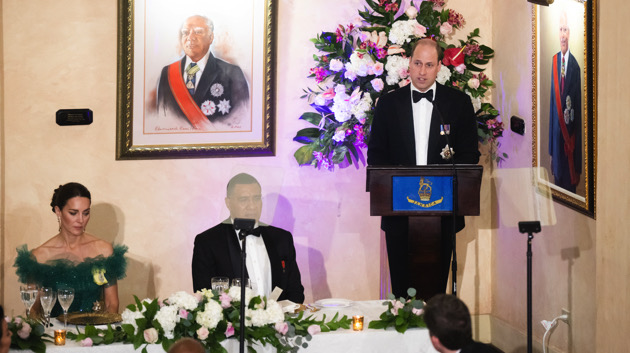
(KINGSTON, Jamaica) — Prince William delivered a speech Wednesday in Jamaica expressing his “profound sorrow” over the history of slavery, as he and his wife, Duchess Kate, have faced protests on their Caribbean tour.
“I want to express my profound sorrow. Slavery was abhorrent. And it should never have happened,” William said at a state dinner hosted by Jamaica’s governor general and attended by local dignitaries and senior politicians.
“While the pain runs deep, Jamaica continues to forge its future with determination, courage and fortitude,” William said in his remarks. “I strongly agree with my father, the prince of Wales, who said in Barbados last year that the appalling atrocity of slavery forever stains our history.”
“The strength and shared sense of purpose of the Jamaican people, represented in your flag and motto, celebrate an invincible spirit,” he continued. “It is this same spirit that spurred on the Windrush generation, who came to the United Kingdom to help rebuild after the Second World War. We are forever grateful for the immense contribution that this generation and their descendants have made to British life, which continues to enrich and improve our society.”
William’s speech came just hours after he and Kate met with Jamaican Prime Minister Andrew Holness, who told them that while he was “happy” to welcome them to Jamaica, the country is on its way to becoming a republic.
Jamaica becoming a republic would mean removing Queen Elizabeth, William’s grandmother, as its head of state.
As monarch, Queen Elizabeth is the head of the British Commonwealth, representing 54 nations, including Belize, Jamaica and the Bahamas, which William and Kate will visit next.
Another Caribbean country, Barbados, became a republic last year, no longer pledging allegiance to the queen.
William and Kate, the Duke and Duchess of Cambridge, are on a goodwill tour to Belize, Jamaica and the Bahamas to celebrate the queen’s Platinum Jubilee, marking her 70 years on the throne.
The Cambridges were forced to cancel one of their first stops in Belize over the weekend when protests led by indigenous people broke out ahead of their arrival.
On Tuesday, the day of William and Kate’s arrival in Jamaica, dozens of protesters gathered in Kingston to protest the visit.
A group known as the Advocates Network, which describes itself as a “non-partisan alliance of individuals and organizations advocating for human rights and good governance,” also published an open letter protesting the royals’ visit, saying that British rule has “perpetuated the greatest human rights tragedy in the history of humankind.”
Robert Nesta Morgan, who holds the position as minister without portfolio within Jamaica’s government — a spokesperson for Jamaica’s government — told ABC News that there is consensus within the country, and agreement between the Jamaican government and opposition leadership that the country is “moving towards becoming a republic.”
“We already have political independence. We’re an independent country,” he said. “But there is a symbolism as to who is the head of state that many persons, including inside and outside of government, wish to change.”
Prime Minister Holness appointed Marlene Malahoo Forte, the country’s former attorney general, to be the minister of constitutional affairs, which took effect in January. Her new role, in part, oversees and advises the government as it seeks to transition to republic status.
Malahoo Forte told the Jamaica Observer in December that Holness gave her instructions for the constitution to be amended for the purposes of becoming a republic.
In addition to the calls for Jamaica to become a republic, activists have also been demanding slavery reparations in many of their demonstrations around William and Kate’s visit.
William did not mention reparations in his remarks on slavery Wednesday.
In July, Jamaica announced plans to ask Britain for compensation for the Atlantic slave trade in the former British colony, according to Reuters, noting the total amount could be “billions of pounds.”
Morgan told ABC News this week that people in Jamaica are looking for “recognition of the damage” done by slavery.
“The pursuit of reparations is not dependent on the acknowledgment of the oppressor that they have oppressed someone. It is based on the experience of those who are oppressed,” he said. “There are many persons in our society who have been fighting really hard for many decades for a recognition of not just the damage that slavery has done to our society, but also a recognition of the need to do repairing of that damage through reparations.”
William and Kate have so far not commented publicly on the controversy surrounding their visit.
While in Jamaica, the couple played soccer with locals and visited a teacher’s college to talk about early childhood development, a particular focus of Kate’s work.
They also visited with medical staff at a local hospital.
William and Kate will spend the next two full days in the Bahamas before returning to the U.K. on Sunday.
(NEW YORK) — Russian forces are continuing their attempted push through Ukraine from multiple directions, while Ukrainians, led by President Volodymyr Zelenskyy, are putting up “stiff resistance,” according to U.S. officials.
The attack began Feb. 24, when Russian President Vladimir Putin announced a “special military operation.”
Russian forces moving from neighboring Belarus toward Ukraine’s capital, Kyiv, have advanced closer to the city center in recent days despite the resistance. Heavy shelling and missile attacks, many on civilian buildings, continue in Kyiv, as well as major cities like Kharkiv and Mariupol. Russia also bombed western cities for the first time this week, targeting Lviv and a military base near the Poland border.
Russia has been met by sanctions from the United States, Canada and countries throughout Europe, targeting the Russian economy as well as Putin himself.
Here’s how the news is developing. All times Eastern.
Mar 24, 11:00 am
Lavrov’s stepdaughter among those targeted by latest UK sanctions on Russia
The United Kingdom imposed sanctions on another 33 people and 26 legal entities from Russia on Thursday.
Various Russian banks, including Gazprombank and Alfa-Bank, and Russian paramilitary organization the Wagner Group, were targeted, as well as Polina Kovaleva, the stepdaughter of Russian Foreign Minister Sergey Lavrov. Kovaleva reportedly owns a house in London. The assets of these persons and legal entities will be frozen under the sanctions, according to a document published by the U.K. Treasury’s Office of Financial Sanctions Implementation.
The document noted that this latest wave of sanctions were meant to target “key strategic industries and individuals,” as Russia’s invasion of Ukraine enters its second month.
Mar 24, 10:40 am
Putin has record month of international calls
Russian President Vladimir Putin made a record number of international telephone calls over the past month, according to the Kremlin.
The most calls — eight — were placed to French President Emmanuel Macron. Others on the list include leaders of Germany, Israel, India, Turkey, Luxembourg, Uzbekistan, Armenia and the European Council. There were also negotiations with the leaders of Azerbaijan, Finland, Bahrain, Senegal, Abu Dhabi, South Africa, Egypt, Belarus, Saudi Arabia, Kyrgyzstan, Kazakhstan, Venezuela, Syria, Iran and China, according to the Kremlin.
Mar 24, 10:08 am
Russia says talks with Ukraine continue virtually
Russia said Thursday that peace talks with Ukraine are continuing and are being held via video conference.
“Negotiations by the Russian and Ukrainian delegations on a draft treaty on the settlement of the situation in Ukraine, its neutrality and guarantees of its security are currently ongoing via video-conferencing. Military, political, and humanitarian aspects are being discussed,” Russian Ministry of Foreign Affairs spokesperson Maria Zakharova said during a press briefing.
“We hope that Kyiv will still come to realize the inevitability of a peaceful solution to the problem of demilitarization and denazification of Ukraine, its transformation into a neutral state,” she added. “The sooner representatives of the Kyiv regime understand this, the sooner the special military operation will be completed.”
Mar 24, 10:00 am
Ukraine accuses Russia of forcibly deporting Mariupol residents
Ukraine claimed Thursday that residents of Mariupol who have survived Russian bombardment are now being forcibly deported to Russia.
“The Russian Federation has launched a new phase of terror against the city of Mariupol,” the Ukrainian Ministry of Foreign Affairs said in a statement. “According to available information, the Russian army has forcibly deported about 6,000 Mariupol residents to Russian filtration camps in order to use them as hostages for political pressure on Ukraine.”
“At the same time, the Russian armed forces are firing on evacuation columns trying to leave Mariupol for the unoccupied territory of Ukraine,” the ministry added. “Russian troops continue to hold a humanitarian convoy of buses that arrived a few days ago from Mariupol from Zaporizhia.”
According to the ministry, some 15,000 residents of the besieged port city in southeastern Ukraine are in danger of being forcibly deported to Russia, with Russian troops confiscating peoples’ passports and other identification documents.
“Such actions by Russia are a gross violation of the laws or customs of war, the rules of international humanitarian law,” the ministry said.
The ministry called on world leaders to “take urgent action to save the lives of residents of Mariupol and other Ukrainian cities who have been in an inhumane siege by the Russian army.”
“The international community must impose new tough sanctions on Russia to stop its deadly military machine, as well as cut off all business ties with Russian companies to stop funding Russia’s war against Ukraine,” the ministry said.
-ABC News Julia Drozd
Mar 24, 9:51 am
NATO leaders discuss how to give Ukraine anti-ship missiles
The mood at NATO’s emergency summit in Brussels has been “sober” and “resolute” so far, according to senior U.S. administration officials.
“There was a very strong sense that that we are facing a significant historical moment, and very strong support from all the leaders who spoke about the need to defend our democracy,” one of the officials told reporters during a telephone briefing Thursday.
The officials said Ukrainian President Volodymyr Zelesnkyy, who addressed NATO leaders remotely, spoke “very eloquently” and “repeated his requests for continued and increased Western security assistance.”
“But notably, there was not a request for a no-fly zone,” an official added. “There was also not a request for NATO membership.”
U.S. President Joe Biden was the first NATO head of state to speak after Zelenskyy’s speech and noted that Thursday marks one month since Russia launched its invasion of Ukraine. He discussed the sanctions that have already been imposed and expressed strong support for Ukraine as well as humanitarian and military aid and reaffirmed his support for Article 5, which is the cornerstone of NATO and states that an attack on one member is an attack on all members.
China was also a topic of discussion among “many of the speakers,” officials said, as the world watches whether Beijing offers any military or economic assistance to Moscow.
“We need to continue to call on China not to support Russia in its aggression against Ukraine, and that we need China to call for a peaceful end of the conflict as a responsible member of the international community,” an official told reporters.
NATO allies are now consulting about “providing anti-ship missiles to Ukraine,” following the Ukrainian navy’s attack on a Russian ship earlier Thursday, though officials noted “there may be some technical challenges with making that happen.”
When asked whether there were discussions about NATO responding to a potential chemical attack by Russian forces in Ukraine, the officials told reporters: “Yes, there were some references to that.”
“It’s something that NATO as a military alliance is already postured to do,” one official said, “and it’s something that they’re recognized that they need to continue to do given the various scenarios that could emerge as part of this conflict.”
Mar 24, 9:09 am
Ukraine accuses Russia of using phosphorus bombs on civilians
Ukrainian President Volodymyr Zelenskyy accused Russia of using phosphorous bombs on civilians in Ukraine on Thursday.
“This morning, by the way, there were phosphorus bombs — phosphorus Russian bombs. Adults were killed again and children were killed again,” Zelenskyy told NATO leaders via video link from Kyiv, during an emergency NATO summit in Brussels. “I just want you to know that the alliance can still prevent the deaths of Ukrainians from Russian strikes, from Russian occupation, by providing us with all the weapons we need.”
Phosphorus munitions inflict excruciating burns and can lead to infection, shock and organ failure.
Mar 24, 8:30 am
Zelenskyy addresses NATO virtually: Never tell us our army doesn’t meet your standards
Ukrainian President Volodymyr Zelenskyy warned NATO leaders on Thursday that Russia’s offensive will ultimately go beyond Ukraine, unless the Western defense alliance takes stronger action.
“Ukraine never wanted this war and does not want to fight for years. We just want to save our people,” Zelenskyy said in an impassioned speech via video link from the Ukrainian capital, Kyiv. “I am sure you already understand that Russia does not intend to stop in Ukraine — does not intend and will not. It wants to go further.”
As all 30 NATO heads of state meet in Brussels for an emergency summit to discuss their response to Russia’s invasion of Ukraine, Zelenskyy lamented that “the worst thing during the war is not having clear answers to requests for help.”
“On Feb. 24, I addressed you with a perfectly clear, logical request to help close our skies — in any format. Protect our people from Russian bombs and missiles. We did not hear a clear answer,” he told NATO leaders. “And you see the consequences today — how many people were killed, how many peaceful cities were destroyed.”
“I have been repeating the same thing for a month now: To save people and our cities, Ukraine needs military assistance without restrictions, as Russia uses without restrictions its entire arsenal against us,” he continued. “Ukraine asked for your planes so that we do not lose so many people. And you have thousands of fighter jets, but we haven’t been given any yet.”
“We asked for tanks so that we can unblock our cities that are now dying,” he added. “You have at least 20,000 tanks. Ukraine asked for a percent — 1% — of all your tanks to be given or sold to us. But we do not have a clear answer yet.”
Zelenskyy criticized NATO for “worrying about how Russia will react” but said he wants “to be clear” that he does not “blame” the alliance.
“It’s not your missiles, it’s not your bombs that are destroying our cities,” he told NATO leaders. “I just want you to know that the alliance can still prevent the deaths of Ukrainians from Russian strikes, from Russian occupation, by providing us with all the weapons we need.”
While Ukraine has been refused NATO membership, “the most powerful defense alliance in the world,” Zelenskyy noted how his country has been defending “all our common values” for the last month.
“Yes, we are not in the alliance,” he said. “But Ukrainians never thought that the alliance and the allies were different.”
After a month of war, Zelenskyy said the “only thing” he demands from NATO now is: “Never, please, never tell us again that our army does not meet NATO standards.”
Mar 24, 7:44 am
Russia claims to have seized city of Izyum in eastern Ukraine
Russia claimed Thursday that its troops have seized Izyum, a city in eastern Ukraine’s Kharkiv Oblast.
The Russian Ministry of Defense said in a statement that units of the Russian Armed Forces had taken control of the city by Thursday morning.
Izyum is about 75 miles southeast of the oblast capital, Ukraine’s second-largest city of Kharkiv, which has faced relentless bombardment by Russian forces since the start of the invasion a month ago.
Ukraine did not immediately comment on the claim.
Mar 24, 7:22 am
Ukraine claims to have sunk large Russian ship at occupied port
The Ukrainian Naval Forces said Thursday that it has sunk the Russian ship Orsk in the Sea of Asov near the southeastern Ukrainian port city of Berdyansk.
The Ukrainian Naval Forces released a video, verified by ABC News, showing a large ship burning in the Russian-occupied port of Berdyansk, with flames and thick smoke billowing into the sky. The Orsk, a Russian Navy amphibious landing ship that was used to ferry Russian troops to Ukraine, was docked in the port.
Russia did not immediately comment on the claim.
Mar 24, 6:50 am
Over 3.67 million refugees have fled Ukraine: UNHCR
More than 3.67 million people have been forced to flee Ukraine since Russian forces invaded on Feb. 24, according to the latest figures from the United Nations refugee agency.
The tally from the U.N. High Commissioner for Refugees (UNHCR) amounts to just over 8% of Ukraine’s population — which the World Bank counted at 44 million at the end of 2020 — on the move across borders in 29 days.
More than half of the refugees crossed into neighboring Poland, UNHCR figures show.
Mar 24, 5:48 am
NATO leaders pose for photo ahead of emergency summit
NATO leaders, including U.S. President Joe Biden, posed for a photo at the alliance’s headquarters in Brussels on Thursday ahead of an emergency summit, as the Russian invasion of Ukraine grants into a second month.
Biden stood in the front row in between NATO Secretary-General Jens Stoltenberg and U.K. Prime Minister Boris Johnson.
Biden and Stoltenberg were the last of the leaders to arrive for the photo-op. As they walked in the room, Biden ignored a question from a reporter about what his message is to Russian President Vladimir Putin. Instead, Biden went to shake hands with Johnson and then greeted French President Emmanuel Macron and Italian Prime Minister Mario Draghi
Mar 24, 5:20 am
Biden arrives at NATO headquarters for emergency summit
U.S. President Joe Biden arrived in Brussels on Thursday morning ahead of an emergency NATO summit to discuss the Western defense alliance’s response to Russia’s invasion of Ukraine.
The European diplomatic capital is also hosting a gathering of the Group of Seven industrialized nations and a summit of the 27 members of the European Union on Thursday. Biden is scheduled to attend all three meetings and hold a press conference at the end of the day.
Upon his arrival at NATO headquarters, Biden was greeted by NATO Secretary-General Jens Stoltenberg. The two leaders stood and spoke for a few moments, though their conversation was inaudible. Biden and Stoltenberg then walked into the building and down the hallway, where they did not stop to speak to reporters who asked whether Russia’s potential use of chemical weapons in Ukraine are a red line that would trigger a response from NATO.
Biden and Stolenberg will now meet privately before taking a photo with other NATO leaders.
Earlier Thursday, U.K. Prime Minister Boris Johnson faced the same question from reporters when he arrived at NATO headquarters.
“Look, I think that the reality is that President Putin has already crossed a red line in barbarism and it’s now up to NATO to consider together the appalling crisis in Ukraine, the appalling suffering of the people of Ukraine,” Johnson replied. “And see what more we can do to help the people of Ukraine protect themselves. See what more we can do to tighten the economic vice around the Putin regime.”
Mar 24, 5:03 am
Ukraine calls Russian military ‘a gang of terrorists’
Ukrainian Defense Minister Oleksiy Reznikov on Thursday lambasted Russia’s military as “a gang of terrorists, criminals and cowards” who she claimed are committing war crimes.
In a statement posted on her official Facebook account, Reznikov marked one month since Russian forces invaded Ukraine and warned that Ukrainians “still have a very difficult period ahead.”
“The Russian military machine will not stop until it is drenched in the blood of its soldiers,” Reznikov said.
Earlier this month, Russian troops opened fire on a nursing home in the eastern Ukrainian city of Kreminna, killing 56 people, according to Reznikov.
“This is not an accidental hit,” she said. “This is the deliberate killing of defenseless people — a war crime. That’s why the Russian army is a gang of terrorists, criminals and cowards.”
Still, Reznikov remained confident that Ukrainian forces will prevail with international support.
“We will drive them out. We will rebuild everything,” she added. “We will clean our land from the effects of war. It will take a lot of effort and time.”
Mar 24, 4:36 am
Russian military leaders repeatedly decline calls from US counterparts
Top Russian defense and military leaders have repeatedly declined telephone calls from their U.S. counterparts since Russia invaded Ukraine on Feb. 24, according to Pentagon spokesman John Kirby.
Kirby said in a statement Wednesday that, over the last month, U.S. Secretary of Defense Lloyd Austin and Gen. Mark Milley, chairman of the U.S. Joint Chiefs of Staff, “have sought, and continued to seek, calls with” Russian Defense Minister Sergei Shoigu and Gen. Valery Gerasimov, chief of the General Staff of the Russian Armed Forces. But the Russians “have so far declined to engage,” he said.
“We continue to believe that engagement between U.S. and Russian defense leaders is critically important at this time,” Kirby added.
Mar 24, 3:31 am
US slams Russia’s plans to partially reopen stock market
The United States is slamming Russia’s plans to reopen its stock market for limited trading on Thursday for the first time in a month since Russian forces invaded Ukraine.
“What we’re seeing is a charade: a Potemkin market opening,” White House deputy national security adviser Daleep Singh said in a statement early Thursday. “After keeping its markets closed for nearly a month, Russia announced it will only allow 15% of listed shares to trade, foreigners are prohibited from selling their shares, and short selling in general has been banned. Meanwhile, Russia has made clear they are going to pour government resources into artificially propping up the shares of companies that are trading.”
“This is not a real market and not a sustainable model—which only underscores Russia’s isolation from the global financial system,” he added. “The United States and our allies and partners will continue taking action to further isolate Russia from the international economic order as long it continues its brutal war against Ukraine.”
Shares plunged and the Moscow Exchange was shut down following Russia’s invasion of Ukraine on Feb. 24.
Mar 23, 11:39 pm
White House team plans for worst-case scenarios, including chemical attacks
A team set up by the White House has been gaming out worst-case scenarios in Ukraine, mostly focused on the possibility Russia carries out chemical and biological attacks, according to a National Security Council official.
The so-called “Tiger Team,” set up at the request of national security adviser Jake Sullivan in late February after Russia’s invasion of Ukraine began, has analyzed the possibility of Russia using nuclear weapons, but the NSC official emphasized that is not the team’s focus. The official said the group is mostly focused on protecting supply chains, security operations of U.S. personnel and planning for chemical or biological weapon attacks.
U.S. officials have repeatedly warned that Russia may be considering using chemical weapons in Ukraine and say Russian allegations that Ukrainians were developing chemical weapons may be a pretense to use such weapons themselves.
(NEW YORK) — Russian forces are continuing their attempted push through Ukraine from multiple directions, while Ukrainians, led by President Volodymyr Zelenskyy, are putting up “stiff resistance,” according to U.S. officials.
The attack began Feb. 24, when Russian President Vladimir Putin announced a “special military operation.”
Russian forces moving from neighboring Belarus toward Ukraine’s capital, Kyiv, have advanced closer to the city center in recent days despite the resistance. Heavy shelling and missile attacks, many on civilian buildings, continue in Kyiv, as well as major cities like Kharkiv and Mariupol. Russia also bombed western cities for the first time this week, targeting Lviv and a military base near the Poland border.
Russia has been met by sanctions from the United States, Canada and countries throughout Europe, targeting the Russian economy as well as Putin himself.
Here’s how the news is developing. All times Eastern:
Mar 23, 8:58 pm
64 attacks on health care facilities since start of invasion: WHO
There have been over 60 attacks on health care facilities since Russia invaded Ukraine, according to the World Health Organization, which said it “condemns these attacks in the strongest possible terms.”
WHO has verified 64 such incidents between Feb. 24 and March 21 — about two to three attacks per day — resulting in 15 deaths and 37 injuries, the organization said in a statement Wednesday assessing the impact of the war on Ukraine’s health infrastructure.
“Attacks on health care are a violation of international humanitarian law, but a disturbingly common tactic of war — they destroy critical infrastructure, but worse, they destroy hope,” Dr. Jarno Habicht, WHO representative in Ukraine, said in a statement. “They deprive already vulnerable people of care that is often the difference between life and death. Health care is not — and should never be — a target.”
Among other health care impacts amid the war, many hospitals are limiting primary health care and essential services to focus on treating the wounded, it said. Nearly 1,000 health facilities are also close to conflict lines or in seized areas, and about half of the country’s pharmacies are believed to have closed, according to WHO.
“The consequence of that — limited or no access to medicines, facilities and health professionals — mean that treatments of chronic conditions have almost stopped,” it said.
Additionally, 1 in 4 Ukrainians have been “forcibly displaced” by the war, “aggravating the condition of those suffering from noncommunicable diseases,” the organization said.
-ABC News’ Christine Theodorou
Mar 23, 8:26 pm
Russian humanitarian resolution on Ukraine defeated in UN
The United Nations Security Council defeated a resolution put forward by Russia on the humanitarian crisis in Ukraine.
In a symbolic gesture, 13 members of the U.N. Security Council on Wednesday abstained from voting on the resolution, which made no mention of Russia’s role in creating the crisis and had been roundly criticized by members. Only Russia and China voted in favor.
No country voted against it, including the veto-wielding United States, United Kingdom or French envoys.
“To be honest, it was not necessary to veto, and I don’t think the resolution that was put before us was worthy of the U.S. using its precious veto power,” U.S. Ambassador Linda Thomas-Greenfield said.
-ABC News’ Conor Finnegan
Mar 23, 7:48 pm
Zelenskyy marks 1 month of war with plea for global support
Ukrainian President Volodymyr Zelenskyy marked the one-month anniversary of Russia’s invasion by calling on the world’s population to publicly and peacefully show their support for Ukraine.
“The war of Russia is not only the war against Ukraine, its meaning is much wider,” Zelenskyy said, pivoting from speaking in Ukrainian to English during his latest address. “Russia started the war against freedom as it is.”
“This is only the beginning for Russia on the Ukrainian land,” he continued. “Russia is trying to defeat the freedom of all people in Europe, of all the people in the world. It tries to show that only crude and cruel force matters. It tries to show that people do not matter as well as everything else that make us people. That’s the reason we all must stop Russia.”
He urged the global community to “stand against the war” on March 24 — the one-month anniversary of the start of the invasion.
“Come from your offices, your homes, your schools and universities. Come in the name of peace. Come with Ukrainian symbols to support Ukraine, to support freedom, to support life,” he said. “Come to your squares, your streets. Make yourselves visible and heard. Say that people matter. Freedom matters. Peace matters. Ukraine matters.”
-ABC News’ Desiree Adib
Mar 23, 7:07 pm
Ukraine’s UN ambassador details ‘humanitarian disaster’
The Ukrainian ambassador called attention to the humanitarian crisis that’s unfolded in the weeks following Russia’s invasion during an emergency special session of the United Nations General Assembly on Wednesday.
“Tomorrow will be another symbolic date, a month since the lives of millions of Ukrainians were split in two parts,” Ukrainian Ambassador Sergiy Kyslytsya said while speaking on a resolution put forward by Ukraine. “A peaceful past full of joy and positive plans, and the present with war, suffering, death, and destruction. Thousands of Ukrainians have lost their lives over this month — young and old, women and men, civilians and military.”
Kyslytsya further detailed the “humanitarian disaster” caused by the war.
“People are starving to death in the occupied or besieged areas. People are being killed in their attempt to flee from conflict-affected areas. Cities are razed to the ground by shelling and airstrikes,” he said.
The ambassador urged countries to vote in favor of the resolution put forward by his country, entitled “Humanitarian Consequences of the Aggression Against Ukraine.”
“It will be critical to prevent the spillover effect for the entire world,” he said. “That is why the text also mentions the impact of the conflict on food security globally, in particular in the least-developed countries, as well as energy security.”
-ABC News’ Zoha Qamar
Mar 23, 5:18 pm
Ukraine military forcing Russia into ‘defensive position’ near Kyiv: US official
Russian forces west of Kyiv are “digging in” and moving into a “defensive position,” according to a senior U.S. defense official.
“It’s not that they’re not advancing, they’re actually not trying to advance right now,” the official told reporters Wednesday. “They’re taking more defensive positions.”
East of Kyiv, Ukrainian forces near Brovary have pushed the Russians “back to about 55 km” (roughly 34 miles) east and northeast of Kyiv, according to the official. That update comes a day after the official said Russian forces had stalled at between 20 and 30 miles east and northeast of Kyiv.
Ukrainian authorities claimed earlier Wednesday that they have managed to encircle the Russian forces that had advanced on Kyiv and were in some key towns on the edge of the capital. They said they had managed to push back Russian troops from the northwestern town of Irpin, although it was still being shelled.
-ABC News’ Luis Martinez and Patrick Reevell
Mar 23, 4:40 pm
Russia claims forces have made advances, destroyed Ukrainian military assets
Russia’s Defense Ministry claimed on Wednesday that its forces have advanced another 2 kilometers and are fighting against units of Ukraine’s 54th Separate Mechanized Brigade in the southern and southeastern outskirts of Novo-Mikhaylovka.
Russia said troops it backs in Donetsk inflicted fire damage to Ukraine’s units of the 25th Airborne Brigade fighting for the capture of Kamenka and Novobakhmutovka.
Russia claimed it hit 86 Ukrainian military assets, among them six command posts; two rocket-launch systems and 49 areas of concentration of equipment and military hardware.
The ministry also claimed Russian forces shot down nine Ukrainian unmanned aerial vehicles near Izyum, Kiev, Sumy, Kharkov and Chernigov.
Russia said it destroyed 255 unmanned aerial vehicles, 189 anti-aircraft missile systems, 1,564 tanks and other armored combat vehicles, 158 multiple launch rocket systems, 612 field artillery and mortars, as well as 1,367 units of special military vehicles since the beginning of the invasion.
Mar 23, 4:31 pm
IAEA ready to send experts, equipment to Ukraine
The International Atomic Energy Agency is ready to send experts and equipment to Ukraine to help ensure the safety and security of its nuclear facilities and prevent the risk of a severe accident, Director General Rafael Mariano Grossi said Wednesday.
In a video statement, Grossi said he is gravely concerned about the situation and stressed the urgent need to conclude an agreed framework that would enable the IAEA to provide technical assistance for the safe and secure operation of Ukraine’s nuclear facilities, which include 15 reactors a well as the Chernobyl site.
“I have personally expressed my readiness to immediately come to Ukraine to conclude such an agreement, which would include substantial assistance and support measures, including on-site presence of IAEA experts at different facilities in Ukraine, as well as the delivery of vital safety equipment,” Grossi said.
He added: “I hope to be able to conclude this agreed framework without further delay. We cannot afford to lose any more time. We need to act now.”
-ABC News’ Rashid Haddou
Mar 23, 4:10 pm
US watching Russian propaganda surrounding chemical weapons
White House National Security Adviser Jake Sullivan said Wednesday that the U.S. is looking at the “deliberate drumbeat of misinformation” and propaganda from Moscow, which has “all the markers of a precursor” for them to use chemical weapons.
Earlier, President Joe Biden said there is a “real threat” of Russia using chemical weapons in Ukraine.
Sullivan declined to comment on whether Biden’s assessment was based on movements of weapons, or if it was based entirely on state propaganda.
Sullivan also commented on negotiations between Russia and Ukraine and said there are questions about Russia’s trustworthiness.
“I will point out that Russia has not been trustworthy in its public statements about its intentions with respect to Ukraine for months. So, we take everything that they say at the negotiating table, or from their podiums, with a very large grain of salt,” he said, talking to reporters on Air Force One.
-ABC News’ Justin Gomez
Mar 23, 3:23 pm
US assesses ‘thousands’ of Ukrainian civilians have been killed
The U.S. has assessed that “thousands” of Ukrainian civilians have been killed by the war, Ambassador-at-Large for Global Criminal Justice Beth Van Schaack said at a briefing on Wednesday.
Van Schaack declined to speak to particular incidents that back up this assessment, but when asked about the attack on the Mariupol theater, which had been marked that children were among those sheltering inside, she said it was a civilian target that the Russians should not have hit.
The U.S. earlier formally declared that Russian forces have committed war crimes in Ukraine.
-ABC News’ Conor Finnegan
Mar 23, 2:24 pm
At least 977 civilians killed, 1,594 injured in Ukraine: UN
The Office of the United Nations High Commissioner for Human Rights said on Wednesday that at least 977 civilians were killed and 1,594 have been injured in Ukraine since Feb. 24.
“Most of the civilian casualties recorded were caused by the use of explosive weapons with a wide impact area, including shelling from heavy artillery and multiple-launch rocket systems, and missile and air strikes,” the OHCHR said in a statement.
The OHCHR said the actual number of casualties are considerably higher. Then receipt of information from some areas with intense hostilities, like Mariupol, have been delayed and many reports are still pending corroboration.
Other areas where the number of casualties are still being corroborated include Volnovakha (Donetsk region), Izium (Kharkiv region), Sievierodonetsk and Rubizhne (Luhansk region), and Trostianets (Sumy region), where there are allegations of numerous civilian casualties, according to the OHCHR. Casualty numbers from these regions are not included.
-ABC News’ Christine Theodorou
Mar 23, 2:16 pm
US formally says Russian forces have committed war crimes in Ukraine
U.S. Secretary of State Antony Blinken on Wednesday announced that the State Deptartment has made a formal assessment that Russian forces have committed war crimes in Ukraine.
Last week, President Joe Biden said he believed Russia’s President Vladimir Putin was a war criminal and Blinken told reporters he personally believed war crimes had been committed. But now, the agency has made a formal determination, Blinken said in a statement.
“Based on information currently available, the U.S. government assesses that members of Russia’s forces have committed war crimes in Ukraine,” Blinken said, citing a “careful review of available information from public and intelligence sources.”
Blinken added: “As with any alleged crime, a court of law with jurisdiction over the crime is ultimately responsible for determining criminal guilt in specific cases. The U.S. government will continue to track reports of war crimes and will share information we gather with allies, partners, and international institutions and organizations, as appropriate.”
Blinken said there are “numerous credible reports of indiscriminate attacks and attacks deliberately targeting civilians, as well as other atrocities.”
“Russia’s forces have destroyed apartment buildings, schools, hospitals, critical infrastructure, civilian vehicles, shopping centers, and ambulances, leaving thousands of innocent civilians killed or wounded,” Blinken said.
-ABC News’ Conor Finnegan
Mar 23, 1:54 pm
Zelenskyy tells French lawmakers Mariupol resembles the ‘ruins of Verdun’
In an address to French lawmakers on Wednesday, Ukraine’s President Volodymyr Zelenskyy said Mariupol resembles the ruins of Verdun following the largest battle fought during WWI.
He said Russia brought “state terror” to Ukraine.
Zelenskyy called for increased sanctions against Russia, more arms for Ukraine and for French companies to leave the Russian market, naming Renault, Auchan and Leroy Merlin.
“You can help us. I know you can!” Zelenskyy said.
-ABC News’ Christine Theodorou
Mar 23, 1:25 pm
Ukraine’s lead negotiator says talks with Russia may take months
Ukraine’s lead negotiator, Mykhailo Podolyak, said Wednesday he believes the talks with Russia are absolutely “real” and that the Kremlin is not trying to use them to “stall for time” in order to regroup.
Podolyak, a senior aid to Ukraine’s President Volodymyr Zelenskyy, told ABC News in an interview that he believes the Russians are looking to make a deal, but he warned Ukraine believes it’s possible it may take months.
He said Russia has stopped issuing ultimatums and is now in the process of seeing how far it has to lower its goals.
Asked if Ukraine is ready to give up its ambitions to join NATO, Russia’s key demand, Podolyak called on the U.S. to take the lead in forming a broader alliance that would give Ukraine security guarantees.
Zelenskyy has made it clear Ukraine is ready to potentially give up NATO membership, provided it gets security guarantees from Western countries that would protect it from a future Russian invasion.
When asked what that would look like, Podolyak suggested a potential security guarantee could be the U.S. and allies putting in writing that, in case of any future aggression from Russia, a no-fly zone would be put in place.
He has suggested that some NATO countries may be prepared to give those guarantees separate to NATO.
Podolyak also denied reports from several newspapers that claimed Russia and Ukraine are discussing a 15-point peace plan in which Ukraine would give up its NATO ambitions and accept some limits on its military in return for security guarantees from western countries.
He said for now, Russia and Ukraine both have drafts and Russia is leaking some of its drafts, pretending that it is a deal close to being signed.
-ABC News’ Patrick Reevell
Mar 23, 12:40 pm
Putin says ‘unfriendly countries’ will only be able to buy Russian gas in rubles
Russian President Vladimir Putin told his cabinet on Wednesday that Russia will require payments for natural gas in rubles, saying he will refuse to accept payments in “compromised currencies,” including the dollar and the euro, according to Russia’s state-run news agency, TASS.
Putin said Russia will continue to supply natural gas to other countries.
“I made the decision to implement within the shortest possible time the package of measures to transfer payments — we will start with that — for our natural gas supplied to the so-called ‘unfriendly’ states to Russian rubles,” Putin said.
-ABC News’ Christine Theodorou
Mar 23, 12:07 pm
Putin blocking hundreds of ships filled with wheat in the Black Sea: von der Leyen
European Commission President Ursula von der Leyen on Wednesday accused Russia’s President Vladimir Putin of blocking hundreds of ships filled with wheat in the Black Sea.
“Our continent is being rocked by a tectonic shift, not seen since the fall of the Berlin Wall. The consequences of this war on Europe’s security architecture will be far reaching. And I’m not just talking about security in military terms, but also energy security and even food security are at stake,” she said in a speech to the European Commission.
Von der Leyen addedd: “The effects of the Russian war go beyond energy of course, they also disrupting vital food supplies and driving food prices up.”
The consequences of this disruption will be felt from Lebanon, Egypt and Tunisia to Africa and the Far East, according to von der Leyen.
“We should not forget that Ukraine alone provides more than half of the world food programs’ wheat supply. The shelling and the bumping makes it impossible for Ukrainian farmers to do so,” she said.
“I call on Putin to let those ships go otherwise he will not only be responsible for one death, but also for famine and hunger. Let these ships go,” von der Leyen added.
-ABC News’ Christine Theodorou
Mar 23, 11:23 am
NATO allies expected to announce major increases to forces in the east
NATO Secretary-General Jens Stoltenberg told reporters Wednesday that he expects allies to announce major increases to forces in the eastern part of the defense alliance at Thursday’s summit.
Stoltenberg said the first step would be the deployment of four new NATO battle groups in Bulgaria, Hungary, Romania and Slovakia. With the existing forces in place, there will be eight multi-national battle groups all along the eastern flank, from the Baltic to the Black Sea.
“We face a new reality for our security, so we must reset our deterrence and defense for the longer term,” Stoltenberg said.
Stoltenberg said he expects allies will agree to provide additional support to Ukraine, including cybersecurity assistance and equipment to help Ukraine protect against chemical, biological, radiological and nuclear threats.
He added that NATO has a responsibility to make sure the conflict does not escalate beyond Ukraine, as “this will cause even more death and even more destruction.”
Stoltenberg also called on Belarus to end its complicity in the war.
-ABC News’ Christine Theodorou
Mar 23, 11:13 am
Bridge linking Chernihiv Oblast to Kyiv destroyed, governor says
The governor of Ukraine’s Chernihiv Oblast, Viacheslav Chaus, claimed Wednesday that Russian forces have destroyed the bridge linking the region to the Ukrainian capital, Kyiv.
In a video posted on Telegram, Chaus shows the destroyed bridge over the Desna river, which he said effectively means that the road from Chernihiv to Kyiv is now severed.
-ABC News’ Fergal Gallagher
Mar 23, 10:53 am
Sending NATO peacekeepers to Ukraine would be ‘very reckless’, Russia warns
Russia warned Wednesday that sending NATO peacekeepers to Ukraine would be “a very reckless and extremely dangerous decision.”
Last week, Polish Prime Minister Mateusz Morawiecki announced that Poland will formally submit a proposal at the NATO summit on Thursday for a peacekeeping mission in Ukraine amid Russia’s invasion.
Kremlin spokesman Dmitry Peskov commented on Poland’s plans while speaking to reporters Wednesday.
“It would be a very reckless and extremely dangerous decision,” Peskov said. “A special military operation is going on, and any possible contact by our troops with NATO troops can lead to quite clear consequences that would be hard to repair.”
Mar 23, 10:32 am
Russia claims US isn’t interested in progress in Ukraine
Russia claimed Wednesday that the United States isn’t interested in the rapid progress of negotiations between Russia and Ukraine.
During a speech to students at the Moscow State Institute of International Relations in Russia’s capital, Russian Foreign Minister Sergey Lavrov accused Washington of wanting to keep Moscow and Kyiv “in a state of hostilities” for “as long as possible.”
“Negotiations are difficult because the Ukrainian side seems to have expressed understanding of the things that should be agreed upon during the negotiations, constantly changing its position, refusing its own proposals,” Lavrov said. “It is difficult to get rid of the impression that they are being held by the hand by their American colleagues.”
He alleged “it is unprofitable” for the U.S. “that this process be completed quickly.”
“They expect to continue pumping weapons to Ukraine. Provocative statements are being made,” he added. “Apparently they want to keep us as long as possible in a state of hostilities.”
Mar 23, 10:27 am
US military aid begins to arrive in Ukraine
The first deliveries from the $800 million-military assistance that President Joe Biden authorized for Ukraine a week ago have started to arrive, a White House official confirmed to ABC News.
The military aid package includes Stinger anti-aircraft systems; Javelin anti-armor weapons; light anti-armor weapons; AT-4 anti-armor systems and tactical unmanned aerial systems.
CNN first reported the deliveries.
-ABC News’ Justin Gomez
Mar 23, 10:11 am
Video shows entire neighborhoods destroyed in Mariupol
Video has emerged showing the devastation in Ukraine’s besieged city of Mariupol.
Drone footage recorded Wednesday and released by a Ukrainian right-wing paramilitary group that has been incorporated into Ukraine’s National Guard shows entire neighborhoods destroyed in Mariupol. Mere shells are all that remain of buildings and smoke is still rising from some of the wreckage. The video has been verified by ABC News.
Ukrainian troops are continuing to battle persistent efforts by Russian forces to seize the strategic port city in southeastern Ukraine.
-ABC News’ Fergal Gallagher
Mar 23, 9:39 am
Russia, Ukraine agree on nine humanitarian corridors for Wednesday
Russia and Ukraine have agreed on nine humanitarian corridors to try to evacuate civilians trapped in embattled Ukrainian towns and cities on Wednesday, according to Ukrainian Deputy Prime Minister Iryna Vereshchuk.
But the agreement does not include a safe passage from the heart of Mariupol, Vereshchuk said in an address Wednesday, adding that she hopes people wishing to leave the besieged southeastern port city can make it to nearby Berdyansk, where humanitarian aid awaits them. She said 24 buses are on standby to transport people.
Some of the previous attempts to evacuate civilians from Mariupol have failed after Russian forces continued to shell the city, despite agreeing to temporary cease-fires.
Mar 23, 9:17 am
Belarus expels several Ukrainian diplomats, closes Ukrainian Consulate General
Belarus announced Wednesday its decision to expel several Ukrainian diplomats and close the Ukrainian Consulate General in Brest.
“The Ukrainian embassy will continue to work in Belarus in a 1+4 format, that is, an ambassador and four staff members,” Belarusian Ministry of Foreign Affairs spokesperson Anatoly Glaz said in a statement, according to the state-run news agency BelTA.
Mar 23, 8:27 am
Ukraine says 100,000 remain trapped in besieged Mariupol
Fierce fighting between Russian and Ukrainian forces continued in Mariupol on Wednesday morning, with the Ukrainian government warning that as many as 100,000 people remain trapped in the besieged port city.
One Mariupol resident, who managed to escape with her elderly parents and four cats, told ABC News her home had no electricity or heat and that she would have to scavenge for food and other supplies under Russian bombardment. She recalled seeing bodies strewn in the streets because residents had no choice but to leave them there.
“We understood anytime we might be killed by the next bomb,” she said during an interview Tuesday.
Pro-Russia separatist forces from the self-declared Donetsk People’s Republic in Ukraine’s disputed Donbas region said Wednesday that 562 civilians, including 110 children, were evacuated from encircled Mariupol to the occupied town of Bezymenne in the past 24 hours. A total of 4,621 civilians were evacuated from Mariupol between March 5 and March 23, according to the separatist forces.
Mar 23, 7:59 am
Russia claims to have swapped prisoners with Ukraine
Russia and Ukraine have exchanged prisoners twice since the start of the war, according to Russian Ministry of Foreign Affairs spokesperson Maria Zakharova.
“Two prisoner exchanges have been completed between Russia and Ukraine,” Zakharova said in a statement Wednesday.
Mar 23, 7:56 am
Poland expels 45 Russian diplomats for espionage
Russia’s ambassador to Poland, Sergey Andreev, said Wednesday that he has received a note from the Polish Ministry of Foreign Affairs demanding the expulsion of 45 Russian diplomats on charges of espionage.
The diplomats must leave Poland within five days, according to Andreev.
The news came after a spokesperson for Poland’s Internal Security Agency announced on Polish television that authorities had compiled a list of 45 Russian diplomats in the country who were suspected of spying.
Mar 23, 7:45 am
Two residential areas of Kyiv shelled overnight, officials say
Russian shelling hit two residential areas of Kyiv on Tuesday night, according to the city administration.
A shopping center and two private houses were damaged in the Sviatoshynskyi district of the Ukrainian capital, but no one was injured and the fires have been extinguished, officials said.
Several private houses and high-rise buildings were on fire in the Shevchenkivskyi district, where four people were injured. Rescuers and medics were still on the scene Wednesday, and the extent of the damage was under assessment, according to officials.
Mar 23, 7:32 am
Russia doesn’t believe claims of civilian deaths in Ukraine
Moscow doesn’t believe Kyiv’s claims of civilian deaths in Ukraine caused by Russian forces, Kremlin spokesman Dmitry Peskov said Wednesday.
“We don’t believe the Ukrainian Prosecutor General’s Office. Russian troops are carrying out no strikes, aren’t firing on civilians,” Peskov told reporters during a daily call. “Russian servicemen are helping civilians and, regrettably, more and more eyewitnesses get out of the cities saying that they are being held there as human shields, and that nationalist battalions are firing — and there are plenty of such cases — on civilians.”
Mar 23, 6:42 am
Over 3.6 million refugees have fled Ukraine: UNHCR
More than 3.6 million people have been forced to flee Ukraine since Russian forces invaded on Feb. 24, according to the latest figures from the United Nations refugee agency.
The tally from the U.N. High Commissioner for Refugees (UNHCR) amounts to just over 8% of Ukraine’s population — which the World Bank counted at 44 million at the end of 2020 — on the move across borders in 28 days.
More than half of the refugees crossed into neighboring Poland, UNHCR figures show.
Mar 23, 5:45 am
Russian forces allegedly destroy Ukrainian weapons depot
Russia claimed Wednesday that its forces carried out an airstrike destroying a weapons depot of the Ukrainian Armed Forces.
The Russian Ministry of Defense also alleged that troops have destroyed 430 aircraft, including drones, as well as more than 1,500 tanks and other combat armoured vehicles belonging to the Ukrainian Armed Forces since the “special military operation” began Feb. 24.
Mar 23, 5:20 am
Talks with Moscow ‘are moving forward,’ Zelenskyy says
Negotiations between Ukraine and Russia are “very difficult” but “moving forward,” Ukrainian President Volodymyr Zelenskyy said Wednesday.
“It’s very difficult, sometimes confrontational,” Zelenskyy said in an early morning address. “But step by step, we are moving forward.”
Zelenskyy added that he is “grateful to all international mediators who are standing up for Ukraine.”
(NEW YORK) — Russian forces are continuing their attempted push through Ukraine from multiple directions, while Ukrainians, led by President Volodymyr Zelenskyy, are putting up “stiff resistance,” according to U.S. officials.
The attack began Feb. 24, when Russian President Vladimir Putin announced a “special military operation.”
Russian forces moving from neighboring Belarus toward Ukraine’s capital, Kyiv, have advanced closer to the city center in recent days despite the resistance. Heavy shelling and missile attacks, many on civilian buildings, continue in Kyiv, as well as major cities like Kharkiv and Mariupol. Russia also bombed western cities for the first time this week, targeting Lviv and a military base near the Poland border.
Russia has been met by sanctions from the United States, Canada and countries throughout Europe, targeting the Russian economy as well as Putin himself.
Here’s how the news is developing. All times Eastern:
Mar 24, 5:48 am
NATO leaders pose for photo ahead of emergency summit
NATO leaders, including U.S. President Joe Biden, posed for a photo at the alliance’s headquarters in Brussels on Thursday ahead of an emergency summit, as the Russian invasion of Ukraine grants into a second month.
Biden stood in the front row in between NATO Secretary-General Jens Stoltenberg and U.K. Prime Minister Boris Johnson.
Biden and Stoltenberg were the last of the leaders to arrive for the photo-op. As they walked in the room, Biden ignored a question from a reporter about what his message is to Russian President Vladimir Putin. Instead, Biden went to shake hands with Johnson and then greeted French President Emmanuel Macron and Italian Prime Minister Mario Draghi
Mar 24, 5:20 am
Biden arrives at NATO headquarters for emergency summit
U.S. President Joe Biden arrived in Brussels on Thursday morning ahead of an emergency NATO summit to discuss the Western defense alliance’s response to Russia’s invasion of Ukraine.
The European diplomatic capital is also hosting a gathering of the Group of Seven industrialized nations and a summit of the 27 members of the European Union on Thursday. Biden is scheduled to attend all three meetings and hold a press conference at the end of the day.
Upon his arrival at NATO headquarters, Biden was greeted by NATO Secretary-General Jens Stoltenberg. The two leaders stood and spoke for a few moments, though their conversation was inaudible. Biden and Stoltenberg then walked into the building and down the hallway, where they did not stop to speak to reporters who asked whether Russia’s potential use of chemical weapons in Ukraine are a red line that would trigger a response from NATO.
Biden and Stolenberg will now meet privately before taking a photo with other NATO leaders.
Earlier Thursday, U.K. Prime Minister Boris Johnson faced the same question from reporters when he arrived at NATO headquarters.
“Look, I think that the reality is that President Putin has already crossed a red line in barbarism and it’s now up to NATO to consider together the appalling crisis in Ukraine, the appalling suffering of the people of Ukraine,” Johnson replied. “And see what more we can do to help the people of Ukraine protect themselves. See what more we can do to tighten the economic vice around the Putin regime.”
Mar 24, 5:03 am
Ukraine calls Russian military ‘a gang of terrorists’
Ukrainian Defense Minister Oleksiy Reznikov on Thursday lambasted Russia’s military as “a gang of terrorists, criminals and cowards” who she claimed are committing war crimes.
In a statement posted on her official Facebook account, Reznikov marked one month since Russian forces invaded Ukraine and warned that Ukrainians “still have a very difficult period ahead.”
“The Russian military machine will not stop until it is drenched in the blood of its soldiers,” Reznikov said.
Earlier this month, Russian troops opened fire on a nursing home in the eastern Ukrainian city of Kreminna, killing 56 people, according to Reznikov.
“This is not an accidental hit,” she said. “This is the deliberate killing of defenseless people — a war crime. That’s why the Russian army is a gang of terrorists, criminals and cowards.”
Still, Reznikov remained confident that Ukrainian forces will prevail with international support.
“We will drive them out. We will rebuild everything,” she added. “We will clean our land from the effects of war. It will take a lot of effort and time.”
Mar 24, 4:36 am
Russian military leaders repeatedly decline calls from US counterparts
Top Russian defense and military leaders have repeatedly declined telephone calls from their U.S. counterparts since Russia invaded Ukraine on Feb. 24, according to Pentagon spokesman John Kirby.
Kirby said in a statement Wednesday that, over the last month, U.S. Secretary of Defense Lloyd Austin and Gen. Mark Milley, chairman of the U.S. Joint Chiefs of Staff, “have sought, and continued to seek, calls with” Russian Defense Minister Sergei Shoigu and Gen. Valery Gerasimov, chief of the General Staff of the Russian Armed Forces. But the Russians “have so far declined to engage,” he said.
“We continue to believe that engagement between U.S. and Russian defense leaders is critically important at this time,” Kirby added.
Mar 24, 3:31 am
US slams Russia’s plans to partially reopen stock market
The United States is slamming Russia’s plans to reopen its stock market for limited trading on Thursday for the first time in a month since Russian forces invaded Ukraine.
“What we’re seeing is a charade: a Potemkin market opening,” White House deputy national security adviser Daleep Singh said in a statement early Thursday. “After keeping its markets closed for nearly a month, Russia announced it will only allow 15% of listed shares to trade, foreigners are prohibited from selling their shares, and short selling in general has been banned. Meanwhile, Russia has made clear they are going to pour government resources into artificially propping up the shares of companies that are trading.”
“This is not a real market and not a sustainable model—which only underscores Russia’s isolation from the global financial system,” he added. “The United States and our allies and partners will continue taking action to further isolate Russia from the international economic order as long it continues its brutal war against Ukraine.”
Shares plunged and the Moscow Exchange was shut down following Russia’s invasion of Ukraine on Feb. 24.
Mar 23, 11:39 pm
White House team plans for worst-case scenarios, including chemical attacks
A team set up by the White House has been gaming out worst-case scenarios in Ukraine, mostly focused on the possibility Russia carries out chemical and biological attacks, according to a National Security Council official.
The so-called “Tiger Team,” set up at the request of national security adviser Jake Sullivan in late February after Russia’s invasion of Ukraine began, has analyzed the possibility of Russia using nuclear weapons, but the NSC official emphasized that is not the team’s focus. The official said the group is mostly focused on protecting supply chains, security operations of U.S. personnel and planning for chemical or biological weapon attacks.
U.S. officials have repeatedly warned that Russia may be considering using chemical weapons in Ukraine and say Russian allegations that Ukrainians were developing chemical weapons may be a pretense to use such weapons themselves.
(NEW YORK) — During a news conference Wednesday, Chinese authorities said that they believe the recovered device is the cockpit voice recorder. It was found in the main impact point of the crash and has been sent to Beijing for repair and analysis, officials said.
Authorities publicly acknowledged for the first time that human remains were found at the crash site.
Investigators are still searching for the second recorder that stores flight data, including airspeed, altitude and wing flap positions.
Early data shows the Boeing 737-800 plunged from 29,000 feet to 8,000 feet, leveled off and then went into a freefall, exploding into a fireball that was seen and filmed by people nearby. One video showed the plane nose-diving into the ground.
“What that cockpit voice recorder is going to tell us is what were the pilots saying to each other. What were they doing? It will mean the difference between being able to say, okay, obviously, they had a major emergency they were fighting all the way down, or maybe there was only one person in the cockpit. We don’t know,” said ABC News contributor John Nance, a former commercial pilot.
The plane crashed after taking off from Kunming, the capital of China’s Yunnan province. The flight was headed to Guangzhou, a port city northwest of Hong Kong, Chinese officials said.
Air traffic controllers made repeated attempts to radio the flight crew when they noticed the aircraft’s rapid descent but were unable to restore communications with the crew before the crash, Chinese officials said.
U.S. intelligence doesn’t have a clear theory on what led to the plane crashing. A source tells ABC News they aren’t ruling anything out, including a possible intentional downing.
“Having an airliner impact the ground as fast as this is going, almost to the speed of sound, means that it’s going to pulverize the airplane and everything in it,” Nance said. “However, the cockpit voice recorder and the flight data recorder are in the tail of the airplane, which slows down considerably by the time they reach the ground. Consequently, even though the box is mangled, the chip inside it can withstand almost 100 G’s, so that should be OK.”
As a precaution, China Eastern Airline grounded its fleet of Boeing 737-800s on Wednesday.
Members of the U.S. National Safety Transportation Board, the Federal Aviation Administration, Boeing and engine-maker CFM International are all joining the probe.
ABC News’ Amanda Maile contributed to this report.
(NEW YORK) — Russian forces are continuing their attempted push through Ukraine from multiple directions, while Ukrainians, led by President Volodymyr Zelenskyy, are putting up “stiff resistance,” according to U.S. officials.
The attack began Feb. 24, when Russian President Vladimir Putin announced a “special military operation.”
Russian forces moving from neighboring Belarus toward Ukraine’s capital, Kyiv, have advanced closer to the city center in recent days despite the resistance. Heavy shelling and missile attacks, many on civilian buildings, continue in Kyiv, as well as major cities like Kharkiv and Mariupol. Russia also bombed western cities for the first time this week, targeting Lviv and a military base near the Poland border.
Russia has been met by sanctions from the United States, Canada and countries throughout Europe, targeting the Russian economy as well as Putin himself.
Here’s how the news is developing. All times Eastern:
Mar 23, 8:58 pm
64 attacks on health care facilities since start of invasion: WHO
There have been over 60 attacks on health care facilities since Russia invaded Ukraine, according to the World Health Organization, which said it “condemns these attacks in the strongest possible terms.”
WHO has verified 64 such incidents between Feb. 24 and March 21 — about two to three attacks per day — resulting in 15 deaths and 37 injuries, the organization said in a statement Wednesday assessing the impact of the war on Ukraine’s health infrastructure.
“Attacks on health care are a violation of international humanitarian law, but a disturbingly common tactic of war — they destroy critical infrastructure, but worse, they destroy hope,” Dr. Jarno Habicht, WHO representative in Ukraine, said in a statement. “They deprive already vulnerable people of care that is often the difference between life and death. Health care is not — and should never be — a target.”
Among other health care impacts amid the war, many hospitals are limiting primary health care and essential services to focus on treating the wounded, it said. Nearly 1,000 health facilities are also close to conflict lines or in seized areas, and about half of the country’s pharmacies are believed to have closed, according to WHO.
“The consequence of that — limited or no access to medicines, facilities and health professionals — mean that treatments of chronic conditions have almost stopped,” it said.
Additionally, 1 in 4 Ukrainians have been “forcibly displaced” by the war, “aggravating the condition of those suffering from noncommunicable diseases,” the organization said.
-ABC News’ Christine Theodorou
Mar 23, 8:26 pm
Russian humanitarian resolution on Ukraine defeated in UN
The United Nations Security Council defeated a resolution put forward by Russia on the humanitarian crisis in Ukraine.
In a symbolic gesture, 13 members of the U.N. Security Council on Wednesday abstained from voting on the resolution, which made no mention of Russia’s role in creating the crisis and had been roundly criticized by members. Only Russia and China voted in favor.
No country voted against it, including the veto-wielding United States, United Kingdom or French envoys.
“To be honest, it was not necessary to veto, and I don’t think the resolution that was put before us was worthy of the U.S. using its precious veto power,” U.S. Ambassador Linda Thomas-Greenfield said.
-ABC News’ Conor Finnegan
Mar 23, 7:48 pm
Zelenskyy marks 1 month of war with plea for global support
Ukrainian President Volodymyr Zelenskyy marked the one-month anniversary of Russia’s invasion by calling on the world’s population to publicly and peacefully show their support for Ukraine.
“The war of Russia is not only the war against Ukraine, its meaning is much wider,” Zelenskyy said, pivoting from speaking in Ukrainian to English during his latest address. “Russia started the war against freedom as it is.”
“This is only the beginning for Russia on the Ukrainian land,” he continued. “Russia is trying to defeat the freedom of all people in Europe, of all the people in the world. It tries to show that only crude and cruel force matters. It tries to show that people do not matter as well as everything else that make us people. That’s the reason we all must stop Russia.”
He urged the global community to “stand against the war” on March 24 — the one-month anniversary of the start of the invasion.
“Come from your offices, your homes, your schools and universities. Come in the name of peace. Come with Ukrainian symbols to support Ukraine, to support freedom, to support life,” he said. “Come to your squares, your streets. Make yourselves visible and heard. Say that people matter. Freedom matters. Peace matters. Ukraine matters.”
-ABC News’ Desiree Adib
Mar 23, 7:07 pm
Ukraine’s UN ambassador details ‘humanitarian disaster’
The Ukrainian ambassador called attention to the humanitarian crisis that’s unfolded in the weeks following Russia’s invasion during an emergency special session of the United Nations General Assembly on Wednesday.
“Tomorrow will be another symbolic date, a month since the lives of millions of Ukrainians were split in two parts,” Ukrainian Ambassador Sergiy Kyslytsya said while speaking on a resolution put forward by Ukraine. “A peaceful past full of joy and positive plans, and the present with war, suffering, death, and destruction. Thousands of Ukrainians have lost their lives over this month — young and old, women and men, civilians and military.”
Kyslytsya further detailed the “humanitarian disaster” caused by the war.
“People are starving to death in the occupied or besieged areas. People are being killed in their attempt to flee from conflict-affected areas. Cities are razed to the ground by shelling and airstrikes,” he said.
The ambassador urged countries to vote in favor of the resolution put forward by his country, entitled “Humanitarian Consequences of the Aggression Against Ukraine.”
“It will be critical to prevent the spillover effect for the entire world,” he said. “That is why the text also mentions the impact of the conflict on food security globally, in particular in the least-developed countries, as well as energy security.”
-ABC News’ Zoha Qamar
Mar 23, 5:18 pm
Ukraine military forcing Russia into ‘defensive position’ near Kyiv: US official
Russian forces west of Kyiv are “digging in” and moving into a “defensive position,” according to a senior U.S. defense official.
“It’s not that they’re not advancing, they’re actually not trying to advance right now,” the official told reporters Wednesday. “They’re taking more defensive positions.”
East of Kyiv, Ukrainian forces near Brovary have pushed the Russians “back to about 55 km” (roughly 34 miles) east and northeast of Kyiv, according to the official. That update comes a day after the official said Russian forces had stalled at between 20 and 30 miles east and northeast of Kyiv.
Ukrainian authorities claimed earlier Wednesday that they have managed to encircle the Russian forces that had advanced on Kyiv and were in some key towns on the edge of the capital. They said they had managed to push back Russian troops from the northwestern town of Irpin, although it was still being shelled.
-ABC News’ Luis Martinez and Patrick Reevell
Mar 23, 4:40 pm
Russia claims forces have made advances, destroyed Ukrainian military assets
Russia’s Defense Ministry claimed on Wednesday that its forces have advanced another 2 kilometers and are fighting against units of Ukraine’s 54th Separate Mechanized Brigade in the southern and southeastern outskirts of Novo-Mikhaylovka.
Russia said troops it backs in Donetsk inflicted fire damage to Ukraine’s units of the 25th Airborne Brigade fighting for the capture of Kamenka and Novobakhmutovka.
Russia claimed it hit 86 Ukrainian military assets, among them six command posts; two rocket-launch systems and 49 areas of concentration of equipment and military hardware.
The ministry also claimed Russian forces shot down nine Ukrainian unmanned aerial vehicles near Izyum, Kiev, Sumy, Kharkov and Chernigov.
Russia said it destroyed 255 unmanned aerial vehicles, 189 anti-aircraft missile systems, 1,564 tanks and other armored combat vehicles, 158 multiple launch rocket systems, 612 field artillery and mortars, as well as 1,367 units of special military vehicles since the beginning of the invasion.
Mar 23, 4:31 pm
IAEA ready to send experts, equipment to Ukraine
The International Atomic Energy Agency is ready to send experts and equipment to Ukraine to help ensure the safety and security of its nuclear facilities and prevent the risk of a severe accident, Director General Rafael Mariano Grossi said Wednesday.
In a video statement, Grossi said he is gravely concerned about the situation and stressed the urgent need to conclude an agreed framework that would enable the IAEA to provide technical assistance for the safe and secure operation of Ukraine’s nuclear facilities, which include 15 reactors a well as the Chernobyl site.
“I have personally expressed my readiness to immediately come to Ukraine to conclude such an agreement, which would include substantial assistance and support measures, including on-site presence of IAEA experts at different facilities in Ukraine, as well as the delivery of vital safety equipment,” Grossi said.
He added: “I hope to be able to conclude this agreed framework without further delay. We cannot afford to lose any more time. We need to act now.”
-ABC News’ Rashid Haddou
Mar 23, 4:10 pm
US watching Russian propaganda surrounding chemical weapons
White House National Security Adviser Jake Sullivan said Wednesday that the U.S. is looking at the “deliberate drumbeat of misinformation” and propaganda from Moscow, which has “all the markers of a precursor” for them to use chemical weapons.
Earlier, President Joe Biden said there is a “real threat” of Russia using chemical weapons in Ukraine.
Sullivan declined to comment on whether Biden’s assessment was based on movements of weapons, or if it was based entirely on state propaganda.
Sullivan also commented on negotiations between Russia and Ukraine and said there are questions about Russia’s trustworthiness.
“I will point out that Russia has not been trustworthy in its public statements about its intentions with respect to Ukraine for months. So, we take everything that they say at the negotiating table, or from their podiums, with a very large grain of salt,” he said, talking to reporters on Air Force One.
-ABC News’ Justin Gomez
Mar 23, 3:23 pm
US assesses ‘thousands’ of Ukrainian civilians have been killed
The U.S. has assessed that “thousands” of Ukrainian civilians have been killed by the war, Ambassador-at-Large for Global Criminal Justice Beth Van Schaack said at a briefing on Wednesday.
Van Schaack declined to speak to particular incidents that back up this assessment, but when asked about the attack on the Mariupol theater, which had been marked that children were among those sheltering inside, she said it was a civilian target that the Russians should not have hit.
The U.S. earlier formally declared that Russian forces have committed war crimes in Ukraine.
-ABC News’ Conor Finnegan
Mar 23, 2:24 pm
At least 977 civilians killed, 1,594 injured in Ukraine: UN
The Office of the United Nations High Commissioner for Human Rights said on Wednesday that at least 977 civilians were killed and 1,594 have been injured in Ukraine since Feb. 24.
“Most of the civilian casualties recorded were caused by the use of explosive weapons with a wide impact area, including shelling from heavy artillery and multiple-launch rocket systems, and missile and air strikes,” the OHCHR said in a statement.
The OHCHR said the actual number of casualties are considerably higher. Then receipt of information from some areas with intense hostilities, like Mariupol, have been delayed and many reports are still pending corroboration.
Other areas where the number of casualties are still being corroborated include Volnovakha (Donetsk region), Izium (Kharkiv region), Sievierodonetsk and Rubizhne (Luhansk region), and Trostianets (Sumy region), where there are allegations of numerous civilian casualties, according to the OHCHR. Casualty numbers from these regions are not included.
-ABC News’ Christine Theodorou
Mar 23, 2:16 pm
US formally says Russian forces have committed war crimes in Ukraine
U.S. Secretary of State Antony Blinken on Wednesday announced that the State Deptartment has made a formal assessment that Russian forces have committed war crimes in Ukraine.
Last week, President Joe Biden said he believed Russia’s President Vladimir Putin was a war criminal and Blinken told reporters he personally believed war crimes had been committed. But now, the agency has made a formal determination, Blinken said in a statement.
“Based on information currently available, the U.S. government assesses that members of Russia’s forces have committed war crimes in Ukraine,” Blinken said, citing a “careful review of available information from public and intelligence sources.”
Blinken added: “As with any alleged crime, a court of law with jurisdiction over the crime is ultimately responsible for determining criminal guilt in specific cases. The U.S. government will continue to track reports of war crimes and will share information we gather with allies, partners, and international institutions and organizations, as appropriate.”
Blinken said there are “numerous credible reports of indiscriminate attacks and attacks deliberately targeting civilians, as well as other atrocities.”
“Russia’s forces have destroyed apartment buildings, schools, hospitals, critical infrastructure, civilian vehicles, shopping centers, and ambulances, leaving thousands of innocent civilians killed or wounded,” Blinken said.
-ABC News’ Conor Finnegan
Mar 23, 1:54 pm
Zelenskyy tells French lawmakers Mariupol resembles the ‘ruins of Verdun’
In an address to French lawmakers on Wednesday, Ukraine’s President Volodymyr Zelenskyy said Mariupol resembles the ruins of Verdun following the largest battle fought during WWI.
He said Russia brought “state terror” to Ukraine.
Zelenskyy called for increased sanctions against Russia, more arms for Ukraine and for French companies to leave the Russian market, naming Renault, Auchan and Leroy Merlin.
“You can help us. I know you can!” Zelenskyy said.
-ABC News’ Christine Theodorou
Mar 23, 1:25 pm
Ukraine’s lead negotiator says talks with Russia may take months
Ukraine’s lead negotiator, Mykhailo Podolyak, said Wednesday he believes the talks with Russia are absolutely “real” and that the Kremlin is not trying to use them to “stall for time” in order to regroup.
Podolyak, a senior aid to Ukraine’s President Volodymyr Zelenskyy, told ABC News in an interview that he believes the Russians are looking to make a deal, but he warned Ukraine believes it’s possible it may take months.
He said Russia has stopped issuing ultimatums and is now in the process of seeing how far it has to lower its goals.
Asked if Ukraine is ready to give up its ambitions to join NATO, Russia’s key demand, Podolyak called on the U.S. to take the lead in forming a broader alliance that would give Ukraine security guarantees.
Zelenskyy has made it clear Ukraine is ready to potentially give up NATO membership, provided it gets security guarantees from Western countries that would protect it from a future Russian invasion.
When asked what that would look like, Podolyak suggested a potential security guarantee could be the U.S. and allies putting in writing that, in case of any future aggression from Russia, a no-fly zone would be put in place.
He has suggested that some NATO countries may be prepared to give those guarantees separate to NATO.
Podolyak also denied reports from several newspapers that claimed Russia and Ukraine are discussing a 15-point peace plan in which Ukraine would give up its NATO ambitions and accept some limits on its military in return for security guarantees from western countries.
He said for now, Russia and Ukraine both have drafts and Russia is leaking some of its drafts, pretending that it is a deal close to being signed.
-ABC News’ Patrick Reevell
Mar 23, 12:40 pm
Putin says ‘unfriendly countries’ will only be able to buy Russian gas in rubles
Russian President Vladimir Putin told his cabinet on Wednesday that Russia will require payments for natural gas in rubles, saying he will refuse to accept payments in “compromised currencies,” including the dollar and the euro, according to Russia’s state-run news agency, TASS.
Putin said Russia will continue to supply natural gas to other countries.
“I made the decision to implement within the shortest possible time the package of measures to transfer payments — we will start with that — for our natural gas supplied to the so-called ‘unfriendly’ states to Russian rubles,” Putin said.
-ABC News’ Christine Theodorou
Mar 23, 12:07 pm
Putin blocking hundreds of ships filled with wheat in the Black Sea: von der Leyen
European Commission President Ursula von der Leyen on Wednesday accused Russia’s President Vladimir Putin of blocking hundreds of ships filled with wheat in the Black Sea.
“Our continent is being rocked by a tectonic shift, not seen since the fall of the Berlin Wall. The consequences of this war on Europe’s security architecture will be far reaching. And I’m not just talking about security in military terms, but also energy security and even food security are at stake,” she said in a speech to the European Commission.
Von der Leyen addedd: “The effects of the Russian war go beyond energy of course, they also disrupting vital food supplies and driving food prices up.”
The consequences of this disruption will be felt from Lebanon, Egypt and Tunisia to Africa and the Far East, according to von der Leyen.
“We should not forget that Ukraine alone provides more than half of the world food programs’ wheat supply. The shelling and the bumping makes it impossible for Ukrainian farmers to do so,” she said.
“I call on Putin to let those ships go otherwise he will not only be responsible for one death, but also for famine and hunger. Let these ships go,” von der Leyen added.
-ABC News’ Christine Theodorou
Mar 23, 11:23 am
NATO allies expected to announce major increases to forces in the east
NATO Secretary-General Jens Stoltenberg told reporters Wednesday that he expects allies to announce major increases to forces in the eastern part of the defense alliance at Thursday’s summit.
Stoltenberg said the first step would be the deployment of four new NATO battle groups in Bulgaria, Hungary, Romania and Slovakia. With the existing forces in place, there will be eight multi-national battle groups all along the eastern flank, from the Baltic to the Black Sea.
“We face a new reality for our security, so we must reset our deterrence and defense for the longer term,” Stoltenberg said.
Stoltenberg said he expects allies will agree to provide additional support to Ukraine, including cybersecurity assistance and equipment to help Ukraine protect against chemical, biological, radiological and nuclear threats.
He added that NATO has a responsibility to make sure the conflict does not escalate beyond Ukraine, as “this will cause even more death and even more destruction.”
Stoltenberg also called on Belarus to end its complicity in the war.
-ABC News’ Christine Theodorou
Mar 23, 11:13 am
Bridge linking Chernihiv Oblast to Kyiv destroyed, governor says
The governor of Ukraine’s Chernihiv Oblast, Viacheslav Chaus, claimed Wednesday that Russian forces have destroyed the bridge linking the region to the Ukrainian capital, Kyiv.
In a video posted on Telegram, Chaus shows the destroyed bridge over the Desna river, which he said effectively means that the road from Chernihiv to Kyiv is now severed.
-ABC News’ Fergal Gallagher
Mar 23, 10:53 am
Sending NATO peacekeepers to Ukraine would be ‘very reckless’, Russia warns
Russia warned Wednesday that sending NATO peacekeepers to Ukraine would be “a very reckless and extremely dangerous decision.”
Last week, Polish Prime Minister Mateusz Morawiecki announced that Poland will formally submit a proposal at the NATO summit on Thursday for a peacekeeping mission in Ukraine amid Russia’s invasion.
Kremlin spokesman Dmitry Peskov commented on Poland’s plans while speaking to reporters Wednesday.
“It would be a very reckless and extremely dangerous decision,” Peskov said. “A special military operation is going on, and any possible contact by our troops with NATO troops can lead to quite clear consequences that would be hard to repair.”
Mar 23, 10:32 am
Russia claims US isn’t interested in progress in Ukraine
Russia claimed Wednesday that the United States isn’t interested in the rapid progress of negotiations between Russia and Ukraine.
During a speech to students at the Moscow State Institute of International Relations in Russia’s capital, Russian Foreign Minister Sergey Lavrov accused Washington of wanting to keep Moscow and Kyiv “in a state of hostilities” for “as long as possible.”
“Negotiations are difficult because the Ukrainian side seems to have expressed understanding of the things that should be agreed upon during the negotiations, constantly changing its position, refusing its own proposals,” Lavrov said. “It is difficult to get rid of the impression that they are being held by the hand by their American colleagues.”
He alleged “it is unprofitable” for the U.S. “that this process be completed quickly.”
“They expect to continue pumping weapons to Ukraine. Provocative statements are being made,” he added. “Apparently they want to keep us as long as possible in a state of hostilities.”
Mar 23, 10:27 am
US military aid begins to arrive in Ukraine
The first deliveries from the $800 million-military assistance that President Joe Biden authorized for Ukraine a week ago have started to arrive, a White House official confirmed to ABC News.
The military aid package includes Stinger anti-aircraft systems; Javelin anti-armor weapons; light anti-armor weapons; AT-4 anti-armor systems and tactical unmanned aerial systems.
CNN first reported the deliveries.
-ABC News’ Justin Gomez
Mar 23, 10:11 am
Video shows entire neighborhoods destroyed in Mariupol
Video has emerged showing the devastation in Ukraine’s besieged city of Mariupol.
Drone footage recorded Wednesday and released by a Ukrainian right-wing paramilitary group that has been incorporated into Ukraine’s National Guard shows entire neighborhoods destroyed in Mariupol. Mere shells are all that remain of buildings and smoke is still rising from some of the wreckage. The video has been verified by ABC News.
Ukrainian troops are continuing to battle persistent efforts by Russian forces to seize the strategic port city in southeastern Ukraine.
-ABC News’ Fergal Gallagher
Mar 23, 9:39 am
Russia, Ukraine agree on nine humanitarian corridors for Wednesday
Russia and Ukraine have agreed on nine humanitarian corridors to try to evacuate civilians trapped in embattled Ukrainian towns and cities on Wednesday, according to Ukrainian Deputy Prime Minister Iryna Vereshchuk.
But the agreement does not include a safe passage from the heart of Mariupol, Vereshchuk said in an address Wednesday, adding that she hopes people wishing to leave the besieged southeastern port city can make it to nearby Berdyansk, where humanitarian aid awaits them. She said 24 buses are on standby to transport people.
Some of the previous attempts to evacuate civilians from Mariupol have failed after Russian forces continued to shell the city, despite agreeing to temporary cease-fires.
Mar 23, 9:17 am
Belarus expels several Ukrainian diplomats, closes Ukrainian Consulate General
Belarus announced Wednesday its decision to expel several Ukrainian diplomats and close the Ukrainian Consulate General in Brest.
“The Ukrainian embassy will continue to work in Belarus in a 1+4 format, that is, an ambassador and four staff members,” Belarusian Ministry of Foreign Affairs spokesperson Anatoly Glaz said in a statement, according to the state-run news agency BelTA.
Mar 23, 8:27 am
Ukraine says 100,000 remain trapped in besieged Mariupol
Fierce fighting between Russian and Ukrainian forces continued in Mariupol on Wednesday morning, with the Ukrainian government warning that as many as 100,000 people remain trapped in the besieged port city.
One Mariupol resident, who managed to escape with her elderly parents and four cats, told ABC News her home had no electricity or heat and that she would have to scavenge for food and other supplies under Russian bombardment. She recalled seeing bodies strewn in the streets because residents had no choice but to leave them there.
“We understood anytime we might be killed by the next bomb,” she said during an interview Tuesday.
Pro-Russia separatist forces from the self-declared Donetsk People’s Republic in Ukraine’s disputed Donbas region said Wednesday that 562 civilians, including 110 children, were evacuated from encircled Mariupol to the occupied town of Bezymenne in the past 24 hours. A total of 4,621 civilians were evacuated from Mariupol between March 5 and March 23, according to the separatist forces.
Mar 23, 7:59 am
Russia claims to have swapped prisoners with Ukraine
Russia and Ukraine have exchanged prisoners twice since the start of the war, according to Russian Ministry of Foreign Affairs spokesperson Maria Zakharova.
“Two prisoner exchanges have been completed between Russia and Ukraine,” Zakharova said in a statement Wednesday.
Mar 23, 7:56 am
Poland expels 45 Russian diplomats for espionage
Russia’s ambassador to Poland, Sergey Andreev, said Wednesday that he has received a note from the Polish Ministry of Foreign Affairs demanding the expulsion of 45 Russian diplomats on charges of espionage.
The diplomats must leave Poland within five days, according to Andreev.
The news came after a spokesperson for Poland’s Internal Security Agency announced on Polish television that authorities had compiled a list of 45 Russian diplomats in the country who were suspected of spying.
Mar 23, 7:45 am
Two residential areas of Kyiv shelled overnight, officials say
Russian shelling hit two residential areas of Kyiv on Tuesday night, according to the city administration.
A shopping center and two private houses were damaged in the Sviatoshynskyi district of the Ukrainian capital, but no one was injured and the fires have been extinguished, officials said.
Several private houses and high-rise buildings were on fire in the Shevchenkivskyi district, where four people were injured. Rescuers and medics were still on the scene Wednesday, and the extent of the damage was under assessment, according to officials.
Mar 23, 7:32 am
Russia doesn’t believe claims of civilian deaths in Ukraine
Moscow doesn’t believe Kyiv’s claims of civilian deaths in Ukraine caused by Russian forces, Kremlin spokesman Dmitry Peskov said Wednesday.
“We don’t believe the Ukrainian Prosecutor General’s Office. Russian troops are carrying out no strikes, aren’t firing on civilians,” Peskov told reporters during a daily call. “Russian servicemen are helping civilians and, regrettably, more and more eyewitnesses get out of the cities saying that they are being held there as human shields, and that nationalist battalions are firing — and there are plenty of such cases — on civilians.”
Mar 23, 6:42 am
Over 3.6 million refugees have fled Ukraine: UNHCR
More than 3.6 million people have been forced to flee Ukraine since Russian forces invaded on Feb. 24, according to the latest figures from the United Nations refugee agency.
The tally from the U.N. High Commissioner for Refugees (UNHCR) amounts to just over 8% of Ukraine’s population — which the World Bank counted at 44 million at the end of 2020 — on the move across borders in 28 days.
More than half of the refugees crossed into neighboring Poland, UNHCR figures show.
Mar 23, 5:45 am
Russian forces allegedly destroy Ukrainian weapons depot
Russia claimed Wednesday that its forces carried out an airstrike destroying a weapons depot of the Ukrainian Armed Forces.
The Russian Ministry of Defense also alleged that troops have destroyed 430 aircraft, including drones, as well as more than 1,500 tanks and other combat armoured vehicles belonging to the Ukrainian Armed Forces since the “special military operation” began Feb. 24.
Mar 23, 5:20 am
Talks with Moscow ‘are moving forward,’ Zelenskyy says
Negotiations between Ukraine and Russia are “very difficult” but “moving forward,” Ukrainian President Volodymyr Zelenskyy said Wednesday.
“It’s very difficult, sometimes confrontational,” Zelenskyy said in an early morning address. “But step by step, we are moving forward.”
Zelenskyy added that he is “grateful to all international mediators who are standing up for Ukraine.”
(NEW YORK) — Russian forces are continuing their attempted push through Ukraine from multiple directions, while Ukrainians, led by President Volodymyr Zelenskyy, are putting up “stiff resistance,” according to U.S. officials.
The attack began Feb. 24, when Russian President Vladimir Putin announced a “special military operation.”
Russian forces moving from neighboring Belarus toward Ukraine’s capital, Kyiv, have advanced closer to the city center in recent days despite the resistance. Heavy shelling and missile attacks, many on civilian buildings, continue in Kyiv, as well as major cities like Kharkiv and Mariupol. Russia also bombed western cities for the first time this week, targeting Lviv and a military base near the Poland border.
Russia has been met by sanctions from the United States, Canada and countries throughout Europe, targeting the Russian economy as well as Putin himself.
Here’s how the news is developing. All times Eastern:
Mar 23, 12:40 pm
Putin says ‘unfriendly countries’ will only be able to buy Russian gas in rubles
Russian President Vladimir Putin told his cabinet on Wednesday that Russia will require payments for natural gas in rubles, saying he will refuse to accept payments in “compromised currencies,” including the dollar and the euro, according to Russia’s state-run news agency, TASS.
Putin said Russia will continue to supply natural gas to other countries.
“I made the decision to implement within the shortest possible time the package of measures to transfer payments — we will start with that — for our natural gas supplied to the so-called ‘unfriendly’ states to Russian rubles,” Putin said.
-ABC News’ Christine Theodorou
Mar 23, 12:07 pm
Putin blocking hundreds of ships filled with wheat in the Black Sea: von der Leyen
European Commission President Ursula von der Leyen on Wednesday accused Russia’s President Vladimir Putin of blocking hundreds of ships filled with wheat in the Black Sea.
“Our continent is being rocked by a tectonic shift, not seen since the fall of the Berlin Wall. The consequences of this war on Europe’s security architecture will be far reaching. And I’m not just talking about security in military terms, but also energy security and even food security are at stake,” she said in a speech to the European Commission.
Von der Leyen addedd: “The effects of the Russian war go beyond energy of course, they also disrupting vital food supplies and driving food prices up.”
The consequences of this disruption will be felt from Lebanon, Egypt and Tunisia to Africa and the Far East, according to von der Leyen.
“We should not forget that Ukraine alone provides more than half of the world food programs’ wheat supply. The shelling and the bumping makes it impossible for Ukrainian farmers to do so,” she said.
“I call on Putin to let those ships go otherwise he will not only be responsible for one death, but also for famine and hunger. Let these ships go,” von der Leyen added.
-ABC News’ Christine Theodorou
Mar 23, 11:23 am
NATO allies expected to announce major increases to forces in the east
NATO Secretary-General Jens Stoltenberg told reporters Wednesday that he expects allies to announce major increases to forces in the eastern part of the defense alliance at Thursday’s summit.
Stoltenberg said the first step would be the deployment of four new NATO battle groups in Bulgaria, Hungary, Romania and Slovakia. With the existing forces in place, there will be eight multi-national battle groups all along the eastern flank, from the Baltic to the Black Sea.
“We face a new reality for our security, so we must reset our deterrence and defense for the longer term,” Stoltenberg said.
Stoltenberg said he expects allies will agree to provide additional support to Ukraine, including cybersecurity assistance and equipment to help Ukraine protect against chemical, biological, radiological and nuclear threats.
He added that NATO has a responsibility to make sure the conflict does not escalate beyond Ukraine, as “this will cause even more death and even more destruction.”
Stoltenberg also called on Belarus to end its complicity in the war.
-ABC News’ Christine Theodorou
Mar 23, 11:13 am
Bridge linking Chernihiv Oblast to Kyiv destroyed, governor says
The governor of Ukraine’s Chernihiv Oblast, Viacheslav Chaus, claimed Wednesday that Russian forces have destroyed the bridge linking the region to the Ukrainian capital, Kyiv.
In a video posted on Telegram, Chaus shows the destroyed bridge over the Desna river, which he said effectively means that the road from Chernihiv to Kyiv is now severed.
-ABC News’ Fergal Gallagher
Mar 23, 10:53 am
Sending NATO peacekeepers to Ukraine would be ‘very reckless’, Russia warns
Russia warned Wednesday that sending NATO peacekeepers to Ukraine would be “a very reckless and extremely dangerous decision.”
Last week, Polish Prime Minister Mateusz Morawiecki announced that Poland will formally submit a proposal at the NATO summit on Thursday for a peacekeeping mission in Ukraine amid Russia’s invasion.
Kremlin spokesman Dmitry Peskov commented on Poland’s plans while speaking to reporters Wednesday.
“It would be a very reckless and extremely dangerous decision,” Peskov said. “A special military operation is going on, and any possible contact by our troops with NATO troops can lead to quite clear consequences that would be hard to repair.”
Mar 23, 10:32 am
Russia claims US isn’t interested in progress in Ukraine
Russia claimed Wednesday that the United States isn’t interested in the rapid progress of negotiations between Russia and Ukraine.
During a speech to students at the Moscow State Institute of International Relations in Russia’s capital, Russian Foreign Minister Sergey Lavrov accused Washington of wanting to keep Moscow and Kyiv “in a state of hostilities” for “as long as possible.”
“Negotiations are difficult because the Ukrainian side seems to have expressed understanding of the things that should be agreed upon during the negotiations, constantly changing its position, refusing its own proposals,” Lavrov said. “It is difficult to get rid of the impression that they are being held by the hand by their American colleagues.”
He alleged “it is unprofitable” for the U.S. “that this process be completed quickly.”
“They expect to continue pumping weapons to Ukraine. Provocative statements are being made,” he added. “Apparently they want to keep us as long as possible in a state of hostilities.”
Mar 23, 10:27 am
US military aid begins to arrive in Ukraine
The first deliveries from the $800 million-military assistance that President Joe Biden authorized for Ukraine a week ago have started to arrive, a White House official confirmed to ABC News.
The military aid package includes Stinger anti-aircraft systems; Javelin anti-armor weapons; light anti-armor weapons; AT-4 anti-armor systems and tactical unmanned aerial systems.
CNN first reported the deliveries.
-ABC News’ Justin Gomez
Mar 23, 10:11 am
Video shows entire neighborhoods destroyed in Mariupol
Video has emerged showing the devastation in Ukraine’s besieged city of Mariupol.
Drone footage recorded Wednesday and released by a Ukrainian right-wing paramilitary group that has been incorporated into Ukraine’s National Guard shows entire neighborhoods destroyed in Mariupol. Mere shells are all that remain of buildings and smoke is still rising from some of the wreckage. The video has been verified by ABC News.
Ukrainian troops are continuing to battle persistent efforts by Russian forces to seize the strategic port city in southeastern Ukraine.
-ABC News’ Fergal Gallagher
Mar 23, 9:39 am
Russia, Ukraine agree on nine humanitarian corridors for Wednesday
Russia and Ukraine have agreed on nine humanitarian corridors to try to evacuate civilians trapped in embattled Ukrainian towns and cities on Wednesday, according to Ukrainian Deputy Prime Minister Iryna Vereshchuk.
But the agreement does not include a safe passage from the heart of Mariupol, Vereshchuk said in an address Wednesday, adding that she hopes people wishing to leave the besieged southeastern port city can make it to nearby Berdyansk, where humanitarian aid awaits them. She said 24 buses are on standby to transport people.
Some of the previous attempts to evacuate civilians from Mariupol have failed after Russian forces continued to shell the city, despite agreeing to temporary cease-fires.
Mar 23, 9:17 am
Belarus expels several Ukrainian diplomats, closes Ukrainian Consulate General
Belarus announced Wednesday its decision to expel several Ukrainian diplomats and close the Ukrainian Consulate General in Brest.
“The Ukrainian embassy will continue to work in Belarus in a 1+4 format, that is, an ambassador and four staff members,” Belarusian Ministry of Foreign Affairs spokesperson Anatoly Glaz said in a statement, according to the state-run news agency BelTA.
Mar 23, 8:27 am
Ukraine says 100,000 remain trapped in besieged Mariupol
Fierce fighting between Russian and Ukrainian forces continued in Mariupol on Wednesday morning, with the Ukrainian government warning that as many as 100,000 people remain trapped in the besieged port city.
One Mariupol resident, who managed to escape with her elderly parents and four cats, told ABC News her home had no electricity or heat and that she would have to scavenge for food and other supplies under Russian bombardment. She recalled seeing bodies strewn in the streets because residents had no choice but to leave them there.
“We understood anytime we might be killed by the next bomb,” she said during an interview Tuesday.
Pro-Russia separatist forces from the self-declared Donetsk People’s Republic in Ukraine’s disputed Donbas region said Wednesday that 562 civilians, including 110 children, were evacuated from encircled Mariupol to the occupied town of Bezymenne in the past 24 hours. A total of 4,621 civilians were evacuated from Mariupol between March 5 and March 23, according to the separatist forces.
Mar 23, 7:59 am
Russia claims to have swapped prisoners with Ukraine
Russia and Ukraine have exchanged prisoners twice since the start of the war, according to Russian Ministry of Foreign Affairs spokesperson Maria Zakharova.
“Two prisoner exchanges have been completed between Russia and Ukraine,” Zakharova said in a statement Wednesday.
Mar 23, 7:56 am
Poland expels 45 Russian diplomats for espionage
Russia’s ambassador to Poland, Sergey Andreev, said Wednesday that he has received a note from the Polish Ministry of Foreign Affairs demanding the expulsion of 45 Russian diplomats on charges of espionage.
The diplomats must leave Poland within five days, according to Andreev.
The news came after a spokesperson for Poland’s Internal Security Agency announced on Polish television that authorities had compiled a list of 45 Russian diplomats in the country who were suspected of spying.
Mar 23, 7:45 am
Two residential areas of Kyiv shelled overnight, officials say
Russian shelling hit two residential areas of Kyiv on Tuesday night, according to the city administration.
A shopping center and two private houses were damaged in the Sviatoshynskyi district of the Ukrainian capital, but no one was injured and the fires have been extinguished, officials said.
Several private houses and high-rise buildings were on fire in the Shevchenkivskyi district, where four people were injured. Rescuers and medics were still on the scene Wednesday, and the extent of the damage was under assessment, according to officials.
Mar 23, 7:32 am
Russia doesn’t believe claims of civilian deaths in Ukraine
Moscow doesn’t believe Kyiv’s claims of civilian deaths in Ukraine caused by Russian forces, Kremlin spokesman Dmitry Peskov said Wednesday.
“We don’t believe the Ukrainian Prosecutor General’s Office. Russian troops are carrying out no strikes, aren’t firing on civilians,” Peskov told reporters during a daily call. “Russian servicemen are helping civilians and, regrettably, more and more eyewitnesses get out of the cities saying that they are being held there as human shields, and that nationalist battalions are firing — and there are plenty of such cases — on civilians.”
Mar 23, 6:42 am
Over 3.6 million refugees have fled Ukraine: UNHCR
More than 3.6 million people have been forced to flee Ukraine since Russian forces invaded on Feb. 24, according to the latest figures from the United Nations refugee agency.
The tally from the U.N. High Commissioner for Refugees (UNHCR) amounts to just over 8% of Ukraine’s population — which the World Bank counted at 44 million at the end of 2020 — on the move across borders in 28 days.
More than half of the refugees crossed into neighboring Poland, UNHCR figures show.
Mar 23, 5:45 am
Russian forces allegedly destroy Ukrainian weapons depot
Russia claimed Wednesday that its forces carried out an airstrike destroying a weapons depot of the Ukrainian Armed Forces.
The Russian Ministry of Defense also alleged that troops have destroyed 430 aircraft, including drones, as well as more than 1,500 tanks and other combat armoured vehicles belonging to the Ukrainian Armed Forces since the “special military operation” began Feb. 24.
Mar 23, 5:20 am
Talks with Moscow ‘are moving forward,’ Zelenskyy says
Negotiations between Ukraine and Russia are “very difficult” but “moving forward,” Ukrainian President Volodymyr Zelenskyy said Wednesday.
“It’s very difficult, sometimes confrontational,” Zelenskyy said in an early morning address. “But step by step, we are moving forward.”
Zelenskyy added that he is “grateful to all international mediators who are standing up for Ukraine.”