
Biden details US raid in Syria that killed ISIS leader

Biden details US raid in Syria that killed ISIS leader
Izzeddin Kasim/Anadolu Agency via Getty Images

(WASHINGTON) — President Joe Biden on Thursday, in remarks from the White House, gave details to the nation about a dramatic U.S. raid overnight in Syria he said had killed the leader of ISIS.

“Last night, operating on my orders, the United States military forces successfully removed in a major terrorist threat to the world, the global leader of ISIS, known as Haji Abdullah. He took over as leader of ISIS in 2019 after the United States counterterrorism operation killed Al Bhaghdadi,” Biden said from the Roosevelt Room. “Thanks to the bravery of our troops, this horrible terrorist leader is no more.”

Amid reports of women and children killed, Biden said he directed the Department of Defense “to take every precaution possible to minimize civilian casualties.”

“Knowing that this terrorist had chosen to surround himself with families, including children, we made a choice to pursue a Special Forces raid at a much greater risk than our to our own people rather than targeting him with an airstrike,” Biden said. “We made this choice to minimize civilian casualties.”

“We do know that as our troops approached to capture the terrorist — in a final act of desperate cowardice he, with no regard to the lives of his own family or others in the building, he chose to blow himself up — not just in the vest but the blow-up that third floor, rather than face justice for the crimes he has committed, taking several members of his family with him. Just as his predecessor did,” Biden said, describing the raid.

Earlier in the day, the White House tweeted a photo it said showed Biden and Vice President Kamala Harris in the Situation Room watching as the raid took place.

The Pentagon also confirmed U.S. special operations forces carried out a what it called a “successful” counterterrorism mission in northwest Syria Wednesday, but provided few other details.

“U.S. Special Operations forces under the control of U.S. Central Command conducted a counterterrorism mission this evening in northwest Syria. The mission was successful. There were no U.S. casualties,” said John Kirby, the Pentagon press secretary, in a statement. “More information will be provided as it becomes available.”

One of the helicopters used in the mission experienced a mechanical problem and then had to be blown up on the ground by U.S. forces, according to a U.S. official.

No details were provided on whether the operation involved ground troops and helicopters, as was claimed in a flurry of social media reports emerging from Syria on Wednesday night.

Social media posts reported possible U.S. military activity in Idlib province, a town in far western Syria, close to the border with Turkey. Some posts included videos that seemed to show night scenes where the sounds of gunfire and low-flying helicopters could be heard near the towns of Atmeh and Dar Ballout.

The opposition-run Syrian Civil Defense, first responders also known as the White Helmets, said 13 civilians were killed as a result of the fighting and blasts that occurred at the raid site, including six children and four women.

Syrian Observatory for Human Rights, a war watchdog group based in the United Kingdom, said in a press statement that nine people, including at least two children and a woman, were killed during Wednesday’s mission. The group cited local sources.

A U.S. official, meanwhile, told ABC News that the reported civilian casualties were not the result of U.S. military fire, but occurred when the target of the raid detonated an explosive device at the beginning of the operation.

There are approximately 1,000 U.S. military troops operating in eastern Syria to support the mission against ISIS.

American troops do not operate in government-controlled areas in northwestern Syria, especially in Idlib province, which was an extremist safe haven for much of the last decade. But they have sporadically carried out counterterrorism missions in Idlib, targeting various Islamic extremist groups with drone strikes.

The highest profile mission was a ground raid that killed ISIS’ top leader, Abu Bakr al Baghdadi, who was hiding out in a house close to the border with Turkey, on Oct. 27, 2019.

Copyright © 2022, ABC Audio. All rights reserved.

Activists say Olympic diplomatic boycotts ‘simply not enough,’ call for further action against China

Activists say Olympic diplomatic boycotts ‘simply not enough,’ call for further action against China
Ana Fernandez/SOPA Images/LightRocket via Getty Images

(NEW YORK) — With the open ceremony of the Beijing Olympic games Friday, the movement to boycott the event has been intensifying with a rising number of protests in recent weeks, as seen lately in Indonesia, Taiwan, Germany, Austria, and Belgium.

Citizens protested to denounce Chinese President Xi Jinping and his government’s propaganda, labor conditions, its treatment of ethnic and religious minorities, as well as its actions to squash freedom of expression and press, among a long list of issues. However, activists and human rights organizations said diplomatic boycotts can only go so far and that so much more needs to be done to improve conditions in China.

Sophie Richardson, the China director at Human Rights Watch, told ABC News that human rights-related commitments made by the Chinese government in the past have mostly fallen short despite what it’s said publicly.

“From greater latitude for journalists, to more open internet access, to at least a little bit of room for Chinese people in China to demonstrate … it really failed on all those counts,” Richard said. And “nobody really imposed any consequences and response to that failure.”

The Chinese government often dismisses or denies these claims, as its Commerce Ministry did last year about allegations of forced labor, before saying that the country will “take necessary measures to firmly safeguard Chinese companies’ legitimate rights and interests,” after the U.S. blacklisted 14 Chinese companies.

Though Human Rights Watch, one of the 243 global groups to call for action against China, is in favor of a diplomatic boycott, Richardson said that “in the grand scheme of things, it’s much more important that the governments push ahead with the idea of a U.N.-backed investigation into” possible prosecutions “for crimes against humanity for the Chinese government officials who are credibly alleged to be complicit in these crimes.”

Diplomatic boycotts are “simply not enough,” Mabel Tung, Chair of the NGO Vancouver Society in Support of Democratic Movement (VSSDM), told ABC News.

Tung’s group, along with fellow NGO, the Vancouverites Concerned About Hong Kong, united last week in front of the Canadian Olympics broadcaster, CBC, to encourage people not to watch the Olympics on TV or social media platforms.

By boycotting the Olympics, the group said it’s attacking China’s economy, which can be a more efficient tool than a diplomatic boycott.

The French government is among those who are not boycotting the Olympics and will send two representatives at the games. However, the French National Assembly recently voted to recognize the Uyghur genocide.

These decisions are a “total shame,” Centre-leftist Eurodeputy, and one of the leading voices on the Uyghur’s plight in France, Raphaël Glucksmann, told ABC News.

“If finally in the European institutions, we have been speaking of the torture of the Uyghurs and the crimes of the Chinese Communist Party, it is thanks to these young people,” Glucksmann said.

Activists, like 22-year-old Hongkongese-American and policy advisor of U.K.-based charity Hong Kong Watch Joey Siu, are further proof that the youth has been a driving force in this fight as seen in the many protests worldwide.

“When we’re talking about a genocide, there has to be a red line,” Siu told ABC News.

Siu said a diplomatic boycott is “only the most basic” first step and that “in the long term, what’s more important is that countries should really be formulating policies to tackle the genocide, to tackle China and hold China accountable for its human rights abuses.” She pointed to the U.S. and the Uyghur Forced Labor Prevention Act the country passed weeks ago as a good example of holding China accountable.

Human Rights Watch estimates that “as many as a million Uyghurs and others” have been arbitrarily detained in Xinjiang over the last several years.

Zumretay Arkin, an Uyghur-Canadian human rights advocate and program manager at the World Uyghur Congress, an international organization that represents the collective interest of the Uyghur people in East Turkistan and abroad, shared Siu’s enthusiasm for actions beyond boycotts.

Speaking of the “genocide” in East Turkistan, the 28-year-old Arkin called the situation “extremely dire.”

Her organization launched a boycott campaign a year and a half ago, and also reached out to multiple Olympic sponsors but “none of them really responded.”

Copyright © 2022, ABC Audio. All rights reserved.

Biden says US raid in Syria killed ISIS leader

Biden details US raid in Syria that killed ISIS leader
Izzeddin Kasim/Anadolu Agency via Getty Images

(WASHINGTON) — President Joe Biden said Thursday that a U.S. raid in Syria killed the leader of ISIS.

“Last night at my direction, U.S. military forces in northwest Syria successfully undertook a counterterrorism operation to protect the American people and our Allies, and make the world a safer place,” he said in a statement. “Thanks to the skill and bravery of our Armed Forces, we have taken off the battlefield Abu Ibrahim al-Hashimi al-Qurayshi—the leader of ISIS. All Americans have returned safely from the operation. I will deliver remarks to the American people later this morning. May God protect our troops.”

The White House tweeted a photo it said showed Biden and Vice President Kamala Harris in the Situation Room watching as the raid took place.

Earlier, the Pentagon has confirmed U.S. special operations forces carried out a what it called a “successful” counterterrorism mission in northwest Syria Wednesday, but provided few other details.

“U.S. Special Operations forces under the control of U.S. Central Command conducted a counterterrorism mission this evening in northwest Syria. The mission was successful. There were no U.S. casualties,” said John Kirby, the Pentagon press secretary, in a statement. “More information will be provided as it becomes available.”

One of the helicopters used in the mission experienced a mechanical problem and then had to be blown up on the ground by U.S. forces, according to a U.S. official.

No details were provided on whether it involved ground troops and helicopters as was claimed in a flurry of social media reports emerging from Syria on Wednesday night.

ABC Senior White House Correspondent Mary Bruce reported that a source familiar with the situation said any reported civilian casualties resulted from the target or a family member detonating an explosive device at the beginning of the operation, not from U.S. forces.

The social media posts reported possible U.S. military activity in Idlib province, a town in far western Syria, close to the border with Turkey. Some posts included videos that seemed to show night scenes where the sounds of gunfire and low-flying helicopters could be heard near the towns of Atimah and Dar Ballout.

The approximately 1,000 U.S. military troops in Syria operate in eastern Syria supporting the mission against ISIS.

American troops do not operate in government-controlled areas in northwestern Syria, especially in Idlib province, which was an extremist safe haven for much of the last decade. But they have sporadically carried out counterterrorism missions in Idlib, targeting various Islamic extremist groups with drone strikes.

The highest profile mission was a ground raid that killed ISIS’ top leader, Abu Bakr al Baghdadi, who was hiding out in a house close to the border with Turkey, on Oct. 27, 2019.

Copyright © 2022, ABC Audio. All rights reserved.
Afghanistan’s women’s rights activists tested Taliban in Oslo, but expect few advancements

Afghanistan’s women’s rights activists tested Taliban in Oslo, but expect few advancements
STIAN LYSBERG SOLUM/NTB/AFP via Getty Images

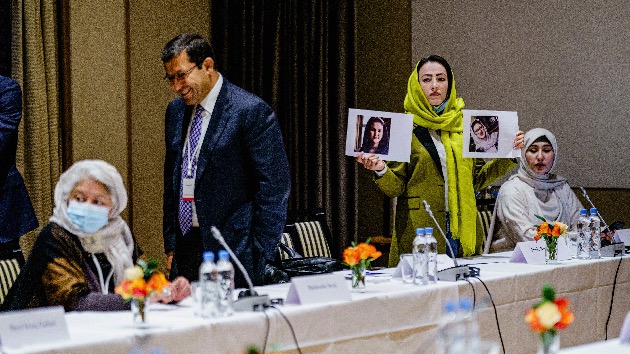
(LONDON) — “Pick up the phone right now, call Kabul and ask the girls to be released immediately,” Hoda Khamosh, an Afghanistan woman’s rights activist shouted at the Taliban’s acting foreign minister, Amir Khan Muttaqi, in Oslo, Norway, last week.

Khamosh demanded the release of Tamana Zaryabi Paryani and Parawana Ibrahimkhel, two female activists who disappeared after their houses were raided on Jan. 20. They had attended a series of protests against the Taliban over the past few months.

Khamosh was one of six Afghan women who were invited to sit with Taliban officials as they made their first invited visit to a Western country since taking control of Afghanistan in August. The talks were to discuss the humanitarian and economic situation in Afghanistan.

The invitation led to different reactions from Afghanistan’s various women’s rights activists, with some welcoming it as a chance for Afghan-to-Afghan negotiations. Others felt that Taliban rule should not be normalized by holding such meetings and casted doubts on the trustworthiness of their promises.

“It was important to us that Norway stressed the invitation did not mean recognition of the Taliban,” Khamosh told ABC News, explaining how the “horrible humanitarian situation” in Afghanistan compelled her to sit face-to-face with the Taliban, pushing for a way to get as many concessions from them as possible.

According to the United Nations Children’s Fund, around 10 million children across Afghanistan are in “urgent” need to humanitarian assistance to survive.

“Without urgent action, almost one million children could be severely malnourished in the coming weeks. That is half of all children under the age of 5,” UNICEF says.

“We were discussing how the money can come to Afghanistan and help with opening schools, opening offices, creating jobs and making the economy wheels turn,” Khamosh said.

However, the Taliban’s track record of female suppression has left many women’s rights activists with almost no reason to trust their promises.

“It is why my first request in the beginning of the meeting with the Taliban was to release our fellow activists they had arrested,” Khamosh said.

In the statement released by the governments of the U.S. and Norway about the Oslo meeting, the Taliban was “urged” to do more to stop the alarming increase of human rights violations, “including arbitrary detentions (to include recent detentions of women’s rights activists), forced disappearances, media crackdowns, extra-judicial killings, torture and prohibitions on women and girls’ education, employment and freedom to travel without a male escort.”

However, the acting foreign minister Muttaqi denied the arrests of the activists for whom Khamosh demanded freedom, saying that the Taliban had not arrested or tortured those women.

“I do not trust him,” Khamosh said, reacting to Mottaqi’s denial. She said she’d been handed documents by one of the women’s mothers that showed the women had been taken by the Taliban.

“This is why the west should not give all the money the Taliban wants in one go and not to give it directly to them,” she said. “We have to wait and see the Taliban’s next move and real intention to fulfil their promises first.”

Former Afghan parliamentarian Shinkai Karokhail, who shared the same concerns as Khamosh, said the Taliban must end its hostilities against women and take a moderate approach towards human rights, as many things have changed since the last time they had the control of the country.

Karokhail advocated for women’s rights during her term, but had to flee Afghanistan when the country fell into the Taliban’s hands.

“Two decades has passed and lots of changes happened in the life of Afghans,” she said, adding that the Taliban has no way but to end isolating women from their social an economic life of Afghanistan.

The Taliban did not respond to ABC News’ inquiry about the Oslo talks and the topics discussed.

Karokhail said she feels the West must ask the Taliban to prove themselves before entering into talks, telling ABC News: “We have to use this Oslo event like a ticket. A ticket that must not be used so much.”

ABC News’ Aleem Agha contributed to this report.

Copyright © 2022, ABC Audio. All rights reserved.

Biden orders US troop deployments to reassure NATO allies amid Russia standoff

Biden orders US troop deployments to reassure NATO allies amid Russia standoff
Michael Reynolds/EPA/Bloomberg via Getty Image

(WASHINGTON) — President Joe Biden has ordered U.S. troop deployments to reassure NATO allies amid the standoff with Russia over Ukraine.

Pentagon press secretary John Kirby announced the imminent arrival of several thousand U.S. troops — some already in Europe and some from the U.S. — to NATO allies in eastern Europe at a Pentagon briefing Wednesday — the first major movement of U.S. forces in response to concerns Russia will invade Ukraine.

“President Biden has been clear that the United States will respond to the growing threat to Europe’s security and stability. Our commitment to NATO Article 5 and collective defense remains ironclad. As part of this commitment and to be prepared for a range of contingencies, the United States will soon move additional forces to Romania, Poland, and Germany,” Kirby said.

All of the troops would be under U.S. command.

“I want to be very clear about something. These are not permanent moves. They are moved designed to respond to the current security environment. Moreover, these forces are not going to fight in Ukraine. They are going to ensure the robust defense of our NATO allies,” he added.

A senior defense official had earlier confirmed to ABC News that about 3,000 U.S. troops will be given orders to deploy to Europe or, if they’re already in Europe, to head to countries in eastern Europe.

One of the units moving into eastern Europe from Germany is an armored Stryker unit.

“It’s important that we send a strong signal to Mr. Putin and frankly, to the world that NATO matters to the United States. It matters to our allies, and we have ironclad Article 5 commitments attack on one is an attack on all,” Kirby said.

The troop movements are separate from the 8,500 U.S. troops put on “heightened alert” to reinforce NATO’s Response Force if needed — and none would go to Ukraine.

Pressed on what signal it sends that the U.S. is not waiting for a NATO vote to deploy an alliance force, Kirby said “the signal that sends — that we’re that we’re moving additional U.S. forces into allied territory, at the request and with the invitation of those countries — is that we take our NATO commitments very, very seriously.”

Kirby said 1,000 soldiers based in Germany will arrive in Romania in “the coming days” at the request of the country, augmenting the roughly 900 U.S. troops already in Romania. Another 2,000 troops from Fort Bragg in North Carolina will deploy to Poland and Germany, most to Poland.

“The 82nd Airborne Division is deploying components of an Infantry Brigade Combat Team and key enablers to Poland. And the 18th Airborne Corps is moving a joint task force capable headquarters to Germany. Both of them as you know are based in Fort Bragg, North Carolina,” Kirby said.

The announcement comes after Biden told reporters on Friday that he would be moving American forces “in the near term.”

Russian President Vladimir Putin blamed the escalating tensions on the U.S. and the West for having “ignored” Russia’s key demand that NATO bar Ukraine from joining the organization. The U.S. and NATO allies argue Russia is the aggressor, having already invaded Crimea and massing troops at the border.

This a developing story. Please check back for updates.

Copyright © 2022, ABC Audio. All rights reserved.

Houthi missile intercepted by UAE during historic Israeli visit raises tensions

Houthi missile intercepted by UAE during historic Israeli visit raises tensions
Israel’s President Isaac Herzog speaks at al-Wasl Dome at Expo 2020 Dubai during Israel’s expo National Day in the gulf emirate on January 31, 2022. – KARIM SAHIB/AFP via Getty Images

(JERUSALEM)– While Israeli’s president Isaac Herzog was in Abu Dhabi on a historic visit on Monday, United Arab Emirates officials announced that a ballistic missile fired by Yemen’s Houthi rebels had been intercepted, the third such attack in three weeks.

Tensions between the two countries have escalated as the Iran-backed Houthis claimed responsibility for a Jan. 15 drone-and-missile attack on the Abu Dhabi National Oil Co. fuel depot, killing three people and wounding six. It was the first deadly attack since 2018, when the UAE-backed forces were fighting the Houthis for control of the Red Sea port city of Hodeidah.

“The operation led to a large number of death and wounded, including Emiratis,” Yahya Sare’e, spokesman of the Houthis, tweeted on Tuesday.

A Saudi-led coalition retaliated the day after with an airstrike on Yemen, killing about 80 people.

In 2020, the UAE and Bahrain signed U.S.-brokered normalization agreements with Israel, known as the “Abraham Accords.” Iran and its regional allies, including the Houthis, were among their shared security concerns. Iran, meanwhile, denounced any normalization of relations with Israel.

“The Islamic republic of Iran not only condemns what some countries are doing aiming at normalization, but also believes that those countries should listen to awakening calls by their own people and stop sowing discord in the Muslim and Arab world. This will be much better for the region’s future,” spokesman of Iran’s foreign ministry Saeed Khatibzadeh said on Monday, according to the Tasnim News Agency.

Yemeni minister of information Dhaif Allah Al-Shami, also made clear his country’s similar stance.

“Every country has its own way of welcoming the leaders of the Zionist entity [Israel], and we in Yemen have only done our duty,” he said on Twitter.

Zakaria Al-Qaq, an expert in national security and war studies, told ABC News the Houthi attack on the UAE coinciding with the Israeli president’s visit had a clear message: “To stop the UAE intervention in Yemen.”

“Second, it’s not only a rejection to the Israel Emirates relation but also a threat to Yemeni National Security, because [of] the security coordination between the two countries,” he added.

Houthis have declared they would continue to fire rockets into the UAE.

“The armed forces affirm that the state of the Emirati enemy will be an unsafe as long as the tools of the Israeli enemy in Abu Dhabi and Dubai continue to launch aggression against our people and our country,” Sare’e wrote in another tweet.

The Houthi spokesman has also repeated threats, telling citizens, residents and companies in the UAE “to stay away from vital headquarters and facilities, as they are vulnerable to targeting during the coming period.”

People in the already war-worn Yemen have been going through a difficult humanitarian situation over the past years. The World Food Programme has warned that more than five million people are on the verge of famine, with 50,000 others now living in famine-like conditions.

The spate of recent attacks have helped raise crude oil prices above $90 per barrel, another worry for a global economy already struggling through the pandemic.

Copyright © 2022, ABC Audio. All rights reserved.

Duchess Kate takes over two patronages from Prince Harry

Duchess Kate takes over two patronages from Prince Harry
JUSTIN TALLIS/AFP via Getty Images

(LONDON) — Duchess Kateis taking over two patronages her brother-in-law Prince Harry relinquished when he and his wife, Duchess Meghan, stepped down from their senior royal roles.

Kate, the Duchess of Cambridge, will become the patron of the Rugby Football League and the Rugby Football Union, Kensington Palace announced Wednesday.

“These new patronages, which have been given to The Duchess by Her Majesty The Queen, closely align with Her Royal Highness’ longstanding passion for sport and the lifelong benefits it can provide,” the palace said in a statement.

Rugby apparently played a large role in Kate’s upbringing in Berkshire, England, with her parents and two siblings. Kate, 40, is the wife of Prince William.

Kate’s sister, Pippa Middleton, told Vanity Fair in 2014, “Rugby was a big thing in our family. We’d plan our weekends around the matches.”

Kate’s new role as patron of the two rugby organizations comes two years after Harry and Meghan stepped down from their senior royal roles in 2020.

The couple, who now live in California with their two young children, agreed at the time to give up all their royal patronages.

The rugby patronages are the first of Harry’s to be redistributed to another member of the royal family. None of Meghan’s patronages have yet to be redistributed.

“Harry is a big rugby fan and the patronage was a natural fit for him,” said ABC News royal contributor Victoria Murphy. “I think it was pretty clear that he had wanted to retain those links when he stepped back.”

She added, “We’re now seeing the reality of Harry and Meghan having handed back their patronages is that things are moving on and the working royals are stepping into those roles and continuing the work.”

Both the Rugby Football League and the Rugby Football Union said they are honored to have Duchess Kate as their new patron.

“We look forward to working with The Duchess in the years to come, and I know all levels of our sport will welcome her to the Rugby League family,” Ralph Rimmer, chief executive of the Rugby Football League, the national governing body for Rugby League in the United Kingdom, said in a statement.

“The Duchess will be greatly valued from our grassroots clubs and fast-growing women and girls’ game, right up to our elite Men’s and Women’s England teams,” added Bill Sweeney, chief executive of the Rugby Football Union, the national governing body for grassroots and elite rugby union in England.

Kate, who played tennis, hockey and sailing as a kid, is also the royal patron of the All England Lawn Tennis and Croquet Club, the home of Wimbledon, a role she took over from Queen Elizabeth in 2016.

Her other sports-related patronages include SportsAid, a charity that helps young athletes, The Lawn Tennis Association and The 1851 Trust, an education charity that teaches kids about STEM (science, technology, engineering, and mathematics) through sailing.

Copyright © 2022, ABC Audio. All rights reserved.

‘End game’: Iran nuclear talks nearing resolution or nuclear crisis, US warns

‘End game’: Iran nuclear talks nearing resolution or nuclear crisis, US warns
simon2579/Getty Images

(WASHINGTON) — While President Joe Biden works to address the crisis over Russia menacing Ukraine, there is another critical one looming, with a senior State Department official telling reporters the “end game” is just weeks away.

Iran nuclear talks are scheduled to resume this week for their ninth round — with the U.S. and Iran still negotiating indirectly about both countries returning to the Obama-era nuclear deal that is in tatters.

This could be the final round before a deal is reached or the U.S. and its European allies call it quits — because after 10 months of negotiating with two different Iranian governments, the country’s nuclear program is advancing to the point of no return, the U.S. says.

“This can’t go on forever because of Iran’s nuclear advances. This is not a prediction. It’s not a threat. It’s not an artificial deadline. It’s just a requirement… Given the pace of Iran’s advances, its nuclear advances, we only have a handful of weeks left to get a deal — after which point it will unfortunately be no longer possible to return to the JCPOA and to recapture the nonproliferation benefits that the deal provided for us,” said the senior State Department official, who briefed reporters on condition of anonymity to discuss the talks using an acronym for the deal’s formal name, the Joint Comprehensive Plan of Action.

Some critics have said the U.S. should have called it quits long ago, with Iran enriching uranium up to 60% and enriching uranium metal, spinning more advanced centrifuges and more of them, and obstructing access for the U.N.’s nuclear watchdog, the International Atomic Energy Agency. Nuclear weapons-grade uranium is enriched at 90%, while the nuclear deal capped Iran’s enrichment at 3.67% for 15 years.

With those steps, Iran is now a matter of weeks away from having enough fissile material to build a nuclear bomb, the official said. Secretary of State Antony Blinken and others have warned for a couple of weeks now that Iran is just a “few weeks” away from that critical threshold — although the senior State Department official said it would take some additional time to actually build a nuclear bomb, declining to provide a timeline for that.

“Do the math. There are many fewer weeks left now than there were when we first said it,” they added.

That puts the pressure on this new round of talks to reach a conclusion before time runs out. The Iranian delegation returned to Tehran after the eighth round broke up last Friday, just as chief U.S. negotiator Rob Malley returned to Washington.

Ahead of talks resuming, the senior State Department official said Biden remains ready to make that decision and return to compliance by lifting sanctions on Iran.

“Now is a time for political decisions. Now is the time to decide whether — for Iran to decide whether it’s prepared to make those decisions necessary for a mutual return to compliance,” they said.

But notably, they repeatedly took the occasion to bash the “prior administration’s catastrophic error” and “terrible mistake” of withdrawing from the deal — seeming to lay the groundwork for a blame game if talks blow up and Iran’s enrichment only grows.

Former President Donald Trump exited the deal in May 2019 and reimposed strong U.S. sanctions on Iran, driving down its oil exports and sparking tit-for-tat attacks across the Middle East region. His administration repeatedly said its campaign of “maximum pressure” would drive Iran to negotiate a new deal, but Iran refused to meet U.S. officials, even after Biden took office.

With talks expected to resume this week, according to Enrique Mora, the senior EU diplomat who coordinates the talks, one key sign to watch will be whether the U.S. and Iran finally engage directly. Iran’s Foreign Minister Hossein Amir-Abdollahian expressed an openness to it last week if Iran sees a “good deal” in sight, but the senior State Department official said there’s no indication so far the Iranians will sit down. The U.S. has consistently said it’s prepared to meet directly, calling the indirect talks an impediment to reaching a deal so far.

If a deal isn’t reached soon, the U.S. is “ready” to “fortify our response, and that means more pressure — economic, diplomatic, and otherwise,” the senior official said, adding, “We will use the tools that we have to ensure that our interests are preserved and that Iran cannot acquire a nuclear weapon.”

Notably, the Biden administration has refused to say out loud whether that includes supporting the use of force, including by Israel — just that no option is off the table.

The one thing the U.S., European allies in the talks, France, the U.K., Germany, and even China and Russia seem to agree on is that time is running out. But while the senior State Department official called a deal a “big if,” Russia’s envoy was been more buoyant about a resolution.

“My instinct tells me that agreement will be reached soon after mid February,” Ambassador Mikhail Ulyanov tweeted Friday as the talks ended.

That’s in stark contrast to the heavy pessimism in early December after talks finally resumed under Iran’s new government, with its much more hard-line approach.

But the Iranians now are “back in a serious, businesslike negotiation in which there are still significant gaps — so I don’t want to in any way understates those — but we are in a position where… we can see a path to a deal if those decisions are made and if it’s done quickly,” the senior State Department official said.

In the meantime, the U.S. continues to press for the release of four U.S. citizens detained by Iran on specious charges, including father and son Baquer and Siamak Namazi. At 84-years old, Baquer is in particularly vulnerable health and had emergency heart surgery in Tehran in October to clear a “life-threatening” blockage in his carotid artery, according to his lawyer Jared Genser. This month marks his sixth year in Iranian custody, while his son Siamak has been held since October 2015.

“We are negotiating on the release of the detainees separately from the JCPOA, but as we’ve said, it is very hard for us to imagine a return to the JCPOA while four innocent Americans are behind bars or are detained in Iran,” the senior State Department official said.

In addition to the Namazi’s, Iran has detained conservationist Morad Tahbaz and businessman Emad Shargi. All four men are dual U.S.-Iranian citizens whose detentions have been called “hostage diplomacy” by Tehran.

Copyright © 2022, ABC Audio. All rights reserved.

Remains of 2 American women missing after Panama plane crash recovered

Remains of 2 American women missing after Panama plane crash recovered
BringDebraAndSueHome.com

(NEW YORK) — The remains of two American women who went missing after their plane crashed off the coast of Panama a month ago have been recovered, officials said.

Debra Ann Velleman, 70, of Waukesha, Wisconsin, and Sue Borries, 57, of Teutopolis, Illinois, both retired public school teachers, were part of a community of snowbirds and expats living in the area of Chame, Panama.

The two friends were traveling home after spending New Year’s Eve weekend at a bed and breakfast on the Panamanian island Isla Contadora on Jan. 3 when their small plane, piloted by the B&B owner, suffered an engine failure and crashed off the coast of Chame, according to friends and family.

Debra Ann Velleman’s husband, Anthony Velleman, another passenger and the pilot were rescued by Panamanian search and rescue teams. Their families believed the women were still in the unrecovered plane wreckage, and as the search stretched on for days and then weeks, they pleaded with the U.S. government for help they said never came.

Tuesday morning, Velleman and Borries were recovered from inside the plane, according to Albert Lewitinn, a representative for the Velleman family.

A Panamanian search and rescue team helped recover the bodies after more than 690 hours of searching, authorities said.

The Panamanian government had requested that the U.S. deploy assets including Navy salvage divers and sonar to aid in the search effort and locate the wreckage in the days after the crash, but the request was denied due to a lack of assets and jurisdiction, according to a statement from the Velleman and Borries families.

The families continued to plead with the U.S. government to send equipment and personnel to aid in the search and recovery effort. As the effort wore on, they enlisted the help of the Wisconsin-based volunteer search and recovery organization Bruce’s Legacy and set up a GoFundMe to help defray the costs of bringing the nonprofit to Panama.

The plane was located with the help of Bruce’s Legacy, as well as a local family whose boats were used in the mission, Lewitinn said.

The families are now working on having the womens’ remains brought back to the U.S., he said.

“It is our intention — almost exactly one month following this tragic accident — to give proper thanks to all those who supported our families during this difficult time, as well as to have many outstanding questions answered by way of a swift and thorough investigation,” the families said in a joint statement. “For now, however, this finally marks the beginning of our grieving process and provides us with a path to closure.”

The Velleman family had been in touch with several Wisconsin and Illinois representatives as they sought assistance from the U.S. government in the search and recovery effort.

According to Wisconsin Sen. Tammy Baldwin’s office, the U.S. Coast Guard provided Panamanian authorities with technical modeling to support the search for the aircraft.

ABC News had previously reached out to the U.S. Embassy in Panama for comment but did not receive a response.

Copyright © 2022, ABC Audio. All rights reserved.

US, Russia agree to keep talking amid Ukraine crisis but Putin claims concerns ‘ignored’

US, Russia agree to keep talking amid Ukraine crisis but Putin claims concerns ‘ignored’
Alexei NikolskyTASS via Getty Images, FILE

(WASHINGTON) — The U.S. and Russia are moving ahead with their diplomatic engagements over Russia menacing Ukraine, according to senior State Department officials, after the two countries’ top diplomats spoke Tuesday.

But as talks continue to proceed, there have been no results yet — with more than 100,000 Russian troops still massed on Ukraine’s borders, including increasingly in its northern neighbor Belarus.

Russian leader Vladimir Putin said the U.S. has “ignored” Russia’s key demands that NATO bar Ukraine from joining and pull back allied troops from Eastern European countries — his first comments on the crisis in over a month.

But his government is still analyzing the U.S. response to Russia, laid out in a formal proposal hand-delivered by the U.S. ambassador in Moscow last week, he said.

During a critical call, Secretary of State Antony Blinken and Russian Foreign Minister Sergei Lavrov “did agree that the ideas on both sides that have been exchanged did form the basis for the potential for serious discussion on a range of issues,” said a senior State Department official.

Those ideas include issues like arms control and greater transparency in military exercises, they added, expressing some hope that Russia’s continued engagement could lay the groundwork for real negotiations.

But for now, Russia is still formulating its response to those U.S. ideas, senior State Department officials said Lavrov told Blinken. Once they are finalized, they will be sent to Putin for approval and then sent to the U.S. After that, Blinken and Lavrov will speak again, the senior officials said.

“I do think they agree that ideas in that non-paper could be the basis for a constructive conversation about how he enhance security in Europe,” said a second senior State Department official. The “non-paper” is what U.S. officials have called the U.S. response to Russia’s original demands.

But Lavrov didn’t outright say that during the call, they conceded. Later on Tuesday, Putin seemed more dismissive of the U.S. proposal, saying, “It is already clear that Russia’s fundamental concerns have been ignored.”

Pressed on whether the Russians may be buying time or stalling before a renewed attack on Ukraine, the second senior State Department official said, “Because we don’t President Putin has made a decision [on whether to further invade Ukraine], we think it’s important to keep the diplomatic option on the table — so to the extent that Russia wants to engage in that diplomatic track, we are also open to having that continued diplomatic engagement.”

Blinken and Lavrov didn’t agree on when or how those talks would continue, but the U.S. has called for them to include one-on-one meetings, as well as negotiations between NATO and Russia and dialogue at the Organization for Security and Cooperation in Europe, a Cold War-era forum that includes the U.S., Russia, and Ukraine.

On Monday, Moscow sent the U.S., as well as several NATO allies and OSCE members, a similar letter seeking clarification about security principles enshrined in one of the OSCE’s key documents, the Helsinki Final Act, according to U.S. and Russian officials. The letter was not Russia’s response to the U.S. proposal, but seems to be part of its effort to formulate one.

“NATO refers to the right of countries to choose freely, but you can not strengthen someone’s security at the expense of others,” Putin said Tuesday during a press conference with Hungary’s autocratic Prime Minister Viktor Orbán.

As the U.S. and NATO wait for that formal response, Blinken again urged Russia to deescalate tensions by pulling back troops, heavy weaponry, and equipment from Ukraine’s borders. But Lavrov gave no indication during the call that Russia would do so, the senior officials said.

“All of the actions that we are seeing on the ground do not suggest escalation. We continue to see in fact more Russian troops coming not only to Russia’s border with Ukraine, but as you know, also to Belarus for these supposed exercises,” the second senior State Department official said.

Russia and Belarus have said those forces are preparing for military exercises to improve their readiness. But the U.S. said Monday it has evidence that more than 30,000 Russian troops will mass in Belarus in the coming days, citing declassified U.S. intelligence — a concerning move that puts them within two hours of Ukraine’s capital Kyiv.

Copyright © 2022, ABC Audio. All rights reserved.