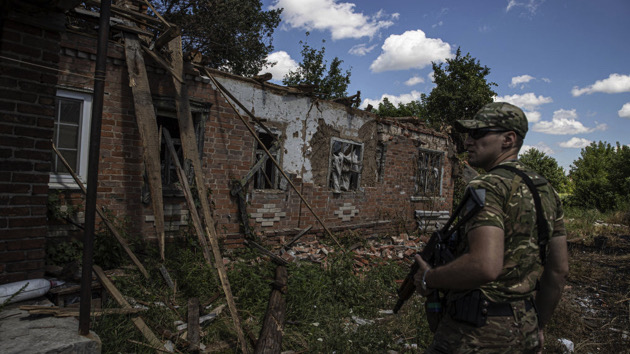
(NEW YORK) — Two Americans thought to have been fighting for Ukraine have died in the eastern reach of the country, according to officials.
“We can confirm the recent deaths of two U.S. citizens in the Donbas region of Ukraine,” a State Department spokesperson said. “We are in touch with the families and providing all possible consular assistance.”
They added: “Out of respect to the families during this difficult time, we have nothing further.”
One of the Americans killed was Luke Lucyszyn, his mother, Kathy Lucyszyn, confirmed to ABC News.
A former U.S. soldier who served with the two Americans told “Good Morning America” they faced overwhelming Russian firepower.
“There was artillery basically 24-7,” the soldier said. “They could shoot at us but we couldn’t even see them.”
This is a developing story. Please check back for updates.
(NEW YORK) — Russian President Vladimir Putin’s “special military operation” into neighboring Ukraine began on Feb. 24, with Russian forces invading from Belarus, to the north, and Russia, to the east. Ukrainian troops have offered “stiff resistance,” according to U.S. officials.
The Russian military has since launched a full-scale ground offensive in eastern Ukraine’s disputed Donbas region, capturing the strategic port city of Mariupol and securing a coastal corridor to the Moscow-annexed Crimean Peninsula.
Here’s how the news is developing. All times Eastern:
Jul 22, 11:12 AM EDT
Both nations sign agreement to end blockade on Ukraine grain
Russia and Ukraine have signed agreements to restart grain exports from Ukraine, said United Nations Secretary-General António Guterres.
The agreement between the two countries was mediated with Turkey and the United Nations.
The blockade on exporting grain from Ukraine had triggered fears of global famine.
The agreement “opens a path for commercial food exports from Ukraine in the Black Sea. It will help avoid a food shortage catastrophe for millions worldwide,” Guterres tweeted. “It is a beacon of hope, possibility & relief.”
The deal will allow for the transport of grain from three Ukrainian ports. Under the deal Ukraine will not de-mine its ports; instead there will be safe channels for cargo ships to sail through.
The agreement lasts for 120 days with the possibility of an extension.
According to Russian media, in exchange for agreeing to sign the deal, Russia received a guarantee from the U.N. to work on lifting sanctions on Russian agricultural and fertilizer exports.
-ABC News’ Patrick Reevell
Jul 22, 10:33 AM EDT
Russia signs agreement to end blockade on Ukraine grain
Russia has signed an agreement to restart grain exports from Ukraine, according to Russia’s defense ministry. Ukraine is expected to sign a separate but identical agreement.
The blockade on exporting grain from Ukraine had triggered fears of global famine.
The agreement between the two countries was mediated with Turkey and the United Nations.
Jul 20, 11:42 AM EDT
Zelenska shares photos of killed civilians in her address to Congress
Ukrainian first lady Olena Zelenska spoke to members of Congress on Capitol Hill Wednesday, saying, “Usually the wives of president are exclusively engaged in peaceful affairs: education, human rights, equality, accessibility. And maybe you expected for me to speak on those topics. But how can I talk about them when an unprovoked invasive terrorist war is being waged against my country?”
Zelenska said this marks the first time the wife of a president of a foreign county addressed members of Congress on the Hill.
Zelenska showed members of Congress several images and stories of carnage impacting civilians, including a photo of 4-year-old Liza who was killed by a Russian missile attack last week.
Liza’s mother was seriously hurt, and “for several days, nobody dared to tell her that Liza has died,” Zelenska said.
She highlighted an Odesa family who lost three generations of women to one missile, and a 96-year-old who survived Nazi concentration camps only to be killed in Kharkiv.
The first lady asked Congress to supply more air defense systems.
“Will my son be able to return to school in the fall? I don’t know, like millions of mothers in Ukraine. Will my daughter will be able to go to university at the beginning of the academic year and experience normal student life? I cannot answer,” she said. “We will have answers if we had air defense systems.”
“America, unfortunately, knows from its own experience what terrorist attacks are and has always sought to defeat terrorists. Help us to stop this terror against Ukrainians,” she said.
Zelenska received a standing ovation after her remarks.
Jul 20, 9:05 AM EDT
US announces four new HIMARS and more ammo for Ukraine
The U.S. will send four more HIMARS advanced rocket systems to Ukraine as part of the new presidential drawdown package coming later this week, Defense Secretary Lloyd Austin announced Wednesday.
Once these four long-range rocket artillery systems arrive, Ukraine will have a total of 16 HIMARS at its disposal.
Austin said these advanced rocket systems “have made such a difference on the battlefield.”
The new package will also include more ammunition for the HIMARS and for the 155 mm artillery weapons the U.S. and other countries have sent to Ukraine, Austin said at the fourth Ukraine defense contact group meeting, with leaders from roughly 50 nations in virtual attendance.
Austin praised the United Kingdom, Germany and Poland in particular for helping Ukraine boost its ability to hit faraway targets.
Jul 19, 2:28 PM EDT
Ukrainian first lady visits White House
President Joe Biden and first lady Jill Biden greeted Ukrainian first lady Olena Zelenska at the White House Tuesday afternoon.
Zelenska was presented with a bouquet of flowers in Ukrainian colors: yellow sunflowers, blue hydrangeas and white orchids.
Oksana Markarova, the Ukrainian ambassador to the U.S., arrived with Zelenska.
Jill Biden and second gentleman Doug Emhoff then held a bilateral meeting with the Ukrainian delegation. Jill Biden said they’ll discuss mental health issues for mothers and children who have “suffered such tragedy and the atrocities” during the war.
Zelenska will address Congress on Wednesday.
-ABC News’ John Parkinson
Jul 19, 8:25 AM EDT
US weapons help stabilize frontline, Ukrainian official says
Ukrainian forces have “stabilized” the situation along the frontline in the eastern and south-eastern regions of the country, in large part thanks to U.S.-supplied HIMARS rocket launchers, the Ukrainian military said on Monday.
“We managed to stabilize the situation. It is complex, intense, but completely controlled,” Valery Zaluzhny, the commander-in-chief of the Ukrainian Armed Forces, said.
An important factor contributing to Ukraine’s retention of its defensive lines and positions is the timely arrival of U.S. supplied M142 HIMARS — High Mobility Artillery Rocket System — rocket launchers, Zaluzhny added. These highly precise and modern weapons have been delivering “targeted strikes” on Russian “control points, ammunition and fuel storage depots,” the top commander added.
Ukrainian troops struck a Russian military facility in the area of an asphalt plant in the eastern town of Nova Kakhovka on Monday, Ukrainian military officials said. Ukrainian forces also hit an administrative building and a hangar filled with Russian fuel tankers in the southern town of Beryslav, killing more than 100 Russian soldiers, the Ukrainian military said on Monday.
Russian forces shelled the town of Nikopol in the Dnipropetrovsk region about 40 times on Monday night, local authorities said. Explosions were also reported in the Odesa region, injuring several civilians. Russian troops also fired cluster shells at the city of Mykolaiv late on Monday.
Russia’s stated immediate objective is to seize all of the Donetsk region, the UK Ministry of Defence said on Tuesday. Even if Russian troops make further territorial gains, the tempo of their advance is likely to be very slow, the ministry added.
Russian units, severely under-manned, face a dilemma between deploying more forces to the Donbas or defending against Ukrainian counter-attacks in the Kherson area, the observers said.
Jul 18, 4:20 PM EDT
Ukraine’s first lady to meet with Jill Biden
Ukrainian first lady Olena Zelenska will meet with first lady Jill Biden in Washington, D.C., on Tuesday, Biden’s office said, one day before Zelenska addresses Congress.
Jul 18, 1:45 PM EDT
Ukraine’s first lady to address Congress on Wednesday
Ukrainian first lady Olena Zelenska will make remarks Wednesday before members of Congress on Capitol Hill, House Speaker Nancy Pelosi announced.
All members of the House and Senate are invited to the event, which is set for 11 a.m ET.
Jul 18, 8:56 AM EDT
Russia orders troops to eliminate Ukraine’s long-range missiles
Russian Defense Minister Sergei Shoigu has visited the East group of Russian forces involved in the fighting in Ukraine and ordered his troops to eliminate the Ukrainian army’s long-range missiles and artillery ammunition it uses to shell targets in the Donbas region, the Russian Defense Ministry said on Monday.
Shoigu instructed the group’s commander to give priority to the use of precision-guided weapons to destroy Ukraine’s long-range missile and artillery assets, the ministry added. Russia has accused Ukraine of using its long-range weapons to shell residential neighborhoods in Donbas communities and set fire to wheat fields and grain storage facilities.
Ukrainian officials said Russian missiles struck targets across much of eastern Ukraine on Sunday and early Monday.
Six people were killed in the town of Toretsk in the Donetsk region after Russian shelling, the state emergency service said. Missiles also struck civilian infrastructure, including a school in the Dnipropetrovsk and Odesa regions.
Russia also carried out 55 strikes on the Sumy region on Sunday. Around 60 projectiles landed in Nikopol, a dozen residential buildings were damaged and one elderly woman was wounded, local officials said.
The southern city of Mykolaiv was subjected to a massive missile strike in the early hours of Sunday as 10 missiles, presumably launched by an S-300 system, hit various parts of town.
Russian officials said on Monday that no clear timeframes have been set for the war in Ukraine, and priority should be given to its efficiency.
“We have no doubts that the special military operation will be completed after all of its objectives are attained. There are no clear timeframes, what counts most is this operation’s efficiency,” Russian presidential press secretary Dmitry Peskov said as quoted by Russian media.
Officials from the self-proclaimed Donetsk People’s Republic claimed on Monday that DPR territory will be liberated from the Ukrainian military this year.
“The liberation of Donbas will be completed this year,” Eduard Basurin, deputy head of the police department of the DPR, said according to Russian media.
-ABC News’ Edward Szekeres, Yulia Drozd, and Max Uzol
Jul 17, 6:20 PM EDT
Number of Ukrainian public officials accused of treason, collaborating with Russia: Zelenskyy
Ukrainian President Volodymyr Zelenskyy said the former head of the Security Service of Ukraine, or SBU, in Crimea, who was dismissed in the beginning of the Russian invasion, has been notified he is being charged with treason.
“Everyone who together with him was part of a criminal group that worked in the interests of the Russian Federation will also be held accountable,” Zelenskyy said during his evening address Sunday. “It is about the transfer of secret information to the enemy and other facts of cooperation with the Russian special services.”
A number of Ukrainian public officials have been notified they will be charged for treason and for collaborating with Russia.
-ABC News’ Christine Theodorou
Jul 17, 2:20 PM EDT
‘Evil cannot win’: Priest breaks down at funeral for 4-year-old Ukrainian girl
A funeral service was held Sunday for a 4-year-old girl with Down syndrome who was among two dozen Ukrainian civilian’s killed last week in a Russian missile attack in the west-central Ukrainian town of Vinnytsia.
During the open-casket funeral for Liza Dmytrieva, a Ukrainian Orthodox priest broke down in tears as he told the little girl’s father and other relatives, “evil cannot win,” according to The Associated Press.
Liza was pushing a stroller in a park as she and her mother were headed to a speech therapist appointment when the attack unfolded Thursday afternoon in Vinnytsia, a city close to the front lines in west-central Ukraine, officials said.
The girl and 23 others Ukrainian civilians were killed, including two boys ages 7 and 8. At least 200 other civilians, including Liza’s mother, were injured, officials said.
“Look, my flower! Look how many people came to you,” Liza’s grandmother, Larysa Dmytryshyna, said, as she caressed the child lying in an open casket filled with teddy bears and flowers.
Orthodox priest Vitalii Holoskevych gave the eulogy at Liza’s funeral struggling through tears.
“I didn’t know Liza, but no person can go through this with calm because every burial is grief for each of us,” Holoskevych said. “We are losing our brothers and sisters.”
Jul 15, 10:01 AM EDT
Grandma of 4-year-old girl killed in missile strike: ‘I hate them all’
The grandmother of a 4-year-old girl killed in Thursday’s Russian missile attack in Vinnytsia told ABC News, “They took the most precious [person] I had in my life.”
Four-year-old Liza was among 23 people, including three children, killed in the strike.
Liza’s grandmother, Larysa Dmytryshyna, called her a “wonderfully sunny child.”
“She was the most wonderful girl in the world and it is so painful that her mother cannot even bury her,” she said.
Asked how she feels about Russia, Dmytryshyna, replied, “I hate them all.”
“We did not ask them to come here. They have caused so much sorrow,” she said of the Russians. “I would give my own life to extinguish the entire country.”
-ABC News’ Tom Soufi Burridge, Ibtissem Guenfoud and Natalya Kushnir
Jul 15, 9:04 AM EDT
Demand for artificial limbs surges in Ukraine
One of Ukraine’s leading medical experts on developing prosthetic limbs for amputees says there has been a dramatic surge in demand for artificial arms and legs since Russia invaded Ukraine.
Dr. Oleksandr Stetsenko told ABC News that financial support or donations of prosthetic parts are needed from abroad to meet the increased demand.
External support, he said, is vital so that people have the chance to continue with their lives.
“With good prosthetics people can come back to life again,” Stetsenko told ABC News.
There is currently no official figure for how many people in Ukraine have undergone surgery to remove limbs because of injuries sustained from the war but Dr. Stetsenko estimates that around 500 people have had limbs amputated since the end of February with the majority of those cases being soldiers and around a fifth being civilians.
While the number of patients in Ukraine needing artificial limbs has increased, the domestic supply of components to make prosthetic arms and legs has reduced.
That is because a third of the companies which were previously producing components in Ukraine are now located in territory which has recently been occupied by Russian forces or in areas near to the frontline, according to the Ukrainian Ministry of Health.
A director at the health ministry, Oleksandra Mashkevych, confirmed that Ukraine is no longer able “to cover all of the demand relating to artificial limbs.”
Mashkevych told ABC News that children who need artificial limbs are sent abroad to Europe or to the United States and that around 20 children in Ukraine are thought to have had limbs amputated since the start of the war in February.
-ABC News’ Tom Soufi Burridge, Ibtissem Guenfoud, Natalya Kushnir and Kuba Kaminski
Jul 15, 6:49 AM EDT
Unprecedented rescue operation underway in Vinnytsia
At least 18 people are still missing after a deadly missile strike on downtown Vinnytsia in central Ukraine on Thursday, the Ukrainian National Police said.
Three Russian Kalibr missiles launched from a submarine struck an office building and damaged nearby residential buildings in Vinnytsia, located about 155 miles southwest of the Ukrainian capital, Kyiv, on Thursday morning.
At least 23 people — including 3 children — died in the attack, Ukraine’s State Emergency Service said, and more than a 100 were wounded, some critically. The bodies of 2 children and 11 adults were yet to be identified on Friday morning, local authorities said.
The strike in the heart of Vinnytsia is “part of a systematic Russian campaign of attacks on residential areas of cities in Ukraine”, the Institute for the Study of War said.
The search continued on Friday morning for at least 18 people who were still missing after the attack. The ongoing rescue operation has been unprecedented in its scale, local officials said, with more than 1,000 rescuers and 200 pieces of equipment being involved in clearing the rubble and searching for those still missing.
Several dozen people were reportedly detained in Vinnytsia on Thursday for questioning under the suspicion of acting as local spotters or aimers on the ground for the Russian strikes.
The eastern city of Mykolaiv also reported 10 powerful explosions on Friday morning. The city’s two biggest universities were hit in the attack, wounding at least four people, local authorities said. Russia also struck a hotel and a shopping mall in Mykolaiv on Thursday.
Russian shelling also targeted Kharkiv, another eastern city, on Thursday night. Local officials claimed 2 schools were damaged in the attack.
The European Union and the United Nations strongly condemned Russia for what the EU called a “long series of brutal attacks against civilians.”
Russia’s missile strikes hit more than 17,000 facilities of civilian infrastructure as opposed to around 300 military facilities since the start of the war, Ukrainian officials said on Thursday.
-ABC News’ Edward Szekeres, Yulia Drozd, Fidel Pavlenko and Yuriy Zaliznyak
Jul 14, 4:02 PM EDT
Russian missile strike kills at least 23 in Vinnytsia
Russian missiles hit the heart of the central Ukrainian city of Vinnytsia on Thursday morning, killing at least 23 people and wounding dozens, according to Ukraine’s State Emergency Service.
Three children were among the dead, the agency said.
The missiles struck an office building and damaged nearby residential buildings in Vinnytsia, located about 155 miles southwest of the Ukrainian capital, Kyiv. The strike also ignited a massive fire that engulfed 50 cars in an adjacent parking lot, according to the National Police of Ukraine. Burned-out vehicles are peppered with holes from the missiles.
The State Emergency Service said about 115 victims in Vinnytsia needed medical attention, with 64 people hospitalized — including 34 in severe condition and five in critical.
Forty-two people are listed as missing, the agency said.
Many Ukrainians moved to Vinnytsia, a city southwest of Kyiv, to get away from the fighting in eastern Ukraine. Until now, Vinnytsia had been seen as a city of relative safety.
Ukrainian President Volodymyr Zelenskyy called the attack “an open act of terrorism” on civilians.
“Every day Russia is destroying the civilian population, killing Ukrainian children, directing missiles at civilian objects. Where there is no military (targets). What is it if not an open act of terrorism?” Zelenskyy said in a statement via Telegram on Thursday.
War crimes investigators are at the scene studying missile fragments.
Russian missile strikes targeted several other Ukrainian cities on Wednesday and early Thursday, including Kharkiv, Zaporizhia and Mykolaiv.
At least 12 people died in the Zaporizhia strike, which hit two industrial workshops on Wednesday, according to local authorities.
At least five civilians were killed and 30 others injured in Mykolaiv on Wednesday after Russian missiles destroyed a hotel and a shopping mall, the local mayor said. The southern Ukrainian city was shelled again on Thursday morning, but no casualties were immediately reported.
-ABC News’ Edward Szekeres, Fidel Pavlenko, Max Uzol, and Yulia Drozd
Jul 14, 1:49 PM EDT
At least 18 Russian filtration camps along Russia-Ukraine border
Michael Carpenter, the U.S. ambassador to the Organization for Security and Cooperation in Europe, is calling the forcible relocation of Ukrainians to Russian filtration camps is “a war crime.”
In an interview with ABC News Live on Thursday, Carpenter said the Russians are “trying to take away Ukrainians who might have Ukrainian civic impulses, who are patriots, who want to defend their country.” Carpenter said the Russians want to “erase Ukrainian identity” and “the Ukrainian nation state, as the entity that governs people’s lives in these regions.”
Carpenter said there are at least 18 filtration camps along the Russia-Ukraine border, adding that it’s impossible to get an exact total because many are located in Russia’s far east.
-ABC News’ Malka Abramoff
Jul 14, 12:04 PM EDT
Russian missile strike kills at least 17 in Vinnytsia
Russian missiles hit the heart of the central Ukrainian city of Vinnytsia on Thursday morning, killing at least 17 people and wounding more than 30 others, according to the Prosecutor General’s Office of Ukraine.
Two children were among the dead, the prosecutor’s office said.
The missiles struck an office building and damaged nearby residential buildings in Vinnytsia, located about 155 miles southwest of the Ukrainian capital, Kyiv. The strike also ignited a massive fire that engulfed 50 cars in an adjacent parking lot, according to the National Police of Ukraine. Burned-out vehicles are peppered with holes from the missiles.
The national police said about 90 victims in Vinnytsia sought medical attention, and 50 of them are in serious condition.
Many Ukrainians moved to Vinnytsia, a city southwest of Kyiv, to get away from the fighting in eastern Ukraine. Until now, Vinnytsia had been seen as a city of relative safety.
Ukrainian President Volodymyr Zelenskyy called the attack “an open act of terrorism” on civilians.
“Every day Russia is destroying the civilian population, killing Ukrainian children, directing missiles at civilian objects. Where there is no military (targets). What is it if not an open act of terrorism?” Zelenskyy said in a statement via Telegram on Thursday.
War crimes investigators are at the scene studying missile fragments.
Russian missile strikes targeted several other Ukrainian cities on Wednesday and early Thursday, including Kharkiv, Zaporizhia and Mykolaiv.
At least 12 people died in the Zaporizhia strike, which hit two industrial workshops on Wednesday, according to local authorities.
At least five civilians were killed and 30 others injured in Mykolaiv on Wednesday after Russian missiles destroyed a hotel and a shopping mall, the local mayor said. The southern Ukrainian city was shelled again on Thursday morning, but no casualties were immediately reported.
-ABC News’ Edward Szekeres, Fidel Pavlenko, Max Uzol, and Yulia Drozd
Jul 13, 6:30 PM EDT
State Department aware of reports on another American detained by Russian proxies
The State Department said Wednesday it is aware of unconfirmed reports that another American has been detained by pro-Russian separatists in Ukraine.
The statement follows a [report from the Guardian] () on 35-year-old Suedi Murekezi, who is believed to have gone missing in Ukraine in early June.
According to the Guardian, Murekezi was able to make contact with a family member on July 7 and told them he was being held in the same prison as Alexander Drueke and Andy Tai Ngoc Huynh, two American veterans captured while volunteering for Ukrainian forces. Murekezi has lived in Ukraine since 2020 and was falsely accused of participating in pro-Ukraine protests, according to the report.
“We have been in contact with the Ukrainian and Russian authorities regarding U.S. citizens who may have been captured by Russia’s forces or proxies while fighting in Ukraine,” a State Department spokesperson said Wednesday. “We call on Russia to live up to its international obligations to treat all individuals captured fighting with Ukraine’s armed forces as prisoners of war.”
Another American — Grady Kurpasi — is also missing in Ukraine. A family spokesperson said the veteran was last seen fighting with Ukrainian forces in late April and is feared to have been either killed or captured.
-ABC News’ Shannon Crawford
Jul 13, 8:27 AM EDT
Shelling continues throughout Donbas region
Shelling from both Russian and Ukrainian forces caused damage to the landscape and destroyed structures throughout the Donbas region on Tuesday and Wednesday, local officials said.
Russian strikes reportedly targeted the eastern town of Bakhmut, killing one person and wounding 5 others, the local governor said. Explosions were heard in several nearby towns too, with one missile falling near a kindergarten.
Shelling also continued in Izyum, Mykolayiv and Kharkiv on Tuesday. Russian troops reportedly conducted unsuccessful attacks north of Slovyansk and the town of Siversk on Tuesday, despite repeated rhetoric of an “operational pause” that Russia allegedly maintains, the Institute for the Study of War said in its latest report.
Russian forces continue to bomb critical areas in preparation for future ground offensive, with air and artillery strikes reported along the majority of the frontline, the experts added.
Ukrainian forces on Tuesday responded to the Russian attacks and claimed to have destroyed six Russian military facilities on occupied Ukrainian territories. Ukrainian officials claimed to have destroyed several ammunition depots, as well as a larger military unit.
Russian media reported on Tuesday that Ukrainian troops launched a “massive attack” on an air defense unit in the Luhansk region.
Ukrainian military officials also claimed to have killed at least 30 Russian troops on Tuesday, along with destroying a howitzer and a multiple rocket launcher, among other weaponry.
But the U.K. Defense Ministry in its latest intelligence update said it still expects Russian forces to “focus on taking several small towns during the coming weeks” in the Donbas region.
These towns are on the approaches to the larger cities of Slovyansk and Kramatorsk that likely remain the principal objectives for this phase of the Russian military operation, the ministry said.
-ABC News’ Edward Szekeres, Max Uzol, Yulia Drozd and Yuriy Zaliznyak
Jul 12, 10:27 PM EDT
US transfers $1.7 billion in economic assistance to Ukrainian government
The United States transferred $1.7 billion to Ukraine’s government Tuesday, the Treasury Department announced.
It’s the second tranche of money the Treasury transferred to Ukraine’s government as part of $7.5 billion approved for this purpose in the $40 billion Ukraine aid package Congress passed and President Joe Biden signed into law in May.
It’ll go, in part, to helping Ukraine’s government provide “essential health care services” and health care workers’ salaries, the Treasury Department said.
The U.S. transferred the first tranche, $1.3 billion, to Ukraine’s government two weeks ago.
-ABC News Benjamin Gittleson
Jul 12, 1:59 AM EDT
Ukraine destroys Russian ammo depot in occupied Kherson region
Ukrainian forces hit and likely destroyed a Russian ammunition depot in the Russian-occupied town of Nova Kakhovka in the Kherson region on Monday night, local officials said.
The strike resulted in a massive blast, videos of which soon circulated online. According to local reports, more than 40 trucks filled with gasoline were destroyed. Russian media didn’t verify the claims, saying instead that pro-Russian forces had destroyed a series of saltpeter warehouses.
“People’s windows are blown out, but they are still happy … because this means that the Ukrainian Armed Forces are close,” Sergey Khlan, from the Kherson Regional Military Administration, said in the aftermath of the attack.
Monday’s strike marked at least the fourth time Ukrainian forces destroyed ammunition depots in Nova Kakhovka, local media reported.
-ABC News’ Edward Szekeres, Tatiana Rymarenko, Max Uzol and Yulia Drozd
(NEW YORK) — An American man was recently arrested and charged with the murder of his wife while they were on their honeymoon at a luxury resort in Fiji, ABC News has learned.
The Fiji Police Force confirmed that on the afternoon of July 9, a woman identified as 36-year-old U.S. citizen Christe Chen was found motionless on the floor of her room by staff at Turtle Island, a 500-acre private island resort located in Fiji’s Yasawa archipelago. The resort’s management alerted authorities, who responded and pronounced Chen dead at the scene. She had been beaten to death, police told ABC News.
Chen’s husband, identified as 38-year-old U.S. citizen Bradley Robert Dawson, was located and arrested two days later in Nadi, a town located on the west coast of Fiji’s main island, Viti Levu, according to police.
Dawson appeared in Lautoka Magistrates’ Court on July 13 and was charged with one count of murder. Due to the seriousness of the incident, Dawson’s case was referred to the Lautoka High Court, where he is scheduled to appear on July 27. He remains in custody at the Fiji Corrections Service’s facility in Lautoka, Fiji’s second-largest city, about 16 miles north of Nadi.
Dawson’s attorney, Iqbal Khan, told ABC News he intends to file a bail application on behalf of his client on July 25 but that he believes it will be difficult to secure bail, because Dawson is a foreigner with no local family or connections that can provide assurances.
Fiji Police Force prosecutor Arvind Kumar told ABC News that authorities are still preparing the disclosure of all the details and findings related to the case, which will be sent to the Lautoka High Court before Dawson’s scheduled appearance there next week.
Turtle Island, which hosts a maximum of 14 couples at a time in private villas, confirmed that “an incident took place between a married couple at the resort on July 9th, resulting in a tragic outcome and charges being laid.”
“We cooperated with the authorities during the investigation and the police left the island over a week ago,” the resort told ABC News in a statement. “It is our understanding that charges have been filed in the case. Our highest priority is the safety and concern for our guests and team, both who we value as family, and we are extremely saddened by the event. We continue to send our condolences to Ms. Chen’s family, friends, and colleagues. Given the need to respect the privacy of our guests and the ongoing legal investigation, please direct all further inquiries to the authorities.”
Meanwhile, a spokesperson for the U.S. Department of State confirmed “the death of a U.S. citizen in Fiji.”
“Out of respect for the privacy of the family, we have no further comment at this time,” the spokesperson told ABC News in a statement.
ABC News contributor Brad Garett, a former FBI special agent, explained that when Americans travel abroad and are alleged to have committed a crime in a foreign country, “the local authorities will use their process.”
“Mr. Dawson is going to be in Fiji for a long time before this case is resolved, one way or the other,” Garett said.
— The Duke and Duchess of Cambridge (@KensingtonRoyal) July 21, 2022
Last year, for George’s eighth birthday, Kate took a photo of her son in Norfolk, England, where their family has a home.
George stole the spotlight last month when he celebrated his great grandmother, Queen Elizabeth II, for her Platinum Jubilee, which marked her 70th year on the throne.
Along with his sister Princess Charlotte, George, who is third in line for the throne, was spotted out and about on a visit to Cardiff Castle, where the two children and their parents met performers and crew taking part in a Platinum Jubilee concert later that evening.
Earlier this month, George was also spotted at Wimbledon with his parents. The family attended the men’s singles final between Serbia’s Novak Djokovic and Australia’s Nick Kyrgios.
(NEW YORK) — NASA will return to the moon with a new mission planned for August, the agency said at a press conference Wednesday.
Fifty-three years after the historic landing of Apollo 11 in 1969, the new mission to orbit the moon is tentatively set to begin on Aug. 29, according to agency officials.
Artemis I will be an uncrewed test-launch with a newly developed spacecraft, Orion, to determine if it’s time to send a human crew to the moon next year.
NASA says Artemis I is the first mission aimed to kick start a larger campaign of increasingly complex missions with the goal of bringing astronauts to the moon and Mars.
The powerful new spacecraft underwent its most recent wet dress rehearsal, or test run, on Wednesday, which was deemed a success, according to NASA officials.
However, the agency is still addressing some repairs to the rocket’s systems, officials said.
NASA officials said that they are making strides on these repairs but are still proceeding carefully to ensure the spacecraft is ready to move forward to a launch.
A navigation and control assembly unit has already been replaced, and personnel are testing batteries and checking the interim cryogenic propulsion stage that will help propel the Orion spacecraft for its orbit around the moon, according to a NASA statement.
There is a rigorous set of operation maintenance requirements that the new ship must pass before it can prepare for take-off, Cliff Lanham, senior vehicle operations manager of NASA’s exploration ground systems program, said at Wednesday’s conference.
The tests run long, but the agency has emphasized a few key requirements for the craft.
This includes tests of the flight termination system, the rocket’s engine section, the rocket’s core stage forward skirt that houses flight computers and avionics systems and the Orion spacecraft, officials said.
According to officials, there are three launch windows in place from Aug. 29 to Sept. 5. The mission will last a varied amount of time depending on which day the rocket launches.
The first launch window, on Aug. 29, begins at 8:33 a.m. and lasts for two hours. Using this window would result in a mission lasting 42 days that ends with a splashdown in the Pacific Ocean off the coast of San Diego on Oct. 10, with the U.S. Navy recovering the capsule.
Next, a window will open on Sept. 2, beginning at 12:38 a.m. and lasting for two hours. Leaving within this window creates a mission lasting 39 days, with a splashdown in the Pacific on Oct. 11. The U.S. Navy will recover the capsule here as well.
Finally, a window will open on Sept. 5 at 5:12 p.m. and last an hour and thirty minutes. This mission would also last 42 days and end with a splashdown in the Pacific on Oct. 17.
There is no launch period from Aug. 30 to Sept. 1 because of an eclipse. During this three-day period, the sun and the Earth are out of alignment, so the Orion capsule’s solar arrays wouldn’t be able to produce enough power, as it would in the shadow of the Earth, officials said.
(LONDON) — The BBC has formally apologized to members of the royal family for the bombshell 1995 interview between the late Princess Diana and then-BBC journalist Martin Bashir.
A report last year found that Bashir had “deceived and induced” Diana to obtain the interview.
The network issued the apology to Prince Charles and Princes William and Harry on Thursday. It was delivered by Tim Davie, director-general of the BBC, who said in a statement the outlet would “never show the programme again … nor will we license it in whole or in part to other broadcasters.”
“It is a matter of great regret that the BBC did not get to the facts in the immediate aftermath of the programme when there were warning signs that the interview might have been obtained improperly,” Davie stated.
“Instead, as The Duke of Cambridge himself put it, the BBC failed to ask the tough questions,” he continued. “Had we done our job properly Princess Diana would have known the truth during her lifetime. We let her, The Royal Family and our audiences down.”
More than 23 million people watched the Panorama interview that Bashir did with Diana, who died just two years later, in August 1997, after a car crash in the Pont D’Alma tunnel in Paris. William and younger brother Harry were 15 and 12, respectively, when their mother died.
Diana’s comments in that interview about her marriage to Prince Charles and his alleged affair with his now-wife Camilla, the duchess of Cornwall, sent shock waves throughout the world — and the royal family. Diana and Charles divorced just one year after the interview aired, in 1996.
Despite vowing to never re-air or distribute the interview again, Davie said Thursday that “it does of course remain part of the historical record and there may be occasions in the future when it will be justified for the BBC to use short extracts for journalistic purposes, but these will be few and far between and will need to be agreed at Executive Committee level and set in the full context of what we now know about the way the interview was obtained.”
“I would urge others to exercise similar restraint,” he added.
After last year’s report, which was released following an inquiry by Lord Dyson, William and Harry issued statements reacting to the news.
“It is my view that the deceitful way the interview was obtained substantially influenced what my mother said. The interview was a major contribution to making my parents’ relationship worse and has since hurt countless others,” William said at the time. “It brings indescribable sadness to know that the BBC’s failures contributed significantly to her fear, paranoia and isolation that I remember from those final years with her.”
“But what saddens me most, is that if the BBC had properly investigated the complaints and concerns first raised in 1995, my mother would have known that she had been deceived,” he added. “She was failed not just by a rogue reporter, but by leaders at the BBC who looked the other way rather than asking the tough questions.”
Harry issued his own statement on the matter.
“Our mother was an incredible woman who dedicated her life to service. She was resilient, brave, and unquestionably honest. The ripple effect of a culture of exploitation and unethical practices ultimately took her life,” he said.
“To those who have taken some form of accountability, thank you for owning it,” he continued. “That is the first step towards justice and truth. Yet what deeply concerns me is that practices like these — and even worse — are still widespread today. Then and now, it’s bigger than one outlet, one network, or one publication.”
“Our mother lost her life because of this, and nothing has changed,” Harry concluded. “By protecting her legacy, we protect everyone, and uphold the dignity with which she lived her life. Let’s remember who she was and what she stood for.”
(HONG KONG) — An An, the world’s oldest giant male panda in captivity and under human care, has died at the age of 35 in Hong Kong.
According to officials at Hong Kong’s Ocean Park where An An had spent the majority of his life, his health had deteriorated progressively over the past several weeks when his caretakers observed a noticeable decrease in his daily physical activities and food intake. By July 17, officials said he had stopped taking in solid foods altogether and was only consuming electrolyte beverages.
“His condition reached a humane endpoint that based on animal welfare reasons, veterinarians from Ocean Park and the Agriculture, Fisheries and Conservation Department made the difficult decision to perform the procedure of humane euthanasia on An An after consulting the China Conservation and Research Centre for the Giant Panda,” read a statement from Ocean Park Hong Kong on social media.
The procedure was carried out at approximately 8:40 a.m. at An An’s home in The Hong Kong Jockey Club Sichuan Treasures at Ocean Park. His age of 35-years-old is roughly equivalent to 105-years-old in human age.
An An, who was born in 1986, had lived at Ocean Park since 1999 when he and his partner Jia Jia were gifted to Hong Kong by China’s central government. Jia Jia passed away on October 16, 2016, according to a statement released at the time of her death by Ocean Park. Jia Jia was also listed as the oldest giant panda living in captivity when she passed away almost six years ago.
“We are truly thankful for the opportunity to take care of Jia Jia and An An throughout the years so that the Park could develop into an important base for panda conservation,” the chairman of Ocean Park Corportaion, Paolo Pong, said in a press release. “Since this long-living panda duo’s arrival at Ocean Park in 1999, they have supported the Park’s endeavours in promoting nature and ecosystems to visitors as its ambassadors.”
A book of condolences has been opened up at An An’s home as well as online for people to pay their tributes to the beloved bear.
Said Pong: “An An is an indispensable member of our family and has grown together with the Park. He has also built a strong bond of friendship with locals and tourists alike. An An has brought us fond memories with numerous heart-warming moments. His cleverness and playfulness will be dearly missed … His legacy will stay as the best testimony to the Park’s ongoing commitment to providing best-in-class husbandry and medical care for giant pandas, with China Conservation and Research Centre for the Giant Panda as an essential partner in all aspects over the years. An An and Jia Jia’s mission will be furthered by giant pandas Ying Ying and Le Le residing at Giant Panda Adventure.”
(LONDON) — Wildfires continue to rage across Europe, as an unprecedented heat wave and drought conditions threaten efforts to combat flames in some regions.
In Greece, 56 forest fires occurred in the last 24 hours, the national fire service said Wednesday.
Most of the outbreaks were controlled early on, though firefighters are battling two larger fires near Athens, the Fire Service of Greece said in a statement.
One — in Penteli, a northern suburb of Athens — has so far burned 20,350 acres, local media reported.
Nearly 100,000 residents were told Tuesday to evacuate from the areas in and around Penteli, Greek Prime Minister Kyriakos Mitsotakis said Wednesday. That included a hospital.
The second large wildfire started in Megara, a small city west of Athens. Nearly 100 firefighters have been deployed to the site, along with dozens of firefighting trucks, aircraft and helicopters, fire officials said Wednesday.
Authorities have not yet determined what sparked the fires.
With temperatures in Athens expected to reach a high of 94 degrees Fahrenheit on Thursday, the national fire service issued an alert for heightened risk of dangerous fires for the state of Attiki, in Athens; several states in the Peloponnese region; the island of Evia, the site of devastating wildfires last year; and the islands of Chios, Samos and Ikaria.
Portugal, Spain and Italy have also been battling multiple wildfires amid elevated temperatures.
In Portugal, officials extended an alert on fire risk through Thursday as several fires burn throughout the country, including in the region of Murça, where high temperatures and strong winds have posed a challenge to combating the blaze.
Spain has seen dozens of wildfires in recent weeks. Currently firefighters are battling 12 active fires in Spain, with over 1,200 personnel responding, state officials said Wednesday.
One fire, in the northeastern region of Aragon, caused a railway company to suspend train service on its Madrid-Zaragoza line on Wednesday.
In Italy, where several wildfires have broken out throughout the country this week, a blaze near the Tuscan town of Lucca burned over 1,400 hectares and forced some 500 people to evacuate, officials said.
Record temperatures and winds are impacting firefighting efforts in France, where tens of thousands of people have been evacuated in recent days and some 2,000 firefighters are battling blazes in the southwestern Gironde region. Two firefighters were seriously injured Tuesday while battling the forest fires, officials said.
French President Emmanuel Macron visited the impacted region on Wednesday, where he toured the devastation and met with firefighters. Climate change, which scientists say will continue to make wildfires more frequent and destructive, will force France and the European Union to take “structural decisions,” he said, according to Reuters.
In the United Kingdom, London has been battling record blazes amid record hot weather.
Wednesday was the busiest day for the city’s fire service since World War II, authorities said, with firefighters responding to more than 1,146 incidents across London.
More than 40 houses and stores were destroyed “after a number of significant grass fires spread to nearby buildings,” the London Fire Brigade said. “Crews worked tirelessly to tackle fires which also engulfed garages, farm buildings, vehicles, outbuildings, a car wash and a church hall.”
No fatalities were reported, though 16 firefighters suffered heat-related injuries, authorities said.
“We can’t afford to have more of these days,” London Mayor Sadiq Khan said on Twitter Wednesday. “We need to adapt our cities and stop these horrific events from occurring by tackling the climate crisis.”
ABC News’ Christine Theodorou contributed to this report.
(NEW YORK) — Russian President Vladimir Putin’s “special military operation” into neighboring Ukraine began on Feb. 24, with Russian forces invading from Belarus, to the north, and Russia, to the east. Ukrainian troops have offered “stiff resistance,” according to U.S. officials.
The Russian military has since launched a full-scale ground offensive in eastern Ukraine’s disputed Donbas region, capturing the strategic port city of Mariupol and securing a coastal corridor to the Moscow-annexed Crimean Peninsula.
Here’s how the news is developing. All times Eastern:
Jul 20, 11:42 AM EDT
Zelenska shares photos of killed civilians in her address to Congress
Ukrainian first lady Olena Zelenska spoke to members of Congress on Capitol Hill Wednesday, saying, “Usually the wives of president are exclusively engaged in peaceful affairs: education, human rights, equality, accessibility. And maybe you expected for me to speak on those topics. But how can I talk about them when an unprovoked invasive terrorist war is being waged against my country?”
Zelenska said this marks the first time the wife of a president of a foreign county addressed members of Congress on the Hill.
Zelenska showed members of Congress several images and stories of carnage impacting civilians, including a photo of 4-year-old Liza who was killed by a Russian missile attack last week.
Liza’s mother was seriously hurt, and “for several days, nobody dared to tell her that Liza has died,” Zelenska said.
She highlighted an Odesa family who lost three generations of women to one missile, and a 96-year-old who survived Nazi concentration camps only to be killed in Kharkiv.
The first lady asked Congress to supply more air defense systems.
“Will my son be able to return to school in the fall? I don’t know, like millions of mothers in Ukraine. Will my daughter will be able to go to university at the beginning of the academic year and experience normal student life? I cannot answer,” she said. “We will have answers if we had air defense systems.”
“America, unfortunately, knows from its own experience what terrorist attacks are and has always sought to defeat terrorists. Help us to stop this terror against Ukrainians,” she said.
Zelenska received a standing ovation after her remarks.
Jul 20, 9:05 AM EDT
US announces four new HIMARS and more ammo for Ukraine
The U.S. will send four more HIMARS advanced rocket systems to Ukraine as part of the new presidential drawdown package coming later this week, Defense Secretary Lloyd Austin announced Wednesday.
Once these four long-range rocket artillery systems arrive, Ukraine will have a total of 16 HIMARS at its disposal.
Austin said these advanced rocket systems “have made such a difference on the battlefield.”
The new package will also include more ammunition for the HIMARS and for the 155 mm artillery weapons the U.S. and other countries have sent to Ukraine, Austin said at the fourth Ukraine defense contact group meeting, with leaders from roughly 50 nations in virtual attendance.
Austin praised the United Kingdom, Germany and Poland in particular for helping Ukraine boost its ability to hit faraway targets.
Jul 19, 2:28 PM EDT
Ukrainian first lady visits White House
President Joe Biden and first lady Jill Biden greeted Ukrainian first lady Olena Zelenska at the White House Tuesday afternoon.
Zelenska was presented with a bouquet of flowers in Ukrainian colors: yellow sunflowers, blue hydrangeas and white orchids.
Oksana Markarova, the Ukrainian ambassador to the U.S., arrived with Zelenska.
Jill Biden and second gentleman Doug Emhoff then held a bilateral meeting with the Ukrainian delegation. Jill Biden said they’ll discuss mental health issues for mothers and children who have “suffered such tragedy and the atrocities” during the war.
Zelenska will address Congress on Wednesday.
-ABC News’ John Parkinson
Jul 19, 8:25 AM EDT
US weapons help stabilize frontline, Ukrainian official says
Ukrainian forces have “stabilized” the situation along the frontline in the eastern and south-eastern regions of the country, in large part thanks to U.S.-supplied HIMARS rocket launchers, the Ukrainian military said on Monday.
“We managed to stabilize the situation. It is complex, intense, but completely controlled,” Valery Zaluzhny, the commander-in-chief of the Ukrainian Armed Forces, said.
An important factor contributing to Ukraine’s retention of its defensive lines and positions is the timely arrival of U.S. supplied M142 HIMARS — High Mobility Artillery Rocket System — rocket launchers, Zaluzhny added. These highly precise and modern weapons have been delivering “targeted strikes” on Russian “control points, ammunition and fuel storage depots,” the top commander added.
Ukrainian troops struck a Russian military facility in the area of an asphalt plant in the eastern town of Nova Kakhovka on Monday, Ukrainian military officials said. Ukrainian forces also hit an administrative building and a hangar filled with Russian fuel tankers in the southern town of Beryslav, killing more than 100 Russian soldiers, the Ukrainian military said on Monday.
Russian forces shelled the town of Nikopol in the Dnipropetrovsk region about 40 times on Monday night, local authorities said. Explosions were also reported in the Odesa region, injuring several civilians. Russian troops also fired cluster shells at the city of Mykolaiv late on Monday.
Russia’s stated immediate objective is to seize all of the Donetsk region, the UK Ministry of Defence said on Tuesday. Even if Russian troops make further territorial gains, the tempo of their advance is likely to be very slow, the ministry added.
Russian units, severely under-manned, face a dilemma between deploying more forces to the Donbas or defending against Ukrainian counter-attacks in the Kherson area, the observers said.
Jul 18, 4:20 PM EDT
Ukraine’s first lady to meet with Jill Biden
Ukrainian first lady Olena Zelenska will meet with first lady Jill Biden in Washington, D.C., on Tuesday, Biden’s office said, one day before Zelenska addresses Congress.
Jul 18, 1:45 PM EDT
Ukraine’s first lady to address Congress on Wednesday
Ukrainian first lady Olena Zelenska will make remarks Wednesday before members of Congress on Capitol Hill, House Speaker Nancy Pelosi announced.
All members of the House and Senate are invited to the event, which is set for 11 a.m ET.
Jul 18, 8:56 AM EDT
Russia orders troops to eliminate Ukraine’s long-range missiles
Russian Defense Minister Sergei Shoigu has visited the East group of Russian forces involved in the fighting in Ukraine and ordered his troops to eliminate the Ukrainian army’s long-range missiles and artillery ammunition it uses to shell targets in the Donbas region, the Russian Defense Ministry said on Monday.
Shoigu instructed the group’s commander to give priority to the use of precision-guided weapons to destroy Ukraine’s long-range missile and artillery assets, the ministry added. Russia has accused Ukraine of using its long-range weapons to shell residential neighborhoods in Donbas communities and set fire to wheat fields and grain storage facilities.
Ukrainian officials said Russian missiles struck targets across much of eastern Ukraine on Sunday and early Monday.
Six people were killed in the town of Toretsk in the Donetsk region after Russian shelling, the state emergency service said. Missiles also struck civilian infrastructure, including a school in the Dnipropetrovsk and Odesa regions.
Russia also carried out 55 strikes on the Sumy region on Sunday. Around 60 projectiles landed in Nikopol, a dozen residential buildings were damaged and one elderly woman was wounded, local officials said.
The southern city of Mykolaiv was subjected to a massive missile strike in the early hours of Sunday as 10 missiles, presumably launched by an S-300 system, hit various parts of town.
Russian officials said on Monday that no clear timeframes have been set for the war in Ukraine, and priority should be given to its efficiency.
“We have no doubts that the special military operation will be completed after all of its objectives are attained. There are no clear timeframes, what counts most is this operation’s efficiency,” Russian presidential press secretary Dmitry Peskov said as quoted by Russian media.
Officials from the self-proclaimed Donetsk People’s Republic claimed on Monday that DPR territory will be liberated from the Ukrainian military this year.
“The liberation of Donbas will be completed this year,” Eduard Basurin, deputy head of the police department of the DPR, said according to Russian media.
-ABC News’ Edward Szekeres, Yulia Drozd, and Max Uzol
Jul 17, 6:20 PM EDT
Number of Ukrainian public officials accused of treason, collaborating with Russia: Zelenskyy
Ukrainian President Volodymyr Zelenskyy said the former head of the Security Service of Ukraine, or SBU, in Crimea, who was dismissed in the beginning of the Russian invasion, has been notified he is being charged with treason.
“Everyone who together with him was part of a criminal group that worked in the interests of the Russian Federation will also be held accountable,” Zelenskyy said during his evening address Sunday. “It is about the transfer of secret information to the enemy and other facts of cooperation with the Russian special services.”
A number of Ukrainian public officials have been notified they will be charged for treason and for collaborating with Russia.
-ABC News’ Christine Theodorou
Jul 17, 2:20 PM EDT
‘Evil cannot win’: Priest breaks down at funeral for 4-year-old Ukrainian girl
A funeral service was held Sunday for a 4-year-old girl with Down syndrome who was among two dozen Ukrainian civilian’s killed last week in a Russian missile attack in the west-central Ukrainian town of Vinnytsia.
During the open-casket funeral for Liza Dmytrieva, a Ukrainian Orthodox priest broke down in tears as he told the little girl’s father and other relatives, “evil cannot win,” according to The Associated Press.
Liza was pushing a stroller in a park as she and her mother were headed to a speech therapist appointment when the attack unfolded Thursday afternoon in Vinnytsia, a city close to the front lines in west-central Ukraine, officials said.
The girl and 23 others Ukrainian civilians were killed, including two boys ages 7 and 8. At least 200 other civilians, including Liza’s mother, were injured, officials said.
“Look, my flower! Look how many people came to you,” Liza’s grandmother, Larysa Dmytryshyna, said, as she caressed the child lying in an open casket filled with teddy bears and flowers.
Orthodox priest Vitalii Holoskevych gave the eulogy at Liza’s funeral struggling through tears.
“I didn’t know Liza, but no person can go through this with calm because every burial is grief for each of us,” Holoskevych said. “We are losing our brothers and sisters.”
Jul 15, 10:01 AM EDT
Grandma of 4-year-old girl killed in missile strike: ‘I hate them all’
The grandmother of a 4-year-old girl killed in Thursday’s Russian missile attack in Vinnytsia told ABC News, “They took the most precious [person] I had in my life.”
Four-year-old Liza was among 23 people, including three children, killed in the strike.
Liza’s grandmother, Larysa Dmytryshyna, called her a “wonderfully sunny child.”
“She was the most wonderful girl in the world and it is so painful that her mother cannot even bury her,” she said.
Asked how she feels about Russia, Dmytryshyna, replied, “I hate them all.”
“We did not ask them to come here. They have caused so much sorrow,” she said of the Russians. “I would give my own life to extinguish the entire country.”
-ABC News’ Tom Soufi Burridge, Ibtissem Guenfoud and Natalya Kushnir
Jul 15, 9:04 AM EDT
Demand for artificial limbs surges in Ukraine
One of Ukraine’s leading medical experts on developing prosthetic limbs for amputees says there has been a dramatic surge in demand for artificial arms and legs since Russia invaded Ukraine.
Dr. Oleksandr Stetsenko told ABC News that financial support or donations of prosthetic parts are needed from abroad to meet the increased demand.
External support, he said, is vital so that people have the chance to continue with their lives.
“With good prosthetics people can come back to life again,” Stetsenko told ABC News.
There is currently no official figure for how many people in Ukraine have undergone surgery to remove limbs because of injuries sustained from the war but Dr. Stetsenko estimates that around 500 people have had limbs amputated since the end of February with the majority of those cases being soldiers and around a fifth being civilians.
While the number of patients in Ukraine needing artificial limbs has increased, the domestic supply of components to make prosthetic arms and legs has reduced.
That is because a third of the companies which were previously producing components in Ukraine are now located in territory which has recently been occupied by Russian forces or in areas near to the frontline, according to the Ukrainian Ministry of Health.
A director at the health ministry, Oleksandra Mashkevych, confirmed that Ukraine is no longer able “to cover all of the demand relating to artificial limbs.”
Mashkevych told ABC News that children who need artificial limbs are sent abroad to Europe or to the United States and that around 20 children in Ukraine are thought to have had limbs amputated since the start of the war in February.
-ABC News’ Tom Soufi Burridge, Ibtissem Guenfoud, Natalya Kushnir and Kuba Kaminski
Jul 15, 6:49 AM EDT
Unprecedented rescue operation underway in Vinnytsia
At least 18 people are still missing after a deadly missile strike on downtown Vinnytsia in central Ukraine on Thursday, the Ukrainian National Police said.
Three Russian Kalibr missiles launched from a submarine struck an office building and damaged nearby residential buildings in Vinnytsia, located about 155 miles southwest of the Ukrainian capital, Kyiv, on Thursday morning.
At least 23 people — including 3 children — died in the attack, Ukraine’s State Emergency Service said, and more than a 100 were wounded, some critically. The bodies of 2 children and 11 adults were yet to be identified on Friday morning, local authorities said.
The strike in the heart of Vinnytsia is “part of a systematic Russian campaign of attacks on residential areas of cities in Ukraine”, the Institute for the Study of War said.
The search continued on Friday morning for at least 18 people who were still missing after the attack. The ongoing rescue operation has been unprecedented in its scale, local officials said, with more than 1,000 rescuers and 200 pieces of equipment being involved in clearing the rubble and searching for those still missing.
Several dozen people were reportedly detained in Vinnytsia on Thursday for questioning under the suspicion of acting as local spotters or aimers on the ground for the Russian strikes.
The eastern city of Mykolaiv also reported 10 powerful explosions on Friday morning. The city’s two biggest universities were hit in the attack, wounding at least four people, local authorities said. Russia also struck a hotel and a shopping mall in Mykolaiv on Thursday.
Russian shelling also targeted Kharkiv, another eastern city, on Thursday night. Local officials claimed 2 schools were damaged in the attack.
The European Union and the United Nations strongly condemned Russia for what the EU called a “long series of brutal attacks against civilians.”
Russia’s missile strikes hit more than 17,000 facilities of civilian infrastructure as opposed to around 300 military facilities since the start of the war, Ukrainian officials said on Thursday.
-ABC News’ Edward Szekeres, Yulia Drozd, Fidel Pavlenko and Yuriy Zaliznyak
Jul 14, 4:02 PM EDT
Russian missile strike kills at least 23 in Vinnytsia
Russian missiles hit the heart of the central Ukrainian city of Vinnytsia on Thursday morning, killing at least 23 people and wounding dozens, according to Ukraine’s State Emergency Service.
Three children were among the dead, the agency said.
The missiles struck an office building and damaged nearby residential buildings in Vinnytsia, located about 155 miles southwest of the Ukrainian capital, Kyiv. The strike also ignited a massive fire that engulfed 50 cars in an adjacent parking lot, according to the National Police of Ukraine. Burned-out vehicles are peppered with holes from the missiles.
The State Emergency Service said about 115 victims in Vinnytsia needed medical attention, with 64 people hospitalized — including 34 in severe condition and five in critical.
Forty-two people are listed as missing, the agency said.
Many Ukrainians moved to Vinnytsia, a city southwest of Kyiv, to get away from the fighting in eastern Ukraine. Until now, Vinnytsia had been seen as a city of relative safety.
Ukrainian President Volodymyr Zelenskyy called the attack “an open act of terrorism” on civilians.
“Every day Russia is destroying the civilian population, killing Ukrainian children, directing missiles at civilian objects. Where there is no military (targets). What is it if not an open act of terrorism?” Zelenskyy said in a statement via Telegram on Thursday.
War crimes investigators are at the scene studying missile fragments.
Russian missile strikes targeted several other Ukrainian cities on Wednesday and early Thursday, including Kharkiv, Zaporizhia and Mykolaiv.
At least 12 people died in the Zaporizhia strike, which hit two industrial workshops on Wednesday, according to local authorities.
At least five civilians were killed and 30 others injured in Mykolaiv on Wednesday after Russian missiles destroyed a hotel and a shopping mall, the local mayor said. The southern Ukrainian city was shelled again on Thursday morning, but no casualties were immediately reported.
-ABC News’ Edward Szekeres, Fidel Pavlenko, Max Uzol, and Yulia Drozd
Jul 14, 1:49 PM EDT
At least 18 Russian filtration camps along Russia-Ukraine border
Michael Carpenter, the U.S. ambassador to the Organization for Security and Cooperation in Europe, is calling the forcible relocation of Ukrainians to Russian filtration camps is “a war crime.”
In an interview with ABC News Live on Thursday, Carpenter said the Russians are “trying to take away Ukrainians who might have Ukrainian civic impulses, who are patriots, who want to defend their country.” Carpenter said the Russians want to “erase Ukrainian identity” and “the Ukrainian nation state, as the entity that governs people’s lives in these regions.”
Carpenter said there are at least 18 filtration camps along the Russia-Ukraine border, adding that it’s impossible to get an exact total because many are located in Russia’s far east.
-ABC News’ Malka Abramoff
Jul 14, 12:04 PM EDT
Russian missile strike kills at least 17 in Vinnytsia
Russian missiles hit the heart of the central Ukrainian city of Vinnytsia on Thursday morning, killing at least 17 people and wounding more than 30 others, according to the Prosecutor General’s Office of Ukraine.
Two children were among the dead, the prosecutor’s office said.
The missiles struck an office building and damaged nearby residential buildings in Vinnytsia, located about 155 miles southwest of the Ukrainian capital, Kyiv. The strike also ignited a massive fire that engulfed 50 cars in an adjacent parking lot, according to the National Police of Ukraine. Burned-out vehicles are peppered with holes from the missiles.
The national police said about 90 victims in Vinnytsia sought medical attention, and 50 of them are in serious condition.
Many Ukrainians moved to Vinnytsia, a city southwest of Kyiv, to get away from the fighting in eastern Ukraine. Until now, Vinnytsia had been seen as a city of relative safety.
Ukrainian President Volodymyr Zelenskyy called the attack “an open act of terrorism” on civilians.
“Every day Russia is destroying the civilian population, killing Ukrainian children, directing missiles at civilian objects. Where there is no military (targets). What is it if not an open act of terrorism?” Zelenskyy said in a statement via Telegram on Thursday.
War crimes investigators are at the scene studying missile fragments.
Russian missile strikes targeted several other Ukrainian cities on Wednesday and early Thursday, including Kharkiv, Zaporizhia and Mykolaiv.
At least 12 people died in the Zaporizhia strike, which hit two industrial workshops on Wednesday, according to local authorities.
At least five civilians were killed and 30 others injured in Mykolaiv on Wednesday after Russian missiles destroyed a hotel and a shopping mall, the local mayor said. The southern Ukrainian city was shelled again on Thursday morning, but no casualties were immediately reported.
-ABC News’ Edward Szekeres, Fidel Pavlenko, Max Uzol, and Yulia Drozd
Jul 13, 6:30 PM EDT
State Department aware of reports on another American detained by Russian proxies
The State Department said Wednesday it is aware of unconfirmed reports that another American has been detained by pro-Russian separatists in Ukraine.
The statement follows a [report from the Guardian] () on 35-year-old Suedi Murekezi, who is believed to have gone missing in Ukraine in early June.
According to the Guardian, Murekezi was able to make contact with a family member on July 7 and told them he was being held in the same prison as Alexander Drueke and Andy Tai Ngoc Huynh, two American veterans captured while volunteering for Ukrainian forces. Murekezi has lived in Ukraine since 2020 and was falsely accused of participating in pro-Ukraine protests, according to the report.
“We have been in contact with the Ukrainian and Russian authorities regarding U.S. citizens who may have been captured by Russia’s forces or proxies while fighting in Ukraine,” a State Department spokesperson said Wednesday. “We call on Russia to live up to its international obligations to treat all individuals captured fighting with Ukraine’s armed forces as prisoners of war.”
Another American — Grady Kurpasi — is also missing in Ukraine. A family spokesperson said the veteran was last seen fighting with Ukrainian forces in late April and is feared to have been either killed or captured.
-ABC News’ Shannon Crawford
Jul 13, 8:27 AM EDT
Shelling continues throughout Donbas region
Shelling from both Russian and Ukrainian forces caused damage to the landscape and destroyed structures throughout the Donbas region on Tuesday and Wednesday, local officials said.
Russian strikes reportedly targeted the eastern town of Bakhmut, killing one person and wounding 5 others, the local governor said. Explosions were heard in several nearby towns too, with one missile falling near a kindergarten.
Shelling also continued in Izyum, Mykolayiv and Kharkiv on Tuesday. Russian troops reportedly conducted unsuccessful attacks north of Slovyansk and the town of Siversk on Tuesday, despite repeated rhetoric of an “operational pause” that Russia allegedly maintains, the Institute for the Study of War said in its latest report.
Russian forces continue to bomb critical areas in preparation for future ground offensive, with air and artillery strikes reported along the majority of the frontline, the experts added.
Ukrainian forces on Tuesday responded to the Russian attacks and claimed to have destroyed six Russian military facilities on occupied Ukrainian territories. Ukrainian officials claimed to have destroyed several ammunition depots, as well as a larger military unit.
Russian media reported on Tuesday that Ukrainian troops launched a “massive attack” on an air defense unit in the Luhansk region.
Ukrainian military officials also claimed to have killed at least 30 Russian troops on Tuesday, along with destroying a howitzer and a multiple rocket launcher, among other weaponry.
But the U.K. Defense Ministry in its latest intelligence update said it still expects Russian forces to “focus on taking several small towns during the coming weeks” in the Donbas region.
These towns are on the approaches to the larger cities of Slovyansk and Kramatorsk that likely remain the principal objectives for this phase of the Russian military operation, the ministry said.
-ABC News’ Edward Szekeres, Max Uzol, Yulia Drozd and Yuriy Zaliznyak
Jul 12, 10:27 PM EDT
US transfers $1.7 billion in economic assistance to Ukrainian government
The United States transferred $1.7 billion to Ukraine’s government Tuesday, the Treasury Department announced.
It’s the second tranche of money the Treasury transferred to Ukraine’s government as part of $7.5 billion approved for this purpose in the $40 billion Ukraine aid package Congress passed and President Joe Biden signed into law in May.
It’ll go, in part, to helping Ukraine’s government provide “essential health care services” and health care workers’ salaries, the Treasury Department said.
The U.S. transferred the first tranche, $1.3 billion, to Ukraine’s government two weeks ago.
-ABC News Benjamin Gittleson
Jul 12, 1:59 AM EDT
Ukraine destroys Russian ammo depot in occupied Kherson region
Ukrainian forces hit and likely destroyed a Russian ammunition depot in the Russian-occupied town of Nova Kakhovka in the Kherson region on Monday night, local officials said.
The strike resulted in a massive blast, videos of which soon circulated online. According to local reports, more than 40 trucks filled with gasoline were destroyed. Russian media didn’t verify the claims, saying instead that pro-Russian forces had destroyed a series of saltpeter warehouses.
“People’s windows are blown out, but they are still happy … because this means that the Ukrainian Armed Forces are close,” Sergey Khlan, from the Kherson Regional Military Administration, said in the aftermath of the attack.
Monday’s strike marked at least the fourth time Ukrainian forces destroyed ammunition depots in Nova Kakhovka, local media reported.
-ABC News’ Edward Szekeres, Tatiana Rymarenko, Max Uzol and Yulia Drozd
(NEW YORK) — Hundreds of millions of people around the world are currently experiencing sweltering, dangerous heat — a new reality as the effects of climate change continue to manifest in severe weather events of every kind.
A scorching airmass remains over the majority of the continental U.S. on Wednesday, with a heat dome sitting over the Southwest and Great Plains and triple-digit temperatures stretching throughout the Midwest and up and down the East Coast.
While Wednesday brought slight relief to Europe with its own block of boiling weather that helped to reach the hottest temperature ever recorded in London, there were wildfires across the continent and more than 1,500 heat-related deaths in Spain and Portugal alone.
The predictions climate scientists have been making for decades about what awaited the planet should the temperatures continue to rise are currently coming into fruition in the form of these heat waves that are occurring concurrently in lands thousands of miles apart, experts told ABC News.
The “most direct” connections between weather and climate change are the increase in intensity, frequency, duration and expanse of heat waves, said Jennifer Francis, senior scientist at the Woodwell Climate Research Center. And “even stronger extremes” are expected in the future, World Meteorological Organization Secretary-General Petteri Taalas said during a press conference Tuesday.
Extreme heat is a “basic consequence of climate change,” and the fact that it’s happening in several different locations at the same time is characteristic of the average global temperatures rising, Jason Smerdon, a climate scientist for the Columbia Climate School’s Lamont-Doherty Earth Observatory in New York, told ABC News.
“While each heat wave itself is different, and has individual dynamics behind it, the probability of these events is a direct consequence of the warming planet,” Smerdon said, adding that a break in low airmass off the Atlantic Ocean moved east and blanketed Spain and Portugal, which is why those countries experienced the worst of the prolonged heat.
Historically, when records are broken, they are done so in very small increments, such as a fraction of a degree — another characteristic that makes the current heat waves much more severe than in years past, Smerdon said. The previous record in the U.K. occurred in London’s Cambridge Botanic Gardens at 101.6 degrees Fahrenheit. On Tuesday, that record was broken when the temperature measured at 104 F — a hallmark that the Earth’s climate is currently in “uncharted territory,” Francis said.
“These things are blowing the roof off of the previous record,” Smerdon said, adding that the same applies to the record-breaking heat waves that occurred in the Pacific Northwest last year. Those heat waves would have been “virtually impossible” without climate change, a study published in 2021 found.
If the Earth were in “normal times,” there would be an even distribution between low-temperature and high-temperature records being broken, Francis said.
The fact that Britain, which is essentially at the same latitude as Calgary in Canada, is experiencing triple-digit temperatures at such frequency poses a danger to human health because the majority of the infrastructure was built during a century that never saw such heat, Smerdon said. A large portion of the population is not equipped with air conditioning in their homes, and therefore are not able to cool off all the heat exhaustion that built up during the day, Rachel Licker, senior climate scientist at the Union of Concerned Scientists, told ABC News. The heat is also colliding with other climate hazards, such as the wildfires in Spain and the poor air quality that comes with it, she added.
Look to the poles for another explanation as to why extreme heat will occur more often, the experts said. Because the North Pole and South Pole are warming faster than the rest of the planet, therefore reducing the difference in temperature between the polar regions and the equatorial regions, it’s shifting the atmospheric patterns of the jet stream, the band of strong winds created by cold air meeting warmer air that moves west to east and helps to regulate weather around the globe, Smerdon said.
There is research to suggest that the pattern of the jet stream, also known as the polar vortex, is becoming more wavy due to the melting Arctic and Antarctic, which would increase the possibility of “pumping a tremendous amount of heat up into western and northern Europe,” Smerdon said.
The weakening jet stream can also be blamed for the extreme cold that reaches southern states that normally do not experience freezing temperatures, such as the freeze that struck Texas in February 2021, knocking out the power grid and leaving millions in the cold.
One of the reasons temperatures in western Europe heated up so quickly was the combination of the dry soil, changes in the jet stream and high-pressure airmass that stalls over one place over a long period of time, Sjoukje Philip, a researcher at the Royal Netherlands Meteorological Institute, said in a statement on Friday.
Temperatures reaching up to 50 degrees Celsius, or 122 degrees Fahrenheit, are not out of the realm of possibility in the coming decades if greenhouse gas emissions are not reduced to zero, Robert Vautard, director of the Dynamic Meteorology Laboratory at Sorbonne University in Paris, said in a statement last week.
“We know such a jump is possible,” Vautard said.
Despite decades of research that projected these heat events, scientists are not immune to worrying about the state of global warming as they watch these heat waves disrupt the daily lives of so many millions of people, Licker said.
“They’re all of these different segments of society that are particularly vulnerable to extreme heat,” such as the elderly and outdoor workers, she said.
The “silver lining” of these heat waves may be the wakeup call that the government and industries need to really focus on reducing carbon footprints in the next decade, Francis said, adding, “We don’t have much time left.”
Climate scientists will now be tasked with answering more prevailing questions, such as whether there are amplifying features they are missing in their predictions.
“Is there a potential that we’ve under-predicted the magnitude of these extreme events because of subtle features in the climate system that we haven’t characterized, adequately?” Smerdon said of the immediate future of climate research.