Yurii Tynnyi/Suspilne Ukraine/JSC “UA:PBC”/Global Images Ukraine via Getty Images
(NEW YORK) — Russia carried out a massive aerial attack across central and eastern Ukraine overnight, killing at least four people and injuring 26 others, according to Ukrainian authorities.
The Ukrainian Air Force said in a Telegram post Saturday morning that Russia overnight had launched 503 projectiles — 458 drones and 45 missiles — of which 415 were shot down while the remaining 78 struck 25 different locations across Ukraine.
Ukrainian President Volodymyr Zelenskyy said in a Telegram post Saturday morning that the targets of the latest Russian strikes “remain the same: ordinary life, residential buildings, our energy system, and infrastructure.”
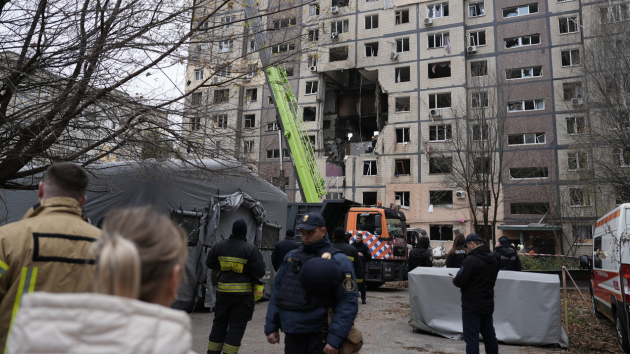
The city of Dnipro was hit hard, with three people killed and another 11 injured there, according to the regional military administration, which said children were among the casualties. A drone struck an apartment building in the city. Three more were injured in the nearby Samarskyi district of the wider Dnipropetrovsk region, authorities said.
In the Kharkiv region, at least one person was killed in the village of Rokytne; eight others were injured in the suburbs of Kharkiv city; one person was injured in nearby Chuhuiv; and another was injured in the village of Hrushivka, according to the regional military administration. The mayor of Kharkiv said in a Telegram post Saturday morning that the city is facing a significant electricity shortage.
Additionally, one person was injured in the Poltava region and another person was injured in the neighboring Kyiv region, according to the respective regional military administrations. The strikes on the Poltava region targeted energy infrastructure facilities, cutting off electricity, water and heating to some communities, authorities said.
The Russian strikes mark the ninth large-scale attack on Ukraine’s gas infrastructure since the start of October, according to Ukrainian state-run energy firm Naftogaz, which in a Telegram post Saturday morning accused Russian of deliberately “targeting enterprises that provide Ukrainians with gas and heat” during the winter months.
The Russian Ministry of Defense confirmed in a Telegram post Saturday morning that it had targeted Ukrainian military and energy infrastructure in an overnight attack. The “massive strike” was carried out in response to “Ukraine’s terrorist attacks on civilian targets in Russia,” according to the Russian defense ministry.
(LONDON) — Ukraine appears at increasing risk of losing the city of Pokrovsk, an important stronghold in eastern Ukraine where its embattled defenders have held off Russia’s grinding assaults for more than a year and a half.
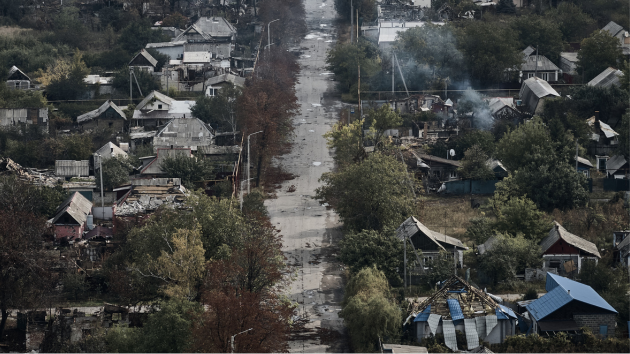
The devastated city — which was home to some 60,000 people before Russia’s February 2022 full-scale invasion — has become a key focus of the Kremlin’s yearslong push to capture all of Ukraine’s eastern Donetsk Oblast, which along with neighboring Luhansk Oblast makes up the Donbas region.
Although Ukraine for now is still maintaining a defense, the fall of Pokrovsk would be one of the most serious defeats Ukraine has suffered since March, when its troops were forced to retreat from Russia’s Kursk region.
Russia has for many months been attempting to encircle Pokrovsk and neighboring Myrnohrad from the north and south. Moscow’s forces are now close to cutting off the main roads into Pokrovsk, with its two key supply routes already under fire from Russian drones making it dangerous and difficult to bring in supplies and also threatening Ukrainian forces ability to withdraw.
In recent weeks, a growing number of Russian troops have advanced into Pokrovsk, with small groups using infiltration tactics to penetrate into the heart of the city, according to both Ukrainian and Russian military analysts.
Intense street fighting is now taking place inside Pokrovsk, with Ukraine’s commander-in-chief Gen. Oleksandr Syrskyi describing the situation as “difficult.”
“The enemy in Pokrovsk is paying the highest price for attempting to fulfill the Kremlin dictator’s task of occupying Ukrainian Donbas,” Syrskyi wrote in a post to Telegram on Saturday.
Ukrainians outnumbered, under fire Ukraine in recent days has launched counterattacks to push Russian forces back from the northern edge of Pokrovsk and keep a road there open to Myrnohrad.
Last weekend, for example, special forces troops under the command of Main Directorate of Intelligence (GUR) chief Kyrylo Budanov launched an audacious heliborne operation into territory that Russian forces claimed they already controlled. The GUR later uploaded video of the assault.
But the momentum in Pokrovsk appears to be with the attacking Russian forces. The city’s fall would be a blow to Ukrainian morale and would complicate its broader defense of the Donbas region.
There are also concerns in Ukraine that its loss could open a route for a Russian offensive towards the cities of Kostyantynivka, Kramatorsk and Sloviansk — the largest Donbas cities still controlled by Kyiv.
But military analysts who spoke to ABC News suggested that the fall of Pokrovsk alone would not necessarily imperil Ukraine’s forces holding the area.
“The Ukrainians could quite likely just as easily continue to defend outside Pokrovsk and Myrnohrad,” Pasi Paroinen of the Finland-based Black Bird Group open-source intelligence analysis organization told ABC News.
Though urban centers “usually make decent tactical defensive positions,” Paroinen added, “when you are already surrounded from three sides and your lines of communications have been cut off or are being disrupted as badly as they are right now over there, then those positions become liabilities, and they are just basically draining Ukrainian resources.”
A Ukrainian withdrawal may even improve Kyiv’s prospects, Paroinen said, assuming that new defenses have been prepared to the city’s west. If those new fortifications are not ready, “then they have a bigger problem than failing to hold Pokrovsk and Myrnohrad,” he said.
The Institute for the Study of War think tank suggested that Russia is unlikely to have the reserves to exploit Pokrovsk’s potential fall to advance rapidly to seize more of the Donbas region. Rather, Moscow’s mauled forces would likely have to continue their slow and costly forward grind, the ISW said.
Regardless, the situation is fraught for Ukrainian units still present in the city. The omnipresent threat of drones could complicate any Ukrainian retreat effort, which would likely see Kyiv’s troops attempt to break out to the west of the city using its under-fire supply routes.
If unable to retreat, large numbers of Ukrainian troops could find themselves cut off and potentially captured. To date and with the exception of the Russian siege of Mariupol in the early stages of the invasion, Kyiv’s forces have avoided being forced into mass surrender, even as they’ve gradually ceded territory in the east of the country.
The fall of Pokrovsk would also likely buoy Russian morale and send a signal that the war is going in its favor — a signal likely to be amplified by Russian state-aligned media and the Kremlin.
Moscow has amassed around 170,000 troops in the Donetsk region with a focus on Pokrovsk, according to remarks by Ukrainian President Volodymyr Zelenskyy on Friday — a signal, he said, of Russian President Vladimir Putin’s intent to capture the area.
Russia has not said how many troops it has deployed to the area. Ukrainian troops defending it are outnumbered eight-to-one, Zelenskyy said.
Visiting a command post in the Dobropillia sector — just north of Pokrovsk — this week, Zelenskyy said Ukrainian forces there are “defending Ukraine and our territorial integrity. This is our country, this is our East, and we will certainly do our utmost to keep it Ukrainian.”
Russian soldiers have already paid a high price. Ukraine’s General Staff said that, since the start of 2025, Moscow has lost some 200,000 soldiers who have been killed or wounded in Donetsk, most of them in the Pokrovsk and Kupyansk directions.
Russia does not release details about its casualties, making it difficult to independently confirm that figure. Ukrainian estimates of Russian casualties have broadly chimed with estimates from U.S. and European intelligence agencies since 2022.
A Russian victory in Pokrovsk will be welcome good news for the Kremlin as Putin maneuvers for advantage over his Ukrainian and American counterparts in anticipation of possible talks over a proposed ceasefire and eventual peace deal.
Russian Chief of the General Staff Gen. Valery Gerasimov last week sought to play up the significance of Moscow’s advance on the city, telling Putin that up to 10,000 Ukrainian soldiers were “encircled” in areas including Pokrovsk — a claim later denied by Ukrainian officials and even disputed by some Russian military analysts, and that most military observers say is currently false.
Fight or flight? The current situation in Pokrovsk is following a similar pattern as other embattled Donbas cities like Bakhmut in 2023 and Avdiivka in 2024. In all three, Russian forces edged forward over several months at staggering human cost despite a resolute Ukrainian defense, according to figures released by Kyiv. In Bakhmut and Avdiivka, Ukrainian forces were eventually forced to abandon the cities.
Zelenskyy and his generals have been criticized by some military bloggers and analysts in Ukraine and abroad for their perceived sluggishness in ordering retreats from doomed Donbas cities.
“The Ukrainians are committing to defending these towns, I would say, for too long,” Paroinen said. “The Russians are already too deep, and I think in too many numbers inside Pokrovsk for Ukrainians to be able to throw them out.”
Ukrainian political and military officials have repeatedly said that military — not political — considerations are front of mind, framing their defense of certain cities as a means to further bleed Russia’s attacking units. Others have argued for a nimbler “defense-in-depth” approach to preserve Ukrainian lives and conserve stretched resources.
“Defense-in-depth is not something the political leadership appreciates too much,” Oleksandr V. Danylyuk — an associate fellow at the Royal United Services Institute think tank in the U.K. and the chairman of the Center for Defense Reforms think tank in Kyiv — told ABC News. “That’s why I would rather expect the government to fight for as long as they can.”
“I think that potentially, Ukraine can actually keep the ground in Pokrovsk, in the same way as the ground has been kept in Chasiv Yar, for instance,” Danylyuk — who has previously served as an adviser to top Ukrainian military and intelligence officials — added, referring to the pivotal fortress city to the northwest where Ukrainian troops have been pushed back but retain a foothold after a yearlong Russian offensive.
“I’m not quite sure if Pokrovsk is of the same importance militarily as Chasiv Yar,” Danlyluk said.
“Personally, I don’t see any real military reason to actually fight for Pokrovsk,” he said. “I understand political reasons. I understand symbolic reasons. And I believe that it is doable. It’s just a matter of price. And I’m not quite sure if we need to pay the price.”
Oleksandr Merezhko — a member of the Ukrainian parliament representing Zelenskyy’s party and the chair of the body’s foreign affairs committee — downplayed the criticism of the decision to fight for Pokrovsk.
“I guess our military philosophy is to defend a particular point till the last opportunity, but at the same time to save people,” he told ABC News. “To make the Russians lose more of their soldiers and to save our soldiers.”
But influential military figures, such as Vitalii Deineha — the well-known Ukrainian volunteer and founder of the Come Back Alive Foundation — are already calling for Kyiv to abandon the city.
“The General Staff reports to the top contain more and more lies every day,” Deineha wrote in a post to Facebook. “In fact, we have practically already lost Pokrovsk, which means that holding Myrnohrad also makes no sense.”
“We should not be afraid of rating drops, because there will be no elections: next year there will be war again. And someone will have to fight it,” he added.
(NEW YORK) — Typhoon Kalmaegi was barreling on Thursday morning toward Vietnam after leaving a trail of destruction in the Philippines.
The storm was expected to make landfall later on Thursday or early on Friday, the U.S. Consulate in Vietnam said in a weather advisory.
Vietnam’s Prime Minister urged the country’s emergency response agencies and ministries to ready themselves as the country braces for the impact of the typhoon.
The Vietnamese National Center for Hydro-Meteorological Forecasting said coastal areas may see waves up to 26 feet and a storm surge up to 2 feet. Winds were expected to be as strong as about 84 mph, the center said.
The country is already battling flash floods and landslides after record rainfall in late October. Those floods killed at least 35 people, officials told AFP.
Some 100,000 homes flooded and the country experienced more than 150 landslides, Vietnam’s environment ministry said, according to AFP.
The typhoon is expected to bring a heightened risk of flooding, flash floods and landslides, weather and state officials said.
“Additionally, infrastructure already weakened by previous flooding may be increasingly unreliable,” the U.S. Mission’s advisory added.
A trail of destruction in the Philippines
In the Philippines, where the typhoon made landfall on Tuesday amid heavy rains and flooding, President Ferdinand R. Marcos Jr. approved a state of emergency declaration on Thursday.
That declaration was intended to “expedite government response efforts in areas” affected by the storm, according to a press release from the official Philippine Information Agency.
The storm killed at least 66 people, according to state-run media. The official Philippine News Agency reported that “most” of those deaths “were due to fallen debris, landslides and flooding.”
Another six Philippine Air Force personnel were killed in a helicopter crash on Tuesday while performing humanitarian assistance, officials said.
The country was already recovering from an offshore earthquake and typhoons in the last few months. The Philippine Area of Responsibility is hit an average of 20 per year, most in the world, according to the Philippines Atmospheric Geophysical and Astronomical Services Administration.
Another potential super typhoon is approaching the country now, local officials said in a news release. That storm is expected to make landfall either Friday night or Saturday morning, officials said.
(LONDON) — A driver was taken into custody after allegedly striking and injuring several pedestrians and cyclists in southwestern France, the interior minister said.
“An investigation has been opened,” Laurent Nunez, the minister, said in French on social media. “At the request of the prime minister, I am heading to the scene.”
The strikes appeared to have been along a “route” through Saint Pierre and Dolus, two villages about 4 miles apart on the island of Oleron, Nunez said.
Two of those who were struck were in serious condition and three others were injured, he added.
Details about the driver and the vehicle were not immediately released.
(ROME) — A worker who had been trapped for 11 hours in the partial collapse of a medieval tower in the heart of Rome was rescued late Monday, officials said.
The 66-year-old man was the last of several workers saved in the rescue operation that was briefly interrupted by a second collapse of the 95-foot-tall Torre de’ Conti tower, Luca Cari, a spokesperson for the Rome Fire Service, told ABC News.
Cari said the worker was extracted from the rubble and was being taken to a hospital ambulance with a police escort. His condition was not immediately released.
“We have achieved an exceptional feat: the injured man has been extracted, brought to ground level, and is already in the ambulance. We can give the exceptional news that he is alive,” Cari said.
Before being saved, the trapped worker was conscious and communicating with search-and-rescue crews, Cari said. About 140 firefighters responded to the scene, some digging with their bare hands to free the worker.
Rome Mayor Roberto Gualtieri told reporters on Monday evening, just before the last rescue was made, that doctors had reached the worker and supplied him with oxygen.
No firefighters were injured in the incident, officials said.
The tower is in the historic part of central Rome near the Roman Forum and the Colosseum.
Cari said the emergency unfolded around 11 a.m. local time. At the time of the first collapse, 11 workers from two companies were working on the tower.
“It all happened suddenly,” one of the workers told Italy’s ANSA news agency. “Then I only saw the cloud of dust and the rescuers.”
Cari said the second partial collapse occurred about an hour after the first, while firefighters were attempting to rescue the workers.
At least three other workers were pulled from the rubble, two of them unharmed, officials said. One rescued worker, a 64-year-old man, was taken to a hospital with a head injury, officials said.
At least 31 workers rescued after tunnel collapse in Los Angeles: LAFD The cause of the collapse remains under investigation.
The tower has been closed to the public since 2007, but recently received a large grant from Italy’s National Recovery and Resilience Plan for the renovation, officials said.
The Torre dei Conti tower, which dates back to the 13th century, was built by Pope Innocent III as a residence for his family.
(LONDON) — A 32-year-old man has been arrested on suspicion of attempted murder for allegedly attacking multiple people with a knife aboard a train headed to London on Saturday evening, according to police, a crime the prime minister called an “appalling incident.”
In a statement shortly after the attack, British Transport Police (BTP) said two people had been arrested. On Sunday afternoon, however, police said a 35-year-old London man initially taken into custody had been released after investigators determined he was not involved.
The victim who was most seriously injured in the attack is a member of the London North Eastern Railway (LNER) staff, who was stabbed when he intervened in an attempt to stop the attack.
Deputy Chief Constable Stuart Cundy of the BTP praised the railway staff member on Sunday afternoon for protecting other passengers, saying security video aboard the train captured the employee’s courageous actions.
“Having viewed the CCTV from the train, the actions of the member of rail staff were nothing short of heroic and undoubtedly saved people’s lives,” Cundy said.
The LNER staffer remained hospitalized on Sunday evening in “life-threatening condition,” according to the BTP. Five other people who were hospitalized with stabbing injuries have been treated and released, according to police.
BTP Superintendent John Loveless said a total of 10 people were taken to hospitals by ambulance, and that an eleventh alleged victim went to a hospital on their own later Sunday night. Initially, Loveless said nine people appeared to have life-threatening injuries when they were taken from the scene.
The BTP said in a statement that it began receiving reports at 7:42 p.m. on Sunday about the stabbings aboard the LNER train that was headed from the city of Doncaster to London’s King’s Cross station.
“Our investigation is moving at pace and we are confident we are not looking for anyone else in connection to the incident,” Deputy Chief Constable Stuart Cundy of the BTP said on Sunday afternoon.
Armed officers boarded the train when it made an unscheduled stop at Huntingdon, roughly 70 miles north of London, and arrested the suspect, whose name was not immediately released, according to Cundy.
“A knife was recovered by officers at the scene,” the BTP statement said Sunday afternoon.
The suspect is from Peterborough in the county of Cambridgeshire, about 74 miles from London, according to Cundy, who also said investigators believe the suspect boarded the train at the Peterborough station.
“As would be expected, specialist detectives are looking into the background of the suspect we have in custody and the events that led up to the attack,” Cundy said.
“This was a horrific attack that has had a wide impact,” Cundy added. “My thoughts and those of everyone in the British Transport Police are with those injured and their families — especially the brave member of the rail staff whose family are being supported by specialist officers.”
The UK’s Counter Terrorism Policing is supporting the investigation to establish “the full circumstances and motivation for this incident,” the BTP said in a statement.
“At this stage, there is nothing to suggest this is a terrorist incident,” Loveless said. “At this early stage, it would not be appropriate to speculate on the causes of the incident.”
Speaking at the scene of the attack on Sunday morning, Loveless said the suspect was arrested within eight minutes of the first emergency call being received.
“The appalling incident on a train near Huntingdon is deeply concerning,” British Prime Minister Keir Starmer said in a statement on social media. “My thoughts are with all those affected, and my thanks go to the emergency services for their response.”
Home Secretary Shabana Mahmood said in a post on X that she was receiving “regular updates” on the investigation.
“Two suspects have been immediately arrested and taken into custody,” she wrote, adding, “I urge people to avoid comment and speculation at this early stage.”
King Charles III, meanwhile, said in a statement posted to the Royal Family’s official X account, “My wife and I were truly appalled and shocked to hear of the dreadful knife attack that took place on board a train in Cambridgeshire last night.”
“Our deepest sympathy and thoughts are with all those affected, and their loved ones,” the king said. “We are particularly grateful to the emergency services for their response to this awful incident.”
ABC News’ Rashid Haddou and Somayeh Malekian contributed to this report.
(NEW YORK) — Two people arrested in the investigation into the Louvre Museum robbery last month have been formally charged in connection with the case, according to the Paris Public Prosecutor’s office. Both denied their involvement in the robbery.
Two others were charged in connection with the heist this week.
French authorities identified the new suspects as a 37-year-old man and a 38-year-old woman. They were charged with organized robbery and conspiracy to commit organized robbery and remanded into custody.
Additionally, three of the five people arrested on Oct. 29 have been released from custody, prosecutors said.
On Oct. 19, four masked thieves stole eight pieces of jewelry from the Louvre, the world’s most visited museum, that were valued at $102 million. The robbery, which authorities say took just seven minutes, sparked a national outcry and nationwide manhunt.
The stolen jewels remain missing, authorities say.
Last week, one suspect was arrested at Paris Charles de Gaulle Airport while trying to board a plane bound for Algeria, police said, while the second suspect was detained as he was about to travel to Mali.
The logo of the United Nations at the General Debate of the UN General Assembly in New York. Over 140 heads of state and government are expected to attend the world’s largest diplomatic event over several days. Photo: Kay Nietfeld/dpa (Photo by Kay Nietfeld/picture alliance via Getty Images)
(NEW YORK) — The United Nations said Friday that U.S. airstrikes on alleged drug trafficking boats in the Caribbean and the Pacific Ocean violate international human rights law and must stop.
In a statement to ABC News, the U.N. High Commissioner for Human Rights Volker Türk said that the attacks breach international law and called for an investigation into the strikes.
“These attacks – and their mounting human cost – are unacceptable. The U.S. must halt such attacks and take all measures necessary to prevent the extrajudicial killing of people aboard these boats, whatever the criminal conduct alleged against them,” Türk said.
“Under international human rights law, the intentional use of lethal force is only permissible as a last resort against individuals who pose an imminent threat to life,” he added. “Based on the very sparse information provided publicly by the U.S. authorities, none of the individuals on the targeted boats appeared to pose an imminent threat to the lives of others or otherwise justified the use of lethal armed force against them under international law.”
White House deputy press secretary Anna Kelly told ABC News that President Donald Trump is working to eliminate threats to U.S. security.
“The UN has failed at everything from operating an escalator to ending wars — it’s ridiculous that they are now lecturing President Trump and running cover for evil narcoterrorists trying to murder Americans. The President acted in line with the laws of armed conflict to protect our country from those trying to bring poison to our shores, and he is delivering on his promise to take on the cartels and eliminate these national security threats from destroying lives,” Kelly said.
Since September, President Donald Trump and Defense Secretary Pete Hegseth have executed over a dozen military strikes against boats in the Caribbean and Eastern Pacific, arguing they are anti-drug and counter-terrorism measures.
Over 60 people have allegedly been killed in the strikes, according to U.S. officials.
In announcing the latest and most deadly strike Wednesday, Hegseth said the U.S. “carried out a lethal kinetic strike on yet another narco-trafficking vessel operated by a Designated Terrorist Organization in the Eastern Pacific.”
“This vessel, like all the others, was known by our intelligence to be involved in illicit narcotics smuggling, was transiting along a known narco-trafficking route, and carrying narcotics,” he added.
This is the first time the U.N. has condemned the strikes.
“The United States should investigate and, if necessary, prosecute and punish individuals accused of serious crimes in accordance with the fundamental rule of law principles of due process and fair trial, for which the U.S. has long stood,” a statement from his office reads.
Ravina Shamdasani, a spokeswoman for Türk, mirrored this sentiment at a Friday U.N. briefing.
“These attacks and their mounting human cost are unacceptable. The U.S. must halt such attacks and take all measures necessary to prevent the extrajudicial killing of people aboard these boats,” she said.
[Editor’s Note: This story includes graphic descriptions of alleged torture.]
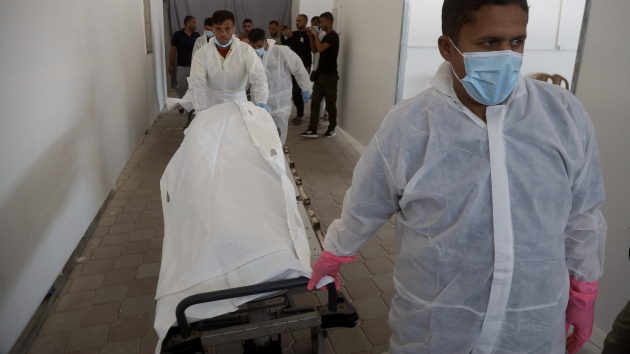
(NEW YORK) — The bodies of some unidentified Palestinians handed over by Israel as part of the ceasefire agreement showed severe signs of torture, according to an aid worker who inspected at least 10 bodies.
“People’s bodies were covered in scars and what looked like open wounds. … It was just horrific,” Moureen Kaki, a Palestinian American activist and aid worker with medical charity Glia, told ABC News.
The bodies had signs of binding the hands and feet, contortion of limbs, cut off fingertips and disfigured heads, according to Kaki. Their hands had “gone stiff” and were “fixed” in a contorted position “as if they’d been that way for a long time,” she noted.
Kaki told ABC News she has not yet formally reported the alleged torture to a government or humanitarian agency.
Israel and Hamas agreed to a ceasefire deal that involved a hostage exchange earlier this month. All remaining living hostages held by Hamas have been turned over to Israel and Hamas said it is continuing to search for the bodies of some deceased hostages.
Under the ceasefire agreement, Israel also turned over living and dead Palestinians in its custody.
The Israel Defense Forces rejected the allegations of torture and told ABC News that it operates “strictly in accordance with international law,” in a statement last week.
The type of scarring on the unidentified Palestinian bodies was “pretty consistent across most of them” and several bodies had “what looked like gunshot wounds in their legs,” according to Kaki.
“Probably about six” of the corpses she looked at had fingers missing, she noted.
“Every single person that I looked at had their hands and feet bound, or like traces of their hands or feet were bound in some way,” Kaki said.
In its statement rejecting allegations of torture, the IDF said it “did not tie any bodies prior to their release to the [Gaza] Strip.”
The bodies were returned by Israel without names and some had numbers “spray-painted” onto them, according to Kaki, who spoke from inside Nasser Hospital in Khan Younis. She has been based in Gaza non-stop since June 2024.
The corpses examined had possibly been held by Israel for as long as two years, Kaki noted.
The bodies had decomposed to some extent by the time she examined them, but medical professionals from Nasser Hospital believe that some sort of preservation process had been applied to the corpses while they were held by Israel, Kaki said.
Asked how confident she could be that the bodies had evidence of torture, Kaki said, “I would say 99% [sure] and the only 1% is that I didn’t see it [the alleged torture] with my own eyes.”
The Nasser Hospital medical professionals who inspected the bodies told her “that this was clearly torture and that most of it, if not all of it, was done while these people were still alive,” Kaki said.
ABC News has reviewed graphic images of corpses obtained by Kaki. The photos were taken from a Palestinian journalist whom Kaki said was present when she examined the bodies. The images appeared to back up her account.
More than 1,900 living Palestinian prisoners and detainees who were released by Israel under the ceasefire agreement. Kaki said she spoke to 35 former detainees who said they had experienced torture.
She also examined wounds on their bodies and, according to Kaki, their accounts “lined up very clearly with what their bodies showed.”
The IDF described the allegations as “false propaganda” and said “all of the [Palestinian] bodies returned [to Gaza] so far are from combatants within the Gaza Strip.”
A mass burial was held for 54 unidentified Palestinians in Deir al-Balah in central Gaza last week.
Kaki said she believed authorities in Gaza were ultimately unable to identify the bodies returned due to their deformities and injuries.
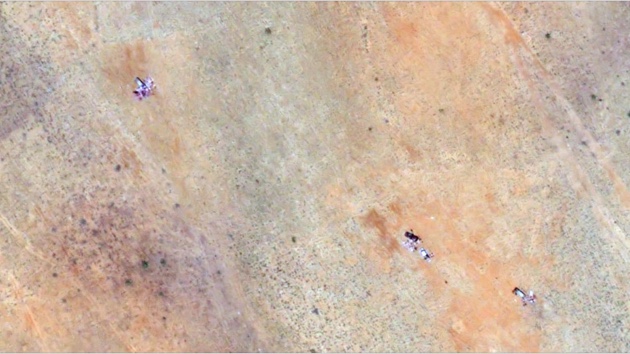
The Humanitarian Research Lab (HRL) at the Yale School of Public Health observed numerous clusters with discoloration around them, consistent with the appearance of human bodies in the Darfur region of Sudan. (Humanitarian Research Lab at the Yale School of Public Health)
(NEW YORK) — Satellite images and verified videos paint a harrowing picture of door-to-door mass killings in the Darfur region of war-torn Sudan as the Rapid Support Forces (RSF) paramilitary rebels captured a key city in the region.
The Humanitarian Research Lab (HRL) at the Yale School of Public Health says they observed numerous clusters with discoloration around them, consistent with the appearance of human bodies across the city as RSF advanced.
The apparent masses were seen in a hospital, all over residential neighborhoods, on the outskirts of the city and by military bases of the opposing Sudanese Armed Forces (SAF).
The alleged killings took place “in under 72 hours since RSF took control of the city,” Nathaniel Raymond, an American human rights and war crimes investigator at HRL who has been documenting the massacres in Sudan with satellite imagery, told ABC News.
With his team at the research lab, Raymond said he observed “an explosion of objects that measure between 1.3 to 2 meters proliferate all over the ground,” which HRL Yale concluded is human bodies due to the length, shape and videos from the ground showing alleged systematic civilian killings.
“In Daraja Oula — a neighborhood where civilians have been hiding — we’re seeing a tactical posture on the vehicles that is highly consistent with house-to-house killing,” Raymond told ABC News. “This is also consistent with video and testimony from those who reached Tawila. Particularly women, who said that the men are being separated by RSF and then they hear gunshots.”
The research lab also observed discoloration around these objects, which they concluded is blood, further confirmed by the presence of Rapid Support Forces (RSF) military vehicles always spotted in close proximity, Raymond said. An update on the report shows that the piles have grown and none of the original objects have moved, Raymond told ABC News.
Researchers said they also corroborated reports of alleged executions at Saudi Hospital, where at least four clusters of bodies appeared. “We see a line of people standing on day one at an RSF detention facility that was formerly a children’s hospital. On day two, we see a pile now in the corner consistent with the color and length of those individuals who are standing there in a line on the previous day,” Raymond said.
On the outskirts of El Fasher, HRL Yale also said they observed multiple clusters appearing between Oct. 26 and Oct. 27, consistent with reports of civilians being killed as they tried to flee. West of the city, along its encircling berm, at least six clusters were observed as well as adjacent technical vehicles, which were not seen in images from Oct. 28, suggesting RSF had moved, leaving the large clusters of bodies behind, according to the research lab.
RSF has also taken control of the opposing Sudanese Armed Forces (SAF) military bases in the city, the HRL analysis appears to show.
Satellite images from Oct. 26 show at least 15 new munition scars and thermal burns on the ground of the 6th Division HQ of the opposing Sudanese Armed Forces in a comparison with images from Oct. 15.
“We’ve seen that all of the Sudan Armed Forces vehicles left en masse at about the same time. Which is consistent with reports that they escaped in the night in what now appears to be a negotiated deal with the Rapid Support Forces, leaving the civilians in Al-Fasher to die,” Raymond said.
During the offensive, El Fasher has been cut off from the outside world. Besieged for 18 months — the UN called it the “epicentre of suffering” — and now with RSF forces inside the city, there is no observable mass movement of people fleeing, likely prevented from escaping the alleged killings in what experts fear is just the beginning of devastating violence.
In January, the U.S. State Department announced it had concluded members of the RSF had committed genocide in Sudan, specifically pointing to human rights violations in Darfur. Raymond says what we are seeing “is the final battle of the Darfur genocide that began 20 years ago.”
Compared to previous RSF offensives — such as one in April on the largest displacement camp in Darfur, ZamZam — humanitarian observers are suggesting the new satellite imagery shows a more systematic way of killing that is making them warn of a possible genocide unfolding.
“Here, in the case of El Fasher, what’s different? They’re not burning the city to the ground. They have the city encircled. They are controlling the entrance and exit. And they are moving pretty systematically, unlike ZamZam. Pretty systematically, block by block. And as they move, we see objects consistent with bodies, often with discoloration, appear,” Raymond told ABC News.
From testimony on the ground, those who have fled said that men have been separated from women and children, who are now likely in hiding, but are next in the firing line, Raymond said.
“It’s now going to accelerate,” he said. “We haven’t even hit top velocity. The people that they will kill now are those who are hiding. And they’re mostly women and children… Now it’ll be those who were too weak to run or those men who were hiding and trying to protect them from the RSF.”