(LONDON) — Nearly 11 days after a massive earthquake and powerful aftershocks rocked southeastern Turkey, two men trapped beneath the rubble have been rescued as the odds of finding survivors diminish by the hour.
Turkish Health Minister Fahrettin Koca posted about the rescues on Twitter, saying both men were pulled alive from the ruins of a collapsed building in hard-hit Hatay province on Thursday evening, 261 hours after the quake.
Mustafa Avci, 33, was rescued first, according to Koca. After initial treatment at a field hospital, Avci was allowed to call a relative whose telephone number he remembered. The health minister tweeted video of the emotional exchange, in which Avci is seen wearing a neck brace and lying on a stretcher as he speaks into a mobile phone held by a rescuer. Avci can be heard asking about his mother and the rest of their family as the man on the other end cries in disbelief. Avci then kisses the hand of the rescuer holding the phone and thanks him.
Hatay’da enkaz altından 261’inci saatte, bu gece kurtarılan Mustafa, tıbbi müdahalenin ardından ilk olarak, telefon numarasını hatırladığı bir yakınını aradı. Kardeşimiz Mustafa’yı bu kadar iyi görmekten çok mutluyuz. pic.twitter.com/t0jrmH0M6r
Mehmet Ali Sakiroglu, 26, was rescued soon after, according to Koca. Sakiroglu was assessed at the field hospital before being transported to the Mustafa Kemal University Hospital in Antakya, where he remains for treatment, Koca said. The health minister tweeted a photo of first responders bringing Sakiroglu into the hospital on a stretcher.
Hayat dolu haberler bu gece birbirini izliyor. Kardeşimiz Mehmet Ali, Hatay’da enkaz altından 261’inci saatte kurtarılan ikinci vatandaşımız. İlk tıbbi müdahalesi Sahra Hastanesinde yapıldı. Şu an Mustafa Kemal Üniversitesi Tıp Fakültesi Hastanesinde tedavi altında. pic.twitter.com/3WNgR8KkKW
The 7.8 magnitude earthquake struck the region before dawn on Feb. 6 and was followed by hundreds of aftershocks. The quake’s epicenter was in Turkey’s southeastern Kahramanmaras province, not far from the border with Syria. Thousands of buildings were toppled on both sides, according to Turkish and Syrian officials.
The death toll in Turkey and Syria has continued to rise in the days since, reaching 42,000 on Thursday, according to combined figures from both countries.
Although most rescues happen within the first 24 hours after a natural disaster, experts told ABC News that people can survive for up to a week or more while trapped under fallen debris depending on several factors, including weather conditions, the extent of their injuries and whether they have access to air and water.
ABC News’ Kerem Inal and Ellie Kaufman contributed to this report.
(THWAITES GLACIER, Antarctica) — Scientists studying one of the most crucial glaciers that’s been deteriorating by climate change got a new look at what’s going on underneath the surface.
In two studies published in the science journal “Nature,” scientists from the UK-US International Thwaites Glacier Collaboration said they were able to measure the bottom of the Thwaites Glacier and insert cameras and probes through a borehole to study the object from underwater.
The images showed researchers that while the glacier overall is melting slower than models projected, the warmer water underneath the ice is creating cracks and crevasses where the ice is melting much faster than the rest of the glacier.
The glacier, nicknamed the “Doomsday glacier” which is roughly the size of Florida, has been sensitive to climate change over the last 30 years and accounts for about 4% of global sea level rise, according to scientists. If the glacier collapses it could add 25 inches to the global sea level rise in the coming centuries, according to researchers.
Britney Schmidt, who’s an Associate Professor at Cornell University and lead author of one of the studies told ABC News that the initial data that was collected changes scientists’ understanding baseline conditions of what is happening with the glacier.
“Now we know that this collapse has happened under less melting than we thought and it means it can be easier to collapse,” she said.
Scientists undertook observations of the grounding line, where the ice first meets the ocean, beneath the Thwaites Eastern Ice Shelf to understand how the ice and ocean interact.
Peter Davis, an oceanographer with the British Antarctic Survey who was the lead author on one of the studies, took ocean measurements through a 600-meter deep borehole around two kilometers from the grounding line, created by a hot water drill in late 2019. These measurements were compared with melt rate observations taken at five other sites underneath the ice shelf.
Over nine months, the ocean near the grounding line became warmer and saltier but the melt rate at the ice base averaged two to five meters per year, which were less than previously modeled, researchers said.
Davis said in a statement that the results were surprising but still not good news for the state of the glacier.
“If an ice shelf and a glacier are in balance, the ice coming off the continent will match the amount of ice being lost through melting and iceberg calving. What we have found is that despite small amounts of melting there is still rapid glacier retreat, so it seems that it doesn’t take a lot to push the glacier out of balance,” he said in a statement.
Schmidt’s team of researchers used a robot called Icefin to go underwater and into the glacier through a 600-meter deep borehole created in 2019 by a research drill. The robot was able to get photos, video and other data from both the ocean floor and the underside of the glacier as it moved, according to the researchers.
“We never had this data before so we had our best guess,” Schmidt said. “We now have the measurements we need to fine-tune our models.”
Schmidt said researchers will continue to take data from the glacier and get a better sense of how bad the climate change damage will be.
“We need those details to inspire our response as people for the change we’ve signed up for,” she said.
(NEW YORK) — Almost a year after Russian President Vladimir Putin launched an invasion into neighboring Ukraine, the two countries are engaged in a struggle for control of areas throughout eastern and southern Ukraine.
Putin’s forces pulled out of key positions in November, retreating from Kherson as Ukrainian troops led a counteroffensive targeting the southern port city. Russian drones have continued bombarding civilian targets throughout Ukraine, knocking out critical power infrastructure as winter sets in.
Here’s how the news is developing. All times Eastern:
Feb 16, 5:28 PM EST
Ukrainian vice prime minister tells remaining civilians in Bakhmut to evacuate
Vice Prime Minister Iryna Vereshchuk called on the roughly 6,000 civilians still in Bakhmut to evacuate “immediately.”
Officials said they don’t want the people still in the city to put themselves and their children at risk and don’t want them to interfere with the Ukrainian army. Five civilians were killed and nine others were injured on Thursday, according to the vice prime minister.
“Frankly speaking, I am very surprised that 6,000 civilians are still working there,” Vereshchuk said in a statement.
-ABC News’ Will Gretsky
Feb 16, 3:25 PM EST
Belarus will fight alongside Russia if it is attacked, president warns
Belarus would only join the war in Ukraine, fighting alongside Russia, if it is attacked, President Alexander Lukashenko told state-run Belta news agency.
“We don’t want a war. And in no case are we going to send our troops into the territory of Ukraine. Unless you commit aggression against the territory of Belarus from there. Here is my answer. It was given a long time ago,” Lukashenko said.
Ukrainian President Volodymyr Zelenskyy addressed Lukashenko’s threat in an interview with the BBC.
“I hope [Belarus] won’t join [the war],” he said. “If it does, we will fight and we will survive.”
Allowing Russia to use Belarus as a staging post for an attack again would be a “huge mistake,” he added.
Russian forces launched part of their full-scale invasion from Belarus 12 months ago. They drove south toward Ukraine’s capital, Kyiv, but were fought back and made to retreat within weeks, after suffering heavy casualties.
Lukashenko is set to meet with Russian President Vladimir Putin on Friday.
-ABC News’ Will Gretsky and Tanya Stukalova
Feb 16, 3:11 PM EST
Zelenskyy rules out territorial deal with Putin in BBC interview
Ukraine’s President Volodymyr Zelensky has ruled out giving up any of his country’s territory in a potential peace deal with Russia.
In a BBC interview to mark a year since Russia’s full-scale invasion, he warned conceding land would mean Russia could “keep coming back,” while Western weapons would bring peace closer.
However, he does believe Ukrainian forces can keep resisting Russia’s advance until they are able to launch a counteroffensive — although he repeated his calls for more military aid from the West.
“Of course, modern weapons speed up peace. Weapons are the only language Russia understands,” Zelensky told the BBC.
-ABC News’ Will Gretsky
Feb 16, 12:13 AM EST
Russian strikes hit infrastructure in Lviv, Ukrainians shoot down eight Russian missiles: Officials
An infrastructure object was hit in Lviv in the early morning hours of Thursday, the head of the Lviv Regional Military Administration, Maksym Kozytskyi, said on Telegram.
There were no casualties, and the fire from the impact has since been put out, Kozytskyi said.
Six Kalibr missiles were also shot down over the Mykolaiv region, and two Kalibr missiles were shot down over the Kherson region overnight, Odesa Military Administration spokesman Serhii Bratchuk posted on Telegram.
All eight of the missiles were fired from a Russian ship in the Black Sea, Bratchuk said in the post.
Feb 15, 2:48 PM EST
6 ‘reconnaissance’ balloons shot down over Kyiv
Authorities in Kyiv are investigating who owns six balloons that were in Ukraine’s airspace and what the balloons were doing over Kyiv. The balloons were shot down by Ukrainian air defense.
After a preliminary assessment, authorities think the balloons had intelligence gathering equipment.
-ABC News’ Will Gretsky
Feb 14, 11:43 AM EST
If Bakhmut falls, won’t have ‘strategic impact’ on Ukraine war: White House
White House spokesman John Kirby said during a briefing Tuesday that the U.S. could not “predict one way or the other” whether Bakhmut will fall to the Russians and if it does fall, “on what timeline.”
“We’re watching this every day, and it is certainly true that the Russians are continuing to make incremental progress there,” Kirby said. “Again, I can’t predict one way or the other whether it falls or it doesn’t fall or on what timeline. They have made incremental progress again in just the last 24, 48 hours.”
He added that the U.S. did not think Russia obtaining control of Bakhmut would have any “strategic impact” on either the overall war or even fighting in that part of the country.
The U.S. thinks Russia — and specifically the Wagner Group and its leader, Yevgeny Prigozhin, which is doing much of the fighting for Bakhmut — wants to take over and benefit financially from gypsum and salt mines located in the area, Kirby said.
“Even if Bakhmut were to fall, it would not have a strategic impact on the overall war,” Kirby said. “I would go so far as to say it won’t even have, necessarily, a strategic impact on the fighting in that part of the country. We think one of the reasons why Prigozhin is so interested in Bakhmut is because there’s a gypsum mine there, and up in Soledar, there’s a salt mine. And it’s entirely possible that Mr. Prigozhin sees some economic benefit to him and his company to take Bakhmut and to take and hold Soledar.”
-ABC News’ Ben Gittleson
Feb 11, 9:43 AM EST
US surveillance data ‘crucial’: Ukrainian commander
Ukrainian Lt. Gen. Serhiy Nayev told ABC News in an interview that the U.S. provides “surveillance data,” allowing the Ukrainian Armed Forces to more accurately pinpoint Russian targets within Ukraine’s borders.
“This help is crucial for us,” he said.
Nayev said he was in “constant contact” with American generals stationed in other parts of Europe. An exchange of data between the Ukrainians and Americans helped the Ukrainian military to pinpoint targets using US-supplied HIMARS rocket systems.
“This work goes perfectly in real time,” he said.
-ABC News’ Tom Soufi Burridge, Dragana Jovanovic and Ale Pavone
Feb 10, 3:09 PM EST
Biden to visit Poland on eve of first anniversary of invasion of Ukraine
President Joe Biden will visit Poland on Feb. 20, on the eve of the first anniversary of the Russian invasion of Ukraine.
Biden will meet with Polish President Andrzej Duda as well as the leaders of the Bucharest Nine, a group of our eastern flank NATO allies, and he’ll deliver remarks to mark the one-year anniversary, White House press secretary Karine Jean-Pierre said Friday.
“President Biden will deliver remarks ahead of the one-year anniversary of Russia’s brutal and unprovoked invasion of Ukraine, addressing how the United States has rallied the world, to support the people of Ukraine, as they defend their freedom and democracy, and how we will continue to stand with the people of Ukraine for as long as it takes,” Jean-Pierre said.
-ABC News’ Ben Gittleson
Feb 10, 12:25 PM EST
Russian missile comes within 22 miles of Romanian border with Ukraine
Romania, a member of NATO, said Friday a Russian missile had come within 22 miles of its border but that it did not cross into the country’s territory, countering a claim made by the Ukrainian military.
“The Romanian Air Forces’ air surveillance system detected on Friday, February 10th, an aerial target launched by a Russian Federation’s ship, navigating in the Black Sea, nearby the Crimean Peninsula. The target is most likely a cruise missile, which flew over the air space of Ukraine and the Republic of Moldova and reentered the Ukrainian air space without ever infringing Romania’s air space,” Romanian Defense Minister Angel Tîlvăr said in a statement Friday.
Ukrainian officials had said earlier Friday that two Russian missiles crossed into the airspace of Moldova and Romania before entering Ukraine and being directed at targets in the country.
“Several Russian missiles passed through the airspace of Moldova and Romania. These missiles are a challenge to NATO and collective security. This is terror that can and must be stopped,” Zelenskyy said Friday.
FILE, photo — aviation-images.com/Universal Images Group via Getty Images
(WASHINGTON) — The U.S. intercepted Russian aircraft flying off Alaska in international airspace as they approached an identification zone for two straight days this week, according to officials.
Planes are required to identify themselves when they approach the Alaska Air Defense Identification Zone, or ADIZ. If they don’t, U.S. aircraft are launched to check on them.
The Alaskan Region of North American Aerospace Defense Command, or NORAD, announced on Thursday an incident that took place on Feb. 14 in which U.S. Air Force F-35s intercepted four Russian aircraft, including two Tu-95 bombers. The U.S. announced on Tuesday it had intercepted two Russian Tupolev Tu-95MS strategic bombers on “a seven-hour flight over neutral waters of the Chukchi Sea and the Sea of Okhotsk” on Feb. 13.
Neither time did the Russian aircraft enter the U.S. or Canadian airspace, according to officials.
“This Russian activity near the North American ADIZ occurs regularly and is not seen as a threat, nor is the activity seen as provocative,” NORAD said in a statement Thursday.
This is a developing story. Please check back for updates.
(NEW YORK) — Almost a year after Russian President Vladimir Putin launched an invasion into neighboring Ukraine, the two countries are engaged in a struggle for control of areas throughout eastern and southern Ukraine.
Putin’s forces pulled out of key positions in November, retreating from Kherson as Ukrainian troops led a counteroffensive targeting the southern port city. Russian drones have continued bombarding civilian targets throughout Ukraine, knocking out critical power infrastructure as winter sets in.
Here’s how the news is developing. All times Eastern:
Feb 16, 12:13 AM EST
Russian strikes hit infrastructure in Lviv, Ukrainians shoot down eight Russian missiles: Officials
An infrastructure object was hit in Lviv in the early morning hours of Thursday, the head of the Lviv Regional Military Administration, Maksym Kozytskyi, said on Telegram.
There were no casualties, and the fire from the impact has since been put out, Kozytskyi said.
Six Kalibr missiles were also shot down over the Mykolaiv region, and two Kalibr missiles were shot down over the Kherson region overnight, Odesa Military Administration spokesman Serhii Bratchuk posted on Telegram.
All eight of the missiles were fired from a Russian ship in the Black Sea, Bratchuk said in the post.
Feb 15, 2:48 PM EST
6 ‘reconnaissance’ balloons shot down over Kyiv
Authorities in Kyiv are investigating who owns six balloons that were in Ukraine’s airspace and what the balloons were doing over Kyiv. The balloons were shot down by Ukrainian air defense.
After a preliminary assessment, authorities think the balloons had intelligence gathering equipment.
-ABC News’ Will Gretsky
Feb 14, 11:43 AM EST
If Bakhmut falls, won’t have ‘strategic impact’ on Ukraine war: White House
White House spokesman John Kirby said during a briefing Tuesday that the U.S. could not “predict one way or the other” whether Bakhmut will fall to the Russians and if it does fall, “on what timeline.”
“We’re watching this every day, and it is certainly true that the Russians are continuing to make incremental progress there,” Kirby said. “Again, I can’t predict one way or the other whether it falls or it doesn’t fall or on what timeline. They have made incremental progress again in just the last 24, 48 hours.”
He added that the U.S. did not think Russia obtaining control of Bakhmut would have any “strategic impact” on either the overall war or even fighting in that part of the country.
The U.S. thinks Russia — and specifically the Wagner Group and its leader, Yevgeny Prigozhin, which is doing much of the fighting for Bakhmut — wants to take over and benefit financially from gypsum and salt mines located in the area, Kirby said.
“Even if Bakhmut were to fall, it would not have a strategic impact on the overall war,” Kirby said. “I would go so far as to say it won’t even have, necessarily, a strategic impact on the fighting in that part of the country. We think one of the reasons why Prigozhin is so interested in Bakhmut is because there’s a gypsum mine there, and up in Soledar, there’s a salt mine. And it’s entirely possible that Mr. Prigozhin sees some economic benefit to him and his company to take Bakhmut and to take and hold Soledar.”
-ABC News’ Ben Gittleson
Feb 11, 9:43 AM EST
US surveillance data ‘crucial’: Ukrainian commander
Ukrainian Lt. Gen. Serhiy Nayev told ABC News in an interview that the U.S. provides “surveillance data,” allowing the Ukrainian Armed Forces to more accurately pinpoint Russian targets within Ukraine’s borders.
“This help is crucial for us,” he said.
Nayev said he was in “constant contact” with American generals stationed in other parts of Europe. An exchange of data between the Ukrainians and Americans helped the Ukrainian military to pinpoint targets using US-supplied HIMARS rocket systems.
“This work goes perfectly in real time,” he said.
-ABC News’ Tom Soufi Burridge, Dragana Jovanovic and Ale Pavone
Feb 10, 3:09 PM EST
Biden to visit Poland on eve of first anniversary of invasion of Ukraine
President Joe Biden will visit Poland on Feb. 20, on the eve of the first anniversary of the Russian invasion of Ukraine.
Biden will meet with Polish President Andrzej Duda as well as the leaders of the Bucharest Nine, a group of our eastern flank NATO allies, and he’ll deliver remarks to mark the one-year anniversary, White House press secretary Karine Jean-Pierre said Friday.
“President Biden will deliver remarks ahead of the one-year anniversary of Russia’s brutal and unprovoked invasion of Ukraine, addressing how the United States has rallied the world, to support the people of Ukraine, as they defend their freedom and democracy, and how we will continue to stand with the people of Ukraine for as long as it takes,” Jean-Pierre said.
-ABC News’ Ben Gittleson
Feb 10, 12:25 PM EST
Russian missile comes within 22 miles of Romanian border with Ukraine
Romania, a member of NATO, said Friday a Russian missile had come within 22 miles of its border but that it did not cross into the country’s territory, countering a claim made by the Ukrainian military.
“The Romanian Air Forces’ air surveillance system detected on Friday, February 10th, an aerial target launched by a Russian Federation’s ship, navigating in the Black Sea, nearby the Crimean Peninsula. The target is most likely a cruise missile, which flew over the air space of Ukraine and the Republic of Moldova and reentered the Ukrainian air space without ever infringing Romania’s air space,” Romanian Defense Minister Angel Tîlvăr said in a statement Friday.
Ukrainian officials had said earlier Friday that two Russian missiles crossed into the airspace of Moldova and Romania before entering Ukraine and being directed at targets in the country.
“Several Russian missiles passed through the airspace of Moldova and Romania. These missiles are a challenge to NATO and collective security. This is terror that can and must be stopped,” Zelenskyy said Friday.
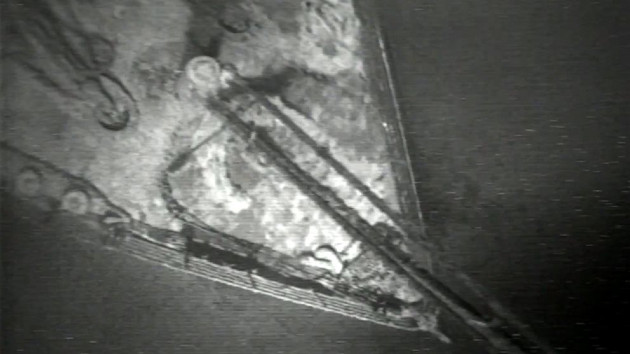
(NEW YORK) — Never-before-seen footage from the 1986 exploration of the site of the Titanic shipwreck was released Wednesday.
The footage was captured by cameras in a three-person research submersible named Alvin and the remotely operated Jason Jr. in July 1986, which marked the first time humans saw the ship since its doomed maiden voyage in 1912.
Most of the footage had never before been seen by the public, according to Woods Hole Oceanographic Institution.
Woods Hole Oceanographic Institution premiered more than 80 minutes worth of footage Wednesday night.
The footage begins with Alvin approaching the Titanic, then exploring the bow and parking on its deck. It also includes interior shots of the Titanic from Jason Jr.
It also shows the chief officer’s cabin and a promenade window, the exterior of the ship and the telemotor used to transmit steering and engine controls to the engine room.
The Titanic hit an iceberg on its trip from Southampton, England, to New York City on April 14, 1912. It was carrying over 2,200 passengers and crew.
More than 1,500 people died when the ship sank.
A joint exploration run by the Woods Hole Oceanographic Institution and a French oceanographic exploration organization, Institut français de recherche pour l’exploitation de la mer, found the ship wreckage in September 1985.
Scientists then returned to the site nine months later and captured the footage.
In 1986, 11 dives were made to the Titanic’s resting place almost 12,500 feet below the ocean’s surface.
(WARRINGTON, U.K) — Two teens have been charged in the death of Brianna Ghey, a transgender girl found dead in the English town of Warrington.
Emergency services were called to a local park Feb. 11 when Ghey’s body was found on a path, authorities said. She was pronounced dead at the scene.
A 15-year-old boy and a 15-year-old girl were initially arrested and questioned by the Cheshire Constabulary police force and were later charged with murder Wednesday.
Police say it is unclear if the circumstances surrounding her death are hate-related, but the investigation into a motive is ongoing.
“A number of enquiries in relation to this incident are underway and we are doing all that we can to establish the exact circumstances of what has happened,” said Detective Chief Superintendent Mike Evans in a statement.
Ghey was described by her family as “a larger than life character who would leave a lasting impression on all that met her.”
“Brianna was a much loved daughter, granddaughter, and baby sister,” her family said in a statement. “Brianna was beautiful, witty and hilarious. Brianna was strong, fearless and one of a kind.”
Ghey was a popular personality on social media, with thousands of followers on Instagram and TikTok.
Candlelight vigils continue to be held across the U.K. – from Glasgow, Scotland to Dublin, Ireland – as the transgender community honors and grieves Ghey’s memory and life.
“The loss of her young life has left a massive hole in our family, and we know that the teachers and her friends who were involved in her life will feel the same,” Ghey’s family said.
(NEW YORK) — Days after a 7.8-magnitude earthquake and hundreds of powerful aftershocks struck southeastern Turkey and northwestern Syria, survivors were still being pulled from the rubble.
Rescue efforts continue even as the death toll has surpassed 41,000 as of Wednesday afternoon.
Although most rescues happen in the first 24 hours after a natural disaster, experts said people can survive up to a week or more trapped under fallen debris depending on several factors including whether they have access to water and air, weather conditions and the extent of their injuries.
“So, a natural disaster is something that leaves us all feeling helpless, in general, just by virtue of what it is,” Dr. Emanuel Maidenberg, a clinical professor of psychiatry at the University of California, Los Angeles, told ABC News. “It’s unpredictable and uncontrollable and, as human beings, we all have to accept that reality of it and the uncertainty that is associated with not knowing when and how intense it could happen.”
He added, “So, we’re mostly not spending days anticipating or waiting for events of that kind. And yet, when it happens, there are other mechanisms that become available to us.”
Make noise
Dr. Stephen Morris, an associate professor in the department of emergency medicine at UW Medicine with international disaster-response experience, told ABC News one of the best ways to help yourself be rescued is to find some way to communicate with the outside world that you’re still alive.
That means screaming or making noise to alert emergency rescue workers to your location.
“The really only thing that’s sort of paramount to express is that being found is really the only way of survival,” he said. “And so, finding a way to communicate, making repetitive noise, this usually involves some sort of tapping against the infrastructure where people are trapped.”
He said, in past earthquakes, survivors have even managed to obtain cell service and are able to call or text to let people know they are in need of rescue.
“Getting the message that you’re there and you’re still alive out is what gets people rescued,” Morris said.
He also stressed that people should try to protect their airways if they are trapped, whether that means making as much room for themselves and keeping objects out of their face.
Importance of drinking water
When people have survived for several days, it’s usually because they have access to fresh drinking water, Morris said.
Although a person can survive without water for about one week, he said being close to water supply when being trapped is the best chance of survival, although this is often a matter of luck.
“There’s a lot of luck involved with the people that have survived for very long periods of time,” Morris said.
A 17-year-old boy named Muhammet Korkut told ABC News he survived while trapped for 94 hours by drinking his own urine.
Morris said he advises against this if you’re trapped under rubble — as well as drinking sea water or alcohol — because it can be dehydrating.
“Almost universally not recommended,” he said. “It can absolutely dehydrate you faster than not drinking anything at all. There’s definitely a psychological event that occurs where people are so desperately thirsty that any liquid will seem preferable to nothing at all. But certainly, from a survival standpoint, these are not adequate.”
Morris said if people absolutely need to drink some sort of liquid and are not near water but have access to soda or coffee, he recommends drinking it in extreme circumstances, as long as people realize that these liquids can still be dehydrating.
Korkut said he also ate his family’s flowers to survive, which is something else Morris said he doesn’t recommend.
“The idea that you need food to survive, that’s just not the case,” he said. “People can survive weeks and weeks, if not months, without eating. It’s very unpleasant … but the majority of people will not die without eating.”
Cold weather can play a factor
One thing that can affect survival is the weather. Currently, in Turkey, temperatures have been unseasonably cold.
Temperatures at night have fallen to as low as 32 F, making it hard for those who are trapped to stay warm. Morris said this is another example of how luck can play a role in survival.
“The inclement weather also plays a role,” Morris said. “So, hypothermia will set in very quickly, in cold, especially when people are unable to access some way to cover themselves and to stay warm after events, and certainly that’s compounded by injuries that they might have from the event itself.”
Psychological survival mechanism activated
Maidenberg said several psychological and physiological mechanisms are activated when people are trapped under rubble or heavy debris.
The goal of these mechanisms is to help humans tolerate distress. Everybody has them, but they are not typically used because there is no need for them, he said.
“In these circumstances, we as human beings are able to activate mechanisms that are needed in order to survive,” Maidenberg said. “So, it’s a survival instinct that includes resilience and flexibility. Flexibility means being in a very uncomfortable — physically and emotionally — position for prolonged periods of time.”‘
He added that people are able to withstand the discomfort or hardship of being trapped because the mechanism has kicked in of fighting for survival.
“Our will to survive and to live becomes the most important goal to pursue,” Maidenberg said. “So. there’s this sort of spiritual process of some kind, there’s a physiological process of some kind, and physical process of some kind that, all together, come to help us to survive for as long as possible.”
Fight-or-flight response
Maidenberg said the fight-or-flight response is also being activated when somebody is trapped under rubble or debris.
This is a psychological reaction that occurs in response to an event that is stressful, frightening or life-threatening. Because the option to flee no longer exists, people are now fighting to survive.
“It really very much has to do with our perception of danger or threat,” he said. “So, if anything happens during the time, that the person stands in that circumstance that he or she interprets as becoming imminently dangerous, that activates that physiological response.”
Maidenberg continued, “And in these circumstances, there is not much typically that the person can do. So, it becomes a matter of perseverance and distress tolerance.”
Following a person being rescued, Morris said it’s important to examine patients for any crush injuries and renal failure, especially if they haven’t had water for days.
“People are dehydrated and the first thing to fail is their kidney,” he said. “Additionally, people that have crush injuries, as the crushed tissue releases a lot of toxins, which then get filtered out through the kidney and damage the kidney.”
Survivors may need IV fluids or dialysis to help flush toxins from the body when the kidneys aren’t functioning properly. They may also need to be evaluated long-term to see if they develop kidney disease.
As for psychological help, Maidenberg recommends using social support or family support to being able to work through — or talk about — the experience.
“There are many different things that can be helpful that we have access to, and it depends on the environment and our own willingness to volunteer information,” he said. “I think that personally, it’s generally always helpful to be able to put emotional experiences into words and be able to describe it, including what happened and how it made us feel.”
But he added that it may be different for other people, saying, “It depends on the specific circumstances and depends on one’s need for other people’s support and understanding. In general, it’s considered to be very helpful, but it’s not for everybody.”
(LONDON) — Scottish First Minister Nicola Sturgeon, a supporter of independence for Scotland, said on Wednesday she plans to resign.
She cited her duty to step back amid the “nature and scale” of the challenges facing her country. Sturgeon, who has served for more than eight years, said new leadership would have “the energy” needed to lead the government and to push for Scotland to break away from the United Kingdom.
“I am firmly of the view that there is now majority support for independence,” she said in a statement. “But that support needs to be solidified — and it needs to grow further if our independent Scotland is to have the best possible foundation.”
She added, “To achieve that we need to reach across the divide in Scottish politics, and my judgement now is that this needs a new leader.”
Sturgeon said she plans to continue in the role until a successor is ready to take office.
British Prime Minister Rishi Sunak in a statement thanked Sturgeon for her long-standing service.
“I wish her all the best for her next steps,” Sunak said on Twitter. “We will continue to work closely with the @scotgov on our joint efforts to deliver for people across Scotland.”
(LONDON) — The exact crown Camilla, the queen consort, will wear at the coronation in May has finally been announced.
Camilla, who will be crowned alongside her husband King Charles III, will wear the Queen Mary’s Crown, Buckingham Palace confirmed Tuesday.
The crown has been removed from the display at the Tower of London in order to make modifications to it ahead of the May 6, 2023, coronation, the palace said.
Camilla’s decision to wear the Queen Mary’s Crown at the coronation brings with it some controversy and a historic first.
This will be the first time in “recent history” that a queen consort has used an existing crown for a coronation, instead of having a new one made, according to the palace.
The palace described Camilla’s decision to re-wear the Queen Mary’s Crown as one made “in the interests of sustainability and efficiency.”
The Queen Mary’s Crown has a complicated history due to the types of diamonds it originally contained.
The crown was created for the 1911 coronation of King George V, according to the Royal Collection Trust. Set with 2,200 diamonds, the crown was worn by his wife Queen Mary at the coronation.
When it was first made, the crown contained three large diamonds, the Kohinoor and Cullinan III and IV diamonds, according to the Royal Collection Trust.
Buckingham Palace said this week that for the coronation in May, the crown will be reset with the Cullinan III, IV and V diamonds, each of which were also worn by the late Queen Elizabeth II.
“The diamonds were part of Queen Elizabeth II’s personal jewellery collection for many years and were often worn by Her late Majesty as brooches,” the palace said in a statement.
The queen’s death last September reignited calls for some of the diamonds in the crown jewels to be returned to their countries of origin.
The Kohinoor diamond was mined in India thousands of years ago and is one of the largest cut diamonds in the world.
Over the centuries, India, Pakistan, Iran and Afghanistan have all claimed ownership and called for the British to surrender it, but the British government has rejected pleas to return the Kohinoor diamond.
Historic Royal Palaces, which oversees the Tower of London, notes that the diamond has a “turbulent history” and is a “symbol of conquest.”
The Cullinan diamond was discovered in South Africa in 1905 in a mine owned by its namesake, Thomas Cullinan.
It was later purchased by the government in the former province of Transvaal, South Africa — which was dissolved in 1994 after the fall of apartheid — where it was found, and “presented to the reigning British monarch, King Edward VII,” according to Encyclopedia Britannica.
The Royal Collection Trust states that the diamond was presented to the king “as a symbolic gesture to heal the rift between Britain and South Africa after the Boer War.”