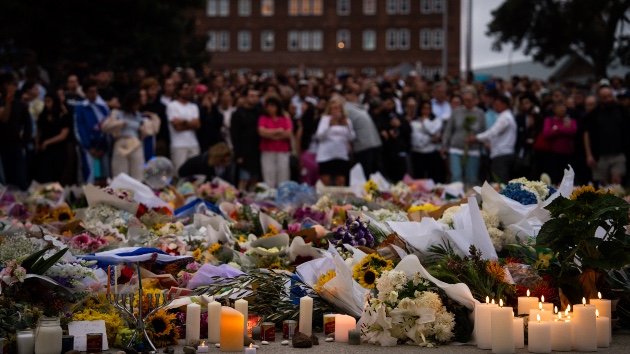
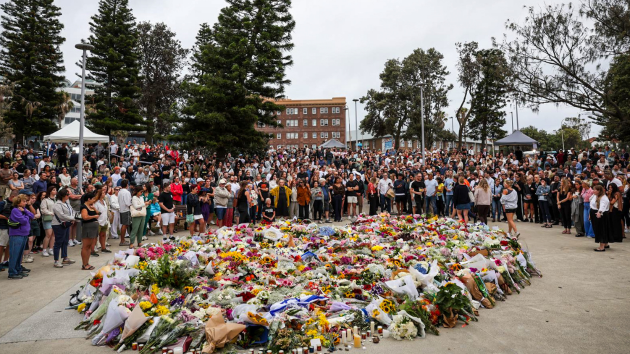
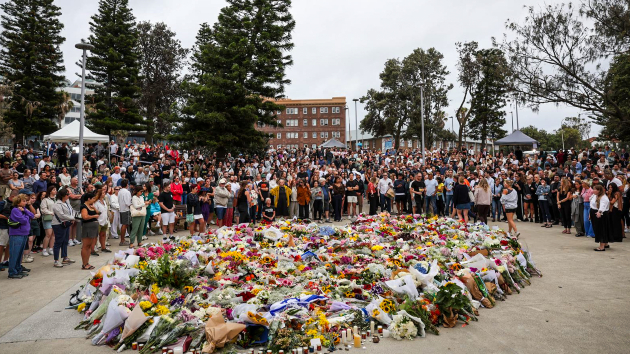
Community members gather outside of Bondi Pavilion at Bondi Beach on December 15, 2025 in Sydney, Australia. (Photo by Audrey Richardson/Getty Images)
(SYDNEY) — When shots rang out at a Hanukkah celebration on Australia’s Bondi Beach, Arsen Ostrovsky said he thought it could’ve been balloons popping.
“Because it was the carnival, there were clowns and children’s activities,” he told ABC News. “But then it was just non-stop, relentless — so I knew that we were under attack.”
As Ostrovsky ran toward his wife and her children, who were exposed and closer to the shooting, he said he felt a bullet strike his head.
“I fell down and I remember saying, ‘I’m hit, ‘I’m hit,’ and the blood just started gushing,” Ostrovsky said, with part of his head still bandaged up.
Fifteen people were killed — including a 10-year-old girl named Matilda and an 87-year-old Holocaust survivor — and more than 40 others were wounded in last weekend’s mass shooting at Bondi Beach.
The two gunmen — who officials say appeared to have been inspired by ISIS — were allegedly father and son. The father, Sajid Akram, was killed by police at the scene, and the son, Naveed Akram, was wounded and taken into custody. He faces charges, including committing a terrorist act and 15 counts of murder.
When asked if he has anything to say to the gunmen, Ostrovsky — who was in Israel during Hamas’ attack on Oct. 7, 2023 — said he hopes they face justice and understand they will never succeed in taking away his humanity.
“We’ve seen the horrors of the last two years in Israel, thinking that we would be coming here to a safe place, and then having to flee for our lives,” Ostrovsky said.
Ostrovsky said the actions of people at Bondi Beach, like Ahmed al-Ahmed — a bystander who was seen on video jumping in and wrestling a gun away from one of the attackers — and other members of the public who ran toward the danger, have helped him see humanity in the darkness.
People were “running from the surf, coming from shops, running from a beach to help,” he said.
“That’s what I choose to take,” he said.
ABC News’ Karson Yiu and James Gillings contributed to this report.
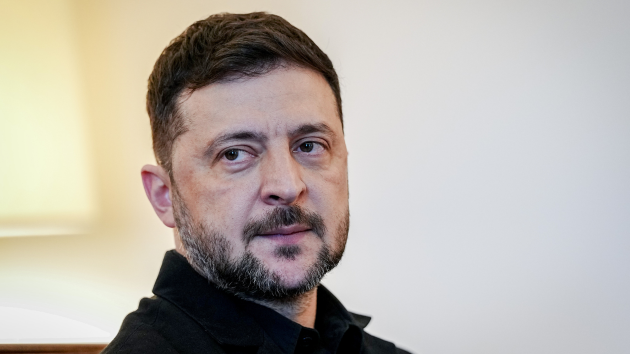
Ukrainian President Volodymyr Zelensky meets German President Frank-Walter Steinmeier at Schloss Bellevue on December 15, 2025 in Berlin, Germany. (Kay Nietfeld – Pool/Getty Images)
(LONDON) — LONDON — Ukrainian President Volodymyr Zelenskyy said in an address on Wednesday that Russia is preparing “the coming year as a year of war,” despite ongoing U.S.-brokered peace talks to end Moscow’s full-scale invasion of its neighbor.
Zelenskyy said Russian President Vladimir Putin sent “signals” of Moscow’s aggressive intent in remarks made on Wednesday, saying the bellicose comments were intended “not only for us.”
“It is important that partners see this,” Zelenskyy added. “And it is important that they not only see it, but also respond, in particular partners in the United States of America, who often say that Russia supposedly wants to end the war. But entirely different rhetoric and different signals are coming from Russia.”
Zelenskyy said an upcoming summit in Brussels to discuss the use of some $250 billion worth of frozen Russian assets to support Ukraine was “important,” and that the outcome of the talks “must be such that Russia feels that its desire to continue the war next year makes no sense, because Ukraine will have support. This depends one hundred percent on Europe, it is Europe that must make this choice.”
Zelenskyy arrived in Brussels on Thursday morning.
European leader stressed the significance of Thursday’s meeting.
Polish Prime Minister Donald Tusk warned that either the European Union would agree on “money [for Ukraine] today or blood tomorrow.”
European Commission President Ursula von der Leyen said in a post to X, “We have one ultimate goal: peace for Ukraine through strength.”
Zelenskyy later said Ukraine would use any funds “mostly for weapons.” He added, “We can’t afford that Ukraine remains without the answer as for the funding for the next year, it’s a big threat.”
“It’s not just about the frontline but about Ukraine’s overall ability to fight,” Zelenskyy said. “If Ukraine doesn’t receive the money in spring the scale of drone production will decrease several-fold.”
Zelenskyy also said that more talks are expected between U.S. and Ukrainian negotiators in the coming week.
Zelenskyy’s comments were prompted by remarks made by Putin at the Russian Defense Ministry’s annual meeting on Wednesday, where the Russian leader claimed that his forces had “gained and firmly holds the strategic initiative across the entire front line.”
Putina added that Russian troops were “confidently advancing and ‘grinding down’ the enemy, its groups and reserves, including the so-called elite units and formations trained in Western military centers and equipped with modern foreign technology and weapons.”
Putin said the objectives of what the Kremlin calls its “special military operation” will be achieved either through diplomacy or through military force.
“We preferred to do this and eliminate the root causes of the conflict through diplomacy,” Putin said. “If the opposing side and their foreign patrons refuse to engage in substantive talks, Russia will achieve the liberation of its historical lands by military means.”
The Russian president again sought to frame Ukraine’s European partners as being responsible for the elongation of the war, which Moscow launched in February 2022. The Kremlin has continued to wage its war despite multiple rounds of diplomacy aimed at securing a ceasefire.
“We welcome the progress that has been made in the dialogue with the new U.S. administration,” Putin said. “Unfortunately, the same cannot be said about the current leadership of most European countries.”
Putin even referred to European leaders as “little pigs” in his Wednesday comments, and was also critical of the pro-Ukraine policies of former President Joe Biden’s administration.
Meanwhile, both Kyiv and Moscow continued their long-range strikes overnight into Thursday.
Ukraine’s air force said Russia launched 82 drones into the country in its latest barrage, of which 63 were shot down or suppressed. Nineteen strike drones impacted across 12 locations, the air force said.
Ukraine’s State Emergency Service said six people were injured by a drone strike in the ️Cherkasy region, as were three people in the Dnipropetrovsk region.
Russia’s Defense Ministry said its forces downed at least 77 Ukrainian drones from Wednesday night into Thursday morning.
ABC News’ Oleksiy Pshemyskiy, Othon Leyva, Tom Soufi Burridge, Guy Davies and Yulia Drozd contributed to this report.
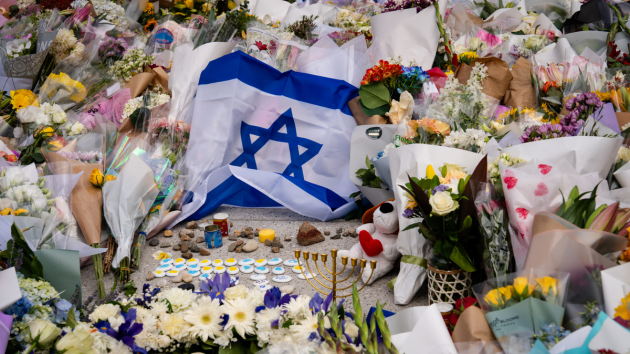
An Israeli flag and flowers are laid outside Bondi Pavilion at Bondi Beach as people gather to mourn in the wake of a mass shooting on December 15, 2025 in Sydney, Australia. (Audrey Richardson/Getty Images)
(SYDNEY) — The 24-year-old man who allegedly opened fire alongside his father on a Jewish gathering at Australia’s Bondi Beach has been charged with committing a terrorist act, 15 counts of murder and dozens of other offenses, the New South Wales Police said on Wednesday.
Naveed Akram has been charged with 59 offenses, including 40 counts of causing wounding or grievous bodily harm to a person with intent to murder, police said in a statement.
Akram, who remains under police guard in a hospital, was expected to appear in court on Wednesday via a video link, police said.
He allegedly opened fire alongside his father, Sajid Akram, 50, at an event at the beach on Sunday, killing fifteen people and injuring another 41, according to officials. The alleged assailant’s father, who was also alleged to have fired on the group, was shot and killed by police, law enforcement said.
The NSW Joint Counter Terrorism Team is leading an investigation into the shooting, after Police Commissioner Mal Lanyon declared it to be terror-related.
“Police will allege in court the man engaged in conduct that caused death, serious injury and endangered life to advance a religious cause and cause fear in the community,” the investigators said in announcing the charges. “Early indications point to a terrorist attack inspired by ISIS, a listed terrorist organisation in Australia.”
Akram has been charged with committing a terrorist act, 15 counts of murder, 40 courts of causing wounding or grievous bodily harm to person with intent to murder, discharging a firearm with intent to cause grievous bodily harm, causing a public display of a prohibited terrorist organization’s symbol and placing an explosion in or near a building with intent to cause harm, according to police.
Australian Prime Minister Anthony Albanese told reporters Tuesday that the father and son traveled to the Philippines in the weeks leading up to the attack and may have been inspired by the ISIS terrorist organization.
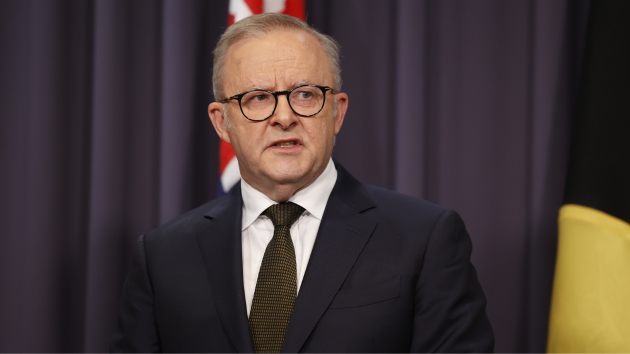
“It would appear that there is evidence that this was inspired by a terrorist organization, by ISIS,” Albanese told reporters at a Tuesday press conference.
Twenty of those who were injured in the attack were still being treated at hospitals across Sydney, officials said on Wednesday. Two of the injured were police officers. A constable was listed on Wednesday in critical but stable condition, while a probationary constable was listed in stable condition, police said.
“Doctors. Nurses. Surgeons. Radiologists. Pathologists. And so many more. We’ve seen humanity at its very best, as you’ve worked tirelessly to save lives,” Albanese said on Wednesday on social media. “We can’t thank you enough.”
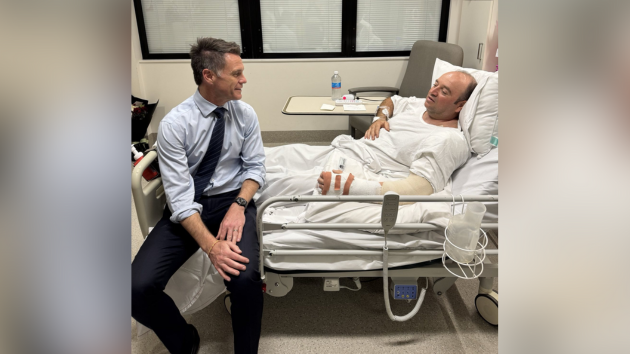
New South Wales Premier Chris Minns visits Ahmed al Ahmed, who was identified as the bystander who seized a rifle from one of the gunmen during the deadly shooting at Bondi Beach on Sunday, at a hospital in Sydney, Dec. 15, 2025. (@ChrisMinnsMP/X)
(SYDNEY) — A Sydney man is being praised as a hero for disarming one of the alleged shooters in the Hanukkah attack that left 15 dead and 42 injured at Australia’s Bondi Beach on Sunday, as seen in video obtained by ABC News
The video shows a man, identified as Ahmed al-Ahmed, 43, running towards one of the alleged shooters. He’s then seen disarming the alleged gunman before pointing his weapon back at him, prompting him to walk away.
Australian Prime Minister Anthony Albanese visited al-Ahmed in the hospital and told him “your courage is inspiring,” according to video of the visit posted to social media.
“Ahmed, you are an Australian hero. You put yourself at risk to save others, running towards danger on Bondi Beach and disarming a terrorist. In the worst of times, we see the best of Australians. And that’s exactly what we saw on Sunday night. On behalf of every Australian, I say thank you,” Albanese said on X.
The fruit seller was having lunch in the area with a friend when the shooting unfolded and he intervened, according to his brother, Huthaifa.
“I’m really proud about my brother,” he told ABC News.
“He’s a good man. He’s brave,” he said.
The father of two was taken to a hospital, where he was treated for bullet wounds. His brother said he is recovering in the hospital, but is not 100% yet.
New South Wales Premier Chris Minns called him a “real-life hero.”
“Last night, his incredible bravery no doubt saved countless lives when he disarmed a terrorist at enormous personal risk,” Minns posted on Instagram while sharing a photo with al-Ahmed in the hospital.
“It was an honour to spend time with him just now and to pass on the thanks of people across NSW. There is no doubt that more lives would have been lost if not for Ahmed’s selfless courage,” he added.
At Sunday night’s National Menorah Lighting in Washington, D.C., Rabbi Levi Shemtov, the director of advocacy group American Friends of Lubavitch, praised al-Ahmed’s heroism and asked for prayers for his recovery.
“I ask all those across the community and beyond — here, and around the world — to please pray for the recovery of Ahmed al-Ahmed, someone who is not a member of the Jewish community, but gave up his safety and wellbeing to stop one of the gunmen and thus prevent even further loss of life. May he recover speedy and fully,” Shemtov said.
A GoFundMe page for al-Ahmed has raised almost $1.5 million with thousands of donations.
“We’re seeing an outpouring of love for Ahmed al Ahmed following his heroic actions at Bondi Beach,” the site posted on X.
Billionaire hedge fund manager Bill Ackman also shared the fundraiser on his X account Sunday, donating $99,999.
Mohamed Fateh al-Ahmed told reporters that his son is “a hero.”
“He served in the police, he has the passion to defend people,” he said.
The victims of Sunday’s mass shooting ranged in ages 10 to 87, and the alleged gunmen are father and son, aged 50 and 24, officials said. Their names have not been released, but authorities said the father is dead and the son was hospitalized.
Six firearms were collected from the scene alongside two improvised explosives, according to officials.
Australian Prime Minister Anthony Albanese called the attack “an act of pure evil, an act of antisemitism” and “an act of terrorism,” in a video shared on his Instagram account.
Mourners gather to lay flowers at Bondi Beach on December 15, 2025 in Sydney, Australia. Police say at least 16 people, including one suspected gunman, were killed and more than 40 others injured when two attackers opened fire near a Hanukkah celebration at the world-famous Bondi Beach, in what authorities have declared a terrorist incident. (Izhar Khan/Getty Images)
(LONDON) — The alleged father and son gunmen who killed 15 people and wounded more than 40 in a mass shooting at Australia’s Bondi Beach traveled to the Philippines in the weeks leading up to the attack and may have been inspired by the ISIS terrorist organization, Australian Prime Minister Anthony Albanese said.
Investigators are probing the months leading up to Sunday’s shooting, when the suspected gunmen — Sajid Akram, 50, and Naveed Akram, 24 — fired at people attending a Hanukkah event. Australian officials have described the shooting as an anti-semitic terrorist attack.
“It would appear that there is evidence that this was inspired by a terrorist organization, by ISIS,” Albanese told reporters at a Tuesday press conference.
Sajid Akram and Naveed Akram allegedly stood on an overpass bridge near the event and shouted “Allahu Akbar” as they carried out the massacre, according to a briefing distributed to U.S. law enforcement and reviewed by ABC News. The father was shot and killed by police and the son was critically hurt and hospitalized, officials said.
New South Wales Police Force Commissioner Mal Lanyon said a car registered to Naveed Akram contained IEDs and ISIS flags.
“We continue to work through the motive of this tragedy and will continue to do so,” Lanyon said.
Law enforcement said they are also investigating a trip taken by the alleged shooters to the Philippines in November.
“The reasons why they went to the Philippines and the purpose of that and where they went when they were there is under investigation at the moment,” Lanyon said.
Sajid Akram, who was born into a Muslim family in India, immigrated in 1998 to Australia, where he got married and had a son and a daughter, Indian authorities told ABC News. Naveed Akram is an Australian citizen, offiicals said.
Authorities noted that Sajid Akram maintained limited contact with his family in Hyderabad, Indiana, since the 1990s, visiting India on six occasions, primarily for family-related matters. Local police said there was “no adverse record” against Sajid Akram during his time in India before he moved.
Australia is now grieving the 15 victims killed, including a 10-year-old girl named Matilda and an 87-year-old Holocaust survivor.
Among the injured is a bystander, Ahmad Al Ahmad, who was seen on video jumping in and wrestling a gun away from one of the attackers, according to police.
Chris Minns, the premier of New South Wales, is pushing back on criticism of the police response time.
Responding officers “acted with bravery and integrity. They didn’t take a backward step,” Minns said during a Tuesday press conference.
“They engaged the gunmen on the footbridge with handguns,” Minns said. “The offenders had long-range rifles and New South Wales police officers were responsible for killing one of them and shooting the other one and as a result saving many, many people’s lives.”
“Now there are two officers in critical care in New South Wales hospitals at the moment. They weren’t shot in the back as they were running away, they were shot in the front,” Minns said.
ABC News’ Joe Simonetti, Somayeh Malekian, Helena Skinner and Dada Jovanovic contributed to this report.
New South Wales Premier Chris Minns visits Ahmed al Ahmed, who was identified as the bystander who seized a rifle from one of the gunmen during the deadly shooting at Bondi Beach on Sunday, at a hospital in Sydney, Dec. 15, 2025. (@ChrisMinnsMP/X)
(SYDNEY) — A Sydney man is being praised as a hero for disarming one of the alleged shooters in the Hanukkah attack that left 15 dead and 42 injured at Australia’s Bondi Beach on Sunday, as seen in video obtained by ABC News
The video shows a man, identified as Ahmed al-Ahmed, 43, running towards one of the alleged shooters. He’s then seen disarming the alleged gunman before pointing his weapon back at him, prompting him to walk away.
The fruit seller was having lunch in the area with a friend when the shooting unfolded and he intervened, according to his brother, Huthaifa.
“I’m really proud about my brother,” he told ABC News.
“He’s a good man. He’s brave,” he said.
The father of two was taken to a hospital, where he was treated for bullet wounds. His brother said he is recovering in the hospital, but is not 100% yet.
New South Wales Premier Chris Minns called him a “real-life hero.”
“Last night, his incredible bravery no doubt saved countless lives when he disarmed a terrorist at enormous personal risk,” Minns posted on Instagram while sharing a photo with al-Ahmed in the hospital.
“It was an honour to spend time with him just now and to pass on the thanks of people across NSW. There is no doubt that more lives would have been lost if not for Ahmed’s selfless courage,” he added.
At Sunday night’s National Menorah Lighting in Washington, D.C., Rabbi Levi Shemtov, the director of advocacy group American Friends of Lubavitch, praised al-Ahmed’s heroism and asked for prayers for his recovery.
“I ask all those across the community and beyond — here, and around the world — to please pray for the recovery of Ahmed al-Ahmed, someone who is not a member of the Jewish community, but gave up his safety and wellbeing to stop one of the gunmen and thus prevent even further loss of life. May he recover speedy and fully,” Shemtov said.
A GoFundMe page for al-Ahmed has raised almost $1.5 million with thousands of donations.
“We’re seeing an outpouring of love for Ahmed al Ahmed following his heroic actions at Bondi Beach,” the site posted on X.
Billionaire hedge fund manager Bill Ackman also shared the fundraiser on his X account Sunday, donating $99,999.
Mohamed Fateh al-Ahmed told reporters that his son is “a hero.”
“He served in the police, he has the passion to defend people,” he said.
The victims of Sunday’s mass shooting ranged in ages 10 to 87, and the alleged gunmen are father and son, aged 50 and 24, officials said. Their names have not been released, but authorities said the father is dead and the son was hospitalized.
Six firearms were collected from the scene alongside two improvised explosives, according to officials.
Australian Prime Minister Anthony Albanese called the attack “an act of pure evil, an act of antisemitism” and “an act of terrorism,” in a video shared on his Instagram account.
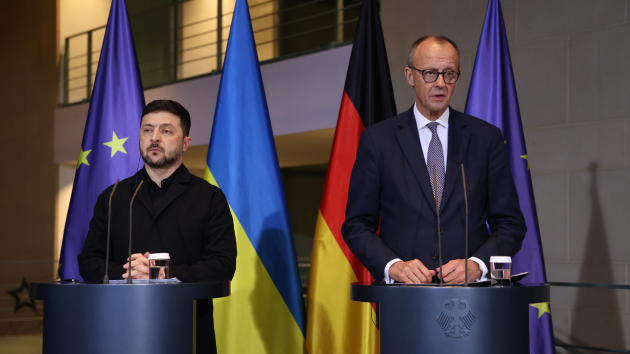
German Chancellor Friedrich Merz (R) and Ukrainian President Volodymyr Zelensky arrive to speak to the media at the Chancellery on December 15, 2025 in Berlin, Germany. (Sean Gallup/Getty Images)
(LONDON) — Ukrainian President Volodymyr Zelenskyy said Monday that no consensus had been reached on key territorial questions as part of a possible peace settlement with Russia, following two days of talks between Ukrainian, American and European negotiators in Berlin, Germany.
“In other issues, there is progress forward,” Zelenskyy said in comments in a group chat with Ukrainian reporters after the talks ended.
U.S. administration officials signaled on Monday that a peace deal between Russia and Ukraine may be closer than ever, telling reporters on the condition of anonymity that “literally 90%” of the issues between the two warring countries had been solved.
Ukraine’s demand for U.S.-backed security guarantees and the fates of four partially-occupied Ukrainian regions have dominated the most recent American push for a peace settlement to end Russia’s full-scale invasion, which it launched in February 2022.
Russia occupies Crimea — which was occupied in 2014 — and partially occupies Donetsk, Luhansk, Zaporizhzhia and Kherson, in the south and east of Ukraine. Moscow has demanded that Ukraine withdraw from Donetsk and Luhansk — which together form the region known as the Donbas — in exchange for an end to the fighting.
Zelenskyy on Monday reiterated Ukraine’s position that it does not want to cede the Donbas region to Russia. The president also said that a demilitarized area or “free economic zone” covering the region cannot be under Russian leadership.
“These are important features for me in any format for Donbas,” Zelenskyy said. “Neither de jure nor de facto will we recognize Donbas as Russian — the part that is temporarily occupied. But nevertheless, we are discussing the issue regarding the territories, and you know that it is one of the key ones.”
Zelenskyy hinted at progress on the issue of Western security guarantees to deter future Russian aggression, without which Kyiv says it cannot agree to a peace deal.
German Chancellor Freidrich Merz said after Monday’s talks, “The legal and material guarantees that the U.S. has put on the table here in Berlin are truly remarkable. This is a very important step forward, which I very much welcome.”
Merz also suggested that Ukraine and Russia agree to a Chrismtas truce, a proposal Zelenskyy said he supports.
Russian Deputy Foreign Minister Sergey Ryabkov told ABC News during an exclusive interview on Monday that he believes the warring parties are “on the verge” of a diplomatic solution to end Moscow’s war.
“We are prepared to have a deal,” Ryabkov said. The deputy foreign minister added that he hoped an agreement would be reached “sooner rather than later.”
More meetings are expected in the coming days, Zelenskyy said, including between American and Russian negotiators. Ukrainian representatives are expecting to travel to the U.S. for further talks “in the near future,” Zelenskyy said, possibly as soon as this weekend.
Ukraine and Russia continued to exchange long-range strikes on Monday and overnight into Tuesday, with the Security Service of Ukraine (SBU) also on Monday claiming an underwater drone attack on a Russian submarine docked at the port of Novorossiysk.
Ukraine’s air force said on Tuesday that Russia launched 69 drones into the country overnight, of which 57 were shot down or suppressed. Ten strike drones impacted across seven locations, the air force said.
Russia’s Defense Ministry, meanwhile, said its forces downed 111 Ukrainian drones overnight into Tuesday morning, including four over the Moscow region.
On Tuesday morning, Zelenskyy addressed the Dutch parliament, telling lawmakers, “We are now in the midst of the most intense and focussed negotiations for peace since the beginning of this war … For true lasting peace. We are not talking about a pause or a temporary, uncertain solution.”
Zelenskyy again urged accountability for Moscow. “Someone else is always expected to make concessions so that Russia will stop spreading bloodshed,” he said. “In Russia’s war against our people, our country, this logic has reached its largest and most dangerous scale.”
(LONDON) — At least nine of the 15 people who were killed in the mass shooting at Bondi Beach in Sydney, Australia, have been identified.
They include a young soccer player originally from France, a rugby team manager, a great-grandfather known for his “love of life” who died while shielding others and a Holocaust survivor.
Two gunmen — believed to be a father and son — opened fire on Sunday at an event marking the first night of the Jewish holiday of Hanukkah, according to authorities.
Here’s what we know about the victims:
Dan Elkayam, 27
Dan Elkayam, 27, a French citizen, was among those killed in the Bondi Beach shooting.
French President Emmanuel Macron posted on X, writing, “I learn with deep sadness of the death our compatriot, Dan Elkayam, during the antisemitic terrorist attack in Sydney,” according to an English translation. “I am thinking of his family and loved ones and express to them the full solidarity of the Nation.”
Elkayam was a player with the Rockdale Ilinden Football Club, a semi-professional football club in the Sydney suburb of Rockdale. Dennis Loether, president of the club, released a statement in response to Elkayam’s passing.
“To say we are shocked would be an understatement. We are [devastated] to learn that our PL1 Association Player — Dan Elkayam — was tragically and senselessly killed in the Bondi Beach massacre,” the statement read.
The statement described Elkayam as an “extremely talented midfield player,” who lived with his girlfriend in in the Eastern Suburbs of Sydney.
“Those who were closest to him described him as a down to earth, happy go lucky individual who was warmly embraced by those he me,” the statement continued. “His smiling face and respectful nature will be sorely missed by his [teammates] and everyone that knew him. We pray for him and for his family.”
Alexander Kleytman, 87
Alexander Kleytman, an 87-year-old Holocaust survivor, was among those killed during the Bondi Beach attack, his wife, Larisa Kleytman, told reporters outside St Vincent’s Hospital in Sydney.
“I think he was shot because he raised himself up to protect me,” Larisa Kleytman told the newspaper The Australian.
Rabbi Leibel Lazaroff
Rabbi Leibel Laaroff’s death was confirmed on X by his father, Yoosi Lazaroff.
“Please say Psalms 20 & 21 for my son, Rabbi Leibel Lazaroff … who was shot in a terrorist attack at a Chanukah event he was running for Chabad of Bondi in Sydney, Australia,” the post read. “The Chabad Rabbi he was working with Rabbi Eli Schlangerwas killed. Praying for all the victims and their families.”
Yaakov Levitan
Yaakov Levitan, secretary of the Jewish institution, the Sydney Beth Din, was killed in the attack. His death was confirmed to Guardian Australia by Sydney Beth Din senior member, Rabbi Yehoram Ulman.
”Yaakov Levitan was a profoundly beloved and active member of the Sydney Jewish community,” according to a post on the crowdfunding site Charidy being overseen by the non-profit organization Jewish House.
“He served as general manager of Chabad of Bondi, a dedicated secretary at the Sydney Beth Din, and was a key figure in educational initiatives at the BINA Centre in Sydney. He was a man of quiet devotion, known for his kindness and tireless work in assisting others, including his commitment to distributing tefillin as a sacred act of service,” the post read.
Peter Meagher
Peter Meagher, also known as “Marzo,” was a longtime volunteer at Randwick Rugby Club, which confirmed his death in a statement on Monday.
“It is with an extremely heavy heart that Randwick DRUFC can confirm the tragic passing of our much loved First Grade Manager and loyal club volunteer Peter Meagher yesterday,” the statement from general manager, Mark Harrison, said.
“Peter was working as a freelance photographer at the ill-fated Hanukkah event and for him it was simply a catastrophic case of being in the wrong place and at the wrong time,” the statement read.
The statement said Meagher served for almost four decades a police officer in the New South Wales police force and retired as a detective sergeant.
“Our deepest condolences go to his wife Virginia, his brothers Greg, David, Andrew and Paul, their extended families and mountain of friends across Randwick Rugby, NSW Police, Sydney Rugby Referees and our local community,” the statement continued.
Reuven Morrison, 67
Reuven Morrison’s death was confirmed in a post on X by Chabad.org, the flagship website of the Chabad-Lubavitch Hasidic movement.
Morrison, 67, emigrated from the former Soviet Union to Australia in the 1970s, according to the post.
Chabad.org reported he divided his time between Sydney and Melbourne and was a “successful businessman whose main goal was to give away his earnings to charities dear to his heart.”
Morrison leaves behind a wife and a daughter, Shaina, according to the post.
Marika Pogany
Marika Pogany’s death was confirmed in a post on X from Peter Pellegrini, president of the Slovak Republic.
“Already yesterday, I unequivocally condemned the brutal, deadly attack on innocent people during the Hanukkah celebrations at Australia’s Bondi Beach and expressed my deep solidarity with a nation plunged into grief and shock,” the statement read. “Today, that grief has reached Slovakia as well — among the victims of this senseless, violent rampage was a Slovak woman, Marika.”
“I extend my heartfelt and sincere condolences to Marika’s family and loved ones.”
Rabbi Eli Schlanger
Rabbi Eli Schlanger’s death was confirmed by his cousin, Zalman N Shterna Lewis, in a post on Instagram.
Schlanger was a 41-year-old father-of-five, according to the Instagram post.
“My dear cousin, Rabbi Eli Schlanger was murdered in today’s terrorist attack in Sydney. He leaves behind his wife & young children, as well as my uncle & aunt & siblings,” Lewis wrote on Sunday. “With confidence knowing that ‘joy breaks all boundaries,’ the positive light of Chanukah will triumph against the darkness for once and for all. I knew Eli well enough to know he’d concur.”
Tibor Weitzen, 78
Tibor Weitzen, a 78-year-old great-grandfather, was one of those killed in the attack, his granddaughter, Leor Amzalak, confirmed to Guardian Australia.
His grandson, Mendy Amzalak, told the Australian that Weitzen was a “man full of life, joy, smiles and laughter”, who died shielding others from the bullets.
COLlive.com, an Orthodox Jewish news outlet reporting on Chabad-Lubavitch communities around the world, wrote in a post on Instagram that Weitzen was known “for his warmth, kindness, and love of life. Tibor brought joy to everyone he met, especially the children at Shul, where he was famous for greeting them with lollipops and a smile.”
Prime Minister Anthony Albanese speaks to the media at Parliament House Canberra on December 14, 2025 in Canberra, Australia. (Hilary Wardhaugh/Getty Images)
(LONDON) — The Australian prime minister said he’s proposing tougher gun laws after 15 people were killed and more than 40 were hurt in a mass shooting at Bondi Beach in Sydney.
Two gunmen — believed to be a father and son — opened fire on Sunday at an event marking the first night of the Jewish holiday of Hanukkah, according to authorities.
The father, 54, was shot and killed by police and the son, 24, was critically hurt and hospitalized, officials said.
Those killed range in age from 10 to 87, the NSW Joint Counter Terrorism Team said.
Australian Prime Minister Anthony Albanese said on Monday the massacre would be remembered as a “dark day in Australia’s history.”
The prime minister encouraged everyone in Australia to put a candle in their windows on Monday evening to show “that light will indeed defeat darkness.”
The National Cabinet met on Monday and ordered police and prosecutors to come up with options for stricter gun laws, including: “Accelerating work on standing up the National Firearms Register; Allowing for additional use of criminal intelligence to underpin firearms licencing that can be used in administrative licencing regimes; Limiting the number of firearms to be held by any one individual; Limiting open-ended firearms licencing and the types of guns that are legal, including modifications; and A condition of a firearm license is holding Australian citizenship,” according to the prime minister’s office.
Four guns and three improvised explosive devices were found at the crime scene and two more guns were found in searches at homes, the NSW Joint Counter Terrorism Team said.
The father had a gun license since 2015 and six licensed firearms, officials said.
Australian Home Affairs Minister Tony Burke told reporters the son is an Australian-born citizen and the father arrived in 1998 on a student visa.
Albanese said the son was investigated by authorities in 2019 for links to the Islamic State, but “there was no indication of any ongoing threat or threat of him engaging in violence.”
Albanese on Sunday called the attack “an act of pure evil, an act of antisemitism” and “an act of terrorism.”
Pope Leo spoke out on social media on Monday, writing, “Enough with this antisemitic violence! Let us eliminate hatred from our hearts.”
ABC News’ Ellie Kaufman and Dada Jovanovic contributed to this report.
(NEW YORK) — The two U.S. soldiers who were killed in an attack in Syria were members of the Iowa National Guard, state officials said over the weekend.
On Monday, the soldiers were identified as Sgt. Edgar Brian Torres Tovar, 25, of Des Moines, Iowa, and Sgt. William Nathaniel Howard, 29, of Marshalltown, Iowa.
“Our hearts are heavy today, and our prayers and deepest condolences are with the families and loved ones of our soldiers killed in action,” Iowa Gov. Kim Reynolds said in a statement.
“I ask that all Iowans stand united in supporting them and lifting them up in prayer during this incredibly difficult time,” she added. “Please pray also for the fast and full recovery of our wounded soldiers.”
An American civilian was also killed, the office said in a statement, adding that three others were injured in the attack.
The two soldiers who died were attacked while they were “conducting a key leader engagement as part of their assigned mission in the ongoing counter-ISIS and counter-terrorism efforts in the region,” the governor’s office said.
“It is with a heavy heart that I confirm the loss of two of our own,” said Maj. Gen. Stephen Osborn, adjutant general of the Iowa National Guard, in a statement.
About 1,800 Iowa Army National Guard soldiers from the 2nd Brigade Combat Team, 34th Infantry Division, began deploying to the Middle East in late May 2025, the governor’s office said.
“Our priority right now is supporting the families of our fallen and wounded Soldiers,” Osborn added. “The entire Iowa National Guard grieves for this terrible loss, and we stand together to support the Soldiers and their families.”