Ihor Kuznietsov/Novyny LIVE/Global Images Ukraine via Getty Images
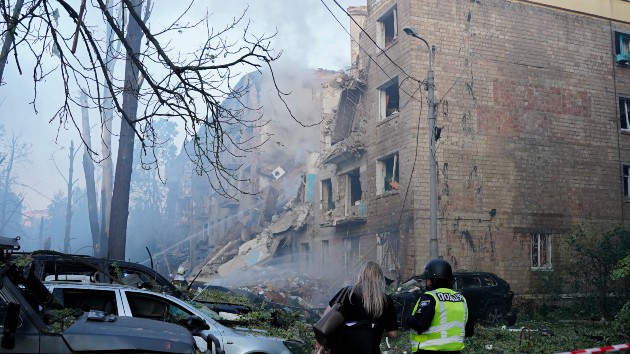
(LONDON) — At least seven people were killed and 28 injured in Kyiv overnight as Russian drone and missile attacks again rocked Ukraine’s capital, Mayor Vitali Klitschko said on Monday, describing Moscow’s latest attack as “terrible.”
Most casualties came from a single strike on a residential building in Kyiv’s northwestern Shevchenkivskyi district, Klitschko said in a post to Telegram, alongside which he published a video from the impact site showing extensive damage to nearby apartment blocks.
Ukraine’s air force said in a post to Telegram that Russia launched 352 drones and 16 missiles into the country overnight, with Kyiv the primary target. Of those, the air force said 339 drones and 15 missiles were shot down or otherwise neutralized.
Direct hits were reported in six locations, the air force said, with falling debris reported in 25 locations.
Ukrainian President Volodymyr Zelenskyy posted a statement on Telegram condemning the “cynical strike,” which he said included the use of North Korean ballistic missiles.
Noting Russia’s condemnation of recent Israeli and U.S. strikes on Iran, Zelenskyy said Moscow remains “silent” on its own ongoing bombardment of Ukrainian cities using Iranian-supplied attack drones.
“A significant part of the drones and missiles were shot down by our sky defenders,” Zelenskyy wrote. “But not all. And everyone in countries close to Russia, Iran and North Korea should think about whether they will be able to protect lives there if this coalition of killers persists and continues to spread terror.”
The Ukrainian president will visit the U.K. on Monday, as British leaders prepare for the NATO summit in the Netherlands on Tuesday.
Zelenskyy said that air defense capabilities will be among the topics to be discussed, capabilities he said “should become the basis for a much stronger joint defense.”
“And we will also agree on new and strong steps to put pressure on Russia for this war and to stop the strikes,” Zelenskyy wrote in his statement.
Russia’s Defense Ministry, meanwhile, said its forces shot down 23 Ukrainian drones overnight.
Maksim Konstantinov/SOPA Images/LightRocket via Getty Images
(LONDON) — Russia announced on Thursday that it is returning to Ukraine five children who have been separated from their families by the war.
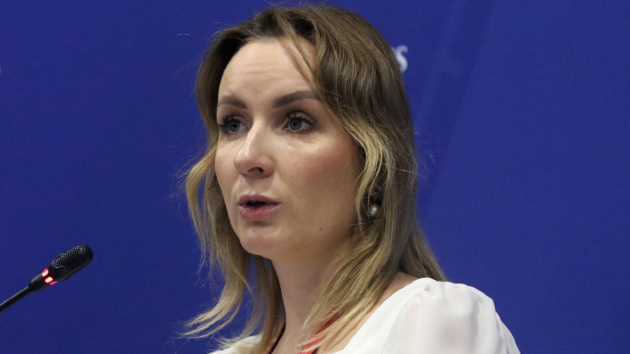
Maria Lvova-Belova, the Kremlin’s commissioner of children’s rights, told reporters that the Ukrainian children will be reunited with their families in Ukraine by the end of this month.
The children were on a list of 339 children that Ukrainian officials gave their Russian counterparts during the last round of peace talks earlier this month in Istanbul, Turkey — negotiations that failed to bring the three-year war to an end.
In response to a question from the Russian news agency Interfax, Lvova-Belova, speaking to reporters on the sidelines of the St. Petersburg International Economic Forum, said the delay in sending the Ukrainian children back to their county was “due to their studies.”
“They are finishing the school year and after that they will return to their relatives in Ukraine,” she said.
Lvova-Belova did not mention status of the other children on Ukraine’s list.
According to Lvova-Belova, Russia is preparing its own list of Russian children believed to be in Ukraine. She said it will be handed over to Ukrainian officials whenever the next round of negotiations is scheduled.
“We also have children in Ukraine who require reunification with Russian families,” Lvova-Belova said. “At the moment, we have eight children on the list who are in EU countries. They were evacuated there from Ukraine, and their parents are in Russia. And from Ukraine, we have about 10 people, with whom we are also currently negotiating their return.”
Ukrainian officials have alleged that many of the country’s children have been abducted and taken to Russia since the war began in February 2022, when Russian troops invaded Ukraine.
In 2023, the International Criminal Court issued warrants for the arrest of Russian President Vladimir Putin on war crimes charges related to the abduction of Ukrainian children.
The Kremlin, however, has denied the allegations, saying the children were taken out of war zones for their own protection.
ABC News’ Anna Sergeeva contributed to this report.
(OAXACA, Mexico) — Hurricane Erick, which rapidly intensified overnight, made landfall Thursday morning on Mexico’s Pacific Coast as a powerful Category 3 storm, the U.S. National Hurricane Center (NHC) said.
Erick came ashore in Mexico’s western state of Oaxaca packing sustained winds of 125 mph and heavy rain, accordin to the NHC.
The hurricane was located on Thursday morning about 20 miles east of Punta Maldonado and was moving northwest at about 9 mph, according to the NHC.
Before making landfall, the Erick had spooled up to an “extremely dangerous” Category 4 storm on the Saffir-Simpson Hurricane Wind Scale, but was downgraded to a Cat 3 before making landfall, the NHC center reported.
Erick is the first Pacific Category 3 hurricane on record to make landfall over Mexico in June.
A hurricane warning remained in effect Thursday from Acapulco to Puerto Angel.
It remained unclear if villages along Mexico’s populated Pacific Coast had sustained damaged. There have been no immediate reports of deaths or injuries.
The major hurricane appeared to hit he coastline between the resort towns of Acapulco and Puerto Escondido in an area near the border of Oaxaca and Guerrero states, according to the NHC.
As it sweeps across the state of Oaxaca, Erick is expected to slam parts of the region with strong winds and heavy rain for most of Thursday before weakening over land by Friday.
Erick will produce heavy rainfall up to 6 to 8 inches across southeastern Guerrero and west-coastal Oaxaca through Friday and likely trigger life-threatening flash flooding and mudslides — especially in areas of steep terrain.
Erick formed as a tropical storm early Tuesday in the Pacific Ocean near southern Mexico and rapidly intensified, reaching hurricane strength by Wednesday, according to the NHC.
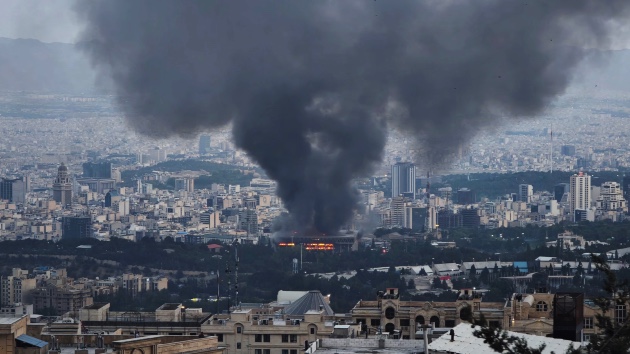
(LONDON) — The repercussions of Israel’s surprise campaign against Iran’s nuclear program and military leadership launched last Friday were evident within hours.
“We are racking up achievements,” Israeli Prime Minister Benjamin Netanyahu said after the opening salvo, which appeared to have devastated Iran’s anti-aircraft defense network and decapitated its military, killing many among the top brass, according to Israeli officials.
Netanyahu, his top officials and the Israel Defense Forces have made clear some of their war goals — the destruction of Iran’s nuclear program plus the erasure of the country’s ballistic missile arsenal.
But, as in Israel’s operations in Gaza, Lebanon and Syria, there are already signs of “rapid mission creep” in Iran, Julie Norman, a senior associate fellow at the Royal United Services Institute think tank in the U.K., told ABC News.
Iran’s weakened defense has prompted fresh questions about “regime change” — long a priority for Iran hawks in Israel and the U.S. seeking to topple Supreme Leader Ayatollah Ali Khamenei and the theocratic system he heads. Critics of such a policy, though, warn that government collapse in Iran could unleash regional chaos.
“The record of regime change is not great, to say the least,” Yossi Mekelberg of the Chatham House think tank in the U.K. told ABC News, warning that the regime’s collapse would more likely produce a dangerous power vacuum in Iran than a coherent and pliant successor.
“You want to experiment with chaos? Well, good luck,” Mekelberg said.
The nuclear front
Netanyahu faces significant challenges to achieve his two expressed goals — an end to Iran’s nuclear and ballistic missile threats.
On the nuclear front, Israel has inflicted damage at several of Iran’s key sites. The International Atomic Energy Agency has reported damage to surface facilities at the Natanz and Isfahan enrichment sites. On Tuesday, IAEA chief Rafael Grossi said the body “identified additional elements that indicate direct impacts on the underground enrichment halls at Natanz.”
But Israel does not have the capabilities needed to destroy the Fordow enrichment plant — where the IAEA says no damage has been reported — which is built deep inside a mountain outside the city of Qom. Only American strategic bombers could deliver a payload capable of punching through up to 300 feet of mountain to reach the underground facility.
Netanyahu is trying to press the White House into intervention.
“Today, it’s Tel Aviv, tomorrow, it’s New York,” the prime minister told ABC News Chief Washington Correspondent Jonathan Karl on Monday.
Trump responded to Israel’s opening attacks by calling for Iran to return to negotiations over its nuclear program. He has since dismissed talk of a ceasefire, said he wants a “real end” to the Iran nuclear issue and warned residents of Tehran — of whom there are around 17 million in the wider metropolitan area — to evacuate.
On Tuesday, Trump raised the prospect of killing Khamenei and wrote on his social media platform that “we now have complete and total control of the skies over Iran,” while lauding the impact of U.S. weaponry. The president has also demanded “unconditional surrender,” a concept Iran’s supreme leader rejected.
Despite Trump’s rhetoric, the U.S. has not joined Israel in attacking Iran offensively. Last year the U.S. twice assisted Israel in helping to shoot down Iranian drones and ballistic missiles Iran had launched in retaliation for Israeli attacks in Syria and Tehran. This marked the first time the U.S. actively participated in Israel’s defense, which has historically taken the form of weapons sales, transfers and intelligence sharing support.
As the conflict escalated this week, the U.S. deployed additional fighter jets and refueling tankers to the Middle East. The USS Nimitz aircraft carrier has also been diverted to the region, to join the USS Carl Vinson carrier which was already deployed there. The deployments, Defense Secretary Pete Hegseth said, are “intended to enhance our defensive posture in the region.”
President Trump told top advisers Tuesday that he approved attack plans for Iran that were presented to him, but said he was waiting to see if Iran would be willing to discuss ending their nuclear program and has not made a final decision on US involvement in the conflict, sources familiar with the matter said. The news of the attack plan approval was first reported by the Wall Street Journal.
“As President Trump said himself today, all options remain on the table,” White House Press Secretary Karoline Leavitt said Tuesday.
Without destroying Fordow, Mekelberg said, the job of neutralizing Tehran’s nuclear program will be incomplete. “If you want to set it three years back, that is not a good enough reason to go for a war of such scale,” he said.
“If the idea was to push Iran to the negotiation table and to scare them — the Iranians are not easily scared. They fought eight years with Iraq in a much inferior situation, and they prevailed. This is not Hezbollah, this is not Hamas, this is not Islamic Jihad.”
Sina Toossi, a senior non-resident fellow at the Center for International Policy think tank, told ABC News that Israel and the U.S. — if Trump opts to engage militarily against Iran — could face a “quagmire.”
“To verifiably destroy what they’ve said they want to destroy, they need boots on the ground eventually,” Toossi said, referring to Iran’s nuclear facilities.
Ballistic missiles
Erasing Iran’s ballistic missile threat is another key goal, Netanyahu has said. The IDF claims to have destroyed at least one-third of Iran’s launch vehicles, along with an unknown number of stockpiled missiles.
The IDF estimated that Tehran started the conflict with 2,000 missiles and as of Tuesday had fired around 400 toward Israel. The number will have been further eroded by ongoing IDF strikes across the country.
“That capacity is going to be weakened,” Norman said, though added that Iran has “a pretty deep arsenal, and I think those will keep coming for some time.”
Toossi noted that American involvement would raise the stakes for Tehran, which still has the capacity to hit American and allied targets in Iraq, across the Persian Gulf and elsewhere. If faced with an existential conflict, “they can inflict a lot of damage in their periphery,” Toossi said.
As time wears on, the burden on Israeli and U.S. anti-missile systems will grow, Toossi said. Interceptor missiles are finite and expensive, plus their production takes time. “There’s an economics to this warfare right now that’s not necessarily in the favor of Israel and the U.S..” Toossi said.
“I think there’s sometimes an overestimation as to how quickly other groups will surrender, or in this case other states will surrender,” Norman said of Netanyahu and his government. While Israel sees its conflicts as existential, so do its enemies, Norman added.
Regime change
Pushing for regime change — a goal the IDF has explicitly denied and Netanyahu has dodged questions on — might prove the biggest gamble of Israel’s attack, experts told ABC News.
Such a policy makes two assumptions, Mekelberg said. “First, that you can bring down the regime, and second, that you’ll get the people that you want.”
Indeed, the 1979 revolution that birthed the Islamic Republic “started with the liberals, not with the religious,” Mekelberg said. “Look how it ended.”
“In any such episode, there is the best case scenario — which usually doesn’t happen — and there is the worst-case scenario,” he said. “And in between, there is the war with its own dynamics and momentum.”
Even if the regime is at risk of collapse, it would be hard to say when. Israel, Mekelberg said, will need to be prepared for an open-ended war of attrition with levels of destruction inside the country that “people are not used to seeing.”
Netanyahu has repeatedly appealed to the people of Iran to act against the government in Tehran. “This is your opportunity to stand up,” he said over the weekend.
But a population under fire may have different priorities. “People are going to be focusing on surviving and getting out, not on starting a revolution,” Norman said.
Continued attacks may also produce a rallying effect. “Many people do not like the Islamic Republic, the theocracy. But Iranians, despite their disgruntlement with the government, when it comes to Iran, its sovereignty, its stability, its territorial integrity, there’s a strong sense of nationalism across the board from secular to religious, to young to old,” Toossi said. “And that is really being stirred right now.”
Skylar Thomson of the Human Rights Activists in Iran NGO — which is based in the U.S. — told ABC News there is a “real atmosphere of fear” among Iranians she is in contact with.
“In the initial days, people were seeing the assassinations of these Islamic Revolutionary Guard Corps commanders that were notoriously cruel” and considered “the leading oppressors in their world,” Thomson said. But fear and uncertainty have spread as hospitals, residential areas, infrastructure and other non-military targets have been attacked, she added.
“You’re talking about a population of people that are already struggling because of external matters,” Thomson said. “And this is just another layer of that.”
ABC News’ Katherine Faulders and Luis Martinez contributed to this report.
(SEOUL and LONDON) — North Korea launched “more than a dozen” rockets on Thursday morning, the South Korean Ministry of Defense said.
The rockets were launched at about 10 a.m. local time from the Sun’an area of North Korea’s capital, Pyongyang, the ministry said, adding that “the details are being analyzed by the Korean and U.S. intelligence authorities.”
“Our military maintains the ability and posture to respond overwhelmingly to any provocation while paying attention to various trends in North Korea under a strong joint defense posture between Korea and the United States so that North Korea does not misjudge in the current security situation,” the ministry said in a statement.
South Korean news agency Yonhap reported that the rockets were fired into the Yellow Sea, which is known in the south as the West Sea.
Kyic Oleksandr Gusev/Global Images Ukraine via Getty Images
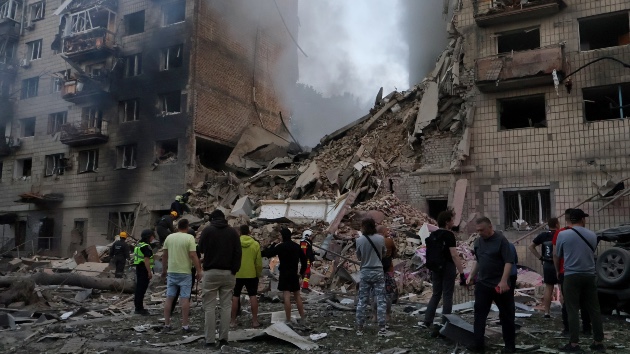
(KYIV, Ukraine) — Massive overnight Russian strikes on Kyiv killed 15 people, Ukrainian officials said, as Moscow launched hundreds of drones and missiles at targets across the country.
The strikes wounded at least 177 others in the Ukrainian capital, according to officials. A United States citizen was among the 15 killed, according to Ukrainian President Volodymyr Zelenskyy.
Nearly 150 residential buildings were damaged in Kyiv, Zelenskyy said, with search and rescue efforts ongoing.
“Rescuers and police officers continue to work at the sites where residential infrastructure was hit,” Ihor Klymenko, Ukraine’s minister of internal affairs, said in a post on the Telegram messaging app. “The rescue operation is ongoing at two locations in Kyiv. There are still people trapped under the rubble, so the work will not stop until everyone is found.”
At a residential building in the Solomianskyi district, “an entire entrance collapsed,” Kyiv Mayor Vitali Klitschko said in an update on Telegram.
The mayor posted a video to Telegram showing what he said were Russian cluster munitions found at one of the impact sites in the capital. Klitschko later declared Wednesday a day of mourning for the victims of the attack.
Ukraine’s air force said in a post to Telegram that the attack consisted of 440 drones and 32 missiles — of which 402 drones and 26 missiles were shot down or otherwise neutralized. The air force reported impacts in 10 locations and downed debris in 34 locations. The attack is believed to have been one of the largest on the capital in several months.
Kyiv bore the brunt of the strikes, Zelenskyy said, with impacts also reported in Odesa, Zaporizhzhia, Chernihiv, Zhytomyr, Kirovohrad and Mykolaiv.
At least two people were killed and 18 injured in Odesa, according to officials. The deceased were recovered from under rubble, Klymenko said.
“Such attacks are pure terrorism,” Zelenskyy wrote on Telegram. “And the whole world, the U.S. and Europe must finally react the way a civilized society reacts to terrorists.”
Russian President Vladimir Putin, Zelenskyy said, “is doing this solely because he can afford to continue the war. He wants the war to continue. It is bad when the powerful of this world turn a blind eye to this. We are contacting all partners at all possible levels to ensure an appropriate response. It is the terrorists who should feel the pain, not normal, peaceful people.”
The attacks came as G7 leaders gathered in Canada, where Russia’s ongoing war on Ukraine is one of several key topics of discussion. President Donald Trump on Monday suggested that Russia — previously a member of the group when it was known as the G8 — should not have been expelled from the bloc in 2014 after its invasion and annexation of Crimea.
Putin “sends a signal of total disrespect to the United States and other partners who have called for an end to the killing,” Ukraine’s Foreign Minister Andrii Sybiha said in a post on X. “Putin’s goal is very simple: make the G7 leaders appear weak. Only strong steps and real pressure on Moscow can prove him wrong.”
ABC News’ Ellie Kaufman contributed to this report.
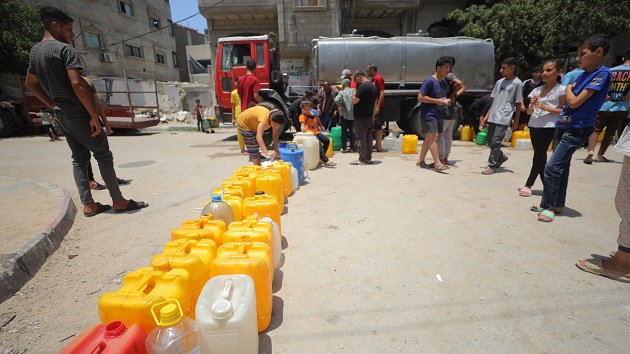
(LONDON) — Almost 60 people are dead after two incidents near locations where people were trying to get food aid in Gaza Tuesday, the Hamas-run Gaza Ministry of Health said.
Fifty-one people were killed in an incident near a food aid truck that got stuck near Khan Younis, according to the Hamas-run Gaza Ministry of Health. The Israel Defense Forces acknowledged the shooting.
“A gathering was identified adjacent to an aid distribution truck that got stuck in the area of Khan Younis, and in proximity to IDF troops operating in the area,” the IDF said in response to an inquiry from ABC News.
“The IDF is aware of reports regarding a number of injured individuals from IDF fire following the crowd’s approach. The details of the incident are under review,” the IDF added.
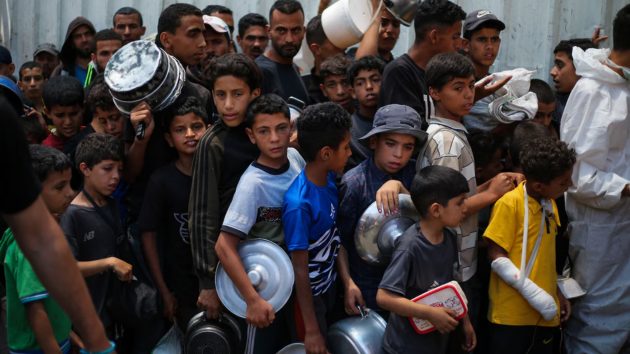
The shooting comes as many in Gaza are in the grip of hunger, according to international aid agencies. The United Nations last week said a “very limited” amount of food was being brought into the Strip.
And it comes a day after COGAT, the Israeli organization tasked with bringing aid into Gaza, said that four aid distribution centers in Gaza were being operated simultaneously for the first time.
Humanitarian aid sites and routes in Gaza have becomeflashpoints in recent weeks, according to the Hamas-run ministry.
Some of the injured and dead in Tuesday’s incident were brought to Nasser Hospital Complex in Khan Younis after the incident. In a video published by Reuters, a man can be seen bleeding from a wound in his back while being wheeled into the entrance.
“We went to wait like other people to get food for our children,” the man told Reuters “They told us there is flour in a certain area, so we went and waited. Then we found rockets falling on us.”
In a separate incident, eight people were killed near an aid distribution site in southern Gaza, the Hamas-run Gaza Ministry of Health said Tuesday. ABC News has asked IDF for comment on this incident.
Kyic Oleksandr Gusev/Global Images Ukraine via Getty Images
(KYIV, Ukraine) — A massive overnight Russian strike on Kyiv killed 14 people and wounded more than 100 others, local officials in the Ukrainian capital said early Tuesday, as Moscow launched hundreds of drones and missiles at targets across the country.
It was not immediately clear whether others may be trapped beneath the rubble, Kyiv Mayor Vitali Klitschko said in an update on the Telegram messaging app. Emergency personnel were working at several sites, including a residential building in the Solomianskyi district, where “an entire entrance collapsed,” Klitschko said.
The mayor posted a video to Telegram showing what he said were Russian cluster munitions found at one of the impact sites in the capital. Klitschko later declared Wednesday a day of mourning for the victims of the attack.
Ukraine’s air force said in a post to Telegram that the attack consisted of 440 drones and 32 missiles — of which 402 drones and 26 missiles were shot down or otherwise neutralized. The air force reported impacts in 10 locations and downed debris in 34 locations. The attack is believed to have been one of the largest on the capital in several months.
President Volodymyr Zelenskyy said the nationwide attack killed at least 15 people were killed. Kyiv bore the brunt of the strikes, Zelenskyy wrote, with impacts also reported in Odesa, Zaporizhzhia, Chernihiv, Zhytomyr, Kirovohrad and Mykolaiv.
At least one person was killed in Odesa and 17 others injured, according to a Telegram post by local Governor Oleg Kiper.
“Such attacks are pure terrorism,” Zelenskyy wrote on Telegram. “And the whole world, the U.S. and Europe must finally react the way a civilized society reacts to terrorists.”
Russian President Vladimir Putin, Zelenskyy said, “is doing this solely because he can afford to continue the war. He wants the war to continue. It is bad when the powerful of this world turn a blind eye to this. We are contacting all partners at all possible levels so that there is an appropriate response. It is the terrorists who should feel the pain, not normal, peaceful people.”
The attacks came as G7 leaders gathered in Canada, where Russia’s ongoing war on Ukraine is one of several key topics of discussion. President Donald Trump on Monday suggested that Russia — previously a member of the group when it was known as the G8 — should not have been expelled form the bloc in 2014 after its invasion and annexation of Crimea.
Putin “sends a signal of total disrespect to the United States and other partners who have called for an end to the killing,” Ukraine’s Foreign Minister Andrii Sybiha said in a post on X. “Putin’s goal is very simple: make the G7 leaders appear weak. Only strong steps and real pressure on Moscow can prove him wrong.”
ABC News’ Ellie Kaufman contributed to this report.
(LONDON) — More than 30 people in Gaza were killed on Monday by alleged Israeli gunfire while trying to reach food aid distribution centers, the Hamas-run Gaza Ministry of Health (MOH) said.
One person was killed near the Netzarim corridor at a distribution site in central Gaza and 33 people were killed near an aid distribution center in Rafah in southern Gaza, according to the ministry.
An additional four people were killed at the site near the Netzarim corridor on Sunday but were not found until Monday, the MOH told ABC News.
The Israel Defense Forces (IDF) did not immediately return ABC News’ request for comment on the incident.
The Rev. Dr. Johnnie Moore, the executive chairman of GHF, did not address the alleged incidents in a post on X on Monday afternoon, where he said aid distribution at four sites “proceeded without incident.” He said three American contract staff sustained “minor injuries” during Iranian attacks on Israel on Sunday, but received medical attention and were diagnosed with concussions.
So far on Monday, 68 people have been killed in Gaza and at least 180 people have been injured, according to the ministry.
The aid sites, run by the U.S.-backed Gaza Humanitarian Foundation (GHF), have been steeped in controversy since they opened about three weeks ago.
The new distribution system was imposed by Israel after the government partly lifted a two-and-a-half-month blockade on all humanitarian aid, which caused widespread malnutrition and famine-like conditions, according to food security experts.
International aid organizations refused to participate in the new system, with deputy U.N. spokesperson Farhan Haq saying the plan is not impartial, neutral or independent.
The IDF has previously released statements about the reports, saying that video footage allegedly showing the shootings is “under review.” The IDF also said it has fired “warning shots” towards people who were allegedly “advancing while posing a threat to the troops.”
The GHF previously denied reports of chaos at the distribution sites but has closed them at times due to “maintenance” and “repair work.”
Gazans have said neither the amount of aid distributed, nor the calories within the aid packages from GHF, is enough to meet the needs of the civilian population.
Dr. Abdulwhhab Abu Alamrain, a physician at Al-Aqsa Martyrs Hospital in central Gaza, said having distribution sites — as opposed to meeting people where they are — does not allow for equitable aid access.
“Vulnerable families with elderly, widows with kids and sole survivor kids can never get aid [because] they would never be able to walk miles or [carry] the package or fight to get a turn in [an] unorganized aid distribution center,” he told ABC News.
Previously, aid was distributed by organizations such as the United Nations Relief and Works Agency for Palestine Refugees in the Near East (UNRWA), which ran hundreds of sites across the strip.
However, Israel has accused of the U.N. of being “anti-Israel and anti-Semitic” and UNRWA as being “infiltrated” by terrorism. Israel has also accused Hamas militants of stealing aid meant for civilians. Hamas denies the accusations and claims that Israel is weaponizing aid through GHF.
Dr. Ayesha Khan, a U.S. emergency medicine physician and humanitarian aid worker who did a month-long medical mission at Al-Aqsa Martyrs Hospital in late 2024, said it is frustrating to see the new distribution plan because the U.N.’s method for distributing aid in Gaza has been successful for decades.
“We have a way to distribute aid,” Khan told ABC News. “In my opinion, this GHF, the Gaza Humanitarian Foundation, was created in order to weaponize humanitarian aid.”
Khan said she spoke to a friend in Gaza who said he didn’t consider the GHF plan to be “humanitarian aid” but rather “humiliation aid.”
“You’ve eliminated everybody being able to get aid because getting aid is contingent upon you coming to the distribution point,” she said. “And sure enough, as soon as the people were told that there was food, after 11, 12, weeks of starvation, they swarmed the area, desperate to get food, of which there was not enough, and the soldiers opened fire.”
“The U.N. has global rules around humanitarian principles: humanity, neutrality, impartiality, independence. Those are those rules are not being followed by GHF,” Khan added.
The most recent deaths at distribution sites come as U.N. Human Rights Chief Volker Türk described Israel’s warfare in Gaza as inflicting “horrifying, unconscionable suffering” on civilians.
“Israel’s means and methods of warfare are inflicting horrifying, unconscionable suffering on Palestinians in Gaza,” Turk said during a meeting of the Humans Rights Council on Monday. “Israel has weaponized food and blocked lifesaving aid. I urge immediate, impartial investigations into deadly attacks on desperate civilians trying to reach food distribution centers. Disturbing, dehumanizing rhetoric from senior Israeli government officials is reminiscent of the gravest of crimes.”
Turk also said Israel’s refusal to allow international journalists to report from Gaza has helped Hamas “avoid transparency and accountability.”
Since Oct. 7, 2023, when Hamas launched a surprise terrorist attack in Israel, more than 55,400 people have been killed in Gaza and more than 128,900 have been injured, according to the MOH.
During Hamas’s surprise attack, the militant group murdered nearly 1,200 Israelis and took captive 251 others, according to Israeli officials. Hamas is still holding 53 hostages, living and dead. Among them are the bodies of two Americans.
ABC News’ Ellie Kaufman contributed to this report.
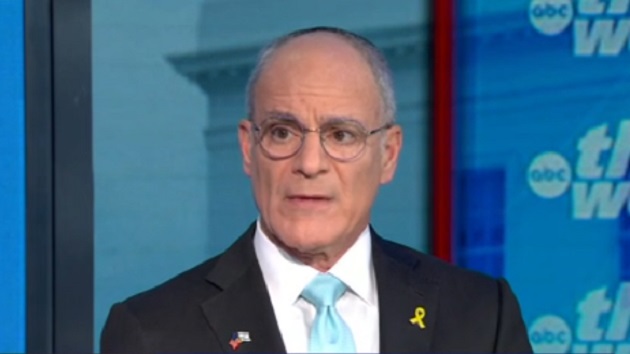
Israel’s ambassador to the U.S., Yechiel “Michael” Leiter, claimed that Israel had set Iran’s nuclear program back significantly after a series of strikes on the country, but that the full operation could take “weeks.”
“We’ve set them back dramatically, but not enough,” Leiter told “This Week” co-anchor Martha Raddatz. “And that’s why this series of strikes is not going to end today or tomorrow, but only at a period of time, which may take weeks, when we are absolutely certain that the nuclear infrastructure with the intention of weaponizing and threatening Israel is terminated.”
The two countries have been engaged in a deadly back-and-forth since Israel launched what it called preemptive strikes on Iran’s nuclear sites, scientists and military leadership.
Asked by Raddatz if Iran’s Ayatollah Ali Khamenei was off of Israel’s target list, Leiter declined to rule that out.
“I think it’s fair to say that nobody who’s threatening the destruction of Israel should be off the target list,” Lieter said. “The idea is to neutralize and terminate the Iranian intention of destroying Israel through nuclear weapons and through ballistic missiles. And anybody who gets in the way of that, or — or is actually advancing, that cause of destroying Israel is obviously somebody we’re going to have to deal with.”
Leiter said that Israel sustained “significant attacks” on Saturday night, which killed more than 10 people and wounded hundreds after Iran launched a barrage of ballistic missiles that struck targets across the country.
“We have some good defense systems, anti-missile defense systems, but they’re not hermetically sealing the skies. So there’s about 10 to 15 percent of these ballistic missiles that get through.”
Here are more highlights from Leiter and former CENTCOM commander Gen. Joseph Votel’s interviews on “This Week”:
Leiter on destroying Iran’s Fordow nuclear site
Raddatz: Let’s talk about Fordow. It’s deep in a mountainside. There are those who do not believe you can destroy Fordow without U.S. help and those bunker-busting bombs. Is it possible without U.S. help?
Leiter: The help that we’ve asked from the United States is confined to defensive posture. We’re very, very thankful to President Trump and the administration for the THAAD missile, anti-missile defense system, for the Aegis missile defense system, but it’s only in a defensive posture. We have a number of contingencies, will — which will enable us to deal with Fordow. Not everything is a matter of, you know, taking to the skies and bombing from afar.
Raddatz: But you’re certain you can wipe out Fordow?
Leiter: We’re certain — we’re — we’re certain that we can set back the nuclear weapons system development within Iran for a very, very long time.
Votel on potential U.S. involvement
Raddatz: But you say delay, so you’re confident they couldn’t destroy [Fordow] without the help of the U.S.?
Votel: Well, I don’t know the full range of all capabilities that the — that the Israelis have, their very sophisticated, savvy military. There are lots of tools that are available to them. I think the conventional wisdom is that the bunker busters, the penetrating munitions that are needed to go after something like this are largely still within the inventory of the United States. So, yeah, I think — I think — I think probably would have some difficulty at doing that and, again, the Iranians are demonstrating some level of resolve here. And we can’t dismiss the fact that they will continue to pursue this program or even try to make a dash to take what they have now and try to — try to create some kind of weapon.
Votel on the possibility of escalation
Raddatz: And how likely do you think it is that this war spreads, that this becomes a regional war involving the U.S.?
Votel: Yeah. I think this largely depends on the directions that the leaders of both of these countries go. It’s not particularly in Iran’s interest to try to spread this, that they don’t need to earn the anger of others in the region. They ultimately have to — have to live there. So, it doesn’t necessarily make a lot of sense for them to widen that. But again, as this progresses as the Iranians run out of options, and they don’t have a lot of great options right now, frankly. They’re fighting a little bit blind in terms of what they’re doing. They don’t have great options. And as they run out of the things that are available to them right now and they begin to reach out and look for other ways to have an impact, that’s when I think the concern for regionalization of the conflict becomes greatest.