

US negotiators leaving Qatar after Hamas response to ceasefire proposal

US negotiators leaving Qatar after Hamas response to ceasefire proposal
Anna Moneymaker/Getty Images

(TEL AVIV, Israel) —  The U.S. is bringing home its team from Doha, Qatar, “after the latest response from Hamas, which clearly shows a lack of desire to reach a ceasefire in Gaza,” U.S. special envoy Steve Witkoff announced on social media.

“While the mediators have made a great effort, Hamas does not appear to be coordinated or acting in good faith. We will now consider alternative options to bring the hostages home and try to create a more stable environment for the people of Gaza,” Witkoff said.

“It is a shame that Hamas has acted in this selfish way. We are resolute in seeking an end to this conflict and a permanent peace in Gaza,” he added.

The talks had seemed more positive earlier in the day Thursday.

The Israeli Prime Minister’s Office announced that, “in light of the response that Hamas gave this morning, it was decided to return the negotiating team” from Doha “for further consultations in Israel.”

Hamas’ latest response to a U.S.-brokered Gaza ceasefire proposal is “currently being reviewed” by Israel, Prime Minister Benjamin Netanyahu’s office said at the time.

Hamas announced Wednesday night it had submitted to mediators a response to the ceasefire deal currently on the table. The details of Hamas’ response were not immediately made public.

A trilateral meeting in Italy between top Israeli, Qatari and American officials was slated to discuss Hamas’ response as early as Thursday, sources familiar with the matter told ABC News. Witkoff himself, President Donald Trump’s Mideast envoy, was traveling to Italy to meet with top officials regarding a Gaza ceasefire, the U.S. State Department said Wednesday.

Representatives from Israel and the militant group have been in Doha, Qatar, for more than two weeks working on a ceasefire proposal for the 21-month-old conflict in Gaza.

Those negotiations continue as more than 100 aid groups warned Wednesday that the enclave was on the verge of “mass starvation.”

ABC News’ Diaa Ostaz contributed to this report.

Copyright © 2025, ABC Audio. All rights reserved.

US Osprey makes emergency landing in Japan, officials say

US Osprey makes emergency landing in Japan, officials say
Dennis Taylor/USAF/Getty Images

(TOKYO) – -A U.S. CV-22 Osprey made what Japanese officials called an emergency landing Thursday at Hanamaki Airport in northeastern Japan, about 300 miles north of Tokyo.

Airport officials say the tilt-rotor aircraft touched down safely after reporting a mechanical issue mid-flight. The U.S. Air Force said the craft made a “precautionary landing” during a flight from Misawa Air Base to its home base, Yokota Air Base.

No injuries were reported. Operations for commercial flights continued as normal. Video from Japanese broadcaster NHK shows the aircraft taxiing to the apron where uniformed personnel could be seen on top of the aircraft, near the center, inspecting the aircraft.

Japan’s Defense Ministry says it has dispatched staff to the site and is in contact with U.S. forces.

The landing came six days after another U.S. Osprey set down in Akita Prefecture for a safety inspection, according to Japanese officials. That aircraft remained on the ground for over seven hours.

A U.S. military public affairs officer described the Thursday incident as a “precautionary landing.” The V-22 Osprey has been involved in several incidents in recent years, including a crash off Yakushima, in southern Japan, in 2023 that killed eight and grounded the fleet for months.

Cullen Drenkhahn, a 1st lieutenant serving as a public affairs advisor for the 353d Special Operations Wing Kadena AB, told ABC News, “I can confirm a U.S. CV-22 Osprey conducted a precautionary landing today at Iwate Hanamaki Airport at 9:45 a.m.”

“The landing was executed safely and in accordance with policies. An assessment is ongoing to gather additional information. No injuries or damages occurred. There were no interruptions to airport operations,” Drenkhahn said. “The aircraft is assigned to the 353rd Special Operations Wing and was flying from Misawa Air Base to its home base, Yokota Air Base.

He added, “No further information at this time. the safety of our pilots and aircrew, as well as the men and women of Japan is our foremost priority.”

Copyright © 2025, ABC Audio. All rights reserved.

Israel reviewing Hamas response to ceasefire proposal

US negotiators leaving Qatar after Hamas response to ceasefire proposal
Anna Moneymaker/Getty Images

(TEL AVIV, Israel) — Hamas’ latest response to a U.S.-brokered Gaza ceasefire proposal is “currently being reviewed” by Israel, Prime Minister Benjamin Netanyahu’s office said on Thursday.

Hamas announced Wednesday night it had submitted to mediators a response to the ceasefire deal currently on the table. The details of Hamas’ response were not immediately made public.

Sources familiar with the matter tell ABC News that a trilateral meeting in Italy between top Israeli, Qatari and American officials is slated to discuss Hamas’s response as early as today. The U.S. State Department said Wednesday President Trump’s Mideast Envoy was traveling to Italy to meet with top officials regarding a Gaza ceasefire.

Representatives from Israel and the militant group have been in Doha, Qatar, for more than two weeks working on a ceasefire proposal for the 21-month-old conflict in Gaza.

Those negotiations continue as more than 100 aid groups warned Wednesday that the enclave was on the verge of “mass starvation.”

ABC News’ Diaa Ostaz contributed to this report.

Copyright © 2025, ABC Audio. All rights reserved.

48 killed in Russian passenger plane crash, official says

48 killed in Russian passenger plane crash, official says
Russia Ministry of Emergency Situations/Handout/Anadolu via Getty Images

(LONDON and MOSCOW) — A passenger plane carrying 48 people crashed on Thursday morning in Russia’s far eastern Amur region with no survivors, according to the local governor.

The Russian news agency Interfax reported that the plane’s wreckage was found around nine miles from its intended destination in the town of Tynda, having traveled from the regional hub of Blagoveshchensk some 360 miles away.

Gov. Vasily Orlov said in a post to Telegram that the An-24 aircraft vanished from radar close to Tynda. Emergency services later found the wreckage in nearby woods. “I regret to inform you that there are no survivors,” Orlov wrote in a later post. “Rescuers have reached the crash site.” Orlov declared three days of mourning.

Artem Korenyako — a spokesperson for Russia’s federal aviation agency Rosaviatsiya — wrote on Telegram that a search and rescue helicopter “discovered a burning fuselage.”

Russia’s Ministry of Emergency Situations also reported the discovery of burning wreckage in a post to Telegram. More than 50 people and 10 pieces of equipment were deployed in search and rescue efforts, the ministry said.

Irkutsk Oblast Gov. Igor Kobzev said that “the flight crew, technical staff and flight attendants lived in the Irkutsk region.” He noted that officials are working to “get a full list of passengers today and, of course, to see who of them lives in the Irkutsk region.”

This is a developing story. Please check back for updates.

ABC News’ Morgan Winsor contributed to this report.

Copyright © 2025, ABC Audio. All rights reserved.

Zelenskyy urges ‘national unity’ amid Ukraine anti-corruption protests

Zelenskyy urges ‘national unity’ amid Ukraine anti-corruption protests
Antonio Masiello/Getty Images

(LONDON) — Ukrainian President Volodymyr Zelenskyy on Wednesday urged national unity as demonstrators took to the streets of more than a dozen cities nationwide to protest a controversial bill that critics said will neuter two key anti-corruption agencies.

Ukrainian media estimated that thousands of people gathered near the presidential office in the capital Kyiv on Wednesday evening, despite a nightly curfew and the ever-present threat of Russian drone and missile strikes.

Those gathered were protesting a controversial law approved by parliament and signed by Zelenskyy on Tuesday. The bill will bring the Anti-Corruption Bureau (NABU) and its partner organization, the Specialised Anti-Corruption Prosecutor’s Office (SAPO), under the direct control of the Prosecutor General’s Office (PGO).

The prosecutor general is appointed by the president, prompting concern among critics that the law will give the president’s office undue influence over NABU and SAPO.

The president sought to ease tensions on Wednesday, promising to put forward a new bill to ensure the independence of the anti-corruption bodies.

Zelenskyy said in a post to Telegram that he met with the heads of all law enforcement and anti-corruption agencies.

“We agreed that the heads of these institutions will jointly propose an action plan — a plan of concrete steps that can strengthen the rule of law in Ukraine,” he wrote. “Of course, everyone has heard what people are saying these days — what they are saying on social media, to each other, on the streets. It’s not falling on deaf ears.”

“We’ve analyzed all the concerns, all the aspects of what needs to be changed and what needs to be stepped up,” he added.

“And what will remain most important is not losing our national unity, ending the war, stopping this Russian evil and securing a dignified peace for Ukraine,” Zelenskyy wrote. “And exactly as we all envision it — as a full-fledged part of Europe. We’ll make it happen.”

On Thursday, Zelenskyy said had approved the text of the new bill which would be sent to parliament. “The most important thing is real tools, no Russian ties and the independence of NABU and [SAPO],” the president wrote.

Both NABU and SAPO were set up in the aftermath of Ukraine’s pro-Western Maidan Revolution in 2014, with the intention of rooting out systemic corruption and helping Kyiv reform its democratic system with an eye on EU accession.

Critics of the new legislation say it constitutes a power grab by Zelenskyy and his presidential office — which is headed by influential chief of staff Andriy Yermak — that undermines Ukrainian democracy and threatens the country’s EU ambitions.

Zelenskyy and his supporters have defended the measures as necessary to root out Russian influence in NABU and SAPO.

The passing of the law followed a series of raids on NABU employees by officers from the Security Service of Ukraine (SBU) and the PGO on Monday. Officers also began inspecting the handling of state secrets at SAPO.

“The anti-corruption infrastructure will work,” Zelenskyy wrote on Telegram late on Tuesday. “Only without Russian influences — everything needs to be cleansed of this. And there should be more justice.”

The domestic political crisis erupted as a Ukrainian delegation headed to Istanbul, Turkey, for the latest round of ceasefire talks with Russian negotiators. Wednesday’s meeting there ended after less than an hour.

Vladimir Medinsky, who led the Russian delegation, told reporters after the talks that the two sides agreed on a new prisoner exchange of at least 1,200 people.

The two sides also discussed the memoranda exchanged during the last round of talks on June 2, Medinsky said, adding that the delegations were “quite far from each other.” The parties agreed to continue negotiations, Medinsky said.

When asked about a potential meeting between Zelenskyy and Russian President Vladimir Putin, Medinsky said any potential meeting should be carefully prepared.

Cross-border drone strikes continued despite the new talks. Russia’s Defense Ministry said its forces downed 42 Ukrainian drones overnight into Thursday morning.

Russian drones and missiles, meanwhile, targeted Odesa, Cherkasy, Kharkiv, Zaporizhzhia, Donetsk, Sumy and Mykolaiv regions, Zelenskyy said in a post to Telegram.

Ukraine’s air force said Russia launched 103 strike drones and four missiles into the country overnight into Thursday morning. Ninety drones and one missile were shot down or suppressed, the air force said, with impacts by 13 drones and three missiles across 11 locations. Falling debris from interceptions was reported in six places.

“Russia does not stop its terror, blocks diplomacy and that is why it deserves full-scale sanctions responses and our strikes on its logistics, military bases and military production facilities,” the president wrote.

“We will do everything to make diplomacy work,” he added. “But it is Russia that must end this war that it started itself.”

ABC News’ Ellie Kaufman, Will Gretsky and Tanya Stukalova contributed to this report.

Copyright © 2025, ABC Audio. All rights reserved.

Zelenskyy faces major anti-corruption protests as Ukraine prepares for Russia talks

Zelenskyy faces major anti-corruption protests as Ukraine prepares for Russia talks
Antonio Masiello/Getty Images

(LONDON) — Ukrainian President Volodymyr Zelenskyy is facing protests across the country after signing a controversial bill on Tuesday that critics say will neuter the independence of two prominent anti-corruption bodies.

As Ukrainian and Russian delegations prepare to meet in Istanbul, Turkey, for a new round of ceasefire talks, Zelenskyy and his allies are facing a groundswell of opposition at home.

On Tuesday, Zelenskyy signed a controversial law passed by parliament that will bring the Anti-Corruption Bureau (NABU) and its partner organization, the Specialised Anti-Corruption Prosecutor’s Office (SAPO), under the direct control of the Prosecutor General’s Office (PGO).

Both bodies were set up in the aftermath of Ukraine’s pro-Western Maidan Revolution in 2014, with the intention of rooting out systemic corruption and helping Kyiv reform its democratic system with an eye on European Union accession.

The passing of the new legislation this week prompted protests in Kyiv and other major cities across Ukraine, with demonstrators even violating the nighttime curfew imposed as a guard against nightly Russian drone and missile strikes.

A spokesperson for the European Commission warned the move could undermine Ukraine’s potential bid to join the EU. Kyiv’s European funding, they added, is “conditional on progress on transparency, judicial reform and democratic government.”

Transparency International’s Ukraine branch, meanwhile, said the move represented a “massive setback in anti-corruption reform” and a “direct threat to Ukraine’s path to the EU.”

The passage of the bill followed dozens of raids on NABU employees by officers from the Security Service of Ukraine (SBU) and the PGO on Monday. Officers also began inspecting the handling of state secrets at SAPO.

Zelenskyy and his supporters have framed the measures as necessary to root out Russian infiltration and influence within Ukraine’s anti-corruption bodies.

“The anti-corruption infrastructure will work,” Zelenskyy wrote on Telegram late on Tuesday. “Only without Russian influences — everything needs to be cleansed of this. And there should be more justice.”

“Of course, NABU and SAPO will work. And it is important that the Prosecutor General is determined to ensure that in Ukraine the inevitability of punishment for those who go against the law is really ensured,” he added. “And this is what is really needed for Ukraine. The cases that were pending must be investigated.”

“For years, officials who fled Ukraine have been living peacefully abroad for some reason — in very nice countries and without legal consequences,” Zelenskyy continued.

“This is abnormal. There is no rational explanation why criminal proceedings worth billions have been ‘hanging’ for years. And there is no explanation why the Russians can still get the information they need.”

“It is important that there is an inevitability of punishment and that society really sees this,” the president wrote.

On Wednesday, Zelenskyy said in another post that he met with the heads all law enforcement and anti-corruption agencies plus the prosecutor general. “We all hear what society says,” Zelenskyy wrote. “We see what people expect from state institutions to ensure justice and the effectiveness of each institution.”

“We agreed that next week there will be an in-depth working meeting regarding the general action plan,” Zelenksyy said. “And in two weeks, a joint plan should be ready — outlining the necessary steps to strengthen Ukraine, address existing issues, provide more justice and genuinely protect the interests of Ukrainian society.”

The bill was passed by the Ukrainian parliament — the Rada — by 263 representatives, having quickly moved through committee. Thirteen MPs voted against, 13 abstained and 35 did not vote.

It was supported in parliament by members of Zelenskyy’s Servant of the People party, as well as former Prime Minister Yulia Tymoshenko’s Batkivshchyna party. The Opposition Platform – For Life party, which is widely considered pro-Russian and has had several representatives accused of treason during the war, also backed the measure.

Oleksandr Merezhko, a member of Zelenskyy’s party and the chair of the parliament’s foreign affairs committee, told ABC News he backed the legislation though admitted he had “some doubts” about its content.

“I trust the president,” Merezkho said. “In such cases I normally also trust the decision of the committee.”

Merezhko said his concerns were over “what consequences it might have from the perspective of the negotiations with the EU on our membership.”

European counterparts, Merezhko continued, “are worried and they are asking questions. I think that we need better communication with our European partners on that issue.”

“There might be some sensitive aspects which need clear explanation to our partners by the president,” he added. “I’m personally in favor of the independence of the anti-corruption bodies. But I’m also in favor of the true rule of law of the state in Ukraine.”

Zelenskyy’s decision to sign the divisive bill has piqued concern of an anti-democratic power grab by the president and his inner circle — chief among them Andriy Yermak, the head of the presidential office.

A former Ukrainian official, who asked not to be identified for fear of reprisal, told ABC News, “We are not losing the war because the West did not give us enough weapons. We are losing the war because of corruption, lack of professional management and because many do not see why they should fight for Zelenskyy’s autocracy.”

“Yermak is just a good implementor of Zelenskyy’s will,” the former official added.

Vitaliy Shabunin, a prominent Ukrainian anti-corruption activist who previously headed the first Public Oversight Council at NABU, said the bill will allow the prosecutor general — who is appointed by the president — to “shut down all investigations involving the president’s friends.”

Kyiv Mayor Vitali Klitschko — who has repeatedly clashed with Zelenskyy’s administration during Russia’s full-scale war — joined protesters in the capital on Tuesday.

The new measure, he wrote on Telegram, “definitely does not bring Ukraine closer to the European Union. It certainly does not bring it closer to democracy, the rule of law, and legality — to those values for which our soldiers are dying today in a bloody struggle against the aggressor.”

Proponents of the bill “are dragging Ukraine faster and faster into authoritarianism,” the mayor added, “hiding behind the war, destroying anti-corruption bodies, local self-government, silencing activists and journalists.”

“Yes, there are many questions about the independence, impartiality, and adherence to legal procedures by all law enforcement agencies,” Klitschko continued. “But the system needs to be changed, not turned into a bulldog of the authorities.”

“And we must not forget that sooner or later, all actions will have to be accounted for — both politically and legally,” the mayor wrote.

ABC News’ Will Gretsky contributed to this report.

Copyright © 2025, ABC Audio. All rights reserved.
July 22 will be the second-shortest day of the year, scientists say

July 22 will be the second-shortest day of the year, scientists say
STOCK IMAGE/Getty Images

(NEW YORK) — Tuesday, July 22 will be the second-shortest day of the year, as Earth completes a full rotation in less time than usual.

The planet on Tuesday will experience a shorter rotation than the typical 24 hours, though not by much: 1.34 milliseconds less than usual, according to Timeanddate.com.

Typically, we think of the shortest day in the Northern Hemisphere as Dec. 21 or 22, which coincides with the winter solstice – July 21 or 22 in the Southern Hemisphere – which is the point at which the hemisphere is tilted farthest away from the sun. In those instances, however, it’s only the number of hours of daylight that are affected, and not the length of time it takes for the Earth to make a full rotation on its axis.

The 1.34-millisecond discrepancy in Tuesday’s length is explained by differences in the gravitational pull between the Earth and the moon, which causes the Earth to spin more quickly, according to the Lunar and Planetary Institute.

In recent years, Earth has broken its own speed records several times, including on July 5, 2024 – the shortest day ever measured, when the planet’s full rotation was completed 1.66 milliseconds faster than usual, according to Timeanddate.com.

This year, July 10 was measured as the shortest day of the year, with a full rotation occurring 1.36 milliseconds faster than normal. Aug. 5 is expected to be the third-shortest day of the year, projected to be 1.25 milliseconds shorter than usual.

Earth completes one full rotation on its axis in 24 hours, or about 86,400 seconds, plus or minus a millisecond or so, according to Timeanddate.com. Before 2020, Earth’s shortest length of day was just 1.05 milliseconds shorter than usual.

If current trends continue, a full second may need to be subtracted from atomic clocks in the near future to accommodate for a “negative leap second,” according to Timeanddate.com.

The system of leap seconds was introduced in the 1970s, according to Time and Date. While there have been dozens of positive leap seconds, in which a second was added, there has never been a negative leap second. The International Earth Rotation and Reference Systems Service, which monitor’s the Earth’s rotation, also determines whether to add or subtract a second.

In its early days – about 4.5 billion years ago – Earth was spinning at a much faster rate, according to the Lunar and Planetary Institute. A full rotation only lasted between three and six hours.

During the mid-Proterozoic period – between 2.5 billion years ago and 543 million years ago – the Earth had slowed such that a day lasted about 19 hours, according to a 2023 study published in Nature Geoscience.

Since then, the length of an Earth day has slowed to its present 24 hours due to the fact that the moon’s gravitational pull “steals” some of energy Earth uses to spin, in addition to causing tidal friction, according to the Institute.

Additionally, climate change is causing days on Earth to become longer due to the melting of ice at the poles, according to a study published in the Proceedings of the National Academy of Sciences. As the poles melt, the redistribution of mass from the resulting sea-level rise also is increasing the length of a day, the researchers found.

Copyright © 2025, ABC Audio. All rights reserved.
28 countries sign statement calling for end of war in Gaza

28 countries sign statement calling for end of war in Gaza
Photo by Moiz Salhi/Anadolu via Getty Images

(LONDON) — Three more countries have joined the original 25 nations that released a joint statement this week calling for the immediate end of the war in Gaza and accusing Israel of not allowing sufficient aid in, demanding it must do so to comply with international humanitarian law.

“We, the signatories listed below, come together with a simple, urgent message: the war in Gaza must end now,” the original statement, released on July 21, began. “The suffering of civilians in Gaza has reached new depths. The Israeli government’s aid delivery model is dangerous, fuels instability and deprives Gazans of human dignity.”

“The Israeli Government’s denial of essential humanitarian assistance to the civilian population is unacceptable. Israel must comply with its obligations under international humanitarian law,” the statement further said.

Throughout the conflict, Israel has maintained they are sending enough aid into Gaza but international aid organizations have repeatedly said there is not enough aid, and the United Nations has reported conditions of malnutrition inside of Gaza.

The statement was initially signed by the foreign ministers of Australia, Austria, Belgium, Canada, Denmark, Estonia, Finland, France, Iceland, Ireland, Italy, Japan, Latvia, Lithuania, Luxembourg, The Netherlands, New Zealand, Norway, Poland, Portugal, Slovenia, Spain, Sweden, Switzerland and the U.K. The foreign ministers of Greece, Malta and Cyprus have now also signed the statement as of July 22.

The call to action was released Monday following an incident Sunday in which at least 81 Palestinians were killed and another 150 were injured while trying to gain access to food, according to the Hamas-run Gaza Ministry of Health, which said the majority of those killed were gathered near the Zikim border between Gaza and Israel.

The Israel Defense Forces said Sunday that its troops fired near crowds “in order to remove an immediate threat posed to them,” though it wasn’t specific. A review is ongoing, but “preliminary review indicates that the reported number of casualties does not align with existing information,” according to the IDF.

On Tuesday, the Hamas-run Ministry of Health reported that hospitals in the Gaza Strip had recorded the deaths of 15 people, including four children, due to famine and malnutrition over the past 24 hours. That brings the total number of deaths from famine and malnutrition since the war began to 101, which includes 80 children, according to the health ministry.

Oren Marmorstein, a spokesperson for the Israel Ministry of Foreign Affairs, said in a statement on X Monday in response to the initial announcement that Israel “rejects” the then-25-nation joint statement “as it is disconnected from reality and sends the wrong message to Hamas.”

“All statements and all claims should be directed at the only party responsible for the lack of a deal for the release of hostages and a ceasefire: Hamas, which started this war and is prolonging it,” Marmorstein’s statement said.

The statement further said that while there is a “concrete proposal for a ceasefire deal,” Hamas “stubbornly refuses to accept it.”

“The statement fails to focus the pressure on Hamas and fails to recognize Hamas’s role and responsibility for the situation.” Marmorstein said. “Hamas is the sole party responsible for the continuation of the war and the suffering on both sides.”

“At these sensitive moments in the ongoing negotiations, it is better to avoid statements of this kind,” the Marmorstein statement concluded.

U.S. Ambassador to Israel Mike Huckabee on Monday called the initial joint statement “disgusting” in a post on X. “25 nations put pressure on @Israel instead of savages of Hamas! Gaza suffers for 1 reason: Hamas rejects EVERY proposal. Blaming Israel is irrational,” the post said.

At least 875 people have been killed in Gaza while trying to get food aid in recent weeks, according to the United Nations.

“It is horrifying that over 800 Palestinians have been killed while seeking aid,” the joint statement said. It also condemned Hamas for refusing to release the remaining Israeli hostages.

“The hostages cruelly held captive by Hamas since 7 October 2023 continue to suffer terribly. We condemn their continued detention and call for their immediate and unconditional release,” the statement said. “A negotiated ceasefire offers the best hope of bringing them home and ending the agony of their families.”

United Nations Secretary-General António Guterres said in a statement Monday that he is “appalled by the accelerating breakdown of humanitarian conditions in Gaza.”

The “last lifelines keeping people alive are collapsing,” Guterres said in part, adding that he “condemns the ongoing violence, including the shooting, killing, and injuring of people attempting to get food for their families.”

“Civilians must be protected and respected, and they must never be targeted. The population in Gaza remains gravely undersupplied with the basic necessities of life,” Guterres’ statement said.

With the joint statement, the 28 signatory countries further called on the Israeli government to “immediately lift restrictions on the flow of aid and to urgently enable the UN and humanitarian NGOs to do their life saving work safely and effectively,” and for “all parties to protect civilians and uphold the obligations of international humanitarian law.”

“We urge the parties and the international community to unite in a common effort to bring this terrible conflict to an end, through an immediate, unconditional and permanent ceasefire,” the statement continued. “Further bloodshed serves no purpose.We reaffirm our complete support to the efforts of the US, Qatar and Egypt to achieve this.”

“We are prepared to take further action to support an immediate ceasefire and a political pathway to security and peace for Israelis, Palestinians and the entire region,” the statement concluded.

On Sunday, Pope Leo XIV also renewed calls for an immediate ceasefire in Gaza.

“I once again call for an immediate end to the barbarity of this war and for a peaceful resolution to the conflict,” the pope said during Sunday Angelus prayer from his summer retreat in Castel Gandolfo, according to the Associated Press.

Copyright © 2025, ABC Audio. All rights reserved.

15 dead, including 4 children, of malnutrition in the Gaza over the past 24 hours, Hamas-run ministry says

15 dead, including 4 children, of malnutrition in the Gaza over the past 24 hours, Hamas-run ministry says
Majdi Fathi/NurPhoto via Getty Images

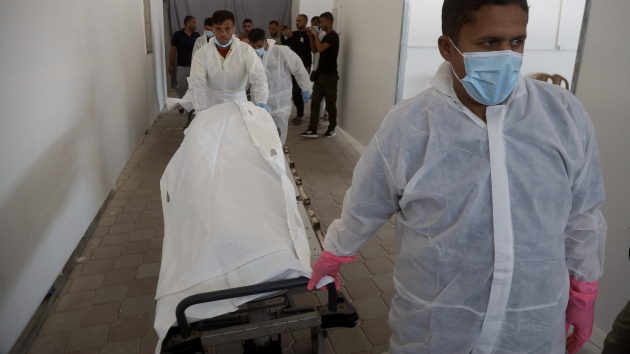
(LONDON) — Hospitals in the Gaza Strip have recorded the deaths of 15 people, including four children, due to famine and malnutrition over the past 24 hours, Gaza’s Hamas-run Ministry of Health said Tuesday.

That brings the total number of deaths from famine and malnutrition since the war began to 101, which includes 80 children, according to the health ministry.

Copyright © 2025, ABC Audio. All rights reserved.
WHO staff residence in Gaza attacked by IDF, WHO says

WHO staff residence in Gaza attacked by IDF, WHO says
Khames Alrefi/Anadolu via Getty Images

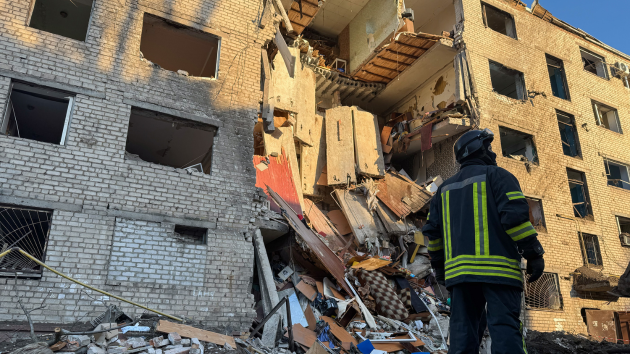
(LONDON) — The World Health Organization’s staff residence in Deir al Balah, Gaza, was attacked three times by the Israel Defense Forces, WHO officials said in a statement.

The Israeli military entered the premises, forcing women and children to evacuate on foot toward Al-Mawasi, according to the Tuesday statement. The WHO said male staffers and family members were handcuffed, stripped, interrogated on the spot and screened at gunpoint.

“WHO condemns in the strongest terms the attacks on a building housing WHO staff in Deir al Balah in Gaza, the mistreatment of those sheltering there, and the destruction of its main warehouse,” WHO said.

The IDF released a statement on Tuesday on social media about its military action in Deir al Balah.

The statement, which was released after the WHO statement, didn’t mention the WHO by name, but said the Israeli military had been “in contact” with international organizations prior to the start of its action in Deir Al Balah.

“We emphasize that the IDF maintains continuous and consistent contact with the international organizations, and throughout the war, the IDF has facilitated the safe evacuations of their personnel from evacuated areas, in coordination with the troops and in accordance with operational requirements,” the IDF said in its statement.

Copyright © 2025, ABC Audio. All rights reserved.