Kim Jae-Hwan/SOPA Images/LightRocket via Getty Images
(SEOUL) — The South Korean military began dismantling loudspeakers that had been placed along its border with North Korea, South Korea’s Defense Ministry said.
The speakers along the Demilitarized Zone were used by the prior administration to broadcast music and news across the border, where the government run by leader Kim Jong Un keeps a tight grip on the media.
The move amounted to a practical measure that was meant to ease tensions between Seoul and Pyongyang, efforts that have been led by the South’s President Lee Jae Myung, who took office in June.
The North Korean leadership had called for the speakers to be taken down, saying they were “psychologically detrimental” to people near the border, but also appeared ready to reject any overtures from Lee’s office.
“We reiterate our official position that we have no interest in any policies established or proposals made in Seoul, and that we have no intention of meeting with South Korea or discussing any issues with it,” Kim Yo Jong, the leader’s sister, said in late July, according to the Korean Central News Agency, a state media outlet.
She added, “The relationship between the two countries has already completely and irreversibly moved beyond the time frame of the concept of compatriotism.”
The South Korean military said the speakers being taken down wouldn’t affect it’s readiness.
(LONDON) — Hospitals in the Gaza Strip recorded five deaths over the past 24 hours due to malnutrition, the Gaza Ministry of Health in the Hamas-run territory said on Monday.
All of those who died from malnutrition in the past 24 hours were adults, the ministry said.
The deaths bring the total number of people who have died due to hunger since the conflict began nearly two years ago to 180 people, including 93 children, the ministry said.
(JERUSALEM) — Unable to find a diplomatic answer to the hostage crisis, Israeli Prime Minister Benjamin Netanyahu is pushing for a “military solution” to free the remaining hostages being held by Hamas terrorists, an Israeli official told ABC News on Sunday.
Netanyahu has suggested expanding the Israeli military operation in Gaza and using military force to extract the final hostages who have been in captivity since being kidnapped in the Oct. 7, 2023, surprise attack on Israel by Hamas terrorists.
It is believed there are about 20 living hostages still being held by Hamas.
The Israeli official told ABC News that Israel and U.S. officials are in constant dialogue.
The official said there is a growing understanding on the Israeli side that Hamas is not interested in a deal on the hostages.
“Therefore, Prime Minister Netanyahu is pushing to expand military operations to release the hostages through a military solution,” the Israeli official said.
On Saturday, thousands of protesters filled the streets of Tel Aviv, demanding their government end the war and bring the last hostages home.
“They are on the absolute brink of death,” Ilay David, whose brother, Evyatar David, is believed to be among the remaining Israeli hostages being held by Hamas, told protesters gathered in Tel Aviv. “In the current unimaginable condition, they may have only days left to live.
Hamas released a video over the weekend showing Evyatar David looking painfully emaciated.
The protest erupted hours after Steve Witcoff, Donald Trump’s special envoy to the Middle East, met in Israel with the families of hostages still in captivity.
As global concern over the hunger crisis in Gaza intensifies, Witkoff and U.S. Ambassador to Israel Mike Huckabee traveled to the Middle East on Friday to inspect the U.S. and Israel-backed aid distribution system there.
For months, humanitarian aid organizations and international bodies have warned that Gaza is facing “critical” levels of hunger and that famine is “imminent” in parts of the Gaza Strip.
An increasing number of deaths due to malnutrition have also been reported, according to the Hamas-run Gaza Ministry of Health.
At least 175 people, including 93 children, have died from malnutrition in Gaza, according to the Gaza Health Ministry.
Throughout the conflict, Israel has maintained that it is sending enough aid into Gaza, but international aid organizations have repeatedly said there is not enough aid, and the United Nations has reported conditions of malnutrition inside Gaza.
The Israeli source who spoke to ABC News said humanitarian aid will continue to enter Gaza in areas outside combat zones and areas no longer controlled by Hamas.
Kherson Regional Military Administration/Anadolu via Getty Images
(LONDON) — Ukrainian President Volodymyr Zelenskyy’s top adviser urged the U.S. to “strangle” Russia’s economy by imposing secondary sanctions on Moscow’s trading partners, as the White House push for a ceasefire appears to languish.
“Sanctions are working,” Andriy Yermak, the head of Zelenskyy’s office, wrote on Telegram on Sunday, citing data he said shows a collapse in Russian railway capacity over the past 12 months.
“The economy, geared for war, cannot withstand the pressure and is holding on only through the sale of energy resources,” Yermak wrote. “It is possible to strangle the economy with secondary tariffs proposed in the USA.”
Yermak appeared to be referring to proposals from President Donald Trump and a bipartisan group of senators to impose secondary sanctions on nations doing business with Russia, particularly those purchasing fossil fuels from the country. China and India are among the top importers of Russian energy products.
On July 14, Trump said he would give Russian President Vladimir Putin 50 days to agree a ceasefire with Ukraine, after which he would consider imposing secondary sanctions and other measures.
On July 29, Trump cut the window to 10 days, citing frustration with Russia’s continued drone and missile strikes on Ukrainian cities. The deadline will now expire on Aug. 8.
The threats raised hopes in Kyiv of a sustained White House pivot to back Ukraine’s efforts to repel Russia’s invasion, now in its fourth year with combat still raging all along the 600-mile front in the east and south of the country.
Official statements from Kremlin spokesperson Dmitry Peskov were relatively muted.
But Dmitry Medvedev — the former Russian president and prime minister now serving as the deputy chairman of the country’s Security Council — framed Trump’s ultimatum as “a threat and a step towards war. Not between Russia and Ukraine, but with his own country.”
Medvedev’s comments prompted Trump to then order two nuclear submarines to move to “appropriate regions,” citing “highly provocative statements” from Medvedev, who has become known as a particularly hawkish voice within Putin’s security establishment.
“A threat was made by a former president of Russia and we’re going to protect our people,” Trump said.
Meanwhile, Ukrainian officials continued their appeals to the U.S. to respond to perceived Russian provocations with concrete measures.
“Ceasefire proposals have been made long ago — Ukrainian proposals, U.S. proposals and many others around the world have communicated this to the Russians,” Zelenskyy said in a statement posted to Telegram on Friday.
“Each time, the only response from there has been attempts to gain more time for war, more time for terror,” he said. “Russia does not operate otherwise.”
“So it is very important that the prospect of new sanctions, strong sanctions, has now begun to put pressure on Russia — and not only against the aggressor state itself,” Zelenskyy added. “All Russian finances, every scheme that fills the Russian budget, must be targeted by the world.”
Both Russia and Ukraine have continued their long-range strike campaigns despite White House pressure to agree to a ceasefire.
In July, Russia set a new monthly record for strikes on Ukraine, launching 6,443 drones and missiles into the country, according to data published by the Ukrainian air force.
The attacks continued through into Sunday morning. Ukraine’s air force said Russia launched 76 drones and seven missiles into the country, of which 60 drones and one missile were shot down or otherwise suppressed.
Six missiles and 16 drones impacted across eight locations, the air force said, with debris from falling targets reported in two locations.
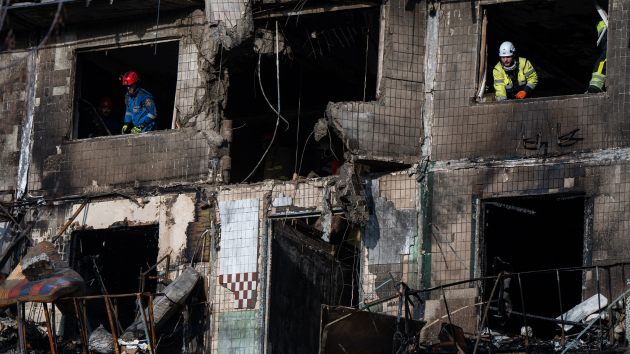
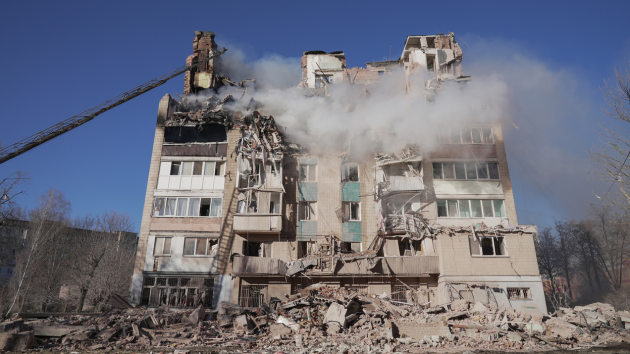
In Mykolaiv, a missile strike injured at least seven people, according to the local military administration. Three houses were destroyed and at last 37 other buildings damaged, the administration said.
In Russia, the Defense Ministry said it shot down at least 96 Ukrainian drones overnight.
Artem Korenyako, a spokesperson for Russia’s federal aviation agency Rosaviatsiya, said in posts to Telegram that temporary restrictions were introduced at airports in St. Petersburg, Kaliningrad, Pskov and Sochi.
In Sochi, on the Black Sea coast, local officials said falling drone debris set fire to a major oil depot.
And in the Voronezh region, local Gov. Alexander Gusev said four people were injured by Ukrainian attacks, which also set fire to a residential building.
(LONDON) — As global concern over the hunger crisis in Gaza intensifies, Steve Witkoff, President Donald Trump’s special envoy to the Middle East, and U.S. Ambassador to Israel Mike Huckabee, on Friday inspected the U.S. and Israel-backed aid distribution system there.
“Special Envoy Witkoff and Ambassador Huckabee will be traveling into Gaza on Friday to inspect the current distribution sites and secure a plan to deliver more food and meet with local Gazans to hear firsthand about this dire situation on the ground,” White House press secretary Karoline Leavitt said Thursday.
Leavitt said that immediately following the visit, Witkoff and Huckabee would brief Trump in order to “approve a final plan for food and aid distribution into the region.”
Witkoff posted as well on X, saying, “At @POTUS’s direction, @USAmbIsrael and I met yesterday with Israeli officials to discuss the humanitarian situation in Gaza. Today, we spent over five hours inside Gaza — level setting the facts on the ground, assessing conditions, and meeting with @GHFUpdates and other agencies. The purpose of the visit was to give @POTUS a clear understanding of the humanitarian situation and help craft a plan to deliver food and medical aid to the people of Gaza.”
The president hinted at a new plan to address humanitarian concerns in Gaza on Monday following a meeting with United Kingdom Prime Minister Keir Starmer.
“We’re going to set up food centers and where the people can walk in and no boundaries. We’re not going to have fences,” Trump said. He later added that he expected European nations to work with the U.S. on the initiative, and that he expected the plan to be operational “very soon.”
But so far, both the White House and the State Department have declined to elaborate on the president’s comments or provide a basic framework for the new plan.
The Trump administration and Israel have backed Gaza Humanitarian Foundation (GHF), a controversial American non-profit now charged with distributing most aid that is allowed to enter Gaza.
The GHF — with Israel’s approval and despite rejection from the United Nations — took over most of the aid distribution system in Gaza on May 27, after an 11-week Israeli blockade on all supplies from entering the strip. Israel has long accused Hamas of stealing aid provided by the U.N. — formerly the main distributor — and others to fund its militant activity — claims which Hamas denies.
Earlier this month, more than 160 charity groups and NGOs called for the GHF to be shut down, claiming that more than 500 Palestinians had been killed while seeking aid from the organization and that its distribution locations “have become sites of repeated massacres in blatant disregard for international humanitarian law.”
But the administration has shown no signs of backing away from the GHF, which it has repeatedly touted as the only organization working in Gaza that is able to ensure aid doesn’t benefit Hamas.
The U.S. has pledged $30 million toward GHF’s efforts in Gaza and a U.S. official told ABC News on Wednesday that the money was expected to be distributed to the group within the coming days — a sign of the administration’s continued confidence in the organization.
As of now, GHF operates only four distribution sites across Gaza. Trump administration officials have always maintained that its operations could be scaled up, but there’s no indication the administration has played any direct role in planning for its expansion.
Ahead of his visit to Gaza, Witkoff met with Israeli Prime Minister Benjamin Netanyahu on Thursday.
Following their discussion, an Israeli official told ABC News that the two had agreed to several tenets related to bringing the war in Gaza to a resolution, including that it was time to consider a ceasefire framework that would free all Israeli hostages, that Hamas must disarm, and that Israel and the U.S. should work together to increase the flow of aid into Gaza even as the conflict continues.
Witkoff’s visit to Gaza of Friday will mark his second trip to Gaza this year.
In late January, when the ceasefire between Israel and Hamas that was negotiated in part by both the Biden and Trump administrations was still in place, Witkoff became the first high-level U.S. official to enter Gaza in more than a decade when he toured an area of the Gaza Strip that was still occupied by the Israeli military.
-ABC’S Michelle Stoddart and Will Gretsky contributed to this report.
(LONDON) — More than three years into Russia’s full-scale invasion, Ukrainians across the country retreat each night to bomb shelters and metro stations in a nightly ritual necessitated by the long reach of Moscow’s drones and missiles. This summer, Ukrainians are spending more time in such shelters than ever before.
The first bombardments of Kyiv and other major cities began in the early morning of Feb. 24, 2022, as Russian troops surged across Ukraine’s borders on several axes. In the years since, the attacks have never stopped.
Through July, Russia launched a record 6,443 drones and missiles into the country, according to data published by the Ukrainian air force. The total is the highest of the war to date, and around 13% more than were recorded in June.
The scale and complexity of Russia’s drone and missile barrages have steadily increased through the war. The Iranian-designed Shahed strike drone — adopted enthusiastically by the Russian military and rebranded as the Geran — has become the workhorse of Moscow’s nightly harassment of Ukrainian cities and vital infrastructure.
For many Ukrainians, the “flying mopeds,” as the Shahed and Geran variants have become known due to their distinctive sound, are emblematic of the Russian threat.
The strikes are terrorizing and deadly. June saw the highest monthly level of Ukrainian civilian casualties in more than three years, according to data published by the UN Human Rights Monitoring Mission in Ukraine — 232 people killed and 1,343 people injured.
Neither Russia nor Ukraine publish data detailing the scale of their own strike campaigns. Ukraine’s air force publishes a daily tally of Russian drone and missile strikes, while Russia’s Defense Ministry only publishes figures of Ukrainian drones shot down.
July marked a high-water mark for Russian drone attacks on Ukraine. Data published by the Ukrainian air force and analyzed by ABC News recorded a total of 6,245 attack and decoy drones launched into the country over the past month at an average rate of around 201 per day.
Russia also launched 198 missiles, with an average of more than six each day.
Though Ukraine’s interception rate is significant, plenty of projectiles arrive with devastating effect. July saw around 89% of drones and around 61% of missiles shot down or otherwise suppressed.
By comparison, June saw 5,438 drones and 239 missiles fired into Ukraine, with a daily average of 181 drones and nearly eight missiles. The air force downed or suppressed 87.2% of all drones and 73% of missiles during June.
And in May, Russia launched a total of 3,835 drones and 117 missiles, for an average of around 124 drones and nearly four missiles each day. Across the month, 85.7% of drones and 57% of missiles were shot down or suppressed.
“Right now, Ukraine sees around 300 to 400 drones attacking civilian targets every day — these types of numbers were unheard of in 2023 or 2024,” Yuriy Boyechko, the founder and CEO of the Hope for Ukraine charity, told ABC News.
Moscow shows no sign of letting up. Russian officials and media have made much of the country’s growing drone production capabilities. A recent report by the Zvezda television channel, for example, showed operations at a Geran factory in Alabuga in Russia’s Republic of Tatarstan, with workers constructing and piling up dozens of attack drones ready for delivery.
The design of the attack drones is ever-evolving. The first were light gray-colored craft flying low and relatively slow to their targets, carrying high-explosive and fragmentation payloads and powered by turbines.
More recently, Geran variants painted black with special material to hide from radar fly higher and with tortuous routes to evade Ukrainian defense teams. Some are armed with thermobaric warheads, are armored and some are powered by jet engines. Ukrainian defenders have also reported that recent Gerans are using AI targeting systems.
Russian forces may soon be able to launch 1,000 to 2,000 drones per day, according to recent warnings issued by the Institute for the Study of War think tank and German Maj. Gen. Christian Freuding.
Pasi Paroinen, an OSINT analyst at the Finland-based Black Bird Group, told ABC News he believes it feasible that Russia could soon launch 1,000 drones per night.
The drone barrages are effective and relatively affordable. Various estimates for the cost of domestically-produced Gerans range from around $10,000 to $50,000.
Though the Western sanctions campaign has complicated Russian military procurement efforts, components from Western companies are still found in their dozens in downed Gerans — a fact repeatedly highlighted by frustrated officials in Kyiv.
The mix of strike and decoy drones poses a “very nasty” problem for Ukraine’s thinly-stretched air defense, Paroinen said. “They have been doing pretty well intercepting them overall. But it’s also tying up Ukrainian manpower — they have to have those groups of mobile anti-aircraft groups rolling around the countryside, shooting these things down.”
“The general consensus among analysts is that this is going to be a major problem,” Paroinen said. “And this is a production capability that won’t be going away, even if the war ends it will still have implications for the rest of Europe as well, that Russia will be able to produce and stockpile these weapons in pretty intense numbers.”
President Donald Trump’s repeated interventions seem to also have failed to move the needle. The president has repeatedly expressed his frustration with Russian President Vladimir Putin’s continuation and expansion of drone and missile strikes on Ukraine.
Putin, Trump said earlier this month, “talks nice and then bombs everybody.”
Ukraine has used its own fast-evolving drone arsenal to target drone production facilities deep inside Russia, but to little apparent avail.
Kyiv is increasing the intensity of its drone attacks into Russia. Across July, the Defense Ministry in Moscow reported downing 3,008 Ukrainian drones at an average of around 97 per day.
In June, the ministry reported downing a total of 2,368 Ukrainian drones, with an average of almost 79 drones per day across the month. Those figures were down from May, during which the ministry said it shot down 3,611 drones with an average of 116 per day.
But, Paroinen said, there is little Ukraine can do about Russia’s growing drone production capability. “It’s far enough away from the front lines that there are not really that many weapons that can reach it. Maybe some very long-range drones, but overall, trying to destroy such a factory is beyond their means,” he said.
“To take down a big industrial complex really takes a lot more firepower and explosives than they can deliver, even if they launch hundreds of drones and have dozens of them hit the target,” he continued. “It’s not that easy — and usually the damage can be repaired pretty quickly.”
Photo by Dawoud Abo Alkas/Anadolu via Getty Images
(LONDON) — At least 37 people were killed and 270 were injured while seeking aid in northern Gaza near the Zikim crossing, according to the director of Gaza’s Al-Shifa Hospital.
The Israel Defense Forces did not immediately respond to ABC News’ request for comment.
An increasing number of deaths due to malnutrition have been reported. According to the Hamas-run Gaza Ministry of Health, seven people died of hunger over a 24-hour period on Wednesday, bringing the total number of deaths from famine to 154 since Oct. 7, 2023, including 89 children.
This is a developing story. Please check back for updates.
(NEW YORK) — U.K. Prime Minister Keir Starmer said Tuesday that his nation will recognize the state of Palestine at a United Nations meeting in September if Israel does not agree to a ceasefire in Gaza.
“Today, as part of this process towards peace, I can confirm the U.K. will recognize the state of Palestine by the United Nations General Assembly in September, unless the Israeli government takes substantive steps to end the appalling situation in Gaza, agree to a ceasefire and commit to a long-term sustainable peace, reviving the prospect of a two-state solution,” Starmer said at a news conference.
“This includes allowing the U.N. to restart the supply of aid and making clear that there will be no annexations in the West Bank,” he continued.
Starmer also delivered a message to “the terrorists of Hamas,” saying that “they must immediately release all of the hostages, sign up to a ceasefire, disarm, and accept that they will play no part in the government of Gaza.”
The prime minister’s office also released a written statement echoing Starmer’s comments.
The Israeli Foreign Ministry said in a statement on Tuesday that it “rejects” Starmer’s statement.
“The shift in the British government’s position at this time, following the French move and internal political pressures, constitutes a reward for Hamas and harms efforts to achieve a ceasefire in Gaza and a framework for the release of hostages,” the ministry said.
Israeli Prime Minister Benjamin Netanyahu also reacted to Starmer’s statement, saying, “Starmer rewards Hamas’s monstrous terrorism & punishes its victims. A jihadist state on Israel’s border TODAY will threaten Britain TOMORROW. Appeasement towards jihadist terrorists always fails. It will fail you too. It will not happen.”
French President Emmanuel Macron announced last week that France would officially recognize Palestine as a state when the U.N. meets in September, and also called for “an immediate ceasefire, the release of all hostages, and massive humanitarian aid to the people of Gaza.”
French Minister for Europe and Foreign Affairs Jean-Noël Barrot on Tuesday applauded Starmer’s announcement.
“The United Kingdom joins today in the momentum created by France for the recognition of the State of Palestine. Together, through this pivotal decision and our combined efforts, we break the endless cycle of violence and reopen the prospect of peace in the region,” Barrot said.
At the time, U.S. Secretary of State Marco Rubio said the U.S. “rejected” France’s plan to recognize a Palestinian state.
“This reckless decision only serves Hamas propaganda and sets back peace. It is a slap in the face to the victims of October 7th,” Rubio wrote in a statement on X.
Starmer’s statement comes on the same day that two sources familiar with the matter told ABC News that Netanyahu is considering a plan to annex territories in Gaza.
“Prime Minister Netanyahu is considering a plan to annex territories in Gaza if Hamas doesn’t agree to a ceasefire plan. This is one of several options,” a source said.
The news comes less than a week after Steve Witkoff, President Donald Trump’s special envoy to the Middle East, said the U.S. was cutting ceasefire talks short and bringing its negotiation team home from Doha, Qatar.
In a post on X on July 24, Witkoff said Hamas “does not appear to be coordinated or acting in good faith.”
“While the mediators have made a great effort, Hamas does not appear to be coordinated or acting in good faith,” Witkoff wrote, in part. “We will now consider alternative options to bring the hostages home and try to create a more stable environment for the people of Gaza.”
Netanyahu echoed Witkoff’s statement, saying Israel was now “considering alternative options to bring our hostages home,” and blamed Hamas for the breakdown in negotiations.
“Special Envoy to the Middle East Steve Witkoff got it right. Hamas is the obstacle to a hostage release deal,” Netanyahu said in a statement the day after Witkoff’s comments. “Together with our U.S. allies, we are now considering alternative options to bring our hostages home, end Hamas’s terror rule, and secure lasting peace for Israel and our region.
Officials have not yet elaborated on what are the “alternative options” to return the remaining hostages and end the war in Gaza.
In its own statement on Sunday, Hamas accused Witkoff and the Israelis of negotiating in bad faith and claimed there is no point in continuing negotiations in the current format.
“In the last round of negotiations, we achieved clear progress and largely agreed with what the mediators presented to us, especially regarding the issue of withdrawal, prisoners, and the entry of aid,” Hamas said, in part. ‘They conveyed to us positive responses from the Zionist occupation, but we were surprised to find that the occupation was withdrawing from the negotiations, and that the US President’s envoy to the Middle East, Witkoff, was in cahoots with it.”
“We clearly state: There is no point in continuing negotiations under the siege, extermination, and starvation of our children, women, and people in the Gaza Strip,” the statement continued.
The news also comes as the Israel-Hamas war reached a a grim milestone, with more than 60,000 Palestinians killed since Oct. 7, 2023, according to the Hamas-run Gaza Ministry of Health.
As of Tuesday, 60,034 people in Gaza have been killed and 145,870 people have been injured, the ministry said.
With an estimated population of 2.3 million people in Gaza at the beginning of the war, the figure, if accurate, means that about 9% of Palestinians in Gaza have been killed or injured since then, according to an ABC News tally.
The ministry clarified that the Palestinians whom they say have died due to hunger have not been classified as “killed” in the war, but “died” due to malnourishment.
At least 147 Palestinians, including 88 children, have died due to malnutrition as of Monday, according to the ministry.
Netanyahu has repeatedly denied that there is starvation occurring in Gaza and has denied that there is an official Israeli policy of starvation.
“There is no policy of starvation in Gaza, and there is no starvation in Gaza,” Netanyahu said in comments in Jerusalem Sunday, in part.
“We enabled humanitarian aid throughout the duration of the war to enter Gaza. Otherwise, there would be no Gazans,” Netanyahu further said. “And what is interdicting the supply of humanitarian aid is one force – Hamas. Again, the reverse of the truth. Hamas robs, steals this humanitarian aid and then accuses Israel of not supplying it.”
Israeli officials have long accused Hamas of stealing aid, which Hamas denies.
A USAID analysis appeared to undercut some of the assertions about the extent to which Hamas had allegedly stolen humanitarian aid. A presentation reviewed by ABC News, examining more than 150 reported incidents involving the theft or loss of U.S.-funded humanitarian aid in Gaza, showed that he group failed to find any evidence that Hamas engaged in widespread diversion of aid to cause this amount of hunger being seen in the strip.
Additionally, a new report on Tuesday from the Integrated Food Security Phase Classification, a global initiative monitoring hunger, said that “the worst-case scenario of famine is playing out in the Gaza Strip,” and that “access to food and other essential items and services has plummeted to unprecedented levels.”
ABC News’ Will Gretsky contributed to this report.
(BEIJING) — Heavy rains and flooding have killed at least 30 people in Beijing, after a year’s worth of rain fell in less than a week, according to state media.
Beijing authorities said they have relocated a further 80,000 residents as rain continues.
Eight people were also killed in the neighboring Hebei Province, after a landslide struck a rural village, with four others still missing, according to state media. Officials said that all residents of the affected village will be relocated as a safety precaution.
The storms dropped more than 6 inches of rain on average across Beijing by midnight Tuesday, with two other towns recording as much as 21 inches of precipitation, according to the Beijing Meteorological Observatory. This has come following a summer of extreme weather across China, with record heat waves in the east and heavy flooding in the southwest.
Districts across China have been evacuated, with state media reporting that in Beijing’s Mentougou District about 15,000 people have been evacuated, with all major tourist sites closed. In the Pinggu District, more than 12,800 people have been relocated, with authorities setting up 40 emergency shelters in gyms, schools, hotels and village offices, officials told state media.
State media reported that 34 teams, involving over 1,000 personnel have been deployed for flood response in the Pinggu region, which is about 44 miles northeast of Beijing.
In response to the disaster, President Xi Jinping urged all-out efforts to ensure the safety of residents and property, saying: “Emergency response must be activated and carried out at the earliest possible moment to fully protect people’s lives and property.”
The Ministry of Finance and the Ministry of Emergency Management on Tuesday allocated 350 million yuan, or about $47 million, in central government disaster relief funds to nine provincial-level regions.
The rainstorm alert in the capital was cancelled Tuesday as the rain shifted eastward, although the city remains on its highest level of flood control emergency response, according to state media. Showers were still forecast through the afternoon and into the evening.
(NEW YORK) — Israeli Prime Minister Benjamin Netanyahu is considering a plan to annex territories in Gaza, two sources familiar with the matter told ABC News.
“Prime Minister Netanyahu is considering a plan to annex territories in Gaza if Hamas doesn’t agree to a ceasefire plan. This is one of several options,” a source said.
The news comes less than a week after Steve Witkoff, President Donald Trump’s special envoy to the Middle East, said the U.S, was cutting ceasefire talks short and bringing its negotiation team home from Doha, Qatar.
In a post on X on July 24, Witkoff said Hamas was not “acting in good faith.”
“While the mediators have made a great effort, Hamas does not appear to be coordinated or acting in good faith,” Witkoff wrote, in part. “We will now consider alternative options to bring the hostages home and try to create a more stable environment for the people of Gaza.”
Netanyahu echoed Witkoff’s statement and blamed Hamas for the breakdown in negotiations.
“Special Envoy to the Middle East Steve Witkoff got it right. Hamas is the obstacle to a hostage release deal,” Netanyahu said in a statement the day after Witkoff’s comments. “Together with our U.S. allies, we are now considering alternative options to bring our hostages home, end Hamas’s terror rule, and secure lasting peace for Israel and our region.
In its own statement on Sunday, Hamas accused Witkoff and the Israelis of negotiating in bad faith and claimed there is no point in continuing negotiations in the current format.
“In the last round of negotiations, we achieved clear progress and largely agreed with what the mediators presented to us, especially regarding the issue of withdrawal, prisoners, and the entry of aid,” Hamas said, in part. ‘They conveyed to us positive responses from the Zionist occupation, but we were surprised to find that the occupation was withdrawing from the negotiations, and that the US President’s envoy to the Middle East, Witkoff, was in cahoots with it.”
“We clearly state: There is no point in continuing negotiations under the siege, extermination, and starvation of our children, women, and people in the Gaza Strip,” the statement continued.
This is a developing story. Please check back for updates.