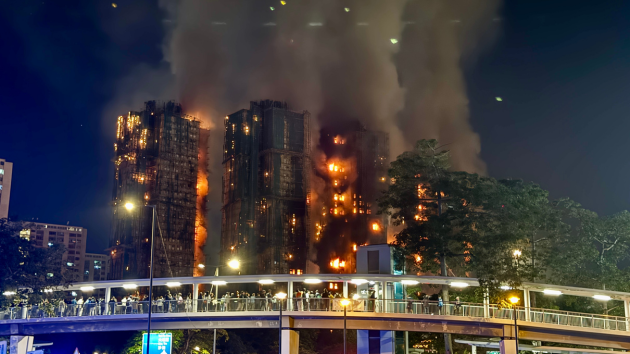
(LONDON) — The death toll from the massive fire at a residential apartment complex in Hong Kong rose to 55 as of Thursday, as search and rescue efforts continued.
Fifty-one of the deceased victims died at the scene, fire department officials said in a press conference, while four more people died in hospital.
There are currently 76 people being treated in hospital, with 15 in a critical condition and 28 in a serious condition, the officials added.
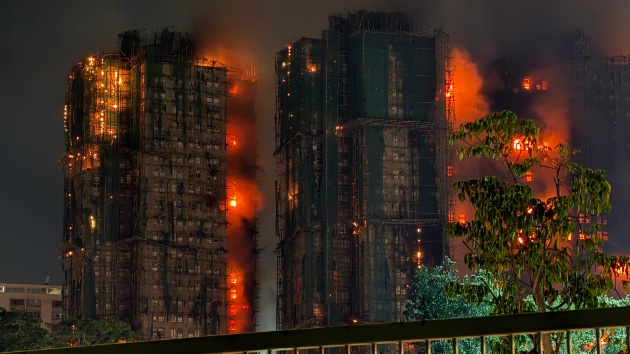
Fires are still burning in three of the seven affected buildings in Tai Po district, officials said, with all remaining blazes now under control. Seven of the eight buildings in the complex were impacted by the fire, officials said.
Three men associated with the construction firm in charge of the renovation at the housing complex have been arrested and are under investigation in connection with the fire, Hong Kong police said during a press conference early Thursday morning.
Police suspect the mesh used during the renovation was not up to standard, and the company installed a large amount of Styrofoam in the windows and the outer walls which acted as an accelerant once the fire began, police said.
The mesh and the Styrofoam were found in the one building that wasn’t impacted by the fire, police said.
More than 140 fire engines and over 800 firefighters and paramedics were deployed on Wednesday to respond to the fire, with drones also in use, officials said.
Some 279 people have been reported missing, Hong Kong leader John Lee said during a press briefing earlier Thursday.
“The fire has resulted in many casualties, including a fireman who died in the line of duty,” Lee said in an earlier statement posted to social media. “I express my deep sadness and my deep condolences to the families of the dead and the injured.”
Chinese President Xi Jinping expressed his condolences and sympathies to the victims’ families and those affected in a statement.
He said he ordered authorities to “do everything possible to ensure search and rescue operations, medical treatment for the injured, and post-disaster relief, and to provide necessary assistance to relevant departments and local authorities to minimize casualties and losses.”
Thick smoke and flames rise as fire engulfs high-rise residential buildings at the Wang Fuk Court complex on November 26, 2025 in Hong Kong, China. At least 13 people are dead and dozens of others injured as a major fire engulfed a residential apartment complex in Hong Kong’s Tai Po district on November 26. (Photo by VCG/VCG via Getty Images)
(LONDON) — At least 13 people were killed and dozens of others were injured as a massive fire engulfed a residential apartment complex in Hong Kong’s Tai Po district on Wednesday, according to fire officials.
“A fire broke out at Wang Fuk Court in Tai Po at 2.51 p.m. today … The fire was upgraded to No. 3 alarm at 3.02 p.m., and to No. 4 alarm at 3.34 p.m.,” according to a statement from the Hong Kong government.
By 6:22 p.m. local time the fire had been upgraded again to a No. 5 alarm, city officials said.
At least 13 people were dead, fire officials said in an update at about 8 p.m. local time. About two hours earlier, city officials had released a statement saying at least four people were dead.
Another 28 people were injured, including many who were transferred to two local hospitals, fire officials said.
One of the dead had been a firefighter who was called to the scene from nearby Sha Tin Fire Station, according to Andy Yeung, the director of Fire Services.
Yeung in a statement named the firefighter as Ho Wai-ho, 37, adding that he “was found collapsed at the scene” of the fire. He was rushed to the hospital, where he later died, Yeung said.
“The fire has resulted in many casualties, including a fireman who died in the line of duty,” Hong Kong’s Chief Executive John Lee said in a statement posted to social media, “I express my deep sadness and my deep condolences to the families of the dead and the injured.”
Secretary for Security Tang Ping-keung said in a statement that emergency departments were at the scene of the blaze. The fire department was “doing its utmost to put out the fire,” he said.
Chinese President Xi Jinping expressed his condolences to the victims and firefighters who died in the fire in a statement. The president also extended his sympathies to the families of the victims and the affected people.
The statement said Xi had ordered authorities to “do everything possible to ensure search and rescue operations, medical treatment for the injured, and post-disaster relief, and to provide necessary assistance to relevant departments and local authorities to minimize casualties and losses.”
ABC News’ Joe Simonetti and Karson Yiu contributed to this report.
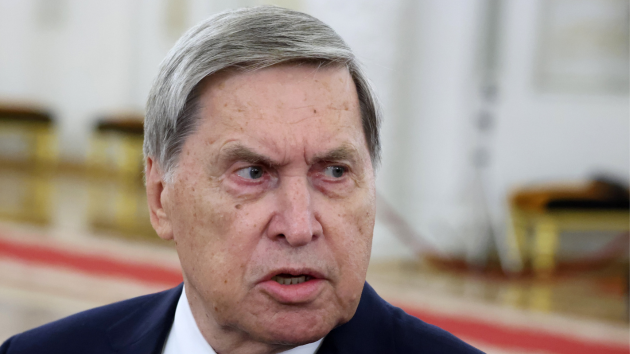
(LONDON and KYIV, Ukraine) — The Kremlin’s top foreign policy aide, Yury Ushakov, confirmed there is a “preliminary agreement” for U.S. President Donald Trump’s special envoy Steve Witkoff — and likely Jared Kushner — to visit Moscow next week, as the White House claims momentum toward a possible Ukraine-Russia peace plan.
“As for Witkoff, I can say that a preliminary agreement has been reached that he will visit Moscow next week,” Ushakov said in an interview with journalist Pavel Zarubin for the program “Moscow. Kremlin. Putin,” broadcast on Wednesday.
“We have agreed to meet with Mr. Witkoff. I hope he will not come alone, but will be accompanied by other representatives of the American team who are working on the Ukrainian dossier, and then we will begin discussions,” Ushakov added.
Witkoff, Ushakov said, will “definitely” meet with Russian President Vladimir Putin if he comes to Moscow next week.
The interview came after Bloomberg published excerpts of a recording of purported phone call between Witkoff and Ushakov, in which Trump’s envoy appeared to offer guidance on how Putin should present the Kremlin’s plan to end the war to Trump.
Ushakov appeared to confirm the call happened but declined to comment. Ushakov also alleged that the leak was intended to undermine the ongoing peace efforts.
“I speak with Witkoff quite often, but I do not comment on the substance of our conversations because they are confidential. No one should comment on them, actually,” he said.
The reported leak was “probably” intended to “hinder” discussions, Ushakov said. “It is unlikely that this is being done to improve relations. They are now being established, with difficulty, through contacts of this kind, including by telephone.”
Ushakov denied that Russia leaked the call. “Someone is leaking them, someone is listening in, but it’s not us,” he said.
In a separate interview with Russia’s Kommersant newspaper published Wednesday, Ushakov said he regularly contacted Witkoff “via secure communication” and via WhatsApp.
Ushakov then suggested that the leak could have been organized by Witkoff’s detractors.
Trump had already told reporters on Tuesday that his envoy would travel to Russia. “Now, Steve Witkoff is going over maybe with Jared. I’m not sure about Jared going, but he’s involved in the process, smart guy, and they’re going to be meeting with President Putin, I believe, next week in Moscow,” he said.
Pressed on the Bloomberg report and concerns that Witkoff was too sympathetic to Russia’s maximalist war goals, Trump replied, “No, but that’s a standard thing, you know, because he’s got to sell this to Ukraine. He’s got to sell Ukraine to Russia. That’s what he’s, that’s what a deal maker does.”
“You got to say, look, they want this. You’ve got to convince him with this. You know, that’s a very standard form of negotiation. I haven’t heard it, but I heard it was standard negotiation, and I would imagine he’s saying the same thing to Ukraine, because each party has to give and take,” Trump added.
Asked whether Witkoff was “too pro-Russia,” Trump did not answer directly. He instead said that a deal would be beneficial for both sides, while appearing to talk up Russia’s military capabilities.
“I think, look, this war could go on for years, and Russia’s got a lot more people, a lot more soldiers,” Trump said. “So I think if Ukraine can make a deal, it’s a good thing. I think it’s great for both. Frankly, I think it’s great for both.”
Weekend talks in Geneva, Switzerland, saw American, European and Ukrainian officials meet to discuss the controversial U.S.-backed peace plan proposal put to Kyiv last week, with terms critics say would have constituted a Ukrainian capitulation.
Russian President Vladimir Putin said last week the blueprint “could also form the basis for a final peace settlement,” and suggested it aligned closely with the outcomes of his meeting with Trump in Alaska in August.
On Monday, a Ukrainian official close to the matter told ABC News that the original 28-point draft had been revised down to 19 points after the Geneva talks, with both American and Ukrainian representatives framing the Geneva talks as productive.
Ukrainian President Volodymyr Zelenskyy said on Tuesday that the Geneva talks produced a “framework,” adding Kyiv is “ready to move forward together — with the United States of America, with personal engagement of President Trump, and with Europe.”
“I am ready to meet with President Trump,” Zelenskyy continued. “There are sensitive points to discuss,” he said.
After the Geneva meetings, a U.S. delegation held additional talks with Russian and Ukrainian representatives in Abu Dhabi in the United Arab Emirates. A U.S. official told ABC News on Tuesday, “The Ukrainians have agreed to the peace deal … There are some minor details to be sorted out but they have agreed to a peace deal.”
A source familiar with the discussions confirmed to ABC News that Ukraine agreed to the new 19-point peace plan during the talks in Geneva, not in Abu Dhabi.
Speaking to reporters on Tuesday, Trump did not elaborate on which issues are still to be agreed with Kyiv. “Standard things,” Trump said when asked. “But people are starting to realize it’s a good deal for both parties if they got to stop the war, they’re losing a lot of people, a lot of soldiers, mostly soldiers.”
Pressed about Ukraine ceding land to Russia, Trump hinted at land swaps and called the overall process “complicated” and said it “doesn’t go that quickly.”
Trump also did not say what concessions Moscow is being asked to make. “They’re making concessions. They’re big concessions. You say stop fighting, and they don’t take any more land again,” the president said.
As to future security guarantees for Ukraine, Trump said the issue is being discussed with European countries. “Europe will be largely involved in that,” he said. “We’re working that out with Europe. Europe really wants to see it end, if possible.”
Moscow is yet to officially comment on the new 19-point plan. But Russian Foreign Minister Sergei Lavrov warned on Tuesday that “if the spirit and letter of Anchorage are removed in terms of the key understandings that we have established, then, of course, it will be a fundamentally different situation.”
In his interview with Zarubin broadcast on Wednesday, Ushakov said the new plan was “passed on to us,” as quoted by Russia’s state-run Tass news agency. But the Kremlin aide added that the plan “hasn’t been discussed in detail with anyone yet.”
Kremlin spokesperson Dmitry Peskov, meanwhile, told reporters on Wednesday it is “too early to say” that the warring parties may be nearing a deal, according to Tass.
ABC News’ Luis Martinez, Hannah Demissie and Anna Sergeeva contributed to this report.
(LONDON and KYIV, Ukraine) — The Kremlin’s top foreign policy aide, Yury Ushakov, confirmed there is a “preliminary agreement” for U.S. President Donald Trump’s special envoy Steve Witkoff — and likely Jared Kushner — to visit Moscow next week, as the White House claims momentum toward a possible Ukraine-Russia peace plan.
“As for Witkoff, I can say that a preliminary agreement has been reached that he will visit Moscow next week,” Ushakov said in an interview with journalist Pavel Zarubin for the program “Moscow. Kremlin. Putin,” broadcast on Wednesday.
“We have agreed to meet with Mr. Witkoff. I hope he will not come alone, but will be accompanied by other representatives of the American team who are working on the Ukrainian dossier, and then we will begin discussions,” Ushakov added.
Witkoff, Ushakov said, will “definitely” meet with Russian President Vladimir Putin if he comes to Moscow next week.
The interview came after Bloomberg published excerpts of a recording of purported phone call between Witkoff and Ushakov, in which Trump’s envoy appeared to offer guidance on how Putin should present the Kremlin’s plan to end the war to Trump.
Ushakov appeared to confirm the call happened but declined to comment. Ushakov also alleged that the leak was intended to undermine the ongoing peace efforts.
“I speak with Witkoff quite often, but I do not comment on the substance of our conversations because they are confidential. No one should comment on them, actually,” he said.
The reported leak was “probably” intended to “hinder” discussions, Ushakov said. “It is unlikely that this is being done to improve relations. They are now being established, with difficulty, through contacts of this kind, including by telephone.”
Ushakov denied that Russia leaked the call. “Someone is leaking them, someone is listening in, but it’s not us,” he said.
Trump had already told reporters on Tuesday that his envoy would travel to Russia. “Now, Steve Witkoff is going over maybe with Jared. I’m not sure about Jared going, but he’s involved in the process, smart guy, and they’re going to be meeting with President Putin, I believe, next week in Moscow,” he said.
Pressed on the Bloomberg report and concerns that Witkoff was too sympathetic to Russia’s maximalist war goals, Trump replied, “No, but that’s a standard thing, you know, because he’s got to sell this to Ukraine. He’s got to sell Ukraine to Russia. That’s what he’s, that’s what a deal maker does.”
“You got to say, look, they want this. You’ve got to convince him with this. You know, that’s a very standard form of negotiation. I haven’t heard it, but I heard it was standard negotiation, and I would imagine he’s saying the same thing to Ukraine, because each party has to give and take,” Trump added.
Asked whether Witkoff was “too pro-Russia,” Trump did not answer directly. He instead said that a deal would be beneficial for both sides, while appearing to talk up Russia’s military capabilities.
“I think, look, this war could go on for years, and Russia’s got a lot more people, a lot more soldiers,” Trump said. “So I think if Ukraine can make a deal, it’s a good thing. I think it’s great for both. Frankly, I think it’s great for both.”
Weekend talks in Geneva, Switzerland, saw American, European and Ukrainian officials meet to discuss the controversial U.S.-backed peace plan proposal put to Kyiv last week, with terms critics say would have constituted a Ukrainian capitulation.
Russian President Vladimir Putin said last week the blueprint “could also form the basis for a final peace settlement,” and suggested it aligned closely with the outcomes of his meeting with Trump in Alaska in August.
On Monday, a Ukrainian official close to the matter told ABC News that the original 28-point draft had been revised down to 19 points after the Geneva talks, with both American and Ukrainian representatives framing the Geneva talks as productive.
Ukrainian President Volodymyr Zelenskyy said on Tuesday that the Geneva talks produced a “framework,” adding Kyiv is “ready to move forward together — with the United States of America, with personal engagement of President Trump, and with Europe.”
“I am ready to meet with President Trump,” Zelenskyy continued. “There are sensitive points to discuss,” he said.
After the Geneva meetings, a U.S. delegation held additional talks with Russian and Ukrainian representatives in Abu Dhabi in the United Arab Emirates. A U.S. official told ABC News on Tuesday, “The Ukrainians have agreed to the peace deal … There are some minor details to be sorted out but they have agreed to a peace deal.”
A source familiar with the discussions confirmed to ABC News that Ukraine agreed to the new 19-point peace plan during the talks in Geneva, not in Abu Dhabi.
Speaking to reporters on Tuesday, Trump did not elaborate on which issues are still to be agreed with Kyiv. “Standard things,” Trump said when asked. “But people are starting to realize it’s a good deal for both parties if they got to stop the war, they’re losing a lot of people, a lot of soldiers, mostly soldiers.”
Pressed about Ukraine ceding land to Russia, Trump hinted at land swaps and called the overall process “complicated” and said it “doesn’t go that quickly.”
Trump also did not say what concessions Moscow is being asked to make. “They’re making concessions. They’re big concessions. You say stop fighting, and they don’t take any more land again,” the president said.
As to future security guarantees for Ukraine, Trump said the issue is being discussed with European countries. “Europe will be largely involved in that,” he said. “We’re working that out with Europe. Europe really wants to see it end, if possible.”
Moscow is yet to officially comment on the new 19-point plan. But Russian Foreign Minister Sergei Lavrov warned on Tuesday that “if the spirit and letter of Anchorage are removed in terms of the key understandings that we have established, then, of course, it will be a fundamentally different situation.”
In his interview with Zarubin broadcast on Wednesday, Ushakov said the new plan was “passed on to us,” as quoted by Russia’s state-run Tass news agency. But the Kremlin aide added that the plan “hasn’t been discussed in detail with anyone yet.”
Kremlin spokesperson Dmitry Peskov, meanwhile, told reporters on Wednesday it is “too early to say” that the warring parties may be nearing a deal, according to Tass.
(LONDON) — At least four people were killed and three others were injured as a major fire engulfed a residential apartment complex in Hong Kong’s Tai Po district on Wednesday, with photos and video from the scene appearing to show serious damage to several buildings.
“A fire broke out at Wang Fuk Court in Tai Po at 2.51 p.m. today … The fire was upgraded to No. 3 alarm at 3.02 p.m., and to No. 4 alarm at 3.34 p.m.,” according to a statement from the Hong Kong government.
By 6:22 p.m. local time the fire had been upgraded again to a No. 5 alarm, city officials said.
Officials said nine people had been transfered to two local hospitals, including four people who were pronounced dead.
Three people were in critical condition, one was in serious position and another was listed as stable, officials said.
This is a developing story. Please check back for updates.
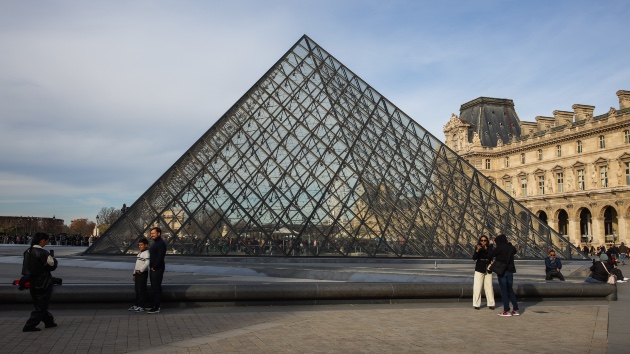
View of the Cour Napoleon, a historic courtyard in the Louvre Museum and the Louvre Pyramid in Paris, France on November 12th, 2025. (Photo by Beata Zawrzel/NurPhoto via Getty Images)
(LONDON) — A fourth suspect believed to be part of a crew that pulled off the Oct. 19 jewel heist at the Louvre Museum in Paris was arrested on Tuesday, along with three other people, according to sources.
The arrests brings the tally of suspects in the brazen robbery to eight.
“Four new individuals were arrested on November 25, 2025, as part of the investigation by the Paris Specialized Interregional Jurisdiction (JIRS) into the burglary committed at the Louvre on October 19, 2025,” according to a statement from the Paris prosecutor’s office. “They are two men, aged 38 and 39, and two women, aged 31 and 40, all from the Paris region. These individuals are to be questioned by investigators.”
The estimated $102 million in jewels stolen in the brazen robbery at the world’s most-visited museum have yet to be recovered.
Law enforcement sources familiar with the investigation told ABC News that one of the suspects arrested on Tuesday was allegedly part of the four-person crew that used a truck-mounted cherry picker and power tools to gain entry to the museum’s Apollo gallery and swipe the historic artifacts.
French investigators said the jewel heist from start to getaway took seven minutes.
Prosecutors have not ruled out making more arrests in the case, but have said the whereabouts of the stolen jewels remains a mystery. Investigators have yet to find any evidence implicating members of the museum staff in the robbery, according to authorities.
Three of the suspects arrested earlier in the investigation were connected to the robbery through DNA left at the scene, officials said.
The prosecutor said investigators have not given up on recovering the jewels, which include diamond and pearl tiaras, emerald and sapphire necklaces, and other items from a collection of Emperor Napoleon and his wives.
“We are examining all aspects of the parallel market,” Paris public prosecutor Laure Beccau said in an interview earlier this month with Franceinfo radio.
Describing the first four suspects arrested in the investigation, Beccuau said they appear to be petty criminals and blue-collar workers from northern Paris suburbs.
A 39-year-old taxi driver and an unemployed 34-year-old former garbage collector were the first two suspects arrested in the investigation.
The 34-year-old suspect was arrested on Oct. 25 at Paris-Charles de Gaulle Airport as he was about to board a flight to Algeria with a one-way ticket, officials said.
Editor’s Note: An earlier version of this story incorrectly attributed the information to French authorities.
Russian Presidential Press Secretary Dmitry Peskov smiles during the Council for Interethnic Relations, on November 5, 2025 in Moscow, Russia. (Photo by Contributor/Getty Images)
(LONDON) — Kremlin spokesperson Dmitry Peskov declined to elaborate on Moscow’s position in the unfolding U.S.-Ukraine negotiations regarding Russia’s full-scale invasion of its neighbor, telling journalists on Tuesday it was “impossible to comment” amid what he called “an information frenzy.”
Russian officials have offered limited reaction to the weekend talks in Geneva, Switzerland, which saw American, European and Ukrainian officials meet to discuss the controversial U.S.-backed peace plan proposal put to Kyiv last week, with terms critics say would have constituted a Ukrainian capitulation.
On Monday, a Ukrainian official close to the matter told ABC News that the original 28-point draft had been revised down to 19 points, with both American and Ukrainian representatives framing the Geneva talks as productive.
Peskov, though, said Tuesday that Moscow could not yet comment. “It’s impossible to comment on every media report right now,” the Kremlin spokesperson said, as quoted by Russia’s state-run Tass news agency.
“I would describe the situation as an information frenzy — there’s no other way to describe it,” he said. “Indeed, a lot of contradictory information is being published, contradictory statements, and so on and so forth.”
Nonetheless, Peskov added that the original U.S. 28-point framework “is currently the only substantive thing.” The Kremlin spokesperson described the proposal as “Trump’s framework.”
“We believe that it could be a very good basis for talks, and this is what our president has stated,” Peskov said. “We will examine it thoroughly when the time comes.”
The initial 28-point American proposal was widely interpreted as favorable to Russia, containing as it did several long-held maximalist Kremlin demands. Among them were that Ukraine cut its armed forces by more than half and cede swaths of territory not yet occupied by Russia.
Ukraine would also be forbidden from possessing long-range weapons, while Moscow would retain virtually all the territory it has occupied — and receive some form of recognition of its 2014 seizure of Crimea under the latest proposed U.S. plan.
On Friday, Russian President Vladimir Putin said during a meeting of his Security Council that the Kremlin had received the 28-point U.S. proposal. “I believe that it could also form the basis for a final peace settlement, but this text has not been discussed with us in detail,” Putin said.
“I believe the reason is the same: the U.S. administration has not yet managed to secure the agreement of the Ukrainian side, as Ukraine is opposed to it,” Putin added. “Apparently, Ukraine and its European allies are still under the illusion that they can inflict a strategic defeat on Russia on the battlefield.”
The Kremlin’s top foreign policy aide, Yuri Ushakov, told reporters on Monday that any proposal would require revision by all parties and that so far no one has discussed it with Russia.
“I would assume that it would be natural to expect the Americans to approach us to meet face-to-face and begin discussions,” he said when asked whether talks between Moscow and Washington on the American plan were expected in the coming weeks.
A U.S. official told ABC News that U.S. Army Secretary Dan Driscoll held secret talks on Monday with a Russian delegation in Abu Dhabi in the United Arab Emirates to follow up on the talks with Ukrainian representatives in Geneva.
Driscoll and his team also met with Ukrainian representatives, a U.S. official told ABC News. “The Ukrainians have agreed to the peace deal,” the official said. “There are some minor details to be sorted out but they have agreed to a peace deal.”
A source familiar with the discussions confirmed to ABC News that Ukraine agreed to the new 19-point peace plan during the talks in Geneva, not in Abu Dhabi.
The source added that Kyrylo Budanov, the head of Ukrainian intelligence, is currently in Abu Dhabi where he is meeting with American officials and might meet with Russian officials as well.
On Tuesday, Russian Foreign Minister Sergei Lavrov said in televised comments that Moscow had received the peace proposal “through unofficial channels.” There are, he added, “a number of issues that, of course, need clarification.”
It is not entirely clear how many of the 19 remaining points were included in the initial proposal.
But a Ukrainian source briefed on the matter told ABC News that the updated proposed peace agreement does not include a strict limit on the size of the Ukrainian army and does not include any offer of amnesty for acts committed during the war.
U.S. President Donald Trump hinted at progress in a Monday social media post. “Is it really possible that big progress is being made in Peace Talks between Russia and Ukraine???” he wrote on social media.
“Don’t believe it until you see it, but something good just may be happening,” Trump added.
Ukrainian President Volodymyr Zelenskyy, meanwhile, said Monday that “after Geneva, there are fewer points, no longer 28, and a lot of the right things have been taken into account in this framework.”
“There is still something to work on together — very difficult — to make a final document, and we need to do everything with dignity,” he added, saying he will discuss “sensitive” issues with Trump.
Rustem Umerov, the secretary of Ukraine’s National Security and Defense Council and long a prominent member of Kyiv’s negotiating team, suggested in a Tuesday social media post that Zelenskyy could visit Washington, D.C. “at the earliest suitable date in November to complete final steps and make a deal with President Trump.”
Zelenskyy, though, said shortly after that Ukraine and Western negotiators had “coordinated our positions and the priority issues for discussion, as well as some of our next steps and contacts.” The president did not mention a potential trip to Washington.
“We see many prospects that can make the path to peace real,” Zelenskyy said. “There are significant results, and much work lies ahead.”
ABC News’ Luis Martinez, Patrick Reevell and Joe Simonetti contributed to this report.
View of the Cour Napoleon, a historic courtyard in the Louvre Museum and the Louvre Pyramid in Paris, France on November 12th, 2025. (Photo by Beata Zawrzel/NurPhoto via Getty Images)
(LONDON) — A fourth suspect believed to be connected to the Oct. 19 jewel heist at the Louvre Museum in Paris has been arrested, according to French authorities.
“Four new individuals were arrested on November 25, 2025, as part of the investigation by the Paris Specialized Interregional Jurisdiction (JIRS) into the burglary committed at the Louvre on October 19, 2025,” according to a statement from the Paris Prosecutor’s Office. “They are two men, aged 38 and 39, and two women, aged 31 and 40, all from the Paris region. These individuals are to be questioned by investigators.”
This is a developing story. Please check back for updates.
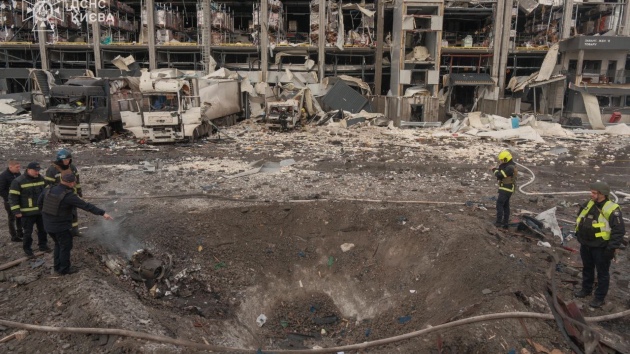
Emergency teams are on the scene dealing with the consequences of a Russian strike in Kyiv, Ukraine, on November 25, 2025, in which 6 people died, 13 were injured, 18 were rescued, and 57 received psychological support. (Photo by State Emergency Service of Ukraine/Anadolu via Getty Images)
(KYIV, Ukraine) — A barrage of at least 22 Russian missiles targeted Ukraine overnight, with at least one striking the capital, Kyiv, in what the Ukrainian minister of energy called a “massive” attack on energy infrastructure.
Russia also fired overnight at least 460 drones, several of which flew into either Moldova or Romania, Ukrainian President Volodymyr Zelenskyy said early on Tuesday.
“That is why all partners must not forget that every day lives need to be saved,” Zelenskyy said on social media. “Weapons and air defense are important, just as important is the sanction pressure on the aggressor.
Six people were killed and another 13 were injured in Ukraine, Zelenskyy said. Kyiv Mayor Vitali Klitschko earlier said two people were killed and seven others were injured.
The missile-and-drone attack followed negotiations in Switzerland over the weekend on a United States-proposed Russia-Ukraine peace plan. The strike also followed a secret meeting on Monday between U.S. Army Secretary Dan Driscoll and a Russian delegation in Abu Dhabi, a U.S. official told ABC News.
“Last night, Russia launched another attack – at a time when Ukraine, together with America, Europe, and many others around the world, are working virtually around the clock to stop the bloodshed,” Zelenskyy said on social media.
Residents of the Ukrainian capital were urged to take shelter as air-raid alerts blared.
“And so this night we spend in bombshelters, listening how the missiles rain down on Kyiv,” Kira Rudik, a member of Ukrainian parliament, said on social media. “This is russia’s response to peace negotiations.”
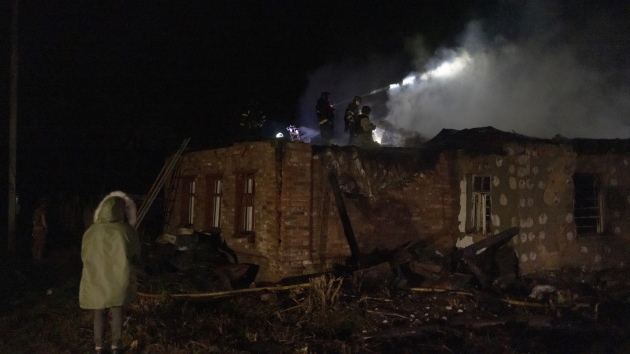
Some areas were experiencing disruptions to power and water, the Klitschko said. A residential building in one area of the city was on fire after debris hit it, he said.
“The enemy attack on Kyiv is ongoing,” Klitschko said in a post to Telegram early Tuesday local time.
Military officials in Ukraine said 438 drones and 14 missiles were destroyed or otherwise didn’t hit their targets. Missile hits and 26 strike drones were recorded impacting across 15 locations, with falling debris reported at 12 locations.
Zelenskyy said Monday said negotiators were were working toward peace “as quickly as possible.” Though he warned Ukrainians that “Russia will not ease its pressure on Ukraine.”
“In these days and weeks, it is essential to take air raid alerts and all similar strike threats very seriously,” he said on X. “We clearly understand whom we are dealing with, and all necessary orders have been issued within the Air Force and across all other components of Ukraine’s Defense and Security Forces. We will react.”
The strikes on Kyiv come a day after Russia launched over 160 drones into the country, Ukraine’s air force said.
Air defenses shot down or suppressed 125 drones, the air force said, with 37 craft impacting across 15 locations. At least four people were killed in Ukraine’s northeastern city of Kharkiv in the attack, the local mayor said.
Officials in Moldova said in a statement that 11 Russian drones entered their airspace overnight into Tuesday morning, one of which fell on a house in the northeast of the country.
Another two entered Romania, which is a NATO member, officials there said. In Romania, two German Typhoons and two Romanian F-16s were scrambled.
A Romanian Defense Ministry spokesperson told ABC News that one drone crashed in the country’s eastern Vaslui County.
It was not immediately clear if the drones were Shahed-style attack drones.
Andrii Sybiha, Ukraine’s minister of foreign affairs, decried the drone intrusions, saying on social media that they amounted to “yet another reminder that Russian aggression directly threatens not only Ukraine but also other European nations and the transatlantic community as a whole.”
“We stand in solidarity with our Odesa Triangle partners, Romania and Moldova, and condemn these reckless Russian actions,” he added.
ABC News’ David Brennan and Joe Simonetti contributed to this report.
Yevhen Titov/Global Images Ukraine via Getty Images
(LONDON) — The United States-proposed Russia-Ukraine peace plan now has fewer points following negotiations in Switzerland to try to make the draft proposal more acceptable to Ukraine, according to a Ukrainian official close to the matter.
The initial 28-point peace plan now has 19 points, according to the official. It is unclear what points were removed.
U.S., European and Ukrainian officials met in Geneva to discuss the contentious proposal put to Kyiv last week, with terms critics say would constitute a Ukrainian capitulation.
On Monday morning, U.S. President Donald Trump hinted at headway being made. “Is it really possible that big progress is being made in Peace Talks between Russia and Ukraine???” he wrote on social media.
“Don’t believe it until you see it, but something good just may be happening,” Trump added.
The talks come as fighting continues to wage in the nearly four-year war. At least four people were killed and 17 were injured in Ukraine’s northeastern city of Kharkiv in what the local mayor called a “massive” Russian drone attack on Sunday night.
“Every night and every day bring new challenges for our city, new destructions and new work,” Mayor Ihor Terekhov said in a post to Telegram.
Kharkiv was among the targets of Russia’s latest overnight attack, which Ukraine’s air force said saw 162 drones launched into the country. Air defenses shot down or suppressed 125 drones, the air force said, with 37 craft impacting across 15 locations.
“The most damage was suffered by civilian infrastructure and private households in the Kharkiv, Chernihiv and Dnipropetrovsk regions,” the air force said in a post to Telegram. “Unfortunately, there are civilian casualties.”
Russia’s Defense Ministry, meanwhile, said its forces shot down at least 103 Ukrainian drones overnight and into Monday afternoon. Four drones were shot down over the Moscow region, of which two were heading toward the capital, the ministry said.
U.S. Secretary of State Marco Rubio said Sunday that the Geneva talks were “probably the most productive and meaningful meeting we’ve had so far in this entire process since we became involved.”
Rubio told reporters that the presidents of both countries would have to approve any framework, but said he was “comfortable” they would.
“We’re making some changes and adjustments in hopes of further narrowing the differences and getting closer to an outcome that both Ukraine and the United States can be comfortable with,” Rubio said.
Rubio later Sunday said that all parties had made “great strides” on a potential peace settlement with Russia. He also said that the deadline for the parties to reach an agreement is “as soon as possible” and that the process could extend past a Thanksgiving deadline set by Trump.
“It evolved. This is a work — this is a living, breathing document every day with input, it changes,” he said of the proposal.
Trump told reporters on Saturday that there is room for further negotiation. Asked by reporters whether the 28-point plan was his last offer, Trump replied, “No.” He added, “One way or another we’ll get it ended.”
But on Sunday, the president criticized Ukraine and its European backers, saying Ukrainian “‘leadership’ has expressed zero gratitude for our efforts” and noting that “Europe continues to buy oil from Russia.”
Asked later on Sunday whether the president still considered the Ukrainians “ungrateful,” Rubio said he believed Trump was now “quite pleased” with progress at the negotiating table.
Ukrainian President Volodymyr Zelenskyy, meanwhile, said in a post to social media on Sunday that his delegation in Geneva “held a series of meetings — with the American side and with our European partners as well.”
“The delegation has just reported on the results of their discussions, and these were substantive conversations. A lot is changing — we are working very carefully on the steps needed to end the war,” Zelenskyy added.
“It is important that there is dialogue with the American representatives and there are signals President Trump’s team is hearing us,” Zelenskyy wrote.
Speaking at a forum in Stockholm, Sweden, on Monday, the president said Kyiv will “continue working with partners, especially the United States, and look for compromises that strengthen, but not weaken us. And we will continue explaining how dangerous it is to pretend that aggression is something one can simply overlook and move on.”
In talks with the U.S. so far, Zelenskyy added, “we’ve managed to keep extremely sensitive points on the table, including the full release of all Ukrainian prisoners of war under the all-for-all formula and civilians, and the complete return of Ukrainian children abducted by Russia. These are important steps, but to achieve real peace, more, more is needed.”
Kremlin spokesperson Dmitry Peskov told reporters on Monday that Russia had “not received anything official yet” regarding the outcomes of the Geneva talks.
“We are, of course, closely monitoring media reports, which have been abundant over the past few days, including from Geneva,” Peskov said.
“We have not seen any plan yet,” Peskov continued. “We have read the statement following the discussions in Geneva. Some adjustments have been made to the text we saw earlier. We will wait. Apparently, the dialogue is continuing there, and some contacts will continue. So far, I repeat, we have not received anything officially.”
On Friday, Russian President Vladimir Putin said during a meeting of his Security Council that the Kremlin had received the new 28-point U.S. proposal. “I believe that it could also form the basis for a final peace settlement, but this text has not been discussed with us in detail,” Putin said.
“I believe the reason is the same: the U.S. administration has not yet managed to secure the agreement of the Ukrainian side, as Ukraine is opposed to it,” Putin added. “Apparently, Ukraine and its European allies are still under the illusion that they can inflict a strategic defeat on Russia on the battlefield.”
ABC News’ Joseph Simonetti contributed to this report.