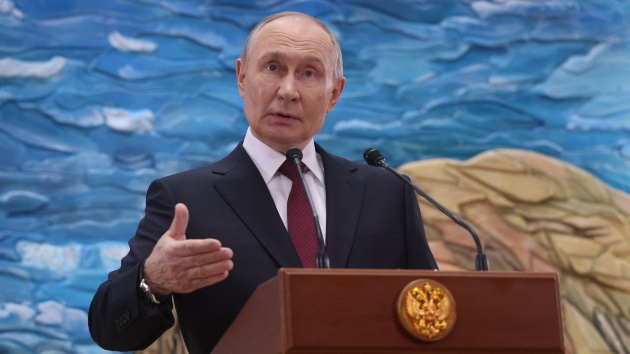
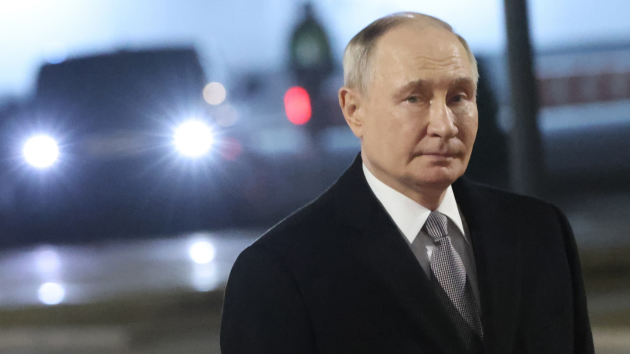
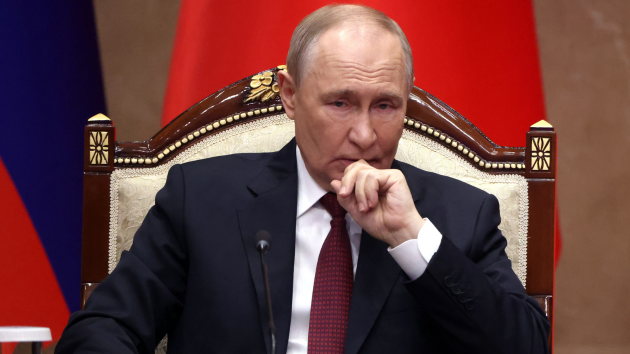
Russian President Vladimir Putin speaks during his press conference after the Summit of Collective Security Treaty Organization, on November 27, 2025 in Bishkek, Kyrgyzstan. (Photo by Contributor/Getty Images)
(KHARKIV, Ukraine and LONDON) — President Donald Trump’s special envoy Steve Witkoff is due to travel to Moscow on Monday to present a peace plan proposal to Russian President Vladimir Putin in what is expected to be a crucial test for the Trump administration’s efforts to end the war in Ukraine.
Witkoff is travelling to Putin a day after taking part in talks with a high-level Ukrainian delegation in Florida, aimed at trying to find a deal to end the war that Ukraine and Russia might accept. The Kremlin on Monday said a meeting between Witkoff and Putin was scheduled for Tuesday.
“The president will hold several closed-door meetings today in preparation for the Russian-American contacts,” spokesperson Dmitry Peskov told reporters in Moscow.
There is little expectation Putin will agree to a deal. The Russian leader has already signalled he will not compromise, last week making hardline remarks where he repeated his demands that Ukraine withdraw from territory he claims and saying it is “pointless” to negotiate with Ukrainian President Volodymyr Zelenskyy. He suggested the Kremlin believes it is making sufficient progress on the battlefield and is content to wait until Kyiv concedes to its conditions.
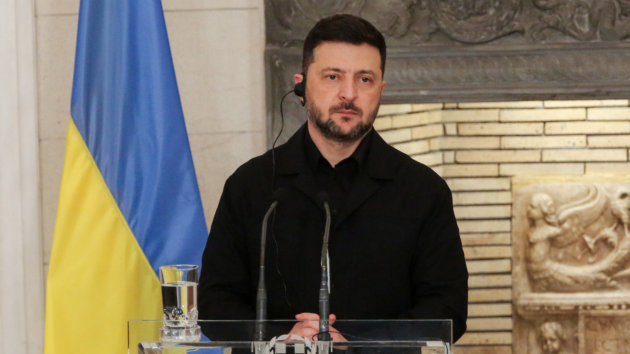
Zelenskyy is expected to be in Paris today to meet with French President Emmanuel Macron, with whom he’s expected to discuss the negotiations with the U.S. Zelenskyy and Europe appear to be signaling solidarity on a day when the U.S. and Putin are expected to dominate the airwaves.
“It will be a very substantive day,” Zelenskyy said on Monday morning. “Diplomacy, defense, energy — the priorities are clear.”
Zelenskyy on Sunday said his emissaries in Florida had reported back the “main parameters” of what had been discussed, along with “some preliminary results.” But the full details were still to be relayed, he said.
“I look forward to receiving a full report from our team during a personal meeting,” Zelenskyy said on social media.
U.S. Secretary of State Marco Rubio said on Sunday after taking part in the talks with Ukraine the next steps in the negotiations were “delicate,” adding that “it’s complicated, there are a lot of moving parts.”
There was “another party involved here that’ll have to be a part of the equation — and that’ll continue later this week when Mr. Witkoff travels to Moscow, although we’ve also been in touch in varying degrees with the Russian side,” Rubio said.
“We have a pretty good understanding of their views as well,” Rubio said.
Officials from Ukraine and the United States both said the about 2-hour meeting at Shell Bay Golf Course in Hallandale Beach were productive, but neither side released details about what agreements were made and there is no indication a breakthrough was made on the most difficult issues that would allow an end to the war.
The meeting discussed a revised 19-point peace plan that was developed a week ago during another round of negotiations in Geneva between the U.S. and Ukraine. Those talks reworked an earlier 28-point plan that the Trump administration had presented and that had alarmed Kyiv and European allies as heavily favoring Russia.
Officials on Sunday did not release details about whether the proposal had again been updated.
A source familiar with the talks said they had discussed security guarantees for Ukraine, as well as including the fate of billions of dollars of Russian assets frozen by Western countries and possible elections in Ukraine. The issue of the frozen assets was a “key” one for the Russians, the source said.
On the crucial issue, though, of Russia’s demand that Ukraine surrender unoccupied territory in the Donbas region, there was no sign of progress. The source said Russia was still unwilling to discuss any form of ceasefire and Ukraine is not willing to cede territory.
Rubio said the talks had been “a very productive and useful session where additional progress was made.”
“I think there is a shared vision here that this is not just about ending the war, which is very important; it is about securing Ukraine’s future, a future that we hope will be more prosperous than it’s ever been,” he told reporters after emerging from the talks with Rustem Umerov, the secretary of Ukraine’s National Security and Defense Council, who had been the lead negotiator from Kyiv.
“We worked — we already had a successful meeting in Geneva, and today we continued this success,” Umerov said, adding that there would be “later stages” to the talks.
Zelenskyy on Monday said initial reports from his team appeared to show that the meeting on Sunday had been “very constructive.”
“There are some tough issues that still have to be worked through,” he added.
ABC News’ Joe Simonetti contributed to this report.
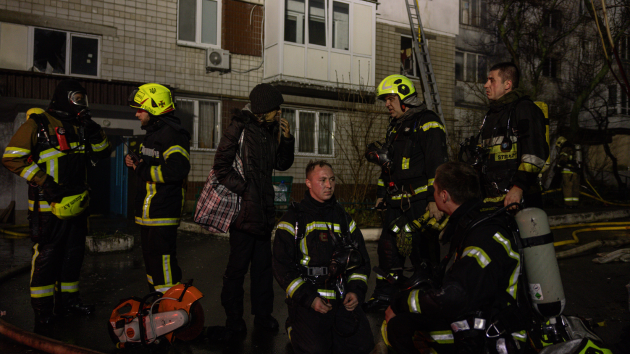
(LONDON) — Russia launched overnight a deadly aerial strike on the Ukrainian capital, killing at least one person, injuring 19 others and damaging residential buildings, President Volodymyr Zelenskyy of Ukraine said early on Sunday.
“Emergency response efforts are currently underway in Vyshhorod, Kyiv region, following the Russian attack,” Zelenskyy said on social media. “Russia struck the city with drones, damaging numerous residential buildings.”
The attack came as Zelenskyy’s top advisers traveled to the United States for high-stakes talks with the Trump administration over its proposed plan for peace between Russian and Ukraine. White House special envoy Steve Witkoff is then expected to travel early next week to Moscow, where he’ll meet with Russian President Vladimir Putin.
Zelenskyy’s advisers are expected on Sunday in Florida, where Secretary of State Marco Rubio, Witkoff and Trump’s son-in-law Jared Kushner are due to lead the talks. Ukraine is trying to hammer out its best starting position before Witkoff goes to Putin.
Doubts remain that Putin would actually agree to any plan that’s deemed acceptable to Kyiv. He has already signalled he won’t compromise — saying any talks with Zelenskyy are “pointless.”
Sunday’s talks are the first high-level negotiations between the U.S. and Ukraine since they met in Geneva, Switzerland. Those talks had begun with a 28-point plan proposed by the United States, which through negotiations became a 19-point plan. But even that revised plan had not settled what were perhaps the most difficult issues — including whether Ukraine would cede any territory to Russia and whether Ukraine could in the future apply for NATO membership.
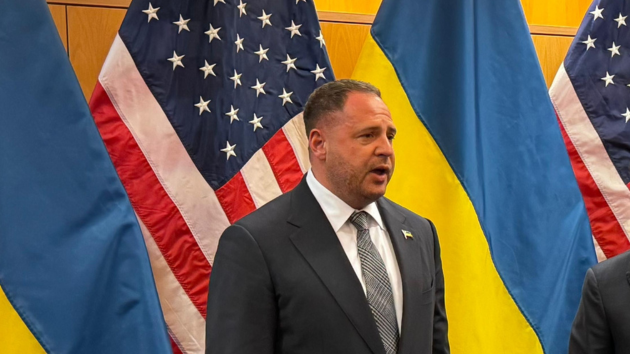
The Ukrainian delegation is being led by Rustem Umerov, the head of the National Security Council. It follows Zelenskyy’s Chief of Staff Andriy Yermak being forced to resign amid a corruption scandal that has rocked the country and left Zelenskyy without his right-hand man at a difficult moment.
Umerov was questioned in connection with the scandal by investigators, according to Reuters and local media, but he has not been formally accused of wrongdoing.
Zelenskyy on Sunday morning said Russia launched a total in the last week of about 1,400 drones and 66 missiles, as well as over a thousand aerial bombs, against Ukraine, underlining the scale of Russia’s increased air campaign as peace talks go on.
“This is exactly why we must strengthen Ukraine’s resilience every single day,” Zelenskyy said. “Missiles and air-defense systems are essential, and just as crucial is active work with our partners for peace. We need real, reliable solutions that will help end this war. I thank everyone who is helping.”
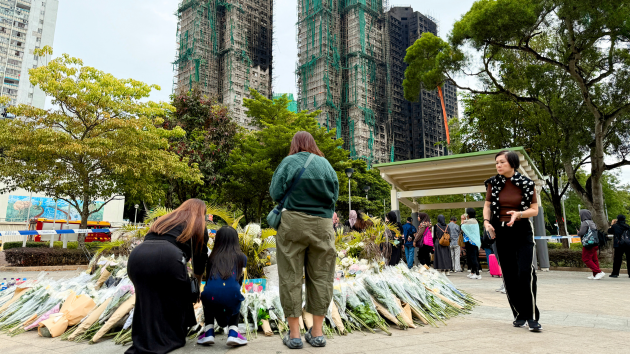
(LONDON) — The death toll following a massive fire that ripped through several Hong Kong high-rises has climbed to 146 people, the Hong Kong police on Sunday.
Speaking at a news conference, the police said they are not ruling out the possibility that the number of dead from the fire would increase.
With an “optimistic” estimation, the police added that the time for the search and operations is three to four weeks.
The massive fire engulfed the Wang Fuk Court, a residential apartment complex in Hong Kong’s Tai Po district, on Wednesday afternoon, officials said. Within hours it was upgraded to a No. 5 alarm, city officials said.
Three men associated with the construction firm in charge of the renovation at the housing complex were arrested and were under investigation in connection with the fire, Hong Kong police said during a press conference on Thursday morning.
Officials in Hong Kong announced Friday there would be three days of mourning for the victims.
From Nov. 29 to Dec. 1, national flags will be flown at half-mast and there will be a three-minute moment of silence on Nov. 29 at 8 a.m. Citizens will also have the opportunity to sign condolence books for the victims.
“During this period, government officials will not attend non-essential public activities. All entertainment and celebration activities organized or funded by the government will be cancelled or postponed as appropriate,” officials said.
(NEW YORK) — Ukraine is sending a high-level delegation to the U.S. on Saturday for more talks on the Trump administration’s new peace plan, ahead of White House envoy Steve Witkoff’s visit to Moscow expected early next week.
Ukraine’s presidential office confirmed the delegation is on its way.
The Ukrainian delegation will now be led by the head of Ukraine’s National Security and Defense Council, Rustem Umerov, after Ukraine President Volodymyr Zelenskyy’s chief of staff was forced to resign on Friday amid a corruption scandal.
Ukraine’s head of military intelligence, Kyrylo Budanov, is also listed as part of the delegation, as well as senior military, security and foreign ministry officials.
The U.S. and Ukraine last held talks around a week ago in Geneva when they revised the peace plan to make it more acceptable to Ukraine.
In a post on social media on Saturday, Zelenskyy said he expects to be briefed by Umerov on the outcome of the talks on Sunday.
The talks are aimed at ensuring the results from the Geneva talks a week ago are “hammered out” and to “swiftly and substantively work out the steps needed to end the war,” he said.
“Secretary of the National Security and Defense Council of Ukraine and head of the Ukrainian delegation Rustem Umerov, together with the team, is already on the way to the United States. Rustem delivered a report today, and the task is clear: to swiftly and substantively work out the steps needed to end the war,” Zelenskyy said.
“Ukraine continues to work with the United States in the most constructive way possible, and we expect that the results of the meetings in Geneva will now be hammered out in the United States,” Zelenskyy continued. “I look forward to our delegation’s report following its work this Sunday. Ukraine is working for a dignified peace.”
Meanwhile, Kyiv was targeted with major attack overnight into Saturday as Ukraine’s foreign minister said last night’s attack shows how Putin is determined to prolong the war despite the peace talks and called on the international community to help out more pressure on Russia.
“While everyone is discussing points of peace plans, Russia continues to pursue its “war plan” of two points: to kill and destroy,” Andriy Sybiha, the the Ukrainian foreign minister, wrote on X.
“Putin wants to prolong the war at any cost. The war he cannot win — and the war refuses to end. But the international community has the means to ensure that this cost becomes unbearable for him,” he said. “We urge additional support for Ukraine’s defense and resilience, additional strong sanctions on Russia, and a swift decision to enable the full use of frozen Russian assets.”
(LONDON) — Ukrainian President Volodymyr Zelenskyy said that Andriy Yermak, his chief of staff, has resigned after anti-corruption searches on his home and office on Friday morning.
Zelenskyy announced the resignation in an address he posted online Friday.
The head of Zelenskyy’s presidential office, Yermak is the president’s powerful right-hand man and had been leading the negotiations with the United States to end the war with Russia.
Yermak’s fall strips Zelenskyy of his closest adviser and chief negotiator at a moment when he has been under intense pressure to agree to a new peace plan with Russia.
Yermak had increasingly faced suspicion he could be implicated in a sprawling high-level corruption scandal in Ukraine’s energy sector that has rocked the country’s government, already taking in a former business partner of Zelenskyy’s and prompting the resignations of the justice and energy ministers.
Zelenskyy had resisted calls for Yermak’s resignation, but after the highly publicized raids on Yermak’s addresses Friday morning, he appeared to have concluded the suspicions against his chief of staff were causing too much damage. He did not directly acknowledge the raids or accusations during his address, saying he had made the decision to remove Yermak because he wanted to “avoid rumors and speculation” that could harm internal unity at a critical time.
““For internal strength to exist, there must be no reasons to be distracted by anything other than defending Ukraine. I want there to be no questions whatsoever about Ukraine,” Zelenskky said in the video statement.
He said he would hold consultations on Saturday to choose Yermak’s replacement.
Investigators from Ukraine’s National Anti-Corruption Bureau (NABU) and Special Anti-Corruption Prosecutor’s Office (SAPO) on Friday morning raided Yermak’s office and home as part of their investigation into the corruption scandal that has been dubbed “Mindich-gate” in Ukraine, a reference to Zelenskyy’s former business partner Timur Mindich who is implicated.
Prosecutors allege senior officials and Mindich arranged a kickback scheme that funneled tens of millions of dollars from contractors building defenses to protect Ukraine’s energy infrastructure. Investigators have not formally announced any allegations against Yermak or charged him. But he has faced mounting suspicion with critics alleging Yermak must have known about the corruption or bore responsibility for it. Some members of Parliament and anti-corruption campaigners also alleged that he was featured in recording made as part of the investigation under the name “Ali Baba.”
Yermak was also accused by opponents of being behind a failed attempt over the summer by Zelenskyy’s administration to strip independence from the same anti-corruption bodies now investigating him, which triggered mass protests.
There is no evidence Zelenskyy himself knew about the alleged corruption scheme or benefited from it. But as the scandal moved to the heart of his administration, he faced widespread calls to act or be seen as complicit, with worries he could face protests again if Yermak remained in post.
On Friday before his resignation Yermak posted he was “fully assisting” investigators.
Often referred to as Zelenskyy’s “grey cardinal,” Yermak has long-faced accusations of creeping authoritarianism and over-centralizing power, while allegations of corruption have lingered.
He has played a central role in Ukraine’s negotiations, including leading the delegation to Geneva last weekend for the talks with the U.S. on the Trump administration’s new peace plan. In an interview on Thursday with Time Magazine, Yermak ruled out ceding any territory to Russia.
Zelenskyy on Friday thanked Yermak for his role in leading the negotiations to end the war, saying “it has always been a patriotic position” and that he had represented Ukraine’s position “exactly as it should be.”
New peace talks are expected to be held perhaps as early as this weekend and Zelenskyy said they would now be headed by the head of Ukraine’s General Staff, as well as its National Security Council and foreign ministry representatives.
(LONDON) — A month after a massacre that was reported in a war-ravaged city of Sudan shocked the world, the United Nations and others are warning that there’s nowhere near enough humanitarian aid being provided to the tens of thousands of residents who fled.
Many thousands more are believed to still be trapped inside El Fasher, the besieged capital of the Darfur region in Sudan’s west. The Rapid Support Forces (RSF), the powerful Sudanese paramilitary group that took over the city last month, is allegedly preventing people from leaving and stopping lifesaving supplies from coming in.
The U.N. Resident and Humanitarian Coordinator in Sudan, Denise Brown, who returned from the Darfur region last week, said the amount of aid they were able to currently provide to the survivors from El Fasher wasn’t close to what is needed.
“We do not have enough food, we do not have enough of anything,” Brown told ABC News in a telephone interview last Friday. “The international community has to step up.”
Sudan has been embroiled in a brutal civil war since 2023, when fighting erupted in the capital of Khartoum between forces loyal to rival military leaders. It was the culmination of weeks of tensions between Gen. Abdel-Fattah Burhan, the commander of the Sudanese Armed Forces, and Gen. Mohammed Hamdan Dagalo, known as Hemedti, the head of the RSF. The two men were once allies who had jointly orchestrated a military coup in 2021 that dissolved Sudan’s power-sharing government and derailed its short-lived transition to democracy, following the ousting of a long-time dictator in 2019.
Officially formed in 2013, the RSF evolved out of the notorious Janjaweed militias used by the Sudanese government to crush an armed rebellion in the Darfur region in the 2000s. Sudanese forces and the Janjaweed were accused of committing war crimes in Darfur.
Ultimately, the International Criminal Court charged Sudan’s former dictatorial ruler Omar al-Bashir with genocide. The reported atrocities in El Fasher are seen by experts as a continuation of that genocide.
Sudan’s civil war has since become “one of the worst humanitarian crises of the 21st century,” according to the U.N., with tens of thousands of people killed and millions more displaced. In January, the U.S. Department of State said both sides had committed war crimes and concluded “that members of the RSF and allied militias have committed genocide in Sudan,” citing the systematic murder of civilians, sexual violence and denial of humanitarian aid for civilians caught in the conflict.
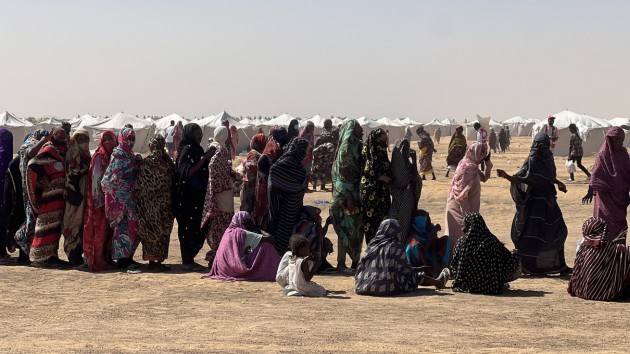
El Fasher was the last stronghold of the Sudanese army and its allied militias in the wider Darfur region, under total siege for over a year and a half before falling to the RSF in late October. At least 80,000 people are estimated to have fled El Fasher and sought refuge in a massive displacement camp in the town of Tawila, with most making the 35-mile journey on foot. The camp was already home to around 600,000 displaced people, according to humanitarian aid workers.
Many of those from El Fasher bring with them horrific accounts of atrocities allegedly carried out by the RSF, including summary executions, gang rape and killing anyone who tries to flee the city. The U.N. believes as many as 50,000 people may still be trapped in El Fasher, considered to be detained there by the RSF, according to Brown.
An analysis of satellite imagery by the Yale School of Public Health’s Humanitarian Research Lab found evidence of continuing mass killings in the days after the RSF took control of El Fasher, with blood-stained sand and piles of bodies apparently visible from space. Moreover, a U.N.-backed monitor for food security declared earlier this month that famine had taken hold in El Fasher and surrounding areas.
Brown said the U.N.’s capability to respond to the crisis is limited by a yawning shortfall in funding from countries and donors.
“We are 28% funded,” she told ABC News. “So what would the international community like me to do to respond to the needs of the people who are traumatized?”
Despite having less than a third of the funding needed, Brown said: “We’re one of the best funded humanitarian responses in the world, at 28%, and there have been cuts across the board by donors. So it’s a cumulative effect of those cuts.”
The United States has long been the U.N.’s largest donor but, under President Donald Trump, has recently withdrawn from several U.N. agencies, frozen funding for others and clawed back $ 1 billion in previously approved funds for the U.N.
“Everyone is calling and asking how can we help? Well, here is how you can help,” Brown told ABC News. “Money is not the solution to what’s going on in Sudan, but money is surely going to help our humanitarian response.”
In particular, Brown said, the U.N. was currently unable to provide enough care or psychological support for women and girls in the Tawila camp who had suffered sexual violence. The U.N. has hundreds of documented cases of gang rape and other sexual violence in the Darfur region, but that is believed to be just “the tip of the iceberg,” according to Brown.
The U.N. has been trying to negotiate with the RSF to allow humanitarian access into El Fasher — so far, unsuccessfully.
The head of the U.N. Office for the Coordination of Humanitarian Affairs, Tom Fletcher, traveled with Brown to Darfur last week to meet with the RSF, requesting complete access throughout Sudan for humanitarian operations and providing the U.N.’s conditions for such an agreement.
“We need safe passage. We want a small team, no presence of any armed militia,” Brown told ABC News. “We need to go to the sites which we have identified as important. We need to be able to evacuate the injured and access to detainees.”
(LONDON) — A woman has died, and a man was seriously injured after a shark attack off Australia’s east coast, police said Friday.
Emergency services were called to a beach at Crowdy Bay, about 40 miles south of Port Macquarie in New South Wales, around 6:30 a.m. Thursday after reports that two people had been bitten, according to New South Wales Police.
A witness helped the victims before paramedics arrived, but the woman, who was believed to be 25, died at the scene, police said.
“The 26-year-old man sustained serious injuries and was airlifted to the John Hunter Hospital where he remains in a serious but stable condition,” police said.
Authorities said the pair are believed to have been visiting from Switzerland, though neither victim has been publicly identified.
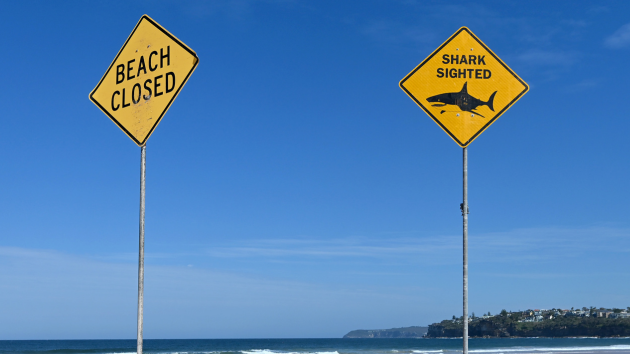
The beach remained closed Friday as police continued their investigation, and a report is being prepared by the coroner.
(NEW YORK) — Authorities on the Caribbean island of Tobago say they’re investigating the death of an American man who was found fatally stabbed on Wednesday.
The victim was identified as Christopher Brown, 42, of Silverthorne, Colorado, the Trinidad and Tobago Police Service told ABC News.
Brown was having dinner with friends at Marguarite’s Local Cuisine in the seaside village of Castara on Wednesday and accompanied the group when they went to a second restaurant and bar nearby to have drinks afterward, police said.
He then apparently left the second location, telling his friends that he was going to buy marijuana, and walked along a main road in Castara, according to the police report.
Police received a report just after 10:30 p.m. local time of a “motionless body bearing a stab wound to the back” on Depot Road in Castara, the report states. When they arrived at the scene, they observed several wounds on the man’s body, as well as a “metallic object” protruding from his back.
“The Division of Tourism, Culture, Antiquities and Transportation is profoundly saddened and deeply disturbed by the tragic murder of a foreign national in the peaceful community of Castara,” the agency said in a statement. “The Division strongly condemns this horrific act of violence and extends our heartfelt condolences to the family, friends and loved ones of the deceased during this unimaginably difficult time,” a statement from the agency read.
One suspect is in custody, but they have not been charged at this time, police said.
(LONDON and KYIV, Ukraine)– Russian President Vladimir Putin said a U.S. delegation is expected to arrive in Moscow in the first half of next week to discuss the latest American proposal to end the Kremlin’s war in Ukraine.
Speaking at a press conference during a visit to Bishkek, Kyrgyzstan, on Thursday, Putin said no draft peace agreement had been agreed to in recent talks between the U.S. and Ukraine, only a list of issues to be discussed.
Putin also said it was “pointless” to sign any documents with Ukraine’s current leadership, alleging that Ukrainian President Volodymyr Zelenskyy lacked legitimacy to do so.
In a series of hardline statements — his most extensive comments on the latest U.S.-proposed peace plan to date — Putin repeated some of Russia’s most hardline demands, including that Ukrainian troops must withdraw from territory Moscow claims. Putin ruled out signing any ceasefire deal before Ukrainian troops withdraw.
“If Ukraine’s troops leave the territory occupied, then military action will stop. If they won’t leave then we will achieve that by armed force,” Putin said.
He also said recognition of Russia’s occupation of Crimea, Donbas and a swath of eastern and southern Ukraine must be part of negotiations with the U.S.
Putin projected confidence about Russia’s battlefield position, claiming there was a “positive dynamic” everywhere on the front. The president said Russia was “ready in principle” to “fight to the last Ukrainian.”
Ahead of Witkoff’s expected trip to Moscow next week, Putin said the latest American peace proposals “can be the basis for future agreements.”
“Overall, we see that the American side is taking into account our position, which was discussed before Anchorage and after Alaska,” he added, referring to his August summit with Trump. “In some areas, we definitely need to sit down and seriously discuss specific issues,” Putin said.
Putin also answered questions about a leaked recording of a purported phone call between President Donald Trump’s envoy Steve Witkoff and top Kremlin aide Yuri Ushakov, in which Witkoff appeared to be offering Ushakov advice on how Moscow could present its own peace plans to Trump.
“This may be some kind of fake news,” Putin said. “Maybe they really did eavesdrop. Actually, this is a criminal offense; eavesdropping is illegal in our country. It’s not about us. It’s about the battle of opinions between the collective West and the U.S. over what needs to be done to end the hostilities.”
(LONDON and KYIV, Ukraine) — Russian President Vladimir Putin appeared last week to be cautiously optimistic on the U.S. 28-point peace plan to end his invasion of Ukraine, but statements made by his emissaries in the days since then have led some analysts to believe he thinks he can get a better deal.
“I believe that it could also form the basis for a final peace settlement, but this text has not been discussed with us in detail,” Putin told his Security Council on Friday.
Momentum has appeared to be building as U.S., European, Ukrainian and Russian representatives met first in Geneva, Switzerland, and then in Abu Dhabi in the United Arab Emirates. U.S. President Donald Trump has now said a deal could be “very close” and has ordered his envoy Steve Witkoff to travel to Moscow next week to present the plan to Putin.
But despite the diplomatic flurry and public optimism, many close observers of Russia still doubt Putin is actually ready to take a deal now or sees much need to compromise.
“I see nothing at the moment that would force Putin to recalculate his goals or abandon his core demands,” Tatiana Stoyanova, founder of R.Politik and a senior fellow at the Carnegie Russia Eurasia Center wrote on X.
“He feels more confident than ever about the battlefield situation and is convinced that he can wait until Kyiv finally accepts that it cannot win and must negotiate on Russia’s well-known terms,” Stoyanova said. “If the Americans can help move things in that direction — fine. If not, he knows how to proceed anyway.”
Boris Bondarev, a former Russian diplomat who quit in protest after Russia’s 2022 invasion, also told ABC News he thought it “most likely” that this latest round of negotiations will fizzle out with the combatants still far apart on key issues, as has been the case with previous efforts.
The new 19-point plan negotiated with Ukraine this week is highly unlikely to align with Moscow’s goals, Bondarev said. Even the original 28-point plan that Russia helped draw up with Witkoff “wasn’t fully acceptable to Russia in the first place,” he said, pointing to the Kremlin’s apparent hesitance to commit to the initial blueprint.
“Now it’s even less acceptable,” he said. “So, of course, they would not accept it.”
But Bondarev didn’t rule out entirely that Putin might lunge for a deal that contains many of his demands.
“Of course, we can and we should be ready for any surprises from the Kremlin,” he said. “They can still surprise sometimes.”
The original 28-point U.S. proposal that heavily favored Russia was revised down to 19, according to U.S. and Ukrainian officials, during the Geneva negotiations.
Some of the most unacceptable points to Kyiv have been removed, according to sources familiar with the discussions, including a cap on Ukraine’s army and a war crimes amnesty. But it is not entirely clear what the new plan includes and the most intractable issues, including Ukraine ceding more unoccupied territory remain.
Kremlin spokesperson Dmitry Peskov on Wednesday again downplayed hopes for a deal, saying it was “too early to say” whether the warring parties are close to an accord. Russia’s deputy foreign minister has since said Moscow will not make any major concessions.
Previous rounds of talks have resoundingly failed. And, while the U.S. has been projecting hope, it’s unclear how serious Russia — which has been eking out battlefield gains — is about making peace.
“Putin does not want an agreement,” John Herbst, a former U.S. ambassador to Ukraine, said at an Atlantic Council event on Tuesday. “The only agreement he wants is diktat — a Ukrainian surrender. Otherwise, he wants to continue fighting.”
“I suspect if Ukraine had accepted those dreadful 28 points, Putin would come back for more,” Herbst said. “He realizes those 28 points reflected great flexibility moving his direction on the part of the United States, and he would say, ‘See what else we can get’.”
Putin’s long march The Kremlin has indicated that the new peace plan was discussed at the summit between Putin and Trump in Alaska in August.
Putin left Alaska with Trump’s endorsement of the “fantastic relationship” between the two presidents, having successfully neutralized Trump’s previous demand he agree an immediate ceasefire and pushing off the threat of more American sanctions, while gaining the prospect of potentially lucrative bilateral economic cooperation.
Despite a nominal commitment to peace talks, as summer turned to fall, Russia only intensified its frontline offensives and expanded its long-range attacks on Ukrainian cities and critical infrastructure, according to information released by Russian and Ukrainian forces.
Russian forces have captured some 350 square miles of Ukrainian territory — roughly the same area as the German capital of Berlin — since Trump and Putin sat down together in Alaska, according to data from the Institute for the Study of War think tank.
Putin has for years said that any peace deal in Ukraine must reflect the “new territorial realities” of Russian occupation of large chunks of the country. As Russian troops edge forward, Putin appears to be trying to entrench those territorial realities.
That new territory is a tiny sliver of the roughly 44,600 square miles — nearly 20% — of Ukraine controlled by Russian forces. But despite the slow rate and reportedly high human cost of Russia’s advance, independent military analysts worry it reflects a growing momentum for Moscow.
A high-profile advance around the destroyed Donetsk city of Pokrovsk and an unexpected local breakthrough on Ukraine southern Zaporizhzhia front have further burnished the Kremlin’s propaganda campaign promoting what they claim as an inevitable Russian victory.
Relentless Russian drone and missile strikes continue to kill civilians and wreak havoc on Ukraine’s critical infrastructure, particularly the energy grid. Concentrated strikes on power stations and natural gas infrastructure have precipitated rolling blackouts in many parts of the country — including in Kyiv — as winter bites.
Zelenskyy’s government has also been rocked by a corruption scandal that has seen two cabinet ministers removed from their posts and figures close to the president investigated.
Bondarev said he believes Russia is repeating its strategy of delay and obfuscation. Putin is “playing for time,” he said, and “outsmarting” his Western adversaries.
“Putin says we need to remove the root causes of the war,” Bondarev said. “You cannot remove these root causes of the war just by signing some memorandum. You need to work it through. It takes a lot of experts, meetings, coordination — so it may take months. And at the same time, he will be fighting.”
“With each new tiny victory — every new village occupied, every square kilometer occupied — the Russian position will be more and more robust, less and less flexible,” Bondarev said.
Red lines “People’s expectations for how long a process like this will take are wildly exaggerated,” Samuel Charap, a senior political scientist at the RAND Corporation, told ABC News this week.
“I think even in the best case we are talking about months not weeks,” Charap added.
Still, Charap said, the new push by the Trump administration was positive, noting it had jumpstarted negotiations and for the first time produced a framework document that at least included almost all the core issues of the conflict.
“You have to give them credit, they have certainly shaken up the stasis which had set in,” he said. “There are conversations happening that weren’t happening a week ago.”
Ukrainian lawmakers and analysts told ABC News there remains little hope in Ukraine that Putin can be trusted to abide by the terms of any peace deal. That is why Kyiv’s demands for Western security guarantees, NATO membership and more military aid have been so central to the Ukrainian negotiating position.
Still, Yehor Cherniev — a member of the Ukrainian parliament and the chairman of his country’s delegation to the NATO Parliamentary Assembly — told ABC News that the framework established with the U.S. “is a good signal and it’s good progress in our peace negotiations, because before we were stuck.”
But some “red lines” remain, Cherniev said, “as before, about the concession of our territories or of or our sovereignty.” Ukrainian officials have said they want to leave such thorny topics to a meeting between Trump and Zelenskyy at the White House.
“I have doubts that Russia will agree with this,” Cherniev added.
Oleksandr Merezhko, another member of parliament and the chair of its foreign affairs committee, told ABC News he believes “Putin will reject this peace plan and will reiterate his maximalist demands.”
“He is not interested in peace or ceasefire — he is only interested in our surrender,” Merezhko said. “We should insist not on a ‘peace treaty’ but on a ceasefire agreement.”
Zelenskyy has consistently urged more pressure on Russia twinned with more muscular Western military aid for Kyiv. Trump has often threatened a tougher line on Moscow, but — according to Daniel Fried, a former U.S. ambassador to Poland — it is unclear if he is willing to deliver.
“In the end, Trump is going to have to stare down Putin to get his deal in any kind of decent form,” Fried said at an event Tuesday.
But Bondarev said he sees little hope of an imminent change in U.S. strategy, suggesting that any disunity within the administration will only further strengthen Moscow’s hand.
“Western diplomacy has never tried to get the initiative, to first elaborate its own agenda and impose it on Russia,” the former diplomat said. “They only follow what Russia is doing. You can never prevail if you just follow your adversary and let him lead.”
“Trump mentioned that ‘it takes two to tango,'” he added. “But there is someone in every couple who leads and someone who follows.”