View of the Cour Napoleon, a historic courtyard in the Louvre Museum and the Louvre Pyramid in Paris, France on November 12th, 2025. (Photo by Beata Zawrzel/NurPhoto via Getty Images)
(PARIS and LONDON) — Nobody was monitoring the live feed.
As masked men hacked a hole in a window at the Louvre Museum in Paris in October, a security camera inside the gallery was picking up the spot where they were working, Noel Corbin, the head of France’s inspectorate general of culture told the country’s Senate at a hearing on Wednesday.
As men clambered into the world-famous museum, nobody was actively monitoring that specific feed, legislators were told. And, even as the robbers collected their loot — allegedly stealing French crown jewels worth some $102 million — the security staff at a bank of screens weren’t yet focused on the camera catching the robbery, Corbin said.
The camera’s zoom wasn’t “activated” until 9:38 a.m., about four minutes after the robbery began, the Senate was told. By then, the blink-and-you-miss-it robbery was all but over.
The Senate was told on Wednesday that there had been “insufficient screens” in the security guard’s control room to simultaneously view images from all the cameras in the museum.
While the live video feed from one the Apollo Gallery appeared to have been transmitted during the robbery, it wasn’t immediately clear why it wasn’t among those being monitored remotely by a live person. Another camera near the scene wasn’t working that day, Corbin said.
The latest details on apparent faults in security at the world’s most-visited museum came as the French government and law enforcement sought through a sprawling investigation to understand how those alleged lapses in procedure and equipment may have worked in favor of the robbers.
The robbery suspects fled on motorbikes, police said at the time of the heist. At least seven people have since been arrested, five of whom have been formally charged in connection to the heist, French officials said. But the irreplaceable jewels taken during the Sunday morning heist have not yet been recovered.
The Senate on Wednesday heard new details on what appeared to have happened during the heist, including that there had been “insufficient screens.” That lack of screens had been highlighted in a security audit carried out earlier in the year, one of five such audits that had been carried out in the last decade, the watchdog said.
One of those audits, the one carried out in 2019 by a private auditor, had specifically focused on the Apollo Gallery, the watchdog said, adding that another in 2015 had focused on the museum’s computer systems.
The Senate was told that the findings of those audits included details about security cameras, some of which were described as “obsolete.” It was not immediately clear if the camera faced at the window in the Apollo Gallery was characterized as such.
As the robbery unfolded, the Senate heard on Wednesday, members of a private Securitas security team arrived outside the museum quickly enough that they may have stopped the robbers from lighting their vehicle — a moving ladder — on fire, thus apparently saving crucial evidence that’s led to arrests.
But if they had arrived at least 30 seconds earlier they could have stopped the robbers from escaping, the Senate was told, with the watchdog adding that a quicker viewing of the live feed from the internal security camera might have made the difference.
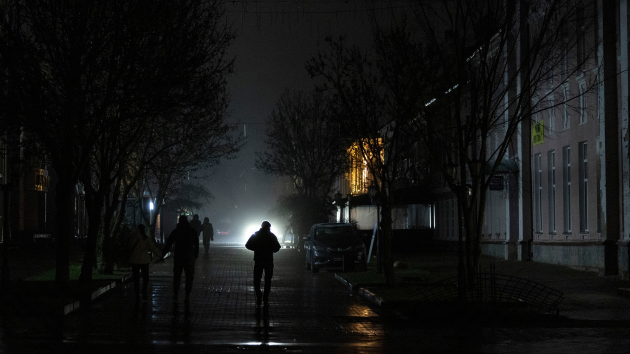
People walk through the streets of Sumy during emergency power cuts on December 9, 2025 in Sumy, Ukraine. (Maksym Kishka/Frontliner/Getty Images)
(LONDON) — Millions of Ukrainians have been plunged into frequent darkness and cold as Russian drones and missiles wage a systematic long-range campaign against the country’s energy grid for the fourth consecutive winter.
Even at the offices of Ukraine’s mammoth state-owned Naftogaz oil and gas conglomerate in Kyiv, emergency generators have been keeping the lights on.
“What I can see from my window — there is an absolutely dark city with only some lights,” CEO Sergii Koretskyi told ABC News during a video interview. “I’m sure people recognize this winter as the most difficult since the full-scale invasion started. We can see power cuts from four up to 10 hours a day.”
Russia’s nightly bombardments have increasingly targeted energy infrastructure in recent months, Ukrainian officials say, often involving hundreds of drones and dozens of missiles.
Ukrainian President Voloydmyr Zelenskyy has repeatedly appealed for more Western military aid to help blunt such strikes. “The Russians’ goal is to hurt millions of Ukrainians,” the president said in a social media post on Saturday.
Between October and December so far, Naftogaz recorded 11 “massive attacks on gas infrastructure across Ukraine,” Koretskyi said. “Our gas production infrastructure has suffered significant damage and destruction,” he added.
Naftogaz estimates the combined cost of covering its gas shortfall and repairing its production and storage infrastructure at more than $3 billion, Koretskyi said.
“We can see that the scale and intensity of strikes have changed dramatically,” Koretskyi added. This year’s bombardments have been even more punishing than those in the back end of last winter, he added, when Ukraine had 42% of its domestic gas production knocked out.
Throughout its full-scale invasion — which began in February 2022 following eight years of lower-intensity cross-border Russian aggression — Moscow has denied intentionally targeting civilians or civilian infrastructure.
The Russian Defense Ministry says it attacks Ukrainian fuel and energy targets that support the Ukrainian armed forces and Ukraine’s military-industrial enterprises.
Ukraine is also waging its own long-range strike campaign against Russian energy targets, particularly oil storage and refining facilities. Kyiv says the lucrative proceeds from Russian oil exports help fund Moscow’s ongoing invasion.
Koretskyi declined to say what proportion of the country’s gas production and storage capacities had been taken offline during this winter’s attacks, citing operational security and Moscow’s use of public statements and statistics to guide its strike campaign.
But virtually all of Ukraine’s regions now routinely face rolling blackouts, imposed to help protect the country’s grid while repairs are carried out, leaving millions with only hours of power.
Naftogaz says it supplies gas to 12.5 million households across Ukraine. Around 80% of the population using gas to heat their homes. Each night of Russian attacks threatens new blackouts for tens of thousands and sometimes hundreds of thousands of people.
“Their goal is clear — this is pure terrorism,” he said, “to put us into the darkness without heat during this winter season.”
Analysts have suggested that Western support could prove vital in helping Ukraine through this winter.
“Without substantial Western support — particularly air defense systems, transformers, and financial assistance for emergency repairs — blackouts are likely to be more regular, people will suffer in the cold, and economic activity may slow,” political consultant Kateryna Odarchenk wrote for the Center for European Policy Analysis this month.
Zelenskyy and his top officials have consistently pressed Western allies to provide more air defense systems and ammunition, to help Ukrainian defenders protect civilian centers, military sites and critical infrastructure.
Yuriy Boyechko, the CEO of the Hope For Ukraine charity, told ABC News that the current energy crisis is a result of inadequate air defenses in the face of “the relentless deluge of Russian missiles and drones.” He added, “The only viable solution is immediate, comprehensive air defense support from Western allies.”
The bombing has wrought holes in Ukraine’s energy network. As of December, Naftogaz estimated that Ukraine needed to import 4.4 billion cubic meters of gas through to the end of this heating season — which Ukraine’s government estimates will end by around March 31.
This is expected to cost some €1.9 billion — around $2.2 billion — Koretskyi said. Zelenskyy and his government have mobilized to secure the funding from foreign partners and financial institutions, but Naftogaz’s chief said a hole of around €600 million remains.
Kyiv is turning to private companies in gas-rich nations like the U.S. to help fill the gap. Companies require two permits to export natural gas — one from the Federal Energy Regulatory Commission and one from the Department of Energy.
This year already, more than 500 million cubic meters of American liquid natural gas (LNG) have been imported, with another 300 million cubic meters agreed for import earlier next year.
Through 2026, Koretskyi said, Ukraine would like to bring in another 1 billion cubic meters of American LNG. “We would like to build long-term relationships with U.S. LNG suppliers,” he said.
A recent agreement to import U.S. LNG through the Soviet-era Trans-Balkan pipeline running from Greece is also part of this drive, Ukrainian officials have said.
But as Russia’s attacks grow larger and more sophisticated, the cost and complexity of recovery grows. Naftogaz’s list of equipment needed for repairs is now 190 items strong, Koretskyi said. The estimated cost of this badly needed equipment is more than $900 million, he added.
“There are two lists of equipment — the first one for repairing or replacing those damaged or even destroyed, and the second is for a strategic reserve for upcoming potential attacks,” he explained. U.S. and European suppliers, Koretskyi said, could prove pivotal in filling the gaps.
“The lead time — of production time, delivery and installation — will take between eight and 18 months,” Koretskyi said. “So, we should be ready not just for this winter season, but for the next heating season.”
Meanwhile, the strikes and blackouts continue.
On Dec. 4, for example, the Kherson central heating plant in the southern frontline city was knocked offline after days of attacks by various Russian weapons systems. Kherson military administration head Oleksandr Prokudin said that disruption left more than 40,000 without heat.
“It’s like a nightmare,” Koretskyi said of life under rolling blackouts for many Ukrainians. “I do believe Ukrainians recognize the risk, the challenge, that Russia will continue bombing us.”
“Nobody can imagine what will happen in the coming months or weeks,” he added, suggesting that Ukrainians may have to summon reserves of resilience already tapped by almost four years of full-scale war.
“This is not a sprint, it’s a marathon,” Koretskyi said. “The war changes, upgrades and becomes different every day. The measures for survival, for protection, should be changed as well … That’s how we live.”
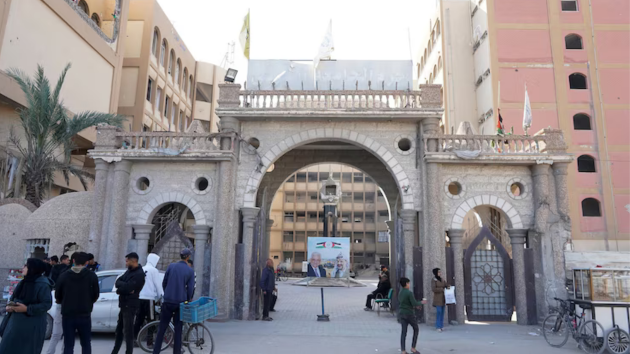
Al Azhar University in Gaza. (Diaa Ostaz/ABC News)
(GAZA STRIP) — After two consecutive years of war that upended nearly every aspect of life in the Gaza Strip, universities are slowly beginning to reopen, restoring a path to education despite extraordinary levels of destruction.
Before Oct. 7, 2023, Gaza had 17 higher-education institutions, comprising hundreds of buildings. Today, most of these facilities are in ruins, according to the Palestinian Ministry of Education and Higher Education.
More than 100 university buildings were destroyed during the war, while roughly 200 university employees were killed, the education ministry said. The devastation has raised doubts about whether higher education could resume at all. But at Al-Azhar University in Gaza, the administration and some students told ABC News they are determined not to let the war erase an entire generation’s future.
When ABC News visited the temporary campus where Al-Azhar has resumed in-person teaching, the damaged classrooms and improvised facilities reflected the depth of the crisis–yet they also highlighted the resilience of students returning with determination to continue their studies.
The university’s vice president, Dr. Muhammad Shubeir, said the decision to reopen was driven by necessity and by a sense of duty.
“During the difficult period of the war, we resumed the teaching,” online, Shubeir told ABC News. He said the staff worked from dangerous areas just to secure satellite internet. “We faced many risks, but thank God, we were able to continue until the war ended.”
As soon as conditions allowed, the administration said it moved toward restoring in-person learning, even though one of Al-Azhar’s largest campuses–its new facility in the Al Zahra area, which turned into the Netzarim corridor during the war — had been completely leveled.
“Despite losing everything at the university–especially the new campus that housed five colleges–we will begin anew with these buildings, gradually and voluntarily,” he told ABC News in an interview.
Shubeir said the university repeatedly stressed to all parties that it had no role in any conflict, and he recalled a phone call with an Israeli intelligence officer ordering the evacuation of the Zahra campus.
“Al-Azhar University is an academic institution that strives for a culture of peace, coexistence, and respect among all peoples,” Shubeir said. He said he reminded the officer that targeting educational institutions violates the Fourth Geneva Convention, though the warning did not stop the demolition.
The IDF told ABC News it found Hamas terrorist infrastructure in the university that was used for Hamas military activities.
IDF said soldiers on Oct. 30, 2024, identified armed terrorists and an anti-tank missile launching position in the Al-Azhar University area, and guided a fighter jet to strike.
“On Dec. 7, IDF soldiers destroyed enemy infrastructure disguised in buildings, that were used for Hamas’ military activities at Al-Azhar University in the Rimal neighborhood of the Gaza Strip,” IDF said in a statement.
“Terror infrastructures were located in the university campus, among them, an underground terror tunnel that leads from the university yard to a school about a kilometer away from it,” the IDF statement continued. “In addition, many weapons of explosive charges, rocket parts, launchers, explosives activation systems and a variety of technological means were found in the university.”
The financial damage to the school is immense, Shubeir said.
“The new university campus was erased from existence, resulting in a loss of $30 million,” he said. He estimated the total destruction of buildings, equipment, and movable assets at more than $40 million.
Still, he said the university’s message to the world remains unchanged. “In Gaza, there are people who want life. We want to live in peace and stability,” he said.
For some students, returning to campus has been both inspiring and overwhelming. Many have lost homes, academic materials, and years of normal schooling. Mira Al-Agha, a first-year pharmacy student, said her motivation to resume her studies came from her belief that education is the only sustainable path forward.
“Honestly, we have great faith in Al-Azhar University that it will definitely return,” she told ABC News. She said that despite limited facilities, university staff “are still working tirelessly, step by step.”
But she said the emotional toll remains heavy.
“We spent two years in places unsuitable for studying,” she said. “But the spirit of education makes you feel that you want to become something in this world. It gives you the motivation to continue.”
For Mira, transportation is one of the biggest obstacles–traveling from Khan Younis to Gaza City is expensive and unpredictable. She said students need better access to transportation, internet, and study spaces.
For dentistry students at Al-Azhar, the challenges are even greater. Much of their practical training relies on specialized labs and equipment — almost all of which were destroyed, the school said.
Dental student Abdul Rahman Amer, in the 5th level of the dentistry program, said the destruction initially shattered his hope.
“When I saw the building destroyed, I lost hope of ever completing our studies,” he told ABC News. But the university’s effort to secure temporary facilities revived his determination. “This gave us a glimmer of hope to resume our education,” he said.
Amer’s daily routine reflects the broader difficulties facing students. He leaves home before sunrise to catch transportation, which he says can cost around $50 per day.
“These aren’t luxuries,” he said, describing the difficulty of finding dental materials. “We help people and relieve their toothaches. But the tools are difficult to find, and the prices are exorbitant.” Still, he insists he will not give up. “Nothing will benefit me except finishing my studies,” he said.
The reopening of higher-education institutions–however limited–is a reminder that rebuilding Gaza begins with safeguarding its students’ futures, Shubeir said. For thousands of young people walking across damaged campuses each morning, education is not just learning; it is an act of resilience and a statement of survival, he added.
Shubeir said the world should understand that Gaza’s students are holding onto education as their last remaining path to a stable future.
“Our buildings were destroyed, but our will was not,” he said. He urged the international community to support efforts to rebuild academic life in Gaza, stressing that education is the foundation on which recovery must begin. “We want life, peace, and dignity,” he said. “Stand with us so we can protect this generation and give them the future they deserve.”
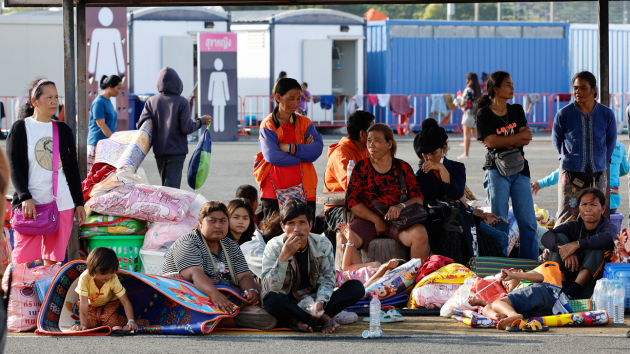
Residents are taking refuge in a temporary shelter in Buriram Province, following clashes between Thai and Cambodian soldiers that have heightened tension along the Thai-Cambodian border. (Sarot Meksophawannakul/Thai News Pix/LightRocket via Getty Images)
(LONDON) — At least seven civilians have been killed and approximately 20 others have been injured in Cambodia amid renewed border clashes with neighboring Thailand, according to the Cambodian Ministry of National Defense.
This week’s Thai attacks, which stem from a long-running border dispute between the two Southeast Asian nations, have also forced more than 20,000 from their homes in several communities, the Cambodian ministry said, along with destroying infrastructure, damaging temples disrupting public services.
“In addition to these major impacts, further tragedies and damages continue to unfold, as the Thai military has launched various types of long-range munitions into Cambodian civilian settlements located up to 30 kilometers from the border,” the ministry said in a statement on Tuesday.
Meanwhile, at least one Thai soldier has been killed and 29 others have been injured in the reignited combat around contested frontier territory, according to the Royal Thai Army.
The army said in a statement that its troops were on Tuesday enduring “continuous attacks against our positions” by Cambodian forces. Opposing troops had been “firing BM-21 multiple-launch rockets and employing bomb-dropping drones and kamikaze drones targeting our bases and defensive positions across several battlefronts” near the border, the army said.
More than 125,000 people were using the hundreds of temporary shelters set up on the Thai side of the border, the army said.
Since Monday, the clashes have spread to several provinces along the Cambodia-Thailand border. Both sides accuse each other for starting the fighting.
The latest clashes come just months after both sides agreed to a ceasefire. The two Southeast Asian nations have long disputed territorial sovereignty along their land border of more than 500 miles, according to The Associated Press.
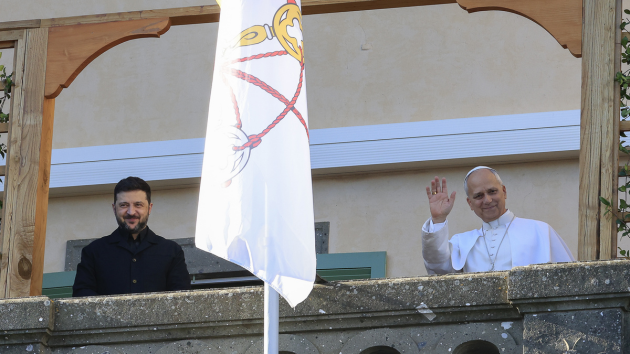
Ukrainian president Volodymyr Zelenskyy (L) and Pope Leo XIV (R) wave to reporters at the end of their meeting at the Papal residence in Castel Gandolfo, on the outskirts of Rome, Italy, on December 09, 2025. (Riccardo De Luca/Anadolu via Getty Images)
(LONDON) — Ukrainian President Volodymyr Zelenskyy met with Pope Leo XIV near Rome on Tuesday, amid a flurry of meetings with fellow European leaders to discuss the latest permutations of a U.S.-proposed peace plan to end Russia’s full-scale invasion of his country.
The Vatican Press office said the two men met at the papal residence at Castel Gandolfo outside the Italian capital.
“During the cordial talks, which focused on the war in Ukraine, the Holy Father reiterated the need for the continuation of dialogue and expressed his urgent desire that the current diplomatic initiatives bring about a just and lasting peace,” the Vatican statement said.
“In addition, the questions of prisoners of war and the need to assure the return of Ukrainian children to their families were also discussed,” the statement said.
Zelenskyy and the pope greeted journalists and photographers from the balcony of the papal residence.
The Ukrainian president is due to meet with Italian Prime Minister Giorgia Meloni on Tuesday afternoon.
That meeting follows discussions with British Prime Minister Keir Starmer, French President Emmanuel Macron and German Chancellor Friedrich Merz in London on Monday.
Zelenskyy is meeting with European leaders to discuss their approach to the latest version of the U.S.-proposed peace deal to end Russia’s invasion.
Following talks in Geneva, Moscow and Miami over the past couple of weeks, the initial 28-point peace plan presented to Kyiv by American negotiators has been revised down to 20 points, Zelenskyy said on Monday.
Key issues such as territorial control and future Western security guarantees for Ukraine remain unsettled.
“The Americans think we must look for compromises. There are difficult questions about territories. In this regard, there is no compromise for now,” Zelenskyy told reporters on a plane after the meetings in London.
Zelenskyy said the “strongest security guarantee” that Ukraine can get would be from the U.S. “They are so far reacting positively to such a move,” he said.
The “Coalition of the Willing,” as the group of mostly European leaders refer to themselves, will also provide security guarantees, but Zelenskyy said he has not received an answer on what they would be ready to do in the event of a “repeated aggression from Russia.”
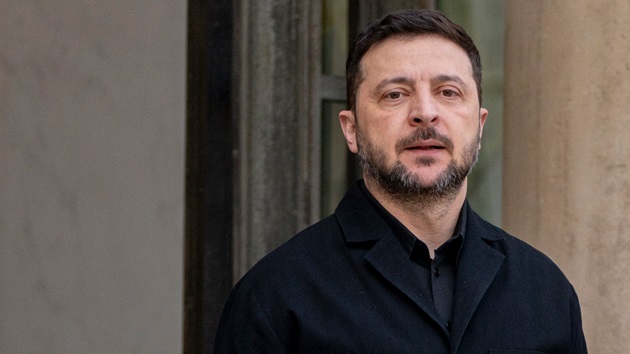
Volodymyr Zelenskiy, Ukraine’s president, at the Elysee Palace in Paris, France, on Monday, Dec. 1, 2025. Nathan Laine/Bloomberg via Getty Images
(LONDON) — No compromise has been reached on the question of territorial control to reach a peace settlement, Ukrainian President Volodymyr Zelenskyy said following his meeting with European leaders on Monday.
“The Americans think we must look for compromises. There are difficult questions about territories. In this regard, there is no compromise for now,” Zelenskyy told reporters on a plane after the meeting in London, translated from Ukrainian.
Following talks in Geneva, Moscow and Miami over the past couple of weeks, the initial 28-point peace plan is now 20 points, Zelenskyy said. Key issues such as territorial control and future Western security guarantees for Ukraine remain unsettled.
Zelenskyy said the “strongest security guarantee” that Ukraine can get would be from the United States, adding, “They are so far reacting positively to such a move.”
The Coalition of the Willing, made up of mostly European leaders, will also provide security guarantees, but Zelenskyy said he has not received an answer on what they would be ready to do in the event of a “repeated aggression from Russia.”
Ahead of traveling to the U.K.,Zelenskyy on Sunday urged “collective pressure on Russia” amid the latest American peace push in Ukraine, and as Moscow and Kyiv both continued their long-range barrages despite renewed diplomatic maneuvers.
“We are starting a new diplomatic week,” Zelenskyy said in posts to social media, saying Ukrainian representatives would be meeting with European counterparts in the coming days.
Zelenskyy said the most pressing questions included “security issues, support for our resilience and support packages for our defense.” For the latter, “air defense and long-term funding for Ukraine” are Kyiv’s prime concerns, he said.
Zelenskyy said the Ukrainian negotiating team held “substantive discussions” with U.S. envoys in recent days, with Kyiv’s delegation — led by National Security and Defense Council Secretary Rustem Umerov and Chief of the General Staff Andrii Hnatov — now returning to Europe.
“I expect detailed information from them on everything that was said to the American envoys in Moscow, and on the nuances the Americans are prepared to modify in negotiations with us and with the Russians,” Zelenskyy said.
“Ukraine deserves a dignified peace, and whether there will be peace depends entirely on Russia — on our collective pressure on Russia and on the sound negotiating positions of the United States, Europe, and all our other partners,” Zelenskyy wrote.
“Russia must be held accountable for what it is doing — for the daily strikes, for the constant terror against our people, and for the war itself,” Zelenskyy said.
Trump on Sunday appeared to express frustration with the Ukrainian position on the latest U.S.-proposed peace deal, which neither Kyiv nor Moscow have publicly committed to supporting in full.
“We’ve been speaking to President Putin and we’ve been speaking to Ukrainian leaders, including President Zelenskyy,” Trump told reporters. “I have to say that I’m a little bit disappointed that President Zelenskyy hasn’t yet read the proposal — that was as of a few hours ago.”
“His people love it, but he has — Russia’s fine with it,” Trump continued. “Russia’s, you know, Russia, Russia, I guess would rather have the whole country, when you think of it. But Russia is, I believe, fine with it. But I’m not sure that Zelenskyy is fine with it. His people love it, but he hasn’t read it.”
The U.S. initially presented Kyiv with a 28-point peace plan that critics dismissed as equivalent to Ukrainian capitulation. The blueprint was widely perceived as pro-Russian for its demand that Ukraine surrender territories in the east of the country and cap the size of its military. Nonetheless, Moscow refrained from offering its full backing, though Russian President Vladimir Putin suggested the document could “form the basis for future agreements.”
Presidential envoy Steve Witkoff and Trump’s son-in-law Jared Kushner have since traveled to Moscow to meet with Putin and held meetings with Ukrainian representatives as they sought to firm up a potential framework for a future peace deal.
Long-range Russian drone and missile strikes continued all across Ukraine through the weekend, with Ukrainian officials reporting that the attacks focused on critical energy infrastructure.
On Monday morning, Ukraine’s air force said Russia launched 149 drones into the country overnight, of which 131 were shot down or suppressed.
Ukraine’s Energy Ministry said in a post to Telegram that the continued Russian strikes had caused significant power outages for customers in Dnipropetrovsk, Donetsk, Zaporizhzhia, Sumy and Chernihiv regions.
Ukraine also continued its own cross-border strike campaign. Russia’s Defense Ministry said on Monday that its forces downed at least 74 Ukrainian drones overnight, including two over the Moscow region.
ABC News’ Hannah Demissie and Meghan Mistry contributed to this report.
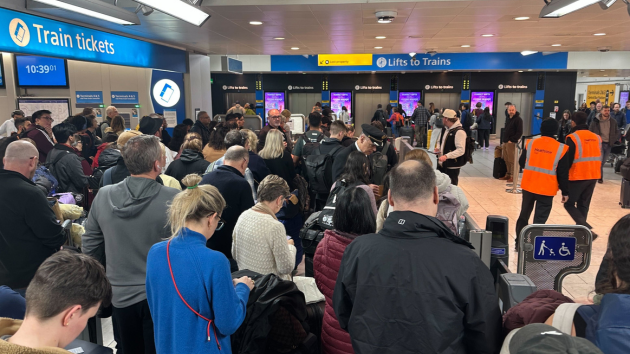
Travelers held at Heathrow where train platforms remained closed. (Jay Davies/Getty Images)
(LONDON) — A man was arrested on Sunday after a “group of men” unleashed what may have been pepper spray during an altercation in a parking garage at London’s Heathrow Airport, the police said.
The incident was not being investigated as terrorism, Cmdr. Peter Stevens, of London’s Met Police, said in a statement. Officers were called just after 8 a.m. local time to the parking garage at the airport’s Terminal 3, where there were reports of “multiple people being assaulted,” the department said.
“A number of people were sprayed with what is believed to be a form of pepper spray by a group of men who then left the scene,” the police said.
The man who was detained, who was not immediately identified, remained in custody on suspicion of assault, the police said.
“At this stage, we believe the incident involved a group of people known to each other, with an argument escalating and resulting in a number of people being injured,” Stevens said.
Police said people were transferred by ambulances to local hospitals with injuries that were thought to be non life-threatening. Officials did not say immediately how many people had been injured.
Terminal 3 remained open, although there was “some disruption of traffic” in the area near the parking garage, police said. Stevens in his statement said the department planned to increase the presence of officers throughout the airport, which is among the busiest in Europe, for the remainder of the morning.
“Passengers are advised to allow extra time when travelling to the airport and to check with their airline for any queries,” Heathrow said on social media.
(LONDON) — American and Ukrainian representatives will continue discussions on a possible framework for a peace deal to end Russia’s full-scale invasion of its neighbor on Saturday, the State Department said in a statement, following meetings between the two teams in Miami this week.
The office of the spokesperson at the State Department said in a Friday statement that U.S. President Donald Trump’s envoy Steve Witkoff and Trump’s son-in-law Jared Kushner held “constructive discussions” with the Ukrainian delegation this week on “advancing a credible pathway toward a durable and just peace in Ukraine.”
The statement said the two delegations agreed on a framework of security arrangements and necessary deterrence capabilities that the State Department said will lead to a “lasting peace” between Ukraine and Russia.
Friday’s State Department statement provided no further details on the framework of any security arrangement.
Kyiv has long said it cannot accept any peace deal that does not include concrete security guarantees from Western partners, chief among them the U.S. Ukrainian President Volodymyr Zelenskyy and his government have warned that without such protections, Russia may be emboldened to launch new rounds of aggression in the future.
The U.S. and Ukrainian delegations met in Miami for talks on Thursday and Friday. The teams are set to reconvene on Saturday to “continue advancing the discussions,” the State Department statement said.
The readout said that the Ukrainian delegation — which was led by Rustem Umerov, the secretary of the country’s National Security and Defense Council — “reaffirmed that Ukraine’s priority is securing a settlement that protects its independence and sovereignty, ensures the safety of Ukrainians and provides a stable foundation for a prosperous democratic future.”
The statement also said that the U.S. envoys discussed their recent meeting with Russian President Vladimir Putin in Moscow, plus “steps that could lead to ending this war.”
“Both parties agreed that real progress toward any agreement depends on Russia’s readiness to show serious commitment to long-term peace, including steps toward de-escalation and cessation of killings,” the statement added.
Ahead of the first meeting in Miami on Thursday, Zelenskyy said in a post to social media that his team’s task was “to obtain full information about what was said in Russia and what other pretexts Putin has come up with to drag out the war and to pressure Ukraine,” referring to the visit of Witkoff and Kushner to the Russian capital earlier in the week.
“Ukraine is prepared for any possible developments, and of course we will work as constructively as possible with all our partners to ensure that peace is achieved,” Zelenskyy added. “Only a dignified peace provides real security, and we fully understand that this requires — and will continue to require — the support of our partners.”
The Kremlin’s public statements suggest it is maintaining its maximalist demands, which include Ukraine’s withdrawal from territories still partially under Kyiv’s control in the east of the country. Ukraine has repeatedly dismissed that proposal.
Putin is projecting confidence, last week claiming a “positive dynamic” everywhere on the front despite high rates of Russian casualties — according to Kyiv’s reporting — and slow battlefield progress. Russia, the president said, is “ready in principle” to “fight to the last Ukrainian.”
Both Russia and Ukraine are sustaining their long-range strike campaigns amid the White House’s latest diplomatic push.
Ukraine’s air force said on Saturday morning that Russia launched 653 drones and 51 missiles — 17 of them ballistic missiles — into the country overnight. The air force said 585 drones and 30 missiles were shot down or suppressed. Drone and missile impacts were reported across 29 locations, the air force said.
Russia’s Defense Ministry, meanwhile, said its forces downed at least 121 Ukrainian drones on Friday night into Saturday morning.
(LONDON) — NATO fighter jets were scrambled and air defense systems put on alert in Poland in response to Russia’s latest overnight drone and missile strikes in Ukraine, the Armed Forces Operational Command in Warsaw said in a series of social media posts.
“Fighter jets have been scrambled and ground-based air defense systems as well as radar reconnaissance systems have reached a state of readiness,” the command said in a post to X.
“These actions are of a preventive nature and are aimed at securing the airspace and its protection, especially in areas adjacent to the threatened regions,” it added.
The alert lasted for just under four hours, after which the command said the fighters and air defense systems had “returned to standard operational activities.” No violations of Polish airspace were observed, a follow-up post to X said.
The Spanish and Czech air forces were involved in the response, the command said, as were German and Dutch air defense systems.
Ukraine’s air force said Russia launched 653 drones and 51 missiles — 17 of them ballistic missiles — into the country overnight. The air force said 585 drones and 30 missiles were shot down or suppressed.
Drone and missile impacts were reported across 29 locations, the air force said.
The attack — which consisted of 704 air attack weapons — was Russia’s largest overnight bombardment since it launched 705 munitions on the night of Oct. 29, according to Ukrainian air force data analyzed by ABC News.
The largest attack of the war to date took place on the night of Sept. 6 and involved 823 air attack vehicles. The latest overnight attack is only the fourth of Russia’s full-scale invasion to date in which the number of air attack vehicles used surpassed 700.
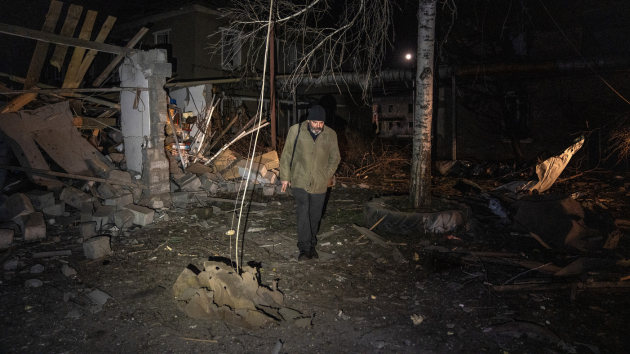
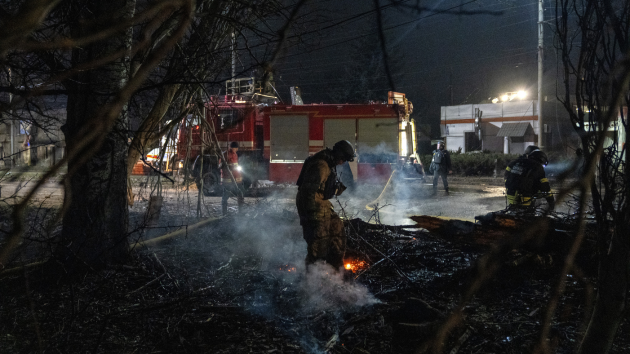
Ukrainian Minister of Internal Affairs Iho Klymenko said in a post to Telegram that 10 regions of the country came under attack, with direct hits to residential buildings, railways and energy infrastructure.
More than two dozen houses in the Kyiv, Dnipropetrovsk, Zhytomyr and Lviv regions were damaged, according to Klymenko.
At least three people were injured in the Kyiv region, another three people were injured in the Dnipropetrovsk region and two people were injured in the Lviv region, Klymenko said.
In the Black Sea port city of Odesa, regional Gov. Oleh Kiper said an energy facility was damaged, resulting in disruptions to the supply of power and heating. Some 9,500 customers were without heating and 34,000 without water as of 9:30 a.m. local time.
There was also damage to energy infrastructure in the Chernihiv, Zaporizhzhia, Lviv and Dnipropetrovsk regions, according to authorities there.
The International Atomic Energy Agency — the U.N.’s nuclear watchdog — said in a post to X that Ukraine’s Zaporizhzhia nuclear power plant also temporarily lost all off-site power during the Russian strikes.
IAEA Director General Rafael Grossi “reiterates call for military restraint to avoid a nuclear accident,” the post said.
Ukrainian Prime Minister Yulia Svyrydenko said she had “convened an emergency coordination meeting” with the ministers of internal affairs and energy as well as the leadership of the state-run energy companies and all services responsible for recovery operations.
Ukrainian Foreign Minister Andrii Sybiha said in a post to X, “Russia continues to disregard any peace efforts and instead strikes critical civilian infrastructure, including our energy system and railways.”
“This shows that no decisions to strengthen Ukraine and raise pressure on Russia can be delayed,” Sybiha added. “And especially not under the pretext of peace process.”
Ukrainian President Volodymyr Zelenskyy said in a post to social media that energy facilities were “the main targets of these strikes.”
“Russia’s aim is to inflict suffering on millions of Ukrainians,” the president wrote. “That is exactly why additional pressure is needed. Sanctions must work, and so must our air defenses, which means we must maintain support for those defending lives.”
Russia’s Defense Ministry, meanwhile, said its forces downed at least 121 drones on Friday night into Saturday morning.
ABC News’ Morgan Winsor, Natalia Kushnir, Natalia Popova and Anna Sergeeva contributed to this report.
Igor Golovniov/SOPA Images/LightRocket via Getty Images
(NEW YORK) — The Eurovision Song Contest slogan is “United By Music,” but the music competition’s organizers are seeing some cracks in that unity.
A discordant note has been struck in that unity over Israel’s participation in the contest over the war between Israel and Hamas and the humanitarian crisis it precipitated.
Four European nations say they will not take part in the popular international song competition next year after Israel was cleared to participate. State broadcasters in the Netherlands, Ireland, Spain and Slovenia cited the ongoing war in Gaza as their reason for withdrawing.
The war started after Hamas launched a surprise terrorist attack in Israel on Oct. 7, 2023, that killed roughly 1,200 Israelis and took about 251 people hostage. Israel responded by declaring war, vowing to eradicate Hamas, the organization that has been de facto governing Gaza and has been designated by the U.S. as a terrorist group. The death toll in Gaza had surpassed 70,000 as of Wednesday, according to the Hamas-run Gaza health ministry.
Both sides agreed to a ceasefire, which has broadly held, this October.
“Culture unites, but not at any price. What has happened over the past year has tested the limits of what we can uphold,” Taco Zimmerman, head of the Dutch broadcaster AVROTROS, said in a statement. “Universal values such as humanity and press freedom have been seriously compromised, and for us, these values are non-negotiable.”
Ireland’s broadcaster RTÉ directly cited the war in its statement.
“RTÉ feels that Ireland’s participation remains unconscionable given the appalling loss of lives in Gaza and the humanitarian crisis there which continues to put the lives of so many civilians at risk,” it wrote.
Ireland has won the Eurovision Song Contest seven times, and is tied with Sweden for the most wins ever. The Swedish group ABBA famously got a boost into worldwide stardom from its Eurovision win for “Waterloo.”
“The situation in Gaza, despite the ceasefire and the approval of the peace process, and Israel’s use of the contest for political purposes, make it increasingly difficult to maintain Eurovision as a neutral cultural event,” Alfonso Morales, secretary general of Spain’s broadcaster RTVE, said in part in a statement.
Spain is part of what’s known as the Eurovision’s “Big 5” — the participants whose broadcasters provide the most, financially, to the contest and have the biggest viewership. The UK, France, Germany and Italy are the other members of this group, and performers representing these countries get automatic entry into the Eurovision final.
A representative for Slovenia’s broadcaster also cited the war in Gaza, and said the Israeli government had been using the contest for political gain.
During this year’s Eurovision, Yuval Raphael’s song “New Day Will Rise” reached second place — it was beaten by Austrian singer JJ’s “Wasted Love.”
The Israeli government was accused by other countries’ broadcasters of manipulating the voting system during this year’s Eurovision. Amid the controversy, the EBU announced new changes to tighten voting rules, but Eurovison Song Contest Director Martin Green told the BBC that Israel did not break the rules.
At a meeting in Geneva on Thursday, the European Broadcasting Union — the organizing body of the contest — and member broadcasters from participating nations gathered to discuss new voting guidelines and contest rules. They did not take a vote on Israel’s participation, which cleared the way for the country to compete.
Four European nations say they will not take part in the popular international song competition next year after Israel was cleared to participate. State broadcasters in the Netherlands, Ireland, Spain and Slovenia cited the ongoing war in Gaza as their reason for withdrawing.
“I am pleased that Israel will once again participate in the Eurovision Song Contest, and I hope that the competition will remain one that champions culture, music, friendship between nations, and cross-border cultural understanding,” Israeli President Isaac Herzog wrote, in part, in a post on X after the Geneva meeting.
Israeli broadcaster KAN was critical of the backlash
“The attempt to remove KAN from the contest can only be understood as a cultural boycott,” one representative said during the meeting.
But some broadcasters — like Britain’s BBC — expressed support for Israel to compete.
Opposition to Israel’s participation had been brewing since 2024, when protesters demonstrated outside the arena in Malmo, Sweden.
Israel first joined the Eurovision Song Contest in 1973. Four Israeli acts have taken home the Eurovision trophy since, most recently in 2018.
The final of the 2026 Eurovision Song Contest will take place in Vienna, Austria, on May 16.