(LONDON) — A man has been arrested after driving a car into a home in east London before getting out and attacking members of the public with a sword, according to police.
The incident happened at approximately 7 a.m. local time Tuesday when the Metropolitan Police in London were alerted to a “serious incident” taking place in Hainault, east London, to reports of a vehicle being driven into a house in the Thurlow Gardens area and multiple people being stabbed, according to a police statement detailing the early morning incident.
“At this time we understand the suspect went on to attack other members of the public and two police officers,” the Met Police said. “Police in London have been called and other emergency services are in Hainault, east London, at a serious incident in which a man with a sword has been arrested.”
“This must have been a terrifying incident for those concerned. I know the wider community will be feeling shock and alarm,” said Deputy Assistant Commissioner Ade Adelekan. “People will want to know what has happened and will we provide more information as soon as we can.”
Police confirmed that a 36-year-old man was arrested at the scene and is in now in police custody.
Authorities did not immediately disclose the number of victims involved in the attack or their medical conditions.
“We do not believe there is any ongoing threat to the wider community. We are not looking for more suspects,” police said. “This incident does not appear to be terror-related.”
The investigation is currently ongoing and authorities are expected to release more information on the stabbings once more information is available.
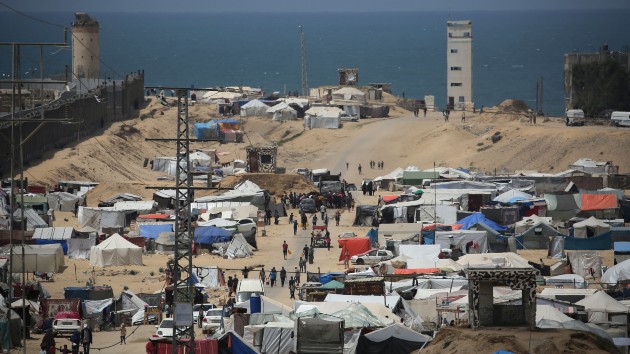
People walk in a camp for displaced people in Rafah in the southern Gaza Strip by the border with Egypt on April 28, 2024, amid the ongoing conflict between Israel and the Palestinian militant group Hamas. (AFP via Getty Images)
(NEW YORK) — As the Israel-Hamas war approaches the seven-month mark, renewed negotiations are underway to secure the release of hostages taken by the terrorist organization, as Israeli forces continue to prepare for an apparent invasion of the southern Gaza town of Rafah.
Meanwhile, President Joe Biden and Israeli Prime Minister Benjamin Netanyahu spoke in a phone call over the weekend, discussing increasing the delivery of humanitarian aid into Gaza and plans for a possible military operation in Rafah, according to the White House.
Here’s how the news is developing:
Apr 29, 4:20 PM White House won’t get info specifics on cease-fire deal
The White House was careful not to get into specifics on the “extraordinarily generous” cease-fire proposal Secretary of State Antony Blinken spoke to earlier this morning, refusing to give specifics as they continued to call on Hamas to accept the proposal.
“I’m not going to characterize the proposal. I’m not going to get into any of the specifics. What we believe is that now is the time for Hamas to take this deal. It is on the table. It is time to, it is way past time to get these hostages home. It is way past time to get to a ceasefire and we need to make sure we continue to get that humanitarian aid,” White House press secretary Karine Jean-Pierre said.
Jean-Pierre noted that Israel “has a lot on their plate,” but expressed a desire for an in-person meeting to take place, in addition to the two virtual meetings the U.S. and Israel have had in recent weeks.
“We would like to have an in-person meeting. That is certainly what we would like to do, but in the meantime, we’ve had two important virtual meetings and in the readout, yesterday, we mentioned that the potential Rafah operations did come up between the two leaders in their conversation,” she said.
Egyptian President Abdel Fattah El-Sisi also spoke to President Joe Biden Monday about ongoing Gaza talks and Egyptian efforts to reach a cease-fire and hostage deal in a phone call, the Egyptian presidency said in a statement.
The call discussed the risks of an Israeli incursion into Rafah, including the “catastrophic” impact on the worsening humanitarian crisis, and implications for the security and stability of the region, the statement added.
-ABC News’ Molly Nagle and Ayat Al-Tawy
Apr 29, 3:53 PM Israel leaders concerned about possible ICC arrest warrants: Source
Israeli leaders are expressing concern over possible arrest warrants issued by the International Criminal Court against key officials, including Prime Minister Benjamin Netanyahu, an Israeli official, who spoke under condition of anonymity, told ABC News.
It is believed that such potential warrants might be related to charges on the scope of humanitarian aid Israel allowed into Gaza, according to the official.
The ICC can charge individuals with war crimes, crimes against humanity and genocide under its powers.
-ABC News’ Dana Savir
Apr 29, 12:20 PM 21 killed, 6 injured after strike in Gaza
At least 21 people were killed in Gaza after an Israeli airstrike Monday, the Al Kuwaiti Hospital in Rafah told ABC News. Six people were injured from the strike, the hospital added.
The updated death toll in Gaza is 34,488 killed and 77,643 injured, according to the Hamas-run Gaza Ministry of Health.
ABC News has reached out to the Israeli army for comment on the strike.
-ABC News’ Dia Ostaz
Apr 29, 8:36 AM Blinken calls for cease-fire in first stop on Middle East trip
U.S. Secretary of Antony Blinken, who is currently in Saudi Arabia, notably called for a cease-fire as “the most effective way to address the humanitarian crisis in Gaza” during a session with his counterparts of the Gulf Cooperation Council.
“The most effective way to address the humanitarian crisis in Gaza to alleviate the suffering of children, women and men and to create space for a more just and durable solution is to get a cease-fire and hostages home, but also not waiting on a cease-fire to take the necessary steps to meet the needs of civilians of Gaza,” Blinken said.
“President Biden is insistent that Israel take specific concrete measurable steps to better address humanitarian suffering, civilian harm and the safety of aid workers in Gaza, including in his most recent call with Prime Minister Netanyahu,” he added, referring to a Sunday call with the Israeli leader.
Blinken said the U.S. was “focused on addressing the greatest threat to regional stability and regional security — Iran.”
Apr 28, 6:00 PM United States Central Command and Royal Jordanian Air Force airdrop aid into Gaza
U.S. Central Command and the Royal Jordanian Air Force conducted a combined humanitarian assistance airdrop into Northern Gaza on Sunday.
The combined joint operation included Jordanian provided food and four U.S. Air Force C-130 aircraft.
The U.S. C-130’s dropped over 25,000 Meals Ready to Eat (MREs), providing life-saving humanitarian assistance in Northern Gaza. Additionally, more than 13,080 meal equivalents of Jordanian food supplies were also delivered.
To date the U.S. has dropped nearly 1,110 tons of humanitarian assistance.
Apr 28, 5:22 PM American hostage’s niece opens up about ‘surreal’ new video
Hanna Siegel, niece of American hostage Keith Siegel, appeared on CBS’ Face the Nation on Sunday morning and talked about the “surreal” feeling of seeing a recently released video purporting to show her uncle and talked about the possibility of a deal that would free him and other people thought to still be held by Hamas in Gaza.
“We’ve always believed that he was alive. We have to believe he’s alive — and his wife, my aunt, who was held for 52 days, [was] released in the deal that took place in November, she was with him,” Siegel said. “When she came out, she told us he was alive, but this is the first time that we’re seeing him, hearing him. It’s surreal.”
When asked about a potential hostage deal and temporary cease-fire between Israel and Hamas, Siegel said that she does think an agreement “can be reached” and pointed to an earlier deal that secured the release of her aunt and others during a brief pause in the war late last year.
Siegel also said that she believes the new release of purported hostage videos shows that Hamas is signaling they are ready to make a deal.
But she said that she is concerned that it might not be in Israeli Prime Minister Benjamin Netanyahu’s “political interest to close a deal,” though Netanyahu has said his goal is freeing the captives in Gaza as well as dismantling Hamas.
Siegel said that the Biden administration should “think about what they can do directly to bring our American citizens home.”
She also said she has felt the “commitment from the Biden administration to get him back,” referring to her uncle.
She became emotional talking about how her family missed her uncle during their Passover celebration and had a picture of him to pay tribute.
“I think there’s so much swirling in the political realm that it’s easy to forget that these are human beings. Keith is a grandfather, he’s a husband, he’s a brother, he’s an uncle,” she said.
She was asked whether her family is worried if a potential Israeli invasion of the Gaza city of Rafah, to further target Hamas fighters, could threaten her uncle’s safety. She responded that she and her family are “very concerned.”
Apr 28, 5:10 PM Hamas to send a delegation to Cairo for hostage and cease-fire negotiations
Hamas will send a delegation to Cairo, Egypt, on Monday to participate in hostage and cease-fire deal negotiations, ABC News has confirmed.
Meanwhile, a senior Hamas official also told the Agence France-Presse on Sunday that the organization has no significant problems with the proposed deal.
“The atmosphere is positive unless there are new obstacles from the Israeli side,” the Hamas official said.
People walk in a camp for displaced people in Rafah in the southern Gaza Strip by the border with Egypt on April 28, 2024, amid the ongoing conflict between Israel and the Palestinian militant group Hamas. (AFP via Getty Images)
(NEW YORK) — As the Israel-Hamas war approaches the seven-month mark, renewed negotiations are underway to secure the release of hostages taken by the terrorist organization, as Israeli forces continue to prepare for an apparent invasion of the southern Gaza town of Rafah.
Meanwhile, President Joe Biden and Israeli Prime Minister Benjamin Netanyahu spoke in a phone call over the weekend, discussing increasing the delivery of humanitarian aid into Gaza and plans for a possible military operation in Rafah, according to the White House.
Here’s how the news is developing:
Apr 28, 6:00 PM United States Central Command and Royal Jordanian Air Force airdrop aid into Gaza
U.S. Central Command and the Royal Jordanian Air Force conducted a combined humanitarian assistance airdrop into Northern Gaza on Sunday.
The combined joint operation included Jordanian provided food and four U.S. Air Force C-130 aircraft.
The U.S. C-130’s dropped over 25,000 Meals Ready to Eat (MREs), providing life-saving humanitarian assistance in Northern Gaza. Additionally, more than 13,080 meal equivalents of Jordanian food supplies were also delivered.
To date the U.S. has dropped nearly 1,110 tons of humanitarian assistance.
Apr 28, 5:22 PM American hostage’s niece opens up about ‘surreal’ new video
Hanna Siegel, niece of American hostage Keith Siegel, appeared on CBS’ Face the Nation on Sunday morning and talked about the “surreal” feeling of seeing a recently released video purporting to show her uncle and talked about the possibility of a deal that would free him and other people thought to still be held by Hamas in Gaza.
“We’ve always believed that he was alive. We have to believe he’s alive — and his wife, my aunt, who was held for 52 days, [was] released in the deal that took place in November, she was with him,” Siegel said. “When she came out, she told us he was alive, but this is the first time that we’re seeing him, hearing him. It’s surreal.”
When asked about a potential hostage deal and temporary cease-fire between Israel and Hamas, Siegel said that she does think an agreement “can be reached” and pointed to an earlier deal that secured the release of her aunt and others during a brief pause in the war late last year.
Siegel also said that she believes the new release of purported hostage videos shows that Hamas is signaling they are ready to make a deal.
But she said that she is concerned that it might not be in Israeli Prime Minister Benjamin Netanyahu’s “political interest to close a deal,” though Netanyahu has said his goal is freeing the captives in Gaza as well as dismantling Hamas.
Siegel said that the Biden administration should “think about what they can do directly to bring our American citizens home.”
She also said she has felt the “commitment from the Biden administration to get him back,” referring to her uncle.
She became emotional talking about how her family missed her uncle during their Passover celebration and had a picture of him to pay tribute.
“I think there’s so much swirling in the political realm that it’s easy to forget that these are human beings. Keith is a grandfather, he’s a husband, he’s a brother, he’s an uncle,” she said.
She was asked whether her family is worried if a potential Israeli invasion of the Gaza city of Rafah, to further target Hamas fighters, could threaten her uncle’s safety. She responded that she and her family are “very concerned.”
Apr 28, 5:10 PM Hamas to send a delegation to Cairo for hostage and cease-fire negotiations
Hamas will send a delegation to Cairo, Egypt, on Monday to participate in hostage and cease-fire deal negotiations, ABC News has confirmed.
Meanwhile, a senior Hamas official also told the Agence France-Presse on Sunday that the organization has no significant problems with the proposed deal.
“The atmosphere is positive unless there are new obstacles from the Israeli side,” the Hamas official said.
U.S. Secretary of State Antony Blinken (L) meets with China’s President Xi Jinping at the Great Hall of the People in Beijing on April 26, 2024. (MARK SCHIEFELBEIN/POOL/AFP via Getty Images)
(LONDON) — U.S. Secretary of State Antony Blinken met with President Xi Jinping of China on Friday following a meeting with Director of the Chinese Communist Party (CCP) Central Foreign Affairs Commission and Foreign Minister Wang Yi, according to the U.S. State Department.
Blinken, in his remarks, described the first meeting with Wang Yi as “extensive and constructive.”
“The two sides had in-depth, substantive, and constructive discussions about areas of difference as well as areas of cooperation as part of responsibly managing competition between the United States and the PRC,” according to Spokesperson Matthew Miller of the U.S. State Department. “The Secretary discussed concerns about PRC support to the Russian defense industrial base, the importance of maintaining peace and stability in the Taiwan Strait, PRC activities in the South China Sea, and the need to avoid further escalation in the Middle East and on the Korean Peninsula.”
Following up on the Woodside Summit between President Joe Biden and President Xi last November, Blinken and Wang Yi discussed “next steps on a range of commitments made by the two leaders on advancing cooperation on counternarcotics, military-to-military communication, talks on artificial intelligence risks and safety, and facilitating people-to-people exchanges,” officials said.
Blinken emphasized that the U.S. will continue to stand up for our interests and values and those of America’s allies and partners, including on human rights and economic issues.
(WASHINGTON) — The U.S. military has begun to build the long-awaited port and causeway off the coast of Gaza that will establish a maritime corridor to bring humanitarian aid into Gaza, the Pentagon said Thursday.
“I can confirm that U.S. military vessels, to include the USNS Benavidez, have begun to construct the initial stages of the temporary pier and causeway at sea,” Maj. Gen. Pat Ryder, the Pentagon’s press secretary, told reporters, referring to the Joint Logistics Over-the-Shore, or JLOTS, system floating pier delivery system.
“We are aware of the significant interest in this important effort and will provide much more information in the very near future as we work alongside the international community to rush aid to the people of Gaza,” he added.
The Pentagon has estimated that, when operational, the pier would complement the existing land crossings for aid into Gaza and could provide as many as two million meals per day to Gaza.
Satellite photos taken by Planet Lab show construction work that has begun to be built in the land area where the causeway will be moored so trucks loaded with aid can get access inside Gaza.
Marine traffic websites show the USNS Roy Benavidez operating off the coast of Gaza, where it has begun the construction of the floating platform by which supplies will be offloaded from civilian cargo ships. The additional ships that will support the floating pier are en route to Gaza from Crete, Greece, where they had been docked after making a trans-Atlantic voyage to the eastern Mediterranean.
A senior U.S. military official who briefed reporters on Thursday said that the construction of the JLOTS landing platform began on Thursday several miles off the shore of Gaza.
“We are on track to begin delivery of humanitarian assistance to Gaza from the sea in early May,” said the official, who added that once operational the JLOTS pier will be able to handle about 90 trucks a day and then quickly build up to 150 trucks worth of humanitarian aid.
“This additional throughput from the sea represents a significant increase of life-saving aid,” the official said.
The plan is that humanitarian assistance from aid agencies will eventually make its way to the JLOTS platform and floating causeway after first being screened, palletized, and prepared for delivery in Cyprus, 200 miles away from Gaza.
The senior U.S. military official explained that the aid would then be unloaded at a floating platform located miles offshore. Then, there will be smaller watercraft each aboard carrying five trucks that will be offloaded onto the floating causeway or pier that will be anchored to the shore, the official said.
Those trucks will drop off their cargo in a secure area for future distribution and constantly repeat that process in a regular back and forth to the floating platform, the official said.
The truck drivers will not be U.S. military personnel or American contractors, the official said, but from an undisclosed country who are not Americans and who will have their own security.
Hundreds of U.S. soldiers and sailors who will build JLOTS and keep it operating will live and sleep aboard the British naval ship Cardigan Bay that will be located miles offshore, the official said.
The Biden administration has repeatedly said that there will be no U.S. “boots on the ground,” but that restriction does not apply to other personnel supporting the JLOTS mission who will be working in Israel.
With no U.S. forces on the ground to anchor the floating platform to the beach in Gaza, a U.S. Army engineering unit partnered with a similar IDF unit to train them on how to anchor it to the beach on “day one.” That training occurred on an Israeli beach “just up the coast,” said the senior military official.
In addition, U.S. military personnel will be working side-by-side with Israeli Defense Forces personnel at a coordination cell established at Hatzor airbase in Ashdod, Israel that is being run by a three-star U.S. general.
Another coordination cell, run by the U.S. Agency for International Development (USAID), has been established in Cyprus to organize the logistics of the flow of aid that will be delivered to Gaza through the maritime corridor.
Earlier on Thursday, a mortar attack in the general vicinity of where the pier will be located near Gaza City raised concerns about the security for the JLOTS mission that U.S. officials have long acknowledged will be provided by the Israeli military.
“It’s important also to highlight that this occurred before any U.S. forces have started moving anything,” said Ryder, who noted that “there is no U.S. equipment per se in this marshaling yard” that will be the future location of distributing aid offloaded via JLOTS.
The senior military official told reporters that the mortar attack has been assessed to have had nothing to do with the JLOTS mission and that security around the location struck will be “far more robust” when it is up and running.
“Force protection is our number one priority,” said the senior U.S. military official, who explained that Israel has committed a brigade of thousands of soldiers plus Israeli Navy ships and aircraft flying above that will protect American forces off-shore and the landing and distribution centers ashore.
The official said the U.S. military assesses that the security at the chosen location for the floating platform “is sufficient to support execution of the mission,” though any final decision will be left up to the commander of U.S. Central Command.
(PORTUGAL) — One of the planet’s most natural defenses against climate change and a key element in sustainable products is found in wine bottles around the world.
Scientists and engineers say cork has been used to make several products in everyday life, from flooring to insulation, and the process of harvesting it leaves a small carbon footprint.
In Portugal, farmers are only able to harvest bark by hand from the trees during a three-month window in the summer every nine years, and they use careful techniques to avoid wounding the trees.
“The tree tells us if we can take or not; you cannot force the cork to come apart,” Conceição Santos Silva, a forest engineer, told ABC News last summer while the farmers were working on the trees.
The forests that produce cork themselves are also instrumental in lowering the carbon dioxide in the air, according to Silva. The Portuguese Cork Association estimates that the forests store about 14 million tons of CO₂ every year.
Cork trees can live for up to 200 years, harvested again and again over the decades, she said.
“Cork oak trees are a barrier to the desertification that comes from the south. This is the forest that is preventing the desert advance until Europe,” Silva added. Desertification is when land can no longer support the same plant growth it had in the past, and the change is permanent, according to NASA’s Earth Observatory.
When the cork is sent to a factory for processing, it is left to dry for up to nine months to remove TCA, which leaves a bad taste, according to engineers.
“You are looking at a factory that has been designed to make life hard for this micro-organism,” Carlos de Jesus, a spokesman for Amorim, the world’s largest cork manufacturer, told ABC News.
About 30% of the cork made at the Amorim plant is used for bottles, but de Jesus said that his plant does not waste any of the material.
“What does not go into a bottle top, can be made into aerospace and defense applications, can be made into footwear, flooring, heavy construction, [and] surfboards,” he said.
The cork that’s of a lower quality is broken down into tiny bits, or granules, which are then assembled into sheets, and bound together by glue. That bonded cork is then used to make those materials, according to engineers.
Cork’s chemical makeup makes it strong enough to withstand high temperatures, which is why it is used for insulation by many companies, including NASA.
Cork dust is swept up and turned into biofuel, which de Jesus said helps make the plant carbon-negative.
“Over 95% of the energy needed for this factory comes from cork dust,” he said.
João Ferreira, the secretary-general of the Associação Portuguesa de Cortiça, a Portuguese cork business association, told ABC News that other countries and companies should look into cork-related solutions for their climate change issues.
“It’s a product that really answers to all the challenges we have as a society. You see the political programs from Europe to [the] US, everyone is trying to find products that are very positive in terms of sustainability. To face a new challenge in the circular economy so nothing is wasted. We can recycle, we can reuse, we can-zero waste. And so I see a bright future,” he said.
Medics walk in front of the emergency ward at Nasser Hospital where bodies were discovered, in Khan Yunis in the southern Gaza Strip on April 23, 2024. (AFP via Getty Images)
(LONDON and GAZA) — In a desperate search for missing loved ones, Gazans have been gathering in the hundreds at Nasser Hospital in Khan Younis, in southern Gaza, where emergency workers are on the fifth day of exhuming bodies from mass graves found on the hospital grounds.
“The hospital smells of rotting corpses. I cannot stand here for long,” Ahlam Salama, a 43-year-old mother who went to the hospital to find her son, told ABC News.
“We are all mothers here searching for our children,” she said, holding back tears and pointing to the other women who had gathered at the hospital.
Salama is among the hundreds of people who have assembled at Nasser Hospital, hoping for news about missing family and friends. According to the Hamas-run Civil Defense, at least 332 bodies have been discovered so far, with other grave sites identified but not yet exhumed.
The organization said Thursday that figure had climbed to 392 bodies. Officials said they have not yet been able to identify about 58% of the recovered bodies.
ABC News has been unable to independently verify these claims, so little is known for certain at this point about the reports of mass graves, including what happened, when it happened and who may be responsible. White House National Security Communications Advisor John Kirby said Tuesday that the reports are “deeply concerning,” but that the White House is not in a place to validate them.
When asked, Kirby further said he “wouldn’t expect a U.S. investigation” into the reports of mass graves and the alleged involvement of the Israel Defense Forces (IDF), but added that the White House will speak with their Israeli counterparts about what they know.
National Security Advisor Jake Sullivan on Wednesday called the reports of mass graves in Gaza “deeply disturbing,” and said that the U.S. has been in touch with the Israeli government on the matter, at multiple levels.
“We want answers. We want to understand exactly what happened. You’ve seen some public commentary from the IDF on that, but we want to know the specifics of what the circumstances on this were, and we want to see this thoroughly and transparently investigated so that the whole world can have a comprehensive answer and we the United States can have as well,” Sullivan said, adding that he could not comment beyond that.
The Israeli Foreign Ministry issued a strong statement Wednesday, denying that it was in any way responsible for the mass graves.
“Any attempt to blame Israel for burying civilians in mass graves is categorically false and a mere example of a disinformation campaign aimed at delegitimizing Israel,” the statement said. “Misinformation is circulating regarding a mass grave that was discovered at Nasser Hospital in Khan Yunis [sic]. The grave in question was dug — by Gazans — a few months ago.”
The IDF withdrew from Khan Younis in early April. Since then, people have been returning to the area to search for the bodies of loved ones, hoping to give them a proper burial. During the fighting in and around the Nasser Hospital complex, which occurred in January and February, social media videos from the time appeared to show that bodies were immediately buried on the hospital grounds, since it was unsafe to take them to cemeteries during the conflict.
“I am here for the third day looking for my son among these bodies buried in the sand, a scene that makes hearts cry,” Salama told ABC News, explaining that her 25-year-old son, Saleh, has been missing since January.
“From that time until now, I know nothing about him, but many told me that he might have been killed by army bullets,” she said.
“I told the Civil Defense that I have a son here who is missing. Perhaps they will find him,” Salma added, lamenting that she cannot remember what her son was wearing to help identify his body.
“He wears a ring on his finger with a letter on it,” Salama explained. “Perhaps I will find him and bury him so that I can know his grave and visit him always.”
“I saw the ugliest pictures as if I were in a nightmare. I cannot believe that dozens here have been buried for months and no one knows anything about them and no one tried to save them,” Salama said. “I constantly lose consciousness while watching the bodies emerging from the ground. The men here do not stop searching for the dead in the sand.”
The IDF stormed Nasser Hospital at the end of February, telling ABC News in a statement Tuesday that “IDF forces conducted a precise and targeted operation against the terrorist organization Hamas in the Nasser Hospital area.”
However, Hamas is accusing the IDF of war crimes, saying that some of the exhumed corpses show signs of execution.
“The Israeli army soldiers stripped dozens of patients, displaced persons, and medical personnel naked before executing them in cold blood by firing squad,” Ismail Al-Thawabta, director of the Hamas government’s media office, said in a statement released Sunday.
Hamas also called for the International Criminal Court to investigate the IDF’s alleged actions.
“We call on the Prosecutor of the International Criminal Court to investigate this massacre committed by the occupation army in the Nasser Complex and also the Shifa Complex, in all its details, whether against the headquarters of the two complexes or against the citizens, displaced, and the medical and journalistic personnel inside them,” the militant group said in a statement released Sunday.
United Nations High Commissioner for Human Rights Volker Turk has said he is “horrified by the destruction of Al Nasser Medical Complex and Al Shifa Medical Complex and the reported discovery of mass graves in and around these locations,” his spokesperson, Ravina Shamdasani, told reporters Tuesday.
“He calls for independent, effective, and transparent investigations into the deaths,” Shamdasani said.
The U.N. said it has not been able to independently verify the claims being made about the bodies with their hands tied or handcuffed, but called for an international investigation.
“Given the prevailing climate of impunity, this should include international investigators. Hospitals themselves are entitled to very special protection under international humanitarian law. And the intentional killing of civilians, detainees, and others who are hors de combat is a war crime,” Shamdasani added.
Similarly, the European Union on Wednesday backed the U.N. call for an independent investigation.
“This is something that forces us to call for an independent investigation of all the suspicions and all the circumstances because indeed it creates the impression that there might have been violations of international human rights committed,” EU spokesman Peter Stano said. “That’s why it’s important to have independent investigation and to ensure accountability.”
After intense fighting at both complexes, the IDF largely destroyed both the Al-Shifa and Nasser hospitals, two of Gaza’s most important medical centers. The IDF maintains Hamas fighters were using the hospitals as command centers and shelters, something medical personnel at both hospitals have denied.
“Some of the bodies were found to be women, elderly, and also wounded, while some were handcuffed and stripped of their clothes, indicating that they were executed with cold blood,” Hamas said in its statement.
The Israeli military refuted these claims in the statement given to ABC News, declaring, “The claim that the IDF buried Palestinian bodies is baseless and unfounded,” and asserting that it had exhumed bodies while looking for Israeli hostages.
It’s been more than six months since Hamas militants entered Israel in a surprise terror attack on Oct. 7, killing over 1,200 people and abducting some 250 hostages, according to Israeli officials. Israel responded with a retaliatory attack against Hamas and has been operating in Gaza since, searching for the estimated 100 remaining hostages. At least 34,000 people have been killed in Gaza, according to the Hamas-run Gaza Health Ministry, which says the majority of which were women and children.
The IDF consistently maintains it is acting within the parameters of international law.
“During the IDF’s operation in the area of Nasser Hospital, in accordance to the effort to locate hostages and missing persons, corpses buried by Palestinians in the area of Nasser Hospital were examined,” the Israeli military statement said.
“The examination was conducted in a careful manner and exclusively in places where intelligence indicated the possible presence of hostages. The examination was carried out respectfully while maintaining the dignity of the deceased. Bodies examined, which did not belong to Israeli hostages, were returned to their place,” the statement further said.
ABC News spoke to a grandmother who had been waiting at Nasser Hospital for hours, hoping to hear news of her grandson.
“Since the morning hours, while I have been here, I have not stopped searching with my eyes for my grandson, Salem, the beautiful young man of 20 years old,” Raeda Subeih, 60, from Khan Younis, told ABC News.
Subeih said she had been sheltering at the hospital with her family when the Israeli army called on everyone to evacuate. She left, but her grandson stayed, saying he wanted to look after an injured friend.
“His friend told us that the army had arrested many young men in the hospital, including Salem, when he went out in the hospital yard. Since that time, we have not spoken to him. When the army withdrew, I came here to look for him,” Subeih said.
Subeih said she had been watching the bodies being exhumed from the ground.
“Many bodies were handcuffed. I was looking at them to see if I might find my grandson,” she said. “Many skulls here, decomposing bodies. Here, everyone talks about the tragedy we saw.”
(WASHINGTON) — The Pentagon confirmed Wednesday the U.S. had secretly provided Ukraine with a long-range Army Tactical Missile System that can reach deep into Russian-occupied areas — or even strike more deeply into Russia itself, potentially provoking a response from the Kremlin, though America intends them only for use in occupied territory.
The missiles, also known as ATACMS, have a maximum range of 186 miles. Ukraine first used them over the past week, two U.S. officials said.
In October, America provided Ukraine with mid-range versions of the ATACMS, which have a minimum range of 43 miles. But Ukraine continued to press the Biden administration to provide longer-range versions.
The White House’s national security adviser, Jake Sullivan, told reporters on Wednesday afternoon that in February, President Joe Biden directed his team to provide Ukraine with a “significant” number of ATACMS missiles for use inside Ukrainian territory — against Russian invaders.
Sullivan said those shipments started moving in March.
Biden “quietly directed his national security team to send ATACMS,” Pentagon spokesman Maj. Charlie Dietz told ABC News.
In mid-March, at a time when Ukraine military aid funding was stalled in Congress and Russia was making incremental gains on the battlefield, the Pentagon cobbled together an emergency $300 million package from savings from contracts to replace existing weapons systems provided to Ukraine.
U.S. officials are now acknowledging that the package secretly contained a shipment of ATACMS but it was not disclosed that they were longer range versions of the missiles.
“When the President approved the provision of ATACMS in February, he asked his team to do so discreetly and they were transferred quietly to Ukraine in order to maintain operational security,” Dietz, the Pentagon spokesman, said.
“We did not announce that we were providing Ukraine with this new capability at the time in order to maintain operational security for Ukraine at their request,” Dietz said. “I will defer questions about their potential use to Ukraine since they should speak for their own military operations.” (A source close to the commander in chief of the Ukrainian army and a military intelligence source confirm the ATACMS were first used last week in an attack on Crimea.)
Sullivan, at the White House briefing, was frank about how the U.S. sees the potential impact of the new weapons.
“There is no silver bullet in this conflict. One capability is not going to be the ultimate solution,” he said. “It is an amalgamation of capabilities that come together and combined with the bravery and skill of Ukraine’s fighters that’s going to make the difference in this conflict.”
Retired Gen. Robert Abrams, an ABC News contributor, said ATACMS make a material difference on the battlefield, changing the “geometry” of the fight, but Ukraine’s precision and its target judgments are x-factors.
“It makes a big explosion,” Abrams said of the missiles. “So they [the Ukrainians] have a list of what we call high-value targets, things that are most important to the Russian war-making machine. They have to translate that high-value target list to a high-payoff target list.”
“If they use them right, it can set the Russian campaign back a little,” he said.
Sullivan was pressed at Wednesday’s briefing by ABC News Senior White House Correspondent Selina Wang on whether the ATACMS could be seen as provocative by Russia, who have warned against their use in the past.
He said the Russians have accepted long-range missiles from countries including North Korea.
“They have used those on the battlefield,” he said. “They have used them to attack Ukrainian civilians as well.”
Two U.S. officials confirmed to ABC News that the longer-range missiles were employed over the last week. One of the officials said the ATACMS were first used in a strike deep into the Crimean Peninsula, which Russia illegally annexed a decade ago, and in another attack on Tuesday near Berdyansk.
Officials said the Biden administration previously hesitated in providing the longer-range versions over concerns that it might impact the supply of the missiles that the Pentagon has on hand.
“Up until recently, and as we have said on many occasions, we were unable to provide long-range ATACMS to Ukraine because of readiness concerns,” said Dietz. Sullivan echoed that point as well.
“But behind the scenes, the Administration has been working relentlessly to address these concerns,” Dietz said.
More broadly, since Russia’s invasion began in 2022, America has temporarily resisted Ukrainian requests for other munitions and aid, including F-16 fighter jets or certain kinds of tanks, with officials saying they were not immediately suited to Ukraine’s needs or could escalate the conflict to engulf more of the region.
Ultimately, however, the U.S. has continued to supply Ukraine with a wide range of aid in its fight, in part because of Russia’s continued onslaught.
Russia’s use of ballistic missiles, provided by North Korea, seemed to factor into the Biden administration’s new willingness to provide Ukraine with long range ATACMs.
Ukraine had been desperately requesting air defense systems to counter Russia’s increased attacks on Ukrainian cities.
Dietz noted on Wednesday how the U.S. “had warned Russia against acquiring North Korean ballistic missiles and against renewing its attacks against Ukraine’s civilian infrastructure.”
Separately on Wednesday, Biden signed a $95 billion aid package that includes military assistance for Ukraine, Israel and Taiwan.
His signature triggered a $1 billion emergency military aid package to Ukraine that included additional air defense systems and artillery ammunition to restore Ukraine’s depleted supplies and Bradley fighting vehicles.
Palestinian medics rush to the site of an Israeli strike on al-Bureij camp in the central Gaza Strip on April 22, 2024, amid ongoing battles between Israel and the militant group Hamas. (AFP via Getty Images)
(NEW YORK) — Israel launched a retaliatory strike against Iran on Friday, a senior U.S. official told ABC News. The strike followed Iran’s April 13 attack, when Tehran sent a volley of more than 300 drones and missiles toward targets in Israel, according to Israeli military officials.
Iran’s attack came more than six months after Hamas terrorists invaded Israel on Oct. 7, after which the Israeli military began its bombardment of Gaza.
Here’s how the news is developing:
Apr 24, 6:25 PM New video claims to show American hostage in Gaza
A video showing a man who identifies himself as Hersh Goldberg-Polin, a 24-year-old American who was captured at the Nova Music Festival on Oct. 7, and made under duress, was released Wednesday on a Hamas-run Telegram channel.
According to the video, his left arm has been amputated at the forearm. Goldberg-Polin suffered a serious injury to that arm before being captured, his parents told ABC News in an interview in Israel just days after the attack. His family said Wednesday they wanted the video and its message published.
In the heavily edited video made under duress, he denounces Israeli Prime Minister Benjamin Netanyahu for failing to secure the release of the hostages.
It is unclear when the video was filmed. In the video, he makes reference to a holiday and says he has been held for nearly 200 days.
“Hirsch’s cry is the cry of all the abductees – their time is up! The State of Israel has no more time to waste, the abductees must be put first, without them the State of Israel will have no resurrection and no victory. All must be brought home – the living for rehabilitation, the murdered for a dignified burial,” a spokesperson for the Hostage Release Center said in a statement Wednesday.
Apr 24, 12:06 PM Gaza could surpass famine thresholds in six weeks, WFP official says
The World Food Programme warns that famine in the Gaza Strip is getting closer by the day and it could surpass famine thresholds of food insecurity, malnutrition and mortality in six weeks, according to an official.
“We estimate 30% of children below age of two is now acutely malnourished or wasted, and 70% of the population in the north is facing catastrophic hunger. There is reasonable evidence that all three famine thresholds — food insecurity, malnutrition, mortality — will be passed in the next six weeks,” said Gian Carlo Cirri, the director of the World Food Programme’s Geneva office.
“The conflict makes it so difficult and sometimes impossible to reach affected people that as humanitarians we usually don’t — for humanitarian principles, to abide to those principles — we don’t call for ceasefire. On these two contexts, we have no other choice than asking for a ceasefire. This is the only way for us as humanitarians, as World Food Programme, to access these people that are in acute needs,” he said.
Apr 23, 5:29 PM Highest number of trucks since Oct. 7 entered Gaza Tuesday: UNRWA
More than 310 aid trucks entered Gaza Tuesday, the highest number of aid vehicles that have entered Gaza since the Israel-Hamas conflict began, according to the United Nations Relief and Works Agency for Palestine Refugees in the Near East (UNRWA).
“It needs now to be sustained & further increased,” the agency said in a statement.
The UNRWA, which has been critical of the aid effort in Gaza, reiterated its calls for increased access for humanitarian groups to prevent famine in the region.
-ABC News’ Will Gretsky
Apr 23, 3:22 PM State Department: Time to move past ‘counting trucks’ in Gaza
Israel has dramatically increased the flow of humanitarian supplies into Gaza, allowing on average 200 aid trucks a day, with some days as many as 400 trucks getting through, according to a top U.S. official.
Now, the focus needs to move beyond “counting trucks” and instead look to ensure the right supplies are being distributed throughout Gaza, according to David Satterfield, the State Department’s special envoy for Middle East humanitarian issues.
“Our first priority was — because it had to be — averting famine,” Satterfield told reporters on Tuesday. “But we now need to move on beyond that goal to addressing the true needs: sanitation, availability of medicines, availability of potable water, the specialized care required for these vulnerable populations.”
The United Nations this week is conducting a more detailed assessment on the needs for the civilian population, Satterfield said.
He said the U.N. needs more trucks that are cleared by the Israeli military to operate inside Gaza. He also said the Erez crossing between Gaza and Israel and an additional northern crossing must become accessible.
“Our work is focused every day, every hour, on seeing continuous progress made,” he said.
Apr 23, 11:36 AM Israel responds to report released on UNRWA
Israel’s Ambassador to the United Nations, Gilad Erdan, is claiming that more than 2,135 workers at UNRWA, the U.N. agency for Palestinian refugees, are members of Hamas or the Palestinian Islamic Jihad.
“Hamas has infiltrated UNRWA so deeply that it is no longer possible to determine where UNRWA ends and where Hamas begins,” Erdan said. “Israel calls on the donor countries to refrain from transferring their taxpayers’ money to UNRWA-Gaza, as these funds will go to the Hamas terrorist organization, and that violates legislation in the donor countries themselves.”
This comes after an independent review of UNRWA released on Monday found the agency had policies in place to back up its principle of neutrality, but also found UNRWA had “serious gaps in implementation,” The Associated Press reported. The report made recommendations to improve the agency’s neutrality.
The report also found that Israel hadn’t provided evidence to back up its claim that a significant number of UNRWA employees were members of Hamas or PIJ, the AP said.
Apr 23, 11:33 AM IDF denies mass grave claims
The Israel Defense Forces has denied accusations from the Hamas-run Gaza Health Ministry that they buried at least 283 bodies in a mass grave near Nasser Hospital in Gaza.
“The claim that the IDF buried Palestinian bodies is baseless and unfounded,” the IDF said in a statement. “During the IDF’s operation in the area of Nasser Hospital, in accordance to the effort to locate hostages and missing persons, corpses buried by Palestinians in the area of Nasser Hospital were examined.”
“The examination was conducted in a careful manner and exclusively in places where intelligence indicated the possible presence of hostages,” the IDF said. “Bodies examined, which did not belong to Israeli hostages, were returned to their place.”
Apr 22, 3:11 PM Iran calls Israel’s attack ‘harassment’ that ’caused no damage whatsoever’
Iranian Foreign Ministry spokesman Nasser Kanaani called Israel’s retaliatory strike against Iran last week “harassment” that has “caused no damage whatsoever.”
“In our opinion, this issue is not worthy of addressing,” Kanaani said Monday.
Apr 22, 2:58 PM State Department considers Gaza a ‘severe humanitarian crisis’
The State Department has released its annual assessment of human rights across the globe.
The U.S. assessed that Israelis have killed or injured nearly 80,000 Palestinians in Gaza — accounting for 3% of the population.
The State Department stressed that Israel “must conduct military operations in accordance with international law and take every feasible precaution to protect civilians.”
“We continue to urgently raise concerns surrounding the deaths of and injuries to tens of thousands of Palestinian civilians in Gaza, including women, children, persons with disabilities, and other vulnerable persons,” the U.S. said. “We repeatedly have pressed concerns about Palestinian civilians’ access to humanitarian assistance, displacement of the majority of the population of Gaza, and the unprecedented number of journalists killed.”
The U.S. continues to review allegations that Israel violated international laws of war in Gaza and the West Bank, and part of that review will look into whether U.S. weapons were involved, Secretary of State Antony Blinken said at a news conference Monday.
Blinken said the process will be fair, whether a country is “an adversary or competitor, a friend or an ally.”
-ABC News’ Chris Boccia
Apr 22, 5:36 AM Israeli intelligence chief resigns over Oct. 7
Maj. Gen. Aharon Haliva, the head of Israel’s Military Intelligence Directorate, has submitted his resignation in the wake of the Oct. 7 surprise terror attack, the Israel Defense Forces said on Monday.
“The Chief of the General Staff thanked Major General Aharon Haliva for his 38 years of service in the IDF, during which he made significant contributions to the security of the State of Israel as both a combat soldier and commander,” IDF officials said in a post on social media.
Apr 22, 5:19 AM US drops 50,000 meals over Northern Gaza
The U.S. military on Sunday dropped 50,688 ready-to-eat meals into northern Gaza, Central Command said.
The humanitarian aid, which was dropped from four Air Force aircraft, brings the total U.S. assistance supplied by air to about 1,001 tons, CENTCOM said.
“The DoD humanitarian airdrops contribute to ongoing U.S. and partner-nation government efforts to alleviate human suffering,” CENTCOM said on social media. “These airdrops are part of a sustained effort, and we continue to plan follow-on aerial deliveries.”
Apr 22, 3:29 AM Three injured in ‘ramming terror attack’ in Jerusalem, police say
Three people were “lightly” injured after being struck by a vehicle in a “ramming terror attack,” Israeli police said on Monday morning. The two suspects allegedly fled the scene.
The pedestrians were struck at about 8 a.m. on Mordechai Tekhelet Street, police said.
“Immediately afterward, two terrorists emerged from the vehicle armed with ‘Carlo’ type weapon, and attempted to open fire, unsuccessfully,” police said.
Investigators recovered a weapon from the area following the incident, police said.
Apr 21, 6:09 PM Israeli Defense Minister responds to potential US sanctions on IDF battalion
Israel’s Minister of Defense Yoav Gallant held a discussion with IDF Chief of the General Staff Lt. Gen. Herzi Halevi regarding the developing report on U.S. intentions to impose sanctions against the IDF’s Netzach Yehuda battalion, an Israeli military unit operating in the West Bank.
“Any attempt to criticize an entire unit casts a heavy shadow on the actions of the IDF, which operates to protect the citizens of Israel,” Gallant said in a statement. “Damage to one battalion, affects the entire defense establishment – this is not the right path for partners and friends.”
Gallant urged the U.S. not to impose sanctions on the unit.
“Our friends and our enemies are closely watching the ties between Israel and the United States, now more than ever,” Gallant said. “I call on the U.S. Administration to withdraw its intention to impose sanctions on the Netzach Yehuda battalion.”
Amid reports of possible sanctions, Gallant recently completed a call with U.S. Secretary of State Antony Blinken. Earlier today, Minister Gallant also held a discussion with the U.S. Ambassador to Israel, Jack Lew.
Apr 21, 1:38 PM 22 reported dead in strikes on Rafah: Hamas-run Gaza Health Ministry
Two strikes were launched on the southern Gaza town of Rafah, killing 22 people, including 18 children, according to the Hamas-run Gaza Health Ministry.
At least one blast occurred at the Al-Shabora refugee camp in Rafah, a spokesperson for the Kuwait Hospital in Rafah told ABC News.
The hospital spokesperson told ABC News doctors were able to rescue an unborn baby whose mother was killed in the blast at Al-Shabora camp. Officials identified the mother as Sabreen Mohamed Al-Sakani.
The Israel Defense Forces confirmed the strikes, telling ABC News, “At the given times, the IDF struck several military targets of the terrorist organizations in Gaza including military compounds, launch posts and armed terrorists.”
Apr 21, 11:23 AM 14 ‘terrorists’ killed in dayslong West Bank raid: IDF
Israeli forces have withdrawn after a dayslong raid in the Nur Shams area of the Tulkarm camp in the West Bank left 14 “terrorists” dead, according to the Israel Defense Forces.
Israel Border Police forces “completed extensive counterterrorism activity based on IDF and ISA (Israel Security Authority) intelligence in the area of Nur Shams,” the IDF said in a statement.
During the raid, which began Friday, “the forces eliminated 14 terrorists in close-quarters combat, apprehended 15 wanted suspects, seized numerous weapons, and destroyed dozens of explosive devices as well as two terror explosives laboratories,” according to the IDF statement.
The IDF said all of the terrorists were killed during fire exchanges with Israeli forces.
Since the raid started, nine IDF soldiers and an Israel Border Police officer were “lightly to moderately” injured in the fighting, according to the IDF.
The Palestine Red Crescent Society, the first responder service in the West Bank, also said 14 people were killed as a result of the raid.
Apr 20, 6:05 PM Netanyahu responds after Blinken says US may impose sanctions on IDF
U.S. Secretary of State Antony Blinken said the department will be announcing his determinations regarding the Israel Defense Forces under the Leahy Law — which empowers the secretary of state to withhold funding from units of a foreign military accused of human rights violations — “in the coming days.”
The State Department could announce sanctions against the IDF and withhold aid to the military.
“I think it’s fair to say that you’ll see results very soon. I’ve made determinations, you can expect to see them in the days ahead,” he told press gathered for G7 meetings.
Israeli Prime Minister Benjamin Netanyahu posted a statement on X saying sanctions must not be imposed on the IDF.
“In recent weeks, I have been working against the imposition of sanctions on Israeli citizens, including in my conversations with senior American government officials. At a time when our soldiers are fighting the monsters of terror, the intention to impose a sanction on a unit in the IDF is the height of absurdity and a moral low,” Netanyahu said Saturday.
(LONDON) — An Iranian court sentenced outspoken rapper Toomaj Salehi to death after his arrest over songs that criticized the government, his lawyer said Wednesday.
“The primary court sentenced Toomaj Salehi to the harshest punishment, death, on the charge of ‘corruption on Earth,'” Salehi’s lawyer, Amir Raesian, said in an interview with Iranian news outlet Shargh Daily.
The sentence by the Islamic Republic Revolution Court of Isfahan contradicted an Iranian Supreme Court ruling that said Salehi’s case qualified for amnesty, Raesian said. The lawyer criticized the “obvious legal conflicts” in the revolutionary court’s decision. “We will definitely appeal this sentence,” he added.
Salehi, who has been arrested multiple times by Iranian forces, frequently called out the regime’s corruption and suppression of dissent in his music and shamed the regime’s apologists who “whitewash” those crimes. He is one of the most prominent artists arrested by the Iranian regime over the past few years for his work.
In one popular song, “The Mouse Hole,” Salehi addresses those who collaborate with the Islamic Republic, warning that they better find a place to hide as they will be punished soon for their wrongdoings.
“Corporate journalist, cheap informer, court artist, buy a mouse hole,” the lyrics read.
Despite being arrested and released in 2021 for releasing songs denouncing the government, Salehi continued to post music videos expressing his opposition to the Iranian regime.
In 2022, he voiced support for protests in Iran that were sparked by the death of 22-year-old Mahsa Amini who died in police custody after she was arrested for allegedly not complying with the country’s hijab laws.
Iranian rap music has become a vehicle for criticism of the regime amid the protests, placing several rap stars in the crosshairs of the regime.
Despite the regime’s crackdown, news of Salehi’s sentence drew a wave of support from across the Iranian music world.
Mehdi Yarrahi, an Iranian pop singer, described Salehi’s sentence as a “black comedy” in a post on X. Yarrahi himself was arrested last August by the Islamic Republic for his songs in support of the Mahsa Amini protests.
“Release my brother unconditionally, or the smoke of this fire will burn your eyes,” he wrote Wednesday, joining many other Iranians demanding Salehi’s freedom.