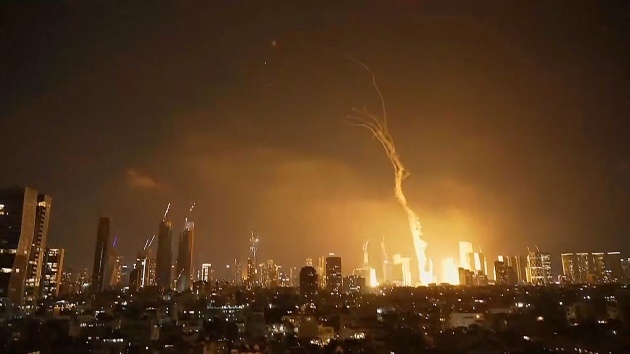
A large flash is seen in Tel Aviv, Israel, June 13, 2025. (ABC News)
(LONDON) — Iranian President Masoud Pezeshkian said that Tehran is in a “full-scale” war with the U.S., Israel and Europe, describing the country’s diplomatic situation as “complicated and difficult.”
“In my opinion, we are in a full-scale war with America, Israel, and Europe; they do not want our country to stand on its feet,” Pezeshkian said in a lengthy interview posted to the official website of Iran’s Supreme Leader Ayatollah Ali Khamenei on Saturday.
“This war is worse than the war in Iraq with us; if one understands well, this war is much more complicated and difficult,” Pezeshkian added, referring to the 1980-1988 Iran-Iraq war.
Pezeshkian said that despite sanctions and foreign pressure, Iran remains steadfast and capable of defending its national interests.
The interview was published ahead of Israeli Prime Minister Benjamin Netanyahu’s visit to the U.S., where he will meet with U.S. President Donald Trump at the latter’s Mar-a-Lago resort in Florida. Iran is among the topics expected to be under discussion.
The meeting is expected to be on advancing the Gaza peace plan, disarming Hamas, demilitarizing Gaza and the fate of the last hostage still remaining in the Strip, a spokesperson for the Israeli foreign ministry said before the Israeli delegation departed on Sunday for the U.S. The spokesperson added that Netanyahu’s agenda is expected to include the “danger Iran poses” to both the Middle East and United States.
The U.S. and Israel combined to attack Iran in June during a 12-day conflict that killed some 1,100 Iranians and saw strikes against Iran’s key nuclear facilities, its air defense network and prominent military and Islamic Revolutionary Guard Corps (IRGC) sites around the country.
Senior military, IRGC and nuclear research personnel were among those killed. Retaliatory missile attacks by Iran killed 28 people in Israel.
In the lead up to and during the June conflict, Netanyahu repeatedly hinted that Israel may pursue a regime change strategy in Iran, seeking to topple the Khamenei-led theocracy there. “This is your opportunity to stand up,” Netanyahu said in an address to Iranians during the war.
Trump even raised the prospect of killing Khamenei in the days before the U.S. joined Israel’s campaign. “We know exactly where the so-called ‘Supreme Leader’ is hiding,” Trump wrote on social media. “He is an easy target, but is safe there — We are not going to take him out (kill!), at least not for now.”
The months since the conflict have seen little progress on a new deal to constrain Iran’s nuclear program or cap its ballistic missile arsenal — two goals long expressed by Trump.
Earlier this month, Trump said that Iran “can try” to rebuild its ballistic missile program, but “it’s going to take them a long time to come back.”
“But if they do want to come back without a deal, then we’re going to obliterate that one, too,” Trump said. “You know, we can knock out their missiles very quickly, we have great power.”
Netanyahu will meet with Trump on Monday shortly after Iran conducted a major military exercise involving ballistic missiles. Referring to recent Iranian activity, Netanyahu warned last week that “any action against Israel will be met with a very severe response.”
At home, the Iranian regime faces serious economic challenges as the country’s currency — the rial — edged lower over recent weeks, causing widespread dissatisfaction and protests.
Over the weekend, groups of shop-owners closed their businesses in two large malls in downtown Tehran protesting the rapid drop in the value of the rial.
Pezeshkian was elected to replace late President Ebrahim Raisi — who died in a helicopter crash in 2024 — with the lowest turnout in the Islamic Republic’s presidential election history. He was widely seen as a moderate alternative to hardliners aligned with the IRGC.
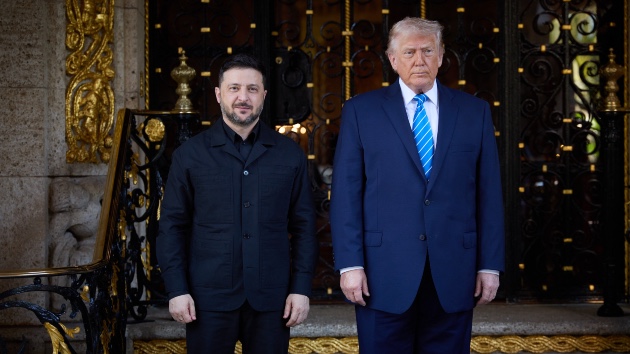
U.S. President Donald Trump (R) welcomes President of Ukraine Volodymyr Zelenskyy (L) at his Mar-a-Lago residence for a meeting and closed-door lunch afterwards in Florida, United States on December 28, 2025. (Photo by Ukranian Presidency / Handout/Anadolu via Getty Images)
(LONDON) — Kremlin envoy Kirill Dmitriev praised U.S. President Donald Trump’s “peace efforts” after Ukrainian President Volodymyr Zelenskyy traveled to the White House on Sunday to discuss a possible peace deal to end Russia’s full-scale invasion of the country.
“The whole world appreciates President Trump and his team’s peace efforts,” Dmitriev, who also serves as the CEO of the Russian Direct Investment Fund and has been closely involved in negotiations with U.S. representatives, said in a post to X.
Dmitriev also posted criticism of what he called “UK/EU warmongers” for their continued backing of Ukraine, echoing the established Kremlin narrative that seeks to frame U.S. diplomatic efforts as being undermined by NATO and European allies.
Trump and Zelenskyy met at the president’s Mar-a-Lago resort in Palm Beach, Florida, on Sunday.
Before the meeting, Trump spoke with Russian President Vladimir Putin by phone, according to Kremlin aide Yuri Ushakov. The call was “organized at the initiative of Trump,” Ushakov said, as quoted by Russia’s state-run Tass news agency.
After his meeting with Zelenskyy, Trump told reporters that the negotiating teams are “getting a lot closer, maybe very close” to achieving a peace deal to end Russia’s full-scale invasion, which Moscow launched in February 2022.
“We had a terrific meeting. We discussed a lot of things. As you know, I had an excellent phone call with President Putin that lasted for over two hours. We discussed a lot of points, and I do think we’re getting a lot closer,” Trump said.
The president said the two leaders covered “95%” of the issues needed to end the war. Trump then detailed a call with European leaders after his bilateral meeting with Zelenskyy, indicating that it went well.
The thorniest negotiating issues still appeared unsettled following the White House meeting. Both Trump and Zelenskyy said the question of Ukrainian territorial concessions — specifically regarding the eastern Donbas region — was yet to be agreed upon.
Russia wants Ukrainian forces to withdraw from the entirety of the Donbas — which is formed of Donetsk and Luhansk regions — in exchange for a peace deal. Zelenskyy has instead proposed a “demilitarized zone” covering the area.
Trump also again dismissed the idea of an immediate ceasefire to facilitate subsequent peace negotiations, which Ukraine has repeatedly proposed. Instead, Trump indicated sympathy with Putin’s demand for a full peace deal before any halt to the fighting.
“He feels that look, you know, they’re fighting and to stop and then, if they have to start again, which is a possibility, he doesn’t want to be in that position,” Trump said of Putin. “I understand that position.”
Zelenskyy nonetheless gave a positive readout of his White House visit in subsequent posts to social media.
“Thank you to President Trump and his team for the negotiations,” he wrote on Telegram. “Thank you to the United States for their support. Together, we have and can implement our vision of a series of steps towards peace.”
Zelenskyy described the talks as “a wonderful meeting,” which included “a meaningful discussion on all issues and highly appreciate the progress made by the Ukrainian and American teams over the past few weeks.”
Zelenskyy also thanked presidential envoy Steve Witkoff and Trump’s son-in-law Jared Kushner, who have been fronting the White House’s recent shuttle diplomacy.
“We discussed all aspects of the peace framework and achieved significant results. We also discussed the sequence of further actions,” Zelenskyy said.
“We agree that security guarantees are key to achieving lasting peace, and our teams will continue to work on all aspects. We agreed that our teams will meet next week to finalize all discussed issues,” he added.
Trump, Zelenskyy said, agreed to host Ukrainian and European leaders in Washington, D.C., in January for further talks. “Ukraine is ready for peace,” Zelenskyy said.
Trump said if things go “really well,” a peace settlement could be reached in “a few weeks.” It’s also possible that a breakthrough never comes.
“But you know, in a few weeks we will know one way or the other,” Trump said, adding, “It’s been a very difficult negotiation.”
On Monday, Kremlin spokesperson Dmitry Peskov said that Putin and Trump will speak over the phone again “in the very near future.” Peskov said the Kremlin did not yet know the outcome of the Sunday talks in Florida, but said Moscow agrees with Trump’s statement that peace is “significantly closer.”
As to a possible call between Putin and Zelenskyy, Peskov said, “There is no talk of such a conversation at this time.”
Responding to questions from journalists while traveling back from Florida on Monday, Zelenskyy gave more details on the ongoing peace talks.
Asked by ABC News whether Ukraine has a plan B, Zelenskyy said, “Ukraine has always had plan A, which is peace.”
“We never wanted war. And in Russia plan A was the war. Therefore, in my opinion, Russia should already think about plan B, about ending the war,” he continued.
Zelenskyy also said he was open to a phone call with Putin, as well as “any options” that can help end the war.
Talks are ongoing as to U.S. security guarantees for Ukraine, Zelenskyy said. The current term of the proposed guarantee is 15 years with the possibility of extension, he added. Kyiv is pushing to extend that term to 30 to 40 years, Zelenskyy said.
Kyiv and Moscow continued their exchange of nightly long-range strikes overnight into Monday, though their scale was somewhat muted compared with major attacks in recent days.
Ukraine’s air force said Russia launched 25 drones into the country overnight, of which 21 were shot down or suppressed. Four drones impacted at two locations, the air force said.
Sunday night’s attack was the smallest since the one launched on the night of June 27 to 28, according to air force data analyzed by ABC News.
Russia’s Defense Ministry, meanwhile, said it downed at least 112 Ukrainian drones overnight.
Flight restrictions were introduced at airports in Krasnodar, Kaluga and Pskov during the overnight attacks, said Russia’s federal air transport agency, Rosaviatsiya.
ABC News’ Natalya Kushnir, Nataliia Popova, Yulia Drozd and Somayeh Malekian contributed to this report.
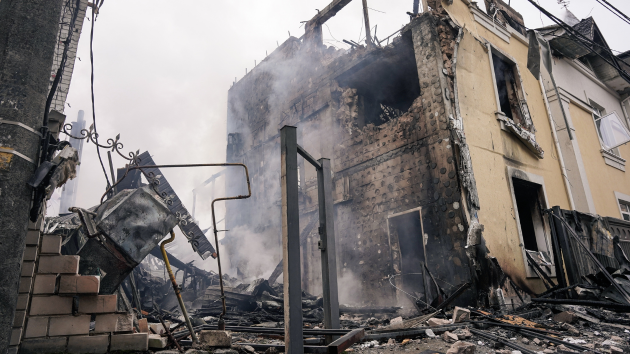
A private residential building in the Darnytskyi district lies partially destroyed by a Russian drone strike on December 27, 2025 in Kyiv, Ukraine. (Andrii Khodkov/Apostrophe/Global Images Ukraine via Getty Images)
(KYIV and LONDON) — Russia has carried out one of the biggest attacks on Kyiv in months, using an estimated 500 drones and 40 missiles, including powerful Kinzhal missiles, according to Ukrainian President Volodymyr Zelenskyy.
The strikes began early Saturday morning and appeared to target power stations and residential area buildings in Kyiv as officials said at least 22 people have been injured, including two children, with 12 being taken to hospital.
In the wider Kyiv oblast, at least one woman has been killed and several apartment buildings were hit as fires broke out and rescue workers looked for people believed to be trapped under the rubble amid the destruction.
More than 2,600 apartment buildings and many schools have lost heating and an estimated 320,000 homes in the region had no electricity.
There were hits on Kyiv’s TPP-5 power plant and on the Bila Tserkva plant, according to officials, in another sign that Russia is attempting to break Ukraine’s energy infrastructure during the winter months.
The Ukrainian president said the attack was Russia’s “answer” to peace efforts, calling on Western countries to send more air defense systems.
Zelenskyy told journalists in a WhatsApp chat on Saturday –while already on the plane to the United States for his planned meeting with President Donald Trump — that Ukraine can only move toward peace if there are strong, legal security guarantees from the U.S. and Europe. He said Ukraine has agreed to “many different compromises,” but stressed they only make sense if the country is fully protected the day after a ceasefire.
Zelenskyy said everything depends on keeping allies together. “If the whole world – Europe and America – is on our side, together we will stop Putin,” he said.
Earlier this week, at least seven people were killed and 39 injured in Ukraine after Russia and Ukraine exchanged hundreds of long-range drone strikes Wednesday night into Thursday morning, according to Ukrainian officials.
“Unfortunately, even on Christmas Eve and during Christmas night, the Russian army did not stop its brutal strikes against Ukraine, targeting our energy system and our people. There are brownouts in many of our cities and villages,” Ukrainian President Volodymyr Zelenskyy said in a post on X.
“Russian troops are once again striking the cities of our east, and in Chernihiv, aid was being provided at the very moment of our conversation with the Patriarch to people wounded by a Russian drone that struck an ordinary residential building,” Zelenskyy added.
Tourist boats on the River Thames in London, UK, on Wednesday, Dec. 24, 2025. UK businesses ended 2025 feeling more upbeat about the economy’s prospects after they were spared much of the tax pain at last month’s budget. (Carlos Jasso/Bloomberg via Getty Images)
(LONDON) — The River Thames winds 215 miles through England, carving out the curves and bends that define much of the geography, including London’s. For centuries, the river has been called “monster soup” and the “dirty old river.”
For thirty years, Lubos Grajciarik, known online as Urban Angler Lou, has stood on its banks with a fishing rod in hand.
“Originally, I came from Slovakia… and I have fished most of my life,” he told ABC News.
He has witnessed firsthand the river’s slow transformation, from Canary Wharf’s rise to the quieter stretches upstream at Richmond and at the weir Teddington Lock.
“Yes, there is improvement,” he said. “Water is still polluted. But it is significantly lower than in previous years.”
Further improvement, and the hope for an even cleaner future, now rests on a monumental infrastructure project beneath London: the £4.5 billion, or about $6 billion, Tideway Tunnel, also known as the “super sewer.” The 25-km tunnel — the largest upgrade to London’s sewers in 150 years — is, according to its designers, intended to intercept overflows and capture waste before it reaches the river.
Four of the tunnel’s 21 gates, which are valves that are designed to stop the waste before it enters the Thames, are operational, with more to open in the coming months.
“The newly completed Tideway Tunnel will reduce the volume of discharges entering the tidal Thames in a typical year by 95%,” said a spokesperson for Thames Water, the company responsible for London’s wastewater.
Optimism from those along the riverbank appears to be supported by science. For more than half a century, the City of London Corporation has collaborated with anglers and ecologists in a citizen science project to track fish populations.
Scientists estimate that more than 100 species now inhabit the Thames, a river once declared biologically dead. In 2024, volunteers caught 122 fish across five species — bass, flounder, eel, pouting and dab.
Grajciarik said his catches reflect that resurgence. “There is a mixture of both species,” he said. “Freshwater pike and perch coexist with occasional mullets, sea bus, sea route.” The Thames, where saltwater meets fresh, has become a rare brackish habitat — alive again, yet still fragile.
But beneath the river’s revival, a darker current still runs.
“In many ways, the Thames is a much healthier ecosystem than it was. Though there are other pressures, like pharmaceuticals, chemicals, [micro]plastics, in the sewage now, against heavy metals several decades ago,” said Dr. Alexander Lipp, an Earth and environmental scientist who created Sewage Map, a platform that tracks sewage overflows in real time.
“Only 6% of the rivers and streams in the Thames basin are classed as in ‘good ecological health’ by the Environment Agency,” a spokesperson for Thames21, an environmental charity working to revive rivers in the Thames Basin, told ABC News. “The primary culprit is physical modifications (straightening, deepening or even paving over rivers), followed by sewage pollution.”
Thames Water saw serious pollution incidents more than double in 2024 — to 33 from 14 a year earlier — according to the Environment Agency’s latest report, which was released before the new “super sewer” began opening. Out of nine water companies assessed, Thames Water alone earned a one-star rating, the lowest possible.
Officials at the Environment Agency — a government agency responsible to protect and improve the environment in the U.K. — attributed the decline in the rating to a mix of factors: unusually wet and stormy weather, years of underinvestment, poor infrastructure maintenance and more rigorous monitoring.
Thames Water said that “all discharges of untreated sewage are unacceptable” in a 2023 statement.
Addressing the low ratings, a company spokesperson said in an emailed response to ABC News, that “in 2024-25, Thames Water also made a record capital investment of £2.225 billion. We know we need to further improve for our customers, community, and the environment, which is why we have embarked on the largest ever investment programme, delivering the biggest upgrade to our network in 150 years.”
Yet those promises are shadowed by debt — nearly £17 billion, or about $22.3 billion, as of March 2025 — amid the growing pressure of climate change. The company said this month that its debt had grown to nearly £20 billion and that it was negotiating with its creditors.
“Any sewage discharged into the Thames negatively affects the river, increasing nutrient loading, bacteria, and plastic pollution,” the Thames21 spokesperson said.
“Climate change is something that’s going to make this worse,” Lipp said. He explained that London’s combined sewage system, where stormwater and wastewater share the same pipes, is easily overwhelmed by heavy rain. With more intense downpours expected, spills will likely become even more frequent.
Still, Lipp noted, “I would say that Thames is better than other companies when it comes to data transparency.”
The company says long-term recovery will take patience. “Transforming Thames is a major programme of work that will take time; it will take at least a decade to achieve the scale of change required,” a spokesperson said.
“I can see the people taking more responsibility for our waters,” said Grajciarik, the fisherman. He often reports oil from nearby boats or sewage spills to the U.K.’s Environment Agency’s hotline number.
But whether the massive investments and new infrastructure will be enough remains uncertain.
Who needs Santa on Christmas when you have a performance from Snoop Dogg?
Snoop entertained fans Thursday with his Holiday Halftime Party, part of Netflix‘s NFL Christmas Day telecast. The performance took place at halftime of the matchup between the Detroit Lions and Minnesota Vikings and began with an introduction from Snoop’s longtime friend Martha Stewart, who put her own spin on the classic “Twas the Night Before Christmas.”
“I sprung from my bed and said, ‘What is cracking?’ Hailing from the one and only LBC, give it up for Snoop D -O- Double G,” Martha said as she flipped the pages to a book with illustrations of Snoop.
Snoop then emerged dressed in a red suit and coat, performing songs including “The One and Only,” “My Favorite Things” and “Nuthin’ But a ‘G’ Thang.” He was backed by an orchestra, a marching band and dancers.
Huntr/x, the trio behind Netflix’s Kpop Demon Hunters movie, joined Snoop for a pop rendition of “The 12 Days of Christmas” and then Lainey Wilson followed with “Santa Claus Is Coming to Town,” arriving in a white sleigh. Andrea Bocelli later took the stage with his son Matteo Bocelli to duet on “White Christmas.”
A view of destroyed residential building as search and rescue and firefighting efforts continue after Russian forces carried out airstrikes on the city of Zaporizhzhia in Ukraine on December 24, 2025. (State Emergency Service of Ukraine / Handout/Anadolu via Getty Images)
(LONDON) — At least seven people were killed and 39 injured in Ukraine after Russia and Ukraine exchanged hundreds of long-range drone strikes Wednesday night into Thursday morning, according to Ukrainian officials.
Russia launched 131 drones into Ukraine overnight, the air force in Kyiv said, of which 106 were shot down or suppressed. Twenty-two drones impacted across 15 locations, the air force said.
As of Thursday morning, local Ukrainian officials and the air force warned that Russian drones were still in the air.
“Unfortunately, even on Christmas Eve and during Christmas night, the Russian army did not stop its brutal strikes against Ukraine, targeting our energy system and our people. There are brownouts in many of our cities and villages,” Ukrainian President Volodymyr Zelenskyy said in a post on X.
“Today, during the daytime, Russian troops are once again striking the cities of our east, and in Chernihiv, aid was being provided at the very moment of our conversation with the Patriarch to people wounded by a Russian drone that struck an ordinary residential building,” Zelenskyy added.
Odesa Gov. Oleh Kiper said in a Telegram post that Russia targeted the southern region’s “port and industrial infrastructure,” damaging industrial facilities and killing at least one person. Two other people were injured, Kiper said.
Ukraine’s State Emergency Service (SES) said on Telegram on Thursday that at least one person was also killed and 14 people injured by a series of Russian attacks in the northeastern Kharkiv region over the previous 24 hours.
The SES said that a Russian drone hit a high-rise residential building in Chernihiv, while several energy infrastructure targets in the city were also attacked.
Chernihiv Gov. Viacheslav Chaus said two people were killed by Russian drone attacks in the city. Two more people were injured, Chaus said.
Ukrenergo — Ukraine’s state-owned electricity operator — said on Telegram that Russian attacks had caused power outages in the Chernihiv, Sumy, Kharkiv, Dnipropetrovsk and Odesa regions. All regions of Ukraine will see power consumption restriction measures enforced throughout Thursday, it added.
Zelenskyy vowed to continue countering Russian aggression “in every way possible,” in a post on X.
Ukraine’s Deputy Prime Minister Oleksiy Kuleba wrote on Telegram, “Even during the Christmas holidays, Russia continues to launch targeted attacks on Ukrainian logistics, ports and critical infrastructure.”
Russia’s Defense Ministry, meanwhile, said its forces shot down at least 141 drones overnight, nine of which were destroyed over the Moscow region.
Moscow Mayor Sergey Sobyanin said in posts to Telegram that emergency services were working at the sites of fallen debris.
In the western Bryansk region, which borders Ukraine, Gov. Aleksandr Bogomaz said one person was hospitalized after being injured by shrapnel from a drone attack, with an apartment building also destroyed.
In Krasnodar Krai in southern Russia, local officials said the port of Temryuk came under attack, with two tanks holding petroleum products catching fire.
Russia’s federal air transport agency, Rosaviatsiya, said temporary flight restrictions were introduced at airports in Krasnodar and Yaroslavl during the latest attacks.
Wednesday night’s strikes followed multiple waves of Ukrainian attack drones launched into Russia on Tuesday night and throughout Wednesday, according to the Defense Ministry.
Through Wednesday, the ministry said its forces shot down at least 387 Ukrainian drones — the largest number reported by the ministry in a 24 hour period of the war to date — including more than a dozen over the Moscow region.
A view of destroyed residential building as search and rescue and firefighting efforts continue after Russian forces carried out airstrikes on the city of Zaporizhzhia in Ukraine on December 24, 2025. (State Emergency Service of Ukraine / Handout/Anadolu via Getty Images)
(LONDON) — Russia and Ukraine exchanged hundreds of long-range drone strikes from Wednesday night through into Thursday morning.
Russia launched 131 drones into Ukraine overnight, the air force in Kyiv said, of which 106 were shot down or suppressed. Twenty-two drones impacted across 15 locations, the air force said.
As of Thursday morning, local Ukrainian officials and the air force warned that Russian drones were still in the air.
Odesa Gov. Oleh Kiper said in a Telegram post that Russia targeted the southern region’s “port and industrial infrastructure,” damaging industrial facilities and killing at least one person. Two other people were injured, Kiper said.
Ukraine’s State Emergency Service (SES) said on Telegram on Thursday that at least one person was also killed and 14 people injured by a series of Russian attacks in the northeastern Kharkiv region over the previous 24 hours.
The SES said that a Russian drone hit a high-rise residential building in Chernihiv, while several energy infrastructure targets in the city were also attacked.
Chernihiv Gov. Viacheslav Chaus said two people were killed by Russian drone attacks in the city. Two more people were injured, Chaus said.
Ukrenergo — Ukraine’s state-owned electricity operator — said on Telegram that Russian attacks had caused power outages in the Chernihiv, Sumy, Kharkiv, Dnipropetrovsk and Odesa regions. All regions of Ukraine will see power consumption restriction measures enforced throughout Thursday, it added.
Ukraine’s Deputy Prime Minister Oleksiy Kuleba wrote on Telegram, “Even during the Christmas holidays, Russia continues to launch targeted attacks on Ukrainian logistics, ports and critical infrastructure.”
Russia’s Defense Ministry, meanwhile, said its forces shot down at least 141 drones overnight, nine of which were destroyed over the Moscow region.
Moscow Mayor Sergey Sobyanin said in posts to Telegram that emergency services were working at the sites of fallen debris.
In the western Bryansk region, which borders Ukraine, Gov. Aleksandr Bogomaz said one person was hospitalized after being injured by shrapnel from a drone attack, with an apartment building also destroyed.
In Krasnodar Krai in southern Russia, local officials said the port of Temryuk came under attack, with two tanks holding petroleum products catching fire.
Russia’s federal air transport agency, Rosaviatsiya, said temporary flight restrictions were introduced at airports in Krasnodar and Yaroslavl during the latest attacks.
Wednesday night’s strikes followed multiple waves of Ukrainian attack drones launched into Russia on Tuesday night and throughout Wednesday, according to the Defense Ministry.
Through Wednesday, the ministry said its forces shot down at least 387 Ukrainian drones — the largest number reported by the ministry in a 24 hour period of the war to date — including more than a dozen over the Moscow region.
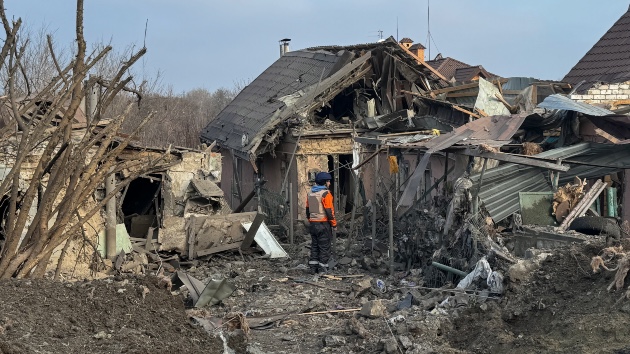
A rescuer stands amid rubble in the yard of house after Russian shelling on December 19, 2025 in Zaporizhzhia, Ukraine. As a result of the shelling, private houses were partially destroyed, a garage cooperative, cars, and residential buildings located near the hit sites were damaged. (Photo by Polina Moroz/Suspilne Ukraine/JSC “UA:PBC”/Global Images Ukraine via Getty Images)
(LONDON) — Russia’s offensive campaign in eastern and southern Ukraine has been grinding on throughout 2025, with much of the fighting of the last 12 months focused on devastated cities in the eastern Donetsk and northeastern Kharkiv regions.
But in September, Russian forces began a relatively rapid advance in the farmlands to the east of Zaporizhzhia, advancing up to six miles in places — according to Ukrainian military officials — as territorial defense units that had been holding the area for two years crumbled under sudden and intense offensive pressure applied by Moscow’s forces.
Russia’s unexpected breakthrough in Zaporizhzhia represented a rare instance of battlefield mobility in a war that has become characterized by labored attritional warfare, in which mechanized troop concentrations and supporting armored vehicles quickly become easy prey for the flocks of drones incessantly swarming above the front lines.
Among the Ukrainian units deployed to stem the Russian advance was the 225th Separate Assault Regiment, which had previously been fighting to repel Russian forces along the shared border in the northeastern Sumy Oblast.
“The situation there remains complicated, and we are trying to stabilize it,” Maj. Oleh Shyriaiev of the 225th regiment told ABC News by phone from close to the front. “It is a mistake to consider that it is 100% stabilized,” he added.
Representatives of the combatants are currently engaged in U.S.-sponsored shuttle diplomacy that the White House hopes will secure an end to Europe’s largest conflict since World War II and a war that U.S. President Donald Trump vowed to end within 24 hours of his return to the Oval Office.
Russian officials have repeatedly framed their slow battlefield gains as evidence of Moscow’s “inevitable” victory, in the words of Deputy Foreign Minister Sergey Ryabkov during a recent interview with ABC News.
That interpretation is hotly disputed by Kyiv and its European allies, but the Kremlin nonetheless seeks to use its gradual seizure of new territory as leverage in the ongoing talks. “The space for freedom of decision-making narrows as territories are lost,” Kremlin spokesperson Dmitry Peskov said in November.
In foxholes, trenches and treelines along the contact line, Shyriaiev said his unit is focused on their day-to-day survival.
“I personally am skeptical about any kind of peace negotiations,” he said. “Even if some kind of a peace agreement is signed, Russia will not stop existing, and it will not stop being our enemy.”
Any deal, he suggested, “will just give time for Russia to regroup. And what happens next? We need to expect a new attack. No guarantees that Russia can give can be considered true guarantees.”
The focus of the Russian offensive in Zaporizhzhia is now in the area of Huliaipole, a small city which before the war was home to around 20,000 people. Only around 150 civilians remain in the devastated city, the head of its military administration told Ukrainian media earlier this month.
In the fields around the city, Ukrainian officials say they have largely stalled Russia’s forward momentum. Shyriaiev said his unit needed time to adapt to the new battlefield and wear down the attackers.
“We had to go out and create a blocking line, fulfil missions and create favorable conditions for further success,” he explained. “At the moment, everything we are doing is focused on stabilizing the front line and blocking the enemy.”
Ukrainian forces in the area are facing Russian units replenished with new recruits and new equipment, Shyriaiev said.
“The enemy has strengthened its UAV component and thanks to that, they are holding under control the access areas to the line of contact — or at least they are trying to hold it under control,” he said.
“The enemy has had some success because their units have been reconstituted according to the most cutting edge experience that they have,” Shyriaiev said. “They have been trained with the latest updates, they have all the ‘lessons learned'” by their predecessors, he added.
Those newly arrived troops are trying to use the wintry weather and resulting “dense fog” to their advantage, Shyriaiev said.
“When there are normal visibility conditions, we can see everything and control everything,” he said. “However, when there is fog around, the enemy is trying to take advantage of this and to infiltrate the space between our positions.”
For the Ukrainians, too, the weather offers opportunities, Shyriaiev said. “When visibility is good, it means that badly hidden or badly masked positions are an open target and the troops that are deployed there can be wounded or destroyed.”
Moscow’s ‘glacial’ advance
Russian President Vladimir Putin has given little indication that he intends to ease the frontline pressure on Kyiv’s troops, despite the recent fresh impetus given to U.S.-brokered peace negotiations.
At his annual end-of-year press conference on Friday, Putin said peace was only possible on the basis of “principles” he outlined in a speech last year, in which he made some of his most hardline demands — Ukraine’s permanent exclusion from NATO and Kyiv’s withdrawal from all of the territory Russia claims in eastern and southeastern Ukraine.
Putin again claimed that military momentum was with Moscow’s forces, saying its troops were “advancing on all fronts.”
Putin’s bombast does not align with battlefield realities, according to Ukrainian officials and independent analysts.
The U.S.-based Institute for the Study of War think tank said this month that Russian forces have seized 0.77% of Ukraine’s territory — some 1,802 square miles — over the past year, while sustaining disproportionately high casualties. The area captured is roughly equivalent to that of Anchorage, Alaska.
Ukraine’s military estimates that Russia has sustained around 1.2 million casualties since February 2022. President Volodymyr Zelenskyy said this month that around 30,000 Russian troops are being killed each month.
Russia does not release details about its casualties, making it difficult to independently confirm that figure. Ukrainian estimates of Russian casualties have broadly chimed with estimates from U.S. and European intelligence agencies since 2022.
Ukraine likewise does not regularly disclose its casualty figures. Zelenskyy said in February 2025 that more than 46,000 Ukrainians have been killed and 380,000 wounded since 2022.
Peter Dickinson, the editor of the Atlantic Council think tank’s UkraineAlert service, wrote in December that while Moscow’s troops hold “the overall initiative,” its attacking units are “grinding forward at glacial pace while suffering catastrophic losses.”
Also this month, Zelenskyy visited the Kharkiv frontline city of Kupyansk, posting videos of himself in the center of the city as proof that Russia’s recent claim to have captured it was false. The visit, Dickinson said, “underscored the fact that Russian victory is anything but inevitable.”
But Putin appears committed to a relentless push, regardless of its slow pace and high cost. Ukrainian Commander-in-Chief Gen. Oleksandr Syrskyi said in a post to Facebook last week that Russia has amassed 710,000 troops along the front for its offensive operations.
“Despite the substantial losses, the Russian army is not giving up on continuing offensive operations, although it has not achieved significant operational success,” Syrskyi said.
Shyriaiev said that although his unit is “well-staffed” and motivated, the difference in manpower and resources is obvious at the front. The Russians, he said, “are focusing on mass in everything.”
Shyriaiev’s unit faces “massive amounts of infantry” attacking from “early morning and until late at night,” he said. “They conduct mechanized assaults on all kinds of vehicles — regular cars, motorbikes, buggies. It could also be proper military equipment, proper military armored vehicles.”
“They are leaving no stone unturned,” he continued. “The ratio of the size of our army and our resources and their resources is, of course, something unfavorable towards us. They have more resources. This is why they do achieve some successes, but that happens at a very high price.”
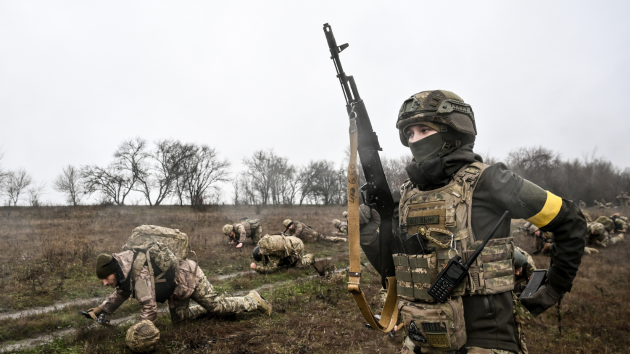
Recruits crawl a designated distance with combat gear under the supervision of instructors during the zero day of basic combined arms training with the 65th Separate Mechanized Brigade at an improvised training ground in Ukraine, on December 12, 2025 (Dmytro Smolienko/Ukrinform) (Ukrinform/NurPhoto via Getty Images)
(LONDON) — Ukrainian President Volodymyr Zelenskyy said on Tuesday that he believes the U.S. “wants to reach a final agreement,” to end the war in Ukraine, with Kyiv offering its full backing for a peace deal.
“We sense that America wants to reach a final agreement, and from our side, there is full cooperation,” Zelenskyy said. “Ukraine has never been, and will never be, an obstacle to peace.”
Ukraine and Russia continued their nightly exchange of long-range drones overnight into Wednesday. Russia’s Defense Ministry said on Wednesday that its forces downed at least 195 Ukrainian drones, including five over Moscow region of which two were “flying toward” the capital.
Russia’s federal air transport agency, Rosaviatsiya, said flight restrictions were introduced at two of Moscow’s four international airports — Domodedovo and Vnukovo — during the attacks. Restrictions were also put in place at airports in Volgograd, Yaroslavl, Orenburg, Ufa and Orsk, Rosaviatsiya said.
Ukraine’s air force, meanwhile, said Russia launched 116 drones into the country overnight, of which 60 were shot down or suppressed. Forty-eight drones impacted across 19 locations, the air force said.
On Tuesday night, Zelenskyy said Ukrainian repair crews were working to restore power after a major Russian drone and missile strike on Monday night. “Throughout the day, repair crews have been working at energy facilities — putting in maximum effort to ensure that Ukrainians have electricity for Christmas,” Zelenskyy said.
“Of course, the Russians are trying to ruin this holiday, this sacred day, as well. No surprise there,” Zelenskyy added.
At a briefing in Kyiv with journalists on Tuesday, Zelenskyy revealed details of the 20-point peace plan negotiated with the U.S. which is now being reviewed by Moscow.
Zelenskyy told reporters that said all sides were “much closer” to finalizing the documents. Kyiv expects to receive a response from Moscow on Wednesday, Zelenskyy added.
The proposed framework includes security guarantees from the U.S., NATO and European partners, though territorial questions remain unresolved. Under the draft plan, Ukraine would hold a presidential election as soon as possible after any deal is signed.
Zelenskyy said the deal would see Article-5-style security guarantees kick in if Russia attacks the country again, even without Ukrainian NATO membership. Zelenskyy again stressed that Kyiv rejected any ban on joining the alliance — a key Russian demand.
Kremlin spokesperson Dmitry Peskov said on Wednesday that Russian President Vladimir Putin has been briefed on recent U.S. contacts.
“We now intend to formulate our future position based on the information received by the head of state and continue our contacts in the very near future through the existing channels that are currently operational,” Peskov said, as quoted by the state-run Tass news agency.
Russian Deputy Foreign Minister Sergei Ryabkov, meanwhile, said Moscow and Washington have “significant similarities” in their positions on a possible settlement.
(GAZA and LONDON) — As Palestinian Christians prepare for their first Christmas without the constant threat of bombardment and attacks after two years of war in Gaza, rare scenes of color, glitter and light can be spotted in a city that is mostly covered with rubble and collapsed buildings.
With the fragile ceasefire broadly holding more than two months since the first phase went into effect, the small remaining Palestinian Christian community in Gaza hopes for long-lasting peace as they practice holiday traditions like putting up Christmas trees and baking pastries.
“This year, Christmas is not just a religious ritual but celebrating a new beginning that we all work towards, which is the beginning of peace and stability in the region,” Mousa Ayyad, coordinator of Princess Basma, a Christian center in Gaza, told ABC News last week while standing by a Christmas tree decorated with ornaments and lights.
The center is located inside Al-Ahli Hospital, the only Christian hospital in Gaza, and provides vital rehabilitation for children.
“You must prepare the atmosphere for the children, and continue to welcome happiness into your home, even if you aren’t at your home and you are displaced,” Ayyad said.
Over 80% of all structures in the Gaza Strip have been damaged as of Oct. 11, according to a United Nations assessment.
The Holy Family Church, the only Catholic church in the Gaza Strip, remains standing, though has signs of damage.
Since the war broke out between Israel and Hamas, the terrorist group that launched a surprise attack on Israel on Oct. 7, 2023, almost half of the Christian population in Gaza has left the strip and at least 23 Palestinian Christians have been killed, according to the Holy Family Church. About 500 people in the community are still in Gaza, with the majority of those currently sheltering in the church, according to the Holy Family Church.
Cardinal Pierbattista Pizzaballa, the Latin Patriarch of Jerusalem, led his first prayer in Gaza following the ceasefire during Mass at the Holy Family Church on Sunday, in what he called a “new phase.”
Amid modest decorations and damaged walls, Pizzaballa led the first communion for several children and baptized a baby, continuing a pastoral tradition he has upheld during each Christmastime visit to Gaza.
Pizzaballa said during a press conference on Sunday that he has witnessed “a desire for a new life” in Gaza, but that “all the problems are still on the table: housing, schools, hospitals, the condition of life and poverty are catastrophic.”
“At the same time, we saw that the resilience of these people is what, at the end, will prevail,” he said, describing Palestinians’ steadfastness as a lesson to the world.
George Messaqo, an 11-year-old displaced Christian who attended the Mass, told ABC News that he feels “very happy” this Christmas, though his joy was tinged with longing.
“Before the war, Christmas was more beautiful,” he said. “There were more people, all our relatives and loved ones, and the atmosphere was warmer.”
George said his aunt was killed during the war and other family members now live abroad.
“We only communicate through video calls,” he said. “I wish to see our friends, relatives and loved ones again, and to live in peace.”