(HAITI) — A Spirit Airlines plane flying from Fort Lauderdale, Florida, to Haiti was diverted after it was struck by gunfire while attempting to land in Port-au-Prince, the Haitian National Office of Civil Aviation (OFNAC) told ABC News.
The plane was struck by gunfire four times while attempting to land at Touissant Louverture Airport in the capital city of Port-au-Prince, OFNAC said.
The Spirit Airlines plane “diverted and landed safely in Santiago, Dominican Republic,” Spirit Airlines said in a statement Monday, adding that no passengers reported injuries and one flight attendant onboard the plane reported unspecified “minor injuries” and was undergoing medical evaluation.
After the plane arrived in the Dominican Republic, “an inspection revealed evidence of damage to the aircraft consistent with gunfire,” the Spirit Airlines statement said. The plane was taken out of service and a different aircraft was secured to return the passengers and crew to Fort Lauderdale, the statement added.
All airlines have temporarily suspended flights at Touissant Louverture Airport, OFNAC told ABC News. American Airlines and JetBlue issued statements announcing that they had suspended flights into Haiti until at least Thursday.
The U.S. Embassy in Haiti issued a security alert saying that it was “aware of gang-led efforts to block travel to and from Port-au-Prince which may include armed violence, and disruptions to roads, ports, and airports.”
“The security situation in Haiti is unpredictable and dangerous,” the embassy alert continued, further noting that “The U.S. government cannot guarantee your safety traveling to airports, borders, or during any onward travel. You should consider your personal security situation before traveling anywhere in Haiti.”
(NEW YORK) — The climate crisis is not a distant threat; it’s happening right now and affecting what matters most to us. Hurricanes intensified by a warming planet and drought-fueled wildfires are destroying our communities. Rising seas and flooding are swallowing our homes. And record-breaking heatwaves are reshaping our way of life.
The good news is we know how to turn the tide and avoid the worst possible outcomes. However, understanding what needs to be done can be confusing due to a constant stream of climate updates, scientific findings, and critical decisions that are shaping our future.
That’s why the ABC News Climate and Weather Unit is cutting through the noise by curating what you need to know to keep the people and places you care about safe. We are dedicated to providing clarity amid the chaos, giving you the facts and insights necessary to navigate the climate realities of today — and tomorrow.
US climate envoy tells global climate conference the fight must continue despite election results
With the future of U.S. climate and environmental policies uncertain following the presidential election, the world is gathering in Baku, Azerbaijan, to talk climate change. COP29, formally known as the 29th Annual Conference of Parties, opened Monday with questions about the United States’ commitment to global climate goals in light of the 2024 election results.
At a press conference on Monday, U.S. Climate Change Envoy John Podesta told reporters, “For those of us dedicated to climate action, last week’s outcome in the United States is obviously bitterly disappointing.”
“It is clear that the next administration will try to take a U-turn and reverse much of this progress,” Podesta said. “And I know that this disappointment is more difficult to tolerate as the dangers we face grow ever more catastrophic,” he added.
In sharp contrast to President-elect Donald Trump calling climate change a hoax, promising to “drill, baby, drill,” and roll back unused Inflation Reduction Act (IRA) funds, Podesta highlighted the Biden-Harris Administration’s efforts to combat climate change, including the move to rejoin the Paris Agreement and the climate and clean energy investments made through the IRA and the Bipartisan Infrastructure Law.
Podesta said that while the Biden Administration will work with the incoming Trump Administration to ensure a peaceful transfer of power, “This is not the end of our fight for a cleaner, safer planet.”
“Facts are still facts. Science is still science,” he added. “The fight is bigger than one election, one political cycle in one country, this fight is bigger still, because we are all living through a year defined by the climate crisis in every country of the world.”
Podesta pointed to extreme heat records, recent hurricanes in the Southeast United States, flooding in Spain, severe drought in southern Africa, and wildfires in the Amazon as some examples of the acute impacts of climate change felt around the world just this year.
Following then-President Trump’s withdrawal from the Paris Agreement in 2017, a coalition of local and state government leaders, organizations and private industry members announced the joint declaration, “We Are Still In.”
Podesta reminded attendees of that effort, saying that while a Trump White House may pose challenges for federal level climate action, the U.S. is not giving up on its goals and that support for clean energy, an issue that “has become bipartisan in the United States.”
“You might not know that by reading the newspapers, but it has,” he said. “57% of new clean energy jobs created since the Inflation Reduction Act passed are located in congressional districts represented by Republicans.”
He added, “We can and will make real progress on the backs of our climate committed states and cities, our innovators, our companies and our citizens, especially young people, who understand more than most that climate change poses an existential threat that we cannot afford to ignore. Failure or apathy is simply not an option.”
-ABC News Climate Unit’s Kelly Livingston and Matthew Glasser
How a university is using AI to reduce cafeteria food waste
Food waste is a massive problem. According to the UN, the world wastes more than a billion tons annually. Here at home, Americans waste around 80 million tons each year. And worldwide, nearly 40% of all the food we produce is lost or wasted, according to the WWF.
At the same time, Feeding America, a nationwide network of food banks and pantries, says 47 million people in the U.S. face hunger, including 1 in 5 children. Then, there are the significant environmental impacts of sending so much wasted food to landfills. Left to decompose, this organic waste releases methane, a powerful greenhouse gas that’s far more potent than carbon dioxide.
Erin Murphy, a student at Georgia State University (GSU) in Atlanta and a sustainability initiatives intern, saw all the food her peers were wasting and wanted to do something about it. She applied for a grant to bring new technology to campus that uses artificial intelligence to examine food waste and provide real-time data on what’s left behind.
The technology, aptly named “Raccoon Eyes,” analyzes the food left on each plate, categorizing and weighing the leftovers to provide detailed data on the waste and recommendations for reducing the leftovers.
When students finish their meals, they place their plates on a conveyor belt, where “Raccoon Eyes” captures an image of the plate. AI then uses that picture to evaluate the contents. This data is displayed on an online dashboard, offering real-time insights to the dining staff.
Ivan Zou, the co-founder of “Raccoon Eyes,” said the information helps identify trends, such as how many plates of a specific meal were uneaten. For example, the system showed that students ate most of the salmon they put on their plates during a particular meal, but they left behind a lot of french fries during another meal.
Jennifer Wilson, GSU’s Director of Sustainability, said that since the program’s launch in January, the AI has analyzed over 400,000 plates and found that approximately 21% contained food waste.
And it turns out that some of the most popular items, like chicken, pizza, and french fries, also generate the most waste. However, the dashboard’s detailed feedback also reveals that popular meals often have leftover portions because students take too much, not because the food is unpopular. This nuanced insight helps dining services adjust not only the menu but also portion sizes and serving methods.
The initiative is already making a difference. In the first four months, GSU reduced food waste by 23%, thanks to AI insights and increased student awareness.
The program even encourages feedback through a kiosk where students can leave comments like “sorry for my waste.” Such feedback has proven invaluable, guiding the dining team in refining their offerings, for instance, by making more of the crowd-favorite Hot Cheetos sushi and less of other less popular items.
-ABC News Climate Unit’s Matthew Glasser, ABC News’ Matt German, and ABC News meteorologist Dan Manzo
Drought in US improves slightly but still a problem for half the country
Heading into November, widespread drought conditions are still a significant concern across the country, with the Northeast currently experiencing some of the worst impacts, according to a U.S. Drought Monitor update released Thursday.
Overall, more than half of the contiguous United States is still grappling with drought. But there are some areas where things are improving slightly. A large swath of the central U.S. saw its drought situation improve, according to the data.
As a result, countrywide drought coverage decreased from 54.08% to 51.89% week over week. Moderate to severe drought conditions expanded in the Northeast, with portions of southern New Jersey now experiencing extreme drought conditions. Recent heavy rain in the Southern Plains brought drought improvements to parts of Texas, Oklahoma and Kansas.
October was one of the driest months on record for the U.S., triggering a significant increase in the area and severity of drought conditions. While the overall drought coverage has decreased slightly, over 87% of the lower 48 states continue to experience abnormally dry conditions, the most extensive coverage area ever recorded by the U.S. Drought Monitor, which began tracking the data in 2000.
Drought is a complex phenomenon influenced by various factors. Among these, extreme heat is strongly linked to human-amplified climate change. More frequent and intense extreme heat events can worsen the effects of drought. Drought risk has increased in the Southwest over the past century, according to the federal government’s Fifth National Climate Assessment.
Over the next week, measurable rain is forecast across most of the country, with widespread significant rainfall likely across portions of the Midwest, Plains and Pacific Northwest.
Looking ahead, NOAA’s Climate Prediction Center said most of the country will likely experience above-average precipitation in mid-November, particularly in the Midwest, Plains and West. Most of the East Coast and Gulf Coast can expect near-average rainfall during this period. No part of the nation should experience below-average precipitation during this time.
-ABC News meteorologist Dan Peck and ABC News Climate Unit’s Matthew Glasser
2024 a near certainty to be the warmest year on record
It’s now virtually certain that 2024 will surpass 2023 as Earth’s warmest year on record, according to a new report by Copernicus, the European Union’s Climate Change Service. As of October 2024, the average global year-to-date temperature was 0.16 degrees Celsius (or 0.29 degrees Fahrenheit) higher than it was in 2023, which is the warmest year ever recorded.
While .16 degrees may not seem significant, even small global temperature increases can trigger substantial changes in weather patterns, leading to more extreme events like heatwaves, droughts, floods, and wildfires, according to climate scientists at NASA.
Last month was also the second warmest October globally, with an average temperature of 15.25 degrees Celsius, or 59.45 degrees Fahrenheit.
Copernicus noted that 2024 will likely be the first year to be 1.5 degrees Celsius warmer (2.7 degrees Fahrenheit) than the pre-industrial average of 1850-1900.
The global average temperature over the past twelve months (November 2023 through October 2024) was 1.62 degrees Celsius or 2.92 degrees Fahrenheit above pre-industrial levels.
The Paris Agreement goals aim to limit global warming to 1.5 degrees Celsius to prevent the worst outcomes of climate change.
Global daily sea surface temperatures across most of the world’s oceans remain well above average, including much of the Atlantic Basin. Unusually warm sea surface temperatures can make hurricanes more intense and may play a role during the remainder of the Atlantic Hurricane Season, which ends on November 30th.
Persistent marine heatwaves are also a major concern for the world’s coral reefs as the largest global coral bleaching event on record continues to impact these delicate ecosystems. The National Oceanic and Atmospheric Administration (NOAA) says that nearly 77% of the world’s coral reef areas have experienced bleaching-level heat stress during this latest event, the second global coral reef bleaching event in the last 10 years.
-ABC News meteorologist Dan Peck and ABC News Climate Unit’s Matthew Glasser
Study finds use of renewable energy sources reduces risk of blackouts
The Texas freeze of 2021 knocked out power for more than 10 million people, leaving some without heat for days. In the aftermath of the storm, Texas Gov. Greg Abbott told a national news network that “Wind and solar got shut down.” He added, “They were collectively more than 10% of our power grid, and that thrust Texas into a situation where it was lacking power on a statewide basis.”
However, in the aftermath, a research study found that renewable energy sources (RES) weren’t to blame. Instead, the researchers found that Texas “failed to sufficiently winterize its electricity and gas systems after 2011.”
Other blackouts have also been blamed on RES, including the 2016 blackout in South Australia and a 2019 outage in the U.K., both of which involved disruptions to wind farms.
Now, according to a new study from The University of Tennessee, grids with higher renewable energy penetration are actually less vulnerable to blackouts than those more reliant on traditional, non-renewable sources.
The analysis found that as the proportion of renewable energy in the grid increases, the intensity of blackouts — measured by the number of affected customers and the length of outages — decreases. This finding challenges the notion that renewable energy inherently makes power grids more fragile.
The researchers analyzed over 2,000 blackouts across the U.S., looking specifically at how renewable energy levels and various weather patterns influenced outage severity. They discovered that high levels of renewables didn’t contribute to an increase in weather-related blackouts.
In grids where renewables made up more than 30% of the energy supply, blackout events were generally less intense and shorter in duration. This trend held even during extreme weather, like high winds and storms, which can place heavy demands on power systems.
-ABC News Climate Unit’s Matthew Glasser
Researchers say they’ve devised the perfect placement for EV chargers
When you buy a gas-powered car, you rarely worry about where to fill it up. That’s because gas stations are everywhere. A 2022 McKinsey survey found that more than 40% of prospective electric vehicle (EV) buyers want that same degree of convenience when it comes to public charger availability for EVs.
Engineers at Cornell University say they have devised a solution for where to place EV charging stations so they are convenient for drivers and profitable for companies.
Using Bayesian optimization, a mathematical method that efficiently analyzes complex data to achieve these results, the research team discovered that for urban areas that it’s best to install an equal percentage of medium-speed and fast chargers. And because motorists use different speed chargers for different reasons, the researchers said it is essential to consider how they are being used when placing them around town.
For example, the engineers found that fast charging is more important at grocery stores when consumers are only inside for 20 minutes. Work and home charging stations should be medium speed because drivers usually park for hours at a time at those locations.
The researchers say their approach can boost investor returns by 50% to 100% compared to random placement strategies.
The team simulated the behavior of 30,000 vehicles over 113,000 trips in the Atlanta region, considering various traffic patterns and driver decisions. This method allowed them to determine optimal charging station placements.
Yeuchen Sophia Liu, the study’s lead author, told the Cornell Chronicle that, “Placing publicly available charging stations around cities sounds like a simple thing, but mathematically, it’s actually very hard.”
She added, “Economically strategic placement of charging stations could play a pivotal role in accelerating the transition to zero-emission vehicles.”
-ABC News Climate Unit’s Matthew Glasser
Nearly 40% of the world’s trees face extinction, according to new assessment
Climate change, deforestation, invasive pests and disease all threaten to permanently wipe out nearly 40% of the earth’s trees, according to a new assessment by the International Union for the Conservation of Nature (IUCN).
The organization, comprised of 1,400 member organizations worldwide and 16,000 experts, said more than one in three tree species across 192 countries is now facing extinction, especially trees found on islands.
development and agriculture, as well as the other threats faced by tree species across the globe.
Since 1964, the IUCN has hosted its “Red List,” a database of threatened species from around the world. The research group found that 16,425 of the 47,282 tree species on their list are at risk of extinction — more than 2,000 of which are used for medicines, food, and fuels.
“Trees are essential to support life on Earth through their vital role in ecosystems, and millions of people depend upon them for their lives and livelihoods,” said Grethel Aguilar, IUCN director general, in a statement.
According to their analysis, “the number of threatened trees is more than double the number of all threatened birds, mammals, reptiles and amphibians combined.”
The group is calling for more habitat protection and restoration to protect these species and the creation of seed banks and botanical gardens to ensure they don’t disappear forever.
“The significance of the Global Tree Assessment cannot be overstated, given the importance of trees to ecosystems and people. We hope this frightening statistic of one in three trees facing extinction will incentivize urgent action and be used to inform conservation plans,” said Eimear Nic Lughadha from the Royal Botanic Gardens, in a statement.
-ABC News Climate Unit’s Matthew Glasser
Report finds climate change increased heat deaths among older adults by 167%; worsened food security
The health and economic costs of climate change are rising worldwide, according to the newly released 2024 Lancet Countdown, a yearly report hosted by University College London and involving more than 300 researchers.
According to the report, “Of the 15 indicators monitoring climate change-related health hazards, exposures, and impacts, ten reached concerning new records in their most recent year of data.”
With global communities facing an additional 50 days of “dangerous heat,” heat-related deaths among older adults increased by a record-breaking 167% in 2023 compared to the 1990s, according to the report’s findings.
In addition to the heat impact, the Lancet report found that climate change is significantly worsening food insecurity, with 151 million more people facing shortages compared to previous decades. And more than 3 million people died in 2021 because of air pollution and fine particulate matter.
The researchers also found that global extreme weather costs have increased by 23% from 2010-14 to 2019-23, amounting to $227 billion annually.
-ABC News Climate Unit’s Kelly Livingston and ABC News Medical Unit’s Sony Salzman
(LONDON) — The Israel Defense Forces continued its intense airstrike and ground campaigns in Gaza — particularly in the north of the strip — and in Lebanon, with Israeli attacks on targets nationwide including in the capital Beirut.
Tensions remain high between Israel and Iran after the former launched what it called “precise strikes on military targets” in several locations in Iran following Tehran’s Oct. 1 missile barrage.
Hezbollah fires 75 projectiles into Israel, IDF says
The Israel Defense Forces said Hezbollah fired at least 75 projectiles into Israel on Monday.
Israel’s Magen David Adom emergency service said it treated three people with shrapnel injuries in the area of Karmiel in northern Israel. Two other people were treated for shrapnel injuries in the Krayot area, the MDA said.
Hezbollah claimed several rocket and drone attacks on Monday.
Among the strikes was a “large rocket salvo” targeting a paratrooper training base in Karmiel settlement, Hezbollah said in a statement.
-ABC News’ Dana Savir and Ghazi Balkiz
IDF orders residents of 21 south Lebanon villages to evacuate
Israel Defense Forces spokesperson Avichay Adraee issued a warning to residents of 21 south Lebanon villages to evacuate their homes until further notice, warning of imminent Israeli strikes there.
Adraee said in a post on X that the villages were the site of Hezbollah military activity and warned that the IDF would “act forcefully” against targets there.
“For your safety, you must evacuate your homes immediately and move to the north of the Awali River,” Adraee wrote. “For your safety, you must evacuate without delay.”
“You are prohibited from heading south,” he added. “Any movement south could be dangerous to your life.”
Around a quarter of Lebanese territory and a quarter of all residents — some 1.2 million people — are under IDF evacuation orders, per United Nations analysis.
Israel has killed more than 3,000 people in southern Lebanon since Oct. 8, 2023, Lebanese authorities have said.
IDF says deadly north Lebanon strike targeted Hezbollah weapons
The Israel Defense Forces said the strike in northern Lebanon that killed dozens of people on Sunday targeted “a Hezbollah terrorist site” which was storing weapons.
Lebanese health officials said the airstrike on the village of Aalmat — in a mainly Christian area in the north of the country — killed 23 and injured at least six others. Seven children were among the dead, officials said. Search and rescue work was ongoing as of Sunday.
The IDF said that Hezbollah fighters “responsible for firing rockets and missiles toward Israeli territory” were “operating from the site,” adding that the details of the incident “are under review.”
Lebanese authorities say that Israeli strikes have killed more than 3,000 people since Oct. 8, 2023. Some 1.2 million people — around a quarter of Lebanon’s population — have also been displaced by Israel’s military campaign.
-ABC News’ Dana Savir
IDF intercepts launch from Yemen
The Israel Defense Forces said Monday it intercepted one projectile “that approached Israel from the direction of Yemen.”
“The projectile did not cross into Israeli territory,” the IDF said in a statement posted to X, noting that the projectile caused sirens to sound in several areas of central Israel.
Overnight, the IDF also said it intercepted four uncrewed aerial vehicles that approached Israel from the east.
-ABC News’ Bruno Nota
New Defense Minister says Israel has defeated Hezbollah
Israeli Defense Minister Israel Katz declared on Sunday that his country has defeated Hezbollah after killing the group’s leader, Hassan Nasrallah.
“We defeated Hezbollah, and the elimination of Nasrallah was the crowning achievement,” Katz said during a handover ceremony at Israel’s foreign ministry on Sunday.
The ceremony comes after Israel’s Prime Minister Benjamin Netanyahu fired the previous defense minister, Yoav Gallant.
There is no word on how this will affect Israel’s operations in Lebanon, which shows no sign of slowing.
“Now it is our job to continue the pressure,” Katz said. “We will work together to materialize the fruits of this victory by ensuring that the security situation in Lebanon has changed.”
Israeli president to meet Biden
Israeli President Isaac Herzog will meet President Joe Biden on Tuesday during his visit to the U.S., according to Herzog’s office.
-ABC News’ Bruno Nota
Netanyahu says he’s spoken to Trump 3 times, ‘we see eye to eye’ on Iran
Prime Minister Benjamin Netanyahu released a statement Sunday to mark the anniversary of Kristallnacht, highlighting the violence Thursday on the streets of Amsterdam that authorities said targeted Israeli soccer fans there, saying in a statement translated from Hebrew: “We will do what is necessary to defend ourselves and our citizens. We will never allow the atrocities of history to recur.”
Netanyahu also said he has spoken to President-elect Donald Trump three times since the election.
“These were very good and important talks designed to further enhance the steadfast bond between Israel and the U.S.,” Netanyahu said. “We see eye to eye on the Iranian threat in all its aspects, and on the dangers they reflect. We also see the great opportunities facing Israel, in the area of peace and its expansion, and in other areas.”
(LONDON) — President Joe Biden will see out his term knowing that President-elect Donald Trump — a man he fought desperately hard to unseat in 2020 and called a “genuine danger to American security” — will succeed him.
Foreign policy has been central in Biden’s long political career. It will likewise form a major chunk of his legacy, as will the two wars — Russia’s invasion of Ukraine and the Middle East conflagration sparked by Hamas’ Oct. 7 attack — that erupted during his term.
Now less encumbered by political calculations — for himself or for Vice President Kamala Harris — and with only two months until Trump’s second inauguration, the outgoing president may have one last window to wield the power of the Oval Office in both theaters.
But with Trump looming above the outgoing Biden-Harris administration, American allies and enemies may be hesitant to engage with the outgoing administration.
European nations, for example, are already shifting focus to how best to court Trump, Leslie Vinjamuri of the British Chatham House think tank told ABC News.
“All these European leaders are very quickly reaching out,” she added. “They’re congratulating him. They want to talk with him. They want to work with him, because they understand that the stakes are extremely high and they clearly feel that by talking with him, they have an ability to influence policy and the outcome.”
“What they don’t want to do is to be seen to be making a deal with Joe Biden that undercuts whatever it is that Trump is going to do,” Vinjamuri added.
“It’s a very tricky position to be in, because if anything’s visible that cuts across what he wants to do, you as a leader risk being punished.”
Those at the top of American politics know that foreign policy success can accelerate careers and define legacies. Former President Richard Nixon infamously undermined President Lyndon B. Johnson’s efforts to negotiate an end to the Vietnam War during the 1968 election campaign for fear it would reduce his chances of victory.
Though he has already secured his second term, Trump appears unlikely to help the Biden administration with any foreign policy “wins” in its closing days.
“There’s a lot of uncertainty and room for maneuver — it’s highly unpredictable,” Vinjamuri said.
Russia and Ukraine
Russia’s war on Ukraine has dominated much of Biden’s presidency. He will leave office with Moscow’s forces holding large parts of Ukraine and still advancing, even if slowly and at huge cost.
“I think that now Biden can be much more decisive in support of Ukraine, especially when he sees that Trump will be the next president,” Oleksandr Merezhko — a member of Ukraine’s parliament and the chair of the body’s foreign affairs committee — told ABC News.
“Biden has his hands completely untied,” Merezhko added. “Now Biden is thinking about his legacy.”
“He might even try to take some decisions which will make irreversible changes in support of Ukraine — for example, he might lift all the restrictions on the use of the Western weapons on the territory of Russia,” Merezhko said. “And he might start the process of inviting Ukraine to join NATO.”
Merezkho acknowledged that progress on the NATO front might be ambitious. “Yes, he doesn’t have much time,” he said. “But he — with [National Security Adviser] Jake Sullivan and [Secretary of State] Antony Blinken — might do something creative to help Ukraine.”
It appears unlikely that Biden’s final months will bring Kyiv any closer to NATO membership. Ukrainian leaders are still pushing for an invitation to join the alliance despite fierce opposition from Russia — and hesitance among key alliance members. Allies have repeatedly said that “Ukraine’s future is in NATO,” but even top officials in Kyiv acknowledge this cannot happen amid war with Moscow.
The outgoing president may at least be able to ring fence much-needed funding for Kyiv.
Matthew Savill of the Royal United Services Institute think tank in the U.K., said Biden “might choose in his last months in office to use the remainder of the funding available for support to Ukraine under Presidential Drawdown Authority, amounting to over $5 billion.”
The Pentagon has already committed to rolling out new funding packages between now and January totaling some $9 billion. “That is consistent with how we’ve been doing this in the past,” Pentagon spokesperson Sabrina Singh told journalists last week. “It’s something that we’ve done on a pretty regular, almost weekly, basis.”
Biden has also reportedly already decided to allow non-combat American defense contractors to work in Ukraine to maintain and repair U.S.-provided weaponry.
Yehor Cherniev — a member of the Ukrainian parliament and the chairman of his country’s delegation to the NATO Parliamentary Assembly — told ABC News that deeper sanctions on “Putin’s inner circle” are on Kyiv’s wish list, along with the delivery of all previously allocated aid, commitments for more, plus the end to restrictions on Western weapon use inside Russia.
Trump has suggested he would quickly end Russia’s invasion by threatening to cut off military aid to Kyiv unless it agrees to hand Moscow direct or indirect control of swaths of occupied territory in the south and east of the country.
As such, his election has raised concerns in Ukraine of an imminent sellout.
Merezhko, though, stressed the unpredictability of the president-elect. “Trump might become even more critical of Russia to show that all suspicions about him are groundless,” he said.
“We know that Trump loves his country and seeks to protect its interests in accordance with his vision,” Cherniev said. “Therefore, we are confident that the U.S. will not leave us alone with Russia, since this is not in the interests of the U.S. and the free world.”
“However, much will depend on Putin’s willingness to make concessions and compromises,” he added. “If the Russian dictator does not show due flexibility, I think Trump will increase his support for Ukraine.”
As to potential tensions between Trump and Biden in the coming months, Merezhko said, “Competition between them will continue.”
“For us, it would be better if they compete amongst themselves on who will do more for Ukraine.”
European nations, meanwhile, will be bracing for Trump while hoping to influence the president-elect’s take on the war.
Vinjamuri, of the Chatham House think tank, said Europeans will also be working closely with the Biden administration “to put in place everything that they can to keep Europe and Ukraine in as good a place as possible before Jan. 20, when Trump comes in and tries to negotiate a peace deal.”
“That means that getting Ukraine in the best position on the ground, because when you start negotiating a peace, a lot of what gets locked in is based on what land people hold,” she said.
The Middle East
The Biden administration’s pre-election Middle East diplomatic push does not appear to have made significant breakthroughs in either Gaza or Lebanon. Fierce ground fighting and devastating Israeli airstrikes continue on both fronts, with the toll of civilian dead and displaced growing ever larger.
The regional war began with Hamas’ Oct. 7, 2023, attack, which killed around 1,200 people in southern Israel and saw around 250 taken back to Gaza as hostages. Israel’s military response in the strip has killed some 43,600 people and injured more than 102,000, according to the Hamas-run Gaza Health Ministry. Israel’s airstrike and ground campaign in Lebanon has killed more than 3,000 since Oct. 8, 2023, Lebanese health officials say.
Israeli Prime Minister Benjamin Netanyahu replaced Defense Minister Yoav Gallant — one of his prime political rivals and an advocate for a cease-fire deal — on the eve of the U.S. election, reinforcing his position and entrenching his government’s commitment to what he has called “total victory.”
Hafed Al-Ghwell, senior fellow and executive director of the North Africa Initiative at the SAIS Foreign Policy Institute, Johns Hopkins University, told ABC News he has little expectation of peace during Biden’s final months. “I don’t think he has any incentive to do anything,” Hafed said.
“In the case of Israel and Palestine, Biden has taken not just a political stand but an ideological one, and there is no sign that he is going to change that,” Hafed added. “He has called himself a Zionist, and he had ample opportunity to stop this war. Even when the United Nations proposed a resolution to end the occupation, he didn’t support it.”
“It would be really controversial for an outgoing president to make any major decisions,” he continued.
Meanwhile, Netanyahu will be confident in the new White House’s backing in his suppression of Palestinian and Lebanese groups, as well as in his wider showdown with Iran.
Netanyahu “probably feels like he has a free run,” Vinjamuri said. “Even if Biden tried to push him, I’m not so sure he would be responsive, because he knows that Trump is now coming into office.”
Hafed suggested Netanyahu’s domestic concerns, too, will be driving his policy in the coming months. “He knows that the minute this war stops, the Israeli public won’t want him around,” he said. “So, he will continue the war in Lebanon and probably threaten Iran, knowing he will have the full support of Trump.”
Burcu Ozcelik at RUSI said the extent of Trump’s influence over Netanyahu tops “a complex list of unknowns.”
“Trump in recent weeks indicated that he was prepared to give Israel freer rein, provided that the war ended by the time he entered office,” he added.
Those living in the region will be left grappling with the fallout, Hafed continued. “For the people of the Middle East, Biden’s legacy is one of a bloodbath,” he said. “The region is bitter and battered.”
ABC News’ Luis Martinez contributed to this article.
(BUDAPEST, Hungary) — A 31-year-old American tourist in Hungary who had been missing for several days was killed, and a suspect has been arrested for her murder, authorities said Friday.
Mackenzie “Kenzie” Michalski, a nurse practitioner, was last heard from early Tuesday while visiting Budapest, according to her friends, who spread the word about her disappearance.
The American went missing while at a nightclub on Tuesday, according to Budapest police. Amid the search for her, investigators identified a man she was seen with in several nightclubs, police said.
The suspect — a 37-year-old Irish citizen — was arrested and allegedly confessed to killing her, police said. He allegedly showed police where he had hidden her body, police said. The name of the suspect, who was a “a couple of years the victim’s senior,” according to investigators, was only identified as L.T.M.
Investigators provided more details about the murder during a news conference Saturday.
Michalski and the suspect met at a nightclub and spent the night together going to other venues, according to investigators. They then went to the suspect’s rented apartment and he allegedly killed here there, according to investigators.
The perpetrator then tried to cover up the murder; so he allegedly cleaned his apartment and hid the woman’s body in the wardrobe cabinet while he went out to buy a suitcase, according to the police.
He then allegedly put the victim’s body in the suitcase, rented a car and drove to Lake Balaton with the suitcase in the trunk, police said.
The suspect allegedly hid the victim in the woods, in an area outside Szigliget and then drove back to Budapest, investigators said.
The suspect allegedly made several suspicious internet searches including “Do pigs really eat dead bodies?”, “Texas woman killed by a wild boar,” according to investigators.
Michalski lived in Portland, Oregon, and was a native of Fredonia, New York, according to ABC Buffalo affiliate WKBW.
A friend told WKBW that she and Michalski had been traveling with a group of friends through Europe and had spent three days in Hungary before parting ways on Monday.
The friend, Gretchen Tower, told WKBW that Michalski was staying behind for one more night in Budapest before flying out on Tuesday.
When Michalski never checked out of the Airbnb they shared in Budapest, her friend said she began to worry. Michalski also missed her flight, according to her friends.
After not hearing from her, Tower told WKBW she called the U.S. Embassy on Tuesday to report Michalski missing.
The U.S. State Department said Friday it is aware of reports that Hungarian police have detained a suspect in connection with the disappearance of a U.S. citizen in Hungary. It said the U.S. Embassy is in contact with Hungarian police but has no further comment due to “privacy and other considerations.”
Michalski’s family and friends released a statement on Friday that said they are “deeply saddened to confirm a report published by Hungarian police announcing the death of our beloved Kenzie.”
“Kenzie will forever be remembered as a beautiful and compassionate young woman who dedicated herself to caring for others and making the world a better place,” the statement said. “As a nurse practitioner, Kenzie used her humor, positivity, and limitless empathy to help heal her patients and encourage family and friends alike.”
Her family and friends thanked the U.S. and Hungarian authorities for their “prompt attention, diligence, care, and consideration” as well as those who helped raise awareness about her disappearance.
“We are thankful that Kenzie’s soul is now at peace,” the statement said. “Her memory and legacy will endure in the hearts of all whom she’s touched. To understand Kenzie’s spirit is to wholeheartedly embrace the vast joy and wonder of life. Her wish for the world: fully embrace the present moment, be your authentic self, practice kindness, and always walk in the light.”
(LONDON) — At least five people have been hospitalized and 62 others detained after a night of violence targeting Israeli soccer fans in Amsterdam Thursday evening, authorities said.
The violence occurred after a UEFA Europa League match between the Israeli Maccabi Tel Aviv Football Club and the Dutch Ajax Football Club in Amsterdam on Thursday.
The Israeli National Security Headquarters told Israeli citizens staying in Amsterdam to “avoid movements in the street and shut oneself in hotel rooms.”
The Dutch Prime Minister, Dick Schoof, said the situation is now calm and that he is “horrified by the antisemitic attacks on Israeli citizens.” Israeli PM Netanyahu said he had been in touch with Schoof and called for increased security for Jewish communities in the Netherlands.
Tensions were rising in the lead up to the game last night, Amsterdam police on Wednesday night had reported a group of people pulled a Palestinian flag off the face of a building in the center of the city, and that police “prevented a confrontation” between a group of visitors and taxi drivers.
The Amsterdam Police have not yet commented on the incident but announced Wednesday evening that a “number of safety measures” had been taken before the match to ensure “that everything proceeds safely and orderly,” in a post on X.
Officials in Amsterdam said there will now be extra police on the move in the coming days and extra attention “for the extra security of Jewish institutions and objects.”
Amsterdam authorities will be holding a press conference at 12 p.m. on Friday where additional measures that will be taken today and in the coming days will be announced.
ABC News’ Ellie Kaufman and Victoria Beaule contributed to this report.
(LONDON) — At least five people have been hospitalized and 62 others detained after a night of violence targeting Israeli soccer fans in Amsterdam Thursday evening, authorities said.
The violence occurred after a UEFA Europa League match between the Israeli Maccabi Tel Aviv Football Club and the Dutch Ajax Football Club in Amsterdam on Thursday.
The Israeli National Security Headquarters told Israeli citizens staying in Amsterdam to “avoid movements in the street and shut oneself in hotel rooms.”
The Dutch Prime Minister, Dick Schoof, said the situation is now calm and that he is “horrified by the antisemitic attacks on Israeli citizens.” Israeli PM Netanyahu said he had been in touch with Schoof and called for increased security for Jewish communities in the Netherlands.
Tensions were rising in the lead up to the game last night, Amsterdam police on Wednesday night had reported a group of people pulled a Palestinian flag off the face of a building in the center of the city, and that police “prevented a confrontation” between a group of visitors and taxi drivers.
The Amsterdam Police have not yet commented on the incident but announced Wednesday evening that a “number of safety measures” had been taken before the match to ensure “that everything proceeds safely and orderly,” in a post on X.
Officials in Amsterdam said there will now be extra police on the move in the coming days and extra attention “for the extra security of Jewish institutions and objects.”
Amsterdam authorities will be holding a press conference at 12 p.m. on Friday where additional measures that will be taken today and in the coming days will be announced.
ABC News’ Ellie Kaufman and Victoria Beaule contributed to this report.
(NEW YORK) — The climate crisis is not a distant threat; it’s happening right now and affecting what matters most to us. Hurricanes intensified by a warming planet and drought-fueled wildfires are destroying our communities. Rising seas and flooding are swallowing our homes. And record-breaking heatwaves are reshaping our way of life.
The good news is we know how to turn the tide and avoid the worst possible outcomes. However, understanding what needs to be done can be confusing due to a constant stream of climate updates, scientific findings, and critical decisions that are shaping our future.
That’s why the ABC News Climate and Weather Unit is cutting through the noise by curating what you need to know to keep the people and places you care about safe. We are dedicated to providing clarity amid the chaos, giving you the facts and insights necessary to navigate the climate realities of today — and tomorrow.
Study finds use of renewable energy sources reduces risk of blackouts
The Texas freeze of 2021 knocked out power for more than 10 million people, leaving some without heat for days. In the aftermath of the storm, Texas Gov. Greg Abbott told a national news network that “Wind and solar got shut down.” He added, “They were collectively more than 10% of our power grid, and that thrust Texas into a situation where it was lacking power on a statewide basis.”
However, in the aftermath, a research study found that renewable energy sources (RES) weren’t to blame. Instead, the researchers found that Texas “failed to sufficiently winterize its electricity and gas systems after 2011.”
Other blackouts have also been blamed on RES, including the 2016 blackout in South Australia and a 2019 outage in the U.K., both of which involved disruptions to wind farms.
Now, according to a new study from The University of Tennessee, grids with higher renewable energy penetration are actually less vulnerable to blackouts than those more reliant on traditional, non-renewable sources.
The analysis found that as the proportion of renewable energy in the grid increases, the intensity of blackouts — measured by the number of affected customers and the length of outages — decreases. This finding challenges the notion that renewable energy inherently makes power grids more fragile.
The researchers analyzed over 2,000 blackouts across the U.S., looking specifically at how renewable energy levels and various weather patterns influenced outage severity. They discovered that high levels of renewables didn’t contribute to an increase in weather-related blackouts.
In grids where renewables made up more than 30% of the energy supply, blackout events were generally less intense and shorter in duration. This trend held even during extreme weather, like high winds and storms, which can place heavy demands on power systems.
-ABC News Climate Unit’s Matthew Glasser
Researchers say they’ve devised the perfect placement for EV chargers
When you buy a gas-powered car, you rarely worry about where to fill it up. That’s because gas stations are everywhere. A 2022 McKinsey survey found that more than 40% of prospective electric vehicle (EV) buyers want that same degree of convenience when it comes to public charger availability for EVs.
Engineers at Cornell University say they have devised a solution for where to place EV charging stations so they are convenient for drivers and profitable for companies.
Using Bayesian optimization, a mathematical method that efficiently analyzes complex data to achieve these results, the research team discovered that for urban areas that it’s best to install an equal percentage of medium-speed and fast chargers. And because motorists use different speed chargers for different reasons, the researchers said it is essential to consider how they are being used when placing them around town.
For example, the engineers found that fast charging is more important at grocery stores when consumers are only inside for 20 minutes. Work and home charging stations should be medium speed because drivers usually park for hours at a time at those locations.
The researchers say their approach can boost investor returns by 50% to 100% compared to random placement strategies.
The team simulated the behavior of 30,000 vehicles over 113,000 trips in the Atlanta region, considering various traffic patterns and driver decisions. This method allowed them to determine optimal charging station placements.
Yeuchen Sophia Liu, the study’s lead author, told the Cornell Chronicle that, “Placing publicly available charging stations around cities sounds like a simple thing, but mathematically, it’s actually very hard.”
She added, “Economically strategic placement of charging stations could play a pivotal role in accelerating the transition to zero-emission vehicles.”
-ABC News Climate Unit’s Matthew Glasser
Nearly 40% of the world’s trees face extinction, according to new assessment
Climate change, deforestation, invasive pests and disease all threaten to permanently wipe out nearly 40% of the earth’s trees, according to a new assessment by the International Union for the Conservation of Nature (IUCN).
The organization, comprised of 1,400 member organizations worldwide and 16,000 experts, said more than one in three tree species across 192 countries is now facing extinction, especially trees found on islands.
development and agriculture, as well as the other threats faced by tree species across the globe.
Since 1964, the IUCN has hosted its “Red List,” a database of threatened species from around the world. The research group found that 16,425 of the 47,282 tree species on their list are at risk of extinction — more than 2,000 of which are used for medicines, food, and fuels.
“Trees are essential to support life on Earth through their vital role in ecosystems, and millions of people depend upon them for their lives and livelihoods,” said Grethel Aguilar, IUCN director general, in a statement.
According to their analysis, “the number of threatened trees is more than double the number of all threatened birds, mammals, reptiles and amphibians combined.”
The group is calling for more habitat protection and restoration to protect these species and the creation of seed banks and botanical gardens to ensure they don’t disappear forever.
“The significance of the Global Tree Assessment cannot be overstated, given the importance of trees to ecosystems and people. We hope this frightening statistic of one in three trees facing extinction will incentivize urgent action and be used to inform conservation plans,” said Eimear Nic Lughadha from the Royal Botanic Gardens, in a statement.
-ABC News Climate Unit’s Matthew Glasser
Report finds climate change increased heat deaths among older adults by 167%; worsened food security
The health and economic costs of climate change are rising worldwide, according to the newly released 2024 Lancet Countdown, a yearly report hosted by University College London and involving more than 300 researchers.
According to the report, “Of the 15 indicators monitoring climate change-related health hazards, exposures, and impacts, ten reached concerning new records in their most recent year of data.”
With global communities facing an additional 50 days of “dangerous heat,” heat-related deaths among older adults increased by a record-breaking 167% in 2023 compared to the 1990s, according to the report’s findings.
In addition to the heat impact, the Lancet report found that climate change is significantly worsening food insecurity, with 151 million more people facing shortages compared to previous decades. And more than 3 million people died in 2021 because of air pollution and fine particulate matter.
The researchers also found that global extreme weather costs have increased by 23% from 2010-14 to 2019-23, amounting to $227 billion annually.
-ABC News Climate Unit’s Kelly Livingston and ABC News Medical Unit’s Sony Salzman
(LONDON) — The Israel Defense Forces continued its intense airstrike and ground campaigns in Gaza — particularly in the north of the strip — and in Lebanon, with Israeli attacks on targets nationwide including in the capital Beirut.
Tensions remain high between Israel and Iran after the former launched what it called “precise strikes on military targets” in several locations in Iran following Tehran’s Oct. 1 missile barrage.
Netanyahu fires Defense Minister Gallant
Israeli Prime Minister Benjamin Netanyahu has fired Defense Minister Yoav Gallant and is replacing him with current Minister of Foreign Affairs Yisrael Katz.
The prime minister and defense minister must have “complete trust” during war, and “over the past few months this trust has been cracked between me and the Minister of Defense,” Netanyahu said in a statement.
Netanyahu said he tried to bridge the gaps, but “they kept widening.”
“They also came to the attention of the public in an unacceptable way, and worse, they came to the attention of the enemy – our enemies were pleased with this and benefited greatly from it,” he said.
Netanyahu said Katz “has already proven his abilities and his contribution to national security as Minister of Foreign Affairs, as Minister of Finance, as Minister of Intelligence for five years, and no less important than that, as a member of the political-security cabinet for many years.”
“He is known as a bulldozer in a combination of responsibility and firmness, quiet firmness,” Netanyahu said.
Families of hostages are critical of Netanyahu’s decision, saying it’s “unfortunate proof of the Israeli government’s poor prioritization.”
“The dismissal of Defense Minister Gallant is a direct continuation of the ‘efforts’ to torpedo the hostage deal,” the families said in a statement. “We demand that the incoming Defense Minister express an explicit commitment to ending the war and implementing a comprehensive deal to return all the hostages immediately.”
Gallant said in a brief statement, “The security of the State of Israel was and will always remain the mission of my life.”
-ABC News’ Will Gretsky
Famine risk looming in north Gaza, health officials warn
Acute food insecurity is a concern across Gaza, but the issue is especially pressing in the northern part of the strip where the Israeli military’s ongoing assault has intensified in recent weeks.
Dr. Abu Safiyeh — who works at Kamal Adwan Hospital in Beit Lahiya — said the besieged facility is running out of all food, collecting video footage of the deteriorating situation there.
Safiyeh’s warning followed a statement last week from the United Nations’ food assistance arm warning that “the ongoing humanitarian crisis in Gaza could soon escalate into a famine unless immediate action is taken.”
-ABC News’ Nasser Atta and Joe Simonetti
Gaza situation ‘has not significantly turned around,’ US says
The State Department said Monday that Israel has not done enough to improve humanitarian conditions in the Gaza Strip, as a 30-day deadline looms for Israeli officials to meet certain requirements or risk potential restrictions on military assistance.
The U.S. set out its conditions in a letter sent to Israeli officials last month and signed by Secretary of State Antony Blinken and Defense Secretary Lloyd Austin.
The letter gave Israel until Nov. 12 to increase the flow of humanitarian aid to the devastated Palestinian territory.
“As of today, the situation has not significantly turned around,” State Department spokesperson Matthew Miller said.
“We have seen an increase in some measurements,” Miller continued. “We’ve seen an increase in the number of crossings that are open. But just if you look at the stipulated recommendations in the letter, those have not been met.”
Miller did not say what steps the U.S. would take if the situation did not improve before the deadline. “I don’t want to forecast in any way what it is that we’ll do at the end of those 30 days,” he said.
-ABC News’ Shannon K. Kingston and Joe Simonetti
Deadly Israeli strikes continue in Gaza
Around 30 people were killed by Israeli strikes in the Gaza Strip on Monday, according to Palestinian health officials.
At least 20 people — including eight women and six children — were killed by an airstrike on a home sheltering several displaced families in the northern town of Beit Lahiya, officials said.
The town is at the heart of Israel’s most recent offensive in the northern part of the strip, which officials at the Hamas-run Health Ministry say has killed around 1,800 people and injured another 4,000.
Separate strikes elsewhere in Gaza killed at least 10 people, health officials said.
-ABC News’ Bruno Nota and Joe Simonetti
Death toll in Lebanon crosses 3,000: Health ministry
More than 3,000 have been killed since the fighting between Israel and Hezbollah began over a year ago, according to the Lebanese Ministry of Public Health.
Sixteen people were killed in Lebanon on Sunday, bringing the death toll to 3,002, it said.
60 rockets fired into Israel, IDF says
The Israel Defense Forces said that at least 60 rockets were fired into Israel by Hezbollah on Monday.
Some of the rockets were intercepted and others fell “in open areas,” the IDF wrote on X.
The IDF also said it attacked one Hezbollah launcher suspected of firing up to 30 rockets, posting what it said was a video of the strike to its X page.
-ABC News’ Joe Simonetti
Israeli strikes kill 31 in Gaza, health officials say
Palestinian medics said Israeli airstrikes killed at least 31 people in Gaza on Sunday.
Almost half of the deaths occurred in northern areas, health officials said, where Israel Defense Forces troops are pressing an intense campaign intended to root out surviving Hamas fighters and stop its units from regrouping.
The Hamas-run Gaza Health Ministry said Monday that around 1,800 people have been killed and 4,000 injured by Israel’s north Gaza campaign, with “widespread destruction of hospitals and infrastructure.”
-ABC News’ Joe Simonetti and Guy Davies
IDF says 4 drones intercepted in north and east
The Israel Defense Forces said in a post to X on Monday that military aircraft intercepted four drones.
Some of the unmanned aircraft were intercepted after crossing into Israel from Lebanon, while the others were shot down before entering the east of the country from the direction of Syria and Iraq, the IDF said.
IDF claims killing of Hezbollah commander in south Lebanon
The Israel Defense Forces said Monday that it killed Hezbollah’s commander of the Baraachit area of southern Lebanon in an airstrike.
The IDF said Abu Ali Rida was responsible for rocket and anti-tank missile attacks on Israeli forces and commanded Hezbollah units in the Nabatieh area.
Israel notifies UN of plans to terminate cooperation with UNRWA
The Israeli government notified the United Nations of its plans to terminate cooperation with the United Nations Relief and Works Agency (UNRWA) in a letter to the president of the U.N. General Assembly on Sunday.
UNRWA is the main U.N. agency operating in Gaza and is responsible for coordinating and supplying humanitarian aid. It also operates in the West Bank. The Israeli government has accused UNRWA of having ties to Hamas. After the initial accusations, the U.N. conducted an internal investigation, and some UNRWA staff members were fired.
Israel maintains that UNRWA still has ties to Hamas. But aid organizations warn if the agency stops operating in Gaza, the humanitarian crisis there will only worsen.
Israel’s termination of UNRWA in the country follows legislation passed by Israel’s parliament at the end of October severing the country’s ties with the organization.
Israel’s governmental body passed two bills — one banning UNRWA from operating in Israel, including in east Jerusalem, and another prohibiting any Israeli state or government agency from working with UNRWA or anyone on its behalf.
The legislation has a three-month waiting period before it goes into effect. It is set to go into effect at the end of January.
Israeli Director-General of the Ministry of Foreign Affairs Jacob Blitshtein wrote in the letter released Sunday that Israel will “continue to work with international partners, including other United Nations agencies, to ensure the facilitation of humanitarian aid to civilians in Gaza in a way that does not undermine Israel’s security.”
-ABC News’ Ellie Kaufman
Northern Gaza hospital says Israeli artillery fire injured children
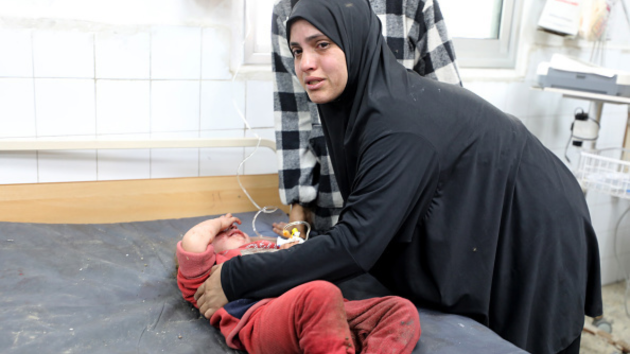
The Kamal Adwan Hospital in northern Gaza said Israeli artillery fire hit a floor of the hospital, injuring children who were being treated there.
The hospital also said there was heavy bombing overnight on the block where it is located, threatening the nearby Al Yemen al Saeed Hospital.
The hospital director said in a statement on Sunday the glass of the doors and windows of the facility were shattered by the force of the blasts.
(LONDON) — The Israel Defense Forces continued its intense airstrike and ground campaigns in Gaza — particularly in the north of the strip — and in Lebanon, with Israeli attacks on targets nationwide including in the capital Beirut.
Tensions remain high between Israel and Iran after the former launched what it called “precise strikes on military targets” in several locations in Iran following Tehran’s Oct. 1 missile barrage.
Famine risk looming in north Gaza, health officials warn
Acute food insecurity is a concern across Gaza, but the issue is especially pressing in the northern part of the strip where the Israeli military’s ongoing assault has intensified in recent weeks.
Dr. Abu Safiyeh — who works at Kamal Adwan Hospital in Beit Lahiya — said the besieged facility is running out of all food, collecting video footage of the deteriorating situation there.
Safiyeh’s warning followed a statement last week from the United Nations’ food assistance arm warning that “the ongoing humanitarian crisis in Gaza could soon escalate into a famine unless immediate action is taken.”
-ABC News’ Nasser Atta and Joe Simonetti
Gaza situation ‘has not significantly turned around,’ US says
The State Department said Monday that Israel has not done enough to improve humanitarian conditions in the Gaza Strip, as a 30-day deadline looms for Israeli officials to meet certain requirements or risk potential restrictions on military assistance.
The U.S. set out its conditions in a letter sent to Israeli officials last month and signed by Secretary of State Antony Blinken and Defense Secretary Lloyd Austin.
The letter gave Israel until Nov. 12 to increase the flow of humanitarian aid to the devastated Palestinian territory.
“As of today, the situation has not significantly turned around,” State Department spokesperson Matthew Miller said.
“We have seen an increase in some measurements,” Miller continued. “We’ve seen an increase in the number of crossings that are open. But just if you look at the stipulated recommendations in the letter, those have not been met.”
Miller did not say what steps the U.S. would take if the situation did not improve before the deadline. “I don’t want to forecast in any way what it is that we’ll do at the end of those 30 days,” he said.
-ABC News’ Shannon K. Kingston and Joe Simonetti
Deadly Israeli strikes continue in Gaza
Around 30 people were killed by Israeli strikes in the Gaza Strip on Monday, according to Palestinian health officials.
At least 20 people — including eight women and six children — were killed by an airstrike on a home sheltering several displaced families in the northern town of Beit Lahiya, officials said.
The town is at the heart of Israel’s most recent offensive in the northern part of the strip, which officials at the Hamas-run Health Ministry say has killed around 1,800 people and injured another 4,000.
Separate strikes elsewhere in Gaza killed at least 10 people, health officials said.
-ABC News’ Bruno Nota and Joe Simonetti
Death toll in Lebanon crosses 3,000: Health ministry
More than 3,000 have been killed since the fighting between Israel and Hezbollah began over a year ago, according to the Lebanese Ministry of Public Health.
Sixteen people were killed in Lebanon on Sunday, bringing the death toll to 3,002, it said.
60 rockets fired into Israel, IDF says
The Israel Defense Forces said that at least 60 rockets were fired into Israel by Hezbollah on Monday.
Some of the rockets were intercepted and others fell “in open areas,” the IDF wrote on X.
The IDF also said it attacked one Hezbollah launcher suspected of firing up to 30 rockets, posting what it said was a video of the strike to its X page.
-ABC News’ Joe Simonetti
Israeli strikes kill 31 in Gaza, health officials say
Palestinian medics said Israeli airstrikes killed at least 31 people in Gaza on Sunday.
Almost half of the deaths occurred in northern areas, health officials said, where Israel Defense Forces troops are pressing an intense campaign intended to root out surviving Hamas fighters and stop its units from regrouping.
The Hamas-run Gaza Health Ministry said Monday that around 1,800 people have been killed and 4,000 injured by Israel’s north Gaza campaign, with “widespread destruction of hospitals and infrastructure.”
-ABC News’ Joe Simonetti and Guy Davies
IDF says 4 drones intercepted in north and east
The Israel Defense Forces said in a post to X on Monday that military aircraft intercepted four drones.
Some of the unmanned aircraft were intercepted after crossing into Israel from Lebanon, while the others were shot down before entering the east of the country from the direction of Syria and Iraq, the IDF said.
IDF claims killing of Hezbollah commander in south Lebanon
The Israel Defense Forces said Monday that it killed Hezbollah’s commander of the Baraachit area of southern Lebanon in an airstrike.
The IDF said Abu Ali Rida was responsible for rocket and anti-tank missile attacks on Israeli forces and commanded Hezbollah units in the Nabatieh area.
Israel notifies UN of plans to terminate cooperation with UNRWA
The Israeli government notified the United Nations of its plans to terminate cooperation with the United Nations Relief and Works Agency (UNRWA) in a letter to the president of the U.N. General Assembly on Sunday.
UNRWA is the main U.N. agency operating in Gaza and is responsible for coordinating and supplying humanitarian aid. It also operates in the West Bank. The Israeli government has accused UNRWA of having ties to Hamas. After the initial accusations, the U.N. conducted an internal investigation, and some UNRWA staff members were fired.
Israel maintains that UNRWA still has ties to Hamas. But aid organizations warn if the agency stops operating in Gaza, the humanitarian crisis there will only worsen.
Israel’s termination of UNRWA in the country follows legislation passed by Israel’s parliament at the end of October severing the country’s ties with the organization.
Israel’s governmental body passed two bills — one banning UNRWA from operating in Israel, including in east Jerusalem, and another prohibiting any Israeli state or government agency from working with UNRWA or anyone on its behalf.
The legislation has a three-month waiting period before it goes into effect. It is set to go into effect at the end of January.
Israeli Director-General of the Ministry of Foreign Affairs Jacob Blitshtein wrote in the letter released Sunday that Israel will “continue to work with international partners, including other United Nations agencies, to ensure the facilitation of humanitarian aid to civilians in Gaza in a way that does not undermine Israel’s security.”
-ABC News’ Ellie Kaufman
Northern Gaza hospital says Israeli artillery fire injured children
The Kamal Adwan Hospital in northern Gaza said Israeli artillery fire hit a floor of the hospital, injuring children who were being treated there.
The hospital also said there was heavy bombing overnight on the block where it is located, threatening the nearby Al Yemen al Saeed Hospital.
The hospital director said in a statement on Sunday the glass of the doors and windows of the facility were shattered by the force of the blasts.