John McDonnell/For The Washington Post via Getty Images
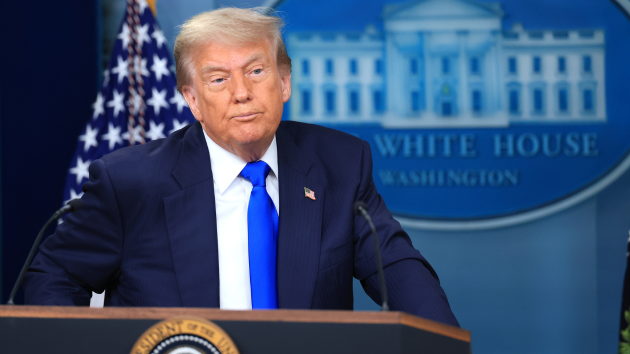
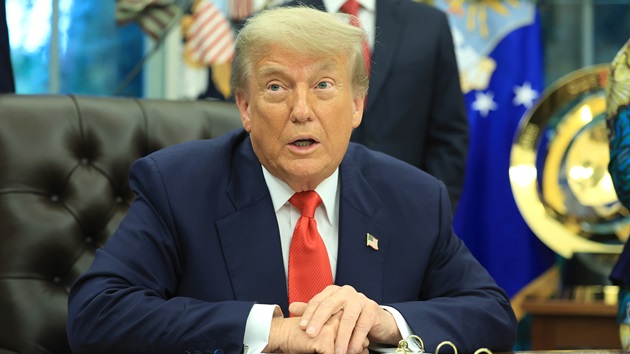
(WASHINGTON) — In an exclusive interview with ABC News to mark his 100th day in office, President Donald Trump on Tuesday said he “could” secure the return of Kilmar Abrego Garcia, the Maryland man his administration said in court was mistakenly deported to El Salvador.
“Now the Supreme Court has upheld an order that you must return him to the– facilitate his return to the United States. What are you doing to comply?” ABC News anchor and Senior National Correspondent Terry Moran asked Trump in the Oval Office.
“Well, the lawyer that said it was a mistake was here a long time, was not appointed by us– should not have said that, should not have said that,” Trump argued. The president then said that Abrego Garcia is a member of the criminal MS-13 gang and “is not an innocent, wonderful gentleman from Maryland.” Abrego Garcia’s lawyers have maintained he’s not MS-13 and has not been charged with or convicted of a crime.
“I’m not saying he’s a good guy. It’s about the rule of law. The order from the Supreme Court stands, sir,” Moran told the president.
“He came into our country illegally,” Trump maintained.
“You could get him back. There’s a phone on this desk,” Moran told Trump, pointing to the phone on the Resolute Desk.
“I could,” Trump conceded.
“You could pick it up, and with all–” Moran began to say.
“I could,” Trump said again.
“–the power of the presidency, you could call up the president of El Salvador and say, ‘Send him back right now,’” Moran explained.
“And if he were the gentleman that you say he is, I would do that,” Trump offered, before saying, “I’m not the one making this decision.”
“You’re the president,” Moran told him.
“I– no, no, no, no. If– follow the law. You want me to follow the law. If I were the president that just wanted to do anything, I’d probably keep him right where he is—” Trump said.
“The Supreme Court says what the law is,” Moran said.
Trump replied, referencing immigration, saying he “was elected to take care of a problem” that was an “unforced error that was made by a very incompetent man,” – an apparent jab at President Joe Biden.
(WASHINGTON) — Doug Emhoff, the former second gentleman of the United States, said on Tuesday that he had been dismissed from the board of trustees of the U.S. Holocaust Memorial Museum.
Emhoff was dismissed from the board by President Donald Trump’s administration, which has the power to appoint and remove members.
“President Trump looks forward to appointing new individuals who will not only continue to honor the memory of those who perished in the Holocaust, but who are also steadfast supporters of the State of Israel,” White House press secretary Karoline Leavitt said in a statement to ABC News.
According to the museum, the United States Holocaust Memorial Council, which serves as the board of trustees of the museum, has 55 president-appointed members, as well as members from the U.S. Senate, House of Representatives and the departments of Education, Interior and State.
Emhoff was appointed in January to the council by then-President Joe Biden.
“Let me be clear: Holocaust remembrance and education should never be politicized,” Emhoff said in a statement to ABC News.
“To turn one of the worst atrocities in history into a wedge issue is dangerous,” he continued, “and it dishonors the memory of six million Jews murdered by Nazis that this museum was created to preserve.”
The dismissal of Emhoff from the board is the latest example of Trump removing people from what were traditionally nonpartisan roles appointed by presidents and other officials.
In February, Trump announced he would be removing board members from the John F. Kennedy Center for the Performing Arts — and also installed himself as chair.
The New York Times was the first to report that a number of board members — including Emhoff — had been dismissed from the Holocaust Memorial Museum, which the White House confirmed to ABC News.
Emhoff, who is Jewish and has talked extensively about the Holocaust and antisemitism, has previously spoken in support of Israel, and he supported Biden’s efforts to broker a ceasefire and hostage release deal in the Israel-Hamas war.
In remarks to Jewish supporters on the sidelines of the Democratic National Convention in August 2024, he framed then-Vice President Kamala Harris as “somebody who knows our community, will continue to support us and Israel, and make sure that just the world is free of hate, including antisemitism.”
The Holocaust Memorial Museum gave a statement to ABC News on Tuesday, saying, “At this time of high antisemitism and Holocaust distortion and denial, the Museum is gratified that our visitation is robust and demand for Holocaust education is increasing.”
“We look forward to continuing to advance our vitally important mission as we work with the Trump Administration,” the statement continued.
(WASHINGTON) — Savior. Ungodly. Patriotic. Un-American. Great. Sad.
A hundred days into his presidency, all are words Americans used to describe President Donald Trump’s performance in office.
Responses run the full spectrum of possible assessments. On the positive side of the ledger in this ABC News/Washington Post/Ipsos poll: “Excellent.” “Awesome.” “Outstanding.” “Strong.” “Best president ever.”
And among the more negative comments: “Disaster.” “Chaotic.” “Appalling.” “Horrible.” “Atrocious.” “Catastrophic.”
As reported Sunday, Trump has a 39% job approval rating in this poll, produced for ABC by Langer Research Associates with fieldwork by Ipsos. That’s the lowest job approval rating at or near 100 days in office of any president dating back to 1945 (as far back as data are available).
Invited to use one word to express their personal reaction to Trump’s performance as president so far, some focused on their feelings: “Frightened.” “Excited.” “Horrified.” “Relieved.” “Worried.” “Angry.” “Confused.” “Happy.” “Devastated.”
Others couldn’t restrain themselves to a single word, with fuller comments further illustrating Americans’ sharply divided opinions:
“He’s doing a fantastic job of accomplishing all that we want him to and voted for him to do!”
“He’s a convicted criminal, he’s a horrible con man who thinks he’s a great businessman and he’s tanking the economy for some ‘give it to the libs’ reason. I did not vote for this.”
“Someone needs to step in and rein him in. He is overstepping his authority. What is really frightening is that the Republican leadership knows he is wrong and will not stop him. Fear of losing their own power.”
“He doesn’t hesitate to support our best interests. He stands strong, and doesn’t give in to those who try and take advantage.”
“He is not taking into consideration the seniors that are on Social Security only which don’t have the discretionary income to handle the drastic cost of groceries and other necessities.”
“He is a horrible human being who cares about no one but himself and is ruining our democracy and all this country stands for.”
“He is courageously taking fast action to do what is best for our country economically and with the infrastructure.”
“Total embarrassment. Too bad so many believed and for some reason still believe in him.”
“He is a bad seed.”
“Trump seems even more unhinged than last time, but what were we all expecting? I’m not surprised, but I am displeased.”
A few others reserved judgment, at least for the time being:
“Don’t know yet, need more time to see the actual results.”
“We will see how this turns out.”
Groups
Among people who disapprove of Trump’s job performance, some characterizations were notably negative: “disgusting,” “disappointing,” “chaotic,” “incompetent,” “disaster,” “horrific,” “terrible” and “horrible.”
Others: “idiotic,” “embarrassing,” “criminal,” “crazy,” “appalling,” “pathetic,” “outrage.” Still others described him as “dictator,” “fascist,” “authoritarian,” “unconstitutional.” And some commented on Trump as a threat: “destructive,” “dangerous,” “frightening,” “reckless.”
Among Trump approvers, on the other hand, common reactions included “excellent,” “great,” “good,” “strong,” “outstanding,” “awesome,” “fantastic” and “amazing.” Others were positive, but less effusive: “acceptable,” “alright,” “decent,” “fair,” “fine,” “OK.” Some approvers were decidedly unenthusiastic: “so-so,” “mediocre,” “meh.”
Some commented on the speed or extent of his actions: “fast,” “hasty,” “quick,” “hectic,” “rollercoaster,” “sprinting,” “too much.” Several said they were “surprised”; others, “hopeful.” Some commented on Trump’s style: “bold,” “aggressive,” “determined.”
In any case, one said: “Better than Biden, so far.”
Methodology
This ABC News/Washington Post/Ipsos poll was conducted online via the probability-based Ipsos KnowledgePanel® April 18-22, 2025, in English and Spanish, among a random national sample of 2,464 adults. Partisan divisions are 30%-30%-29%, Democrats-Republicans-independents.
Results have a margin of sampling error of 2 percentage points, including the design effect. Error margins are larger for subgroups. Sampling error is not the only source of differences in polls.
The survey was produced for ABC News by Langer Research Associates, with sampling and data collection by Ipsos. See details on ABC News’ survey methodology here.
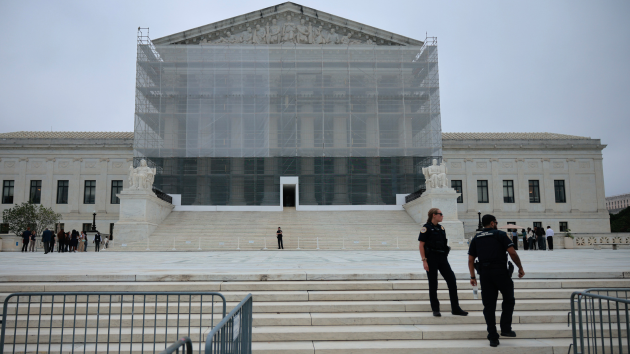
(WASHINGTON) — The Supreme Court appears poised to rule narrowly in a closely watched dispute over when federal law enforcement can be held liable for mistakes that harm innocent victims.
Justices heard arguments on Tuesday in a case from Atlanta involving a 2017 pre-dawn FBI raid of the wrong house that traumatized a family and left thousands of dollars of damage.
Lower courts tossed out the victims’ claims for compensation because of sweeping legal immunity for government officials.
Much of the debate, while highly technical, focused on an exception to the immunity clause that Congress added to the Federal Tort Claims Act in 1974.
“If you really, really meant to drop the pizza off at the right address, it doesn’t matter. You still need to give a refund if you drop it off at the wrong address,” argued Patrick Jaicomo, an attorney representing the family.
A Trump administration attorney insisted officers exercising discretion in performance of their duties should not be subjected to lawsuits and second-guessed by courts.
“The officers here made a reasonable mistake,” said Frederick Liu, an assistant solicitor general.
Several justices did not appear to be buying the argument.
“That is so ridiculous,” Justice Sonia Sotomayor said. “Congress is … providing a remedy to people who have been wrongfully raided, and you’re now saying, ‘No, they really didn’t want to protect them fully.'”
Most law enforcement agencies don’t keep track of wrong-house raids or publicly report data, according to legal experts. Civil rights advocates estimate that are hundreds of cases of wrong-house raids nationwide each year, and most victims are not compensated for the physical or emotional harm that often results from them.
When Liu argued the FBI agents in the case did not violate any government policy despite the mistake, Justice Neil Gorsuch shot back incredulously.
“No policy says, ‘Don’t break down the wrong door? Don’t traumatize the occupants’? Really?” Gorsuch asked Liu.
“It’s the United States’ policy to execute the warrants at the right house,” Liu replied.
“I should hope so,” Gorsuch responded.
Despite sympathy for the plaintiffs, many of the justices appeared wary of a broad ruling that might open the floodgates to litigation against the government.
Justice Brett Kavanaugh, who is the justice most often in the majority, suggested the Supreme Court is likely to provide a limited decision and return the case to lower courts for further consideration.
A decision in the case is expected by the end of June.
(WASHINGTON) — Democrats, responding to the 100-day mark of President Donald Trump’s second term, argue that the American public’s opinion of the White House and Republicans in Congress — as well as consternation around high prices — give them an opening to flip the balance of power in the U.S. House of Representatives in 2026.
In a strategy memo obtained exclusively by ABC News, the Democratic Congressional Campaign Committee (DCCC), the campaign arm of House Democrats, wrote, “In just 100 days, House Republicans and Donald Trump have lost the support of the American people and left a trail of broken promises that will cost them the House majority next year.”
Recent polls show approval ratings for Trump and congressional Republicans are underwater — although congressional Democrats have sometimes performed even worse. In a recent ABC News/Washington Post/Ipsos poll, Trump beats Democrats in Congress in terms of trust to handle the nation’s main problems.
The DCCC, however, argues in the memo that Democrats have momentum. The group pointed to ads from some Republican members during the 2024 campaign cycle where they said they would work to get costs down, claiming that they and others have abandoned those promises. The group also alleged that the recent budget blueprint passed by House Republicans will potentially lead to cuts to Medicare and Medicaid.
Republicans have argued that the budget blueprint does not and will not threaten any benefits or entitlements and that Democrats are causing undue fear. Some also blame actions by the previous White House under Democratic President Joe Biden or factors outside of anyone’s control have caused higher prices.
“The DCCC and House Democrats will continue to fight back and hold Republicans accountable for their broken promises … With every new bill that gets introduced, committee meeting held, and amendment vote taken, the American people will know that Republicans don’t work for them, they work for the billionaires,” the Democratic group wrote.
And looking to 2026, the DCCC added, “Their trail of broken promises have helped to put House Democrats on offense with an expansive battleground map, including more initial Districts in Play than any cycle since 2018. The DCCC will continue to build upon this momentum on our way to taking back the House next year.”
Republicans held on to a slim majority in the House in the 2024 election.
The National Republican Congressional Committee (NRCC), the campaign arm of House Republicans, has expressed confidence that the GOP will hold the House in the 2026 midterms. The group celebrated Trump’s 100 day mark on Tuesday as a milestone for momentum for an agenda the group said is revitalizing the country.
NRCC chair Rep. Richard Hudson, R-N.C., wrote in a statement on Tuesday, “In just 100 days, President Trump has reignited American greatness. He’s secured our border, put America back on top, and restored the American Dream. House Republicans will continue working with him and building on this historic momentum.”
The DCCC’s memo comes as Democratic officials and other figures mark 100 days of Trump’s second term in office, although the party is still divided over how to rebuild after its losses in 2024.
To mark the 100-day milestone, Democratic mayors and governors have been pointing to federal government spending cuts or new policies that they say have a deleterious impact on their states.
A few well-known governors, including Illinois Gov. JB Pritzker — who created buzz during remarks on Sunday in New Hampshire when he said that “these Republicans cannot know a moment of peace” — will be holding a virtual town hall on Tuesday night about “how Democratic governors are standing up to protect the people in their states,” according to the Democratic Governors Association.
Meanwhile, Democratic members of Congress and party officials have been marking the run-up to the 100-day mark with town halls and protests. Sen. Cory Booker, D-N.J., and House Majority Leader Hakeem Jeffries, D-N.Y., staged an hours-long “sit-in” on the House steps on Sunday to protest Congressional Republicans’ budget plans.
Some Democrats have argued that the disparate responses to the administration are actually a strength for the party while it is locked out of power in Washington.
Minnesota Gov. Tim Walz, who was the running mate for Vice President Kamala Harris in 2024, said at a talk on Monday night that the Democratic Party needs to “flood the zone” and “fill every single lane, and if there’s one that’s better than another, then let’s all pick that lane and do more of that.”
Harris herself is set to deliver remarks on Wednesday in San Francisco, one day after the administration’s 100-day mark, at the 20th anniversary celebration for Emerge, an organization that supports Democratic women running for office.
(WASHINGTON) — On the campaign trail, and in the weeks leading up to his return to the White House, President Donald Trump vowed to hit the ground running — what experts describe as a “flood the zone” strategy to push forward on his conservative and controversial policies.
The pace has meant an often unprecedented first 100 days in office: “Trump speed,” the White House calls it.
Earlier this month, he told Republican lawmakers at a party dinner: “We’re setting records right now. We’re getting more things approved than any president has ever done in the first 100 days. It’s not even close. I had somebody say the most successful month — first month in the history. Now they said the most successful 100 days in the history of our country.”
How he’s done so, legal experts told ABC News, will have a long-lasting impact on the presidency and the federal government.
His main strategy has been to sign executive orders almost daily, including ones that challenge Congress’ power to fund and oversee federal agencies and programs, while others relentlessly test the limits of immigration enforcement.
Other presidents on both sides of the aisle have tried to flex their executive muscle, such as President Joe Biden’s EO to require 50% of cars and light trucks sold to be zero-emission electric vehicles by 2030, according to Tabitha Bonilla, research assistant professor at the Institute for Policy Research at Northwestern University.
“Every president over the last few decades have been trying to add more power to the executive branch and forward their agenda,” Bonilla told ABC News. “Trump is taking that to the extreme.”
As an example, experts cited Trump using legal and financial threats to punish universities and law firms for alleged political opposition and failure to “align” with his agenda, as well as his wholesale firings of top career officials, replacing them with loyalists.
James Sample, a constitutional law expert at Hofstra University, said that Trump’s playbook appears to be straight out of Project 2025, a blueprint for “taking the reins of the federal government” prepared for years by Trump’s most conservative allies in anticipation of his comeback — although Trump claimed to never have read it.
Trump and his supporters said his actions are justified because unelected bureaucrats and judges, they claim, had seized control from presidents — the one person elected nationwide, they argue, and granted total executive power by the Constitution.
Regardless, Sample said, the tactic should raise a red flag.
“The purpose of a blitzkrieg is to overwhelm the opposition,” he said.
While Trump’s tactics have been met with little to no protest from the Republican lawmakers who control the House and Senate, the judicial branch has often been ready to stem the flood through rulings and injunctions in dozens of court cases.
Still, experts told ABC News, that even if all of Trump’s moves are blocked or even reversed, they have done both serious short-term and long-term damage.
“It’s all about implanting the narrative,” Bonilla said. “Trump’s policies and rhetoric have pushed everything to the right and hurt our strength on the global scale.”
Floodgates opened
Since Trump took office on Jan. 20, he has issued more than 140 executive orders on various policies as of Monday, shattering records and upending widely held interpretations of federal law and the Constitution.
President Joe Biden, by comparison, issued 162 EOs in his entire term, and Trump issued more than 30 executive orders during the first 100 days of his first term, according to historical records.
White House chief of staff Susie Wiles told Fox News in March that in this second term, the Trump team knew it needed to act fast, citing the midterm elections in November 2026 that could change the congressional map.
“This 18 months is our time frame. One hundred days, certainly six months into the year, and 18 months, are sort of our benchmarks,” she said.
The “flood the zone” goal has been long-touted by Trump’s allies.
His former White House political adviser Steve Bannon appeared to coin the idea during Trump’s first term. After Trump left office, conservative activists and Trump loyalists crafted a proposed battle plan for a second term.
In a 2023 speech, Russell Vought, a chief architect of Project 2025 and now Trump’s current director of the Office of Management and Budget, laid out one strategy at his Center for Renewing America, a pro-Trump Washington think tank.
“I want the bureaucrats to be traumatically affected because they are increasingly viewed as villains. We want to put them in trauma,” he said in a speech reported by ProPublica.
Video of his making that speech was brought up during Vought’s confirmation hearings earlier this year but he repeatedly avoiding answering questions about his provocative rhetoric and plans.
Many of Trump’s EOs have dealt with Elon Musk’s brainchild — the Department of Government Efficiency, which has slashed agency budgets and tens of thousands of federal employees throughout the country, while others have pushed forward the president’s crackdown on immigration, such as the end to birthright citizenship and deporting migrants as alleged foreign invaders under the 1798 Alien Enemies Act.
Bernadette Meyler, the Carl and Sheila Spaeth professor of law at Stanford Law School, told ABC News that executive orders have always been a tool presidents have used to set their agenda, even if just symbolically.
“It is an effective tactic. It’s difficult even for courts to react rapidly,” Meyler said.
Conservative groups have long advocated for a federal government shakeup and agued that the president needed more power to make the country more efficient.
“What he’s doing is kickstarting what will ultimately be our legislative agenda,” House Speaker Mike Johnson said in January after Trump’s first round of executive orders.
The Heritage Foundation, the far right think tank that helped to produce Project 2025, has contended that Trump’s efforts are essential and fast action can make the government more efficient.
Lindsey Burke, director of the Center for Education Policy at The Heritage Foundation, and Jonathan Butcher, a senior research fellow at the think tank, referenced this idea in a statement last month after Trump issued an executive order for a drastic reduction in force for the Department of Education.
“Reducing the bloated bureaucracy will give state and local education officials more decision-making authority,” they said.
War of words, resistance to courts
Legal experts said another effective aspect of the “flood the zone” tactic was Trump’s multiple media appearances and photo ops, where he continues to make controversial and provocative claims.
Meyler contends Trump’s war of words is part of a deeper tactic to undermine the public’s trust in the federal government.
She noted even with courts issuing injunctions, Trump’s statements and resistance to judge’s orders with aggressive appeals has still moved the needle more toward the right.
“It can seem he is doing a lot even without of lot of judicial action,” Meyler said.
How much steam is left?
Trump and his allies have been adamant that they will stick to their plans to reassert the powers of the executive branch long after the first 100 days are up and are vowing to take all of their cases up to the Supreme Court if necessary.
As of Sunday, there have been 217 court cases against the second Trump administration, according to an ABC News accounting, and a large majority of those have led to temporary restraining orders, reversals and, in some cases, full-on blocks of Trump’s agenda.
“In the first Trump administration, we saw a lot of executive actions in the beginning and then saw it slow down,” Bonilla said. “We will be living in the space of a lot happening all at once for a while, but at some point, there is going to be a moment where there is so much that [the executive branch] can’t keep up.”
Meyler agreed but added that Trump, the Project 2025 architects and their allies have stated that they are willing to work with Congress to get their agenda passed through legislative channels.
“That might secure his policies, and slow things down, and avoid the courts,” she said.
That pivot will meet more resistance, especially as we approach the midterms, according to Meyler.
“It’s easier for some than others because of various practical matters, but there is a tipping point,” she said. “People are already protesting and Trump’s public ratings are dipping.”
Still, future presidents will likely emulate the “flood the zone” tactic in their first weeks, according to Meyler.
“Over the long course of presidential history, there is rarely a retraction of presidential power,” she said.
(WASHINGTON) — President Donald Trump, upon his return to the White House, appears to have quickly turned one of his more ominous campaign promises into reality.
Among his first acts after being sworn in inside the Capitol Rotunda was to strip the security clearances from 51 former intelligence officials who signed a letter during the 2024 campaign describing a news story abut the public release of emails from Hunter Biden’s laptop as potentially part of a Russian disinformation operation.
In the days that followed, he removed protective details for former officials who received threats over their work, including retired Gen. Mark Milley, Dr. Anthony Fauci, former Secretary of State Mike Pompeo and others. Trump’s reasoning at the time was, “You can’t have a security detail for the rest of your life.”
Trump told supporters at his first 2024 rally, back in March 2023: “I am your retribution.”
Now, 100 days into his second term, his list of targets appears to be growing. And much of the action is aligned with his own political interests.
“He’s really taking it to the next level,” said Nick Akerman, a former federal prosecutor who helped investigate President Richard Nixon during the Watergate scandal.
Some predictable Trump targets have included former President Joe Biden and former Vice President Kamala Harris, whose access to classified information he revoked. (While it is the norm for former presidents to receive briefings, the move against Biden came after Biden stripped Trump of having access to them in 2021, citing his “erratic behavior.”)
Trump’s list of his critics who he said should no longer have access to classified material also included Hillary Clinton, his 2016 opponent; former Republican Reps. Liz Cheney and Adam Kinzinger, who investigated his role in the Jan. 6 Capitol attack; New York Attorney General Letitia James, who prosecuted his company for fraud; and Manhattan District Attorney Alvin Bragg, who led the hush money case against Trump that resulted in the first-ever criminal conviction of a former president.
Trump also signed executive orders against some of the nation’s top law firms.
Perkins Coie, which represented Clinton’s 2016 campaign, was the subject of an order mandating its lawyers have their security clearances stripped. The executive action also sought to terminate any government contracts that might exist with the firm or other entities that it represents, bar agencies from hiring employees of Perkins Coie and prohibit the firm’s staff from accessing government buildings.
Trump also took aim at WilmerHale, which has ties to former special counsel Robert Mueller, with an order alleging it engages in “conduct detrimental to critical American interests” in its pro-bono work. Trump ordered his administration to suspend the security clearances of WilmerHale employees and also requires government contractors to disclose any business they do with the law firm.
Richard Painter, who served as a White House ethics lawyer in the George W. Bush administration, criticized Trump’s attacks on law firms as an affront to the rule of law.
“The executive orders against law firms are a fundamental infringement on the right to counsel and the right of lawyers to represent clients of their choice without retribution by the government,” Painter said.
“The First Amendment right to petition the government for redress of grievances includes the right to legal representation in court for anybody, even Democrats,” Painter added.
Several universities have found themselves in Trump’s crosshairs as his administration made demands regarding campus policies and governance. Harvard University, after refusing, had $2.2 billion in federal grants frozen.
News media, too, hasn’t been spared.
The Associated Press was barred from White House events because the outlet wouldn’t refer to the Gulf of Mexico only as the “Gulf of America,” after Trump’s order renaming the body of water, though the outlet appeared to gain back some access as the White House instituted a new policy lumping wire service reporters into a broader collective of print outlets. The White House has also suggested funding for NPR and PBS, which Trump accused of being left-leaning, is a waste of taxpayer money.
Trump signed orders directing the Department of Justice to investigate two individuals who worked in his first administration who became outspoken critics of his leadership.
Chris Krebs, resigned from his job at a private cybersecurity firm after Trump directed Attorney General Pam Bondi to review Krebs’ actions while leading the Cybersecurity and Infrastructure Agency (CISA) — a job Trump appointed him to in 2017. Krebs has long assured the 2020 election was secure, criticizing Trump for spreading debunked claims of election fraud.
“For those who know me, you know I don’t shy away from tough fights. But I also know this is one I need to take on fully — outside of SentinelOne,” Krebs said in a social media post announcing his resignation. “This will require my complete focus and energy. It’s a fight for democracy, for freedom of speech, and for the rule of law. I’m prepared to give it everything I’ve got.”
Miles Taylor, the deputy chief of staff to former Homeland Security Secretary Kirstjen Nielsen, was also the target of an order from Trump directing the Justice Department to launch an investigation as Trump alleged he may have committed “treason.”
Taylor penned a 2018 New York Times op-ed describing Trump as “detrimental to the health of our republic” and a 2019 book about the first administration under the pseudonym “Anonymous” before going public in 2020.
Trump’s targeting of various individuals and institutions come after he, for years, accused President Joe Biden of weaponizing law enforcement.
“Those days are over and they are never going to come back. They’re never coming back. Now, as the chief law enforcement officer in our country, I will insist upon and demand full and complete accountability for the wrongs and abuses that have occurred,” Trump said as he spoke at the Justice Department in March.
Republicans have praised some of Trump’s moves, namely against universities and some news outlets.
“The vast majority of the American people do not want to prop up these institutions,” Republican Rep. Elise Stefanik said when the Trump administration made demands of Harvard and other schools. Stefanik added, “Higher education has fundamentally lost its way, and it’s increasingly out of touch, and the tuition rates go higher and higher. So we need to defund across the board, and President Trump is rightly holding these schools accountable.”
House Speaker Mike Johnson, while criticizing NPR and PBS, said, “The American people support the free press, but will not be forced to fund a biased political outlet with taxpayer funds.”
But critics said it’s Trump who is wielding the powers of the presidency to go after political opponents in sweeping fashion.
“All of these things are much more blatant and much more out in the open,” Akerman said, attributing Trump’s boldness, in part, to the Supreme Court’s blockbuster ruling last year granting presidents some immunity from criminal prosecution for official acts.
Painter’s message for Trump, as a former White House ethics chief: “He’s got to focus on carrying out his agenda as president, not just going after his personal enemies and political enemies.”
“Using the presidency to go after political enemies is a very dangerous thing, very dangerous for democracy, and he shouldn’t be doing that,” Painter said.
(WASHINGTON) — While final seat totals are still pending, Canadian broadcasters have called that Mark Carney led the Liberals to victory in Canada’s election on Monday.
It is still not clear whether the Liberals will form a minority or majority government. As of Tuesday morning, the Liberals had won or were leading in 168 out of 343 ridings. Pierre Poilievre’s Conservatives are set to remain in opposition, with 144 ridings so far. Parties need 172 seats to form a majority.
Carney’s victory cements the Liberal Party’s decade in power, replacing former Prime Minister Justin Trudeau, who had been leading the country since 2015.
Carney stepped in as prime minister-elect when Trudeau resigned in March.
In a social media post on the day of Canada’s election, President Donald Trump suggested that Canadians should vote for him in order for Canada to become the 51st state.
“Elect the man who has the strength and wisdom to cut your taxes in half, increase your military power, for free, to the highest level in the World, have your Car, Steel, Aluminum, Lumber, Energy, and all other businesses, QUADRUPLE in size, with ZERO TARIFFS OR TAXES, if Canada becomes the cherished 51st. State of the United States of America,” Trump said on Monday, seeming to refer to himself as the candidate.
He added, “America can no longer subsidize Canada with the Hundreds of Billions of Dollars a year that we have been spending in the past. It makes no sense unless Canada is a State!”
Despite Trump’s suggestion, Canadians cannot vote for him since he is not on the ballot. There are 16 registered political parties in Canada — with the Liberals and the Conservatives being the most dominant. Other parties include the Green Party, the Libertarian Party, the United Party and the Canadian Future Party.
In response to the president’s post, Conservative Party leader Pierre Poilievre issued a sharp reply, saying Trump should “stay out of our election.”
“The only people who will decide the future of Canada are Canadians at the ballot box. Canada will always be proud, sovereign, and independent, and we will NEVER be the 51st state,” Poilievre wrote in a post on X. “Today, Canadians can vote for change so we can strengthen our country, stand on our own two feet, and stand up to America from a position of strength.”
Canadian Prime Minister and Liberal Party leader Mark Carney posted a video on X on Monday with the message: “This is Canada — and we decide what happens here.”
Canada has a parliamentary system, meaning if the Liberals win a majority of seats in the election, or are able to form a minority government with members of another party, Carney will continue to serve as prime minister.
Nearly all of the polls for the election are expected to close by 9:30 p.m. ET on Monday.
(WASHINGTON) — In a speech to a joint session of Congress in March, President Donald Trump took direct aim at diversity, equity and inclusion policies, saying hiring and promotion practices should be based on merit, not race and gender.
“We’ve ended the tyranny of so-called diversity, equity and inclusion policies all across the entire federal government and indeed the private sector and our military. And our country will be ‘woke’ no longer,” said Trump, using the term some conservatives have adopted to negatively describe progressive values.
In the first 100 days of his new administration, Trump has wielded the power of the Oval Office in an attempt to root out DEI programs beyond the federal government, threatening to withhold billions of dollars in federal funding and grants from universities, including Harvard University, unless they fall in line.
A new ABC News/Washington Post/Ipsos poll released on Sunday indicated that the country is almost evenly split on the issue. While 51% of respondents said they believe DEI efforts help level the playing field, 47% said such policies create unfair discrimination.
Despite the president’s claim that DEI in America is history, supporters say Trump’s war against what they refer to as “wokeism” is far from over.
“It’s definitely not over. And those of us who want to see corporate America get back to neutral and focusing on uniting Americans around creating value rather than dividing us on the basis of race and sex, we have a long, long way to go,” said Stefan Padfield, executive director of the Free Enterprise Project, which is part of National Center for Public Policy Research, a non-partisan conservative think tank in Washington, D.C.
Padfield said one of his primary focuses is on “reversing what we might refer to as the woke capture of corporate America” by filing shareholder proposals, engaging in litigation and conducting educational research across the nation.”
“One of the things that I and others on our side are concerned about is this idea and this notion that somehow we’ve won,” Padfield told ABC News.
Using the analogy of the Allied troops storming the beach at Normandy during the 1944 D-Day invasion, Padfield said, “Could you imagine if the Allied forces just packed up and left and claimed to have won World War II after they took Normandy beach? It would be a very different world.”
“So, we’ve got a very long march to go and certainly the proponents of DEI and related ESG [environmental, social and governance] agendas, they’re making very clear that they’re not going to go quietly, certainly,” Padfield said.
Target boycott
In a letter dated Feb. 12, 2025, a coalition of the nation’s largest civil and human rights organizations, including the NAACP and the National Urban League, asked for an urgent meeting with congressional leadership “to discuss actionable steps to protect diversity, equity, and inclusion programs to ensure equal opportunity for all Americans.”
The letter was addressed to House Speaker Mike Johnson, R-La., Senate Minority Leader Chuck Schumer, D-N.Y., Senate Majority Leader John Thune, R-South Dakota, and House Minority Leader Hakeem Jeffries, D-N.Y. “We are deeply concerned about the recent executive actions by the Trump Administration that seek to undo decades of bipartisan support for civil and human rights,” the coalition wrote.
“Diversity is and will always be one of America’s greatest strengths because a diverse America is an innovative and prosperous America,” the letter said. “Diversifying our institutions, providing opportunities, and working to ensure that everyone is included are not partisan values. These values strengthen our nation and are rooted in our country’s history of advancing equal opportunity and ‘liberty and justice for all.'”
The letter goes on to characterize the actions taken by the Trump administration as “misguided” and, according to the coalition, “seek to erode progress and stifle opportunity for all.”
The letter emphasizes that America’s strength and leadership “in an increasingly diverse and competitive world depends on our ability to be an inclusive society.” It goes on to say that history has shown that without clear-cut guidelines that encourage diversity, equity and inclusion, institutions will “continue discriminatory and exclusionary patterns that hold us all back.”
Some corporations have taken Trump’s cue and have started to eliminate or roll back DEI programs. After Minnesota-based retailer Target announced in January that it would phase out some of its DEI initiatives, the Rev. Jamal Bryant, senior pastor of New Birth Missionary Baptist Church, a megachurch in the Atlanta suburb of Stonecrest, Georgia, organized a 40-day “fast” of Target.
Bryant said he encouraged followers of his movement to fight back with their pocketbooks and not shop at the chain’s stores from the first day of Lent, March 5, until Easter Sunday.
In an interview with ABC News, Bryant said he announced at his church on Easter that the “fast” is now a full-fledged boycott of Target.
“We began the boycott against Target because the Black community felt betrayed,” Bryant said.
Among the programs Target said it is phasing out is one established in the wake of the 2020 police-involved killing of George Floyd, a 46-year-old African American man. The program assists Black employees in building meaningful careers and promoting Black-owned businesses.
“For them to roll back DEI, it was felt as a slap in the face,” Bryant said.
Bryant noted that the Montgomery bus boycott led by the Rev. Martin Luther King Jr. in 1955 and 1956 lasted 381 days.
“We have just been boycotting Target for 10 weeks and I think that the African American community is resolved that we’re not going back into the store until we see a market change,” Bryant said.
In response to the boycott, Target, which has 2,000 stores nationwide and employs more than 400,000 people, said in a April 23 statement, “We have an ongoing commitment to creating a welcoming environment for all team members, guests, and suppliers.”
“It’s core to how we support and grow our business,” Target said. “We remain focused on supporting organizations and creating opportunities for people in the 2,000 communities where we live and operate.”
But Target isn’t the only major U.S. company scaling back on DEI programs. McDonald’s, Meta, Walmart, Ford, John Deere and Harley-Davidson have all announced they are eliminating some DEI programs.
Some of the companies changed their DEI programs after coming under pressure from conservative groups.
Conservative political commentator and anti-woke activist Robby Starbuck publicly attacked Walmart’s DEI programs. This prompted the big-box retail giant to announce it was rolling back diversity policies and pivoting from the term DEI in internal communications.
After Walmart said it was eliminating the use of the phrase “DEI” altogether, Starbuck said in a social media post, “This is the biggest win yet for our movement to end wokeness in corporate America.”
In a statement to ABC News, Walmart said, “Our purpose, to help people save money and live better, has been at our core since our founding 62 years ago and continues to guide us today. We can deliver on it because we are willing to change alongside our associates and customers who represent all of America.”
Universities under fire
The Trump administration has also threatened to withhold federal funding and grants from universities nationwide that decline to roll back DEI programs or curb protests on campuses, including pro-Palestinian demonstrations that the administration deems antisemitic.
Some universities have fought back against the administration.
The Trump administration threatened to withhold from Harvard University $2.2 billion in multi-year grants and $60 million in multi-year contract value after demanding that the school end its DEI programs, adopt what the administration deems merit-based admissions, and cooperate with immigration authorities.
But Harvard President Alan Garber has refused to give in to the White House’s demands, writing in an April 14 letter addressed to members of the Harvard community, that the school “will not surrender its independence or relinquish its constitutional rights” by agreeing to the terms proposed by the Trump administration.
On April 21, Harvard sued the Trump administration, asking a Massachusetts federal judge to block Trump’s funding freeze, arguing that it is “unlawful and beyond the government’s authority.” Harvard also argued that by withholding funds, the Trump administration is violating the First Amendment, flouting federal law, and threatening life-saving research.
“All told, the tradeoff put to Harvard and other universities is clear: Allow the Government to micromanage your academic institution or jeopardize the institution’s ability to pursue medical breakthroughs, scientific discoveries, and innovative solutions,” Harvard’s lawyers wrote.
Trump’s Department of Education has also attempted to pressure public schools K-12 to do away with DEI programs or risk losing federal funding. Education groups sued the administration over the move.
Federal judges in both Maryland and New Hampshire issued rulings this month siding with the education groups.
“This Court takes no view as to whether the policies at issue here are good or bad, prudent or foolish, fair or unfair,” wrote U.S. District Judge Stephanie A. Gallagher of Maryland, a Trump appointee, on Thursday. “But this Court is constitutionally required to closely scrutinize whether the government went about creating and implementing them in the manner the law requires. The government did not.”
New Hampshire U.S. District Court Judge Landya McCafferty also issued an order Thursday partially blocking the Department of Education from withholding funding to public schools that did not end DEI programs.
“Ours is a nation deeply committed to safeguarding academic freedom, which is of transcendent value to all of us and not merely to the teachers concerned,” McCafferty wrote, adding the “right to speak freely and to promote diversity of ideas and programs is…one of the chief distinctions that sets us apart from totalitarian regimes.”
The Department of Education did not immediately respond to the rulings on Thursday.
Two sides, similar arguments
Supporters of doing away with DEI programs claim the policies are racist, discriminatory and further divide the nation, while advocates for keeping the programs argue it is racist, discriminatory and divisive to end them.
Rev. Bryant told ABC News that he believes Trump is pursuing his “war on woke” to appeal to his base.
“I think he’s playing to his base of uneducated white males, who for some reason feel threatened,” Bryant said. “They’re getting ready to see that America is better when we’re together, not when we are segregated.”
Bryant said Trump’s fight against wokeism has been an attack on civil rights that demonstrators have shed blood and died for going back to the 1950s and 1960s.
“It looks like we’re going back to yesteryear and it’s a very disturbing probability,” Bryant said.
On the other hand, Padfield described most DEI programs in corporate America as “overt racial discrimination.”
“It’s problematic because it sets the corporation up for legal liability and it’s problematic on a moral basis because that’s not the country that we want to live in, where some of our most powerful institutions have decided that the way to get what they want in terms of demographic outcomes is just start brazenly and, in fact, proudly, discriminating on the basis of race and sex,” Padfield said.
Padfield added, “The problem is that the pro-DEI solution actually makes things worse and divides us further. And what I’m hoping for is that ultimately corporate America wakes up and starts addressing these inequalities on a colorblind basis.”
Allison Robbert for The Washington Post via Getty Images
(WASHINGTON) — Since Donald Trump took office 100 days ago, the president and his administration have faced an average of more than two lawsuits per day, challenging nearly every element of his agenda.
The breakneck pace of the president’s policies has been matched in nearly equal force by a flood of litigation — at least 220 lawsuits in courts across the country — challenging more than two dozen executive orders, the firing of twenty high-ranking government officials, and dozens of other executive actions.
While the Trump administration has had some victories in the courts, federal judges have blocked key parts of Trump’s agenda ranging from parts of his immigration policy and military guidelines to his effort to roll back diversity and equity initiatives.
“The administration has basically gone on a shock-and-awe bombing campaign,” said Justin Levitt, a law professor at Loyola Marymount University. “There is a huge amount of what they are currently doing that they probably could have achieved lawfully, but they have crashed through any of the existing legal guardrails in an attempt to do everything, everywhere, all at once.”
The suits have come at a steady clip — 20 in January, approximately 70 in both February and March, and about 50 so far in April — as the Trump administration has rolled out its new policies.
Approximately 60 of those cases have focused on the president’s immigration policy, with courts so far blocking the president’s attempts to remove birthright citizenship, withhold funding from sanctuary cities, remove noncitizens to countries other than their place of origin with little-to-no due process, and strip thousands of their temporary protected status. Some of those policies have earned the president rebukes from judges questioning the rationale for his unilateral immigration policy.
“It has become ever more apparent that to our president, the rule of law is but an impediment to his policy goals,” U.S. District Judge John Coughenour, a Reagan appointee, said of Trump’s executive order on birthright citizenship. “There are moments in the world’s history when people look back and ask, ‘Where were the lawyers, where were the judges?’ In these moments, the rule of law becomes especially vulnerable. I refuse to let that beacon go dark today.”
Courts have also blocked the Trump administration from effectively banning transgender people from military service, limiting gender-affirming care, requiring proof of citizenship to register to vote, attempting to freeze trillions in funding to states and nonprofits, and moving to block billions in foreign aid.
But in many cases federal courts have not stopped the president outright — tentatively allowing the mass firing of thousands of government employees, greenlighting a historic federal buyout, and, for now, allowing the dismantling of the United States Agency for International Development. The Department of Education and the Consumer Finance Protection Bureau are also undergoing massive staffing reductions as judges actively consider the legality of the Trump administration’s cuts.
The president’s supporters have decried the litigation as a “judicial coup,” while those opposing his policies have praised judges for serving as a check against the administration. But the seemingly constant conflict between the Trump administration and the judiciary could risk permanent damage to the separation of powers at the heart of the Constitution, some judges have warned.
“Now the branches come too close to grinding irrevocably against one another in a conflict that promises to diminish both. This is a losing proposition all around,” wrote federal Judge Harvie Wilkinson III, a Reagan appointee who rebuked the Trump administration inaction after being ordered to return a man from a Salvadoran prison.
Acting in ‘bad faith’
In the first hundred days since Trump took office, lawyers challenging his actions in court alleged that his administration violated court orders at least six times, according to court records reviewed by ABC News.
While no judge has held members of the Trump administration in contempt of court, two federal judges have sharply rebuked the government for acting in “bad faith” during ongoing lawsuits. U.S. District Judge James Boasberg — who heard arguments over the deportation of two planeloads of alleged migrant gang members to El Salvador under the Alien Enemies Act — an 18th century wartime authority used to remove noncitizens with little-to-no due process — ultimately determined the Trump administration likely violated his order by failing to return the migrants to the United States.
An appeals court temporarily blocked Judge Boasberg from beginning the process of contempt proceedings, but his most recent ruling invoked the words of former Chief Justice John Marshall to describe the stakes of the Trump administration’s actions.
“The Constitution does not tolerate willful disobedience of judicial orders — especially by officials of a coordinate branch who have sworn an oath to uphold it. To permit such officials to freely ‘annul the judgments of the courts of the United States’ would not just ‘destroy the rights acquired under those judgments’; it would make ‘a solemn mockery’ of ‘the Constitution itself,'” Boasberg wrote.
Lawyers representing the Trump administration have argued that Judge Boasberg’s order fell outside his jurisdiction because the flights in question had left U.S. airspace, and have insisted that a federal judge should not dictate U.S. foreign policy.
The Trump administration has also faced legal challenges for its refusal to return Kilmar Abrego Garcia, a Salvadoran native living in Maryland, to the United States after he was mistakenly deported to his home country despite an order barring his deportation there due to fear of persecution.
The administration has so far declined to bring Abrego Garcia back to the United States despite the Supreme Court ordering his release, though administration officials have complied with a lower court’s order to provide regular updates about him.
The administration has rebutted orders to bring Abrego Garcia back to the United States despite the Supreme Court ordering them to facilitate his release.
Judge Wilkinson, in the meantime, has condemned the Trump administration’s attempt to send alleged migrant gang members to El Salvador’s notorious CECOT prison.
“The government is asserting a right to stash away residents of this country in foreign prisons without the semblance of due process that is the foundation of our constitutional order,” he wrote. “This should be shocking not only to judges, but to the intuitive sense of liberty that Americans far removed from courthouses still hold dear.”
In an ABC News/Washington Post/Ipsos poll, 65% of respondents said Trump’s administration is trying to avoid complying with federal court orders, and 62% said they don’t think his administration respects the rule of law.
‘It was a sham’
With the Trump administration just 100 days in, most lawsuits have not made their way through the appeals process to the Supreme Court — but the Trump administration has asked the Supreme Court to block some court orders on an emergency basis.
Those appeals have led to some losses for the Trump administration — among them a 5-4 Supreme Court decision ordering the Trump administration to unfreeze nearly $2 billion in foreign aid funds for work that aid groups have already completed on the government’s behalf.
On the flip side, the Supreme Court — citing largely technical reasons — handed the Trump administration a series of temporary wins, including vacating an order blocking deportations under the Alien Enemies Act. In that case, the justices opted to throw out the case because the case was filed in the wrong court, declining to weigh in on the merits of the issue.
The Supreme Court also handed the Trump administration a temporary win by blocking a lower court’s ruling that barred the Trump administration from firing thousands of probationary government employees without cause. The district judge who blocked the firings slammed the Trump administration for using a “sham” and “gimmick” to fire thousands of federal workers.
“I just want to say it is a sad day when our government would fire some good employee and say it was based on performance when they know good and well that’s a lie,” U.S. District Judge William Alsup said. “That should not have been done in our country. It was a sham in order to try to avoid statutory requirements.”
But the Supreme Court vacated his order because the plaintiffs who brought the lawsuit — a group of unions and interest groups — lacked the legal standing to bring the lawsuit.
Over the next month, the Supreme Court is set to hold oral arguments for the first time in a lawsuit challenging the Trump administration’s attempt to eliminate birthright citizenship as guaranteed by the 14th Amendment, which confers American citizenship to anyone born on U.S. soil regardless of their parents’ immigration or citizenship status.
The Trump administration also asked the Supreme Court to take up a legal challenge to the Pentagon’s transgender service ban after three judges blocked it from taking effect.
‘A shocking abuse of power’
Despite President Trump’s vow to restore free speech and end censorship, his administration has faced multiple lawsuits challenging his actions on the grounds they violate the First Amendment.
Four law firms have sued the Trump administration after they were targeted for their past work, with each firm arguing the Trump administration unlawfully retaliated against them and violated their First Amendment rights. Judges have temporarily blocked the Trump administration from targeting Susman Godfrey LLP, Jenner & Block LLP, Wilmer Cutler Pickering Hale and Dorr LLP, and Perkins Coie LLP.
“The framers of our Constitution would see this as a shocking abuse of power,” U.S. District Judge Loren AliKhan said regarding the order targeting Susman Godfrey LLP.
At least nine law firms have already acquiesced to the Trump administration’s demands, agreeing to donate a total of $940 million in legal services to promote causes supported by the president.
After the Trump administration attempted to freeze more than $2 billion dollars in federal funding to Harvard University, the country’s oldest school cited the First Amendment in their lawsuit challenging the funding freeze, arguing the “threat of additional funding cuts will chill Harvard’s exercise of its First Amendment rights.” More than two in three Americans support Harvard in their ongoing dispute with the Trump administration, according to an ABC News/Washington Post/Ipsos poll.
“Harvard will be unable to make decisions regarding its faculty hiring, academic programs, student admissions, and other core academic matters without fear that those decisions will run afoul of government censors’ views on acceptable levels of ideological or viewpoint diversity on campus,” Harvard’s lawyers argued.
At least nine current or recent students have challenged the Trump administration’s attempt to revoke their visas or green cards, with several alleging they were targeted for their outspoken support of Palestinians. The Trump administration’s policy of revoking student visas marks the government’s most aggressive approach in more than two decades and the first time students have been targeted over their speech, according to immigration attorney Renata Castro.
“The government is looking at speech — the exercise of free speech — and using that to dig into perceived immigration violations so that they can revoke student visas,” Castro said.
The Trump administration also invoked a rarely used law — 8 U.S.C. § 237 (a)(4)(C)(i) — to justify removing noncitizens such as Mahmoud Khalil, a legal permanent resident who was a prominent figure during student protests at Columbia, because he and others allegedly harm U.S. foreign policy.
According to an analysis of past immigration cases conducted by political scientists Graeme Blair and David Hausman, the United States had only used that provision as a basis to remove a noncitizen two times in the last 25 years.
“The Trump administration is targeting me as part of a broader strategy to suppress dissent,” Khalil wrote in a public letter last month from an ICE detention facility in Louisiana. “At stake are not just our voices, but the fundamental civil liberties of all.”
Earlier this month, an immigration judge ruled that Khalil can be deported on the grounds that he threatens U.S. foreign policy. While he remained in ICE detention and prepared an appeal, Khalil’s wife gave birth to their child last week.