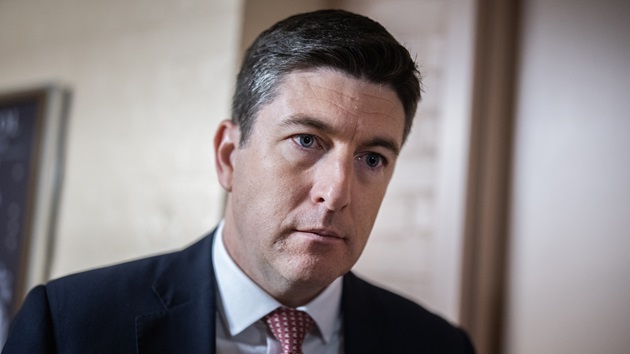
(ELKHORN, Wis.) — In a rowdy town hall on Thursday night, Wisconsin Republican Rep. Bryan Steil was booed when he expressed support for President Donald Trump’s trade policies.
“I really feel that this is a terrible tax that’s going to be placed on the citizens of the Unites States. I would like to know what dire economic circumstances put Trump in a position of deploying tariffs on over 190 countries?” the attendee asked, prompting applause from the crowd. “You have allowed him to do that and it’s sad. So tell me the dire circumstances that triggered his tariff wars.”
Steil’s response prompted loud boos from participants.
“As we look at the broader tariffs back and forth with the administration, this really is, at its core needs to be, an opportunity to make sure other countries are treating the United States fairly,” the congressman said.
In the Elkorn town hall, the congressman was also pressed on other topics, including the impacts Trump’s megabill will have on Medicaid and other services.
The nonpartisan Congressional Budget Office estimated the cuts to Medicaid included the sweeping tax and spending cut bill, which Trump signed into law on July 4, will result in 10 million Americans losing health insurance.
Responding to the event on X, Steil wrote “despite a handful of individuals attempting to disrupt the discussion, we had a great dialogue about the issues that matter most.” He committed to holding future events.
Some in the room were local protestors, ABC News affiliate WISN reported, including members of a group who last week carried a mock cardboard coffin to Steil’s home to protest Medicaid cuts.
House Democrats are being challenged at their town halls, too, facing pushback on topics such as the response to the war in Gaza. Earlier this week, Illinois Rep. Bill Foster, a Democrat, hosted a town hall event where he was repeatedly interrupted by anti-war protesters.
(WASHINGTON) — Kids in America’s public schools will soon be lacing up their sneakers for the Presidential Fitness Test as President Donald Trump is set to announce its return more than a decade after it was discontinued.
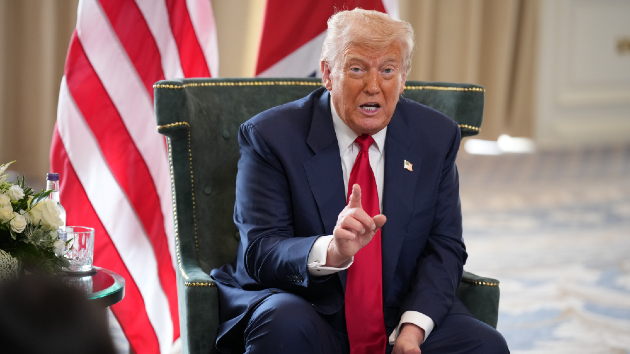
Trump will sign an executive order on Thursday that will expand the President’s Council on Sports, Fitness & Nutrition and bring back the Presidential Fitness Test in public schools, White House Officials confirmed to ABC News.
The fitness test, which began under former President Dwight Eisenhower in 1956, will return after it was discontinued in 2012 during former President Barack Obama’s presidency. Obama replaced it with the Presidential Youth Fitness Program, a comprehensive school-based program that promoted living an active and healthy lifestyle.
While there have been different versions of the Presidential Fitness Test, the one most are familiar with includes a one-mile run, pull-ups or push-ups, sit-ups, shuttle run and sit-and-reach, according to Harvard Health. It’s not yet clear what will be included in the Trump administration’s Presidential Fitness Test.
“President Trump wants to ensure America’s future generations are strong, healthy, and successful. President Trump wants every young American to have the opportunity to emphasize healthy, active lifestyles — creating a culture of strength and excellence for years to come,” White House press secretary Karoline Leavitt told ABC News in a statement on Thursday.
It’s all part of the administration’s goal to develop “bold and innovative fitness goals” for young Americans — a move that aims to foster a new generation of healthy, active individuals, the White House official said.
Trump will sign the executive order Thursday afternoon where he will be surrounded by several athletes, including Kansas City Chiefs’ kicker Harrison Butker; professional golfer Bryson DeChambeau; Chief Content Officer of the WWE and son-in-law of Education Secretary Linda McMahon, Paul “Triple H” Levesque; and former New York Giants linebacker Lawrence Taylor, a registered sex offender.
The order comes as the Trump administration weighs in on sports — including a ban on transgender athletes participating in women’s sports. Also, the United States is set to host several major sports events over the course of Trump’s second term, including the Ryder Cup, the FIFA World Cup in 2026 and the summer Olympics in 2028.
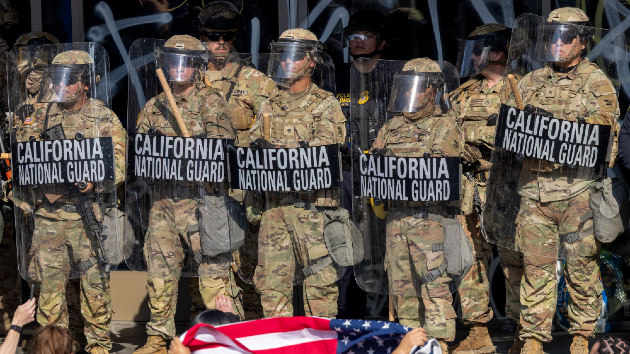
(LOS ANGELES) — The Pentagon has announced that 1,350 more federalized members of the California National Guard will be withdrawn from the security mission in Los Angeles that started in early June following protests against immigration raids carried out by Immigrations and Customs Enforcement (ICE). A remaining force of 250 National Guardsmen will remain in place to continue protecting federal government buildings and personnel in Los Angeles.
Close to 5,000 National Guard members and Marines were deployed to Los Angeles on June 7 for a mission that could potentially last up to 60 days, a time limit that ends next week.
“On Wednesday, Secretary Hegseth ordered the release of approximately 1,350 California National Guardsmen from the federal protection mission,” Sean Parnell, the Pentagon’s chief spokesman, said in a statement provided to ABC News.
“Approximately 250 California National Guardsmen remain in Los Angeles to protect federal personnel and property,” Parnell said. “We greatly appreciate the support of the more than 5,000 Guardsmen and Marines who mobilized to Los Angeles to defend Federal functions against the rampant lawlessness occurring in the city.”
In recent weeks the Pentagon had announced the withdrawals of 2,000 Guard members and 700 Marines, along with the reassignment of 150 Guard members to firefighting duty.
The initial mobilization came in the wake of protests following ICE raids in Los Angeles and was unusual in that they were ordered by the Trump administration instead of by Gov. Gavin Newsom. City officials labeled the deployment of the Guard and Marines as unnecessary and said that Los Angeles Police Department was more than capable of responding to the initial protests.
Because they were federalized National Guard and Marines, they were not able to carry out law enforcement duties, which is prohibited by law. However, during their mission to protect federal buildings and personnel, the mobilized military personnel had the authority to temporarily detain individuals before quickly transferring them to law enforcement personnel.
As the mission continued, some of the forces received training to accompany ICE personnel on immigration raids, though their role was specifically limited to providing force protection.
Michael A. McCoy/For The Washington Post via Getty Images
(WASHINGTON) — The federal government is paying more than 154,000 federal employees not to work as part of the deferred resignation program, an administration official confirmed to ABC News.
The updated figure, first reported by the Washington Post, includes thousands of government workers across dozens of agencies who took the buyout offers through June to maintain benefits and pay until the end of the fiscal year on Sept. 30.
It represents just over 6% of the 2.3 million federal civilian workforce.
To critics, the program has been administered haphazardly, throwing government offices into chaos and disrupting federal workers and programs indiscriminately, and prompting a number of legal fights between federal unions and the government — all of it at taxpayers’ expense.
“The American taxpayer ultimately is not only watching federal employees who are deeply interested in serving the public be sidelined, they’re having to pay for them too. It makes no sense at all,” Max Steier, the president and CEO of the Partnership for Public Service, told ABC News. “They’ve done ‘ready, fire, aim,’ instead of ‘ready, aim, fire.’ It’s detrimental to the capability of our government to meet our needs.”
To its proponents, the program has been an innovative way to streamline the federal government to focus on set priorities and recoup long-term cost savings after this fiscal year.
“Ultimately, the deferred resignation program was not only legal, it provided over 150,000 civil servants a dignified and generous departure from the federal government,” Office of Personnel Management spokeswoman McLaurine Pinover told ABC News. “It also delivered incredible relief to the American taxpayer. No previous administration has gotten even close to saving American taxpayers this amount of money in such a short amount of time.”
Former President Bill Clinton led an effort to reduce the federal workforce by more than 300,000 jobs, an initiative that took several years with congressional support.
The Office of Personnel Management could not tell ABC News how much the government is spending on salaries and benefits for workers who have not been working and are resigning — and how much the government has spent defending the “buyouts” in court.
In a report released Thursday, Senate Democrats estimated that the government has spent billions on workers who are on leave by choice or involuntarily due to litigation — and that the entire Department of Government Efficiency cost-saving campaign led by Elon Musk has cost the government $21.7 billion because of mistakes and waste.
The $21.7 billion figure provided by Democrats is an estimate that might include figures disputed by the administration. It also includes an estimate for 200,000 employees in the “buyout” program, when the actual figure is 154,000.
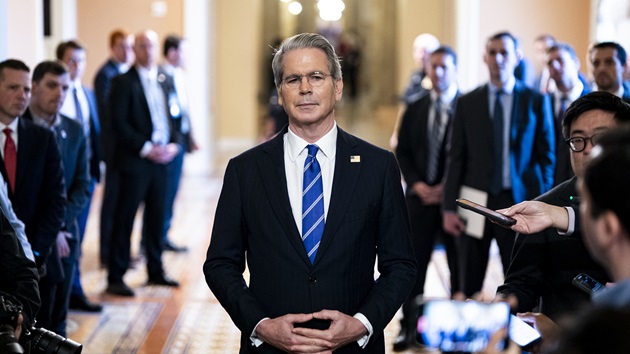
(WASHINGTON) — Treasury Secretary Scott Bessent is trying to walk back his suggestion that the so-called Trump savings accounts for newborns could be a “back door” to start privatizing Social Security.
Bessent made the comments in an interview with Breitbart while he was speaking at length about the importance of financial literacy.
“But in a way, it is a back door for privatizing Social Security,” Bessent said.
In a social media post on Wednesday evening, Bessent sought to clarify his remarks.
“Trump Baby Accounts are an additive benefit for future generations, which will supplement the sanctity of Social Security’s guaranteed payments,” Bessent wrote on X. “This is not an either-or question: our Administration is committed to protecting Social Security and to making sure seniors have more money.”
The “Trump Savings Accounts” were part of his megabill agenda narrowly passed by congressional Republicans earlier this month. The policy will deposit $1,000 into a tax-deferred, low-cost index fund account that will track the overall stock market for each newborn.
Additional contributions can go up to $5,000 annually. When the children reach adulthood, they can access funds to cover expenses such as college or a down payment on a home.
If a child is born after December 31, children under the age of 18 will have one thousand dollars put in their accounts for investment purposes.
The program is a new initiative to promote financial literacy among Americans.
“And, you know, people can put in up to certain amounts every year for their child, and they can invest that stuff in the market, and they can learn how to do this,” Bessent said in his interview with Breitbart.
When asked if companies matching would be a good thing, Bessent responded positively, saying it would be a “great thing.”
“At the end of the day, I’m not sure when the distribution level date should be. Whether should it be 30 and you can buy a house? Should it be 60? But in a way, it is a back door for privatizing Social Security,” Bessent said. “Social Security is a defined benefit plan paid out to the extent that if all of a sudden, these accounts grow and you have hundreds of thousands of dollars for your retirement, then that’s a game changer, too.”
Several Democrats quickly criticized Bessent’s comments.
Senate Minority Leader Chuck Schumer, a New York Democrat, slammed the treasury secretary in floor remarks on Thursday.
“Now, of course, Secretary Bessent had rushed to Twitter later to do a little cleanup, but the truth came out, the real truth,” Schumer said. “Actions speak louder than words, and the actions Donald Trump and his gang are taking against Social Security speaks volumes.”
“Well, Republicans said the quiet part out loud: They want to ‘privatize Social Security.’ Your money. Your benefits. Sold to the highest bidder. So much for standing with seniors,” Rep. Katherine Clark, the Democratic whip, wrote on X on Wednesday.
“Today the Treasury Secretary said the quiet part out loud: Republicans’ ultimate goal is to privatize Social Security, and there isn’t a backdoor they won’t try to make Wall Street’s dream a reality,” Rep. Richard Neal, the top Democrat the House Ways and Means Committee, said in a statement on Wednesday. “For everyone else though, it’s yet another warning sign that they cannot be trusted to safeguard the program millions rely on and have paid into over a lifetime of work.”
AARP, an interest group that focusing on issues affecting those 50 and older in the U.S., also pushed back on Bessent.
“AARP condemns Treasury Secretary Scott Bessent’s endorsement of a “backdoor” to Social Security privatization. We have fought any and all efforts to privatize Social Security, and we will continue to,” said AARP Senior Vice President of Campaigns John Hishta. “President Trump has emphasized many times that Social Security ‘won’t be touched,’ and that he is ‘not going to touch Social Security.’ This must include any and all forms of ‘privatization.'”
ABC News’ Alexandra Hutzler contributed to this report.
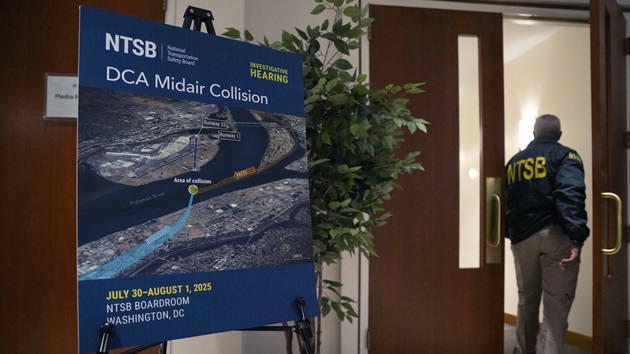
(WASHINGTON) — The National Transportation Safety Board on Thursday continued to grill officials from the Army, air traffic controllers and members from the Federal Aviation Administration over protocols following the January deadly air collision between a Black Hawk helicopter and a passenger jet approaching Ronald Reagan Washington National Airport (DCA.)
The hearing, the second of three days, is focused on the training guidance of the parties involved in the Jan. 29 incident that resulted in the deaths of 67 people. NTSB started the daylong hearing examining the responsibilities and readiness of DCA’s air traffic controllers.
Clark Allen, the former operations manager of the control tower at DCA, was asked Thursday about the training for the air traffic controllers. Allen said they have been trained to flag a supervisor and ask for additional help if they are being overwhelmed, but said there is no training for supervisors to proactively look out for that pile up of duties.
On Wednesday, the NTSB revealed that the pilots of a Black Hawk helicopter likely didn’t know how high they were flying or how close they were to an airliner before the deadly crash — potentially because of faulty altimeters inside the series of Black Hawk helicopters like the one they were flying.
Nick Fuller, the FAA’s acting deputy chief operating officer of operations, testified Thursday that it is up to the pilot to maintain visual separation while in the air.
“It is the pilot’s responsibility, but air traffic controllers will go the extra mile to make sure we are providing extra information as necessary,” he said.
Later asked if DCA was safe for flights, Fuller said it was.
“The controllers at DCA are responsible, well trained and I would have no problem leaving on a flight in or out of that airport,” he said.
NTSB Chair Jennifer Homendy alleged on Wednesday that some FAA tower employees knew there “was a problem” with U.S. Army helicopters flying in close proximity to passenger aircraft near the airport.
The agency also revealed that the warnings to the helicopter from air traffic control were “stepped on” as a microphone button was being pushed at the same time as the controller.
Homendy, however, said it’s possible that the midair collision was not due to pilot error.
“So it’s always easy for people to focus on there was a pilot error here. We don’t know. We’re going to look but it’s possible there was zero pilot error here,” she told reporters Wednesday.
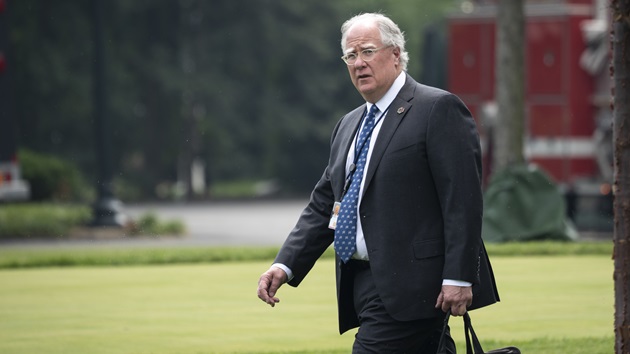
(WASHINGTON) — Mike Donilon, former President Joe Biden’s senior adviser, is appearing for a closed-door interview on Thursday in the House Oversight Committee’s probe into the former president’s mental fitness while in office.
Donilon, one of Biden’s oldest and closest advisers, is speaking before the Republican-led committee’s attorneys as its chairman, Republican Rep. James Comer, continues his investigation into Biden.
No members are expected to attend Donilon’s interview on Thursday, which began shortly after 10 a.m.
Donilon is the latest in a line of former Biden officials who have been called before the committee to answer questions about the former president’s mental capacity while he was in office. On Wednesday, Steve Ricchetti, who served as a counselor for Biden, answered questions.
Last week, former Chief of Staff Ron Klain cooperated with the committee for several hours.
However, several other aides have not been willing to engage with the committee and invoked the Fifth Amendment, including Dr. Kevin O’Connor, the former physician to Joe Biden, and Annie Tomasini, who served as the deputy chief of staff to Biden.
Biden himself rejected reports of cognitive decline during an appearance on ABC’s “The View” in early May.
“They are wrong. There’s nothing to sustain that,” Biden said at the time.
(TEXAS) — New congressional maps were proposed by Republican state legislators in Texas on Wednesday, following a push by President Donald Trump for maps more favorable to Republicans to help the GOP keep the majority in the U.S. House in 2026.
The maps come as Texas lawmakers continue meeting for a special legislative session called for by GOP Gov. Greg Abbott, who set an agenda that included considering congressional district redistricting “in light of Constitutional concerns raised by the U.S. Department of Justice.”
Trump has said he wants Republicans to pick up five new seats in Texas and others elsewhere; Democrats have decried the maneuver and said it risks hurting minority voters. Blue-state governors have said they’re considering mid-decade redistricting in response.
The state legislative bill that contains the maps, filed by Republican Texas state Rep. Todd Hunter on Wednesday morning, says it would supersede “all previous enactments or orders adopting congressional districts for the State of Texas” and would take effect first in the 2026 primary and general elections – meaning that if adopted successfully, it would impact the 2026 midterms.
The new map could net Republicans between three and five seats if enacted, analysts told ABC News.
David Wasserman, senior editor and elections analyst for The Cook Political Report, told ABC News that three of the seats in the map, he said, have been fully redrawn to favor Republicans, while two in south Texas that are currently held by Democratic Representatives Henry Cuellar and Vincente Gonzalez may still be feasible for Democrats to hold onto.
More broadly, Wasserman pointed to how Republicans made inroads among Hispanic voters in 2024 and that the map reflects how they likely assume those changes will be durable. “Republicans have very little to lose here, because this map doesn’t really weaken any of their own incumbents,” he said.
Republicans won a narrow three-seat majority last November and currently hold 219 seats to Democrats’ 212. Currently, four are vacant.
The Texas congressional delegation currently has 25 Republican House members and 12 Democratic House members. (One seat, formerly held by Democratic U.S. Rep. Sylvester Turner, has been vacant since he died in March.)
While any details of the bill and map plan could change in committee meetings, state House floor debate, or after future litigation, the current proposal shows that multiple Democratic members could be made more vulnerable.
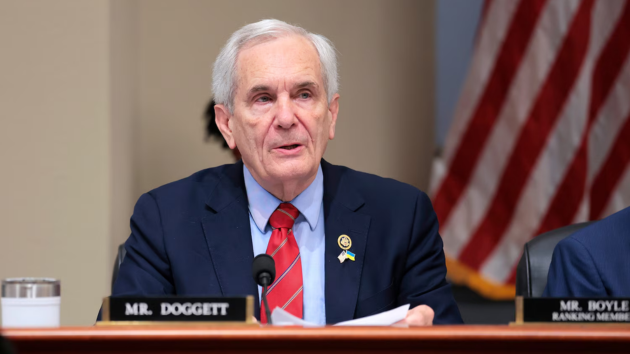
Some of those are among five sets of members from opposing parties being redistricted into the same district; and two Democrats – U.S. Reps. Greg Casar and Rep. Lloyd Doggett – would be redistricted into the same district.
(These members could run in different districts, retire from the House, or run for a different office – there’s no guarantee they’ll face each other if the map goes through.)
There is no set timing for specifically when the bill needs to go through the motions in the legislature, but the special legislative session, which began July 21st, can only last 30 days and thus ends August 20. Gov. Greg Abbott could call for further special sessions.
Republicans hold majorities in both chambers of the Texas legislature, as well as on both the House and Senate special session redistricting committees.
One major Republican voice appears to be giving support to the endeavor.
Vice President JD Vance, in a since-deleted tweet, criticized how most of the districts in Democratic-dominated California are not Republican even though four-tenths of voters in the state vote Republican. (Trump received almost 40% of the vote in California in 2024.) “Every GOP-controlled state should be following the Texas example,” he added.
In a subsequent tweet, Vance removed the reference to Texas and simply wrote after discussing the Republican vote in California, “How can this possibly be allowed?”
Legislative Democrats have said they’re keeping their options open as to how they might respond to any new maps. Multiple Texas state Democrats have said they would consider walking out of the special session or helping break quorum to delay or stymie efforts by legislative Republicans, but they would need 51 Democrats to break quorum and would accrue financial penalties.
Some of the members of Congress potentially affected by the new map slammed it as a power grab by Republicans.
U.S. Rep. Greg Casar, criticizing how the state’s 35th and 37th congressional districts effectively get merged in the new map, wrote, “By merging our Central Texas districts, Trump wants to commit yet another crime — this time, against Texas voters and against Martin Luther King’s Voting Rights Act of 1965. United, we will fight back with everything we’ve got.”
In a statement to ABC News, former Attorney General Eric Holder slammed efforts to redistrict in Texas, and says he doesn’t oppose Democratic efforts to fight back.
Holder runs the National Democratic Redistricting Committee.
“In this moment steps must be taken to respond to the authoritarian measures being considered in certain states and now so brazenly taken in Texas,” said Holder.
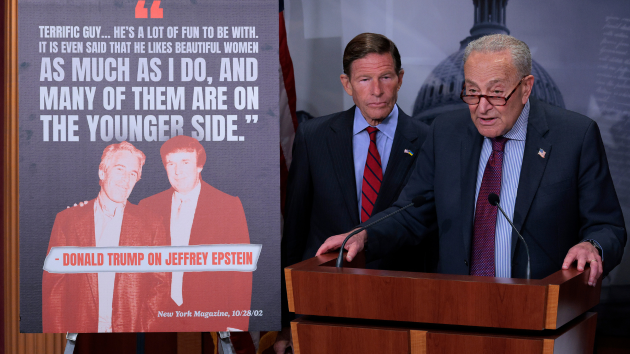
(WASHINGTON) — Senate Democrats on Wednesday said they are attempting to force the release of the Jeffrey Epstein files through a little-known, decades-old law.
All seven Democrats on the Homeland Security Committee invoked a law that requires federal agencies provide information about “any matter within the jurisdiction of the committee” if at least five members request it.
“This letter demands that the Justice Department produce documents that Attorney General Pam Bondi and FBI Director Kash Patel have publicly already confirmed they have in their possession,” Sen. Gary Peters, the panel’s top Democrat, said at a press conference.
“We all know in fact that the attorney general said, quote, she said they’re sitting on her desk. It should be pretty easy to turn over documents that are sitting on the attorney general’s desk,” Peters added.
The Justice Department did not immediately respond to request for comment.
Peters was joined by Senate Minority Leader Chuck Schumer and Sen. Richard Blumenthal at the press conference, during which they touted their move as a turning point in their quest for transparency over the Trump administration’s handling of the Epstein matter.
“Today’s letter matters. It’s not a stunt, it’s not symbolic, it’s a formal exercise of congressional power under federal law, and we expect an answer from DOJ by August the 15, that’s what accountability looks like,” Schumer said. “This is what oversight looks like, and this is what keeping your promises to the American people look like.”
Blumenthal agreed that this measure was invoked as a powerful oversight tool.
“This letter has some force of law,” Blumenthal said. “This letter invokes a statute that has been little used because it has been unnecessary in the past to enforce transparency. It’s necessary now because this administration is stonewalling and stalling and concealing, and the American people are rightly asking where they have to hide. What’s at stake here is not just the president’s promises.”
The Democrats, who said their urging of a release of the Epstein files was also done as a way of seeking justice for Epstein’s victims, were asked at the news conference whether Democratic senators would be comfortable with redactions in their release.
Schumer said lawmakers “wouldn’t force any agreements that have been broken,” but added that he believes “almost everything can come out.”
Schumer also said that they’ve been “talking” to their Republican colleagues to get these files public but would eventually seek “recourse in the courts” if cooperation isn’t achieved.
“We have talked to some of our lawyers, and we will — this can be challenged in the courts, yes,” Schumer said.
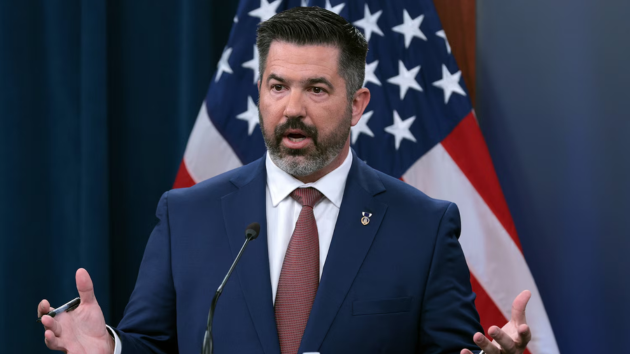
(WASHINGTON) — A top aide to Defense Secretary Pete Hegseth is berating independent auditors at the Pentagon for their ongoing review into the secretary’s use of the Signal messaging app, calling the assessment “a political witch hunt” and a “sham.”
The statement by Sean Parnell, Hegseth’s chief spokesman, suggests the defense secretary is preparing to challenge the upcoming findings by the Defense Department Office of the Inspector General, which is expected to be released in coming weeks.
Parnell’s use of the term “sham” to describe the IG’s work also raises questions about the fate of the independent watchdog office under President Donald Trump.
During his first week in office, Trump fired the Pentagon’s inspector general at the time, Robert Storch, along with more than a dozen other agency IGs. With Storch fired by Trump, the review is being led by acting Inspector General Steve Stebbins, who spent much of his career in the Army before becoming a career civil servant.
Mollie Halpern, a spokesperson for the IG office, declined to comment.
“Consistent with the long-standing policy of the DoD OIG, we do not comment on ongoing oversight project,” Halpern wrote in an emailed statement.
In his statement provided to reporters late Tuesday, Parnell said the IG evaluation “is clearly a political witch hunt” by “Biden administration holdovers.”
“The Secretary has provided a statement to the IG — which points out why this entire exercise is a sham, conducted in bad faith and with extreme bias,” he added.
Parnell initially released his statement to the The New York Times, which first reported Tuesday that Hegseth now requires general officers nominated for a fourth star to meet with Trump in advance of their nominations being finalized. A U.S. official confirmed to ABC News that the new process is in place.
Anna Kelly, a White House spokesperson, said Trump “wants to ensure our military is the greatest and most lethal fighting force in history, which is why he meets with four-star-general nominees directly to ensure they are war fighters first — not bureaucrats.”
Under consideration by the IG is whether Hegseth violated Pentagon policies last March when the secretary used the commercial messaging app Signal to relay details about a military strike in Yemen.
According to texts released by The Atlantic, which the White House confirmed as authentic, Hegseth detailed in an unclassified chat group with other officials how a strike would unfold and when, including the use of F-18 fighter jets and Tomahawk missiles.
“THIS IS WHEN THE FIRST BOMBS WILL DEFINITELY DROP,” Hegseth wrote at one point referencing Yemen and noting the military time of 1415 (2:15 p.m.) ahead of the March 15 strike.
Hegseth also shared details about the imminent attack in a second group chat that included his wife, his brother and his personal lawyer, two sources familiar with the contents of the chat told ABC News. Sources say the details on the strike originated from a classified document and that among the questions being asked by the IG is whether Hegseth personally wrote the texts or if another staffer typed out the details.
Hegseth has insisted repeatedly that the information was never classified in the first place. CIA Director John Ratcliffe and Tulsi Gabbard, director of national intelligence, also testified that the chat did not include classified information.
Stebbins, as acting IG, agreed to conduct an “evaluation” of the Pentagon’s Signal use at the request from Congress, which included Sen. Roger Wicker of Mississippi, the Republican chairman of the Armed Services Committee. Sen. Jack Reed of Rhode Island, the top Democrat on the panel, also requested the review.
“The information as published recently appears to me to be of such a sensitive nature that, based on my knowledge, I would have wanted it classified,” Wicker said following the report by The Atlantic.
In a statement to reporters, Reed said it was wrong for Parnell to criticize the IG office.
“The civilian leadership of the Department of Defense is not above the law,” Reed said. “To suggest that the nonpartisan Inspector General is doing anything other than their impartial duties is simply wrong. Taxpayers and military personnel deserve to know the truth, and the Inspector General’s office has a responsibility to follow all evidence and report its independent findings.”