
Expected vaccine requirement for federal workers raises new questions

Official White House Photo by Adam Schultz

(WASHINGTON) — President Joe Biden is likely to announce a vaccine requirement for the nation’s federal employees Thursday, according to a source familiar with the discussions.

The decision is dependent on an ongoing policy review, which could determine whether employees will be able to opt out of vaccination and instead, undergo regular testing and continue masking.

“It’s under consideration right now,” Biden said of a vaccine mandate for federal workers Tuesday afternoon. “But if you’re not vaccinated, you’re not nearly as smart as I thought you were.”

“Our goal as a federal employer is to keep our employees safe and to also save lives,” principal deputy press secretary Karine Jean-Pierre said Wednesday.

For the nation’s nearly 2.1 million civilian federal workers, many questions about the move remain unanswered. The possible requirement also raises ethics questions, since the vaccines have not been fully authorized by the Food and Drug Administration.

Pfizer, Moderna and the Johnson and Johnson vaccines were granted an Emergency Use Authorization (EUA), but the FDA is facing pressure to issue full authorization of the vaccines, which could open the door to mandates in schools, and the military.

“The FDA recognizes that vaccines are key to ending the COVID-19 pandemic and is working as quickly as possible to review applications for full approval,” FDA spokesperson Alison Hunt said in a statement.

David Magnus, the director of the Stanford Center for Biomedical Ethics, argued that the step was not ethically needed to require vaccines, given they have proven to be safe and effective in their current use.

“I don’t think that the FDA approval versus the EUA should have any bearing at all on whether or not a mandate is put in place,” he told ABC News in an interview.

Magnus argued that the expected announcement could leave workers with some choice on vaccine, but a consequence for not getting the shot.

“Some of the vaccine mandates — I believe the one that’s proposed by Biden, and the one that’s been put in place here in California are actually quite soft. They’re not really mandates,” Magnus said.

“They’re requirements, but not mandates, because not only do they have exceptions allowed, the consequences of not being vaccinated are not that this is a condition of employment. It’s that if you fail to do this then you have to take other public health measures to ameliorate it, like regular testing and wearing a mask at all times,” he added.

But Department of Justice lawyers have concluded that the law “does not prohibit public or private entities from imposing vaccination requirements,” even for vaccines that are not yet fully approved by the FDA, according to a July 6 opinion from the department’s Office of Legal Counsel.

“Although many entities’ vaccination requirements preserve an individual’s ultimate ‘option’ to refuse an EUA vaccine, they nevertheless impose sometimes-severe adverse consequences for exercising that option,” the DOJ legal analysis concludes, citing, for example, refusal to enroll students who refuse to vaccinate at a university.

In June, a federal judge in Texas ruled in favor of a Houston Methodist Hospital, which was sued by 117 employees over the hospital’s vaccine mandate.

“Methodist is trying to do their business of saving lives without giving them the COVID-19 virus. It is a choice made to keep staff, patients, and their families safer,” U.S. District Judge Lynn N. Hughes wrote in the opinion.

The leading plaintiff, the judge wrote, “can freely choose to accept or refuse a COVID-19 vaccine; however, if she refuses, she will simply need to work somewhere else.”

One professional association representing federal employees, the Federal Law Enforcement Officers Association, expressed concern about the expected vaccine requirement Wednesday.

“Forcing people to undertake a medical procedure is not the American way and is a clear civil rights violation no matter how proponents may seek to justify it,” association President Larry Cosme said in a statement. “We would therefore encourage the administration to work collaboratively with FLEOA and other federal employee groups to incentivize all federal employees to be vaccinated, rather than penalize those who do not.”

The expected vaccine requirement comes as the Centers for Disease Control and Prevention released revised mask guidance on Tuesday, calling for fully vaccinated individuals in “high” or “substantial” transmission level areas to resume wearing them.

Departing the White House for a trip to Pennsylvania Wednesday, Biden was seen unmasked exiting the Oval Office, despite Washington being considered a “substantial” transmission area. Biden’s destination, Macungie Township in Pennsylvania’s Lehigh Valley, is considered a “moderate” transmission area, so the president did not don a mask there.

But shortly after the CDC’s announcement Tuesday, White House reporters were instructed to resume wearing masks while indoors by the White House Correspondents Association and Vice President Harris was seen wearing a mask during an indoor meeting.

Harris was blunt about the development.

“No one likes wearing a mask,” she said Tuesday. “Get vaccinated. That’s it.”

Copyright © 2021, ABC Audio. All rights reserved.

Senate votes to start debate on $1.1 trillion bipartisan infrastructure deal

Drew Angerer/Getty Images

(WASHINGTON) — In a key test vote Wednesday evening, the Senate voted in favor of beginning debate on a $1.1 trillion bipartisan infrastructure deal that would provide funding for core items like roads, bridges, waterways and broadband.

Negotiators announced earlier in the day that they had reached a deal on the major aspects of plan.

Shortly after news broke that a deal had been reached, Senate Majority Leader Chuck Schumer announced that he would hold the test vote on the bill Wednesday, a critical first step to its passage.

Republican negotiators, all of whom blocked the procedural motion last week, said that they were ready to vote to move the bill forward and on Wednesday evening, 17 Republicans — including Senate Minority Leader Mitch McConnell — voted with all of the Democrats to advance the legislation, which was still being finalized. In a surprise split in the Republican leadership, McConnell’s deputy, Sen. John Thune, R-S.D., voted no.

Details about the agreement were still emerging, but an aide close to the talks confirmed to ABC News that the top-line value for new spending has decreased from $579 billion in the original bipartisan agreement to $550 billion.

Sen. Rob Portman, R-Ohio, the lead Republican negotiator for the bipartisan group, said the bill is “more than paid for,” an essential priority for Republicans, without raising taxes on those making under $400,000 a year, a red line for President Joe Biden.

The deal includes $110 billion in new funds for roads and bridges, $66 billion for rail, $7.5 billion to build out electric vehicle charging stations, $17 billion for ports, $25 billion for airports, $55 billion for clean drinking water, a $65 billion investment in high-speed internet and more.

Sen. Kyrsten Sinema, D-Ariz., the chief Democratic negotiator, told reporters that she expects some of the bill text to be available Wednesday with further updates released as the remaining details are worked out.

A “small, tiny thing” related to transit and a “small thing” related to broadband must still be addressed, Sinema said, adding that negotiators are “very excited” to have a deal.

Sinema said she spoke with Biden and said he too is “very excited” about and “committed to” the plan.

Biden released a statement Wednesday afternoon hailing the deal as a signal to the world that “our democracy can function, deliver, and do big things.”

“As the deal goes to the entire Senate, there is still plenty of work ahead to bring this home,” Biden wrote. “There will be disagreements to resolve and more compromise to forge along the way.”

Portman announced the agreement flanked by the four other Republicans in the core negotiating group early Wednesday afternoon.

“As of late last night and really early this morning we now have an agreement on the major issues we are prepared to move forward,” Portman said. “We look forward to moving ahead and having the opportunity to have a healthy debate here in the chamber regarding an incredibly important project to the American people.”

Sen. Susan Collins, R-Maine, who was part of the bipartisan negotiation group, touted the deal as a much-needed signal that bipartisanship is possible, even in an evenly divided Senate.

“I am delighted that we’ve been able to come together as a bipartisan group,” Collins said. “America needs to see us be able to tackle an important issue that will affect the lives of Americans throughout this country.”

It’s still not clear if all Democrats are going to support the bipartisan deal. Sen. Dick Durbin of Illinois, the Democratic whip, said Wednesday morning that was an “unanswered question.”

“We certainly don’t have a whip or people signing on the dotted line,” Durbin said. “We need some assurances that we are all in this together.”

Wednesday’s test vote in the Senate was expected to be the first in a long series of hurdles to pass this bill and Biden’s other agenda priorities. In addition to the procedural hurdles which still threaten to trip up the bipartisan deal on the floor, Democrats are also working to push through a second, larger budget bill containing the remainder of Biden’s American Families Plan priorities along party lines.

Schumer has long insisted that both the budget bill and the bipartisan bill need to pass together using a “two-track” approach.

But Sinema threatened to derail that plan on Wednesday, announcing in a press release that she won’t support spending the $3.5 trillion that Budget Committee Democrats agreed to as a top line for the budget bill.

“I have told Senate leadership and President Biden that I support many of the goals in this proposal to continue creating jobs, growing American competitiveness, and expanding economic opportunities for Arizonans,” Sinema said. “I have also made clear that while I will support beginning this process, I do not support a bill that costs $3.5 trillion — and in the coming months, I will work in good faith to develop this legislation with my colleagues and the administration to strengthen Arizona’s economy and help Arizona’s everyday families get ahead.”

To pass the budget bill, Democrats will need the support of every Democrat serving in the Senate. Sinema’s opposition points to the possibility of a long road ahead for many of Biden’s infrastructure priorities.
 

Copyright © 2021, ABC Audio. All rights reserved.

Republicans, Democrats battle over new House mask mandate

Alex Wong/Getty Images

(WASHINGTON) — Republicans and Democrats on Wednesday battled over the new House of Representatives’ new mask mandate, with more than a dozen Republicans voting twice without masks, despite new guidance from the Capitol physician aimed at preventing fast-spreading COVID-19 infections.

House Speaker Nancy Pelosi, D-Calif., called House GOP Leader Kevin McCarthy “such a moron” Wednesday morning when asked about his criticism of the new mask mandate in the House.

“That’s the decision from the Capitol physician, a mandate from him,” Pelosi told reporters. “I have nothing to say about that, except we honor it.”

Asked about McCarthy saying the decision was not “based on science,” she replied, “He’s such a moron,” as she got into her car.

In a directive issued Tuesday night, The Office of the Attending Physician, Dr. Brian Monahan, said it was now required that all members and staff wear “medical-grade” masks throughout the House, unless members are speaking in the halls of the House or individuals are alone.

Members and staff will once again be prohibited from stepping on the floor to vote without a mask, or risk incurring fines.

The directive cited the increasing threat from the delta variant and noted House members travel weekly to and from areas of both high and low rates of disease spread. It also mentioned the new Centers for Disease Control and Prevention mask guidance for vaccinated people to wear masks indoors in where transmission is high or substantial, as well as recommending universal masking in schools.

“The same bureaucratic ‘public health experts’ who completely upended our society by pushing lockdowns and yearlong school closures now want to force Americans to return to pre-vaccine control measures. By forcing vaccinated Americans to return to masks, the Biden administration is not only casting doubt on a safe and effective vaccine, but contradicting why vaccines exist,” McCarthy said in a statement in response. “Make no mistake — the threat of bringing masks back is not a decision based on science, but a decision conjured up by liberal government officials who want to continue to live in a perpetual pandemic state.”

After meeting with the top doctor on Capitol Hill Wednesday afternoon, McCarthy took to the House floor to decry the return of the House mask mandate and to slam Pelosi for calling him a “moron.”

“Today, the Speaker who didn’t know her own science, and said names to people, broke her own rules. Twice today, I saw the speaker in a crowded room without a mask. Less than 24 hours after imposing a mask mandate,” he said.

“You don’t know the facts or the science!” he said. “Do you know what frustrates Americans the most? Hypocrisy.”

McCarthy claimed the vaccination rate for members of Congress is over 85 percent. “And, as of today, the transmission rate on the Capitol campus is less than 1 percent,” he continued. “Well, the facts would tell us this isn’t a hot spot, so the CDC recommendation doesn’t apply to us!”

Republicans derailed the House floor schedule twice earlier on Wednesday, by forcing procedural votes protesting the new requirements.

At one point, the House was forced to vote on a motion to adjourn offered by Republican Rep. Chip Roy of Texas to disrupt proceedings, ostensibly over the mask mandate.

“This sham of an institution is doing nothing for the American people!” Roy yelled.

“We have people infected with Covid coming across the southern border,” he added, demanding that Dr. Fauci appear before Congress to testify about natural immunity. “Which is it? Vaccines or masks?”

“I don’t believe that masks make any difference,” Rep. Bob Good, R-Va., told ABC News when asked why he wasn’t wearing a mask. “If they’ve been vaccinated, what are they worried about a threat from me?”

When asked if he had been vaccinated, he said, “I don’t answer that question because it’s no one’s business.”

Rep. Pat Fallon, R-Texas, another unmasked member, said he had “double immunity” from the vaccine and a prior COVID-19 infection.

“I’ll pay the fines, I’m not wearing a damn mask,” he said.

Rep. Byron Donalds, R-Fla., another unmasked and unvaccinated member, got into a shouting match with liberal Rep. Jared Huffman, D-Calif., who told him to “get vaccinated,” and continued the feud on Twitter.

“You can’t compel people to put something in their own body. People have to decide to do that for themselves,” Donalds said. “I’m 42, healthy, and I already had COVID.”

Asked about his colleague Rep. Clay Higgins, R-La., who was hospitalized despite believing he already had COVID, he said, “The reality is that people are going to make their own decisions.”

As for the possibility of spreading the disease to vulnerable people with preexisting conditions, he said, “Anybody would be concerned about that.”

“What we’re doing is shifting the goalposts to eliminating COVID. And I want to eliminate COVID but we can’t be just shifting the goalposts on every American,” Higgins said. “If you have symptoms, go get tested. If you test positive, go isolate. This is not hard.”

Among the Republicans bristling at the return of the mask mandate on Wednesday was longtime opponent Rep. Lauren Boebert, R-Colo., who was seen throwing a mask back at a House staffer who offered her one.

According to two people who saw the exchange, Boebert threw a mask back at a staffer on the House floor and refused to put one on to comply with the latest rules. One person said she threw the mask on the ground.

Boebert’s office did not dispute the exchange, saying in a statement, “Rep. Boebert refuses to comply with Speaker Pelosi’s anti-science, totalitarian mask mandate. When offered a mask, she returned it with a quick slide across the table.”

Boebert could receive a $500 fine for breaking the new mandate. GOP Reps. Roy, Andy Biggs of Arizona and Marjorie Taylor Greene of Georgia, who also appeared on the floor without masks, could be fined as well.

Members can appeal the fines to the ethics committee, and receive $2500 fines for subsequent offenses.

Copyright © 2021, ABC Audio. All rights reserved.

Jan. 6 select committee to meet on next steps, move on subpoenas

Elisank79/iStock

(WASHINGTON) — A day after its first hearing with emotional testimony from police officers brought the Jan 6. Capitol attack back into the national spotlight, the House select committee investigating the assault will meet this week on possible next steps, including issuing subpoenas.

“I have no reluctance whatsoever in issuing subpoenas for information,” Chairman Bennie Thompson, D-Miss., told MSNBC’s Morning Joe Wednesday morning, asserting the committee “absolutely” has the authority. “Nothing is off limits in this investigation.”

His comment comes after the Department of Justice said in letters to former DOJ officials and provided to congressional committees that they can participate in investigations related to the Jan. 6, according to sources and letters reviewed by ABC News Tuesday, which the House Oversight Committee later confirmed. Therefore, if witnesses try to fight subpoenas, they may have to do so on their own dime.

“Members of Congress have already admitted that they talked to the White House while it was going on. Now many of them are trying to walk back the conversation they had,” Thompson said. “We plan to pursue it.”

Rep. Liz Cheney, R-Wyo., who sits on the committee, told ABC News’ George Stephanopoulos that the committee had not ruled out calling Rep. Jim Jordan, R-Ohio, who has criticized the committee and was vetoed from it by House Speaker Pelosi over comments she said would damage its credibility, to testify.

Jordan admitted on Tuesday evening that he — like GOP Leader Kevin McCarthy — spoke to former President Donald Trump on the phone on Jan. 6, and in another interview Wednesday with Ohio Spectrum News reporter Taylor Popielarz, confirmed he spoke to Trump on Jan. 6.

Asked by Popielarz if he spoke to Trump before during or after the attack, Jordan said he didn’t remember.

“I spoke with him that day. After? I think after. I don’t know if I spoke with him in the morning or not. I just don’t know,” he said.

Fox News host Brett Baier also pressed Jordan Tuesday on whether he spoke to Trump that day, and Jordan repeatedly deflected, saying he’s “talked to the former president umpteen times — thousands, countless times.”

Baier followed up, “But I mean on January 6, congressman.”

“Yes,” Jordan said. “I mean, I’ve talked to the president so many — I can’t remember all the days I’ve talked to him, but I’ve certainly talked to the president.”

Conversations in Trump’s orbit, such as the apparent call with Jordan, are key to what the committee is seeking to investigate, with Cheney saying Tuesday that Americans should know what happened “what happened every minute of that day in the White House.”

House Speaker Nancy Pelosi affirmed the committee’s subpoena power in her weekly news conference on Capitol Hill, but distanced herself from the committee itself as House Republican leaders disparaged the two GOP members who joined the panel as “Pelosi Republicans.”

When asked what will happen if House members don’t comply with subpoenas, Pelosi emphasized she is not involved with the select committee and “has not been a party to any of those decisions, so I cannot tell you what they might decide.”

The speaker also dismissed concerns that there will be political backlash if the committee’s work drags out or loses momentum, asked if she would like to see the committee move more expeditiously.

“They will take the time that they need,” she said. “We were very late in getting to this because we were striving for the bipartisan commission, which we thought was very possible.”

While lawmakers have a seven-week recess coming up, Thompson said Wednesday that the committee will meet again to discuss its next steps this week.

“We’ll have a meeting before we break for the August recess, but in reality, I think you know we’ll be back during that recess doing our work because we have to get to the bottom of it,” he told MSNBC. “Our democracy depends on it.”

At its first hearing, the committee heard from four officers who recounted they feared for their lives on Jan. 6 as they were brutally beaten and outnumbered by a pro-Trump mob. One officer described fearing he would be “torn apart” and chants of “kill him with his own gun.” Another said he was taunted with racial slurs in uniform for the first time in his career.

They all criticized lawmakers who have downplayed the attack and pleaded with the panel to uncover if those in power aided and abetted rioters, including the former president.

“There was an attack on Jan. 6, and a hit man sent them,” said Capitol Police officer Harry Dunn. “I want you to get to the bottom of that.”

Democrats are already coming to the defense of the officers after right-leaning cable news hosts attacked the testimonies as performative Tuesday night.

“Stupidity has no reach. It can go anywhere. It’s unfortunate that people would interpret the brave people who defended the Capitol as somehow disingenuous in their presentations,” Thompson said Wednesday.

While Capitol police officers watched the hearing on TVs and phones in the hallways of the building that was attacked, Republican leaders who blocked efforts to investigate the day dismissed the hearing as a political play and said they didn’t watch.

Senate GOP Mitch McConnell, who said after the attack that the “mob was fed lies” and “provoked by the president and other powerful people,” said he was “busy doing work” during the hearing.

“I don’t see how I could have expressed myself more forthrightly than I did on that occasion, and I stand by everything I said,” he said.

McCarthy, who held an event outside the Capitol ahead of the hearing as a preemptive strike to the officers’ testimony, told a Politico reporter he wasn’t able to because he was stuck in “back-to-back meetings.”

Notably, McCarthy has suggested Pelosi didn’t do enough to secure the Capitol that day, but McConnell, as leader of the Senate, has not faced the same criticism. Security at the Capitol is controlled by the Capitol Police Board.

GOP Rep. Matthew Rosendale of Montana told ABC News he only watched the opening statement from Cheney, who was ousted as the No. 3 House Republican earlier this year following her criticism of Trump’s role on Jan. 6.

“I was quite disappointed,” he said, before launching into a series of questions he wanted to be answered.

But because Republicans gave up their ability to participate in the hearing, with McCarthy withdrawing all of his members, they couldn’t lead the discussion in their preferred direction.

Rep. Pete Aguilar, D-Calif, who sits on the committee, blasted Republicans to ABC News who chose not to hear from the officers who helped protect them.

“For Kevin McCarthy and for my colleague from Montana to just say, ‘Oh I didn’t have the time to watch this hearing,’ you know, is just unfortunate and sad, and they just want to play politics with this,” he said. “That’s all this is.”

Aguilar added the public can expect more public hearings to come, though the date for the committee’s next hearing has not yet been announced.

ABC News’ Alex Mallin, Katherine Faulders and Ben Siegel contributed to this report.

Copyright © 2021, ABC Audio. All rights reserved.

DOJ issues guidance cautioning states on so-called election ‘audits’

JL Images/iStock

(WASHINGTON) — The Justice Department on Wednesday released guidance intended to caution states embarking on so-called post-election ‘audits’ of vote counts for the 2020 presidential election that they must not run afoul of federal voting laws.

The guidance, previously previewed last month by Attorney General Merrick Garland in his policy address on voting rights, outlines federal statutes that the department says elections officials must adhere to during such “audits,” such as preserving all federal elections materials and making sure they’re not tampered with.

“This document sets down a marker that says the Justice Department is concerned about this, and we will be following this closely,” a DOJ official told reporters on a media conference call Wednesday.

The guidance echoes a warning sent by the department back in May to the Republican-run audit in Arizona, warning officials there that all election records must be preserved and expressing concern about the state handing over election materials to the private contractor group Cyber Ninjas.

After the department’s letter, Arizona officials backed off of a plan to send contractors from the group to visit homes in the state’s largest county of Maricopa to ask voters whether or not they had cast ballots. The Wednesday guidance includes a warning that officials who seek to embark on such “audits” can’t do so in a way that will intimidate voters.

DOJ officials on Wednesday declined to provide any update on the department’s review of the Arizona “audit.” But the guidance comes as Republicans in several other states have expressed interest or are already moving forward with similarly partisan reviews of the 2020 vote count in certain jurisdictions — despite lacking any evidence of widespread fraud.

The department also issued separate guidance Wednesday that outlines the range of federal laws protecting voting by different methods.

“It’s responsive to the fact that more Americans than ever are voting, not on Election Day in person in a polling place, but that are voting at voting centers or voting early or voting by mail,” one official said.

An official said that the second set of guidance should be a note of caution to states that might be looking to roll back policies that expanded access to voting during the COVID-19 pandemic. The official gave the example of the election bill passed this year by Republicans in Georgia that implemented voting restrictions the department is now suing over, alleging it unlawfully targets minority communities.

“You should not assume that if you abandon the practices that have made it easier for people to vote, that abandonment is not going to get scrutiny from the Department of Justice,” an official said.

Copyright © 2021, ABC Audio. All rights reserved.

Bipartisan infrastructure deal reached: Negotiators

iStock/CHUNYIP WONG

(WASHINGTON) — Negotiators say they have a deal on bipartisan infrastructure.

A redo of last week’s failed test vote is expected Wednesday evening. Republican negotiators, all of whom blocked the procedural motion last week, said they’re ready to vote tonight, though a Democratic leadership aide said a time has not yet been set for the vote.

Negotiators also said they expect enough Republicans to support beginning debate.

Democrats called a special lunch to talk about the proposal behind closed doors this afternoon. Many say their support will hinge upon what is discussed during the meeting.

Details about the agreement are still emerging, but an aide close to the talks confirmed to ABC News that the topline value for new spending has decreased from $579 billion to $550 billion.

Sen. Kyrsten Sinema, D-Ariz., the chief Democratic negotiator, told reporters that she expects some of the bill text to be available Wednesday, with further updates released as remaining details are worked out.

A “small tiny thing” related to transit and a “small thing” related to broadband must still be addressed, Sinema said.

Sinema said she spoke with President Joe Biden and said he is “very excited” about and “committed to” the plan.

Sen. Rob Portman, who has been the chief negotiator for Republicans on the bill, announced the agreement flanked by the four other Republicans in the core negotiating group.

“As of late last night and really early this morning we now have an agreement on the major issues we are prepared to move forward,” Portman said. “We look forward to moving ahead and having the opportunity to have a healthy debate here in the chamber regarding an incredibly important project to the American people.”

Democrats who are part of the negotiations confirmed that a deal had been struck.

Sen. Joe Manchin, asked if it was his understanding that a bipartisan deal had been reached, replied “That sure is.”

It’s still not clear if all Democrats are going to support the bipartisan deal. Democratic Whip Dick Durbin Wednesday morning said it was an “unanswered question” whether all Democrats back the deal.

“I don’t believe we certainly don’t have a whip or people signing on the dotted line,” Durbin said. “We need some assurances that we are all in this together.”

Copyright © 2021, ABC Audio. All rights reserved.

Culture wars threaten to overtake war on COVID

iStock/ninjaMonkeyStudio

(WASHINGTON) — The TAKE with Rick Klein

It takes less than ever to find partisan grooves these days — and the fact that they’ve been etched deeper out of the fallout from Jan. 6 serves as a case in point.

That’s the reality that confronts President Joe Biden with this next uncertain phase of combatting the pandemic. New federal guidance on mask mandates and the consideration of a vaccine requirement for federal workers run into longstanding political arguments about individual liberties and personal accountability.

The push for vaccinations has become less partisan of late, with prominent Republicans adding new emphasis — and giving special credit to the previous administration — to make the case.

Yet mask-wearing and vaccine requirements have long since taken on cultural as well as political significance, and the fallout of Biden’s latest comments offer just a taste. Former President Donald Trump is offering strong pushback to mandates, and consider as well how readily some Republicans are using Dr. Anthony Fauci as a foil — raising money off the mention of his name, and even threatening legal action against him.

Biden indicated that he will outline next steps in the push to vaccinate the country on Thursday, as some statistics showing rates going up of late. The president on Tuesday also served up a reminder that as a candidate he “promised to be straight with you about COVID — good news or bad.”

Another reminder: 11 months ago, Biden said he wouldn’t hesitate to order another shutdown if that’s what his advisers recommended.

“I would shut it down; I would listen to the scientists,” he told ABC “World News Tonight” Anchor David Muir last August.

The campaign was quick to clarify that comment at the time. Biden’s statement Tuesday about masks and vaccines framed them as a way “to avoid the kind of lockdowns, shutdowns, school closures and disruptions we faced in 2020.”

“We are not going back to that,” the president said.

The RUNDOWN with Averi Harper

The testimony of Capitol Police officer Harry Dunn underscored the additional layer of trauma Black law enforcement officers experienced on Jan. 6.

Dunn’s heartbreaking testimony chronicled the racial slurs he endured as he tried to defend the seat of our nation’s democracy.

Among the insurrectionists were attackers who carried Confederate flags, donned shirts with anti-Semitic messages and freely hurled the n-word at Black officers.

“No one had ever, ever called me a n***** while wearing the uniform of a Capitol Police officer,” said Dunn.

He also brought with him the stories of other Black officers, later adding, “Another Black officer later told me he had been confronted by insurrectionists in the Capitol who told him, put your gun down and we’ll show you what kind of n***** you really are.”

For many, listening to Dunn recount the epithets stung as they were broadcast uncensored. The attack at the Capitol is often referred to as one of our nation’s darkest days, it’s particularly poignant that racism crept its way into the ugliness of it all, too.

It’s a vile reminder that racism in America, even in its most blatant forms, still exists.

The TIP with Alisa Wiersema

Republicans in Washington have one more representative joining their ranks — but the victory serves as an upset to Trump, despite his looming influence over the Republican Party on a national scale.

Nearly three months after the May 1 special election, State Rep. Jake Ellzey came out on top in Tuesday’s runoff election for Texas’ 6th Congressional District. Ellzey faced off with fellow Republican, Susan Wright, who had Trump’s backing going into the contest due to the political legacy of her late husband, Rep. Ron Wright, who died in February from COVID and complications with cancer.

The conclusion of the race is the latest indicator of the former president’s looming influence over his party in a state that is increasingly becoming ground zero for intra-party battles.

On Monday, Trump waded into another high-profile Texan battle by endorsing incumbent Attorney General Ken Paxton for another term. The move served a devastating — and complicated — blow to Land Commissioner George P. Bush, who was the only member of his storied political family to publicly back Trump, despite the former president launching repeated attacks against his father, Jeb Bush.

Copyright © 2021, ABC Audio. All rights reserved.

DOJ declines to back Rep. Mo Brooks in lawsuit brought by Rep. Swalwell over Jan. 6 incitement

iStock/Michał Chodyra

(WASHINGTON) — The Justice Department declined a request from Rep. Mo Brooks, R-Ala., Tuesday night to intervene for him in a lawsuit brought by a Democratic lawmaker suing him for his role in allegedly inciting the Jan. 6 attack on the U.S. Capitol.

In a new filing, the DOJ said it has determined it does not believe Brooks was acting within the scope of the duties of his office when he spoke in front of a pro-Trump rally just before rioters stormed the building, telling the crowd, “today is the day American patriots start taking down names and kicking a**.”

Brooks had asked for the Justice Department to replace him as a defendant in a lawsuit brought by Rep. Eric Swalwell, D-Calif., providing him legal immunity under a law known as the Westfall Act that former President Donald Trump similarly has sought to use to shield him from an effort by columnist E. Jean Carroll to sue him for defamation over his denial of her rape allegation.

“We appreciate the thoughtful analysis by the Committee on House Administration and the Department of Justice and could not agree more with their conclusion,” Rep. Swalwell’s attorney Philip Andonian said in a statement Tuesday night. “This conduct manifestly is outside the scope of Brooks’s employment as a member of Congress and the House and DOJ made the right call in requiring him to answer directly for his actions. This is a great step toward justice.”

Attorney General Merrick Garland faced a barrage of criticism last month when the department said it would continue to seek to substitute itself for Trump in the lawsuit, arguing that the law did apply to Trump even if they believed his statements were “crude” and “disrespectful.”

“The essence of the rule of law is that like cases be treated alike,” Garland said in defense of the move in testimony before a Senate panel. “That there not be one rule for Democrats and another for Republicans. That there not be one rule for friends and another for foes.”

Brooks similarly argued that by speaking to the rally and repeating Trump’s false claims of a stolen election that he was performing an official act of his office by representing the interests of his constituents.

Brooks has not responded to ABC News’ request for comment following the DOJ’s decision Tuesday.

But the chair of the House Administration Committee, Rep. Zoe Lofgren, D-Calif., disputed that assertion in a July 23 letter to the Justice Department, saying that Brooks’ conduct was “in furtherance of political campaigns” and thus should be deemed outside the scope of his office.

“Essentially, in deflecting the allegation that his speech was an incitement to violence, Representative Brooks has sworn under oath to the court that his conduct was instead in furtherance of political campaigns,” Lofgren wrote. “As noted, standards of conduct that apply to Members and precedents of the House are clear that campaign activity is outside the scope of official duties and not a permissible use of official resources.”

The Justice Department in its late filing Tuesday night largely backed Lofgren’s position, saying, “Brooks’s appearance at the Jan. 6 rally was campaign activity, and it is no part of the business of the United States to pick sides among candidates in federal elections. … Indeed, although the scope of employment related to the duties of a Member of Congress is undoubtedly broad and there are some activities that cannot be neatly cleaved into official and personal categories, Brooks’s request for certification and substitution of the United States for campaign-related conduct appears to be unprecedented.”

“Members of Congress are subject to a host of restrictions that carefully distinguish between their official functions, on the one hand, and campaign functions, on the other,” the department said. “The conduct at issue here thus is not the kind a Member of Congress holds office to perform, or substantially within the authorized time and space limits, as required by governing law,” the DOJ wrote.

The DOJ also notes that “if proven” the conduct Brooks is alleged by Swalwell to have engaged in “would plainly fall outside the scope of employment for an officer or employee of the United States.” “… conspiring to prevent the lawful certification of the 2020 election and to injure Members of Congress and inciting the riot at the Capitol.”

“Alleged action to attack Congress and disrupt its official functions is not conduct a Member of Congress is employed to perform and is not “actuated . . . by a purpose to serve” the employer, as required by District of Columbia law to fall within the scope of employment,” the department wrote in its filing.

Legal experts have been closely watching what the DOJ would ultimately decide in Brooks’ case, believing it could have a significant impact on other cases brought against allies of former President Trump being sued for encouraging or inciting the pro-Trump mob that stormed the Capitol on Jan. 6.

It is still unclear, however, whether the judge overseeing the case will decide to grant Brooks’ request to substitute the DOJ for himself despite DOJ’s stated opposition Tuesday evening.

Copyright © 2021, ABC Audio. All rights reserved.

Key takeaways from Jan. 6 hearing: Powerful testimony counters revisionist history

uschools/iStock

(WASHINGTON) — The House select committee tasked with investigating the Jan. 6 attack on the Capitol held its first hearing Tuesday in which lawmakers heard dramatic, emotional accounts from law enforcement officers who defended the building against a pro-Trump mob.

“We’re going to revisit some of those moments today, and it won’t be easy,” Chairman Bennie Thompson, D-Miss., said to open the hearing, while praising the officers for holding the line. “But history will remember your names and your actions.”

Here are key takeaways from the first hearing:

All witnesses feared for their lives during attack

The four officers testifying — Capitol Police officers Aquilino Gonell and Harry Dunn and Metropolitan Police Department officers Michael Fanone and Daniel Hodges — flatly rejected any attempts to rewrite history on Jan. 6 and downplay the attack as one that shouldn’t be investigated further, telling lawmakers they all feared for their lives on Jan. 6.

When Rep. Liz Cheney, R-Wyo., asked Gonell to respond to former President Donald Trump’s calling the crowd “loving.” Gonell placed responsibility on him for sending his supporters to the Capitol.

“It’s a pathetic excuse for his behavior for something that he himself helped to create — this monstrosity,” Gonell said. “I’m still recovering from those ‘hugs and kisses’ that day.”

Hodges, who referred to the rioters as “terrorists,” detailed the weapons used against officers that day including police shields, batons, hammers, a sledgehammer, flag poles, tasers, pepper spray, bear and wasp spray, copper pipes, rocks, table legs broken down, guardrails, cones and “any items they can get their hands on.”

“There were over 9,000 of the terrorists out there with an unknown number of firearms and a couple hundred of us, maybe. So we could not — if that turned into a firefight, we would have lost,” he said. “And this was a fight we couldn’t afford to lose.”

Hodges, who was crushed in a doorway that day, recalled how he had to wrestle with one rioter who tried to take his baton and how another shouted at him, “‘You will die on your knees.'”

Gonell also described the day as a scene “from a medieval battlefield.”

“I could feel myself losing oxygen and recall thinking to myself, ‘this is how I’m going to die, trampled defending this entrance,'” he said.

But the officers said they didn’t think twice about defending the Capitol and democracy, as traumatic as the experience was for them, their colleagues and families.

“Us four officers, we would do Jan. 6 all over again,” Dunn said. “We wouldn’t stay home because we knew what was going to happen. We would show up. That’s courageous. That’s heroic. So what I ask from you all, is to get to the bottom of what happened.”

The lawmakers choked up at times during the officers’ testimony including Rep. Adam Kinzinger, R-Ill., who told them, “You guys may like individually feel a little broken … but you guys won.”

“Democracies are not defined by our bad days. We’re defined by how we come back from bad days,” he said.

Racial slurs heard at riot haunt hearing room: ‘I guess it is America’

Racial slurs haunted the hearing room as officers recounted chants made by the mob, moving some officers to tears and prompting some lawmakers to hang their heads.

Dunn recounted the racist verbal abuse he endured from rioters in emotional testimony and said it was the first time he had been called the n-word in uniform.

“I’m a law enforcement officer and I do my best to keep politics out of my job, but in this circumstance I responded, ‘Well, I voted for Joe Biden, does my vote not count? Am I nobody?'” he said he told rioters who falsely shouted at him the election was stolen.

“That prompted a torrent of racial epithets,” Dunn said. “One woman in a pink MAGA shirt yelled “You hear that guys, this n***** voted for Joe Biden.”

Dunn, who also witnessed a Confederate flag carried through the Capitol, said that other Black officers shared similar stories of racial abuse from the day.

“I sat down on the bench in the Rotunda with a friend of mine, who is also a Black Capitol Police officer and told him about the racial slurs I endured. I became very emotional and began yelling, ‘How the blank could something like this happen? Is this America?'” he said. “I began sobbing.”

When Rep. Adam Schiff, D-Calif., posed the same question to Dunn later, the officer said, “I guess it is America. It shouldn’t be.”

Committee looking to subpoena Trump, lawmakers

Cheney, in her opening statement, made clear the committee is open to subpoenaing the former president, White House aides and members of Congress as they create a timeline of the day.

“We must also know what happened every minute of that day in the White House. Every phone call, every conversation, every meeting, leading up to, during, and after the attack. Honorable men and women have an obligation to step forward,” she said.

Adding to that pressure, all four witnesses told lawmakers they wanted an investigation into those in power who may have aided and abetted rioters.

Dunn used an analogy with a hitman to describe his expectations, in an apparent nod to the former president, after the witnesses spent three and a half hours recounting chants of “Trump sent us,” among others.

“If a hitman is hired and he kills somebody, the hitman goes to jail, but not only does the hitman go to jail but the person who hired them does. There was an attack carried out on Jan. 6 and a hitman sent them,” he said. “I want you to get to the bottom of that.”

Thompson said at a press conference after the hearing that the committee could be brought back for another hearing during the House’s August recess, which starts Friday. The panel said its work is just beginning.

The Department of Justice said in letters to former Trump officials, and provided to congressional committees, that they can participate in the investigations into the Jan. 6 attack, according to sources and letters reviewed by ABC News earlier Tuesday.

Cheney and Kinzinger poke holes in GOP arguments against committee

The two Republicans on the panel spent their questioning time pushing back on some of the most prominent Republican talking points after Jan. 6 — including that the rioters were not violent and that whatever took place at the Capitol paled in comparison to violence perpetrated by antifa during racial justice protests.

“I condemn those riots and the destruction of property that resulted — but not once did I ever feel that the future of self-governance was threatened like I did on Jan. 6,” Kinzinger said. “There was a difference between breaking the law and rejecting the rule of law, between a crime, even grave crimes and a coup.”

Kinzinger also defended his choice to serve on the committee, saying it’s “not in spite of my membership in the Republican Party, but because of it, not to win a political fight, but to learn the facts and defend our democracy.”

Cheney reminded in her opening statement that she and other lawmakers preferred to establish an independent commission to investigate the attack, but that effort was “defeated by Republicans in the Senate.”

“That leaves us where we are today. We cannot leave the violence of Jan. 6 and its causes uninvestigated,” she said. “If those responsible are not held accountable, and if Congress does not act responsibly, this will remain a cancer on our constitutional republic.”

The former No. 3 House Republican also reminded that her GOP colleagues had “recognized the events that day for what they actually were” in the days after the attack, even if members downplay it now.

Ahead of Tuesday’s hearing, Republicans who boycotted the select panel said the hearing should focus on the fact that Capitol Police were unprepared for Jan. 6. But because they gave up their ability to participate in the hearing, they couldn’t lead the discussion in their preferred direction — or challenge Democrats’ lines of inquiry the way Cheney and Kinzinger picked apart some of their claims.

Officers, while praised for heroism, blast lawmakers for partisan politics

While the officers were praised throughout the hearing for holding the line on Jan. 6, with lawmakers on the panel thanking them for their protection, the officers didn’t hold back when describing their disapproval in how partisan politics has muddied the search for the truth.

Fanone, the Metropolitan Police Department officer who was dragged down the Capitol steps, beaten with a flagpole, tased repeatedly and taunted with chants of “kill him with his own gun,” called out lawmakers on Tuesday who have blocked efforts for an investigation.

“The indifference shown to my colleagues is disgraceful,” he said, slamming his fist on the witness table. “I feel like I went to hell and back to protect them and the people in this room, but too many are now telling me that hell doesn’t exist or that hell actually wasn’t that bad.”

“Nothing — truly nothing — has prepared me to address those elected members of our government who continue to deny the events of that day, and in doing so betray their oath of office,” he added.

Gonell said of the former president downplaying the day, “It’s insulting, it’s demoralizing because everything that we did was to prevent everyone in the Capitol from getting hurt.”

Dunn said that the investigation is innately political because of the landscape surrounding the attack, but that it shouldn’t stop lawmakers from seeking the truth.

“It’s not a secret that it was political. They literally were there to stop the steal. So when people say it shouldn’t be political, it is. It was and it is. There’s no getting around that,” he said.

“Liz Cheney and Adam Kinzinger are being lauded as courageous heroes and while I agree with that notion, why? Because they told the truth? Why is telling the truth hard?” he asked. “I guess in this America, it is.”

Copyright © 2021, ABC Audio. All rights reserved.
Biden: Requirement for all federal employees to get vaccine ‘under consideration’

Alex Edelman/CNP/Bloomberg via Getty Images

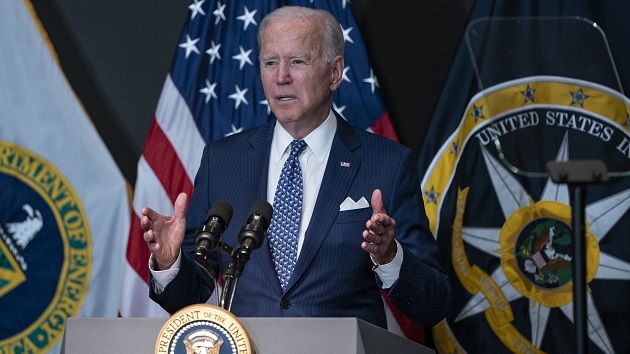
(WASHINGTON) — President Joe Biden said Tuesday afternoon that a mandate to require all federal employees to be vaccinated is now “under consideration.”

He said this one day after the Department of Veterans Affairs moved to require all health workers get a COVID-19 vaccine and shortly after the Centers for Disease Control and Prevention cited new science on the transmissibility of the delta variant and reversed its mask guidance.

“It’s under consideration right now,” Biden said when asked by ABC News if the federal government would expand the vaccine mandate. “But if you’re not vaccinated, you’re not nearly as smart as I thought you were.”
 

As he wrapped a visit to the Office of the Director of National Intelligence, ABC News also asked the president about Tuesday’s new guidance from the CDC, recommending masks for vaccinated Americans in public, and whether it would cause confusion, but Biden continued to focus on those who remain unvaccinated.

“We have a pandemic because the unvaccinated — and they’re sowing enormous confusion,” he said. “The more we learned — the more we learn about this virus and the delta variation, the more we have to be worried, concerned.”

“And the only one thing we know for sure, if those other 100 million people got vaccinated we’d be in a very different world. So get vaccinated. If you aren’t, you’re not nearly as smart as I thought you were,” Biden continued.

Following his remarks, Biden released a statement saying the CDC decision is “another step on our journey to defeating the virus” and that he’d have more to say on Thursday when he will “lay out the next steps” to get more Americans vaccinated.

Regarding the CDC recommendation for students, Biden said it’s “inconvenient,” but gives them a chance to learn “with their classmates with the best available protection.”

He also acknowledged concerns that as cases rise and mask guidance is reversed that the U.S. could be heading back to restrictions and closures but said in the statement, “We are not going back to that.”

“In the meantime, more vaccinations and mask wearing in the areas most impacted by the delta variant will enable us to avoid the kind of lockdowns, shutdowns, school closures and disruptions we faced in 2020. Unlike 2020, we have both the scientific knowledge and the tools to prevent the spread of this disease,” he said.

Earlier Tuesday, the CDC cited new science on the transmissibility of the delta variant and reversed its mask guidance to recommend that everyone in areas with high levels of COVID, vaccinated or not, wear a mask, as the virus continues to spread rapidly across the U.S.

“This new science is worrisome and unfortunately warrants an update to our recommendation,” CDC Director Rochelle Walensky told reporters during a briefing on Tuesday afternoon.

Throughout Washington there was a quick return to mask wearing for many who had grown accustomed to being without.

Vice President Kamala Harris, meeting with Interior Secretary Deb Haaland and Native American voting rights advocates Tuesday afternoon, wore a mask indoors for the first time since May 13.

Asked about the development, Harris gave a little shrug.

“None of us like wearing masks,” she said bluntly.

She noted that most people dying at this point are not vaccinated.

“People need to get vaccinated. That’s the only way we’re going to cut this thing off. No one likes wearing a mask. Get vaccinated. That’s it,” she said, then hitting her hand on the table for emphasis.

ABC News’ Cheyenne Haslett and Anne Flaherty contributed to this report.

Copyright © 2021, ABC Audio. All rights reserved.