
Ex-White House chief of staff Mark Meadows rebuffs Jan. 6 committee pending court ruling

Ex-White House chief of staff Mark Meadows rebuffs Jan. 6 committee pending court ruling
OlegAlbinksy/iStock

(WASHINGTON) — Former White House chief of staff Mark Meadows wants a court to resolve former President Donald Trump’s claims of executive privilege before he cooperates with the House committee investigating the Jan. 6 Capitol riot.

This comes after the White House notified Meadows’ attorney in a letter obtained by ABC News that President Joe Biden has no plans to assert executive privilege over testimony or documents.

“President Biden recognizes the importance of candid advice in the discharge of the President’s constitutional responsibilities and believes that, in appropriate cases, executive privilege should be asserted to protect former senior White House staff from having to testify about conversations concerning the President’s exercise of the duties of his office,” said the letter from deputy White House counsel Jonathan Su to lawyer George Terwilliger. “But in recognition of these unique and extraordinary circumstances, where Congress is investigating an effort to obstruct the lawful transfer of power under our Constitution, President Biden has already determined that an assertion of executive privilege is not in the public interest, and is therefore not justified, with respect to particular subjects within the purview of the Select Committee.”

Su also writes that Biden has determined he will not assert immunity to “preclude your client from testifying before the Select Committee.”

Terwilliger said in a statement to ABC News that “it now appears the courts will have to resolve this conflict.”

“Contrary to decades of consistent bipartisan opinions from the Justice Department that senior aides cannot be compelled by Congress to give testimony, this is the first President to make no effort whatsoever to protect presidential communications from being the subject of compelled testimony,” Terwilliger said. “Mr. Meadows remains under the instructions of former President Trump to respect longstanding principles of executive privilege. It now appears the courts will have to resolve this conflict.”

Meadows was first subpoenaed on Sept. 23 and has since been in talks with the committee through his lawyer on the extent to which he will cooperate with its probe. But sources familiar with the committee’s dealings say there has been growing frustration over the lack of progress regarding Meadows’ potential cooperation.

In a letter Thursday night, the committee threatened to hold Meadows in contempt of Congress if he doesn’t appear for a deposition before the committee on Friday.

“Simply put, there is no valid legal basis for Mr. Meadows’s continued resistance to the Select Committee’s subpoena. As such, the Select Committee expects Mr. Meadows to produce all responsive documents and appear for deposition testimony tomorrow, November 12, 2021, at 10:00 a.m. If there are specific questions during that deposition that you believe raise legitimate privilege issues, Mr. Meadows should state them at that time on the record for the Select Committee’s consideration and possible judicial review,” the letter reads.

“The Select Committee will view Mr. Meadows’s failure to appear at the deposition, and to produce responsive documents or a privilege log indicating the specific basis for withholding any documents you believe are protected by privilege, as willful non-compliance,” it continues. “Such willful non- compliance with the subpoena would force the Select Committee to consider invoking the contempt of Congress procedures in 2 U.S.C. §§ 192, 194—which could result in a referral from the House of Representatives to the Department of Justice for criminal charges—as well as the possibility of having a civil action to enforce the subpoena brought against Mr. Meadows in his personal capacity.”

Copyright © 2021, ABC Audio. All rights reserved.

Democrats move to censure Gosar over violent video attacking Biden, AOC

Democrats move to censure Gosar over violent video attacking Biden, AOC
uschools/iStock

(WASHINGTON) — A group of House Democrats have announced that on Friday they will formally introduce a measure to censure Rep. Paul Gosar, R-Ariz., for tweeting an edited Japanese cartoon showing him stabbing President Joe Biden and killing Rep. Alexandria Ocasio-Cortez, D-N.Y.

Gosar on Monday tweeted the message, “any anime fans out there?” with what appeared to be an edited clip of the Japanese cartoon series “Attack on Titan,” in which the main characters fight off giants trying to exterminate humanity.

The edited clip of the show’s opening credits depict Gosar and other GOP lawmakers flying through the air and stabbing giants with the faces of Biden and Ocasio-Cortez, in between images of Border Patrol officers with migrants at the U.S.-Mexico border.

Gosar was immediately condemned by House Speaker Nancy Pelosi, Ocasio-Cortez and other Democrats, some of whom called for his expulsion from Congress and charged him with glorifying violence against the prominent Democrats.

Pelosi tweeted on Tuesday, “Threats of violence against Members of Congress and the President of the United States must not be tolerated. @GOPLeader should join in condemning this horrific video and call on the Ethics Committee and law enforcement to investigate.”

“For a Member of Congress to post a manipulated video on his social media accounts depicting himself killing Representative Alexandria Ocasio-Cortez and attacking President Biden is a clear cut case for censure,” Rep. Jackie Speier, D-Calif., and other Democrats co-sponsoring her resolution wrote in a statement on Wednesday.

“For that Member to post such a video on his official Instagram account and use his official congressional resources in the House of Representatives to further violence against elected officials goes beyond the pale.”

Ocasio-Cortez also denounced House Minority Leader Kevin McCarthy for not publicly criticizing Gosar’s actions. Aides to the California Republican did not respond to a message from ABC News seeking comment on the video.

Gosar eventually took down the tweet and video Tuesday night, after Twitter placed a public interest notice on the post. He said the video produced by his office was meant to “symbolize the battle for the soul of America” and was “in no way intended to be a targeted attack against” the Democrats.

“The cartoon depicts the symbolic nature of a battle between lawful and unlawful policies and in no way intended to be a targeted attack against Representative Cortez or Mr. Biden,” Gosar said in a statement.

“It is a symbolic cartoon. It is not real life. Congressman Gosar cannot fly. The hero of the cartoon goes after the monster, the policy monster of open borders. I will always fight to defend the rule of law, securing our borders, and the America First agenda,” the statement said.

If the censure resolution is taken up by the full House and approved by a majority of lawmakers present and voting, Gosar could be forced to stand in the center of the House chamber as the resolution condemning his actions are read aloud.

It’s not yet clear if the House will take action against Gosar, who has courted controversy for spreading conspiracy theories about the Jan. 6 attack on the Capitol and appearing at a white nationalist event last winter — though he distanced himself from the main organizer and his comments.

Twenty-three members of Congress have been censured for misconduct, according to a 2016 Congressional Research Service Report.

Former Rep. Charlie Rangel, D-N.Y., was the last member of Congress to be censured — in December 2010 — accused of nearly a dozen ethics violations.

Copyright © 2021, ABC Audio. All rights reserved.

Court pauses handover of Trump White House records to Jan. 6 committee

Court pauses handover of Trump White House records to Jan. 6 committee
kuzma/iStock

(WASHINGTON) — An appeals court has put a temporary pause on the handover of records from the Trump White House to the House committee investigating the Jan. 6 insurrection.

A three-judge panel in the D.C. Circuit Court of Appeals on Thursday granted a request from former President Donald Trump’s legal team for a temporary injunction to block the exchange of records from the National Archives to the committee, which was set to take place Friday, and scheduled a Nov. 30 hearing to hear arguments from all parties in the case.

Trump sued the committee and the National Archives last month, asserting executive privilege over a broad swath of documents the national archivist had identified as relevant to the Jan. 6 committee’s investigation into Trump’s efforts to overturn the 2020 election and the subsequent attack on the U.S. Capitol.

A district court judge this week twice denied Trump’s request to block or delay the release of the documents, ruling that President Joe Biden’s decision to not assert privilege over the materials outweighed Trump’s efforts to do so as a private citizen.

“[Trump’s] position that he may override the express will of the executive branch appears to be premised on the notion that his executive power ‘exists in perpetuity,'” district judge Tanya Chutkan said in her ruling. “But Presidents are not kings, and Plaintiff is not President.”

It’s unclear how the temporary delay might affect the work of the Jan. 6 committee. The committee’s chairman, Rep. Bennie Thompson, has previously said he hopes the committee’s investigation could conclude by early next year.

According to the national archivist, the first tranche of documents that were set to be handed over on Friday included daily presidential diaries, call logs, White House appointments that occurred around Jan. 6, and three handwritten notes from the files of former White House chief of staff Mark Meadows, among other documents.

Copyright © 2021, ABC Audio. All rights reserved.

Biden says mandates work. He’s about to find out with his own civilian workforce.

Biden says mandates work. He’s about to find out with his own civilian workforce.
iStock/koto_feja

(NEW YORK) — Pamela Millwood isn’t against getting vaccinated. But at the federal prison where she works in Jesup, Georgia, many of her coworkers are skeptical or downright opposed to getting a shot.

The result, she predicts, will be an exodus of some 30% to 40% of staff this holiday season, when prison employees will fall under a sweeping mandate that requires the nation’s 2 million civilian workers to become fully immunized against COVID-19.

That type of mass resignation hasn’t happened at other employers with mandatory vaccinations, such as Tysons Foods, United Airlines and New York City firefighters and teachers. The U.S. military, too, already has required COVID vaccines.

In each instance, personnel eventually complied, even after some raucous protests, with 90% or more of those workers now vaccinated.

But Millwood said she’s not so sure that will be the case at the Jesup prison, where working conditions are particularly stressful and employees are living in a state with some of the lowest COVID vaccination levels despite high transmission levels.

“We’ve got some very strong-minded staff who are going to stand their ground on it,” said Millwood, who also serves as the local union president in Jesup, some 60 miles south of Savannah. “And we’re going to lose some staff over this.”

After initially dismissing a vaccine mandate as the wrong approach, President Joe Biden this summer switched gears. Vaccination rates had stalled out earlier than anticipated, and COVID cases again began ticking upward. Children too young for the vaccine began crowding pediatric ICUs, and hospitals warned of potentially having to ration care as beds overflowed with mostly unvaccinated patients.

In September, Biden announced a new plan: Anyone working for or doing business with the federal government would have to get vaccinated, without the option of testing for the virus. Health care workers at facilities that accept federal money through programs like Medicaid and Medicare also would be required to get their shots. Additionally, private businesses with 100 or more employees would have to impose mandates of their own, although those workers would be given the option of weekly testing.

As the separate mandates face multiple lawsuits, Biden has argued that office spaces and assembly lines aren’t safe without widespread vaccinations, and that it’s up to employers to protect workers against COVID-19 the same as they would asbestos exposure or any other occupational hazard.

“I waited until July to talk about mandating because I tried everything else possible,” Biden said last month at a CNN Town Hall. “The mandates are working.”

According to the Centers for Disease Control and Prevention, unvaccinated people are six times more likely to test positive and 11 times more likely to die. When vaccinated people test positive, they also tend to recover and clear the virus more quickly, making them less contagious and protecting those around them.

Research also has found that “natural immunity” isn’t enough. One study of 7,000 people hospitalized for COVID-19 across nine states found that unvaccinated people who had been previously infected still were five times more likely to be re-infected than those who were vaccinated.

Still, as the holiday season approaches and employers complain of a worker shortage, Biden’s mandates are now at the forefront of a nationwide debate on whether the government is going too far.

Under Biden’s plan, the estimated 2 million civilians who work for the federal government — the vast majority of whom reside outside the Washington, D.C., area — were supposed to have gotten their last shot by now in anticipation of a Nov. 22 deadline. The CDC considers a person “fully immunized” two weeks after their last dose.

How much of the federal workforce will meet that deadline remains to be seen. The White House won’t release estimates yet because it insists workers still have time to report their vaccinations, even though guidance to the federal agencies has said disciplinary action could begin as early as this week.

Of particular concern are workers essential to national security and law enforcement, including the more than 50,000 Transportation Security Administration employees at airports tasked with screening an estimated 4 million air travelers over Thanksgiving.

As of last month, some 40% TSA workers remained unvaccinated. The White House and TSA haven’t updated those figures, but did say Thanksgiving travel shouldn’t be greatly affected because potential terminations won’t be immediate.

If workers refuse a vaccination, they would be subject to an initial counseling session, followed by a warning, after which they’d be subject to termination.

But it’s unclear how long that could take. Federal guidelines posted online suggest counseling efforts are limited to five days, to be followed by a 14-day suspension during which workers would be required to initiate getting a shot.

White House officials said agencies are being given discretion on how to implement the mandate, and they’re insisting Biden’s Nov. 22 deadline isn’t a “cliff.”

“The purpose, I think, most importantly, is to get people vaccinated and protected, not to punish them,” Jeff Zients, the White House coordinator on COVID-19, said at a recent press briefing.

At the same time, the administration appears to be slow-walking the mandate while simultaneously arguing that getting vaccinated is urgent.

When asked why the deadline for federal workers can’t be moved to Jan. 4 to align with the private sector, as suggested by union officials, a spokesperson for the Office of Management and Budget said: “The vast majority of the federal workforce wants to know they’re safe in the workplace because their coworkers are vaccinated.”

In Jesup, Millwood said protests and employee attrition are inevitable. Two coworkers already have left, stretching thinner an already strained staff, she said.

Millwood acknowledged that her husband agreed to get vaccinated only when faced with the mandate. She said she’s still not sure about her coworkers.

“There are a lot of people,” Millwood said, “who are absolutely either going to wait to the last minute, or are just [saying], ‘You’re going to have to fire me.’ And that’s just the way it is.”

ABC News’s Cheyenne Haslett contributed to this report.


Copyright © 2021, ABC Audio. All rights reserved.

Biden to sign infrastructure bill Monday during bipartisan ceremony

Biden to sign infrastructure bill Monday during bipartisan ceremony
Official White House Photo by Adam Schultz

(WASHINGTON) — President Joe Biden will sign the $1.2 trillion infrastructure bill into law on Monday, joined by a bipartisan group of members of Congress during a ceremony at the White House, according to a White House official.

A bipartisan group of governors and mayors, as well as labor union and business leaders, would also join Biden at the ceremony, according to the official. The members of Congress who will attend will include those who helped write the legislation, the official said.

Facing low poll numbers, rising inflation and challenges getting the rest of his legislative priorities passed, the president has put off signing the infrastructure bill in order to put his major, bipartisan accomplishment on display.

During his remarks Monday, Biden also plans to address how the infrastructure legislation will play a role in bolstering supply chains and dealing with bottlenecks, the White House official said. The president planned to visit a port in Baltimore on Wednesday with a similar message.

The House of Representatives passed the bill late Friday, after the Senate passed it in August. Biden has said he wanted to hold a ceremony with members of Congress, who were on recess and out of Washington this week, as well as Vice President Kamala Harris, who is currently visiting France.

“Vice President Harris and I look forward to having a formal signing ceremony for this bipartisan infrastructure soon,” Biden told reporters Saturday.

“I’m not doing it this weekend,” he added, “because I want people who worked so hard to get this done — Democrats and Republicans — to be here when we sign it.”

The bill, officially known as the the Infrastructure Investment and Jobs Act, provides hundreds of billions of dollars to improve the nation’s highways, bridges and roads; passenger rail; public transit; broadband access; and the power grid, among other investments in physical infrastructure.

The White House has cited outside economists to argue it will create hundreds of thousands of jobs over the next decade.

Despite wide public support for the infrastructure bill — as well as for the “Build Back Better” social bill he is also trying to push through Congress — the president himself has suffered from low approval ratings.

Biden and his administration have launched a public relations campaign to promote the two bills, with the president visiting a port in Baltimore on Wednesday and sitting for an interview with a Cincinnati television station, and Cabinet officials conducting interviews to explain how the infrastructure bill in particular will benefit Americans.

A nationwide poll from Monmouth University conducted Nov. 4 to 8 found that 42% of Americans approved of the way Biden was handling his job, and 64% of respondents said they believed things in the United States have gotten off on the wrong track.

But 65% of respondents said they supported the infrastructure package, and 62% said they supported the larger social spending plan.

In the coming weeks, the president, vice president, and Cabinet will continue to travel the country to communicate how the law will help communities, grow the economy, and position America to compete in the 21st century.

Copyright © 2021, ABC Audio. All rights reserved.

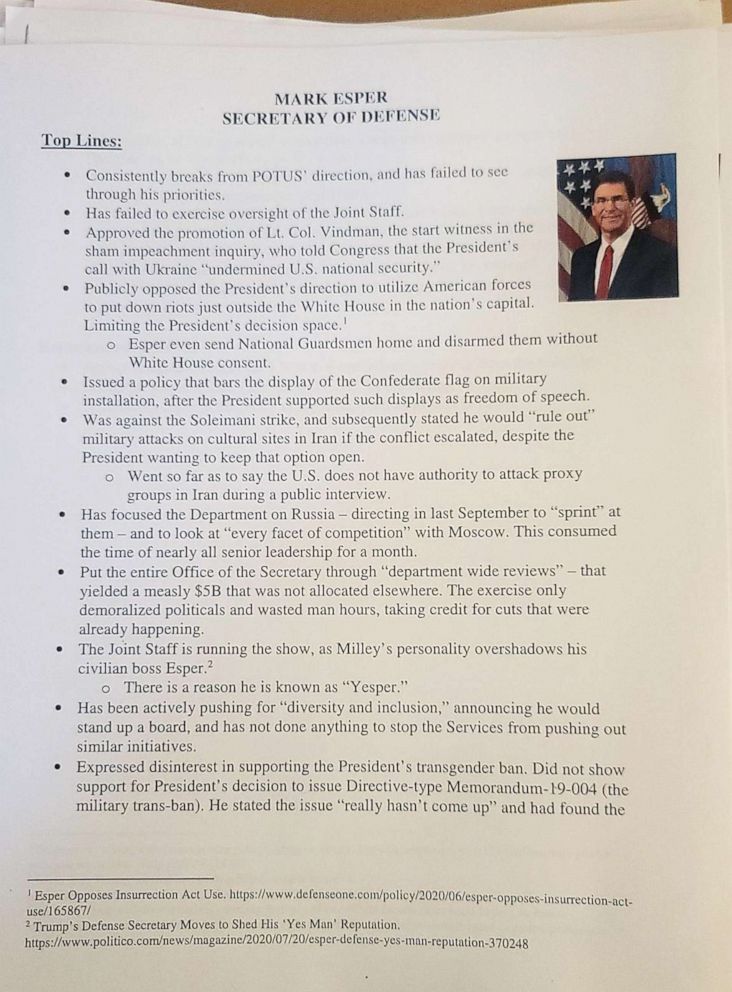
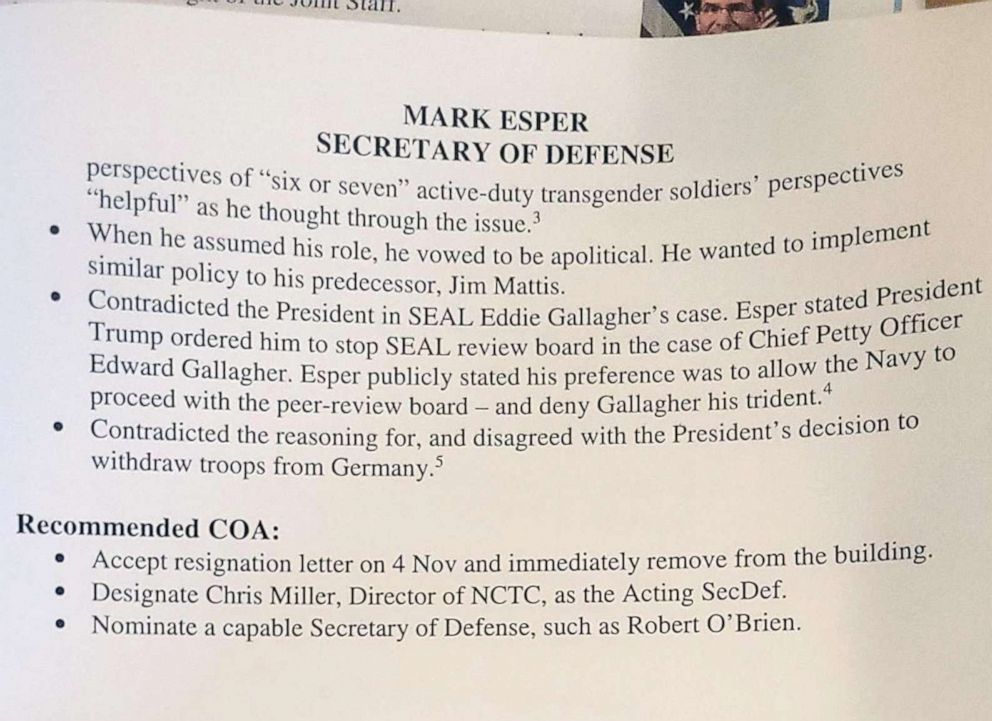
Read the memo from Trump aide’s office making the case to fire Defense Secretary Mark Esper

Read the memo from Trump aide’s office making the case to fire Defense Secretary Mark Esper
Oleg Albinsky/iStock

(WASHINGTON) — In a memo never before made public, the Presidential Personnel Office under the direction of John McEntee, a favorite aide of former President Donald Trump, made a case for firing then-Secretary of Defense Mark Esper three weeks before Esper was terminated, according to reporting in a new book by ABC News Chief Washington Correspondent Jonathan Karl.

The contents were first reported by Karl in The Atlantic for an article adapted from his forthcoming book, “Betrayal: The Final Act of the Trump Show.”

The memo from McEntee’s office, dated Oct. 19, 2020, provides what Karl calls a remarkable window inside the thinking of the Trump White House during the final months of his presidency and the power held by the then-29-year-old director of the Presidential Personnel Office.

It includes bullet points outlining what Karl calls Esper’s “sins against Trumpism,” including that he “barred the Confederate flag” on military bases, “opposed the President’s direction to utilize American forces to put down riots,” “focused the Department on Russia,” and was “actively pushing for ‘diversity and inclusion.'”

Three weeks later on Nov. 9, 2020, Karl says, Trump fired Esper in precisely the way McEntee recommended and replaced, as recommended, by Christopher Miller. The firing also came two days after Trump lost reelection and as the former president was expected to purge top members of his administration with whom he had long been unhappy.

Memo
Obtained by ABC News Chief Washington Correspondent Jonathan Karl

Esper’s termination was made official with a terse two-sentence letter dated Nov. 9 and signed by McEntee that has also, until now, never been made public.

The Presidential Personnel Office, what Karl describes as a normally under-the-radar group responsible for the hiring and firing of the roughly 4,000 executive branch appointees, transformed into an internal police force in the final year of the Trump administration, with employees scouring for acts of dissidence in their ranks.

“Betrayal: The Final Act of the Trump Show” is scheduled to be released on Nov. 16, 2021.

Copyright © 2021, ABC Audio. All rights reserved.
Transcript of Cuomo investigation interviews released

Transcript of Cuomo investigation interviews released
Michael M. Santiago/Getty Images/File

(NEW YORK) — Former New York Gov. Andrew Cuomo said in an interview over the summer he “wouldn’t be surprised” if somebody who worked for him at some point sat on his lap.

“I don’t recall anyone specifically. But, you know, I have people who have worked with me 14 years, 10 years,” Cuomo said, according to a newly released transcript of a July interview with attorneys deputized by the New York Attorney General to investigate claims of sexual harassment. “If somebody were to sit on my lap, you know, I wouldn’t push them off.”

Cuomo resigned in August after a monthslong investigation by State Attorney General Letitia James found he sexually harassed 11 women, including current and former state employees.

The interview began just after 8 a.m. on July 17 in the governor’s Manhattan office. The 515-page transcript, which was released Wednesday, depicts Cuomo as standoffish from the start, sparring with attorneys Joon Kim and Anne Clark over their titles and reminding them of his potent political resume.

“I’m a former attorney general,” Cuomo reportedly said in the 11-hour interview. “I’m aware of the attorney general’s power. I’m aware of the special prosecutor power, independent investigator power.”

Cuomo was governor of New York for 10 years and previously served as the state’s attorney general. In all of that time of government service, Cuomo said he only recalled taking sexual harassment training in 2019.

“I don’t remember what years I did or didn’t take sexual harassment training,” Cuomo said.

Cuomo also told the investigators he had come to believe some of the sexual harassment accusations were the work of political opponents who “have been part of orchestrating and resonating the complaints against me.”

“That’s what you think now?” Kim asked. “That’s what I know now,” Cuomo replied.

The investigation included interviews with 165 witnesses, including several of Cuomo’s accusers, including former New York Executive Chamber employee Brittany Commisso.

According to the transcript, Commisso alleged throughout her interview that Cuomo would hug and kiss her in a way that made her feel uncomfortable and that he made “inappropriate comments about her marital status.”

“His hugs definitely got closer and tighter to the point where I knew I could feel him pushing my body against his,” she alleged.

“I definitely noticed that when he would kiss me on the cheek, I took it as OK, he is being friendly,” she said. “Then obviously when he would turn his head and get me on the lips, it startled me. It obviously wasn’t normal.”

When asked about the allegations made by Commisso, Cuomo said they were “not even feasible” because he believed that his conduct was constantly under scrutiny, including by Kim when the lawyer served as acting U.S. Attorney in the Southern District of New York.

“You’ve investigated me for six years,” he told Kim, referring to corruption investigations conducted by federal prosecutors during Kim’s tenure. “I would have to lose my mind to do some — such a thing. It would be an act of insanity to touch a woman’s breast and make myself vulnerable to a woman for such an accusation.”

Cuomo cast Commisso as the “initiator” of any intimate conduct.

“She was very affectionate. I would say more she was the initiator of the hugs,” Cuomo said, according to the transcript. “She said that she was Italian and Italians are very affectionate people. But she was a hugger.”

A state trooper on Cuomo’s security detail also said she felt “completely violated” during an encounter at the end of a 2019 groundbreaking ceremony for a new arena for the NHL’s New York Islanders

The trooper told investigators she held open the door when it came time for the governor to leave.

“And while he’s walking and we’re in motion, while he’s walking into the door, he takes his left hand and basically like thumb facing down, I felt the palm of his hand in the center of my stomach on my bellybutton and like pushed back towards my right hip like where my gun is. So he’s walking one way, his hand is running across my stomach in the opposite direction,” the trooper said, according to the transcript.

“And I felt completely violated because to me, like, that’s between my chest and my privates, which, you know, if he was a little bit north or a little bit south, it’s not good.”

When Kim asked Cuomo about the alleged incident in the interview, the former governor said if he did touch her, “It was incidental, and I don’t remember doing that.”

Cuomo also denied asking if he could kiss the trooper as she also alleged.

“Do you remember ever asking her on any occasion, ‘Can I kiss you? May I kiss you?’” Kim asked.

“No, I don’t remember that,” Cuomo replied.

A spokesperson for Cuomo called the investigation a “fraud” in a statement.

“These transcripts include questionable redactions and raise even more questions about key omissions made during this slanted process, which reeks of prosecutorial misconduct,” spokesperson Rich Azzopardi said.

Members of the Assembly Judiciary Committee have been invited to Albany to review the report next week, Assemblymember Charles Lavine, chair of the committee, said in a statement sent to ABC News.

ABC News’ Luc Bruggeman, Celia Darrough and Soorin Kim contributed to this report.

Copyright © 2021, ABC Audio. All rights reserved.
Jan. 6 committee issues 10 more subpoenas targeting Trump administration officials

Jan. 6 committee issues 10 more subpoenas targeting Trump administration officials
uschools/iStock

(WASHINGTON) — The House select committee investigating the Jan. 6 Capitol riot issued 10 subpoenas on Tuesday to former members of the Trump administration — including West Wing aides and senior officials who were in or around the Oval Office and former President Donald Trump when the riot unfolded on Capitol Hill.

They include senior adviser Stephen Miller, press secretary Kayleigh McEnany, personnel director John McEntee, deputy chief of staff Chris Liddell, and Keith Kellogg, who served as former Vice President Mike Pence’s national security adviser and was with Trump watching coverage of the riot on television, according to Bob Woodward and Robert Costa’s book Peril.

With this latest tranche, the committee has now issued at least 35 subpoenas as part of its investigation.

The panel has asked for documents to be produced by Nov. 23, and for the recipients to appear for closed-door depositions in late November to mid-December.

On Monday, the committee issued six subpoenas to senior Trump campaign officials and advisers, including campaign manager Bill Stepien and spokesman Jason Miller.

Separately, a federal judge on Tuesday evening rejected Trump’s efforts to block the Jan. 6 select committee from obtaining records out of the National Archives that the panel has sought in its investigation of Trump’s attempts to overturn the 2020 election.

D.C. district judge Tanya Chutkan made it clear in her opinion that President Joe Biden’s decision to not assert executive privilege over the documents outweighs Trump’s own assertions.

“At bottom, this is a dispute between a former and incumbent President,” Chutkan writes. “And the Supreme Court has already made clear that in such circumstances, the incumbent’s view is accorded greater weight.”

The Trump team immediately filed an appeal of the decision to the D.C. Circuit Court of Appeals.

Copyright © 2021, ABC Audio. All rights reserved.

Sununu not running for Senate from New Hampshire, likely hurting GOP hopes to gain a seat

Sununu not running for Senate from New Hampshire, likely hurting GOP hopes to gain a seat
Maddie Meyer/Getty Images

(WASHINGTON) — New Hampshire GOP Gov. Chris Sununu announced Tuesday that he will not run for Senate in the 2022 midterms, likely hurting Republicans chances to gain a seat in Washington.

Instead, Sununu plans on running for his fourth term as governor.

While many anticipated he would announce a Senate run, Sununu, speaking at a news conference at the governor’s mansion, said his “responsibility is not to the gridlock of and politics of Washington.”

The 2022 midterms are key for Republicans to gain back majorities in Congress — needing to scoop only one seat in the Senate and nine seats in the House.

Sununu acknowledged the importance of the race in gaining back the party’s Senate majority, but said the office is not his “style.”

The race “is clearly seen as one of the best opportunities America has to have a 51st vote to stop Chuck Schumer from implementing what we all see as a losing agenda for America,” he said.

Sununu was seen as a formidable challenger to Democratic Sen. Maggie Hassan, who is running for reelection.

Two Republicans have filed for candidacy to challenge her, and her campaign recognizes the race will be hard-fought no matter who emerges as the Republican candidate, Hassan’s campaign manager Aaron Jacobs said in a statement.

While Sununu ruled out running for Senate next year, he didn’t completely close the door on heading to Washington.

Short of saying he is considering a run for president in 2024, Sununu said he might be open to a Cabinet position later in the future.

Sununu admitted that at one point he was leaning towards running for Senate. But after speaking with other senators, he said he realized he could have more of an impact as governor.

“I’d rather push myself 120 miles an hour delivering wins for New Hampshire, than to slow down and end up on Capitol Hill debating partisan politics without results,” he said.

Copyright © 2021, ABC Audio. All rights reserved.

Judge dismisses portion of inauguration lawsuit against Trump Organization

Judge dismisses portion of inauguration lawsuit against Trump Organization
carterdayne/iStock

(WASHINGTON) — The Trump Organization secured a partial victory on Monday as a Washington, D.C., superior court judge dismissed a portion of a lawsuit brought by the D.C. attorney general over actions by former President Donald Trump’s 2017 Presidential Inaugural Committee.

The judge dismissed a claim by D.C. Attorney General Karl Racine that Trump’s inaugural committee “wasted” $1 million in rented ballrooms at Trump’s Washington, D.C., hotel, writing that they have not met the standard of proof that would allow that part of the lawsuit to proceed.

“In short, there is no genuine dispute that the value paid for the space at the Trump Hotel reaches the extreme burden that Plaintiff need to carry a waste claim to its fruition,” Judge José López wrote.

But López did allow the case to proceed, in part, on the claim of “private inurement” — the question of whether the inaugural committee used their funds for private benefit and not for nonprofit purposes — which means the case could proceed to trial.

“It’s a big deal that our lawsuit is moving forward and going to trial. The Inaugural Committee misspent more than $1 million in nonprofit funds to unlawfully benefit private interests,” a spokesperson for the D.C. attorney general’s office said in a statement. “We cannot allow those in power to get away with using money to illegally enrich themselves and their families. AG Racine is working to get that money back and make sure it supports a legitimate public purpose.”

The ruling removed the Trump Organization as a named defendant in the case, yet still keeps the former president’s Washington hotel as a named defendant, as well as the inaugural committee itself.

The judge ordered a status hearing be held in February to determine how the remaining parties want to proceed.

The AG’s probe has been looking into the spending of the Trump inaugural committee, specifically at the Trump International Hotel in Washington.

The investigation began, in part, after claims were leveled by Stephanie Winston Wolkoff, a one-time adviser to former first lady Melania Trump, who worked on the inauguration events and later wrote a tell-all book, “Melania and Me,” about her relationship with the Trump family

“I’m working with three different prosecutors, and it’s taken over my life,” Winston Wolkoff told ABC News in an interview last year, referring to the U.S. Attorney’s Office in the Southern District of New York and local attorneys general in New Jersey and Washington, D.C.

No case has yet to be brought by prosecutors from New York’s Southern District or New Jersey.

The Trump Inaugural Committee, a private tax-exempt organization, raised nearly $107 million in donations and spent $104 million of that on the event, the most ever for an inauguration and twice as much as the amount spent on President Barack Obama’s first inauguration.

The money not spent — totaling about $3 million — was reportedly donated to charity.

Copyright © 2021, ABC Audio. All rights reserved.