
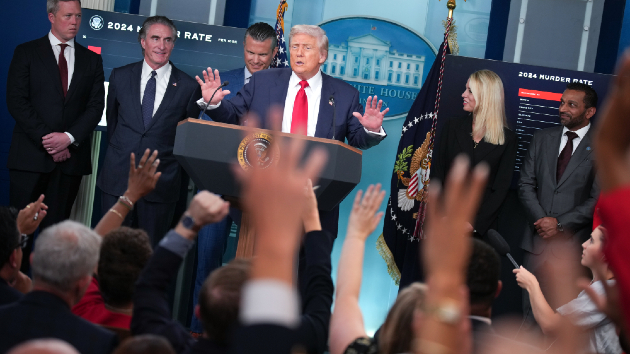
Trump directs DOJ, White House counsel to investigate Biden’s mental state in office

Trump directs DOJ, White House counsel to investigate Biden’s mental state in office
Kevin Dietsch/Getty Images

(WASHINGTON) — President Donald Trump ordered Attorney General Pam Bondi to investigate whether former President Joe Biden’s administration sought to conspire to cover up his mental state while in office, prompting a response from Biden.

“Let me be clear: I made the decisions during my presidency,” Biden said in a statement. “I made the decisions about the pardons, executive orders, legislation, and proclamations. Any suggestion that I didn’t is ridiculous and false.”

The move by the White House represents a significant escalation, as it is a directive to the Justice Department to formally investigate.

It goes beyond the review into Biden’s last-minute pardons before leaving office.

Biden responded to Trump’s memo to Bondi and the Department of Justice, calling an investigation “nothing more than a mere distraction” and defending his decision-making ability. In a statement he says any suggestion he was not in control is “ridiculous and false.”

“This is nothing more than a distraction by Donald Trump and Congressional Republicans who are working to push disastrous legislation that would cut essential programs like Medicaid and raise costs on American families, all to pay for tax breaks for the ultra-wealthy and big corporations,” Biden said in a statement sent to ABC News.

The president directed the U.S.’s top law enforcement official, in coordination with his White House counsel, to investigate “the circumstances surrounding Biden’s supposed execution of numerous executive actions during his final years in office,” according to a statement from the White House.

Copyright © 2025, ABC Audio. All rights reserved.

‘Immoral’: Republican senator challenges Trump’s spending bill over deficit concerns

‘Immoral’: Republican senator challenges Trump’s spending bill over deficit concerns
ABC News

(WASHINGTON) — A key Republican senator is pushing back against President Donald Trump’s major spending bill, warning that it would add trillions to the nation’s debt.

On Wednesday, Sen. Ron Johnson of Wisconsin told ABC News he cannot support what Trump calls his “One Big Beautiful Bill Act,” despite pressure from the White House to pass it by July 4.

“I refuse to accept $2 trillion-plus deficits as far as the eye can see as the new normal,” Johnson said. “We have to address that problem, and, unfortunately, this bill doesn’t do so.”

The Congressional Budget Office (CBO) said the bill would add $2.4 trillion to the deficit. While Office of Management and Budget Director Russell Vought claimed there are “massive levels of savings in this bill,” Johnson disagreed.

“We went from $4.4 trillion in spending in 2019 to over $7 trillion this year,” he said, adding that the slight reduction proposed in the bill is “barely a rounding error in this massive spending.”

The senator told ABC News he isn’t worried about political fallout from opposing Trump’s bill.

“I’m worried about our kids and grandkids, the fact that we’re mortgaging their future. It is wrong. It’s immoral,” Johnson said.

Instead of one large bill, Johnson wants to split it into two smaller pieces. His plan would first deal with matters like border security, defense and extending current tax laws. Then, he wants Congress to take time to carefully review government spending and find ways to cut waste.

On possible criticism from Trump, Johnson said he had a “very cordial conversation” with the president about his concerns.

“I want to see President Trump succeed. I’m a big supporter,” Johnson said, but he added that fixing the budget “is going to take time.”

The bill also faces criticism over its impact on healthcare, with CBO estimates showing around 11 million people could lose health insurance coverage.

As the July 4 deadline approaches, Johnson remained firm in his position.

“You have to do the things we agree on,” he said, listing border security, defense and extending current tax law as priorities. “Then come back, do the hard work of forensically auditing spending on these programs, and get serious about reducing that deficit trajectory, bending it down, rather than having it skyrocket upward.”

Copyright © 2025, ABC Audio. All rights reserved.
RFK Jr. to tell medical schools to teach nutrition or lose federal funding

RFK Jr. to tell medical schools to teach nutrition or lose federal funding
Paul Morigi/Getty Images

(WASHINGTON) — Health Secretary Robert F. Kennedy Jr. said he plans to tell American medical schools they must offer nutrition courses to students or risk losing federal funding from the Department of Health and Human Services.

Speaking at an event in North Carolina in April, Kennedy lamented, “There’s almost no medical schools that have nutrition courses, and so [aspiring physicians] are taught how to treat illnesses with drugs but not how to treat them with food or to keep people healthy so they don’t need the drugs.”

He added, “One of the things that we’ll do over the next year is to announce that medical schools that don’t have those programs are not going to be eligible for our funding, and that we will withhold funds from those who don’t implement those kinds of courses.”

The idea, which Kennedy mentioned in passing at an event focused on plastics in the environment, lacks details but has drawn optimism from some nutrition experts who have for years sought ways for medical schools to teach more nutrition content.

An HHS official told ABC News that Kennedy “is committed to understanding and drastically lowering chronic disease rates and ending childhood chronic disease, which includes fresh thinking on nutrition and over-reliance on medication and treatments.”

The official did not respond to requests for more information about Kennedy’s plan, like whether he would require medical schools to follow a specific curriculum. Nor did the official say whether Kennedy has begun speaking with medical schools about the issue.

A study published in the Journal of Biomedical Education in 2015 surveyed 121 American medical schools in 2012-2013 and found that medical students spend, on average, only 19 hours on required nutrition education over their four years.

This does not account for education during residency or fellowship training after medical school, or continuing medical education required throughout a doctor’s career to maintain a medical license or board certification.

Those numbers have frustrated some nutrition experts, who argue doctors should focus more on preventing diet-driven conditions like obesity and diabetes and less on prescribing drugs that treat the problems.

“I think there’s a great sense of urgency that we have to do something about this,” said Dr. David Eisenberg, a professor at the Harvard T.H. Chan School of Public Health, who told ABC News that requiring nutrition education at all medical schools is “long overdue.”

“I think the public imagines that physicians are required to know a lot more than they are trained to know about nutrition and giving practical advice about food to patients,” added Eisenberg.

When presented with Kennedy’s threats to withhold funding, some medical schools reached by ABC News said they already offer sufficient nutrition education.

“We have an extensive nutrition curriculum as part of our medical school training,” Sarah Smith, a spokeswoman for Weill Cornell Medicine, said in an email.

A spokesperson for the University of North Carolina School of Medicine touted the school’s Department of Nutrition, which the spokesperson said is “recognized as a global leader in research and training, and is unique in that it is the only nutrition department in the U.S. that is situated in both a school of public health and a school of medicine.”

A representative for the Association of American Medical Colleges, which counts more than 170 medical schools among its members, declined to comment but told ABC News that an e-survey of medical schools the group conducted last year found that every school that responded reported “covering nutrition content in some form.”

Still, the 2015 study, conducted by two researchers from the University of North Carolina and one from Harvard, painted a damning picture of the state of nutrition education at America’s medical schools.

“Many US medical schools still fail to prepare future physicians for everyday nutrition challenges in clinical practice,” the authors wrote.

Dr. Jo Marie Reilly, a professor at the University of Southern California’s Keck School of Medicine, told ABC News that since the 2015 study (the most recent “scoping review” of medical schools’ nutrition offerings, she said), medical schools have gradually begun offering more nutrition education.

The problem, though, according to Reilly, is the absence of a consistent set of standards for medical schools to abide by.

“Every school has got their own thing,” she said.

That could be changing: Reilly and Eisenberg are among a group of medical and nutrition experts who last year published proposed recommendations in JAMA Network Open for a national curriculum, which would involve 36 “nutritional competencies” for medical students to meet.

“Nothing before this had said, well here’s what we want [medical students] to know, this is what we think we should teach. Now we have those,” Reilly told ABC News.

“We’re moving in the right direction, but we have quite a ways to go,” she said.

Kennedy has long spoken of the need to address chronic disease through changes to what Americans eat.

Withholding or withdrawing federal funding from medical schools, if HHS were to do so, would follow similar moves from departments across the new Trump administration.

This spring, HHS was among several departments which canceled grants to Columbia University in protest of what it called the school’s “continued inaction in the face of persistent harassment of Jewish students.” The university said it planned to work with the federal government to restore its funding.

Copyright © 2025, ABC Audio. All rights reserved.
Trump to shore up support among Senate GOP at White House meeting

Trump to shore up support among Senate GOP at White House meeting
Isaac Wasserman/NCAA Photos via Getty Images

(WASHINGTON) — Senate Republicans will try to chart a path forward for the “One Big Beautiful Bill Act” during a series of meetings on Wednesday — including one where the President Donald Trump will work to shore up support for the megabill that advances his legislative agenda

Republican members of the powerful Senate Finance Committee will go to the White House to meet with Trump at 4 p.m. Wednesday, multiple White House and Hill sources confirm.

The Finance Committee is responsible for writing the tax policy components of the bill, including the extension of the Trump 2017 tax cuts, a key priority for the package.

The House-passed legislation also boosts spending for the military and border security — while making some cuts to Medicaid, SNAP and other assistance programs. It could also add $2.4 trillion to the deficit over the next decade, according to a new analysis out Wednesday from the nonpartisan Congressional Budget Office.

The Senate Finance Committee’s Republican members are expected to attend the meeting, including Majority Leader John Thune and GOP Whip John Barrasso, who are both on the panel. Republican Sen. Ron Johnson, who is at odds with the White House and is pushing for deeper cuts than those in the bill the House sent to them, is expected to be at the meeting as a member of the committee, too.

Appearing on ABC News Live Wednesday, Johnson attacked the bill, saying it “doesn’t meet the moment.”

Senate Republicans are separately expected to meet behind closed doors as a conference on Wednesday to discuss the parameters of the bill as a group.

Thune has so far not made clear what his strategy will be for moving the package through the upper chamber. As things currently stand, Thune can only afford to lose three of his GOP members to pass the package, and right now, he has more members than that expressing serious doubts about the bill.

Trump’s meeting with the committee is an opportunity for the president to attempt to sway those senators who have concerns about the bill. Earlier this week, Trump worked the phones and took meetings with many of those senators including Republican Sens. Rand Paul, Josh Hawley, Rick Scott and Johnson.

Trump also met with Thune to talk through moving the House-backed bill through the Senate as expeditiously as possible. Lawmakers aim to send a bill to Trump by the Fourth of July.

“At the end of the day, failure is not an option,” Thune said at a news conference Tuesday, adding that he thinks the conference can meet the timing goal.

Trump works to allay senators’ concerns at the same time Elon Musk attacks the bill online, calling it a “disgusting abomination” in a post on X Tuesday. Musk even chastised those who supported the bill.

“Shame on those who voted for it: you know you did wrong. You know it,” Musk wrote.

Copyright © 2025, ABC Audio. All rights reserved.
CBO says Trump’s bill will add $2.4T to deficit, leave 11 million without health insurance

CBO says Trump’s bill will add .4T to deficit, leave 11 million without health insurance
CBO says Trump’s bill will add $2.4T to deficit, leave 11 million without health insurance
Tim Graham/Getty Images

(WASHINGTON) — The “One Big Beautiful Bill Act” — a massive tax and immigration bill to fund much of President Donald Trump’s agenda — could add $2.4 trillion to the deficit over the next decade, according to a new analysis out Wednesday from the nonpartisan Congressional Budget Office.

The CBO released updated estimates on the legislation as focus turns to the Senate, where a handful of Republican members are expressing concerns about the deficit and changes to Medicaid.

The budget office is projecting 10.9 million more people will be uninsured in 2034 because of changes to health care.

The budget office also estimates the bill will cut taxes by $3.7 trillion and cut spending by $1.2 trillion. The CBO has not yet completed an analysis of the macroeconomic effects of the bill.

The White House preemptively defended the bill just before the CBO release, with deputy chief of staff Stephen Miller accusing the nonpartisan office of being “lefty” and touting the legislation as a “dream bill.”

House Majority Leader Steve Scalise slammed the CBO report at a press conference with Republican leadership on Wednesday morning, taking issue with it not recognizing potential economic growth, which it will do in a later, separate estimate.

“I get we have to play by the rules of the referee, but the referee is wrong. The referee is trying to sack our quarterback,” Scalise said.

The bill narrowly passed the House in May, but now some GOP members are signaling regret on their stamp of approval. Georgia Rep. Marjorie Taylor Greene, a staunch Trump ally, wrote in a social media post that she wasn’t aware of a provision related to AI regulations and that she would have voted against the bill had she known it was included. Greene called for the measure to be removed by the Senate.

Meanwhile, President Trump is set to meet with the Senate Finance Committee at the White House later Wednesday in his push to have the megabill passed.

The president’s lashed out at GOP senators who are threatening to complicate that, including Kentucky Sen. Rand Paul.

This is a developing story. Please check back for updates.

Copyright © 2025, ABC Audio. All rights reserved.

Elon Musk privately expresses frustration on a range of recent moves by Trump administration: Sources

Elon Musk privately expresses frustration on a range of recent moves by Trump administration: Sources
Kevin Dietsch/Getty Images

(WASHINGTON) — Elon Musk’s grievances with the Trump administration extend beyond the level of spending in the president’s signature bill, sources tell ABC News.

Multiple people who have spoken to the president and Musk described a widening rift on a range of recent moves by the administration.

Musk has privately expressed frustration about a portion of the spending bill that would cut the electric vehicle tax credit, multiple people who have spoken with the billionaire said.

After the November election, Musk called for ending the tax credit, but more recently, his company, Tesla, has become a vocal opponent of removing the provision.

“Abruptly ending the energy tax credits would threaten America’s energy independence and the reliability of our grid,” the company posted on social media.

Musk had also grown increasingly frustrated with the Trump administration striking artificial intelligence deals with his competitor OpenAI, sources tell ABC News.

Behind the scenes, Musk raised objections about a deal that did not include his AI start-up company, but it ultimately moved forward, sources said.

Another source of tension: the withdrawal of Musk ally Jared Isaacman’s nomination as NASA administrator over the weekend, according to sources who stated that Musk was deeply disappointed by the move.

There have also been deep disagreements on trade policy. In April, Musk called trade advisor Peter Navarro a “moron” and “dumber than a sack of bricks” in a series of posts on X.

On Tuesday, Musk took to X to lambaste the funding bill to advance Trump’s legislative agenda, calling it a “disgusting abomination.” He continued to attack the bill in a flurry of X posts Tuesday night into Wednesday morning.

“Mammoth spending bills are bankrupting America! ENOUGH,” Musk wrote in one post.

The White House declined to comment. A representative for Musk did not respond to a request for comment.

Some of these details were first reported by Axios.

Copyright © 2025, ABC Audio. All rights reserved.
Democrats accuse McMahon of stonewalling Department of Education IG

Democrats accuse McMahon of stonewalling Department of Education IG
Anna Moneymaker/Getty Images

(WASHINGTON) — Congressional Democrats are demanding that Department of Education Secretary Linda McMahon cooperate with the agency’s Office of Inspector General review of the Trump administration’s efforts to overhaul the agency.

In a letter first obtained by ABC News, a group of Democrats on the Education, Oversight, Homeland Security and Governmental Affairs, and Appropriations committees in the House and Senate sent the secretary a letter accusing her of stonewalling the agency’s inspectors general.

“The OIG must be allowed to do its job,” they wrote.

“We urge the Department to immediately meet its obligation under the law to fully comply with the OIG’s review,” the letter said. “Congress and the public need to understand the full extent and impact of the Administration’s actions on the Department and the students, families, and educational communities it may no longer be able to serve.”

ABC News reached out for comment from the Department of Education on the allegations but did not receive an immediate reply.

McMahon will face these questions in person when she testifies before the House Education and Workforce Committee on Wednesday.

The letter stems from what McMahon calls her “final mission” as the 13th education secretary to shutter the department, and the administration’s first steps to diminish the agency through a reduction in force that slashed nearly half its staff in early March. The lawmakers are requesting a response no later than Friday. After several attempts to conduct its review over the last two months, an OIG letter said the prolonged had resulted in “unreasonable denials” and “repeated delays” to its work.

According to a recent OIG letter sent to the House and Senate committee members, the Education Department blocked it from “timely access to all records, reports, audits, reviews, documents, papers, recommendations, or other materials available to the department.” House Education and Workforce Committee ranking Democrat Bobby Scott told ABC News, “I think the fact that they have indicated that there is a lack of cooperation ought to be concerning to people when inspectors general can’t do their jobs.”

The OIG contends its “statutory mission” to oversee the changes at the department under the Inspector General Act have been impeded.

“Our review has been delayed by the refusal of the Department to provide the OIG with a majority of the information and documents requested or direct access to staff for interviews,” acting Inspector General René L. Rocque wrote last month in a letter fulfilling her dual reporting requirement.

The department has canceled scheduled OIG interviews with its staff and insists that an Office of the General Counsel lawyer be present for any rescheduled interviews, according to the OIG. The OIG alleges those requests from the department are unprecedented and contrary to the OIG’s longstanding practice.

The OIG office is the statutory, independent entity within the department responsible for identifying fraud, waste, abuse and criminal activity involving department funds, programs, and operations, according to its website. By denying the federal watchdog access to the department’s records, the lawmakers believe McMahon is failing to meet her obligation as an agency head. There is no basis to withhold department documents from the OIG regardless of the privileged nature of the information or if it’s subject to litigation, the OIG said.

The news comes as McMahon testifies before Congress on the agency’s priorities and policies, specifically calling for a $12 billion cut to education under President Donald Trump’s fiscal year 2026 budget outline. McMahon has stressed she will continue all statutory functions of the agency and work to abolish it in a “lawful fashion.”

Ahead of his committee’s hearing with McMahon, Scott said, “We hear all these pronouncements about what’s going to happen. What is the plan? They’ve acknowledged they can’t get rid of the Department of Education without legislation. Are they supporting legislation?”

Democrats, including Scott, have decried the administration’s work force reductions, particularly the impact the layoffs could pose to the department’s critical responsibilities such as administering Federal Student Aid services and ensuring students’ civil rights. Their three-page letter to McMahon claims states have experienced delays in accessing relevant portals to receive federal funding, college financial aid advisors have experienced significant delays in getting answers from FSA personnel, parents with pending Office for Civil Rights OCR cases have been left in the dark.

“When they have all these cases of discrimination in the Office for Civil Rights enforcing Title VI, including anti semitism, how is the job going to get done if you fired most of the staff in the Office of Civil Rights?” Scott said.

“If the inspector general can’t get an answer, then oversight is lost,” he added.

Copyright © 2025, ABC Audio. All rights reserved.
Trump frustrated by Justice Amy Coney Barrett, other Supreme Court picks: Sources

Trump frustrated by Justice Amy Coney Barrett, other Supreme Court picks: Sources
Chip Somodevilla/Getty Images

(WASHINGTON) — President Donald Trump has privately expressed frustration about the Supreme Court justices he appointed, mostly complaining about Justice Amy Coney Barrett, three people familiar with the conversations told ABC News.

Those sources said the president conveyed that the justices he appointed could do more to back his agenda.

Several Trump allies have also taken their complaints about Barrett directly to the president, labeling her as “weak.”

Others have expressed their viewpoints publicly, according to sources familiar with the matter.

Conservative lawyer Mike Davis recently said on Steve Bannon’s podcast, “She’s a rattled law professor with her head up her a–.” Davis, a Trump ally, is in frequent communication with the president, sources have told ABC News.

Justice Barrett has not commented on brewing right-wing criticism of her votes from the bench nor would she be expected to: members of the court almost never engage directly, much less in the moment, with political critiques.

A senior administration official and additional sources familiar with Trump’s thinking tell ABC News the president is looking to nominate judges in the mold of Samuel Alito, Clarence Thomas, and late Antonin Scalia.

Barrett is a former Scalia law clerk, which Trump and Barrett both highlighted when he announced her as his nominee to replace the late Ruth Bader Ginsburg in 2020.

“Particularly poignant to me was her long and deep friendship with Justice Antonin Scalia, my own mentor,” Barrett said in the White House Rose Garden at the time. Maureen Scalia was also in the audience.

In a statement to ABC News, principal deputy press secretary Harrison Fields stated: “President Trump will always stand with the U.S. Supreme Court, unlike the Democrat Party, which, if given the opportunity, would pack the court, ultimately undermining its integrity. The president may disagree with the Court and some of its rulings, but he will always respect its foundational role.”

CNN was first reported Trump’s private frustration with Barret Tuesday.

While the president has privately complained about Barrett, it is notable that he has not attacked her publicly.

Trump defended her after she sided with the court’s liberal justices ruling the Trump administration must unfreeze foreign aid payment.

“She’s a very good woman. She’s very smart, and I don’t know about people attacking her, I really don’t know,” Trump told reporters.

However, Trump recently attacked Federalist Society leader Leonard Leo, who advised him on judicial nominations during his first term, calling him a ‘sleazebag.’

“I am so disappointed in The Federalist Society because of the bad advice they gave me on numerous judicial nominations,” Trump wrote.

Copyright © 2025, ABC Audio. All rights reserved.
Hegseth orders Navy to rename ship honoring gay rights activist Harvey Milk

Hegseth orders Navy to rename ship honoring gay rights activist Harvey Milk
Terry Schmitt/San Francisco Chronicle via Getty Images

(WASHINGTON) — Defense Secretary Pete Hegseth has ordered the Navy to strike the name of gay rights activist Harvey Milk from one of its ships, orchestrating the change as Pride month celebrations take place.

A defense official said the timing of the decision was intentional.

The order was first reported by Military.com and confirmed by ABC News.

The USNS Harvey Milk is one of several ships named after prominent civil rights leaders and activists. A new name has not been announced.

Milk was one of the first openly gay men elected to public office in the United States after winning a seat on the San Francisco Board of Supervisors in 1977. He was assassinated a year later.

Before his death, Milk was credited with encouraging his friend and artist Gilbert Baker, a U.S. Army veteran to create the Pride flag. Milk was played by Sean Penn in the 2008 biographical film “Milk.”

Hegseth and Navy Secretary John Phelan did not immediately respond to requests for comment from ABC News.

Copyright © 2025, ABC Audio. All rights reserved.

FEMA’s acting director unaware hurricane season has started, White House denies US is ill-prepared

FEMA’s acting director unaware hurricane season has started, White House denies US is ill-prepared
Department of Homeland Security

(WASHINGTON) — Acting Federal Emergency Management Agency Director David Richardson told staff in an all-hands meeting that he was unaware hurricane season had started, according to sources familiar with the meeting.

Hurricane season started on Sunday, June 1, and goes through Nov. 30. It is unclear if Richardson, who has led the agency since mid-May, was joking in the Monday meeting, but a Department of Homeland Security spokesperson argued he was.

When asked by reporters Tuesday during a White House press briefing whether President Donald Trump is “still comfortable” with Richardson following his remarks, press secretary Karoline Leavitt dismissed concerns and said FEMA is taking hurricane season “seriously, contrary to some of the reporting we have seen based on jokes that were made and leaks from meetings.”

Reuters first reported on Richardson’s comments.

Richardson’s comments follow an internal review indicating FEMA is “not ready” for the 2025 hurricane season in mid-May.

The DHS spokesperson denied FEMA is unprepared, saying, “Despite meanspirited attempts to falsely frame a joke as policy, there is no uncertainty about what FEMA will be doing this Hurricane Season.”

“FEMA is laser-focused on disaster response and protecting the American people,” the spokesperson added.

Senate Minority Leader Chuck Schumer, D-N.Y., slammed Richardson, posting on X that he is “unaware of why he hasn’t been fired yet.”

“Trump’s FEMA chief is incompetent,” Sen. Ed Markey, D-Mass., added. “People will die.”

The meeting was held Monday morning after Richardson had said he would update staff on a plan to tackle hurricane season.

“It’s not a secret that under Secretary Noem and acting Administrator Richardson, FEMA is shifting from bloated, D.C.-centric dead weight to a lean, deployable disaster force that empowers state actors to provide relief for their citizens,” the spokesperson added. “The old processes are being replaced because they failed Americans in real emergencies for decades.”

However, sources in the meeting said Richardson is sticking with the original plan, made during the Biden administration, in order to avoid getting in the way of FEMA’s Review Council, which was established by President Donald Trump and Homeland Security Secretary Kristi Noem.

Dan Stoneking, a former FEMA official and owner of Stoneking Strategic Communications, argued this reveals that the Trump administration believes its best chance at success this hurricane season is relying on the last administration’s plan, rather than its own.

Still, Stoneking said the original plan was created with more funding and before thousands of employees departed FEMA since the Trump administration took over, which he said would “clearly necessitate changes in planning in order to be successful.”

“This is not laser-focused. This is not empowering,” he said. “It is nothing more than a preamble to a less efficient federal response that this administration has caused but will still erroneously and egregiously blame on their predecessors.”

“You can fool all the people some of the time and some of the people all of the time, but you cannot fool all the people all of the time,” he added.

Leavitt denied that the United States is ill-prepared to handle disasters, saying, “The president will deeply and thoughtfully consider any requests for federal aid that come to his desk.”

Copyright © 2025, ABC Audio. All rights reserved.