(CONCORD, N.H.) — The New Hampshire Executive Council on Wednesday approved a request to buy 1 million at-home COVID tests and sell them at state liquor stores, according to Gov. Christopher Sununu.
The governor expects they will be hitting shelves in the next two weeks.
“We will buy them for a certain price. We will put them on the shelves and sell them for that exact same price, approximately in the $13 range,” Sununu said during the press conference.
New Hampshire made the move to help meet the high demand for tests, according to Sununu.
“We also know that a lot of folks in New Hampshire might try to get some at stores and maybe there’s not as many on shelves with the federal government buying up so much supply. And we know that demand is still going to be there,” Sununu said.
New Hampshire provided free tests in November and these tests are becoming available in addition to those provided by the federal government, he said.
The Biden administration set up a plan to ship a total of 1 billion free at-home COVID tests to Americans’ homes. They are expected to begin arriving in late January.
Dai Sugano/MediaNews Group/The Mercury News via Getty Images
(SAN JOSE, Calif.) — The National Association for Gun Rights filed a lawsuit against the city of San Jose, California, seeking to end a rule passed by city council which aims to reduce gun harm.
The rule, passed on Tuesday, requires gun owners to purchase liability insurance and pay an annual “gun harm reduction” fee. Gun owners will also be required to pay city cost recovery fees related to the program’s implementation.
“Liability insurance can reduce the number of gun incidents by encouraging safer behavior and it can also provide coverage for losses and damages related to gun incidents,” the bill states.
In the lawsuit, the National Association for Gun Rights claimed the new rule is unconstitutional.
“San Jose’s imposition of a tax, fee, or other arbitrary cost on gun ownership is intended to suppress gun ownership without furthering any government interest. In fact, the penalties for nonpayment of the insurance and fees include seizure of the citizen’s gun,” the lawsuit said. “The Ordinance is, therefore, patently unconstitutional”
The bill, which the group is attempting to strike down, will become law on July 25, six months after it was passed.
“If left intact, the City of San Jose’s Ordinance would strike at the very core of the fundamental constitutional right to keep and bear arms and defend one’s home,” the gun rights group said in the lawsuit.
“They want to tax law-abiding gun owners simply for exercising their Second Amendment rights,” the association said in a post on its website. “This is just as unthinkable as imposing a ‘free speech tax’ or a ‘church attendance tax.'”
“If this California city can tax citizen’s Second Amendment rights, gun grabbers in cities all across the country will quickly follow suit,” the association said on its website.
San Jose Mayor Sam Liccardo said he plans to support efforts to replicate these initiatives across the nation.
“Tonight San José became the first city in the United States to enact an ordinance to require gun owners to purchase liability insurance, and to invest funds generated from fees paid by gun owners into evidence-based initiatives to reduce gun violence and gun harm,” Liccardo said in a statement on Tuesday.
The mayor’s office and the National Association for Gun Rights did not immediately respond to ABC News’ request for comment.
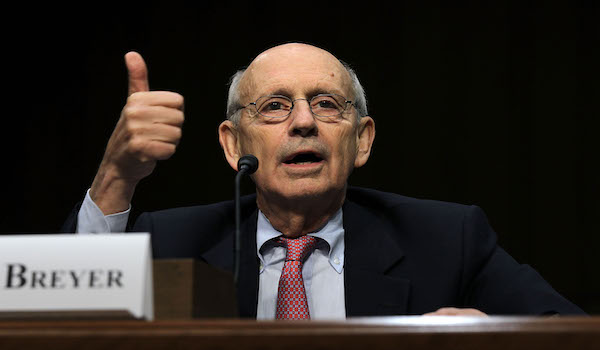
(WASHINGTON) — President Joe Biden and Justice Stephen Breyer appeared together Thursday at the White House to announce Breyer’s retirement from the Supreme Court, clearing the way for Biden to follow through on his campaign promise to nominate the first Black woman to the high court as his historic first pick.
“I’m here today to express the nation’s gratitude to Justice Stephen Breyer for his remarkable career of public service, and his clear-eyed commitment to making our country’s laws work for its people,” Biden said.
Biden praised Breyer’s career in public service, beginning in the United States Army as a teenager before going on to serve in all three branches of government before he turned 40. Multiple times, Biden noted his personal connection to Breyer, as the only president to have presided over a justice’s confirmation — when he was chairman of the Senate Judiciary Committee and Breyer was nominated to the Supreme Court in 1994 by President Bill Clinton.
“He has patiently sought common ground and built consensus, seeking to bring the court together. I think he’s a model public servant in a time of great division in this country,” Biden said, hailing Breyer for being a justice who could bridge divides on the bench.
Turning to the vacancy he will leave, Biden also reaffirmed his commitment to nominate the first Black woman to the Supreme Court, which he said was “long overdue.”
BREAKING: “I’ve made no decision except one: The person I will nominate will be someone with extraordinary qualifications…That person will be the first Black woman ever nominated to the United States Supreme Court,” Pres. Biden announces. https://t.co/hQKNJg7Lhrpic.twitter.com/yDjebjLOVu
“While I’ve been studying candidates’ backgrounds and writings, I’ve made no decision except one: the person I will nominate will be someone with extraordinary qualifications, character, experience and integrity. And that person will be the first Black woman ever nominated to the United States Supreme Court. It’s long overdue in my opinion, I made that commitment during the campaign for president, and I will keep that commitment,” he said.
Biden said he’s made “no choice at this point” but it’s his intention to announce his nominee “before the end of February” after consulting with both Democratic and Republican senators. He also noted Vice President Kamala Harris will play a key consulting role in the process.
“I will fully do what I’d said I’d do. I will fulfill my duty to select a justice, not only with the Senate’s consent, but with its advice,” Biden said. “I’m going to invite senators from both parties to offer their ideas and points of view.”
Biden said he will keep in mind Breyer’s spirit when he makes his decision on filling the seat.
“In the end, I will nominate a historic candidate, someone who’s worthy of Justice Breyer’s legacy, and someone who like Justice Breyer, provide incredible service on the United States Supreme Court,” Biden said.
Breyer, quoting from President Abraham Lincoln’s Gettysburg Address, reminded that the nation’s founders described American democracy as one great “experiment.”
“‘We are now engaged in a great Civil War to determine whether that nation or any nation so conceived and so dedicated can long endure,'” he said, citing Lincoln’s famous words, saying they are still relevant today.
Supreme Court Justice Stephen Breyer reflects on his career: “It’s a kind of a miracle, when you sit there and see…people that are so different in what they think, and yet they’ve decided to help solve their major differences under law.” https://t.co/JhNQIRZvbDpic.twitter.com/OZFj5gW6ry
Recalling conversations with his students, Breyer said it’s now up to the next generation will “determine whether the experiment still works.”
“It’s an experiment that’s still going on. And I’ll tell you something, you know who will see whether that experiment works? It’s you, my friend. It’s you, Mr. high school student,” Breyer said. “I am an optimist, and I’m pretty sure it will.”
Earlier Thursday, in a letter to the president Thursday, Breyer formally notified Biden of his retirement and wrote he intends to complete term and remain until a successor is confirmed, holding his seat in several blockbuster decisions that will close the term in late June.
Breyer called the job a privilege and great honor, saying “I have found the work challenging and meaningful. My relations with each of my colleagues have been warm and friendly.”
BREAKING: Justice Stephen Breyer announces his retirement from the Supreme Court.
The move clears the way for Pres. Biden to follow through on his campaign promise to nominate the first Black woman to the high court for his historic first pick. https://t.co/Szf1sdE8A9pic.twitter.com/wq6rKFjrRy
In finishing out the term — but stepping down ahead of the midterm elections — Breyer, 83, the most senior member of the Supreme Court’s liberal wing who served on the bench for 27 years, fulfills the wish of Democrats who lobbied to ensure Biden could name a successor while Democrats controlled the Senate.
With the slimmest of margins, Democrats can now pass Biden’s nominee without a single Republican vote due to a 2017 rule change under then-Senate Majority Leader Mitch McConnell, which lowered the threshold to break the filibuster from 60 votes to 51 votes for Supreme Court nominees. McConnell said last year that the GOP may try to block a Democratic nominee to the court if Republicans won control of the Senate in November and a vacancy occurred in 2023 or 2024.
Following Biden and Breyer’s joint announcement, McConnell called on Biden to select a nominee to fill Breyer’s vacancy who has “demonstrated reverence for the written text of our laws and constitution” and urged him “not to outsource this important decision to the radical left.”
Senate Majority Leader Chuck Schumer said Wednesday the chamber is prepared to move to confirm Biden’s nominee with “all deliberate speed.” Judge Ketanji Brown Jackson, who once served as a clerk to Breyer and was confirmed to the D.C. Circuit Court of Appeals last year with bipartisan support, is considered a top contender.
Once Biden nominates a replacement, Senate Democrats plan to not only hold a confirmation hearing swiftly — similar to Justice Amy Coney Barrett, who had her first hearing within 13 days of her nomination — but also to hold those proceedings while Breyer is still sitting on the bench, according to two Democratic aides familiar with the matter.
While the transition presents an exciting opportunity for Biden and his supporters, replacing Breyer will not change the court’s 6-3 conservative majority.
ABC News’ Sarah Kolinovsky contributed to this report.
(WASHINGTON) — Secretary of State Antony Blinken, speaking at the State Department on Wednesday, confirmed the U.S. had delivered a written response to Moscow security demands as Russia amassed troops on its borders with Ukraine.
“Today, Ambassador Sullivan delivered our written response in Moscow. All told, it sets out a serious diplomatic path forward, should Russia choose it,” Blinken said.
“The document we’ve delivered includes concerns of the United States and our allies and partners about Russia’s actions that undermine security, a principled and pragmatic evaluation of the concerns that Russia has raised, and our own proposals for areas where we may be able to find common ground,” he continued.
“This is not a negotiating document,” Blinken said, adding that President Joe Biden was “involved from the get-go” and had signed off on it.
“The ball is their court,” he added, referring to the Russians.
Russia had said it would not continue talks until Moscow had the responses in hand, and Blinken announced after meeting in Geneva last week with Russian Foreign Minister Sergei Lavrov that the U.S. would oblige, which some argued might be seen as a U.S. concession.
But Blinken denied that, saying the U.S. did not change its positions in the paper, but “reiterated what we said publicly for many weeks and, in a sense, for many, many years.”
That includes rejecting Russia’s key demands, laid out in its own draft treaties last month, that NATO bar Ukraine from joining the Western military alliance and that NATO pull back troops from its Eastern European member states, who were formerly Soviet states.
“There is no change. There will be no change,” he told reporters. “I can’t be more clear — NATO’s door is open, remains open, and that is our commitment.”
Blinken and Lavrov will speak in the coming days once Russia has reviewed the U.S. response, the top U.S. diplomat said. While there are fears that Russia is using the diplomatic exchange as pretext to attack Ukraine, saying diplomacy failed to address their concerns, Blinken said the U.S. would not be the one to end talks, even as it prepares sanctions and readies NATO deployments.
“You may be right, that Russia is not serious about this at all. But we have an obligation to test that proposition, to pursue the diplomatic path,” he said. “The point is we’re prepared either way.”
Blinken’s comments follow Biden saying Tuesday there could be some U.S. troop movements in the “nearer term” — and that he would consider personally sanctioning Russian President Vladimir Putin if Russia invades Ukraine — a day after 8,500 American forces were put on “heightened alert” in the region.
But in Ukraine, leaders have offered a different assessment from that put forward by the White House that a full-scale Russian attack is imminent.
During a news conference on Wednesday, Ukraine Foreign Minister Dmytro Kuleba said they believe Russia’s forces are currently “insufficient” for a full-scale invasion and that right now the Kremlin is seeking to destabilize Ukraine with the threat of attack and other means, not yet actually launching one.
In a televised address to the nation Tuesday night, Ukrainian President Volodymyr Zelenskiy urged people to stay calm about the threat of a Russian attack and said there was work in progress to bring about a meeting between him and the leaders of Russia, France and Germany.
“Protect your body from viruses, your brain from lies, your heart from panic,” Zelenskiy said.
The White House and State Department have defended the administration’s decisions and rhetoric, denying that drawing down the embassy, putting 8,500 U.S. troops on alert, and warning of an “imminent” threat have escalated the situation.
Asked on Tuesday about the criticism from Kyiv that the U.S. is giving into Russia’s playbook, State Department Spokesperson Ned Price denied the U.S. created a “panic.”
“We have been clear about our concerns. We have been clear about the depth of those concerns,” Price said. “Given what we’re seeing on Ukraine’s borders, what we’re seeing in what should be an independent sovereign country of Belarus, with the Russian military buildup there, what we’re seeing with preparations for potential hybrid operations — all of this is cause for concern, but certainly no one is calling for panic.”
(WASHINGTON) — President Joe Biden on Wednesday declined to expand on reports Justice Stephen Breyer would be retiring from the Supreme Court at the end of the current term, saying he would wait to speak further until the justice personally announces his plans.
“Every justice has the right and opportunity to decide what he or she is going to do, announce it on their own. There’s been no announcement from Justice Breyer. Let him make whatever statement he’s going to make, and I’ll be happy to talk about it later,” Biden said.
Breyer, the most senior member of the U.S. Supreme Court’s liberal wing and staunch defender of a nonpartisan judiciary, stepping down from the bench fulfills the wish of Democrats who lobbied for his exit and for Biden’s first high court appointment.
The vacancy now paves the way for Biden to nominate a Black woman to the court — a historic first and something he promised during the 2020 campaign.
Biden’s first public appearance since the news was at an afternoon White House event with American business executives to discuss his stalled Build Back Better agenda.
Several progressive House lawmakers have already amped up the pressure on Biden with Reps. Ayanna Pressley, D-Mass., Cori Bush, D-Mo., and Jamaal Bowman, D-N.Y., all reminding Biden on Twitter of his promise to elevate a Black woman to the position.
When reporters followed up with the president on Wednesday, Biden added, “I’ll be happy to talk about this later. I’m gonna get into this issue.”
White House press secretary Jen Psaki shared the president’s sentiment in an earlier tweet.
“It has always been the decision of any Supreme Court Justice if and when they decide to retire, and how they want to announce it, and that remains the case today,” she said.
Senate Majority Leader Chuck Schumer, in a statement, said the Senate is prepared to move to confirm Biden’s nominee to fill the Supreme Court vacancy with “all deliberate speed.”
“President Biden’s nominee will receive a prompt hearing in the Senate Judiciary Committee, and will be considered and confirmed by the full United States Senate with all deliberate speed,” he wrote in a statement.
Sen. Dick Durbin, D-Ill., who chairs the Senate Judiciary Committee, which holds hearings for court nominees, said in a statement that the vacancy presents Biden “the opportunity to nominate someone who will bring diversity, experience, and an evenhanded approach to the administration of justice” and that he looks forward to moving the nominee “expeditiously through the Committee.”
Republican Sen. Lindsey Graham of South Carolina reacted to the news with a reminder that Democrats — having the slimmest of majorities in the Senate — still have the ability to pass Biden’s nominee without Republican support. Sen. Mitch McConnell, as majority leader in 2017, lowered the threshold to break the Senate filibuster from 60 votes to 51 votes for Supreme Court nominees in order to pass former President Donald Trump’s first pick.
“If all Democrats hang together – which I expect they will – they have the power to replace Justice Breyer in 2022 without one Republican vote in support. Elections have consequences, and that is most evident when it comes to fulfilling vacancies on the Supreme Court,” Graham said in a statement, in a nod to the 2020 Senate elections in Georgia which Democrats won.
Progressive activists had put unprecedented public pressure on Breyer, who was nominated in 1994 by President Bill Clinton, to retire. McConnell said in June that the GOP may try to block a Democratic nominee to the court if the party wins control of the Senate in November and a vacancy occurs in 2023 or 2024.
ABC News’ Devin Dwyer, Allison Pecorin and Eric Fayeulle contributed to this report.
(WASHINGTON) — With the retirement of Supreme Court Justice Stephen Breyer at the end of the current term, one name keeps rising to the top of the list of potential replacements: Judge Ketanji Brown Jackson.
Jackson, whom President Joe Biden nominated to replace Merrick Garland on the high-profile D.C. Circuit Court of Appeals when he picked Garland for attorney general, is a Harvard Law graduate who served as a clerk to Breyer from 1999-2000 and interviewed with former President Barack Obama for former Justice Antonin Scalia’s vacancy in 2016.
After the Supreme Court, the D.C. Circuit Court of Appeals is the most important federal court in the country, with jurisdiction over cases involving Congress and the executive branch agencies.
Biden, who has said he would appoint the first African American woman to the Supreme Court because the court should “look like the country,” would be able to make good on that promise with a Jackson nomination. No Black woman has ever been nominated to the high court.
Other top contenders include Judge Leondra Kruger, of the California Supreme Court; Judge Leslie Abrams Gardner, of the US District Court Georgia; and Judge J. Michelle Childs, of the US District Court South Carolina.
Jackson was the first Black woman confirmed to an appellate court in a decade and is one of six Black female circuit court judges currently serving. She is also one of just 39 active Black female federal judges out of 793 total.
The 51-year-old also has some bipartisan appeal. She was confirmed 53-44 to her current seat in June 2021, drawing votes from three Republicans — Sens. Lindsey Graham, R-S.C., Susan Collins, R-Maine, and Lisa Murkowski, R-Alaska.
At the time, several Republican senators brought up the advocacy group Demand Justice, which has supported Jackson’s nomination and has called for expanding the Supreme Court.
“Demand Justice claims that the Supreme Court is broken,” Sen. John Cornyn, R-Texas, said. “Do you think the Supreme Court is broken?”
“Senator, I’ve never said anything about the Supreme Court being broken,” Jackson said in response. “Again, I’m not going to comment on the structure, the size, the functioning even, of the Supreme Court.”
Under questioning, she also characterized religious liberty as a foundational tenet of the U.S. government and said the Supreme Court has made clear that the government cannot infringe on religious rights.
She was also asked if she believed race would play a role in her decision making, if mandatory minimums were racist and the role of race in the judicial system.
Jackson repeatedly emphasized her belief in judicial independence.
Jackson grew up attending public schools in Miami and graduated from Harvard College. She has served as an assistant public defender and as vice chair and commissioner on the U.S. Sentencing Commission.
The mother of two teenage daughters is related to former House Speaker Paul Ryan by marriage.
Ryan testified on her behalf when she was nominated to the district court in 2012, offering his “unequivocal” endorsement.
During her circuit court confirmation hearing, she offered a poignant response when Sen. Alex Padilla, D-Calif., asked what the nomination meant to her.
“It is the beauty and the majesty of this country, that someone who comes from a background like mine could find herself in this position,” she answered. “And so I’m just enormously grateful to have this opportunity to be a part of the law in this way, and I’m truly thankful for the president giving me the honor of this nomination.”
ABC News’ Lauren Lantry and Adia Robinson contributed to this report.
(WASHINGTON) — At the dawn of the COVID-19 pandemic, vaccine makers raced to design a shot that perfectly matched the new virus’s genetic code. Their efforts were successful, resulting in highly effective vaccines in record time.
But the virus has continued to evolve into new, concerning variants, each with a slightly different genetic code. Although current vaccines still work well against new variants, they are no longer a perfect match.
Vaccine makers like Pfizer and Moderna are now exploring tweaked booster shots to match the now-dominant omicron variant, but the U.S. government is aggressively pursuing a different approach: a pan-coronavirus vaccine that would work equally well against any COVID-19 variant.
“Since September of 2020 there have been five SARS-CoV-2 variants of concern — alpha, beta, gamma, delta and now, the current, omicron,” Dr. Anthony Fauci said at a White House task force briefing Wednesday. “So, obviously, innovative approaches are needed.”
Fauci, who heads up the National Institute of Allergy and Infectious Diseases, has issued $43 million in research grants across several academic institutions to support development of a pan-coronavirus vaccine, sometimes called a “universal” coronavirus vaccine.
The idea, scientists say, is to create a vaccine that works as as a generalist rather than a specialist. A pan-coronavirus vaccine will be designed using features of the virus’s genetic code that are shared universally across all different versions of the virus — and hopefully, any new versions that will emerge.
Several research groups are already working on a pan-coronavirus vaccine, including scientists at the California Institute of Technology, Duke University, University of Washington, Brigham and Women’s Hospital in Boston and the University of Wisconsin, Madison.
But scientists at the Walter Reed Army Institute of Research are arguably the furthest along. The Army vaccine appears to work well in monkeys, and is now being tested for safety in a phase 1 study in human volunteers.
In a rare look inside the Walter Reed laboratories last year, ABC News’ Bob Woodruff spoke to a team of Army scientists hopeful that their vaccine candidate would work not only against COVID-19 variants, but also against related coronaviruses, like those that caused the SARS-1 and MERS outbreaks in 2003 and 2012, respectively.
But designing a pan-coronavirus vaccine is no easy feat. Scientists say it could take months, even years, to find a vaccine that works equally well against multiple coronavirus strains.
“I don’t want anyone to think that pan-coronavirus vaccines are literally around the corner in a month or two,” Fauci said. Current vaccines dramatically reduce the risk of hospitalization and severe illness, even against new variants like omicron. And crucially, they are available today.
“Do not wait to receive your primary vaccine regimen,” Fauci said. “If you are vaccinated, please get your booster if you are eligible.”
ABC News’ Matthew Seyler contributed to this report.
(WASHINGTON) — Officials at the Federal Reserve on Wednesday signaled that they could “soon” raise interest rates for the first time in three years, as inflation concerns cast a shadow over the pandemic-battered economy.
The central bankers said in a statement Wednesday that they were leaving rates unchanged for now, at near-zero levels, but with a recovering labor market and the threat of inflation, this will likely change in the near future.
“With inflation well above 2 percent and a strong labor market, the Committee expects it will soon be appropriate to raise the target range for the federal funds rate,” the Fed said in a statement Wednesday.
Federal Reserve Chair Jerome Powell said during his closely watched news conference Wednesday that the Fed’s “policy has been adapting to the evolving economic environment and will continue to do so,” alluding to the backdrop of elevated inflation and labor market gains.
“Economic activity expanded at a robust pace last year, reflecting progress on vaccinations and the reopening of the economy,” Powell said. “Indeed, the economy has shown great strength and resilience in the face of the ongoing pandemic.”
Powell said the sharp rise in COVID-19 cases associated with the omicron variant likely will weigh on economic growth in the short term, but he expressed hope, as health experts have suggested, that the omicron variant hasn’t been as virulent as previous strains, and that it’s expected for cases to drop off more rapidly.
Powell added that “inflation remains well above our longer run goal of 2%,” which it notably has for some time now. He attributed this largely to supply and demand imbalances related to the pandemic and the reopening of the economy.
“These problems have been larger and longer lasting than anticipated, exacerbated by waves of the virus,” Powell said Wednesday. “While the drivers of higher inflation have been predominantly connected to the dislocations caused by the pandemic, price increases have now spread to a broader range of goods and services. Wages have also risen briskly, and we are attentive to the risks that persistent real wage growth in excess of productivity could put upward pressure on inflation.”
The Fed chair said that they expect inflation to decline over the course of the year, but signaled that the central bankers are taking this issue seriously — they’re very aware of the pain it causes for consumers and will be “watching carefully” to see how the economy evolves.
“We understand that high inflation imposes significant hardship, especially on those least able to meet the higher costs of essentials like food, housing and transportation,” Powell added. “In addition, we believe that the best thing we can do to support continued labor market gains is to promote a long expansion and that will require price stability. We’re committed to our price stability goal.”
Powell continued: “We will use our tools both to support the economy and a strong labor market, and to prevent higher inflation from becoming entrenched.”
The Fed officials noted in their latest policy statement that indicators of economic activity and employment have continued to strengthen.
“The sectors most adversely affected by the pandemic have improved in recent months but are being affected by the recent sharp rise in COVID-19 cases,” the statement said. “Job gains have been solid in recent months, and the unemployment rate has declined substantially.”
Still, they noted that supply and demand imbalances related to the pandemic and reopening of the economy “have continued to contribute to elevated levels of inflation,” and that much of the economic recovery still remains at the mercy of the virus.
The unemployment rate as of last month fell to 3.9%, only slightly above the pre-pandemic rate of 3.5% in February 2020.
Soaring inflation, however, has thrown a new wrench into the economic recovery. Government data released earlier this month indicated that consumer prices have jumped 7% over the last 12 months, the largest one-year increase since 1982.
The Fed officials also reiterated Wednesday that they expect to continue to taper their pandemic-era asset purchasing program meant to buoy the economy during the health crisis and end it completely by early March.
In previous projections released last month, Fed officials indicated that they anticipated as many as three interest rate hikes starting in 2022.
(WASHINGTON) — Justice Stephen G. Breyer, the most senior member of the U.S. Supreme Court’s liberal wing and staunch defender of a nonpartisan judiciary, is retiring from the bench, fulfilling the wish of Democrats who lobbied for his exit and clearing the way for President Joe Biden’s first high court appointment.
Breyer, the court’s oldest member at 83, will step down despite apparent good health, deep passion for the job and active involvement in cases. This term he authored major opinions upholding the Affordable Care Act, affirming free speech rights of students off-campus and resolving a multi-billion dollar copyright dispute between two titans of American technology, Google and Oracle.
“He has been operating at the peak of his powers,” said Jeffrey Rosen, law professor and president of the National Constitution Center. “It was so inspiring that this term his pragmatic vision of compromise and moderation were ascendant and all of the unanimous decisions were a moving tribute to his inspiring legacy.”
While Breyer has disavowed political considerations, many will see them in his decision to leave now. Stepping down early in the Biden presidency and while Democrats retain a razor-thin majority in the U.S. Senate will help ensure his seat is filled with someone who shares his judicial philosophy.
“It’s a highly personal decision,” Breyer told ABC News of retirement in a 2015 interview.
Progressive activists had imposed unprecedented public pressure on Breyer, who was nominated in 1994 by President Bill Clinton, to retire quickly. Senate Republican Leader Mitch McConnell said in June that the GOP may block a Democratic appointment to the court if the party retakes control of the Senate next year and a vacancy occurs in 2023 or 2024.
Many Democrats remain haunted by Republican obstruction of President Barack Obama’s nominee to the court in 2016 and the rushed confirmation of Justice Amy Coney Barrett last year, just weeks before the 2020 election and after the sudden death of Justice Ruth Bader Ginsburg.
In the lead up to his retirement, Breyer distanced himself from partisan politics.
“It is wrong to think of the court as another political institution,” he said in an April speech at Harvard Law School. “And it is doubly wrong to think of its members as junior league politicians.”
He added, justices “are loyal to the rule of law, not to the political party that helped to secure their appointment.”
“He’s very savvy,” said Rosen. “He understands that democracy is fragile and people in the past have not obeyed the court and the court doesn’t have any ability to enforce its decisions. That’s why being attentive to its legitimacy is so important to him.”
The vacancy now clears the way for Biden to nominate an African American woman to the court, a historic first and something he promised during the 2020 campaign.
There have been five female justices in Supreme Court history; three are currently serving — Justices Barrett, Elena Kagan and Sonia Sotomayor, the first and only woman of color confirmed to the high court.
U.S. Appeals Court Judge Ketanji Brown Jackson, a former Breyer clerk, public defender and Biden appointee who won three Senate Republican votes in confirmation, is considered a top contender for nomination along with Judge Leondra Kruger of the California Supreme Court, a former deputy solicitor general in the Obama administration who has argued a dozen cases before the high court.
“We are putting together a list of a group of African American women who are qualified and have the experience to be on the court,” Biden said in June 2020. “I am not going to release that until we go further down the line in vetting them.”
While Breyer never enjoyed the rock-star status held by Ginsburg, he has long been revered and celebrated as a consensus-seeker and happy warrior throughout his 27 years on the court.
“He is not a dogmatist, generating rules from some high-level theory. He is in search of workable results,” former federal appeals court Judge Richard Posner said of Breyer in the Yale Law Journal.
As a devout institutionalist, Breyer has passionately defended the Supreme Court’s reputation as an impartial and apolitical branch of American government. Later this year, he will publish a book on the subject, “The Authority of the Court and the Peril of Politics.”
“A judge has to do his best not to have an opinion on a political matter,” he told ABC News in 2015. “And if I have an opinion, I might talk to my wife about it but I’m not going to talk to you.”
He has described differences among the justices as contrasts in “philosophical outlook” rather than differences of politics and chaffed at the labeling of justices as “liberal” or “conservative.”
“Politics to me is who’s got the votes. Are you Republican or Democrat? I don’t find any of that here,” he told ABC News Chief Washington Correspondent Jonathan Karl.
Breyer has been one of the few justices to be a regular attendee at State of the Union addresses before a joint session of Congress.
“I think it is very, very, very, important — very important — for us to show up at that State of the Union,” the justice told Fox News in 2010. “Because people today, as you know, are more and more visual … and I would like them to see the judges too, because federal judges are also part of that government.”
In recent years, as the court was repeatedly thrust into an uncomfortable spotlight during the Donald Trump presidency, Breyer joined with Chief Justice John Roberts to help steer the institution away from the headlines.
“The more the political fray is hot and intense, the more we stay out of it,” Breyer explained during a 2020 interview with the Kennedy Institute.
The nine justices have handed down more unanimous opinions in 2021 than any time in at least the last seven years. Court analysts credit a narrow focus on common ground rather than sweeping, more divisive pronouncements. Some see a vindication of Breyer’s longtime approach in the results.
During oral arguments, Breyer is frequently one to lean in, animatedly challenging lawyers on both sides of a debate to address the real life consequences of a case. He has earned the moniker “king of hypotheticals” for his creative use of the technique.
“You have to have the imagination to understand how those words will affect those lives,” Breyer said in a 2017 interview with NYU School of Law. “That means you understand something about the lives of other people.”
Breyer has cultivated a reputation for pragmatism and compromise in his opinions, which have been praised for their colloquial language and avoidance of jargon.
“My job … is to write opinions,” Breyer told Fox News Sunday in 2010. “The job of 307 million Americans is to criticize those opinions. And what they say is up to them. And the words I write are carrying out my job under the law as best I see it.”
In 2014, Breyer wrote for an unanimous court to limit the scope of a president’s power to make recess appointments.
“Pro forma sessions (of Congress) count as sessions, not as periods of recess,” he said, dealing a rebuke to Obama who had tried to force appointments to the National Labor Relations Board. “The Senate is in session when it says it is.”
He has twice authored significant majority opinions on the issue of abortion.
In 2000, Breyer wrote a 5-4 decision striking down a Nebraska law criminalizing “partial-birth abortions” as “an undue burden upon a woman’s right to make an abortion decision.” Two decades later, his opinion in June Medical Services v. Russo cast a Louisiana law requiring hospital admitting privileges for abortion doctors as a “substantial obstacle” to women that violates the Constitution.
On the First Amendment, Breyer was the pivotal vote in a pair of 5-4 decisions in 2005 involving public displays of the Ten Commandments. He voted to uphold a longstanding monument at the Texas state capitol, while opposing placement of framed copies of the commandments inside Kentucky courthouses. He was the only justice to agree with both decisions.
“The government must avoid excessive interference with, or promotion of, religion. But the Establishment Clause does not compel the government to purge from the public sphere all that in any way partakes of the religious,” Breyer wrote in a concurring opinion in the Texas case. “Such absolutism is not only inconsistent with our national traditions, but would also tend to promote the kind of social conflict the Establishment Clause seeks to avoid.”
Breyer frequently championed “six basic tools” that judges should use when deciding a case — text, history, tradition, purpose, precedent and consequences. He has also urged consideration of international law.
“When you’re talking about the Constitution, different judges emphasize different ones of those,” he said in a 2017 interview, “but nobody leaves any of those out completely.”
When Breyer’s analysis put him at odds with his colleagues, he frequently wrote in dissent, defending the use of race as a factor in school admissions; pushing for deference to legislatures on gun control laws; and, opposing partisan gerrymandering.
“The use of purely political considerations in drawing district boundaries is not a necessary evil that, for lack of judicially manageable standards, the Constitution inevitably must tolerate,” Breyer wrote in a 2004 case.
In the hotly contested 2000 election, Breyer lamented the court’s decision to get involved in the dispute between George W. Bush and Al Gore.
“The Court was wrong to take this case. It was wrong to grant a stay,” he wrote at the time. “We do risk a self-inflicted wound — a wound that may harm not just the Court, but the Nation.”
Breyer has been a staunch critic of the death penalty and what he sees as unacceptably lengthy delays between sentences and executions.
In a famous 40-page dissent in 2015, Breyer urged the court to reconsider whether capital punishment violates the Eighth Amendment.
“Lack of reliability, the arbitrary application of a serious and irreversible punishment, individual suffering caused by long delays, and lack of penological purpose are quintessentially judicial matters,” he wrote.
“They concern the infliction — indeed the unfair, cruel, and unusual infliction — of a serious punishment upon an individual,” he continued. “The Eighth Amendment sets forth the relevant law, and we must interpret that law.”
Breyer’s career on the high court caps a lifetime of public service.
He grew up in San Francisco, where he attended public schools and earned the rank of Eagle Scout. In 1957, Breyer joined the U.S. Army Reserves and served a tour of active duty in the Army Strategic Intelligence during his six-year career.
He studied philosophy at Stanford University and became a Marshall Scholar at Oxford University. In 1964, he earned his law degree from Harvard University and went on to clerk for justice Arthur Goldberg on the U.S. Supreme Court.
“I’m sure they wanted me to be a lawyer,” Breyer said of his parents in a 2017 oral history. “I thought, well I’d like to be a lawyer. I sort of always knew I would be.”
After a short stint in the Justice Department antitrust division, Breyer joined the faculty at Harvard Law School in 1967, specializing in administrative law. That same year he married Joanna Hare, a member of the British aristocracy and a pediatric psychologist at the Dana-Farber Cancer Institute.
In the mid-1970s, he cut his teeth in politics, serving as an assistant special prosecutor in the Watergate investigation and later as special counsel to the Senate Judiciary Committee working alongside Sen. Ted Kennedy.
“A few lessons I learned from Kennedy. One of them: the best is the enemy of the good,” Breyer said in 2017. “If you could get an inch, it’s much better to get that inch then to complain about not getting a mile.”
He was first appointed to the federal bench in 1980 by President Jimmy Carter, going on to serve 13 years as an appellate judge until Clinton elevated him to replace Justice Harry Blackmun on the Supreme Court in 1994. The Senate confirmed Breyer 87-9.
Asked in 2017 how he would like to be remembered, Breyer told an interviewer: “You play the hand you’re dealt. You’re dealt one. And you do the best with what you have. If people say yes, he did, he tried, he did his best and was a decent person, good.”
(TALLAHASSEE, Fla.) — A Florida bill that would limit classroom discussions on sexual orientation and gender identity and encourage parents to sue schools or teachers that engage in these topics is speeding through the state House and Senate.
It’s being called a “Don’t Say Gay” bill by LGBTQ advocates, who fear that if this bill is signed into law, it could act as a complete ban on the lessons on LGBTQ oppression, history and discussions about LGBTQ identities.
“This would erase LGBTQ+ history and culture from lesson plans and it sends a chilling message to LGBTQ+ young people and communities,” said Melanie Willingham-Jaggers, the executive director of the national LGBTQ youth advocacy group GLSEN.
Activists say that erasing LGBTQ presence from schools may imply to students that their gender identity or sexual orientation is something to be ashamed of or hidden.
“We have to create a learning environment where they feel safe and healthy, or it’s not an effective learning environment,” said Heather Wilkie of the Zebra Coalition, a Central Florida LGBTQ advocacy group.
“When you have laws like this, that directly attack our kids for who they are, it prevents them from learning,” she said. “It prevents them from being able to be healthy.”
The two bills in the state legislature, HB 1557 and SB 1834, state that a school district “may not encourage classroom discussion about sexual orientation or gender identity in primary grade levels or in a manner that is not age-appropriate or developmentally appropriate for students.”
The House Education & Employment Committee has moved the bill forward, handing it off to the Judiciary Committee.
It adds that parents who violate this rule can sue, seeking damages and reimbursement for attorney fees and court costs.
Rep. Joe Harding, who is the sponsor of the legislation, hopes it will “reinforce the fundamental right of parents to make decisions regarding upbringing & control of their children,” according to the bill’s text.
Harding did not respond to ABC News’ request for comment.
Chasten Buttigieg, activist and husband of U.S. Secretary of Transportation Pete Buttigieg, denounced Florida Gov. Ron DeSantis and the state legislature for the efforts.
LGBTQ advocacy organizations say these bills are reminiscent of the “no promo homo” laws of the 1990s that barred educators from discussing queer topics in schools, but with an added mandate on parent and family involvement.
“These mandates are harmful and risk carelessly outing LGBTQ+ young people to families who do not affirm their children’s identities,” Willingham-Jaggers said.
2021 was a record-breaking year for anti-LGBTQ legislation, according to the Human Rights Campaign. More than 250 of these bills were introduced and at least 17 were enacted into law.
Several states, including Arizona, Alabama, Florida, Indiana, Kentucky, Oklahoma, New Hampshire and South Dakota, have already introduced anti-LGBTQ legislation in 2022.
This Florida legislation follows similar bills that restrict educators from teaching about oppression in the U.S.
Wilkie said that queer issues and access to supportive resources have been the priority against anti-LGBTQ attacks in recent years, and this has been a heightened effort since the Pulse nightclub shooting in 2016.
LGBTQ youth in the state, who have a higher risk for suicidal ideation, depression and anxiety, have been struggling, but Wilkie says advocacy groups will continue to fight these bills.
“We will fight,” she said. “It’s so disheartening to think that they would not be able to freely talk about themselves, or learn anything about their history.”