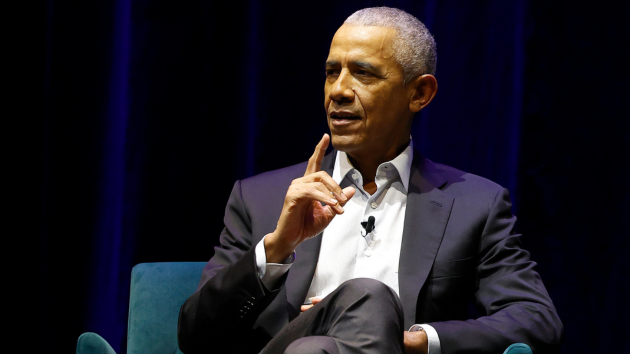
Former U.S. President Barack Obama participates in a book talk with former German Chancellor Angela Merkel at The Anthem on December 02, 2024 in Washington, DC. Obama and Merkel discussed her memoir “Freedom” as well as world politics and the history the two former leaders have witnessed. (Photo by Kevin Dietsch/Getty Images)
(WASHINGTON) — Former President Barack Obama on Thursday joined a virtual meeting with Texas House Democrats who left the state to deny Republicans the ability to pass newly drawn GOP-favorable congressional maps, cheering on their efforts and stressing their work comes at a critical time in the fight against partisan gerrymandering.
ABC News is first to report on the meeting and its contents.
Obama “lauded their fight against the Republican efforts to enact an even more egregious gerrymander in Texas ahead of the midterms. He made clear that they are part of a bigger effort to protect free and fair elections and commended them for inspiring others with their actions,” an Obama spokesperson told ABC News in a statement.
This is a developing story. Please check back for updates.
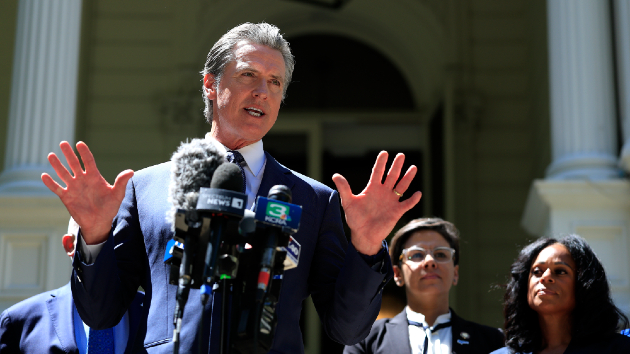
(WASHINGTON) — California Gov. Gavin Newsom announced Thursday that he is moving forward with putting proposed new congressional maps for the state on the ballot on a Nov. 4 special election in an attempt to counter mid-decade redistricting being pushed by Republicans in Texas.
“I know they say ‘Don’t mess with Texas.’ Well, don’t mess with the great Golden State,” Newsom said at a news conference, flanked by Democratic members of Congress and California union leaders.
“We’re doing this in reaction to a president of the United States that called a sitting governor of the state of Texas and said, ‘Find me five seats,'” he added later.
He said the state government will affirm its commitment to the state’s independent redistricting commission after the 2030 census, “but we’re asking the voters for their consent to do midterm redistricting in 2026, 2028 and 2030 for the congressional maps to respond to what’s happening in Texas … and we’ll do so in a way that also affirms our desire as a state to level the playing field all across the United States.”
In a campaign video released concurrently with his announcement, Newsom framed the issue in stark terms.
“It is a five-alarm fire for democracy in the United States of America. Donald Trump, who is trying to light a torch on democracy, continues to try to rig the election,” Newsom says in the video.
As the governor was speaking, federal agents appeared to be conducting an immigration enforcement operation outside of the venue.
“Where are we? We are at Democracy Center and right outside at this exact moment? There are dozens and dozens of ICE agents, you Donald Trump, you think it’s coincidental? Donald Trump and his minions, Tom Homan, tough guy, clearly decided, coincidentally or not, that this was a location to advance ICE arrests,” said.
Los Angeles Mayor Karen Bass said there was “no way” the operation was a coincidence.
“This was widely publicized that the governor and many of our elected officials were having a press conference here to talk about redistricting. And they decided they were going to come and thumb their nose in front of the governor’s face,” she said. “Why would you do that? It’s unbelievably disrespectful. It’s a provocative act. They’re talking about disorder in Los Angeles and they are the source of the disorder in Los Angeles right now. This is just completely unacceptable.”
ABC News has reached out to Customs and Border Protection for comment.
The California legislature will have to pass legislation to put the maps on the ballot.
Speaking to reporters after the announcement, Newsom said California won’t move forward with its mid-decade redistricting plans if Republican-run states considering redistricting don’t move forward with redrawing their own maps.
“This does not go forward — I want to remind everybody — unless one of these other states move forward, there’s still an exit ramp — not just Texas, but Missouri, as I mentioned, or Florida, Indiana, these other states that are considering doing the unprecedented, rigging their elections with midterm redistricting. So we’re hopeful they don’t move forward. If that’s the case, this effort will not be necessary. But we’re not waiting,” he said.
Republicans are criticizing Newsom’s move as political.
“Gavin Newsom’s latest stunt has nothing to do with Californians and everything to do with consolidating radical Democrat power, silencing California voters, and propping up his pathetic 2028 presidential pipe dream,” National Republican Congressional Committee spokesperson Christian Martinez said in a statement ahead of the press conference.
“Newsom’s made it clear: he’ll shred California’s Constitution and trample over democracy — running a cynical, self-serving playbook where Californians are an afterthought and power is the only priority.”
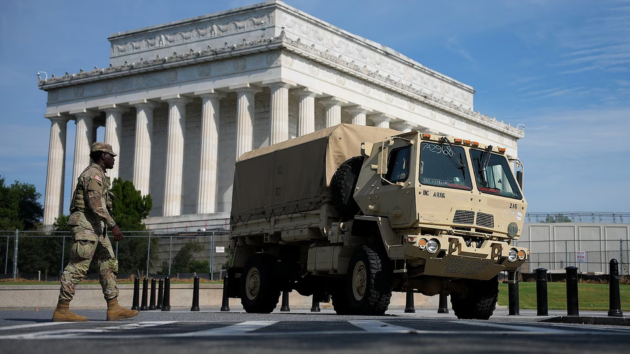
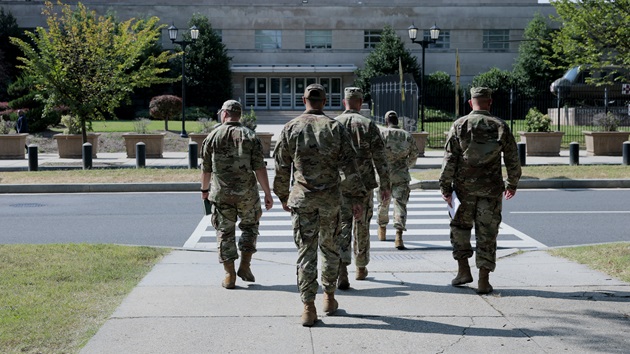
(WASHINGTON) — National Guard troops have begun 24-hour operations around Washington, D.C., as of Thursday morning, according to a Department of Defense official.
It’s part of President Donald Trump’s plan to address crime in Washington by taking over the city’s police department and deploying the National Guard troops.
Thursday’s National Guard presence in Washington included one small unit deployed to both Union Station and the National Mall early in the morning, according to a spokesperson for joint task force behind the operation. The idea is that residents and tourists would awake Thursday morning to the sight of military presence, according to a person familiar with the effort.
Earlier this week, some National Guard troops patrolled along the National Mall — a relatively safe and quiet stretch of Washington known for museums, monuments and hot dog vendors serving tourists.
Guard members on patrol are not carrying weapons as of now, and they will not have the weapons in their vehicles, according to two defense officials.
A White House official told ABC News that overnight Wednesday into Thursday, the multi-agency federal task force made 45 arrests — 29 of which were immigration-related arrests. Law enforcement teams arrested people on a variety of charges including first and second degree assault, controlled substance possession and distribution, and carrying a concealed weapon, the White House official said.
FBI Director Kash Patel posted on X that overnight Wednesday into Thursday, the FBI and law enforcement partners in Washington contributed to the 45 arrests with 16 arrests “tied to the violent crime surge” and seized three firearms.
“Your FBI will make DC Safe Again,” Patel wrote.
Law enforcement agents conducted a traffic safety compliance checkpoint on busy 14th Street in Northwest Washington Wednesday night, which led to one arrest. A group of protesters spoke out against the checkpoint, shouting at the law enforcement officers, according to video from Washington’s ABC station, WJLA.
Army officials said their mission was to aid law enforcement with logistics support, transportation and administration duties, as well as being visible around the Mall.
“That’s part of our assignment — to go to the national monuments and be present,” Col. Dave Butler, an Army spokesperson, told ABC News on Tuesday.
Trump announced Monday that he planned to mobilize 800 National Guard troops to address what he considered “out of control” crime in the city, as well as taking over control of the Metropolitan Police Department. Trump has made claims about rampant violent crime in Washington, which D.C. police statistics show is actually decreasing. Washington Mayor Muriel Bowser said the city has spent the last two years driving down violent crime — “driving it down to a 30 year low, in fact,” she told MSNBC on Sunday.
“It is true that we had a terrible spike in crime in 2023, but this is not 2023, this is 2025 and we’ve done that by working with the community, working with the police, working with our prosecutors, and, in fact, working with the federal government,” Bowser told MSNBC.
Defense officials said the joint task force, led by Army Col. Larry Doane, will run the operation.
The task force includes 800 activated National Guard members, defense officials said. The troops will work in shifts of 100 to 200 troops at a time, and some of them will be assigned to administrative or logistical roles in support of local law enforcement.
Pentagon Press Secretary Kingsley Wilson on Thursday said the 800 National Guard troops will remain “until law and order has been restored.”
“They will remain until law and order has been restored in the District as determined by the president, standing as the gatekeepers of our great nation’s capital,” she said.
The task force overseeing the activated Guard troops will operate similarly to how the D.C. Guard has handled inaugurations or responding to crises, as it did during the Jan. 6 riots. The National Park Service will play a considerable role because of its oversight of the National Mall, officials said.
ABC News’ Michelle Stoddart, Kelsey Walsh and Lalee Ibssa contributed to this report.
(WASHINGTON) — California Gov. Gavin Newsom and Democratic leaders are set to hold a news conference on Thursday where they’ll make a “major announcement” in response to Republican-led efforts in Texas to redraw the state’s congressional maps.
Newsom said Tuesday night that California will move forward with drawing new congressional maps that “WILL END THE TRUMP PRESIDENCY” and allow Democrats to take control of the U.S. House of Representatives. He had previously sent a letter to President Donald Trump on Monday asking the president to tell Texas Gov. Greg Abbott and other Republican governors to abandon efforts to draw new congressional maps in Texas, which could help Republicans flip three to five congressional seats if passed.
Republicans currently hold a slim majority in the U.S. House with 219 seats to Democrats’ 212. Other states such as Missouri, Indiana, New York, and Illinois have begun weighing mid-decade redistricting in light of Texas’ effort.
Newsom has floated holding a special election statewide on Nov. 4 for Californians to vote on new congressional maps and temporarily bypass the state’s independent redistricting commission. The California Citizens Redistricting Commission is meant to prevent gerrymandering and partisan influence. Both Democrats and Republicans in the state have expressed concerns over sidelining the commission.
No maps have been released publicly, but multiple legislative sources familiar with the matter told ABC station KGO-TV that five Republican seats would be targeted, going tit-for-tat with Texas.
But if lawmakers don’t declare a special election by Aug. 22, it would be nearly impossible for the state to run a statewide election that meets federal standards or would hold up in a court challenge, according to the office of the California Secretary of State.
Elections officials in California have also pointed to federal deadlines such as the 45-day-pre-election deadline to issue ballots to military and overseas voters, which could make it more technically challenging to run an election on short notice.
Republicans have also cried foul. U.S. Rep. Kevin Kiley, R-Calif., who has proposed a bill that would nullify any new congressional maps introduced before the next U.S. census, told Newsmax on Tuesday, “Gavin Newsom is a unique threat to democracy. He is trying to overturn the will of voters … So I’ve introduced this bill saying this cannot be done. We need to stop Newsom’s scheme in its tracks. And that will also stop this brewing redistricting war from breaking out across the country, which I don’t think is going to be a good thing.”
Newsom’s gambit comes as Democratic state legislators in Texas remain outside of the state in an effort to run out the clock on a special legislative session in Texas that is considering new maps by denying quorum.
Abbott said Wednesday that the House of Representatives would be willing to “get to work” if Democrats returned to Texas for the second special session Friday but are keeping all options on the table if they don’t come back.
“If they show up, great, we’ll get to work and get all these bills passed. If they don’t show up, we’ll continue with the law enforcement efforts to try to track them down, arrest them and take them to the Capitol, but we will be ready either way,” he told Texas-based radio host Mark Davis.
Texas House Democratic Caucus chair Rep. Gene Wu, in a statement Wednesday afternoon, said that another special legislative session in the Texas legislature could be “a reset moment” for getting aid to victims of the flooding in central Texas – but he placed the onus on Texas Gov. Greg Abbott.
Wu wrote, “This could be a reset moment: a chance to finally deliver real solutions for flood victims and fix the broken emergency preparedness system that continues to put every community in Texas at risk … ready to fight for flood relief, defend our communities, and invest in the safety Texans deserve. Will the Governor finally work with us for our families in the Second Special Session?”
ABC News’ Brittany Shepherd and KGO-TV’s Monica Madden contributed to this report.
Members of the National Guard arrive at the Guard’s headquarters at the D.C. Armory on August 12, 2025 in Washington, DC. Anna Moneymaker/Getty Images
(WASHINGTON) — President Donald Trump said on Wednesday that he will seek more permanent federal control of the Washington, D.C., police force as he continues his efforts to ramp-up crime enforcement in the nation’s capital.
Earlier this week, Trump announced his plans to deploy National Guard troops in the nation’s capital, declaring a public safety emergency in order to put the Washington police department under federal control and station the National Guard on the city’s streets. Trump’s current control of the D.C. police force expires in 30 days, after which Congress would have to weigh in.
Asked Wednesday whether he’d work with Congress to extend the emergency authorization allowing him to temporarily seize control of local law enforcement, Trump said he’ll ask Congress for a “long-term” extension of federal authority over the Washington police force.
“We’re going to be asking for extensions on that — long-term extensions, because you can’t have 30 days,” Trump said at an event at the Kennedy Center.
Trump indicated at one point that he’d ask Congress for more funds to fight crime and to make repairs to Washington’s streets and parks.
“We’re going to make Washington beautiful. We’re going to redo roads. We’re going to redo the medians. The pavers and the medians are all throughout the city. We’re going to take all the graffiti off. We’re going to have to remove the tents. And the people that are living in our parks, we’re going to be redoing the parks, the grasses and all. We’re going to be going to Congress for a relatively small amount of money. And [Senate Budget Committee chair and GOP Sen.] Lindsey [Graham] and the Republicans are going to be approving it,” Trump said.
Trump has long threatened to take control of Washington, saying he wants to crack down on violent crime in the District although police statistics show that in the past two years, violent crime has gone down.
“Fighting crime is a good thing. We have to explain we’re going to fight crime — that’s a good thing,” Trump said Wednesday. “Already they’re saying, ‘He’s a dictator,’ he said, referring to Democrats. “The place is going to hell. We’ve got to stop it. So, instead of saying, ‘He’s a dictator,’ they should say, ‘We’re going to join him and make Washington safe.'”
“We’re going to be essentially crime-free. This is going to be a beacon, and it’s going to also serve as an example of what can be done,” Trump said.
National Guard troops began deploying in larger numbers along the National Mall overnight, according to a person familiar with the plan.
According to a person familiar with the effort, the latest plan calls for sending the activated Army soldiers to spots around the National Mall in the middle of the night so they will be visible to D.C. residents by Friday morning.
Officials said the Trump administration is still in the process of setting up a joint task force, which will be led by Army Col. Larry Doane. While the task force is expected to include 800 activated soldiers, D.C. residents won’t see that many on the streets.
The troops will work in shifts of 100 to 200 troops at a time, and some of them will be assigned to administrative or logistical roles in support of local law enforcement, officials told ABC News.
ABC News producers did not see any National Guard or increased law enforcement presence around Washington Wednesday afternoon — including around the National Mall, D.C. Armory or in Logan Circle where a man was gunned down and killed earlier this week.
A White House official told ABC News that, beginning Wednesday night, officials expected a “significantly higher National Guard presence to be on the ground throughout Washington, D.C.” The White House official added that beginning Wednesday night, the deployment will transition to round-the-clock, 24/7 operations. Those operations had been previously focused on evening and overnight hours.
On Tuesday night, more than 1,450 federal law enforcement officers and National Guard members patrolled Washington, according to a White House official. Law enforcement teams made 43 arrests on Tuesday night — nearly twice the number made Monday night, the official said.
Those law enforcement teams included 750 D.C. Metropolitan Police Department officers who were “uniformed, marked as patrol and directly assigned as anti-crime officers,” the White House official said. That was in addition to the federal law enforcement who had been previously mobilized in the area. The White House official said that there were about 30 National Guard troops on the ground last night.
The law enforcement teams were “deployed throughout all seven districts in D.C. to promote public safety and arrest violent offenders,” the White House official said.
After Trump’s announcement Monday, approximately 850 officers and agents fanned out over D.C. right after Trump declared a crime emergency in the capital, making 23 arrests, White House press secretary Karoline Leavitt said Tuesday.
On Tuesday, National Guard troops were spotted on the National Mall, with many stationed around the base of the Washington Monument. The troops left Wednesday morning.
It was not immediately clear why the presence of U.S. troops along the National Mall was needed, other than to put Trump’s orders on display. The area, marked by museums, monuments and long stretches of grass, is known as a relatively safe part of the city that attracts mostly tourists and school groups.
ABC News’ John Parkinson contributed to this report.
Editor’s note: This story has been updated to reflect that National Guard did not make any arrests of individuals in Washington.
Members of the National Guard arrive at the Guard’s headquarters at the D.C. Armory on August 12, 2025 in Washington, DC. Anna Moneymaker/Getty Images
(WASHINGTON) — President Donald Trump said on Wednesday that he will seek more permanent federal control of the Washington, D.C., police force as he continues his efforts to ramp-up crime enforcement in the nation’s capital.
Earlier this week, Trump announced his plans to deploy National Guard troops in the nation’s capital, declaring a public safety emergency in order to put the Washington police department under federal control and station the National Guard on the city’s streets. Trump’s control of the D.C. police force expires in 30 days, after which Congress would have to weigh in.
Asked Wednesday whether he’d work with Congress to extend the emergency authorization allowing him to seize temporary control of local law enforcement, Trump said he’ll ask Congress for a “long-term” extension of federal control of the Washington police force.
“We’re going to be asking for extensions on that — long-term extensions, because you can’t have 30 days,” Trump said at an event at the Kennedy Center Wednesday afternoon.
Trump indicated at one point that he’d ask Congress for more funds to fight crime and to make repairs to Washington.
“We’re going to make Washington beautiful. We’re going to redo roads. We’re going to redo the medians. The pavers and the medians are all throughout the city. We’re going to take all the graffiti off. We’re going to have to remove the tents. And the people that are living in our parks, we’re going to be redoing the parks, the grasses and all. We’re going to be going to Congress for a relatively small amount of money. And Lindsey [Graham] and the Republicans are going to be approving it,” Trump said.
Trump has long threatened to take control of Washington, saying he wants to crack down on violent crime in the District although police statistics show that in the past two years, violent crime has fallen dramatically.
“Fighting crime is a good thing. We have to explain we’re going to fight crime — that’s a good thing,” Trump said Wednesday afternoon. “Already they’re saying, ‘He’s a dictator.’ The place is going to hell. We’ve got to stop it. So instead of saying, ‘He’s a dictator,’ they should say, ‘We’re going to join him and make Washington safe.'”
Trump pledged to make Washington “crime-free.”
“We’re going to be essentially crime-free. This is going to be a beacon, and it’s going to also serve as an example of what can be done,” Trump said.
On Tuesday night, more than 1,450 federal law enforcement officers and National Guard members patrolled Washington, according to a White House official. Forces made 43 arrests on Tuesday night — nearly twice the amount they made Monday night.
Those forces included 750 D.C. Metropolitan Police Department officers who were “uniformed, marked as patrol and directly assigned as anti-crime officers,” the White House official said. That was in addition to the federal law enforcement who had been previously mobilized in the area. The White House official said that there were about 30 National Guard troops on the ground last night.
The forces, which included 19 inter-agency teams, were “deployed throughout all seven districts in D.C. to promote public safety and arrest violent offenders,” the White House official said.
After Trump’s announcement Monday, approximately 850 officers and agents fanned out over D.C. right after Trump declared a crime emergency in the capital, making 23 arrests, White House press secretary Karoline Leavitt said Tuesday.
The surge in federal law enforcement has yielded more than 100 total arrests since Aug. 7, according to a White House official. The official said that the charges have included one homicide charge, seven narcotics charges, 33 firearms charges, 10 warrants, 23 charges against undocumented immigrants and 29 other charges. The official adds that they have seized 24 firearms since operations began.
The official said that on Wednesday night they expect “significantly higher National Guard presence to be on the ground throughout Washington, D.C.” The White House official adds that beginning Wednesday night, the operations will transition to round-the-clock, 24/7 operations. Operations had been previously focused on evening and overnight hours.
On Tuesday, National Guard troops were spotted on the National Mall, with many stationed around the base of the Washington Monument. The troops left Wednesday morning. It was not immediately clear why the presence of U.S. troops along the National Mall was needed, other than to put Trump’s orders on display. The area, marked by museums, monuments and long stretches of grass, is known as a relatively safe part of the city that attracts mostly tourists and school groups.
On Tuesday night, more than 1,450 federal law enforcement officers and National Guard members patrolled Washington, according to a White House official. Forces made 43 arrests on Tuesday night — nearly twice the amount they made Monday night.
Those forces included 750 D.C. Metropolitan Police Department officers who were “uniformed, marked as patrol and directly assigned as anti-crime officers,” the White House official said. That was in addition to the federal law enforcement who had been previously mobilized in the area. The White House official said that there were about 30 National Guard troops on the ground last night.
The forces, which included 19 inter-agency teams, were “deployed throughout all seven districts in D.C. to promote public safety and arrest violent offenders,” the White House official said.
On Monday, Trump announced his plans to deploy National Guard troops in the nation’s capital, declaring a public safety emergency in order to put the Washington police department under federal control and station the National Guard on the city’s streets. Trump’s control of the D.C. police force expires in 30 days, after which Congress would have to weigh in.
Trump has long threatened to take control of Washington, saying he wants to crack down on violent crime in the district although police statistics show that in the past two years, violent crime in Washington has fallen dramatically.
“Fighting crime is a good thing. We have to explain we’re going to fight crime — that’s a good thing,” Trump said of the effort during an event at the Kennedy Center Wednesday afternoon. “Already they’re saying, ‘He’s a dictator.’ The place is going to hell. We’ve got to stop it. So instead of saying, ‘He’s a dictator,’ they should say, ‘We’re going to join him and make Washington safe.'”
After Trump’s announcement Monday, approximately 850 officers and agents fanned out over D.C. right after Trump declared a crime emergency in the capital, making 23 arrests, White House press secretary Karoline Leavitt said Tuesday.
The surge in federal law enforcement has yielded more than 100 total arrests since Aug. 7, according to a White House official. The official said that the charges have included one homicide charge, seven narcotics charges, 33 firearms charges, 10 warrants, 23 charges against undocumented immigrants and 29 other charges. The official adds that they have seized 24 firearms since operations began.
The official said that on Wednesday night they expect “significantly higher National Guard presence to be on the ground throughout Washington, D.C.” The White House official adds that beginning Wednesday night, the operations will transition to round-the-clock, 24/7 operations. Operations had been previously focused on evening and overnight hours.
On Tuesday, National Guard troops were spotted on the National Mall, with many stationed around the base of the Washington Monument. The troops left Wednesday morning. It was not immediately clear why the presence of U.S. troops along the National Mall was needed, other than to put Trump’s orders on display. The area, marked by museums, monuments and long stretches of grass, is known as a relatively safe part of the city that attracts mostly tourists and school groups.
California Gov. Gavin Newsom speaks during a news conference with Texas lawmakers at the Governor’s Mansion on July 25, 2025 in Sacramento, California/Photo by Justin Sullivan/Getty Images
(SACRAMENTO, Calif.) — California Gov. Gavin Newsom said California will move forward with drawing new congressional maps that he said “WILL END THE TRUMP PRESIDENCY” and allow Democrats to take control of the U.S. House of Representatives.
“DONALD ‘TACO’ TRUMP, AS MANY CALL HIM, ‘MISSED’ THE DEADLINE!!! CALIFORNIA WILL NOW DRAW NEW, MORE ‘BEAUTIFUL MAPS,’ THEY WILL BE HISTORIC AS THEY WILL END THE TRUMP PRESIDENCY (DEMS TAKE BACK THE HOUSE!),” Newsom wrote Tuesday night, in a post written in the style of President Donald Trump’s occasionally all-caps social media posts.
The redistricting battle in Texas — and potentially other states — has national implications, with control of the U.S. House potentially at stake. The Texas GOP’s proposed congressional map could net Republicans between three and five seats in next year’s midterm elections — seats that could make a difference as Republicans work to maintain their small majority in the U.S. House.
A spokesperson for California State Assembly Speaker Robert Rivas confirmed to ABC News that the state legislature is aiming to release draft maps on Friday.
Newsom’s post did not offer any details on the maps or how he plans to get them approved, although Newsom has said previously he would consider trying to have maps on the ballot in a special election in November.
The California governor said he would be part of a press conference this week with “powerful” Democrats, but didn’t offer details about who would be in attendance.
Newsom sent a letter to Trump on Monday asking the president to tell Texas Gov. Greg Abbott and other Republican governors to abandon efforts to draw new congressional maps. Texas Democrats have fled the state in protest of the maps.
The Texas House of Representatives was once again unable to reach a quorum Tuesday. Texas House Speaker Dustin Burrows said that the House will convene once again on Friday, adding if there’s no quorum by then, Abbott will adjourn the current session and call a second special session to begin immediately.
California Gov. Gavin Newsom speaks during a news conference with Texas lawmakers at the Governor’s Mansion on July 25, 2025 in Sacramento, California/Photo by Justin Sullivan/Getty Images
(SACRAMENTO, Calif.) — California Gov. Gavin Newsom said California will move forward with drawing new congressional maps that he said “WILL END THE TRUMP PRESIDENCY” and allow Democrats to take control of the U.S. House of Representatives.
“DONALD ‘TACO’ TRUMP, AS MANY CALL HIM, ‘MISSED’ THE DEADLINE!!! CALIFORNIA WILL NOW DRAW NEW, MORE ‘BEAUTIFUL MAPS,’ THEY WILL BE HISTORIC AS THEY WILL END THE TRUMP PRESIDENCY (DEMS TAKE BACK THE HOUSE!),” Newsom wrote Tuesday night, in a post written in the style of President Donald Trump’s occasionally all-caps social media posts.
The announcement comes amid Texas Republicans’ efforts to redraw congressional maps in their party’s favor. The redistricting showdown in Texas has led blue states to threaten to retaliate — with Newsom proposing to cut five GOP-held seats in California.
The redistricting battle in Texas — and potentially other states — has national implications, with control of the U.S. House potentially at stake. The Texas GOP’s proposed congressional map could net Republicans between three and five seats in next year’s midterm elections — seats that could make a difference as Republicans work to maintain their small majority in the U.S. House.
A spokesperson for California State Assembly Speaker Robert Rivas confirmed to ABC News that the state legislature is aiming to release draft maps on Friday.
Newsom’s post did not offer any details on the maps or how he plans to get them approved, although Newsom has said previously he would consider trying to have maps on the ballot in a special election in November.
The California governor said he would be part of a press conference this week with “powerful” Democrats, but didn’t offer details about who would be in attendance.
Newsom sent a letter to Trump on Monday asking the president to tell Texas Gov. Greg Abbott and other Republican governors to abandon efforts to draw new congressional maps. Texas Democrats have fled the state in protest of the maps.
The Texas House of Representatives was once again unable to reach a quorum Tuesday. Texas House Speaker Dustin Burrows said that the House will convene once again on Friday, adding if there’s no quorum by then, Abbott will adjourn the current session and call a second special session to begin immediately.
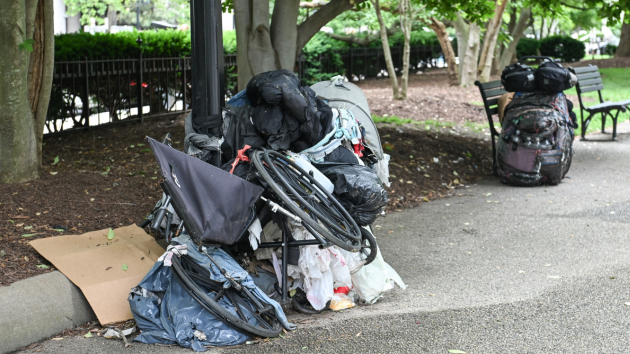
(WASHINGTON) — President Donald Trump vowed this week to rid Washington, D.C., of homeless encampments, issuing a warning that the “homeless have to move out, IMMEDIATELY.” Though what those plans will look like, including where people will go, is unclear, sparking concerns among advocacy groups.
While previewing an announcement regarding D.C., Trump told those experiencing homelessness in a social media post on Sunday, “We will give you places to stay, but FAR from the Capital.”
In his remarks the following day, Trump said that the federal government will be “removing homeless encampments from all over our parks” in D.C. as part of an effort to “rescue our nation’s capital from crime, bloodshed, bedlam and squalor and worse.”
“There are many places that they can go, and we’re going to help them as much as you can help. But they’ll not be allowed to turn our capital into a wasteland for the world to see,” Trump said during a press briefing on Monday while announcing plans for the federal government to take over the D.C. police department and deploy National Guard troops in D.C.
Dismantling homeless encampments is not a new practice in D.C. for either the Trump administration or local government, Dana White, the advocacy director for Miriam’s Kitchen, a nonprofit focused on ending chronic homelessness in D.C., told ABC News.
“What is particularly startling is the vague language about removing them from the district altogether, without any details about where they would go, who would transport them, how that’s funded, what that means for their human and civil rights,” White said of Trump’s recent remarks.
Donald Whitehead Jr., executive director of the D.C.-based National Coalition for the Homeless, said that though Trump mentioned homelessness during Monday’s press conference several times, there was “no concrete information about how to address the issue,” such as resources that would be developed to address the issue in a non-punitive matter, or where people will be moved.
“Our question is, is this the same solution that we’ve seen with the immigration population? Are people just going to be moved to remote destinations?” he said.
“Really, for a homeless advocate, it was really an information-less press conference,” Whitehead said. “It points to it being more of a stunt than an actual conference about solutions to homelessness.”
The two executive orders issued Monday, which were the focus of Trump’s press briefing, did not specifically mention homelessness.
D.C. Mayor Muriel Bowser told reporters Monday that her office has not gotten any more details from the White House but will be following up with Attorney General Pam Bondi.
“We really haven’t gotten any more detail about the plan, about the words that he said,” she said during a press briefing Monday afternoon when asked about Trump’s remarks on homelessness. “It wasn’t referenced in the executive order that came down.”
“I believe he had a previous executive order that also identified Attorney General Bondi as a point of contact as it relates to homelessness and such, so we’ll follow up with her,” Bowser continued.
On any given night in D.C., there are 798 unhoused people on the street, according to the Community Partnership, a nonprofit working to prevent homelessness in D.C.
In March, Trump issued an executive order for the removal of homeless encampments on federal land within D.C. Since then, the U.S. Park Police have removed over 70 homeless camps, Interior Secretary Doug Burgum said Monday.
Last month, Trump also signed an executive order seeking to make it easier for cities and states to remove homeless people from the streets and into treatment centers by reversing judicial precedents and ending consent decrees. It also looks to redirect federal funds toward programs that tackle substance abuse and targets “housing first” policies, which prioritize permanent housing as the first step in addressing homelessness.
The orders have been met with pushback from homeless advocates, who contend that permanent, affordable housing with supportive services is a proven solution for chronically homeless people, and that dismantling homeless encampments is a counterproductive strategy to resolving homelessness.
“When we clear encampments, we disconnect people from the services they need to survive and to start the process of being housed, and often disconnects them from their belongings and from the communities that they formed in encampments,” White said.
Without affordable housing, people will most likely pop up in a new camp, he and Whitehead said.
“They’re basically moved from one site to another because there’s not enough shelter beds to meet the needs of the population in D.C.,” Whitehead said. “They don’t have a place to go. There isn’t enough shelter. There certainly isn’t enough housing.”
According to D.C.’s most recent census of people experiencing homelessness, released in May, there was an overall 9% decrease in homelessness in 2025 from the previous year, including an 18.1% decrease among families and a 4.5% decrease among single individuals.
White said Miriam’s Kitchen is working to make sure that single adults experiencing chronic homelessness are prioritized in funding and policy.
“It’s certainly a more tense environment, because folks who are unhoused and housing advocates alike don’t really know what to expect from this administration,” he said. “We’re just going to try to continue to provide our services as usual and prepare to respond rapidly as needed.”