In an aerial view, the Texas Capitol is seen on August 04, 2025 in Austin, Texas. Brandon Bell/Getty Images
(AUSTIN, Texas) — Texas House Democrats confirmed on Monday morning that they are returning to Austin after a two-week standoff with Republicans over proposed congressional maps, potentially clearing the way for Republicans to approve changes that could net Republicans as many as five new House seats next year.
The Democrats did not confirm any specific action they plan to take on or off the House floor, but they say that they are going to build a “legal case against the discriminatory map”. The new maps are widely expected to be hit by lawsuits if they pass the legislature.
“We killed the corrupt special session, withstood unprecedented surveillance and intimidation, and rallied Democrats nationwide to join this existential fight for fair representation — reshaping the entire 2026 landscape,” Democratic Caucus chair state Rep. Gene Wu said in a statement. “We’re returning to Texas more dangerous to Republicans’ plans than when we left.”
After the Texas state legislature began a second special legislative session on Friday and failed still to meet quorum, Republican legislators are expected to try for a quorum Monday and then to work to advance proposed new congressional maps, which will have to once again pass through the House’s redistricting committee and procedural votes.
Separately, in California, days after Gov. Gavin Newsom formally announced plans to get new congressional maps to go before voters in November in a counter to Texas, the state legislature will convene on Monday from recess and is set to rapidly work on passing legislation to get the maps on the ballot. Republicans and anti-gerrymandering advocates plan to protest and to call out what they say is an unfair process.
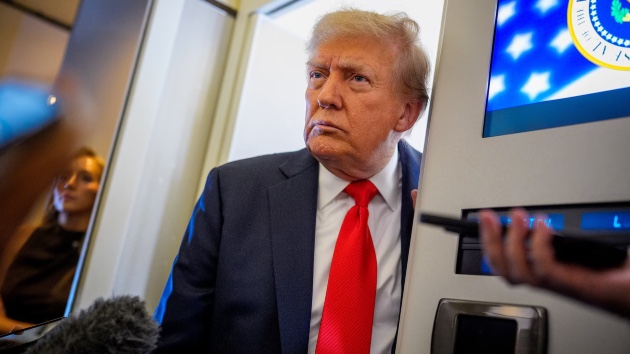
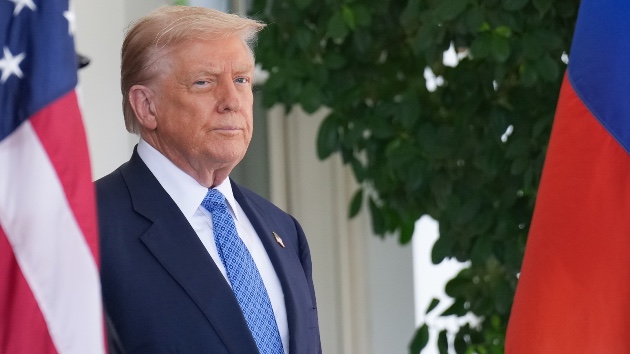
President Donald Trump speaks to reporters aboard Air Force One in the air on August 15, 2025, en route to Anchorage. (Andrew Harnik/Getty Images)
(WASHINGTON) — President Donald Trump on Monday wrote in a post to his social media platform that he will lead a “movement” to get rid of mail-in ballots and voting machines, falsely claiming that they lead to voter fraud.
“I am going to lead a movement to get rid of MAIL-IN BALLOTS, and also, while we’re at it, Highly ‘Inaccurate,’ Very Expensive, and Seriously Controversial VOTING MACHINES, which cost Ten Times more than accurate and sophisticated Watermark Paper, which is faster, and leaves NO DOUBT, at the end of the evening, as to who WON, and who LOST, the Election,” Trump wrote in his social media post.
Trump said he will begin his efforts by signing an executive order ahead of the 2026 midterm elections. Any such order would likely face legal challenges.
“Remember, the States are merely an ‘agent’ for the Federal Government in counting and tabulating the votes. They must do what the Federal Government, as represented by the President of the United States, tells them, FOR THE GOOD OF OUR COUNTRY, to do,” Trump wrote.
The Constitution gives power state legislatures to determine the “times, places and manner” of holding elections, subject to acts of Congress that regulate the process.
Trump has long sown doubts about mail-in voting, often over the objections of many Republicans. He’s claimed mail-in voting contributed to his 2020 election loss, though no widespread fraud has been found.
The president’s post comes after Trump told Fox News that he spoke about mail-in voting in the United States with Russia’s Vladimir Putin. When the two met in Anchorage, Alaska, last week, Putin claimed Russia’s war on Ukraine wouldn’t have happened if Trump had been president.
“Vladimir Putin, smart guy, said you can’t have an honest election with mail-in voting,” Trump told Fox News’ Sean Hannity in an interview after Friday’s summit.
Trump added that Putin “said there’s not a country in the world that uses it now” — though Russia itself also has mail-in voting.
Russia’s 2024 presidential election outcome, which showed a landslide win for Putin, was decried by many Western nations as not free or fair. The U.S. State Department said it had “occurred in an environment of intense political repression that has marginalized or completely silenced all independent voices.”
Trump’s former top adviser, Fiona Hill, who was present when Trump suggested in 2018 that he believed Putin’s denial that Russia interfered in the 2016 election over the findings of U.S. intelligence, weighed in on the issue during an appearance on CBS News’ “Face the Nation” on Sunday.
“Well, look, this is Vladimir Putin, as usual, trying to manipulate U.S. domestic politics,” Hill said. She added that Putin “wants to sow chaos in the American electoral system ahead of the midterms.”
This is a developing story. Please check back for updates.
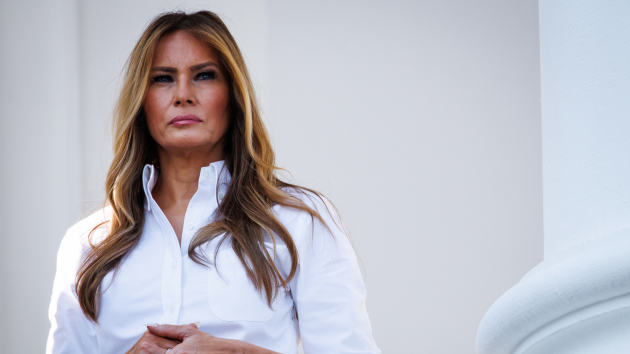
(WASHINGTON) — President Donald Trump shared on social media the “peace letter” from first lady Melania Trump that was hand delivered to Russian President Vladimir Putin at the Trump-Putin summit in Alaska on Friday.
The first lady writes “it is time” to protect children and future generations worldwide.
“Every child shares the same quiet dreams in their heart, whether born randomly into a nation’s rustic countryside or a magnificent city-center. They dream of love, possibility, and safety from danger,” Melania Trump’s letter begins.
The first lady states that all children are born innocent, regardless of their nationality, political views or beliefs.
“A simple yet profound concept, Mr. Putin, as I am sure you agree, is that each generation’s descendants begin their lives with a purity — an innocence which stands above geography, government, and ideology,” she said.
“In today’s world, some children are forced to carry a quiet laughter, untouched by the darkness around them — a silent defiance against the forces that can potentially claim their future,” she continued.
The first lady tells the Russian president that protecting children “will do more than serve Russia alone” and “will serve humanity itself.”
“Such a bold idea transcends all human division, and you, Mr. Putin, are fit to implement this vision with a stroke of the pen today,” she concludes.
“It is time,” she signs off.
The physical letter was first obtained by Fox News Digital.
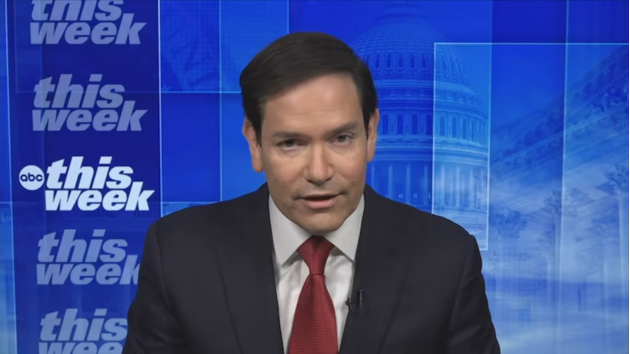
(NEW YORK) — Secretary of State Marco Rubio said Sunday that both Russian President Vladimir Putin and Ukrainian President Volodymyr Zelenskyy must make concessions to achieve a peace deal.
“You can’t have a peace agreement unless both sides give and get. You can’t have a peace agreement unless both sides make concessions,” Rubio told ABC News’ “This Week” co-anchor Martha Raddatz. “If not, it’s just called surrender, and neither side is going to surrender, so both sides are going to have to make concessions.”
On those concessions, Rubio said the United States did ask Putin to make them; however, when it comes to sanctions, the Trump administration believes that as soon as it levies additional sanctions to those already in place, the negotiations will halt.
“Of course, concessions were asked, but what utility would there be of me going on a program and tell you, ‘We’ve wagged our finger at Putin and told him, “You must do this,” and “you must do that.”‘ It’s going to make — it’s only going to make it harder.”
“The problem is this: The minute you levy additional sanctions, strong additional sanctions, the talking stops. Talking stops. And at that point, the war just continues,” he said.
“Now, we may end up being at a point where we have to do that, where there is no other recourse, and that’s the end. By the way, there already are sanctions on Russia. The President hasn’t lifted any sanctions on Russia. They’re already facing sanctions, severe sanctions, and they’re facing ones from the Europeans as well. So we may very well reach a point where everyone concludes, ‘no peace is going to happen here, we’re going to have to do more sanctions.'” Rubio said. But if it comes to that, the secretary added, “You are basically walking away from any prospect of a negotiated settlement here, which is what everyone is asking us to do.”
While Russia has publicly taken issue with Ukraine’s demand for security guarantees as part of a peace deal, Rubio suggested that the United States believes that Ukraine is justified in its request, calling it “very reasonable.”
On the other hand, Rubio suggested that the United States believes that Ukraine is justified in their request for security guarantees, calling it a “very reasonable” request.
“We do know that Ukraine has said repeatedly and publicly talked about is security guarantees. They need to be able to enter into security guarantees that ensure that this is never going to happen again, that they’re not going to get re-invaded in two and a half or three years or four years or whenever it may be,” Rubio said. “That’s something we’re working on. And that’s something the Russian side has to understand, obviously, is that as a sovereign country, Ukraine has a right, like every sovereign country, to enter into security alliances and agreements with other countries.”
Rubio also indicated that Trump’s position on the war in Ukraine hasn’t changed after Friday’s summit and that Ukraine’s involvement is essential for a peace deal.
“I don’t think his mind has changed at all. I think ultimately, if this whole effort doesn’t work out, then there is going to have to be additional consequences to Russia. But we’re trying to avoid that by reaching a peace agreement,” Rubio said.
“We’re not at the precipice of a peace agreement. We’re not at the edge of one. But I do think progress was made,” he continued.
Trump had said before the summit that he wanted a ceasefire and for the killing to stop and there would be consequences if it didn’t.
In a subsequent interview on “This Week,” President Joe Biden’s former national security adviser Jake Sullivan pointed to the president’s goal before the summit to argue that since it wasn’t achieved, the summit was unsuccessful.
“President Trump’s stated goals were very simple, get an immediate ceasefire, and in the absence of a ceasefire, impose what he called severe consequences,” Sullivan said. “Well, the summit has come and gone. There is no ceasefire. There are no consequences. Meanwhile, President Putin has a simple goal. Keep the war going without facing further economic pressure from the United States. And he has achieved both of those goals on an open-ended basis.”
Sullivan also disagreed with Rubio’s position on sanctions, saying increasing them now would actually give the U.S. leverage.
“One thing that I think Secretary Rubio has backwards is the idea that additional pressure would hurt diplomacy. From my perspective, part of the reason that Putin came to Alaska is because he’s worried about the possibility of pressure. And if President Trump were prepared to escalate sanctions, squeeze Putin harder, I believe it would give him leverage to bring this war to an end more rapidly,” he said, adding that he hopes Zelenskyy and other European leaders traveling to Washington Monday will press Trump on this issue.
But Rubio did stress that a peace agreement can’t be achieved if only one side is involved in the talks — something Ukraine has stressed as well — and he said it’s the U.S.’s objective to bring both nations together.
“You’re not going to reach a ceasefire or a peace agreement in a meeting in which only one side is represented. That’s why it’s important to bring both leaders together, and that’s the goal here,” Rubio said.
Rubio said that details of Trump’s meeting with Putin will not be disclosed.
“These peace agreements and negotiations — they don’t work when they’re conducted in the media, either through leaks or through lies,” Rubio said.
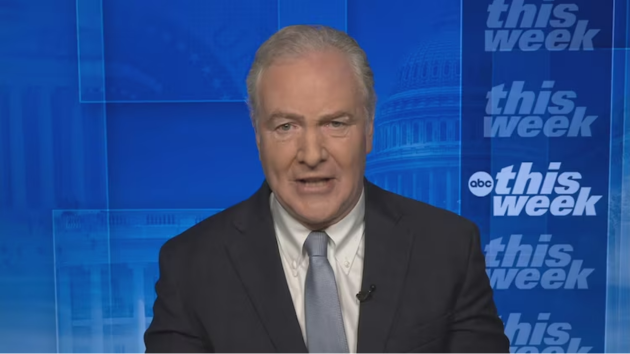
(WASHINGTON) — Sen. Chris Van Hollen, D-Md., on Sunday underlined his stance that President Donald Trump deploying the National Guard to Washington, D.C., over concerns of high crime and the level of homelessness amounts to an “abuse of power.”
“All of this is a total abuse of power. It’s a manufactured emergency,” Van Hollen said in an interview with “This Week” co-anchor Martha Raddatz. “Obviously D.C. can do more to reduce violent crime, as we can across the country. But as you pointed out, crime in D.C. is at a 30-year low and a downward trajectory. So, this is all an opportunity for Donald Trump to play dictator in Washington, D.C.”
“The way the law is written, it appears he has the legal authority. And Mayor [Muriel] Bowser conceded that. So, what is the abuse of power here?” Raddatz pressed.
“The abuse of power is claiming that this is an emergency. And everybody who is watching what happens knows that this is not an emergency in Washington, D.C.,” Van Hollen argued.
Violent crime levels have decreased compared to years prior, down 26% since 2024, a 30-year low, leaving outstanding questions over why Trump deployed roughly 800 troops around the city.
Over the weekend, several Republican-led states announced additional Guard troops would also deploy to Washington to support the president’s mission.
As some outlets report the National Guard could be armed soon, Van Hollen said, “Well, that’s very troubling, because, as you know, the National Guard, first of all, is not supposed to engage in any local law enforcement activity. We have the Posse Comitatus Act that prohibits them from engaging in local law enforcement. And so I’m not sure what it is that they need to do where they need to be armed.”
Despite fierce criticism from Democrats like Van Hollen and protests from some Washington residents, the White House has defended its decision to surge federal law enforcement to the city and bring in the National Guard as necessary and legal.
Here are more highlights from Van Hollen’s interview
On D.C. police chief saying additional law enforcement ‘positive’ Raddatz: The mayor suggested this week that the surge of — of federal police could be useful in fighting crime. And there is a crime problem in D.C. We all live here. I want you to — I want to play you something that D.C.’s police chief, Pamela Smith, said this week.
Pamela Smith (video clip): You’re talking about 500 additional personnel in the District of Columbia. And as you know, we’ve talked about the fact that we’re down in numbers with our police officers. And so, this enhanced presence clearly is going to impact us in a positive way.
Raddatz: So, do you see anything positive about this?
Van Hollen: Well, I understand the position the police chief is in. The best way to help the police chief in Washington, D.C., is for President Trump and Republicans in Congress to give them the $1 billion in money that belongs to them so that they can hire those police, rather than bringing in these federal agents.
I would also say, Martha, I would think that taxpayers all over the country, federal taxpayers, have to ask themselves how it is that we are using resources, national resources, the FBI, the DEA, folks who are supposed to be out and about protecting the country from violent criminals, and now they’re spending their time taking down tents of homeless people in the District of Columbia. I would think people all over the country would worry about that diversion of resources.
On what Congress does if Trump goes past the 30-day limit Raddatz: The — the president says he’s going to maintain control of D.C. police past this 30-day limit, no matter what Congress does. So, then what do you do?
Van Hollen: Well, that clearly is a violation of the statute. And so, we’ll end up right back in court. Of course, the president also thought he had the ability to essentially take out the police chief and have his people come in and run the police department. A federal judge already said that that was not authorized. And in the same way, his ability to extend it beyond 30 days is not authorized. And so, they’re going to have to pass this statute in the — this extension in the Congress. And I don’t think that that’s going to pass.
On his reaction to the Trump-Putin summit Van Hollen: Well, Martha, there’s no sugarcoating this. Donald Trump, once again, got played by Vladimir Putin. Vladimir Putin got the red carpet treatment on American soil. But we got no ceasefire, no imminent meeting between Putin and [Ukrainian President Volodymyr] Zelenskyy. All the threats and sanctions that, you know, Donald Trump talked about, apparently, have been set aside. Donald Trump got flattered by Vladimir Putin. But when it comes to Ukraine under European allies, this was a setback. I do believe that Congress now, the Senate in particular, should move forward on bipartisan legislation that has over 60 senators as co-sponsors that would impose sanctions on Russia and Vladimir Putin.
Personal relations are important. And I have no objection to people talking. But you want to have a clear objective in mind. Clearly, Vladimir Putin had a clear objective in mind. And he came to Alaska and gave up nothing, whereas, you know, Donald Trump said he had hoped to do, you know, a ceasefire, he had hoped to fly in Zelenskyy maybe even while Vladimir Putin was there. None of that happened. And meanwhile, they’ve taken the pressure off the sanctions. I mean, again, Donald Trump was supposed to impose sanctions on Russia weeks ago now, and nothing. So, this was a victory for Vladimir Putin.
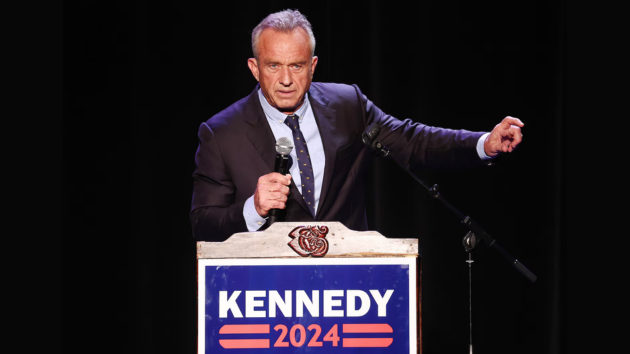
Democratic presidential candidate Robert F. Kennedy Jr. speaks at a Hispanic Heritage Month event at Wilshire Ebell Theatre, Sept. 15, 2023, in Los Angeles. Mario Tama/Getty Images
(WASHINGTON) — Health and Human Services Secretary Robert F. Kennedy Jr. on Friday ruled out running for president in 2028, apparently defending himself against accusations by conservative influencer Laura Loomer that he and top aides are quietly preparing for another White House bid as Kennedy runs America’s health apparatus.
“The swamp is in full panic mode,” Kennedy wrote in a lengthy post on X. “DC lobby shops are laboring fiercely to drive a wedge between President Trump and me, hoping to thwart our team from dismantling the status quo and advancing [Trump’s] Make America Healthy Again agenda.”
“They’re pushing the flat-out lie that I’m running for president in 2028. Let me be clear: I am not running for president in 2028.”
In the post, Kennedy also defended his longtime aide and deputy chief of staff at HHS, Stefanie Spear, whom Loomer accused in a Politico interview this week of trying “to lay the groundwork for a 2028 RFK presidential run.”
In his X post, Kennedy defended Spear, calling her “a fierce, loyal warrior for MAHA who proudly serves in the Trump Administration and works every day to advance President Trump’s vision for a healthier, stronger America.”
Spear served as press secretary for Kennedy’s failed presidential campaign, which ended last August with an endorsement of Trump.
Loomer, a staunch pro-Trump figure, has previously boasted of initiating the firings of government officials she deemed insufficiently loyal to the president. She did not immediately respond publicly to Kennedy’s post.
A view of a B-2 Stealth Bomber flyover attends Preakness 147 hosted by 1/ST at Pimlico Race Course, May 21, 2022, in Baltimore. (Paul Morigi/Getty Images)
(ANCHORAGE, Alaska) — President Donald Trump greeted Russian President Vladimir Putin at a U.S. air base in Alaska on Friday with a flyover that included the same type of bomber and fighter jets used to strike Iran’s nuclear sites last June.
The two leaders walked along a red carpet rolled out at Joint Base Elmendorf-Richardson with F-22 fighter jets on either side as the four F-35s and a B-2 Spirit bomber soared overhead.
According to two officials, two B-2 bombers were flown into the base ahead of Friday’s summit; the F-35 jets arrived from nearby Eielson Air Force Base in Alaska. The F-22 planes were based out of Elmendorf.
It was not immediately clear whether Trump personally ordered the bombers and the flyover to the Air Force base as a kind of show of force ahead of his discussions with Russia, which also is a nuclear power.
The B-2 is considered a symbol of U.S. power, as the bombers can fly around the world nonstop and can carry both conventional and nuclear munitions. The stealth B-2 bombers are the same kind used by the U.S. during June’s Operation Midnight Hammer, in which seven of the aircraft flew 36 hours straight from Whiteman Air Force Base in Missouri to Iran where they dropped more than a dozen bunker-buster bombs.
The Pentagon did not respond to a request for comment.
In recent weeks, Trump has repeatedly praised the power of the B-2 aircraft and the skill of its pilots.
Trump has insisted the sites were “obliterated.” U.S. military officials say a damage assessment is still under way. On Aug. 6, he announced his administration ordered “new and enhanced” B-2 aircraft.
“It’s an amazing machine,” he told reporters, holding up a small model of the bomber.
A view of a B-2 Stealth Bomber flyover attends Preakness 147 hosted by 1/ST at Pimlico Race Course, May 21, 2022, in Baltimore. (Paul Morigi/Getty Images)
(ANCHORAGE, Alaska) — Two B-2 bombers were flown into Alaska’s Joint Base Elmendorf-Richardson ahead of Friday’s summit between President Donald Trump and Russian President Vladimir Putin, according to two officials.
The stealth bombers are the same kind used by the U.S. to strike Iran’s nuclear sites in June’s Operation Midnight Hammer.
The B-2 is considered a symbol of U.S. power, as the bombers can fly around the world nonstop and can carry both conventional and nuclear munitions.
The Pentagon did not respond to a request for comment.
The high-stakes summit at the Anchorage base comes as the U.S. seeks a ceasefire in the Russia-Ukraine war.
It marks the first time in a decade that Putin has traveled to the U.S.
One key party who will not be in attendance at Friday’s summit is Ukrainian President Volodymyr Zelenskyy.
Trump said Thursday he hopes the summit will lead to a second meeting that would include Zelenskyy.
U.S. President Donald Trump at the White House on August 8, 2025 in Washington/ (Photo by Andrew Harnik/Getty Images)
(WASHINGTON) — President Donald Trump’s highly anticipated one-on-one summit with Russian President Vladimir Putin marks his latest effort at securing a peace deal over Ukraine, a priority in his second term.
The meeting comes after a string of deals and agreements the White House said Trump has helped broker globally that should earn him something the president has long desired — a Nobel Peace Prize.
“President Trump has brokered on average about one peace deal or ceasefire per month during his six months in office,” White House press secretary Karoline Leavitt said during a press briefing last month. “It’s well past time that President Trump was awarded the Nobel Peace Prize.”
Trump himself has voiced grievance over not having a Nobel Peace Prize; while taking questions in the Oval Office in February alongside Israeli Prime Minister Benjamin Netanyahu, weeks after the U.S. helped broker an ultimately short-lived ceasefire agreement over Gaza, the president said, “They will never give me a Nobel Peace Prize. I deserve it.”
The president has also said he deserves the Nobel Peace Prize for U.S.-brokered deals in other conflicts, including the June peace agreement between the Democratic Republic of the Congo and Rwanda and the May ceasefire between India and Pakistan.
“No, I won’t get a Nobel Peace Prize no matter what I do, including Russia/Ukraine, and Israel/Iran, whatever those outcomes may be, but the people know, and that’s all that matters to me!” Trump said on social media in June.
Observers say Trump’s desire for the Nobel Peace Prize looms large over the summit with Putin, as the president looks to fulfill a campaign promise to end the war between Russia and Ukraine. It’s something he said he would do in the first 24 hours of his second term, though months into his term, as the war raged on, said he had meant the 24-hour pledge “figuratively.”
Ahead of the planned meeting with Putin in Alaska on Friday, some foreign policy experts have voiced concern over how Trump and his supporters’ fixation on the prize could impact diplomatic relations.
Max Boot, a senior fellow at the Council on Foreign Relations, argued in a Washington Post column that “Trump’s unhealthy obsession with winning the Nobel Peace Prize has driven him to make a series of rash decisions in pursuit of ending the war in Ukraine.”
“The latest example is the scheduling of a premature summit with Russian dictator Vladimir Putin in Alaska — an object lesson in how not to do diplomacy,” he wrote.
Ian Bremmer — the president and founder of Eurasia Group, a political risk research and consulting firm — said in a post on X ahead of the talks that he fully expects Putin to “exploit Trump’s ambitions for admiration (a la Nobel Peace Prize) in an effort to get what he wants.”
Several world leaders and officials have expressed their support for Trump getting a Nobel Peace Prize in recent months.
Among them, the government of Pakistan said in June it has formally recommended that Trump receive the 2026 Nobel Peace Prize “in recognition of his decisive diplomatic intervention and pivotal leadership during the recent India-Pakistan crisis.”
A month later, Netanyahu told Trump that he nominated the president for the award after Trump pushed for a ceasefire between Israel and Iran.
After signing a U.S.-brokered agreement at the White House aimed at ending decades of conflict between their countries, the leaders of Azerbaijan and Armenia said this month that Trump deserves the Nobel Peace Prize and they would advocate for it.
Ahead of Friday’s summit, John Bolton, Trump’s former national security adviser, told ABC News “This Week” co-anchor Jonathan Karl that nominating Trump for the Nobel Peace Prize is “the way to his heart.”
“I think what Trump has done is make it clear that he wants a Nobel Peace Prize more than anything else,” he said. “And the way to his heart, as Pakistani Chief of Staff [Asim] Munir found, Bibi Netanyahu found — offer to nominate him.”
Bolton, who has been critical of Trump’s foreign policy decisions, left his post during Trump’s first term amid reports of conflict among the president’s foreign policy advisers. Trump said he fired Bolton, while Bolton said he resigned. At the start of Trump’s second term, Bolton said Trump terminated his Secret Service protection.
White House officials have touted Trump as a “deal maker” intent on reaching peace. Heading into the summit, Vice President JD Vance called the expected meeting with Putin “a major breakthrough for American diplomacy,” saying in an interview with Fox News that a peace deal wouldn’t happen without Trump.
“We’re gonna try to find some kind of negotiated settlement that the Ukrainians and Russians can live with, where they can live in relative peace, where the killing stops,” Vance said.
“Both the Russians and the Ukrainians probably at the end of the day are gonna be unhappy with it. But I don’t think you can actually sit down and have this negotiation absent the leadership of Donald J. Trump,” Vance continued.
Though he often brings it up, Trump has contended that he is “not politicking” for the Nobel Peace Prize, which was last given to a U.S. leader in 2009, when former President Obama received it less than a year into his first term.
“It would be a great honor, certainly. But I would never politic. I’m not doing it for that,” he said during this month’s Azerbaijan-Armenia peace summit. “I’m doing it because of really, number one, I want to save lives. That’s why I’m involved so much with Ukraine and Russia — saving lives of Russians and Ukrainians.”
A day before the planned summit, Trump said he believed he’d have a “good” conversation with Putin but said that the more significant development in the peace effort would be a second meeting between the U.S., Putin and Ukrainian President Volodymyr Zelenskyy.
“I’m there for one reason,” he said. “I want to see if I can stop the killing.”
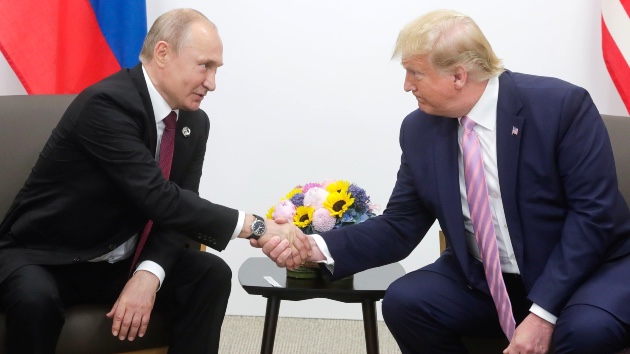
US President Donald Trump (R) meets Russian President Vladimir Putin (L) on the first day of the G20 summit in Osaka, Japan on June 28, 2019. (Photo by Kremlin Press Office / Handout/Anadolu Agency/Getty Images)
(WASHINGTON) — In his first term, President Donald Trump met with Russia’s Vladimir Putin six times but one moment stood out.
It happened in Helsinki, Finland, in 2018 when Trump, standing next to him, suggested he believed Putin’s denial that Russia interfered in the 2016 election over the findings of U.S. intelligence.
At the time, Trump said U.S.-Russia relations had “never been worse” than before they met but that had “changed.”
Now, Trump is set to hold his first one-on-one meeting with Putin of his second term at Joint Base Elmendorf-Richardson in Anchorage, Alaska.
The backdrop for Friday’s highly-anticipated summit is a darker one, amid Russia’s relentless onslaught on Ukraine and Putin presenting a frustrating obstacle to Trump’s professed desire to end the war.
The meeting will spotlight their relationship — one that Trump said during the 2024 campaign was so strong he could end the conflict on his first day in office or even before.
“It seems that Donald Trump used to think that he understands Putin well and has a good rapport with him, but over the last few months we’ve seen him alter his position in that regard and actually become more frustrated with Putin. I think he’s becoming more moderated in his expectations about what the meeting can bring,” said Maria Snegovaya, a senior fellow for Russia and Eurasia with the Center for Strategic and International Studies.
Trump called Putin a “strong leader” in his first term and a “genius” shortly after his forces first invaded Ukraine.
Early in his second term, Trump said that Putin would be “generous” in peace talks and Ukraine more difficult.
Trump made several public demands of Ukraine, including that it would have to give up its goal of joining NATO and possibly cede some territory, while notably not setting any such red lines for Russia.
The president even sympathized with Putin’s status as a global pariah, saying in February that he would “love” for Russia to rejoin the Group of Seven nations and that it was a mistake for Moscow to have been expelled from the company of world leaders following Putin’s annexation of Crimea.
“Look, nothing’s going to happen until Putin and I get together, OK?” Trump said back in the spring.
Over the last few months, however, Trump’s tone toward Putin has shifted.
“I’ve always had a very good relationship with Vladimir Putin of Russia, but something has happened to him. He has gone absolutely CRAZY!” Trump wrote on his social media platform in late May.
Trump expressed repeatedly that he’s “disappointed” in the Russian president as strikes intensified between Russia and Ukraine this summer.
In July, Trump said he was fed up with the “bull—- thrown at us by Putin.” “He’s very nice all the time, but it turns out to be meaningless,” he said.
“We’re not happy with Putin. I’m not happy with Putin. I can tell you that much right now, because he’s killing a lot of people,” Trump added.
Trump has kept American-made weapons supplied to Ukraine through a deal with European partners and recently slapped steep secondary tariffs on India, one of the largest purchasers of Russian oil, in indirect pressure on Moscow.
Still, Trump held back on his threats to impose harsher sanctions on Aug. 8 if Putin did not agree to a ceasefire. Instead, on that date, Trump announced he would host the Russian leader on U.S. soil for a one-on-one meeting.
“He has more that he could do in order to push Putin to come to the table,” said William Taylor, a former U.S. ambassador to Ukraine currently serving as a senior fellow at the Atlantic Council.
So far, Trump has tempered expectations about Friday’s summit. He’s called it a “feel-out meeting” and the White House described it as a “listening exercise.”
At the same time, he warned again this week of “severe consequences” if Russia didn’t end the conflict.
“I think that Trump believes that strongmen of Putin’s kind are to be negotiated with eye to eye, and he wants to feel the ground to see what he gets from the meeting with Putin. The problem with that is Putin is also a shrewd manipulator and he has the KGB background, he is known to be very convincing and make people like him in person,” said Snegovaya.
John Bolton, Trump’s former national security adviser, said Putin’s goal for this summit is to get back into Trump’s good graces.
“What Putin wants to get back, he’s not so worried about the sanctions, he wants the relationship back with Trump. We’ll see if he gets it,” Bolton said on ABC’s “This Week.”