(DENVER) — Colorado will become the first state to accept cryptocurrency as payment for state taxes and fees, Governor Jared Polis announced Wednesday.
Polis said the state, which was also the earliest to use blockchain technology for government infrastructure, will take the digital coin payments and deposit the equivalent value in dollars into the state’s treasury.
“In Colorado, we’ve been laying the groundwork to be a center of crypto and blockchain innovation for a number of years,” Polis said in a statement. “We see it as a critical part of Colorado’s overall innovation ecosystem.”
The announcement comes as legislators in other states, including Arizona and California, are proposing laws which, if ratified, would deem cryptocurrency an accepted form of payment statewide, not just for tax purposes.
Governor Polis has long been a vanguard in the intersecting world of cryptocurrency and politics. In 2014, he accepted Bitcoin for campaign donations during his run for the U.S. Congress following a Federal Exchange Commission ruling that went in his favor.
Although Colorado will be the first state to officially welcome cryptocurrency payments for taxes, Ohio implemented a similar program for a test run in 2018, which was ultimately deemed unsuccessful and abandoned in 2019.
Outside the U.S., El Salvador has been on a similar path for the better part of nine months. In June 2021, the country’s Legislative Assembly passed a law that made Bitcoin legal tender, allowing it to be used for everyday purchases.
Critics of accepting cryptocurrency highlight the volatility of digital currencies and inflation fears as reasons the initiative could cause economic destruction in El Salvador. In January, the International Monetary Fund called for the Central American nation to reverse its decision.
Cryptocurrency investment and interest have skyrocketed throughout the pandemic, with Bitcoin—the original digital currency—seeing gains of more than 300% between March and December 2020, only to crash down almost 45% from an all-time high in November 2021.
Polis has expressed an interest in having the state be able to process and accept cryptocurrency by the summer, although he has yet to provide a more specific timeline.
(NEW YORK) — Two prosecutors leading the criminal investigation into former President Donald Trump and his family real estate business have resigned, the Manhattan District Attorney’s Office said, casting doubt about the likelihood the former president would face any criminal charges.
Carey Dunne and Mark Pomerantz submitted their resignations to Manhattan District Attorney Alvin Bragg, who inherited the Trump investigation from his predecessor, Cyrus Vance.
“We are grateful for their service,” a spokesperson for Bragg told ABC News regarding Dunne and Pomerantz. “The investigation is ongoing.”
The resignations could be a sign that Bragg has doubts about whether to continue a case that has already seen charges filed against the Trump Organization and its long-serving chief financial officer, Allen Weisselberg.
Both have pleaded not guilty.
The investigation has centered on how the former president and his company valued their holdings depending on whether they were seeking loans or trying to pay lower taxes.
New York Attorney General Letitia James is conducting a parallel civil investigation and has successfully gone to court to force Trump and two of his children to sit for depositions in the coming days.
(WASHINGTON) — Ivanka Trump, the eldest daughter of former President Donald Trump, is in active conversations with the House Select Committee on Jan. 6 about meeting for a voluntary interview, ABC News has confirmed, marking the first time a member of the Trump family has engaged in voluntary negotiations outside of a subpoena.
“Ivanka Trump is in discussions with the committee to voluntarily appear for an interview,” a spokeswoman for Trump confirmed in a statement Wednesday.
Ivanka Trump was one of a small handful of aides with the president inside the West Wing as the Capitol was under attack the president after his speech on the morning of Jan. 6.
Ivanka’s possible cooperation comes as ABC News has previously reported the committee is in active negotiations with Trump lawyer Rudy Giuliani about also appearing for an interview with the committee.
This is a developing story. Check back for updates.
Tom Williams/CQ-Roll Call, Inc via Getty Images/POOL
(WASHINGTON) — Civil rights attorney Ben Crump publicly urged President Joe Biden to tap Judge Ketanji Brown Jackson for the Supreme Court on Wednesday, as the president closes in on a decision for his first nomination to the high court.
“In my view, that of a civil rights lawyer and advocate who is committed to bringing justice, respect, and fairness to this nation, and particularly to my community, that woman is Judge Ketanji Brown Jackson,” Crump said in a statement, provided first to ABC News.
The endorsement — the first from a high-profile Black civil rights advocate — is a significant boost for Jackson after African American community leaders have spent weeks largely remaining neutral on the pick.
Over the past decade, Crump has represented the families of Trayvon Martin, Michael Brown, Breonna Taylor, George Floyd, Ahmaud Arbery, Jacob Blake, Daunte Wright — Black Americans whose deaths at the hands of police sparked outrage and calls for justice. Crump joined the Floyd family for a meeting with the president at the White House last April, on the first anniversary of George Floyd’s death.
“My standards for this nominee go beyond integrity, brilliance and fairness,” Crump said in the statement. “I carry the additional purchase that this justice must represent African Americans in a way that has cultural competency, forcefulness and instills deep pride.”
Crump’s embrace of Jackson is a break with South Carolina Democratic Rep. Jim Clyburn, an influential Biden ally, who has spent weeks lobbying for U.S. District Court Judge J. Michelle Childs, touting her blue-collar background and educational diversity as a graduate of state universities in contrast to the Ivy League pedigree of most other justices.
Jackson, the daughter of school teachers and product of Miami-Dade public schools, is a graduate of Harvard and Harvard Law.
ABC News has confirmed the president has completed interviews with Childs, 55, Jackson, 51, and Kruger, 45, and that a final decision is imminent. A Black woman has never been nominated to Supreme Court.
In his statement, Crump praised Clyburn and his late wife Emily for securing Biden’s commitment during the 2020 campaign to nominate a Black woman, but says Jackson is better prepared for the high court.
“There will be no learning curve for Judge Jackson, she knows the law, has adjudicated it well, and is battle tested. Jackson has the educational credentials and commitment which put her in an elite with which the Court is familiar, having the same credentials as most of the modern justices, if not more than,” Crump said.
“We African Americans eagerly await and demand that model: a talented African American woman who not only acts justly and upholds our Constitution, but is rooted in an experience that so many of us share. That person is Judge Ketanji Brown Jackson,” Crump highlighting her experience as a public defender, clerk for Justice Stephen Breyer, and advocate for criminal sentencing reform in her role for the U.S. Sentencing Commission.
Crump and Jackson have taught twice at a seminar at Harvard’s Trial Advocacy Workshop, serving as teachers and mentors for students calling her “humble” and “gracious.”
“But through it all she’s been an advocate for and proud of our African American community,” he said. Adding, “For the combination of brilliance, integrity, experience, and assurance that African Americans will hold this choice as we do the memory of Thurgood Marshall and Constance Baker Motley, I overwhelmingly support the historic choice of Judge Ketanji Brown Jackson.”
Other Black leaders have been reluctant to endorse a candidate.
A group of 14 Black female lawmakers led by Rep. Cori Bush, D-Mo. sent a letter to the president outlining their priorities and called on him to select a nominee committed to advancing civil rights but declined to name a candidate.
Bush told reporters, “I just don’t think it’s our place to pit Black women against each other who are trying to get this spot.”
(WASHINGTON) — More than two decades before becoming a top contender to be President Joe Biden’s Supreme Court nominee, a young Ketanji Brown Jackson sat across from Justice Clarence Thomas, reportedly perplexed by how someone of his background — not so different from her own — could have developed such a conservative bent.
“I don’t understand you,'” Jackson, who clerked for Justice Stephen Breyer from 1999 to 2000, remembered thinking, according to a 2007 biography of Thomas, Supreme Discomfort: The Divided Soul of Clarence Thomas.
“‘You sound like my parents. You sound like the people I grew up with.’ But the lessons he tended to draw from the experiences of the segregated South seemed to be different than those of everybody I know,” the book, by authors Kevin Merida and Michael Fletcher, said Jackson thought as she and Thomas shared lunch.
Jackson acknowledged doing an interview for the book during her confirmation hearings last year for the U.S. Court of Appeals.
Her reported candid reflection offers a glimpse into how she perceived Thomas, a polarizing figure who may soon be her colleague, and illustrates what could be a compelling new wrinkle to the court’s makeup.
If Biden taps Jackson for the role, as many commentators expect, it will be the first time two African Americans share the bench. Experts say the dissonance between Jackson, 51, and Thomas, 73, may present a fresh opportunity to explore racial identity, experience and expectations.
“We’re now going to actually see at least one layer of the diversity of Black political thought in the United States — it’s going to be on display for the world to see,” said Leah Wright-Rigueur, a professor in public policy at Harvard University. “That’s a really big deal.”
Some Black legal scholars ABC News spoke to noted why Jackson and other Black Americans who share in her cultural experience might be puzzled by Thomas’ conservative judicial philosophy, which critics say has encouraged policies that have disenfranchised minority communities.
Yvette Simpson, an ABC News contributor and CEO of Democracy for America, a progressive political action committee, characterized Jackson’s observation of Thomas as “an honest reflection from someone who was trying to understand a man who grew up in one world and seems to be emulating something totally different.”
Experts point out that Thomas’ background and upbringing bears similarities to the one that molded Jackson. Both were raised in middle- or working-class Black families in the South and attended predominantly white institutions — including Ivy League law schools.
“[Jackson] recognizes Clarence Thomas … there’s a familiarity there,” said Wright-Rigueur. “They have a very similar trajectory and very similar experiences, and yet, they come to such radically different spaces politically and ideologically.”
As the court’s longest-serving justice, Thomas has emerged in recent years as possibly the most visible Black conservative in the country. Notoriously sparing in his comments from the bench in his earlier years, Thomas boasts an unblemished record of siding with the conservative block in politically charged cases. In the past few years, he’s become one of the most loquacious justices and, as the court’s senior justice, is given the privilege of asking the first questions at oral arguments.
Data shows Thomas’ views conflict with a large cross-section of Black voting behavior in America. In the 2020 presidential election, for example, Biden landed 92% support from Black voters — a figure consistent with previous national voting sentiments.
But Black voters’ overwhelming support for Democrats “obscures a much more complicated story,” said Wright-Rigueur. The Pew Research Center found in 2020 that a quarter of Black Democrats characterize their views as conservative.
“There’s a kind of everyday conservatism that runs right through Black communities,” she said. “It’s just that their conservatism rarely translates into partisan support for the Republican Party.”
A senior Republican Party official, who is African American, told ABC News that Thomas’ conservative disposition has been unfairly scrutinized during his time on the high court bench because he contradicts Black political norms.
“There is a notion out there that if a Black person’s thought pattern, or vote, or disposition is not liberal, then it’s wrong. … If Clarence Thomas makes an opinion and it happens to be conservative, it is automatically thought to be against the Black community just because it’s conservative and not liberal,” the official, who declined to be named, said.
“It’s a sad state when your Blackness is questioned just because of your political affiliation,” the official continued, adding that Thomas’ conservatism is consistent with his values, which are derived from his southern African-American upbringing.
Gender also plays a role, experts said. Conservatism in Black communities is more common in Black men, polling shows — Black women are the most consistent Democratic voting bloc of any demographic. Having a Black woman on the Supreme Court will mark a notable shift in the panel’s dynamic, experts said.
“The differences in the lived experience of Black women in this country feels really significant or important to note,” said Karundi Williams, executive director of Re:Power, a progressive training group. “This person will bring a different lens by which she will rule and advance our country forward. And I think that that’s wrapped up in the significance of this appointment.”
Some experts wondered whether the presence of a Black woman on the court might alter Thomas’ staunchly conservative interpretation of the law — one way or the other. As the lone Black voice on the court for so long, Thomas may have reveled in cultivating a streak of independence.
“When you’re the only one, it does something to you — there’s a protectionism that Thomas has demonstrated,” Simpson said. “I wonder if, when a Black woman joins the court, Thomas digs in — or if she causes him to challenge the way he thinks about the world.”
Biden has indicated that he would start interviewing prospective candidates for the upcoming vacancy as soon as last week, but the White House has yet to release details on his shortlist. Biden has pledged to announce his nomination by the end of February.
In an interview with NBC News earlier this month, Biden said he’s done a “deep dive” on “about four people” who have already seen “thorough background checks” as he keeps an eye on replicating the qualities of the retiring Breyer.
“I’m not looking to make an ideological choice here,” Biden said. “I’m looking for someone to replace Judge Breyer with the same kind of capacity Judge Breyer had, with an open mind, who understands the Constitution, interprets it in a way that is consistent with the mainstream interpretation of the Constitution.”
The symbolism and historic nature of Biden’s choice will far outweigh the nominee’s relationship with Thomas, compelling as it might be, experts said. Not only will the new justice break an important barrier, but after three decades of Thomas as the sole Black presence, a new voice more in line with the overwhelming views of that demographic will usher an important new era of representation on the court.
“Ten years ago, the idea of two Black people being on the on the Supreme Court at the same time was laughable — it just wasn’t going to happen,” Wright-Rigueur said. “And now it’s actually happening, so we actually get to see [the diversity of Black political thought] play out.”
(TALLAHASSEE, Fla.) — A Florida bill that would limit classroom discussions on sexual orientation and gender identity and encourage parents to sue schools or teachers that engage in these topics continues to move through the state House and Senate.
It’s being called a “Don’t Say Gay” bill by LGBTQ advocates, who fear that if this bill is signed into law, it could act as a complete ban on the lessons on LGBTQ oppression, history and discussions about LGBTQ identities.
An amendment to the bill was proposed Friday that also would require school officials to disclose a student’s sexual or gender identity to their parents within six weeks of finding out about the student’s identity. State Rep. Joe Harding, the sponsor of the legislation, withdrew the amendment Tuesday afternoon before it was to be debated and voted on the House floor.
Harding said in a statement to the Tallahassee Democrat Tuesday that “nothing in the amendment was about outing a student,” and that it was intended to “create procedures around how, when and how long information was withheld from parents so that there was a clear process and kids knew what to expect.”
“Rather than battle misinformation related to the amendment, I decided to focus on the primary bill that empowers parents to be engaged in their children’s lives,” the statement continued.
The Florida Senate Education Committee had moved the bill forward earlier this month, but it still has to be approved by other Senate committees and the state House.
Gov. Ron DeSantis signaled support for the bill at a recent public event.
The Biden administration has denounced the efforts as anti-LGBTQI+.
“Every parent hopes that our leaders will ensure their children’s safety, protection, and freedom,” the White House said in a statement Feb. 8.
“Today, conservative politicians in Florida rejected those basic values by advancing legislation that is designed to target and attack the kids who need support the most – LGBTQI+ students, who are already vulnerable to bullying and violence just for being themselves,” the statement said. “But make no mistake – this is not an isolated action. Across the country, we’re seeing Republican leaders take actions to regulate what students can or cannot read, what they can or cannot learn, and most troubling, who they can or cannot be.”
President Joe Biden also weighed in on Twitter. “I want every member of the LGBTQI+ community — especially the kids who will be impacted by this hateful bill — to know that you are loved and accepted just as you are,” Biden said in the post.
Activists say that erasing LGBTQI+ presence from schools may imply to students that their gender identity or sexual orientation is something to be ashamed of or hidden.
“We have to create a learning environment where they feel safe and healthy, or it’s not an effective learning environment,” said Heather Wilkie of the Zebra Coalition, a Central Florida LGBTQ advocacy group.
“When you have laws like this, that directly attack our kids for who they are, it prevents them from learning,” she said. “It prevents them from being able to be healthy.”
The two bills in the state legislature, HB 1557 and SB 1834, state that a school district “may not encourage classroom discussion about sexual orientation or gender identity in primary grade levels or in a manner that is not age-appropriate or developmentally appropriate for students.”
The House Education & Employment Committee moved another version of the bill forward in January, handing it off to the Judiciary Committee.
“This would erase LGBTQ+ history and culture from lesson plans and it sends a chilling message to LGBTQ+ young people and communities,” said Melanie Willingham-Jaggers, the executive director of the national LGBTQ youth advocacy group GLSEN.
If the bill passes, it would go into effect on July 1.
It adds that parents who violate this rule can sue, seeking damages and reimbursement for attorney fees and court costs.
Rep. Harding hopes it will “reinforce the fundamental right of parents to make decisions regarding upbringing & control of their children,” according to the bill’s text.
Harding did not respond to ABC News’ request for comment.
Chasten Buttigieg, activist and husband of U.S. Secretary of Transportation Pete Buttigieg, denounced Florida Gov. Ron DeSantis and the state legislature for the efforts last month in a Twitter post.
LGBTQ advocacy organizations say these bills are reminiscent of the “no promo homo” laws of the 1990s that barred educators from discussing queer topics in schools, but with an added mandate on parent and family involvement.
“These mandates are harmful and risk carelessly outing LGBTQ+ young people to families who do not affirm their children’s identities,” Willingham-Jaggers said.
2021 was a record-breaking year for anti-LGBTQ legislation, according to the Human Rights Campaign. More than 250 of these bills were introduced and at least 17 were enacted into law.
Several states, including Arizona, Alabama, Florida, Indiana, Kentucky, Oklahoma, New Hampshire and South Dakota, have already introduced anti-LGBTQ legislation in 2022.
This Florida legislation follows similar bills that restrict educators from teaching about oppression in the U.S.
Wilkie said that queer issues and access to supportive resources have been the priority against anti-LGBTQ attacks in recent years, and this has been a heightened effort since the Pulse nightclub shooting in 2016.
LGBTQ youth in the state, who have a higher risk for suicidal ideation, depression and anxiety, have been struggling, but Wilkie says advocacy groups will continue to fight these bills.
“We will fight,” she said. “It’s so disheartening to think that they would not be able to freely talk about themselves, or learn anything about their history.”
(WASHINGTON) — President Joe Biden is zeroing in on his first pick for the U.S. Supreme Court, completing interviews with candidates on his short list and moving toward a final decision this week, a person familiar with the process confirmed to ABC News on Tuesday.
Biden said this month he was considering “about four” names — all Black women — to replace retiring Justice Stephen Breyer, studying their writings, legal experience and personal backgrounds.
U.S. District Court Judge J. Michelle Childs, 55, is the only person publicly confirmed by the White House as under formal consideration and is endorsed by South Carolina Democratic Rep. James Clyburn, an influential Biden ally. U.S. Appeals Court Judge Ketanji Brown Jackson, 51, and California Supreme Court Justice Leondra Kruger, 45, are also getting a close look, sources have told ABC News.
Jackson, a former Breyer clerk who previously met one-on-one with Biden at the White House ahead of her appeals court nomination, is widely considered the front-runner. A spokesman said the president has been impressed with her “experience in roles at all levels of the justice system, her character and her legal brilliance.”
The completion of several interviews means the president is nearing a decision, but a White House spokesman said late Tuesday that “the president has not yet chosen a nominee.”
“He continues to evaluate eminently qualified individuals in the mold of Justice Breyer who have the strongest records, intellect, character, and dedication to the rule of law that anyone could ask for – and all of whom would be deserving of bipartisan support,” White House spokesman Andrew Bates tweeted.
The Washington Post, citing anonymous sources, reported that Jackson and Childs have been interviewed. The White House and allies close to the process declined to comment on the report to ABC News.
Despite the fact that Biden’s schedule and attention have been dominated by the crisis between Russia and Ukraine, aides say announcement of the nomination — promised by the end of the month — is expected this week. Exact timing and format of a nomination event have not been determined because the president has not formally made his pick, sources said.
The president’s allies on Capitol Hill and among grassroots groups have begun mobilizing to promote and defend the nominee, gearing up for a media blitz to mark both the historic nature of the nomination and counter expected Republican attacks, some of which have already been racially-charged.
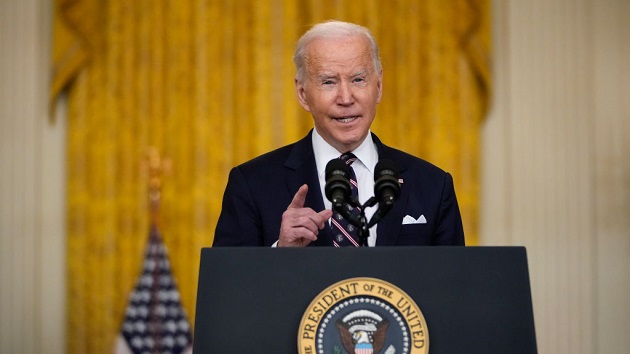
(WASHINGTON) — Saying the world is witnessing “the beginning of an invasion — of a Russian invasion — of Ukraine,” President Joe Biden announced Tuesday he would begin to impose major new sanctions on Russia, threatening to add more if Russian President Vladimir Putin takes even more aggressive action.
“This is the beginning of a Russian invasion of Ukraine, as he indicated and asked permission to be able to do from his Duma,” referring to the Russian parliament, Biden said in remarks from the White House. “So, I’m going to begin to impose sanctions in response — far beyond the steps we and our allies and partners implemented in 2014,’ when Russian forces took over Crimea and tried to destabilize the Ukrainian government.
“If Russia goes further with this invasion, we stand prepared to go further as with sanctions,” Biden continued.
Putin, in ordering Russian troops into two Russian-backed separatist regions in eastern Ukraine, was “setting up a rationale to take more territory by force,” he said. “Who in the Lord’s name does Putin think gives him the right to declare new so-called countries on territory that belonged to his neighbors?”
Calling the Russian moves “a flagrant violation of international law” and one that “demands a firm response from the international community,” Biden said “full blocking sanctions would be placed on two large Russian financial institutions and “comprehensive sanctions’ on Russia’s sovereign debt.
“That means we’ve cut off Russia’s government from western financing. It can no longer raise money from the West and can not trade in its new debt on our markets or European markets either,” he said.
Starting Wednesday, he said, “we’ll also impose sanctions on Russia’s elites and their family members. They share in the corrupt gains of the Kremlin policies and should share in the pain as well.”
By calling it the “beginning of an invasion,” Biden appeared to be addressing the question of how the U.S. would characterize and react to Putin’s moves.
After for weeks saying the U.S. would impose “severe and swift” sanctions on Russia if it invaded Ukraine, the Biden administration was grappling with whether Russia’s decision to send troops across the border would trigger the most severe punishments it had prepared.
The U.S. has condemned Russia for recognizing the independence of two breakaway Ukrainian provinces already partially controlled by pro-Russian separatists — imposing limited sanctions on Monday — and blasted Russian President Vladimir Putin for ordering troops into those regions.
But as the White House stopped short of putting in place sanctions it said would make Russia an “international pariah,” observers were left to parse what, in President Joe Biden’s eyes, would actually prompt that.
“Russia will be held accountable if it invades,” Biden said at a news conference on Jan. 19. “And it depends on what it does. It’s one thing if it’s a minor incursion and then we end up having a fight about what to do and not do, et cetera.”
Within hours, his press secretary, Jen Psaki, clarified: “If any Russian military forces move across the Ukrainian border, that’s a renewed invasion, and it will be met with a swift, severe, and united response from the United States and our allies.”
The next day, Biden, too, added: “If any — any — assembled Russian units move across the Ukrainian border, that is an invasion” that “would be met with severe and coordinated economic response that I’ve discussed in detail with our allies.”
And his top national security adviser, Jake Sullivan, said in a Feb. 6 interview with NBC News: “President Biden has spoken to the fact that if a Russian tank or a Russian troop moves across the border, that’s an invasion” that would result in “severe economic consequences.”
But with Putin so far ordering troops into regions where Russian operatives already operate — albeit within Ukraine’s internationally recognized borders — it was unclear what, exactly, would trigger the larger sanctions.
“We think this is, yes, the beginning of an invasion, Russia’s latest invasion, into Ukraine, and you already seeing the beginning of our response that we’ve said would be swift and severe,” Jon Finer, the principal deputy U.S. national security adviser, said in an interview with CNN Tuesday.
“An invasion is an invasion, and that is what is underway,” he said. “But Russia has been invading Ukraine since 2014.”
Administration officials, though, had in the past suggested to reporters that sanctions would not come in a piecemeal fashion.
Psaki, though, said Monday that the sanctions the U.S. was announcing were “separate from and would be in addition to the swift and severe economic measures we have been preparing in coordination with allies and partners should Russia further invade Ukraine.”
The linguistic dance took place in Europe, as well, where the European Union’s foreign policy chief, Josep Borrell, on Tuesday told reporters that “Russian troops are on Ukrainian soil” but that he wouldn’t call Russia’s actions “a fully-fledged invasion.”
NATO’s secretary-general, Jens Stoltenberg, also said Tuesday that there was evidence additional Russian forces had moved into Ukraine, and that Russia had moved from “covert attempts to destabilize Ukraine to overt military action.”
After Russia’s actions Monday, the U.S. and its allies began imposing a series of cascading sanctions.
The U.S. on Monday targeted people connected to the two separatist-controlled areas. On Tuesday, Germany took the major step of suspending the Nord Stream 2 gas pipeline from Russia; the UK imposed sanctions on three Russian oligarchs, five Russian banks and Russian parliamentarians; and the European Union put penalties on banks, decision makers and lawmakers involved in the independence recognition, and limits on Russia’s ability to access EU financial markets and services.
But the moves — particularly from the United States – stopped far short of the most severe sanctions the White House has threatened. It has warned it was preparing to restrict Russians’ access to semiconductors; punish Russia’s aerospace, defense, and high-tech industries; cripple the country’s largest financial institutions; and hit even Putin and those around him.
“If Russia invades Ukraine, it would become a pariah to the international community, it would become isolated from global financial markets, and it would be deprived of the most sophisticated technological inputs,” the White House’s top national security official crafting sanctions, Daleep Singh, said Friday.
U.S. officials have for weeks been working to get European allies to act in unison on reacting to Russia. Biden and other top U.S. officials have repeatedly threatened “swift and severe consequences.”
American officials have signaled that there is more agreement with other Western nations on what would happen if Russia carries out a full-scale invasion of Ukraine – but that if Russia stops short and the world sees other scenarios play out – like a partial invasion of eastern Ukraine, or solely recognizing the regions’ independence, for example – the kaleidoscope of possible penalties might not come into full harmony.
ABC News’ Mary Bruce and Christine Theodorou contributed to this report.
(WASHINGTON) — After for weeks saying the U.S. would impose “severe and swift” sanctions on Russia if it invaded Ukraine, the Biden administration is now grappling with whether Russia’s decision to send troops across the border would trigger the most severe punishments it had prepared.
The U.S. has condemned Russia for recognizing the independence of two breakaway Ukrainian provinces already partially controlled by pro-Russian separatists — imposing limited sanctions on Monday — and blasted Russian President Vladimir Putin for ordering troops into those regions.
But as the White House stopped short of putting in place sanctions it said would make Russia an “international pariah,” observers were left to parse what, in President Joe Biden’s eyes, would actually prompt that.
“Russia will be held accountable if it invades,” Biden said at a news conference on Jan. 19. “And it depends on what it does. It’s one thing if it’s a minor incursion and then we end up having a fight about what to do and not do, et cetera.”
Within hours, his press secretary, Jen Psaki, clarified: “If any Russian military forces move across the Ukrainian border, that’s a renewed invasion, and it will be met with a swift, severe, and united response from the United States and our allies.”
The next day, Biden, too, added: “If any — any — assembled Russian units move across the Ukrainian border, that is an invasion” that “would be met with severe and coordinated economic response that I’ve discussed in detail with our allies.”
And his top national security adviser, Jake Sullivan, said in a Feb. 6 interview with NBC News: “President Biden has spoken to the fact that if a Russian tank or a Russian troop moves across the border, that’s an invasion” that would result in “severe economic consequences.”
The president was scheduled to speak about the situation in Ukraine at 1 p.m. Tuesday.
But with Putin so far ordering troops into regions where Russian operatives already operate — albeit within Ukraine’s internationally recognized borders – it was unclear what, exactly, would trigger the larger sanctions.
“We think this is, yes, the beginning of an invasion, Russia’s latest invasion, into Ukraine, and you already seeing the beginning of our response that we’ve said would be swift and severe,” Jon Finer, the principal deputy U.S. national security adviser, said in an interview with CNN Tuesday.
He said the U.S. would announce “additional sanctions steps” later Tuesday. But he also suggested this was Russia’s “latest” invasion — that it was “making overt” what it had denied in the past,
“An invasion is an invasion, and that is what is underway,” he said. “But Russia has been invading Ukraine since 2014.”
Administration officials, though, had in the past suggested to reporters that sanctions would not come in a piecemeal fashion.
Psaki, though, said Monday that the sanctions the U.S. was announcing were “separate from and would be in addition to the swift and severe economic measures we have been preparing in coordination with allies and partners should Russia further invade Ukraine.”
The linguistic dance took place in Europe, as well, where the European Union’s foreign policy chief, Josep Borrell, on Tuesday told reporters that “Russian troops are on Ukrainian soil” but that he wouldn’t call Russia’s actions “a fully fledged invasion.”
After Russia’s actions Monday, the U.S. and its allies began imposing a series of cascading sanctions.
The U.S. on Monday targeted people connected to the two separatist-controlled areas. On Tuesday, Germany took the major step of suspending the Nord Stream 2 gas pipeline from Russia; the UK imposed sanctions on three Russian oligarchs, five Russian banks and Russian parliamentarians; and the European Union said it was preparing to banks and decision makers involved in the independence recognition.
But the moves — particularly from the United States – stopped far short of the most severe sanctions the White House has threatened. It has warned it was preparing to restrict Russians’ access to semiconductors; punish Russia’s aerospace, defense, and high-tech industries; cripple the country’s largest financial institutions; and hit even Putin and those around him.
“If Russia invades Ukraine, it would become a pariah to the international community, it would become isolated from global financial markets, and it would be deprived of the most sophisticated technological inputs,” the White House’s top national security official crafting sanctions, Daleep Singh, said Friday.
U.S. officials have for weeks been working to get European allies to act in unison on reacting to Russia. Biden and other top U.S. officials have repeatedly threatened “swift and severe consequences.”
American officials have signaled that there is more agreement with other Western nations on what would happen if Russia carries out a full-scale invasion of Ukraine — but that if Russia stops short and the world sees other scenarios play out — like a partial invasion of eastern Ukraine, or solely recognizing the regions’ independence, for example — the kaleidoscope of possible penalties might not come into full harmony.
(WASHINGTON) — Twenty-eight days, three forms, and several calls — that’s what Pam Gaskin says it took for her to finally be able to cast her ballot in Texas. The 74-year-old has voted by mail for nearly a decade, but this year, she says a typically easy process turned into a “nightmare.”
“It’s like being in a maze. You don’t know which way to turn,” she told ABC News’ Congressional Correspondent Rachel Scott.
Texas Republicans passed a sweeping election overhaul bill last year which includes adding new requirements for mail-in voting, expanding access to partisan poll watchers, and banned drive through and 24-hour voting, which was largely utilized by Harris County. Now, with Texas voters heading to the polls for the nation’s first primary, the impact of the state’s new and strict election law is being felt for the first time.
“Jim Crow 2.0,” Gaskin called the new law. “These laws were meant to stop certain classes and categories of people from voting.”
Gaskin and her husband, John, who suffers from Parkinson’s disease, were denied mail-in ballots twice. One reason: For the first time, voters are required to submit their Social Security number or driver’s license number. The problem? The new law says the ID number or other information provided must match the information they used when they first registered to vote.
For Gaskin, that was 46 years ago.
“I’m 74 years old. I can barely remember what I ate yesterday. So, I certainly didn’t remember what I put on my application,” Gaskin said.
She’s not alone. Thirty percent of mail-in ballots were rejected or marked for rejected in Harris County, which includes Houston, when the law first went into effect. After the county gave voters like Gaskin the opportunity to correct the problem, the number lowered to a 13.45% rejection rate, according to ABC News.
It took three forms, 28 days, several calls, and a whole lot of guessing before Gaskin’s mail-in ballot was finally accepted. But she worries other voters won’t go through the lengths she did to vote.
“It makes you kind of think, is it worth it? And one of the reasons I’m talking to you, is I want everybody who can hear me say this, to hear this. It is worth it. It is worth it. Don’t give up. Don’t give in,” she said.
Texas Republicans insist the new law protects the integrity of elections. However, there was no evidence of widespread voter fraud in the 2020 election, and the office of former Texas Secretary of State Ruth Hughs, who oversaw the 2020 election and was appointed by the Republican governor, even called the election “smooth and secure.”
Still, in a state former President Donald Trump won handily, some voters say the new changes give them more security in the election system.
“I have more confidence,” Jan Riley, a Houston voter told ABC News. “I don’t want any fraud.”
Nineteen states have passed laws making it tougher for people to vote and 27 states are considering similar legislation, according to the Brennan Center for Justice.
More than half of the legislation being considered targets mail-in voting.