
How schoolhouse culture wars may factor into the 2022 midterms

How schoolhouse culture wars may factor into the 2022 midterms
Jetta Productions/Getty Images

(NEW YORK) — States nationwide are grappling with ongoing debates over critical race theory, sexual orientation and book censorship.

In many ways, some of the most contentious and deeply divisive issues in politics are anchored in the classroom and playing out in school boards across America.

Republicans across the country have been zeroing in on how social issues are covered by teachers, including lessons on race, gender identity, sexual orientation and more.

At least 35 states have introduced what is being called anti-critical race theory legislation that limits lessons about race and inequality which are perceived to be divisive by Republican bill supporters.

The country saw the power of “parental rights” and education play out in the Virginia election, where the now-governor was propelled to victory by focusing on those exact issues.

Experts say that Democrats have to pay close attention to these debates and shift the conversation away from the culture wars to avoid losses at the ballot box in 2022.

But students themselves are caught in the middle, especially those in vulnerable groups who are suffering as a result, experts say.

Parental Rights

While education has always been a key issue in America, it has gained steam in the past two years a proxy for the culture wars that were intensified during the pandemic.

Many Republicans have been pushing back against what they believe to be aspects of public education systems run amok, first with COVID-related restrictions and then with issues like race and sexuality, attempting to restrict and refocus discussions.

The Florida legislature recently passed the deeply controversial Parental Rights Education Bill, dubbed the “Don’t Say Gay” bill by LGBTQ activists, which would limit what some classrooms can teach about sexual orientation and gender identity.

Under the new legislation, these lessons “may not occur in kindergarten through grade 3 or in a manner that is not age-appropriate or developmentally appropriate for students in accordance with state standards.”

It’s an effort that gives parents and guardians more control over what their children learn in school and that opponents say is overly broad.

Similar bills from Republican legislators restricting LGBTQ education have crept up in several other states, including Tennessee, Arkansas, Montana and Georgia.

However, a new ABC News/IPSOS poll found that 62% of Americans oppose legislation that would prohibit classroom lessons about sexual orientation or gender identity in elementary school, while 37% of Americans support legislation that would.

There have also been attempts to impart issues like structural racism and comprehensive sex education into school curricula. Especially since protests sparked by the killing of George Floyd, there has been a renewed push to highlight the role of racism in American history and institutions.

Many of those efforts have been lumped under the banner of “critical race theory,” a discipline in higher education that teaches about racism in U.S legal systems. While it is not taught in K-12 classes, many legislators have been invoking critical race theory broadly in their arguments to attempt to restrict discussions of race in the classroom.

What is taught in schools has typically been a state and local issue (with relatively recent exceptions like No Child Left Behind), impacting governor races across the country, according to experts. However, many experts now predict that the importance of education may extend nationally to the midterm elections.

A recent CNN poll found that 81% of respondents said education was either extremely or very important to them heading into the 2022 elections.

Shavar Jeffries, the national president of political advocacy organization Democrats for Education Reform, said he believed that growing frustrations from parents on their involvement in education may be swaying them at the polls.

Jeffries pointed to Republican Gov. Glenn Youngkin’s win in Virginia, after making education a centerpiece of his campaign and promising to “invest more in schools, raise teacher pay, and demand better performance from our schools.” His slogan: “parents matter.”

“The 2022 midterms will hinge on Democrats’ ability to learn from these lessons and lead on education,” said Jeffries in a press release on Youngkin’s win.

Republicans steer education debate

Joanna Rodriguez, a spokesperson for the Republican Governor Association, told ABC News that Republican governors said they are hearing from parents that they want a say in their children’s education. Now, governors are channeling that energy, and believe a parent’s say “needs to be codified into law.”

Most, if not all, legislation that restricts LGBTQ content or race education in schools comes from Republican legislators.

“As we begin to see those successes — with those surface-level successes, and public opinion changing — we also begin to have these very big conversations around the nation’s history and inequality within the nation’s history,” Rigueur told ABC News.

The debate even made it into the White House, with the Trump administration issuing its 1776 Report in opposition to the 1619 project which reframes the story of America by placing “slavery and its continuing legacy at the center of the [country’s] national narrative,” according to the project website.

Rigueur said that so-called “culture warriors” are trying to channel the fears and vulnerabilities of some parents to turn back the clock on social progress.

“One of the fastest ways to get parents to rally around a cause is to [imply] that schools are teaching something that’s inappropriate … something dangerous,” Rigueur said.

“It is a relatively easy way to get parents, who often feel powerless in the education process, deeply invested in order to change both the curriculum and the subject matter that their children have access to.”

On anti-LGBTQ legislation, Cathryn Oakley, state legislative director and senior counsel at the Human Rights Campaign, said education is the key to combating fear-mongering and the demonization of LGBTQ people.

“It is about painting a picture that is just completely not true,” Oakley said of this legislation. “The American public needs to understand that they’re being lied to by the folks who are putting these bills forward.”

As the midterm elections approach, Rigueur said Democrats have to fight to combat the forces against them.

Not only does the party of the incumbent president typically have a much harder time during the midterms, but the pandemic has also piled on the pressure in several political spheres, Rigueur said.

Rigueur added that a lot of these culture wars have been tied to the pandemic. The debate about freedom regarding mask mandates and vaccines highlights the growing want for parental control amid the dramatic changes that COVID-19 has caused.

“Part of what Democrats can do is really push the issue back to these bread-and-butter issues that the vast majority of Americans signify over and over again that they care about,” she said, like the economy and health care.

However, as politicians fight these ongoing political battles, students lie in their wake according to Becky Pringle, the president of the National Education Association (NEA).

“True learning only happens when students feel supported and celebrated in the classroom,” Pringle said in response to the Florida anti-LGBTQ bill.

Battleground heads to the classroom

Some students have circumvented book bans by delivering restricted readings to other students, holding sit-ins in the state Capitol building, or walking out of their classrooms in protest of bills that are anti-race education and anti-LGBTQ.

“Students, pre-K through [12th grade] are always silenced,” CJ Walden, a youth activist in South Florida, told ABC News. “Lawmakers need to know that this is not a game that they are playing.”

Other activist organizations, including the NEA, LGBTQ suicide prevention group The Trevor Project and the Human Rights Campaign, have highlighted the impact this will have on students in the classroom.

“We will not fall for the politics of division and distraction, in Florida or anywhere — we will continue to join together to ensure all students can learn, grow, and thrive,” Pringle said.

Copyright © 2022, ABC Audio. All rights reserved.

DHS evaluating Ukrainians’ asylum claims on case-by-case basis: Mayorkas

DHS evaluating Ukrainians’ asylum claims on case-by-case basis: Mayorkas
Drew Angerer/Getty Images

(WASHINGTON) — Homeland Security Secretary Alejandro Mayorkas said Thursday that Customs and Border Protection will handle asylum claims by Ukrainian and Russian nationals at the U.S.-Mexico border on a case-by-case basis.

Advocates have criticized the Biden administration alleging it has been turning away both Ukrainian and Russian refugees from ports of entry along the southern border.

‘We address an individual’s claim for humanitarian relief as they are presented to us,” Mayorkas told reporters on Thursday. “We have a number of efforts already underway … to provide humanitarian relief for individuals fleeing a war-torn Ukraine. We are looking at other programs that we can implement to expand the avenues of humanitarian relief.”

“For example, if someone makes a claim under the Convention Against Torture, or an individual presents to the Border Patrol agents, a case of acute of vulnerability such as a medical condition or otherwise,” he said, adding the department has sent refugee affairs officers to Eastern Europe.

White House press secretary Jen Psaki told reporters on Thursday President Joe Biden is “willing” to welcome refugees into the United States but the administration so far has been providing funding for humanitarian aid to neighboring countries in Europe.

DHS has been tasked with the federal domestic response to the Russia and Ukraine conflict.

Mayorkas believes most Ukrainian refugees ultimately will want to go back to Ukraine.

“The vast majority of Ukrainians are displaced in the countries in that region with the hope understandably of being able to return to their country,” he said.

The secretary did not offer any details on what else DHS is looking to do concerning the refugee situation in Ukraine, but the department previously stood up Operation Allies Welcome when Afghanistan was under siege by al-Qaida.

He also did not give any estimates on how many Ukrainian refugees he expects to attempt to get into the U.S.

Mayorkas said DHS has issued guidance to all CBP officers on the border reminding them of the exceptions to the Title 42 authority and how it relates to Ukrainian nationals “and everyone else” attempting to make credible fear claims at the southern border.

DHS is using Title 42 authority at the border to send the majority of adults back to their country of origin under the guise of a public health emergency. The policy was enacted at the start of the pandemic by the Trump administration.

Mayorkas said he didn’t have a timeframe for when Title 42 would be rolled back, and instead said it was a Centers for Disease Control and Prevention decision, but did say his department is prepared.

“We plan for the possibilities, whether or not they ultimately materialize or when they materialize it is our responsibility to plan and that is what we do,” he said.


Copyright © 2022, ABC Audio. All rights reserved.

Move over Iowa. New Jersey Democrats vie to hold early presidential primary

Move over Iowa. New Jersey Democrats vie to hold early presidential primary
chokkicx/Getty Images

(NEW YORK) — As the Democratic National Committee considers changes to its primary calendar, New Jersey Democrats are pitching themselves for consideration as one of the early presidential primary states.

In a letter sent Wednesday afternoon to DNC Chair Jamie Harrison, New Jersey Democratic State Committee Chair LeRoy J. Jones, Jr. asked Harrison to consider New Jersey, suggesting the traditional lineup, which leads with Iowa caucuses, is outdated.

ABC News reviewed the letter, which was also sent to the Rules and Bylaws Committee along with their co-chairs, Lorraine Miller and James Roosevelt Jr.

“Moving to a new, modernized presidential nominating system would send a strong message that the Democratic Party is focused not on the past, but on the future. Our party cannot cling to outdated traditions that do not help us reach new voters and motivate the diverse coalition of supporters needed to win elections and enact our pro-middle class agenda,” Jones Jr. writes.

Jones Jr. argues New Jersey presents a cost-effective alternative for candidates who find other early states’ media markets too expensive, as well as a diverse state that captures many of the party’s key demographics.

“No other state affords its residents the opportunity to wake up in a city, spend the day hiking on a rural trail or mountain, and then enjoy an oceanfront view for dinner the way that New Jersey does — making our state the ideal proving ground for political candidates across urban, suburban, and rural settings. In many ways, we are truly a microcosm of the country,” Jones Jr. writes.

The DNC declined ABC News’ request for comment.

Iowa’s first-in-the-nation status has been critiqued by Democrats for years, and attacks sharpened during the last election cycle in large part due to its lack of racial diversity. Iowa is made up of 90% white residents, according to data from the U.S. Census.

President Joe Biden’s bid for office was all but written off after a stunningly poor performance at the Iowa caucuses before the 2020 election. Momentum shifted after a major endorsement in the South Carolina early state primary.

“Our party is best when we reflect the people we are trying to serve, and it’s just as plain as that,” Harrison said at The DNC spring meeting. “This process will be guided by that north star.”

During the event’s Rules and Bylaws meeting, several members pushed for modernizing the primary process, making clear that Iowa’s status was on the chopping block. Several members also expressed openness to change during the group’s winter meeting in January.

“Now is not a time for us as a party to stand on tradition; now is not the time for us as a party to stand on status quo,” said Rules and Bylaws member Mo Elleithee, who laid out a series of proposed guidelines for state parties to be considered in the early nominating contest.

But unseating Iowa is not a simple process, necessitating changes to state law and Rules and Bylaws members coming to an agreement on guidelines for early state waiver applicants by the DNC’s summer meeting, expected in either August or September.

“New Jersey lies at the center of our party’s efforts to protect our majority in the U.S. House of Representatives, with four frontline incumbent Democrats whose victories are critical to that mission,” writes Jones Jr. “It is time for the Democratic Party to move boldly into the future with a presidential primary calendar that reflects the diversity of our party and nation. Let’s make New Jersey one of the first primary states, and set up future Democratic Party presidential nominees for long-term success.

Copyright © 2022, ABC Audio. All rights reserved.

Irish prime minister’s COVID case scrambles St. Patrick’s Day plans in Washington

Irish prime minister’s COVID case scrambles St. Patrick’s Day plans in Washington
Win McNamee/Getty Images

(WASHINGTON) — President Joe Biden met virtually with Irish Prime Minister Micheál Martin Thursday after Martin tested positive for COVID-19, scrambling holiday plans in Washington and hopes that St. Patrick’s Day traditions would return in-person after two years.

“I’m really, deeply sorry for the inconvenience, that we have to meet virtually again this year — although I did at a little distance for seven-and-a-half minutes get to see you yesterday and your beautiful wife, but especially after flying all the way here to Washington, with a lot going on up in the Hill and the rest,” Biden said, speaking to the Taoiseach over video, seated next to a screen in the Oval Office.

Biden said the two leaders were meeting “in a moment when demands on unity in the world are really accelerating.”

Martin, who has isolated across the street from the White House at the Blair House, where the Irish flag is on display, used his positive diagnosis to promote vaccinations.

“Last year, we met virtually across the Atlantic. This year, we’re meeting virtually across the road, so we’re getting closer,” he joked. “But I’m feeling good, and I think that reminds us of the importance of vaccines, and, cause vaccines prevent severe illness. And that it reminds us that central message we give the people: get vaccinated if you’re not vaccinated.”

Biden, known to tout his Irish heritage, was set to host Martin for a traditional bilateral meeting and Shamrock handover, an Oval Office tradition to mark St. Patrick’s Day dating back to 1952, but the event took place virtually, as they were forced to do last year in the pandemic when the UK was under travel restrictions.

House Speaker Nancy Pelosi was seated next to Martin at Wednesday’s Ireland Funds 30th National Gala, when he learned of his positive result over a course of appetizers, but she is still moving forward with her plans to host the Annual “Friends of Ireland” luncheon on Capitol Hill, which Martin had been scheduled to attend.

Pelosi tested negative this morning with a PCR test administered by the Capitol attending physician, according to a source familiar.

“In consultation with the Office of Attending Physician, the Speaker will continue regular testing and follow CDC guidance. The Friends of Ireland Lunch today will proceed but without the participation of the Taoiseach,” her office said in a statement to ABC News.

Asked if she had any concerns for her health, Pelosi told reporters Thursday, “No, I don’t, but I get tested almost every day.”

“The Taoiseach had on a mask when he sat down but then when he started to eat, he took off the mask, and then it was right during the appetizer, they pulled him aside. We didn’t know why. But then, sometime later, when it was my turn to speak, they told how we would proceed, that he would not be speaking,” Pelosi explained during her weekly press conference.

Biden also spoke at the gala, but the White House said he was not deemed a close contact of Martin. While the president’s plans to meet Martin in the Oval Office are shot, Biden is still scheduled to attend Pelosi’s luncheon on the Hill.

“I think we, Irish, are the only people in the world who actually are nostalgic for the future,” Biden joked at Wednesday’s gala, with Martin in the audience. “But, of course, that means dealing with the present. At this time, in our time, we’ve seen more change and challenge, I believe, than any time in generations.”

Biden, 79, tested negative for COVID late last year after he was in close contact with an aide that tested positive. An aide of Pelosi’s, 81, tested positive last summer, but her spokesperson said the aide had not been in close contact with the speaker since the exposure. Both Biden and Pelosi are fully vaccinated and boosted.

The Taoiseach’s positive test rocking Washington comes as the nation largely eases COVID restrictions like mask mandates and as the White House shifts its messaging from mitigating the virus to living with it.

To that end, the White House announced Thursday morning that COVID response coordinator Jeff Zients will be replaced in April by Dr. Ashish Jha, dean of the Brown University School of Public Health, who has taken on a prominent role on television networks communing the pandemic to Americans.

Jha signaled that the role will be less about vaccine distribution and more about preparing for a future of living with the virus — but he takes on the position with little political experience, at a time when the White House desperately needs Congressional funding to be prepared, and faces the prospect of dealing with a potential new surge from the BA.2 variant.

On Thursday, Pelosi expressed her anger and disappointment over Congress’ inability to pass additional COVID relief funding after House Democrats were forced to strip $15.6 billion from the spending bill last week over concerns about how the bill would be paid for. Republicans don’t think there is a need for additional funding, and Democrats don’t want that funding to be offset by cutting into other programs.

“With all the protections of the Taoiseach of Ireland, he gets a positive diagnosis. Barack Obama, the former president of the United States, has a positive indication. What chance does a poor person with a big family, living in a small apartment working in a situation that may or may not be safe…?” Pelosi said Thursday, following a meeting with Dr. Anthony Fauci.

Pelosi has been fuming that members of her own party held up passage of the COVID funding last week, sources familiar told ABC News.

“I think we need all the money we can get, to have the resources that we need to fight COVID,” she added. “The last thing we need is another variant.”

Just this week, Second Gentleman Doug Emhoff tested positive for COVID, marking the first time a member of the first or second families shared a positive test result. Former President Barack Obama, who also shares an Irish heritage with Biden, also announced he tested positive for COVID one day prior.

ABC News’ Cheyenne Haslett, Oren Oppenheim, Chad Murray and Mariam Khan contributed to this report.

Copyright © 2022, ABC Audio. All rights reserved.

Congress addresses bomb threats at historically Black colleges

Congress addresses bomb threats at historically Black colleges
Image Source/Getty Images

(WASHINGTON) — Congress is addressing campus security at historically Black colleges and universities in the wake of dozens of high-profile bomb threats.

The House Committee on Oversight and Reform and the Subcommittee on Civil Rights and Civil Liberties will hold a hearing Thursday featuring HBCU students alongside FBI and Department of Education officials.

The hearing aims to explore how the government can help to improve institution security and prevent domestic terrorism.

“In one threatening call targeting Spelman College, an HBCU for women in Atlanta, a caller claimed they had singled out that school for one reason: ‘there are too many Black students in it,'” said Oversight and Reform Committee Chairwoman Sen. Carolyn B. Maloney in her opening statement.

The campuses of at least 36 HBCUs, as well as other universities, have been targeted and at least 18 of these colleges and universities were targeted on Feb. 1 — the first day of Black History Month.

More than one-third of the nation’s 101 historically Black academic institutions have been threatened.

The FBI announced that the threats were being investigated as “racially or ethnically motivated violent extremism and hate crimes” and stated that the investigation was of the “highest priority.”

No bombs have been found on any of the campuses. Several persons of interest have been identified, according to the FBI, but no one has been arrested.

“These reprehensible threats against Black institutions echo the tactics employed by the Ku Klux Klan and others decades ago as they tried to instill terror in the Black community and prevent Black Americans from gaining civil rights,” Maloney added.

These threats came as hate crimes against Black Americans are on the rise, increasing by nearly 50% between 2019 and 2020, according to the FBI.

“It is imperative that law enforcement agencies prioritize holding perpetrators accountable and working to keep campuses safe—while also pursuing a broader strategy to address the rising tide of violent white supremacy in this country,” Maloney said.

Vice President Kamala Harris announced Wednesday that targeted HBCUs will be eligible for new grant funding for additional campus security tools.

Secretary of Education Miguel Cardona and Homeland Security Secretary Alejandro Mayorkas have also met with HBCU leaders on tools they can use to strengthen campus safety.

“HBCUs matter, and every HBCU student matters,” Maloney said. “That is why we must do everything possible to support them, especially when they are threatened or attacked.”

Copyright © 2022, ABC Audio. All rights reserved.
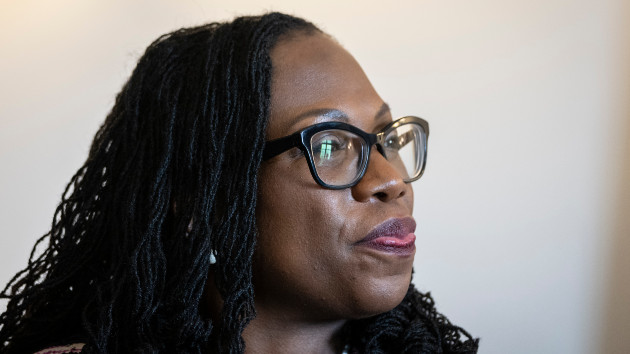
Ketanji Brown Jackson’s Harvard ties scrutinized over affirmative action case

Ketanji Brown Jackson’s Harvard ties scrutinized over affirmative action case
Drew Angerer/Getty Images

(WASHINGTON) — At her Senate confirmation hearing next week, Supreme Court nominee Ketanji Brown Jackson will face calls to recuse herself from one of the first major cases she would hear as a justice: a challenge to Harvard University’s use of race as a factor in undergraduate admissions.

Jackson, an alumna of Harvard College and Harvard Law School, currently sits on the university’s Board of Overseers that “provides counsel to the University’s leadership on priorities, plans, and strategic initiatives,” according to its website.

The justices this fall are slated to hear a challenge to the school’s admissions policy brought by a group of Asian American students that alleges they were illegally targeted and rejected at a disproportionately higher rate because of their race. The case could determine the fate of affirmative action policies nationwide.

“It would be profoundly inappropriate for a jurist to sit on a case for a school in which she has held a governing position and a role in setting institutional policies,” George Washington University law professor Jonathan Turley wrote in a column this month. “For that reason, Jackson will be asked in her confirmation hearing to confirm whether she will recuse herself from the Harvard case.”

It could also provide an opening for Republicans to raise sensitive issues of race, opposition to affirmative action in general, and President Joe Biden’s pledge to prioritize race and gender in his high court pick.

“I expect one of the first questions at this hearing to be: You are highly qualified, but a lot of other highly qualified people weren’t considered for this job because of their race. Would you think that was lawful if it happened at a private employer?” said Sarah Isgur, a former Trump Justice Department lawyer and ABC News contributor.

Jackson’s six-year Harvard board term concludes on May 26, a school spokesman said. Supreme Court oral arguments in the school’s case would be heard several months later.

Federal law stipulates that federal judges must recuse themselves from cases whenever their “impartiality might reasonably be questioned” or when “the judge has a personal bias or prejudice concerning a party, or personal knowledge of disputed evidentiary facts concerning the proceeding.”

Enforcement of the rules on the Supreme Court is by honor system, leaving it to each justice individually to decide when it’s appropriate to recuse from a case. Those decisions are rarely explained.

“Six years on the Board is a long time, and her impartiality in the case — that is, in favor of Harvard, given her ties to the Board — might be reasonably questioned,” said Gabe Roth, executive director of Fix the Court, a nonpartisan judicial watchdog group. “I think that balancing these factors, it’d be prudent for her to recuse, though it’s not as clear cut as some pundits have made it out to be.”

Board involvement in setting admissions policy, including potential consideration of race as a factor, and in guiding the school’s response to the lawsuit is not clear. A university spokesman declined to comment.

“As I understand it, the Board of Overseers is not a policymaking body and does not make admissions decisions or policies, nor are its members in a fiduciary relationship with the university,” said Stephen Gillers, an expert in legal ethics at NYU School of Law. “Recusal would not be necessary, even if Judge Jackson were still a board member when the case is heard.”

Judge Jackson, who is a member of the board’s executive committee, has not publicly addressed the apparent potential conflict or possible recusal from the Harvard case.

Former Democratic Sen. Doug Jones of Alabama, who is shepherding Jackson through the confirmation process, declined to say whether recusal has been discussed.

“That’s a question that she’ll answer once she gets at the confirmation hearings, rather than me trying to answer for her,” Jones told ABC.

White House spokesman Andrew Bates told ABC News “Judge Jackson would follow the highest ethical standards when it comes to recusals.”

As a U.S. District Court judge, Jackson removed herself from at least two cases involving Harvard University, according to her written responses to a Senate Judiciary Committee questionnaire this month.

In 2016, she recused herself from a case involving the Education Department’s sexual assault guidelines for colleges and universities because the Harvard Board of Overseers was “evaluating its own potential response to those guidelines.” In 2018, Jackson stepped aside in a case involving a Harvard research librarian who was suing the Environmental Protection Agency over a Freedom of Information Act request.

“For similar reasons – even if Jackson resigns from the Board – she may need to recuse from the [affirmative action] case because she ‘has personal knowledge of disputed evidentiary facts concerning the proceeding,’ as described in the federal statute governing judicial disqualification,” said Carrie Severino, president of the Judicial Crisis Network, a conservative legal advocacy group with influence among Republican senators.

Isgur said an apparent conflict of interest is already evident.

“She’s been on the Harvard Board of Overseers for five years — that’s from the start of this litigation through the discovery process. The likelihood that she hasn’t discussed the case while on that Board is very, very low,” Isgur observed.

Jackson would become the fifth graduate of Harvard Law School on the nation’s highest court if she’s confirmed, though legal analysts noted that simply being an alumnus of the school did not alone create an ethics issue.

“Her being a graduate won’t be a problem at all,” said Cardozo School of Law professor and ABC News legal analyst Kate Shaw. “If it were, there’d be several other recusals. But it might be prudent for her to resign from that board prior to joining the Supreme Court, which I think would resolve any conflict.”

The Harvard case and a related suit against the University of North Carolina will be argued together at the Supreme Court sometime in October or November. Many court watchers believe the conservative majority will move to roll back, or outright ban, the use of race in admissions.

The cases will be the first test on affirmative action for the six-justice conservative majority since the retirement of Justice Anthony Kennedy and death of Justice Ruth Bader Ginsburg, both of whom defended the policy.

Judge Jackson’s views are not clear, but an examination of her jurisprudence suggests she would likely be in tandem with the court’s liberal wing.

Copyright © 2022, ABC Audio. All rights reserved.

What to know about the 100 US ‘Switchblade’ drones heading to Ukraine

What to know about the 100 US ‘Switchblade’ drones heading to Ukraine
U.S. Marine Corps

(WASHINGTON) — In a White House list of weapons being sent to Ukraine as part of a new $800 million military support package announced by President Joe Biden Wednesday — among nearly 10,000 anti-armor weapons, 800 anti-aircraft Stinger systems, and thousands of rifles — appeared 100 “tactical unmanned aerial systems.”

But these aren’t the large U.S. drones you’re used to seeing.

The 100 unmanned systems heading to Ukraine are actually small “Switchblade” drones, a U.S. official told ABC News.

Unlike long-range Predator drones, which look similar to small planes and fire missiles at targets, the smallest Switchblade model fits in a rucksack and flies directly into targets to detonate its small warhead.

Less than 2-feet long and weighing only 5.5 pounds, the Switchblade 300 can be launched from a small tube that resembles a mortar, after which it can fly for up to 15 minutes. The larger Switchblade 600 is effective against armored targets and can fly for more than 40 minutes, but weighs 50 pounds, according to the manufacturer.

The U.S. official could not say whether one or both of the systems would be included in the 100 units destined for Ukraine.

Both Switchblades use onboard sensors and GPS to guide them to their targets. Both also have a “wave-off” feature so that human operators can abort an attack if civilians appear near the target or if the enemy withdraws.

“These were designed for U.S. Special Operations Command and are exactly the type of weapons systems that can have an immediate impact on the battlefield,” said Mick Mulroy, former deputy assistant secretary of defense and an ABC News national security and defense analyst.

Copyright © 2022, ABC Audio. All rights reserved.

Congress to address bomb threats at historically Black colleges

Congress addresses bomb threats at historically Black colleges
Image Source/Getty Images

(WASHINGTON) — Congress is set to address security at historically Black colleges and universities in the wake of dozens of high-profile bomb threats.

The House Committee on Oversight and Reform and the Subcommittee on Civil Rights and Civil Liberties will hold a hearing Thursday featuring HBCU students alongside FBI and Department of Education officials.

The hearing aims to explore how the government can help to improve campus security and prevent domestic terrorism.

The campuses of at least 36 HBCUs, as well as other universities, have been targeted and at least 18 of these colleges and universities were targeted on Feb. 1 — the first day of Black History Month.

More than one-third of the nation’s 101 historically Black academic institutions have been threatened.

The FBI announced that the threats were being investigated as “racially or ethnically motivated violent extremism and hate crimes” and stated that the investigation was of the “highest priority.”

No bombs have been found on any of the campuses. Several persons of interest have been identified, according to the FBI, but no one has been arrested.

These threats came as hate crimes against Black Americans are on the rise, increasing by nearly 50% between 2019 and 2020, according to the FBI.

Vice President Kamala Harris announced Wednesday that targeted HBCUs will be eligible for new grant funding for additional campus security tools.

Secretary of Education Miguel Cardona and Homeland Security Secretary Alejandro Mayorkas have also met with HBCU leaders on tools they can use to strengthen campus safety.

Copyright © 2022, ABC Audio. All rights reserved.

Message to Moscow: Biden boosts military aid to Ukraine in public display

Message to Moscow: Biden boosts military aid to Ukraine in public display
Kent Nishimura / Los Angeles Times via Getty Images

(WASHINGTON) — Hours after an emotional address to Congress by Ukrainian President Volodymyr Zelenskyy, where he pleaded for a no-fly zone and more lethal U.S. aid, President Joe Biden on Wednesday announced the U.S. is increasing its supply of missiles, firearms, and now drones to Ukraine in a public display.

The White House has now detailed exactly what weaponry the U.S. is providing — when just weeks ago U.S. officials refused to say.

The message is meant to not only reassure Ukraine of strong U.S. support, but also send a message to Moscow that it will pay a bloody price for its invasion of its neighbor.

“The American people are answering President Zelenskyy’s call for more help, more weapons for Ukraine to defend itself, more tools to fight Russian aggression, and that’s what we’re doing,” Biden said in an address Wednesday.

That increase comes after intense pressure from Kyiv, as well as Washington, where lawmakers of both parties have urged Biden to escalate U.S. military support.

But the president has repeatedly cautioned against crossing certain lines, saying they would lead to “World War III.” Among them, the administration has ruled out implementing a no-fly zone, sending U.S. troops into Ukrainian territory, or having the U.S. directly provide Soviet-era warplanes from NATO allies like Poland.

Instead, Biden said that an initial tranche of $800 million — from the nearly $14 billion Congress approved in humanitarian and military aid for Ukraine — would include 800 Stinger anti-aircraft missiles, 100 Switchblade drones, and 9,000 anti-armor missiles, including 2,000 Javelin anti-tank missiles.

The Switchblade drone is the newest form of lethal assistance — a small kamikaze-style drone launched from a tube that can track and attack armored targets.

Ukrainian armed forces have made powerful use of drones in their fight against invading Russian forces already, although some military analysts say the Switchblade is not powerful enough and the U.S. isn’t sending enough of them.

“The Switchblade is a capable system, but has its drawbacks compared to some more modern versions of ‘loitering munitions’… that you can return to base and re-use,” said retired Gen. Robert Abrams, former chief of U.S. Forces Korea and now an ABC News analyst.

To date, Ukraine has received thousands of Javelin missiles from the U.S. and other NATO allies, according to a U.S. official — including approximately 2,600 from the U.S., the White House announced Wednesday.

Javelins were once seen as too escalatory by the Obama administration to provide Ukraine after Russia first invaded its smaller, democratic neighbor in 2014, seizing the Crimean Peninsula and sparking a separatist war in the eastern provinces Donetsk and Luhansk.

Now, the White House is confirming not just the delivery of thousands of them, but of hundreds of Stinger missiles, too — something it wouldn’t confirm it was delivering even days into the war.

Still, there are many who say more must be done, from U.S. lawmakers to Ukrainian officials to leaders of NATO countries in the alliance’s eastern flank.

After meeting Zelenskyy in Kyiv, for example, Jaroslaw Kaczynski, the powerful leader of Poland’s ruling party who serves as deputy prime minister, told reporters an international peacekeeping mission should be sent to Ukraine, with the means to defend itself.

U.S. officials have ruled that out, starting with Biden and stretching to include Republican lawmakers.

“[A] NATO no-fly zone seems to be a bridge too far for me and the administration,” said Sen. Lindsey Graham, R-S.C.

But he added that “there is bipartisan support for sending a package that includes fighter jets and air defense systems to Ukraine immediately so that we can have a Ukrainian no-fly zone manned by Ukrainian pilots and manned by missile systems in the hands of the Ukrainian military.”

The administration is consulting with U.S. allies that have more advanced missile systems than the shoulder-fired Stingers and Javelins that have been provided so far, according to State Department and Pentagon officials. In particular, there are talks to resupply Soviet-era or Russian-made missile systems, they said — such as the S-300 missile battery.

“Those are the systems on which they’re already using, the systems on which they’re already trained and have actually demonstrated great effect already,” State Department spokesperson Ned Price told reporters Wednesday.

Only three NATO allies have the S-300 — Greece, Bulgaria, and Slovakia. Biden’s national security adviser Jake Sullivan spoke on Wednesday to his Greek counterpart, Dr. Thanos Dokos, including about “international efforts … to ensure Ukraine has the ability to defend itself,” the White House said.

But the Pentagon has rejected an idea from Poland to have Polish Soviet-era warplanes known as MiG-29s transferred to U.S. custody and then passed onto Ukraine, saying a U.S. intelligence assessment warned the move would be seen as too escalatory by the Kremlin.

“The equipment that we provided is defensive, as you know, not offensive, and we see that as being a difference,” White House press secretary Jen Psaki said Wednesday.

To some, any lethal U.S. aid may be seen as crossing Putin’s red line after the strongman leader warned the world that countries interfering in his so-called “special military operation” would face “consequences you have never seen.”

U.S. officials have said they’re still encouraging other countries to provide warplanes directly, but lawmakers continue to press the White House to get involved, especially after Zelenskyy’s address.

“Never in the history of warfare have 28 planes meant so much to so many,” said Graham Wednesday.

Ukraine already has a fleet of MiG-29s that the Pentagon has said they are not using often in part because Russia has not dominated the country’s airspace.

In addition, fewer than half of Poland’s planes may be flyable, according to retired Gen. Joseph Ralston, the former commander of U.S. European Command and Supreme Allied Commander Europe. The Soviet-era planes require spare parts from Russia — out of the question in the current conflict — and constant maintenance, although providing their spare parts to the Ukrainians now be helpful, he said.

“The MiG-29 issue has taken on more of a symbolic issue than it is a real-world issue,” Ralston said during an event at the Center for Strategic and International Studies, a Washington think tank.

While the White House has publicly touted this aid in the midst of pressure to do more, it’s been very tight-lipped about how it is getting into Ukrainian hands. Russia has made clear that the delivery of military aid is a potential “target.”

“Pumping Ukraine with weapons from a number of countries orchestrated by them is not just a dangerous move, but these are actions that turn the corresponding convoys into legitimate targets,” Russian Deputy Foreign Minister Sergei Ryabkov told state-run Channel One news agency.

A strike Sunday in western Ukraine, just 10 miles from the Polish border, has brought that risk home, killing 35 people and injuring more than 100.

“We have to act and act quickly. It’s not a matter of weeks, it’s a matter of hours and days,” said Sen. Rob Portman, R-Ohio.

ABC News’ Luis Martinez contributed to this report from the Pentagon and Trish Turner from Capitol Hill.

Copyright © 2022, ABC Audio. All rights reserved.

Biden calls Russia’s Putin a ‘war criminal’ over invasion of Ukraine

Biden calls Russia’s Putin a ‘war criminal’ over invasion of Ukraine
Alex Wong/Getty Images

(WASHINGTON) — President Joe Biden on Wednesday called Russian President Vladimir Putin a “war criminal” for his violent invasion Ukraine, including attacks on civilians.

The president initially told a reporter “no,” when asked if he was ready to label Putin a war criminal, but moments later Biden circled back, asking her to repeat the question which he appeared to have initially misunderstood.

“I think he is a war criminal,” Biden said.

A short time later, White House press secretary Jen Psaki said Biden was speaking “from the heart” at an afternoon press briefing after he made the comment, while carefully noting there is still a State Department review of whether it considers Russia’s attacks on Ukrainian civilians a war crime.

Despite the evidence, the White House until now had gone out of its way not to label Putin a war criminal, repeatedly noting there was an official review underway before they could formally accuse Putin of war crimes.

Earlier this month, Biden said it was “clear” Russian forces were targeting civilian areas but said that it was too early to call them war crimes.

“Do you believe Russia is committing war crimes in Ukraine?” Biden was asked on March 2.

“We are following it very closely. It’s early to say that,” he said.

The shift in characterization follows a wave of U.S. sanctions on Russia including personal sanctions on Putin and following a powerful appeal from Ukrainian President Zelenskyy to Congress, in which he called on Biden to do more to aid Ukraine.

One year ago to the day that Russia forces began invading Ukraine, Biden told ABC News Anchor George Stephanopoulos in an interview that be believed Putin was a “killer.”

Copyright © 2022, ABC Audio. All rights reserved.