(NEW YORK) — Russian people do not support Russia’s actions in Ukraine, Marina Ovsyannikova, the Russian journalist who made headlines after staging an anti-war protest on live TV, said Sunday, branding the unprovoked invasion “Putin’s war.”
“It’s Putin’s war, not [the] Russian people’s war,” Ovsyannikova told ABC “This Week” anchor George Stephanopoulos in her first interview with an American broadcast network.
Ovsyannikova ran onto the set of the main Russian state news live broadcast last Monday with an anti-war sign to protest Russia’s invasion of Ukraine, standing behind a Channel One anchor as they were speaking.
The sign read, “NO WAR,” and “Don’t believe the propaganda. They’re lying to you here,” in English and Russian, respectively.
The program cut away within seconds, and officials took Ovsyannikova into custody, where she stayed overnight. The court fined Ovsyannikova 30,000 rubles (about $280) after being charged with an “administrative offense” stemming from an earlier video she recorded calling on Russians to take part in demonstrations against the war.
Under a newly enacted censorship law, any person speaking out against the Russian government’s narrative about the war, including by calling it a “war” or “invasion,” faces up to 15 years in prison. Ovsyannikova could still be charged under this law.
Stephanopoulos asked Ovsyannikova why she took the risk of speaking out.
“As soon as the war began, I could not eat. I could not sleep,” Ovsyannikova said.”What we showed on our programs was very different from what was going on in reality.”
Ovsyannikova told Stephanopoulos she wanted to do something that would attract more attention than protesting in the square, as well as to show the rest of the world that Russians do not support the war.
“I could show to the Russian people that this is just propaganda, expose this propaganda for what it is and maybe stimulate some people to speak up against the war,” Ovsyannikova said.
Ovsyannikova encouraged people to analyze information from multiple sources to understand what is really happening.
An independent protest monitoring group reports that as of Sunday, more than 15,000 people have been detained in Russia for protesting against the country’s war against Ukraine.
Stephanopoulos asked Ovsyannikova if she is worried for her safety, despite rejecting France’s offer of asylum.
“I am very worried for the safety of my children,” Ovsyannikova replied. “I have publicly refused to take political asylum in France because I am a patriot; I want to live in Russia.”
She acknowledged Russia is in a “very dark and difficult” period, but she encouraged people to speak up.
Stephanopoulos followed up, asking Ovsyannikova what her message is for President Vladimir Putin and the West.
Ovsyannikova said she wanted to show the world that not all Russians believe the same thing. She said that the sanctions against Russia are not just impacting Putin and his oligarchs.
“Ordinary people, ordinary Russian citizens who are against the war are also being affected,” Ovsyannikova said.
Ovsyannikova then gave her final message to her fellow citizens: “to think critically and analyze the information that is being presented to them critically.”
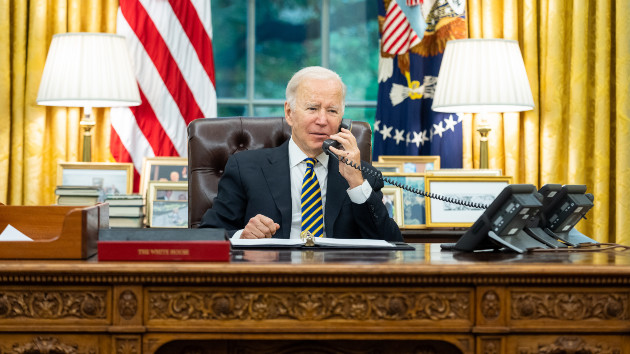
(WASHINGTON) — As President Joe Biden heads to Brussels this week for an extraordinary NATO summit, Sen. John Barrasso, the third-ranking Senate Republican, said he wants the president to “lead from the front” and laid out certain objectives for him to do so.
“Number one is, he needs to tell NATO that we collectively are going to supply the people of Ukraine things that they know how to use, whether it’s drones, planes, missile systems,” Barrasso, R-Wyo., told ABC “This Week” anchor George Stephanopoulos in an exclusive interview Sunday.
“Number two, he has to say that he is going to go to Brussels to the eastern front of NATO to show the resolve of NATO, and the United States’ commitment as well,” he added. “And third, he needs to say to the people of Europe who are really in a tough situation with regard to energy and the dependence that they have on Russian energy, that we are going to increase the exporting of liquified natural gas from America to them.”
As the ranking Republican on the Senate Energy and Natural Resources Committee, Barrasso has been a strong critic of Biden’s renewable energy agenda.
Republicans, like Barrasso, are pushing the administration to increase domestic oil production while reducing foreign energy dependency. Biden already banned all Russian oil imports, and Americans are coping with inflation and steep prices at the gas pump.
Earlier on “This Week,” Sen. Dick Durbin, D-Ill., dismissed claims that Biden is to blame for rising gas prices at home. But Barrasso said no matter who they blame “Democrats have a very big problem.”
“Well, Joe Biden can’t hide from the fact that he is the president of high gas prices,” Barrasso said. “And they’re looking for anyone to blame, whether it’s Putin, whether it’s Republicans, whether it’s energy companies, whether it’s COVID. The Democrats have a very big problem with 40-year high inflation, highest gas prices ever.”
Sen. John Barrasso: “Joe Biden can’t hide from the fact that he is the president of high gas prices. And they’re looking for anyone to blame, whether it’s Putin, whether it’s Republicans, whether it’s the energy companies, whether it’s COVID.” https://t.co/lqnKvv6LuXpic.twitter.com/WerKVlhdzu
Democrats, however, have blamed energy companies for price gouging and have pointed out that a barrel of oil now costs what it did before the war — yet prices remain high.
When asked by Stephanopoulos what more the U.S. should be doing to aid Ukraine, Barrasso accused Biden of being too slow to respond to the crisis so far.
“The president has had to be pushed and pulled to where he is today. It was Congress that brought about sanctions, that brought about the ban on Russian oil, that brought about weapons and all of this big aid package that I voted for a week or two ago, $13 billion,” he said.
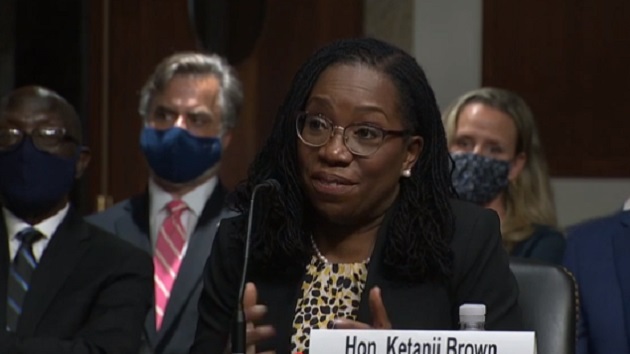
Meanwhile, a historic Supreme Court hearing is set to start Monday on the first Black woman nominee to the high court.
Republican Sen. Josh Hawley of Missouri suggested on Twitter last week that Jackson has a “long record” of letting child porn offenders “off the hook,” an assertion Washington Post fact-checker Glenn Kessler gave “Three Pinocchios.”
“You met with Judge Ketanji Brown Jackson earlier this week. And you said — you didn’t say — suggest how you were going to vote, but you said this should not be a process of character assassination. Is that what Senator Hawley was doing?” Stephanopoulos asked.
“I did meet with her. Clearly, very intelligent. We talked about judicial philosophy. I talked about Justice [Antonin] Scalia, that the — it’s the Constitution, a legal document, not a living document. We had a very good meeting,” answered Barrasso, who voted against Jackson’s confirmation to become a federal judge on the D.C. Court of Appeals last June. “I’m less concerned about her statements than I am about Chuck Schumer’s statements. He said she’s going to rule with empathy. A judge ought to be making decisions based on the law as written, not the way they feel about it.”
Republican colleagues have flagged concerns about Jackson’s record as a public defender, and Barrasso said, “that’s all going to come out with the hearings” while pledging the process will remain fair, thorough and respectful.
Stephanopoulos pressed Barrasso once more, asking: “But do you think Senator Hawley’s attacks were fair?”
“Well, he’s going to have his opportunity to question the judge as will all the members of the committee,” Barrasso responded. “The last time we had a hearing with [Brett] Kavanaugh, he was accused of being a serial rapist with no evidence whatsoever. So, I think we’re going to have a fair process and a respectful process, unlike what the Democrats did to Justice Kavanaugh.”
(WASHINGTON) — The Senate Judiciary Committee on Monday opens a week of high-profile confirmation hearings for Judge Ketanji Brown Jackson, the first Black woman nominated to the U.S. Supreme Court in its 233-year history.
While Democrats have the votes to confirm President Joe Biden’s high court nominee on their own, the hearings could prove critical to the White House goal of securing at least some Republican support and shoring up the court’s credibility.
The spotlight on a historic nominee — and the court itself during such a consequential term of cases — is also an opportunity for both political parties to appeal to key voting constituencies ahead of the midterm campaign season.
Jackson, 51, who currently sits on the nation’s second most powerful court, the U.S. Court of Appeals for the D.C. Circuit, will face questions from the committee’s 11 Republicans and 11 Democrats over two days, starting Tuesday.
Republicans have signaled a desire to scrutinize the substance of Jackson’s record while avoiding the types of personal inquires they opposed in other recent confirmations.
Several GOP senators have telegraphed plans to question Jackson’s defense of detainees at Guantanamo Bay as a private defense attorney; her support of reduced sentences for convicted drug offenders; and the backing of her nomination by outside progressive advocacy groups.
In a sign the hearings could get contentious, Republican Sen. Josh Hawley of Missouri — a former Supreme Court clerk for Chief Justice John Roberts, a potential presidential hopeful and a member of the Judiciary Committee — suggested in a barrage of tweets Thursday that Jackson has a “long record” of letting child porn offenders “off the hook.”
He pointed to aspects of her record from law school, the U.S. Sentencing Commission and decisions from the bench to suggest she is “soft on crime.”
Senate Minority Leader Mitch McConnell, speaking on the Senate floor, said he was concerned that Democrats and what he called Jackson’s “far-left activist” supporters are touting her as someone with “special empathy” after having served as a public defender. “If any judicial nominee does have special empathy for some parties over others, that’s not an asset, it’s a problem.”
White House press secretary Jen Psaki push back hard on Friday.
“After weeks of trying hard to find some way to attack Judge Jackson, first saying that she was an affirmative action pick, then saying she was the product of dark money, then saying she should be — she should be suspect because she was a public defender, a group of far-right Republican senators … have launched a last-ditched eve of hearing desperation attack on her record on sentencing in sexual offense cases,” she said.
“The facts are that, in the vast majority of cases involving child sex crimes, broadly, the sentences Judge Jackson imposed were consistent with or above what the government or U.S. probation [authorities] recommended. And so, this attack that we’ve seen over the last couple of days relies on factual inaccuracies and taking Judge Jackson’s record wildly out of context,” Psaki said.
Both sides are also expected to zero in on Jackson’s nearly 600 written opinions as a federal judge and the 14 times her rulings were reversed or vacated by higher courts, according to a tabulation by the Alliance for Justice, a left-leaning legal advocacy group.
“We know that she is a liberal jurist, but that’s a large spectrum,” said Sarah Isgur, a former Trump administration attorney and ABC legal analyst. “When she was ruling on something related to the Trump administration, she tended to rule against them. And those were the cases that she would sometimes get reversed on.”
Jackson has been vetted twice previously by the Judiciary Committee and twice confirmed by the full Senate as a judge — most recently last year, with Republican votes. She was also confirmed in 2010 as vice chair of the U.S. Sentencing Commission.
“She is not a blank slate. She is someone who has received Republican votes before,” said Rachel Barkow, vice dean of NYU Law School and former Jackson classmate at Harvard Law School. “You can see in her opinions a very principled kind of decision making that the Republicans have said they are looking for.”
GOP Sens. Susan Collins, Lisa Murkowski and Lindsey Graham voted in favor of Judge Jackson’s confirmation to the D.C. Circuit in June 2021. After private meetings with Jackson this month, all three were noncommittal about supporting her again.
Senate Judiciary Committee Chair Dick Durbin has said he is hopeful more than three Republicans will support the nomination this time around. But GOP Whip Sen. John Thune said Tuesday he would be surprised it that was the case.
“I think it’s important to recognize that she has been confirmed three times now, so this is not a candidate who is a blank slate to us,” Collins said after spending more than 90 minutes one-on-one with Jackson. “I will, of course, await the hearings before the Judiciary Committee before making a decision.”
No Republican senator has publicly disputed Jackson’s qualification to be a justice, though several have raised concerns about her rulings and presumed judicial philosophy, which she has insisted she does not have.
“She obviously is someone with a high degree — a very high degree of legal acumen and, I think, grasp of the precedents in court, and so I think her hearings will be very very substantive,” said Missouri Republican Sen. Josh Hawley after meeting the judge this month.
McConnell, who has said there’s “no question” Jackson is qualified for the position, plans to press the judge about proposals to overhaul the high court and expand its membership.
“I didn’t get an answer to that but I’m sure she’ll be asked that again in her hearings before the Judiciary Committee,” McConnell said after meeting with Jackson.
As a double graduate of Harvard and a member of the university’s Board of Overseers, Jackson is also expected to face questions about whether she would recuse herself from a major case this fall involving the school’s use of race as a factor in admissions.
Several Republicans have signaled willingness to ask Jackson about whether she considers herself an “affirmative action” pick for the high court given Biden’s 2020 campaign promise to nominate a Black woman at his first opportunity.
“That could hurt Republicans if they try to spend too much time on this,” Isgur said, “but I expect one of the first questions at this hearing to be: You are highly qualified, but a lot of other highly qualified people weren’t considered for this job because of their race. Would you think that was lawful if it happened at a private employer?”
The White House has said it views courting Republican support for Jackson as important to dialing down partisanship around high court confirmations. The 2020 vote installing Amy Coney Barrett as the newest Supreme Court justice marked the first time no senator in the minority party supported a nominee in at least 150 years of recorded votes, according to the Senate Historical Office.
Jackson has more experience fielding questions during high-intensity Senate hearings than any nominee since Clarence Thomas in 1991. She has described it as an “extremely nerve-wracking” process, telling audiences that she took up knitting as a way to channel nervous energy.
“The lights are as bright as they are in here, in terms of cameras and attention, and you do your best not to make a fool of yourself in front of the senators,” Jackson said in a conversation for the D.C. Circuit Historical Society in 2019.
For each half hour of the proceeding, up to 60 members of the public invited by senators will also be allowed to attend.
The confirmation process has been moving at near-record pace with just 24 days elapsing between the president’s announcement of his pick to replace retiring Justice Stephen Breyer and the scheduled hearings.
The median interlude is 49 days, according to the Congressional Research Service. Republicans’ blitz to confirm Amy Coney Barrett in late 2020 — holding hearings just 13 days after Trump named her — is the quickest confirmation push since 1975.
“She is so thoughtful and even handed and tries to look at both sides, and another amazing thing about her – she’s had such a breadth of experience,” said Senate Democratic Leader Chuck Schumer following his meeting with Jackson.
Democrats hope to confirm Jackson before the middle of April. She is not expected to be fully sworn in for duty on the high court until July, once Justice Breyer steps down.
(WASHINGTON) — A little over a year ago, the U.S. pandemic response was all about the COVID-19 vaccine rollout. The focus was on getting vials and needles to cities and towns, far and wide, as quickly as possible.
Jeff Zients was deemed the right man for the job of White House coronavirus response coordinator because he had a reputation as a savvy businessman who could cut bureaucratic red tape.
So on Thursday, when the White House announced Zients was stepping down in April and that Dr. Ashish Jha, a leading public health voice, would be the new face of the federal coronavirus response, it emphasized the recent shift in the nation’s pandemic strategy to a phase that’s more about preparedness and communication rather than maximizing operational effort.
Jha, the dean of the Brown University School of Public Health, initially stepped into the spotlight during the pandemic as a doctor with straightforward advice and predictions about the pandemic. He has at times been a daily presence on television, including on ABC News, and he’s been applauded for giving candid answers about what people should do to stay safe. On Twitter, his takes on the latest pandemic news have garnered him hundreds of thousands of followers.
Brown University announced that Jha will take a short-term leave from the School of Public Health for the temporary White House special assignment.
For the White House, Jha’s popularity is a selling point in the face of a growing communications problem for the Biden administration, under whom the Centers for Disease Control and Prevention has been criticized for being too slow and vague in its guidance on issues like masking recommendations and quarantine timelines. And as the country moves away from masks, administration officials say Jha’s deft communication skills will be an important asset in light of a potential resurgence in cases from the BA.2 variant.
If mask guidance changes, Jha will be at the forefront of explaining why Americans should put them back on.
He’ll also be at the helm while experts at the CDC and the Food and Drug Administration consider whether Americans will need a second round of booster shots, and at what point shots will be authorized for those under five years old, which vaccine companies expect to happen sometime this spring.
During the course of the pandemic, Jha — who is a practicing internist in New England in addition to working in academia — has already racked up some government experience, participating in congressional hearings on the national pandemic response and advising the Biden White House on the National COVID-19 Preparedness Plan.
He’s also been tied to the Washington circuit through consulting work — including work with one firm that some experts have criticized for the opaque nature of its client lists, raising questions regarding potential conflicts of interest. Listed as a “senior advisor” at the boutique international consulting firm Albright Stonebridge Group, Jha is the latest addition to a long list of senior Biden administration officials who have previously worked at consulting firms with murky client lists.
Many such officials have disclosed much of their consulting work as part of their obligatory financial disclosures — and Jha, as an incoming member of the White House team, is required to disclose his past employment and sources of income, along with his personal finances, within 30 days of assuming his role.
But the specifics of Jha’s work for Albright Stonebridge might not be part of that disclosure unless he discloses the work as part of his ethics agreement — because Jha says he did not get paid for his work at the firm. Officials are only required to include in their personal financial disclosures clients that have paid them more than $5,000 for their services.
Last year, when news of his work with the group circulated on Twitter, Jha wrote that he had advised the group on “pandemic preparedness,” but not for a fee: “In 2020, I volunteered for Madeline Albright’s group (got paid $0) to advise on their work around future pandemic preparedness,” Jha said.
The arrangement could present the appearance of a conflict of interest in Jha’s new role, said Delaney Marsco, ethics legal counsel for the Washington-based nonprofit Campaign Legal Center. But to what extent would depend on Jha’s specific clients, the nature of his consulting work, and what he will be working on while in government, Marsco said.
“Positions that are more honorary and passive are less likely to raise a conflict or even an appearance,” Delaney told ABC News. “If he was directly working on issues related to the COVID-19 pandemic for a private company with a significant interest in the government’s current response, there is heightened concern. More disclosure can help us assess the potential for conflict.”
When contacted by ABC News for a comment from Jha, Mahrokh Irani, an associate director in the Brown University School of Public Health’s dean’s office, said that “Dr. Jha was an unpaid advisor for ASG from June, 2020 to February, 2022. Dr. Jha provided to ASG his views on the latest developments in the pandemic and how to be prepared. His work was unrelated to Pfizer, Merck or pharmaceutical company IP issues.”
Of his work for Albright Stonebridge, Jha also said on Twitter in May 2021: “Do dozens of these kinds of things. Happy to put together list of everyone I advise/talk to. I’ll do that.” However, records and social media searches suggest that Jha has not yet publicly released a list of his private consulting clients.
Representatives for Albright Stonebridge Group declined to comment to ABC News.
White House officials say that Jha will undergo extensive ethics training as he joins the administration, as every new hire does.
“While we can’t comment on specific past affiliations, as a White House employee, Dr. Jha will receive rigorous ethics counseling on his obligations under federal ethics law and the Biden-Harris Ethics Pledge, and will follow all applicable ethics and recusal requirements to prevent any conflicts of interest or even the appearance of a conflict, including with respect to his past affiliations,” a White House official said in a statement.
Sarah Reingewirtz/MediaNews Group/Los Angeles Daily News via Getty Images
(WASHINGTON) — When President Joe Biden said “the answer” to nationwide crime surges was to fund police, he reignited intense debate on defunding police departments.
“The answer,” Biden said in his State of the Union speech on March 1, “is not to defund the police. The answer is to fund the police. Fund them with resources and training they need to protect our communities.”
With that, more are taking deeper looks into whether funding can be effective at lowering crime rates. But some advocates who spoke with ABC News continue to wonder whether defunding police departments and shifting monies to efforts like mental health service and youth programs is the ideal, multi-pronged approach to combating rising crime.
Across the country, major cities are contending with disturbing increases in crime rates.
For example, New York City saw a 38.5% increase in overall crime when comparing January 2020 to January 2021 and Philadelphia’s homicide rate in 2022 is beginning to outpace the dangerous, record-high numbers of 2021.
And when crime rises, political leaders typically focus on increasing police budgets — a Wall Street Journal report found that about half of the top 20 largest U.S. police jurisdictions proposed police funding increases in their 2022 budgets.
However, after the racial reckoning of the summer of 2020 following the murder of George Floyd by former Minneapolis officer Derek Chauvin, some called for “defunding” the police.
Those who advocate for defunding police say that funds from police departments should be reallocated toward other programs that address community issues like poverty, housing and more.
Those who are against defunding the police say that reducing funding will worsen crime and leave police departments without the resources to do their jobs efficiently.
“Without the police, you’re left with … no line of defense between innocent people and the potential for lawlessness,” said Jim Pasco, the executive director of the Fraternal Order of Police.
Facts about police department funding
Nationally, $115 billion is spent each year on policing, according to the criminal justice research and policy organization Vera.
The vast majority of police funding — an estimated 80% – 95% of a department’s total budget — goes to personnel, according to the International Association of Chiefs of Police.
This means that most money goes toward putting police on the street.
“One of the largest expenditures of any police department is their payroll,” said Pasco. “It’s getting those officers hired and trained, out on the street — it’s an extraordinarily expensive undertaking.”
Spending also goes toward equipment (like gear and patrol cars), operational costs (like uniforms and office supplies), and the funding of community programs.
Police agencies across the country reported to the Police Executive Research Forum that hiring has stalled or decreased, while resignations and retirements have increased.
Those who advocate for defunding police say this proves money allocated to personnel should go elsewhere, while others say it shows more money is needed to better train and retain good police officers.
“You need money to hire people,” Pasco said. “You need money to recruit qualified people, hire them, train them and put them out on the street and put them to work.”
Others say funding to get police back on the streets isn’t worth it because the job has become almost impossible to recruit for.
Eugene O’Donnell, a former NYPD officer and lecturer at John Jay College of Criminal Justice, says police are forced to work longer and take on dangerous situations with less backup due to the poor retention and hiring rates.
“You’re simply not going to get humans to put on police uniforms, especially in places where they would be needed the most. They’re not going to go near the job now,” O’Donnell said. “The people that will want the job will be scary.”
As a result, he says departments — those provided with more funding or not — are extraordinarily stretched.
To fund or defund: Measuring which is more successful
Factors like falling crime, fewer violent or harmful police interactions and successful community programs are just a few of the considerations for some experts to consider that expanded police funding is a productive tactic.
But others, including Sakira Cook, senior director of the justice reform program at The Leadership Conference on Civil and Human Rights, says that investing in an increased police presence and funding is not the way to go.
“For decades, policymakers have pushed tough-on-crime policies that have not made us safer, but only wreaked havoc and destroyed lives — particularly in Black and Brown communities, while costing us billions,” Cook said.
She says that tough-on-crime officials have often implemented strict criminal codes, long prison sentences and expanded police power on the streets.
A University of Dayton Law Review study said it found that these kinds of policies did not reduce crime rates. Research in the Police Journal also failed to find a relationship between increased police presence and crime deterrence.
A National Bureau of Economic Research study found that additional officers can translate to fewer homicides — but can lead to more arrests for low-level offenses.
Hans Menos, the vice president of Law Enforcement Initiatives for the Center for Policing Equity says that these laws and funded efforts don’t fix the roots of crime — poor local infrastructure, accessibility to community programs and services, etc.
“I vastly prefer conversations on funding and resources that talk about systems of care, like community development … all the other things that have been neglected in favor of systems of punishment,” Menos told ABC News.
However, some departments have shifted resources and now fund mental and behavioral health professionals who can respond to lower-level calls. This, proponents say, reduces pressure on the police, reduces community contact with police and eases the burden on the criminal justice system.
“Many people have started these alternate responder programs with great success,” Menos said.
He added: “The programs that take social services and embed them within police departments are successful because it’s taking the idea of a first responder and recognizing that it needs to be a whole lot more specialized and needs to be a lot more responsive to community concerns.”
How funded and defunded police departments measure up
Some of the most well-funded departments in the country — many of which increased their budgets in 2021, including Baltimore, Maryland and Washington, D.C., — saw a rise in violent crimes. However, a few have seen major decreases, like in Wilmington, Delaware.
Several of the departments that have reduced their budgets, including Portland, Oregon, and San Francisco have also seen spikes in crime.
Some of the departments that cut their budgets invested in mental health responders to low-level or non-violent calls.
Many of these programs are relatively new, so it’s difficult to measure long-term success.
The complexities of the current state of policing in the U.S. has experts disagreeing on whether more funding or less funding is “the answer.”
“To make this investment in our communities, we must shrink the footprint of the criminal-legal system in our lives, by sizing budgets and shifting resources away from solely criminalization and incarceration toward investments in social programs and services,” Cook said.
Some think the police are no longer the public safety tool of choice with the way they are currently functioning.
“The police profession at this point is beyond repair,” O’Donnell said. “And we would be better off figuring out other ways to secure the public. “
Some say otherwise.
“The vast majority of Americans want to be want to feel safe in their homes and in their churches and their schools and their transportation systems,” Pasco said. “It sometimes takes police officers to ensure that that is a possibility.”
(WASHINGTON) — The Biden administration is considering ways to fast-track bringing Ukrainian refugees to the U.S. amid the historic surge across Europe of Ukrainians fleeing Russia’s war, according to U.S. officials.
But the administration faces some legal hurdles to doing so, especially to giving Ukrainians refugee status, and has instead repeatedly emphasized that “the vast, vast majority of refugees want to stay in neighboring countries,” as White House press secretary Jen Psaki said Thursday, adding, “That is where we have been focus our energies at this point.”
That focus comes in the form of U.S. assistance: $293 million so far, with another $4 billion specifically for humanitarian aid in the new funding bill President Joe Biden signed earlier this week.
But as the needs grow — as cities like Warsaw and countries like Moldova are overwhelmed — there’s growing pressure on the White House, including from some U.S. lawmakers, to do more.
The refugee resettlement process, however, is complex and time-consuming, with very few avenues to expediting cases from the point they are referred to the U.S. by the United Nations refugee agency, through the vetting process, to their resettlement in a local community.
But Secretary of State Antony Blinken confirmed the administration is “looking at things that we can do ourselves and do directly.”
“As this and if this goes on, as the numbers increase, as the burden increases for European partners, we will certainly do everything we can to help,” he added Thursday, saying it was “something we’re very focused on right now” and previewing “more to say on this in the coming.”
So far, the White House has ordered some steps. Last week, the Department of Homeland Security announced it had granted Temporary Protected Status for Ukrainians already in the U.S. by March 1, allowing them to stay legally and work for at least the next 18 months.
In addition, U.S. embassies and consulates in the region have been expediting visa processing for immediate family members of U.S. citizens, but they are overwhelmed.
“We are throwing many, many resources at the assistance for U.S. citizens in this region as well as visa processing, but the demand, as you can imagine, is very high,” a senior U.S. administration official said. “We are not able to process the volume of the people who are thinking about that as an option.”
That pool of people is also already limited. Immigrant visas only apply to immediate family members as defined under U.S. law — spouses, unmarried children under 21, and parents.
If a U.S. citizen’s family member doesn’t fall into those categories, there’s a process to petition U.S. Citizenship and Immigration Services to approve their case, but that is not being expedited, according to the senior administration official, meaning their application could take months, even years.
Refugee advocates, however, say there are potentially thousands of Ukrainians for whom the USCIS has confirmed their familial relationship, but haven’t yet fully approved their petition — arguing their cases can and should now be expedited.
It’s unclear if the administration is weighing that. Blinken told reporters Thursday they were “looking at steps we may be able to take on family reunification.”
Wait times for nonimmigrant visas are often shorter, and applicants can request your application be expedited. But the senior administration official said there’s a risk of being denied because these are “not the appropriate tool to begin an immigrant, refugee, or resettlement process.”
“If your plan is to go to the United States and you have absolutely no idea what you’ll do after that — which I have to say on a human level is very understandable — as U.S. consular officers who are charged with executing U.S. immigration law, they [Ukrainian applicants] would be well advised to have much more of a plan afterward,” they said.
The Department of Homeland Security also has the ability to provide another kind of temporary legal status known as humanitarian parole that allows a foreigner to enter the U.S. usually for up to a year. Reuters has reported that Customs and Border Patrol agents have been granting humanitarian parole to Ukrainians crossing the U.S.-Mexico border.
DHS declined to comment to ABC News about those reports.
“We address an individual’s claim for humanitarian relief as they are presented to us,” Homeland Security Secretary Alejandro Mayorkas said Thursday. “We are looking at other programs that we can implement to expand the avenues of humanitarian relief.”
But DHS continues to use a public health authority known as Title 42 to send the majority of adults attempting to cross the border back to their country of origin. The policy was enacted at the start of the COVID-19 pandemic by the Trump administration, and despite intense pressure from immigrants’ rights group and progressive Democrats, the Biden administration has yet to lift it.
Mayorkas said DHS has issued guidance to all CBP officers on the border reminding them of the exceptions to the Title 42 authority and how it relates to Ukrainian nationals “and everyone else” attempting to make credible fear claims at the southern border. But Psaki said revoking Title 42 “wouldn’t be done in response to a war in a European country. It’s done by — a decision would be made by the CDC and then it would be implemented.”
The push to “fast track” the refugee process, however, is unlikely to yield results, with the program defined by law and requiring a referral and thorough vetting. The senior administration official said it “is not an emergency response program, so our goal would be to provide humanitarian assistance to keep people safe where they are for now” instead.
For many refugees seeking to move to the U.S., it is a years-long process. There are already 7,000 Ukrainian refugees who have been in the pipeline for resettlement, according to Church World Service.
While Blinken said “of course we will take referrals” for new refugees, he also emphasized the administration is “looking at steps that we can take in the near term.”
Refugee resettlement agencies say the administration is considering using the Lautenberg program as one way to potentially expedite refugee status. The Cold War-era program allows religious minorities, including Ukrainian Greek Catholics and Ukrainian Autocephalous Orthodox Christians, to bring family members to the U.S. with refugee status.
One agency told ABC News there are thousands of Ukrainian applications that the U.S. could swiftly admit, but it’s not clear the administration agrees.
ABC News’s Ben Gittleson and Sarah Kolinovsky contributed to this report.
On Friday, the U.S. House of Representatives has passed the CROWN Act (Create a Respectful and Open Workplace for Natural Hair), in a 235-189 vote which will further put an end to race-based hair discrimination.
This new legislation will prohibit discrimination based on one’s hair texture or hairstyle — specifically pointing to hairstyles associated with a particular race or national origin.
With this new passing, the bill will now head to the Senate to be voted upon with legislative sponsors Democratic New Jersey Sen. Cory Booker and Rep. Bonnie Watson Coleman leading the charge.
In a Twitter post, Coleman recalled that on the last day of Black History Month, 188 House Republicans temporarily obstructed passage of the CROWN ACT.
“Despite what my GOP colleagues may tell you, this bill is too important to give up on,” she added. “That’s why today, I brought it to the floor again.”
Coleman also elaborated in a statement saying, “Natural Black hair is often deemed ‘unprofessional’ simply because it does not conform to white beauty standards. Discrimination against Black hair is discrimination against Black people. I’m proud to have played a part to ensure that we end discrimination against people for how their hair grows out of their head.”
GOOD NEWS: The #CROWNAct has passed the House! Today, America got one step closer to ending racial discrimination.
The bill now heads to the Senate, where I hope my colleagues will pass it without delay. pic.twitter.com/jBqoSr9qaN
— Rep. Bonnie Watson Coleman (@RepBonnie) March 18, 2022
As many supporters and sponsors of the potential federal law continue to carry enthusiasm, several have also spoken out applauding the recent House passage.
“Every day in this country, Black women and girls face discrimination because of their natural hair at their workplaces and schools,” said Congressional Black Caucus Chairwoman Joyce Betty in a statement. “So today, I proudly voted yes on the #CROWNAct to finally end race-based hair discrimination once and for all.”
She continued, “It’s simple — discrimination against Black hair is discrimination based on race. I look forward to swift passage of this critical legislation in the Senate and to standing with President Biden as he signs it into law. To every young Black girl and boy, I say to you, your hair — from your kinks to your curls, from your fros to your fades, from your locs to your braids — is a crown. Be proud of your hair and know the Congressional Black Caucus is fighting for you.”
Today, the House of Representatives passed the #CROWNAct: Creating a Respectful and Open World for Natural Hair.
President Joe Biden’s Administration has already shown support for the legislation as well by sharing in a statement that the “administration looks forward to working with the Congress to enact this legislation and ensure that it is effectively implemented.”
Following California’s official ban in 2019, the CROWN Act has also seen legislative wins in 13 additional states including New Jersey, Virginia, Colorado as well as in 34 municipalities.
(WASHINGTON) — In a high-stakes video call, President Joe Biden and China’s President Xi Jinping spoke Friday morning for the first time since November amid concerns that China will help Russian President Vladimir Putin’s ongoing invasion of Ukraine.
The White House said the two leaders spoke for one hour and 50 minutes.
White House press secretary Jen Psaki said Biden would be candid and direct and that the call provided a chance for him to “assess where President Xi stands.” The conversation would center on “managing the competition between our two countries as well as Russia’s war against Ukraine and other issues of mutual concern,” according to the White House.
Biden was expected to warn Xi that if China directly helps Russia in its assault on Ukraine there will be consequences — but it’s unclear if he laid out specific actions the U.S. will take if China were to supply Russia with military equipment or economic assistance to offset the impact of global sanctions.
In what appeared to be a warning shot to the West, Russia’s Foreign Minister Sergei Lavrov said Friday that any foreign supplies to Ukraine containing military equipment will be considered “legitimate targets” for Russian strikes after Biden announced this week a slate of weapons the U.S. is supplying to Ukraine.
“We clearly said that any cargo moving into the Ukrainian territory which we would believe is carrying weapons would be fair game. This is clear because we are implementing the operation the goal of which is to remove any threat to the Russian Federation coming from the Ukrainian soil,” Lavrov said in an English-language interview with the RT television channel.
Ukrainians woke up Friday to the first strike on the outskirts city of Lviv, considered a safe haven until now, and not far from the Polish border. It follows a stark warning from the Pentagon that Russia was broadening its target and escalating attacks this week.
While the Biden administration has hesitated from drawing red lines of what would change its position on not supporting a no-fly zone or troops on the ground in Ukraine, Lavrov’s message raises concerns that Russia could fire at military bases in neighboring NATO ally Poland to Ukraine, triggering an Article 5 response.
Earlier this week, national security adviser Jake Sullivan had a seven-hour meeting with his Chinese counterpart in Rome, which was described as “intense.” A senior Biden administration declined to tell reporters whether China had expressed an openness to providing Russia with military or economic support or if it had already provided support to Russia since it invaded Ukraine.
“We do have deep concerns about China’s alignment with Russia at this time, and the national security adviser was direct about those concerns and the potential implications and consequences of certain actions,” the official said.
That meeting had been “long-planned” and “long-discussed” as a way to maintain communication with China, but it happened to take place at “a really timely and important moment in this crisis,” the official added.
Biden and Xi’s critical call comes on the heels of Biden labeling Putin a “war criminal,” a “murderous dictator,” and a “pure thug” in the last 48 hours. Secretary of State Antony Blinken said Thursday he “personally” agrees with Biden that Russia has committed war crimes in Ukraine.
(WASHINGTON) — Officials from the Biden administration met with Florida LGBTQ students and their families in a virtual roundtable concerning the now-dubbed “Don’t Say Gay” bill and other legislative efforts advocates deem anti-LGBTQ.
U.S. Secretary of Education Miguel Cardona and Rachel L. Levine, assistant secretary for health at the U.S. Department of Health and Human Services, listened to the students and their family members discuss concerns and fears about the impact of such bills.
The two were advised on what resources could be provided to support the Florida LGBTQ community.
“Laws around the country, including in Florida, have targeted and sought to bully some of our most vulnerable students and families, and create division in our schools,” Cardona said in a statement.
He added: “My message to you is that this Administration won’t stand for bullying or discrimination of any kind, and we will use our authorities to protect, support, and provide opportunities for LGBTQI+ students and all students.”
The Parental Rights in Education bill, dubbed the “Don’t Say Gay” bill by LGBTQ activists, would limit what classrooms can teach about sexual orientation and gender identity.
Under this legislation, these lessons “may not occur in kindergarten through grade 3 or in a manner that is not age-appropriate or developmentally appropriate for students in accordance with state standards.”
The bill would also allow parents to sue school districts that engage in these topics. The bill is awaiting a decision from Gov. Ron DeSantis.
The Biden administration has denounced the efforts as “hateful.”
“Every parent hopes that our leaders will ensure their children’s safety, protection, and freedom,” the White House said in a statement Feb. 8.
It continued: “Today, conservative politicians in Florida rejected those basic values by advancing legislation that is designed to target and attack the kids who need support the most – LGBTQI+ students, who are already vulnerable to bullying and violence just for being themselves.”
After the bill was passed by the Florida House and Senate, Cardona slammed the legislators responsible for its passage.
“The Department of Education has made clear that all schools receiving federal funding must follow federal civil rights law, including Title IX’s protections against discrimination based on sexual orientation and gender identity,” Cardona said.
Levine and Cardona also shared with students and families the mental health resources and support that are currently available for these students.
“We need to support LGBTQI+ youth, their parents and families to help them achieve the good health and quality care they deserve,” Levine said. “Our communities have a champion in President Biden. The President supports equality and works to ensure everyone is represented. And that gives people a voice, a chance to effect change, to help people understand the diverse needs of our nation.”
Legislation targeting the LGBTQ community has sent shockwaves throughout the U.S.
States continue to debate whether trans youth should receive gender-affirming health care, whether trans girls should be allowed to play girls’ sports, or whether LGBTQ content can be taught in schools.
(WASHINGTON) — With President Joe Biden’s $15.6 billion request for COVID-19 relief stalled in Congress, the federal government plans to begin significantly cutting the number of viral treatments available to the states, according to internal planning documents obtained by ABC News, which show a decrease of some 30%.
The drawdown, which begins Monday, includes monoclonal antibodies that have been shown to work against the omicron variant. Their ability to curb hospitalization rates, particularly among unvaccinated high-risk patients, has made them a key component in Biden’s COVID plan.
Weekly allocations of the monoclonal antibody Sotrovimab from GSK and Vir Biotechnology will be cut from 52,250 to 35,000 through at least the next three weeks, according to the documents, which were verified by two people familiar with the situation.
Weekly allocations of Eli Lilly’s recently authorized monoclonal Bebtelovimab, which has so far worked against both the omicron and BA.2 subvariant, will be cut from 49,000 to 30,000 doses.
The White House has also warned that antiviral pills from Pfizer and Merck could run out by September if the government doesn’t place more orders soon.
Also starting Saturday, unordered doses in each distribution cycle will be reclaimed and reabsorbed into the federal inventory for later redistribution, according to the planned allocation schedule. The monoclonal Evusheld, which is meant for highly vulnerable groups like immunocompromised people to protect them even before exposure to the virus, will be allocated on a monthly basis, and unordered doses will be swept up at the end of each month, starting March 31.
This new supply policy comes as the COVID funding cuts threaten to force the government to ration lifesaving drugs.
The White House has warned that with funding stalled in Congress “critical COVID response efforts” will grind to a halt; absent that cash infusion, the nation will not be able to keep up with testing, supplies of antibody treatments, boosters and antiviral treatments.
A new purchase of hundreds of thousands more monoclonal courses planned for next week will also be canceled. The White House predicts the U.S. will fully exhaust the supply by May.
“The allocation projections are subject to change and should be used for planning purposes only,” the planning document advises. “Of course, the COVID-19 environment remains dynamic.”
ABC News’ Anne Flaherty, Cheyenne Haslett, Ben Gittleson, Eric M. Strauss and Sony Salzman contributed to this report.

![‘It’s Putin’s war, not [the] Russian people’s war’: Russian anti-war journalist](https://s3.amazonaws.com/syndication.abcaudio.com/files/2022-03-20/032022_ABCNews_RussianJournalist.jpg "‘It’s Putin’s war, not [the] Russian people’s war’: Russian anti-war journalist")