(WASHINGTON) — Jared Kushner, former President Trump’s son-in-law who served as a senior West Wing aide during the Trump administration, is expected to appear voluntarily before the House select committee investigating the Jan. 6 Capitol attack as early as Thursday, according to multiple sources familiar with the plans.
A spokesman for the committee did not respond to a request from ABC News seeking comment on plans to question Kushner, which could be postponed or delayed.
Plans are for Kushner to appear virtually before the panel, according to sources.
Kushner was traveling back to Washington, D.C., from Saudi Arabia on Jan. 6 when the attack on the Capitol began, and did not return to the White House when he landed.
According to ABC News Chief Washington Correspondent Jonathan Karl in his book “Betrayal,” Kushner avoided the White House because he thought he would get in a “fight” with the president, Kushner told a GOP lawmaker one day after the riot.
Kushner’s wife Ivanka was with Trump at the White House that day, and repeatedly tried to get him to help stop the riot at the Capitol, according to Karl. The committee has been negotiating with Ivanka Trump over whether she will cooperate with the panel’s inquiry in recent weeks.
Kushner held a broad portfolio in the White House — covering the federal coronavirus response and Middle Eastern peace efforts — but kept his distance from efforts to challenge and overturn the election results.
But he was still seen as a key figure in the West Wing; in text messages obtained by the committee, Ginni Thomas — the conservative activist and wife of Supreme Court Justice Clarence Thomas — suggested to Trump’s Chief of Staff Mark Meadows that she was in contact with Kushner regarding Trump attorney Sidney Powell, who repeated and promoted unfounded conspiracy theories about widespread voting fraud.
The panel could ask Thomas to voluntarily cooperate with its investigation in the coming days, sources tell ABC News.
(WASHINGTON) — A federal judge has found that former President Donald Trump “more likely than not” committed felony obstruction in the effort to overturn the 2020 presidential election.
The judge said Trump’s former lawyer John Eastman must turn over documents to the Jan. 6 House committee investigating the attack on the U.S Capitol.
(NEW YORK) — Senate Judiciary Committee member Amy Klobuchar said Supreme Court Justice Clarence Thomas should recuse himself from certain cases after it emerged that his wife, Virginia “Ginni” Thomas, sent text messages to former White House Chief of Staff Mark Meadows urging him to help overturn the 2020 election results, calling it “a textbook case for” recusal.
Meadows voluntarily turned over the messages to the committee last year before deciding not to cooperate with the inquiry. In January, the court declined to block the Jan. 6 committee from obtaining Trump White House records over the objection of only one justice: Thomas.
“The facts are clear here. This is unbelievable,” Klobuchar, D-Minn., told “This Week” co-anchor Jonathan Karl in an exclusive interview on Sunday. “You have the wife of a sitting Supreme Court justice … advocating for overturning a legal election to the sitting president’s chief of staff.”
“She also knows this election — these cases are going to come before her husband,” she added. “This is a textbook case for removing him, recusing him from these decisions.”
Karl followed up, and “if he doesn’t recuse himself?”
Klobuchar said “the entire integrity of the court is on the line here” and that she’s looking to leadership from Chief Justice John Roberts and the rest of the bench to speak out on the issue.
“They had better speak out on this because you cannot have a justice hearing cases related to this election and, in fact, the ethics rules that apply to all the other federal judges say that if it involves a family member, appearance of impartiality, they have to recuse themselves,” she said.
“So not only should he recuse himself, but this Supreme Court badly needs ethics rules,” Klobuchar added.
Following a week of contentious hearings to consider President Joe Biden’s Supreme Court nominee, Ketanji Brown Jackson, Karl pressed Klobuchar, who was present for those hearings, on whether any Republicans would vote for Jackson, the first Black woman to be nominated to the high Court. With West Virginia Democratic Sen. Joe Manchin making clear his intention to vote for Jackson, she is on track for confirmation with or without GOP support.
“I think she (will). She has in every other nomination that she’s had for very levels of the court… I can’t tell you who. I can’t tell you how much. But I think that will be very important to this process,” Klobuchar said, applauding Jackson as “the pillar of strength” for how she handled Republicans’ “attacks” during the hearings.
In a defining moment of his presidency, Biden warned Russian President Vladimir Putin to not “even think about moving on one single inch of NATO territory,” during a Saturday speech from the grounds of the Royal Castle in Warsaw, Poland.
He also surprised many when he said Putin “cannot stay in power,” leading White House officials to clarify that the United States is not calling for regime change in Russia.
But Karl noted “that was the headline around the world,” and “that was the message heard in Moscow.”
Klobuchar responded by saying she’s been on the Polish-Ukrainian border and seen and heard firsthand the horrors from refugees escaping Ukraine “leaving everything they have behind, everything, their little stuffed animals and their backpacks, moms with suitcases leaving their husbands behind to fight.”
“Vladimir Putin is a monster,” she said. “But the position of the United States government is not to send troops there. It is to give all the aid we can to Ukraine…it’s the humanitarian aid, over $1 billion pledged, taking in over 100,000 refugees, that is what we are doing.”
Karl pressed: “And it’s not regime change in Moscow?”
“That has been made very clear,” she said.
ABC News’ Benjamin Siegel, Katherine Faulders, Jonathan Karl and Devin Dwyer contributed to this report.
(SALT LAKE CITY) — The Utah state legislate has voted to override Gov. Spencer Cox’s veto of an anti-transgender sports bill that would ban transgender girls’ participation in sports.
The state House and Senate each gathered the necessary two-thirds of votes to override Cox’s veto Friday. The ban will take effect July 1.
Cox wrote a letter Tuesday to state Senate President Sen. J. Stuart Adams and state House Speaker Rep. Brad R. Wilson listing the “fundamental flaws” he considered when vetoing the bill.
He wrote that he chose to veto it “because the bill was substantially changed in the final hours of the legislative session with no public input and in a way that will likely bankrupt the Utah High School Athletic Association and result in millions of dollars in legal fees for local school districts.”
Adams responded by vowing to override the veto.
“Doing nothing is taking a step backward for women. Finding a solution to this complicated issue is necessary to maintain fair competition now and in the future,” Adams said in a March 22 online statement.
HB11 initially allowed trans participation in girls’ sports and proposed that a commission decide if there is a threat to safety or fairness against cisgender girls in competitions.
However, on the last day of the legislative session, a substitute of the bill was introduced to implement an all-out ban on transgender women’s participation in sports, and the commission would only come into play if a court prohibited the ban.
“It is important to note that a complete ban was never discussed, never contemplated, never debated and never received any public input prior to the Legislature passing the bill on the 45th and final night of the session,” Cox wrote.
Cox warned that school districts will also be liable for any lawsuits to come from this ban.
He states that only four trans students are playing sports in the state, with only one athlete in girls’ sports, and they are not unfairly dominating. He said the high rates of mental health challenges transgender youth face due to discrimination also influenced his decision.
“Four kids who are just trying to find some friends and feel like they are a part of something. Four kids trying to get through each day,” Cox said.
He added, “Rarely has so much fear and anger been directed at so few. I don’t understand what they are going through or why they feel the way they do. But I want them to live.”
Cox warned legislators that he also plans on calling a special session to change the section of the bill in order to avoid bankrupting the athletic association and local schools if they override his veto.
Indiana Gov. Eric Holcomb has also vetoed a transgender sports bill this week and is also facing attempts from the legislature to override his decision.
At least 11 other states have implemented bans against transgender athletes.
(WASHINGTON) — The Pentagon has been providing daily updates on the Russian invasion of Ukraine and Ukraine’s efforts to resist.
Here are highlights of what a senior U.S. defense official told reporters Friday on Day 30:
In apparent shift, Russian offensive toward Kyiv stopped, troops now in defensive positions
The official described how Russian forces around Kyiv appear to have stopped offensive operations toward the capital city and are moving into defensive positions as they seem to be prioritizing offensive operations in the Donbas, the eastern part of the country.
“It appears that the Russians are at the moment not pursuing a ground offense or ground offensive towards Kiev,” said the official. They are digging in. They are establishing defensive positions.” However, the official said that the bombardment of the city using long-range weapons is continuing.
“They don’t show any signs of being willing to move on Kyiv from the ground,” said the official. “And that is in keeping with our assessment of a couple of days ago that they are going to prioritize the eastern part of the country with in terms of ground offense. And that is exactly what we’re seeing.”
Earlier on Friday, a top Russian general told reporters that Russia’s initial military operations had been completed and that operations would now focus “on the most important thing, the complete liberation of Donbas.”
“They have stopped trying to move forward and what they have started to do is try to defend what they have,” said the senior U.S. defense official. “We’re seeing the Ukrainians really go now on the offense on them around Kyiv and that includes to the west of it.” The official described heavy fighting in the towns of Bucha and Irpin northwest of Kyiv where he said the Ukrainians are ‘trying hard to dislodge the Russians.'”
Russian military now prioritizing operations in Donbas in eastern Ukraine
“They are putting their priorities and their effort in the east of Ukraine and that’s where still there remains a lot of heavy fighting,” said the official. “We think they are trying to not only secure some sort of more, more substantial gains there as a potential negotiating tactic at the table, but also to cut off Ukrainian forces in the eastern part of the country.”
“They are more focused on the Donbas,” said the official, describing the easternmost area of the country where Russian-backed separatists have been fighting against Ukraine’s military for the past eight years.
“The defensive crouch that they’re now taking in Kyiv, we think is consistent with their desire now to be more on the offense and to be more aggressive in the east and Donbas.” And that includes increased air bombardment in the region including in the port city of Mariupol that continues to see what the official described as “vicious vicious fighting.”
Russian forces lose full control of strategic southern city of Kherson
In a significant setback, Russian forces have lost full control of the strategic southern city of Kherson according to the official. If the Ukrainians were to retake the city, it would mark the first time that Russian troops will have been pushed out of a major city seized by Russia.
“It doesn’t appear to be as solidly in Russian control as it was before,” said the official. “The Ukrainians are trying to take Kherson, but we would argue that Kherson is actually contested territory again.”
If Ukrainian forces were to retake the port city, it “would be a significant development, no question about that in terms of the southern part of the war,” the official said. If that happened Russian troops would be “sandwiched” between Ukrainian forces in Mykolaiv to the west and Kherson, the official said.
“That would put them smack in the middle and that would make it very, very difficult for them to make any kind of ground movement on Odessa. If in fact, that was their plan,” the official said.
Russian reinforcements headed to Ukraine from Georgia
“We’ve seen our first indications that they are trying to send in some reinforcements from Georgia,” said the official. “We have seen the movement of some number of troops from Georgia.
In recent days, U.S. officials have said that it appeared that Russia was seeking reinforcements for its military operations in Ukraine, but interestingly from outside of Russia.
“We don’t have an exact number,” said the official. “I couldn’t tell you whether it’s a whole BTG (battalion tactical group) or how many troops.”
Russian troops have been in breakaway Russian areas of Georgia since 2008.
Russian missile failure rates between 20% and 60%
The senior U.S. defense official did not dispute press reports that Russian missiles are failing to launch between 20% and 60% of the time.
“It’s hard for us to assess that perfectly in terms of numbers, but we have seen some failures,” said the official.
“The ranges I’ve seen in the press from anywhere from 20 to 60%. I would not push back on that assessment,” said the official.
“But again, it’s a range, and it’s very nearly from day to day, but we have seen times … when our assessment is they have they have experienced a significant amount of failure in their missiles,” the official added.
While the airspace over Ukraine remains contested, the official said that Russian planes are now flying about 300 sorties a day and are continuing to fire a lot of missiles that are causing their supplies to dwindle.
“They still have more than 50% but that’s the air launch cruise missiles in particular the thing that they’re running the lowest on,” said the official.
Since the start of the war, Russia has fired more than 1,250 missiles into Ukraine.
(WASHINGTON) — The Biden administration official is steering clear of defining any use by Russia of chemical weapons in Ukraine as a “red line,” a senior administration official told ABC News.
“We learned our lesson” the official said in describing the Obama administration’s ineffective response to Syria’s use of chemical weapons in 2012.
Instead, the administration is considering a new round of economic sanctions against Russia as a potential response should Russia use chemical or biological weapons in Ukraine, according to a senior administration official.
A senior administration official told ABC News that the U.S. would most likely respond to Russia’s use of chemical and biological weapons “with dramatically stepped-up” sanctions that could target Russia’s gold reserves or Russian leadership.
However, the official noted that developing additional rounds of sanctions might be difficult to put into play given the wide range of international sanctions against Russia that have been put in place since Russia’s invasion.
ABC News has previously reported that the Biden administration and NATO are looking to get chemical and biological detection systems into Ukraine in light of the concerns raised about the possible Russian use of the weapons.
In recent weeks, American officials have expressed concerns that Russia has been preparing a false-flag operation — claiming Ukraine’s use of chemical or biological weapons — that Russia could use as a justification for its use of such weapons.
Following meetings with NATO leaders in Brussels on Thursday, President Joe Biden said the United States would respond to Russia’s use of chemical and biological weapons, but did not lay out specifics for possible responses.
“We would respond if he uses it,” Biden said at a news conference. “The nature of the response would depend on the nature of the use.”
“We are working through contingency planning for a range of different scenarios,” national security adviser Jake Sullivan told reporters traveling with the president on Friday. “In broad terms, I believe that there is convergence around the fundamental nature of how the alliance would respond to these issues.”
“Any use of weapons of mass destruction, nuclear, chemical, biological, Russia would pay a severe price for the use of those weapons, as the president has previously said,” Sullivan added. “We have spoken to our allies, we’ve done contingency planning within our own government, and we have communicated directly to the Russians.”
The administration also is weighing how it would respond should Russia target the supply lines inside Poland and other NATO countries that are flowing in thousands of American-made Javelin anti-tank missiles and Stinger anti-aircraft missiles to Ukraine’s military.
The administration will most likely pursue a response of “careful reciprocity” to avoid escalation according to the official. Such a response might include the proportional targeting of any Russian weapons system involved in an attack on supplies inside of Poland said the official.
Contemplating a tougher response is tempered by the reality that “everyone knows what that would lead to” said the official.
(WASHINGTON) — Supreme Court nominee Ketanji Brown Jackson never uttered the word ’empathy’ in nearly 19 hours of testimony before the Senate Judiciary Committee this week, but she effectively made clear it’s a hallmark of her style and an asset to judicial credibility.
“My professional experiences, including my work as a public defender and as a trial judge, have instilled in me the importance of having each litigant know that the judge in their case has heard them, whether or not their arguments prevail in court,” she said.
Jackson also insisted it has no influence on her legal decisions.
“I am not importing my personal views or policy preferences,” she told the committee. “The entire exercise is about trying to understand what those who created this policy or this law intended.”
The defense of empathy and impartiality as fully compatible was a defining feature of Jackson’s three days of historic testimony. It also opened a new chapter in a long-running political battle over the importance of a judge’s ability to understand and acknowledge the experiences of opposing parties in a case.
What Judge Jackson and her supporters tout as a selling point, Republican critics call a major liability.
“I’m looking for a justice who will make decisions based on the law, not based on their preferences, not on empathy,” Sen. Tom Cotton, R-Ark., told Jackson this week.
Republican Sen. Thom Tillis of North Carolina told her, “it seems as though you’re a very kind person and there’s at least a level of empathy that enters into your treatment of a defendant.”
“Maybe beyond what some of us would be comfortable with with respect to administering justice,” Tillis added.
The partisan clash over empathy — which some have dubbed the “Empathy Wars” — has its roots in a campaign promise by Barack Obama more than 15 years ago, when the then presidential candidate made the quality a key criteria for a high court nominee.
“We need somebody who’s got the heart, the empathy, to recognize what it’s like to be a young teenage mom. The empathy to understand what it’s like to be poor, or African American, or gay, or disabled, or old,” Obama said on a 2007 campaign stop. “And that’s the criteria by which I’m going to be selecting my judges.”
Republicans blasted the Obama standard as code for outright bias and weakness on crime, and it dominated the confirmation hearings of Obama high court picks Sonia Sotomayor and Elena Kagan, who were both pushed to disavow having “heart” on the bench.
“No sir,” Sotomayor told Republican Sen. Jon Kyl at her hearing in 2009. “I don’t wouldn’t approach the issue of judging the way the president does. It’s not the heart that compels conclusions in cases, it’s the law.”
Jackson made clear in her testimony that she agrees; but in subtle ways, she also advanced a belief that impartial judges can empathetically address both victims and defendants, even in cases over heinous crimes.
“My attempts to communicate directly with defendants is about public safety,” Jackson told Tillis, who scrutinized her treatment of child porn offenders, “because most of the people who are incarcerated via the federal system, and even via the state system, will come out, will be a part of our communities again.”
She said directly and holistically addressing a defendant’s experience is aimed at getting the offender to accept responsibility and see more fully the impact of their crimes.
“I was the one in my sentencing practices who explained to those things in an interest of furthering Congress’s direction that we’re supposed to be sentencing people so that they can ultimately be rehabilitated to the benefit of society as a whole,” Jackson said.
Most Republicans were unmoved.
“I just don’t understand why after saying this and believing this, you could give this guy three months in prison,” said Sen. Josh Hawley, R-Missouri, who spent the entirety of his time questioning Jackson’s below-guidelines sentence in a child porn case involving an 18-year-old offender. “Do you have anything to add?”
“No, senator,” Jackson shot back.
Having empathy on the high court was once widely considered a vaunted quality. Justice Stephen Breyer, whom Jackson would succeed, called empathy “a crucial quality [to have] in a judge.”
Justice Anthony Kennedy, a Ronald Reagan appointee, said in 2013 that empathy requires “caution” but that cases are “stories about real people” and that judges must understand “real people are going to be bound by what you do.”
Some legal scholars who have studied the impact of empathy on court decision making have found it as a necessary factor for avoiding partiality.
“Empathy matters for judging because judges must expressly and consciously take into account the full positions of the parties, from where the parties stand, to avoid making unconscious and biased judgments,” wrote Rebecca K. Lee in a 2014 Cincinnati Law Review article “Judging Judges: Empathy as the Litmus Test for Impartiality.”
But other jurists take a broader view.
“Wisdom, as opposed to the more narrow empathy, is a foundational requirement throughout our legal system,” said Sarah Isgur, a former Justice Department lawyer and ABC News legal analyst.
“A judicial philosophy may have empathy as one element of it, but it strives to treat similar situations alike by creating a framework to determine which cases are similar and which aren’t,” Isgur said. “Judge Jackson was never able to articulate a judicial philosophy and without one, empathy can actually be the antithesis of justice.”
In a letter to the Judiciary Committee, more than two dozen conservative lawyers who served in GOP administrations or hold right-leaning views hailed Jackson this week, in part because her more than 500 opinions showed an “even-handed” awareness of both sides.
“They have also demonstrated another attribute essential for a judge — a sense of empathy for the situations of others,” the group wrote.
As Jackson heads toward likely confirmation as the nation’s first Black woman justice, her view of the law — and of empathy — could be poised shape the high court for years to come.
“In my capacity as a justice, I would do what I’ve done for the past decade, which is to rule from a position of neutrality, to look carefully at the facts and the circumstances of every case, without any agendas, without any attempt to push the law in one direction or the other,” Jackson said, “and to render rulings that I believe and that I hope that people would have confidence in.”
(NEW YORK) — A new generation of politicians is emerging just in time for the midterms.
This election cycle marks the first time members of Generation Z, those born after 1996, are eligible to run for seats in the House of Representatives, where legislators must be 25 years old by the time they’re sworn in.
Karoline Leavitt, a Republican from New Hampshire, and Maxwell Frost, a Democrat from Florida, are the two main viable Generation Z candidates running for Congress in the 2022 midterms.
Leavitt turns 25 just a few weeks before the New Hampshire primary in August, and Frost turned 25 earlier this year.
Both candidates have some political experience.
Leavitt worked in the Trump administration as an assistant press secretary. Following that, she served as communication director for the No. 3 Republican in the House, Rep. Elise Stefanik, R-N.Y.
She was raised in New Hampshire and is running in the GOP primary to represent its 1st District, hoping for the chance to go head-to-head against the Democratic incumbent, Rep. Chris Pappas.
“I’m honored to be considered a contender in this primary race to represent my home district and defeat the Democrat, who I obviously feel is not doing a good enough job,” said Leavitt, who has been outspoken about her false belief that Trump won the 2020 election.
Some of Leavitt’s campaign promises include strengthening the Second Amendment, fighting for energy independence, tackling the opioid crisis and advocating for legislation that supports the anti-abortion movement.
“We need young, fresh leadership in Washington on both sides of the aisle,” said Leavitt. “There are politicians that have been [in Washington] literally three times as long as I’ve been alive. This is a serious problem for our country and my generation, [which particularly] lacks young conservative voices.”
Another Gen Z candidate is also running in that crowded race. Tim Baxter, who shares a pro-Trump platform, is struggling to gain traction, however, and had to take out a loan for over $100,000 to continue funding his campaign.
Frost — the Gen Zer running in the Democratic primary for Florida’s 10th Congressional District — was a national organizer for the ACLU and then became the national organizing director of March for Our Lives, a youth-led organization dedicated to ending gun violence.
He’s hoping to fill the open seat of Rep. Val Demmings, who is running for a Senate seat.
Frost said one particular moment cemented his decision to run: being reconnected with his biological mother and having a conversation with her about his birth.
She told him she had him at one of the most vulnerable points in her life, he said, which is when Frost decided to see the world through the eyes of its most vulnerable people.
“I hung up the phone and said, I need to run for Congress, not just for myself, but for people like my biological family, my family, friends, and people who live in central Florida.”
Both Leavitt and Frost agree it’s time to elect young people to Congress to represent issues younger voters care about and to give them more of a say in decisions being made now, which will impact young Americans down the line.
The median age of a senator in Congress is 64, while it’s 58 for members of the House. Nearly two-thirds of Congress is over 55, according to Pew Research.
Leavitt believes it’s crucial for the Republican Party to “encourage young conservative leaders when they come along” while Frost said Generation Z faces unique challenges and the country “needs a diversity of opinions, thoughts, experiences and age” in Congress.
When people tell Leavitt to wait her turn, she said her response is, “for who?”
Frost said he’s had similar experiences with people questioning his age and experience. But he tells them something he picked up from a voter, that he’s “just on time” for a congressional bid.
(WASHINGTON) — President Joe Biden touched down Friday in Poland, what’s become the epicenter for millions fleeing their home country, to meet with U.S. service members and refugees as his presence in Europe sends a powerful message that NATO is united against Russia’s violent invasion.
At a briefing in Rzeszów on the humanitarian response to the ongoing crisis, Biden, again, called Russian President Vladimir Putin a “war criminal,” after the State Department announced this week its formal assessment that Russian forces have committed war crimes in Ukraine.
“The single most important thing that we can do from the outset is to keep the democracies united in our opposition and our effort to curtail the devastation that is occurring at the hands of a man who I quite frankly think is a war criminal,” Biden said, flanked by Poland’s President Andrzej Duda and USAID Administrator Samantha Powers. “I think it will meet the legal definition of that as well.”
Biden’s schedule was slightly delayed Friday after the plane flying Poland’s president turned back en route to Rzeszow to make an emergency landing in Warsaw.
Earlier, Biden and Secretary of Defense Lloyd Austin greeted members of the 82nd Airborne division in Rzeszów to thank them for their service — and ended up staying for a slice of pizza.
“Thank you very, very much for all you do. And it’s not hyperbole to suggest you’re the finest fighting force, not in the world — in the world. That’s not hyperbole,” Biden told the room.
But the president also raised eyebrows when he appeared to tell the group that American troops will be going into Ukraine, though he has repeatedly said that he will not send troops there.
“You know, with the Ukrainian people, Ukrainian people have a lot of backbone, they have a lot of guts and I’m sure you’re observing it,” Biden said. “And you’re gonna see when you’re there, and some of you have been there. You’re gonna see, you’re gonna see women, young people standing, standing in the middle, in front of a damn tank, just saying I’m not leaving. I’m holding my ground. They’re incredible. But they take a lot of inspiration from us.”
Asked to clarify Biden’s comment, a White spokesperson told ABC News, “the President has been clear we are not sending U.S. troops to Ukraine and there is no change in that position.”
Biden also told the room that what they are engaged in is “much more than just whether or not you can alleviate the pain and suffering of the people of Ukraine.”
“What’s at stake, and not just in what we’re doing here in Ukraine to try to help the Ukrainian people and keep the massacre from continuing, but beyond that, what’s at stake is…what are your kids and grandkids gonna look like in terms of their, their, their freedom,” the president said.
Raising his familiar line of the current fight between autocracies and democracies, Biden told these troops what they are doing is “really consequential” and goes beyond just helping Ukrainians from this invasion.
“The fact of the matter is that you are the finest — this is not hyperbole. You’re the finest fighting force in the history of the world. Let me say it again, the finest fighting force in the history of the world. Part of the reason is you’ve had to fight so much for the last 20 years. For real,” he said.
He also brought up his late son, Beau, saying, “Proudest thing he ever did was put that uniform on. Like many of you, he didn’t have to go either,” Biden said.
National Security Advisor Jake Sullivan confirmed earlier Friday that the president will meet with refugees Saturday when he is in Warsaw and deliver a “major address” ahead of his departure.
“He will also have the opportunity to meet with Ukrainian refugees, and with American humanitarians who are they’re trying to help feed and respond to the material needs of the refugee population in Warsaw,” Sullivan told reporters on Air Force One.
“And he will give a major address tomorrow that will speak to the stakes of this moment, the urgency of the challenge that lies ahead, what the conflict in Ukraine means for the world, and why it is so important that the free world sustain unity and resolve in the face of Russian aggression,” Sullivan added.
In neighboring Ukraine, the war continues.
In one of the worst attacks yet, the city council of the besieged Ukrainian city of Mariupol has said 300 people were killed in a devastating bombing of its drama theater, where hundreds of people were sheltering. The building was marked with the words “Children” written in giant Russian letters on the ground to either side.
Biden and the leaders of the other 29 NATO member countries came together in Brussels Thursday in a powerful show of solidarity against Russia’s invasion.
Biden announced new sanctions against Russia, targeting a majority of the Duma, the lower level of parliament, over 40 Russian defense companies and yet more Russian oligarchs. He also announced the U.S. will provide $1 billion in humanitarian aid to support people within Ukraine and those impacted by Russia’s war against Ukraine. That funding will go to food, shelter, clean water, medical supplies and other assistance.
Pushed on what the U.S. and NATO would do if Russia used chemical weapons in Ukraine, Biden would not get specific or confirm intelligence that Vladimir Putin is moving chemical weapons into Ukraine but said they “would respond” and that “the nature of the response would depend on the nature of the use.”
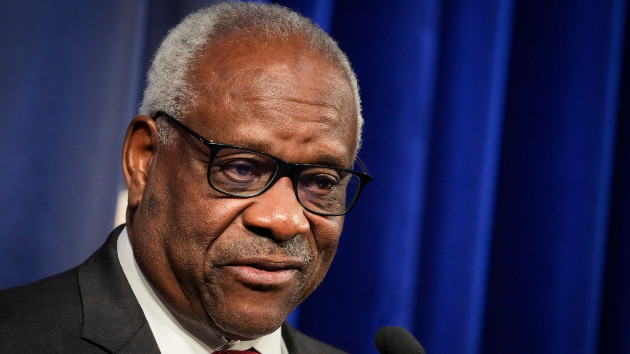
(WASHINGTON) — Justice Clarence Thomas was discharged from Sibley Memorial Hospital in Washington on Friday, one week after being admitted for treatment of an infection, a Supreme Court spokeswoman said.
No further information has been provided on his diagnosis, treatment, or prognosis.
Thomas’ chambers has also not responded to requests for comment about the new revelations surrounding his wife’s political activities in the aftermath of the 2020 election and direct contact with the White House.
In the fall of 2020, after Joe Biden defeated Donald Trump in the presidential election, Virginia “Ginni” Thomas, repeatedly urged White House chief of staff Mark Meadows to attempt to overturn the election results, according to text messages obtained by congressional investigators.
On Sunday, Supreme Court spokeswoman Patricia McCabe said in a statement, “Justice Clarence Thomas was admitted to Sibley Memorial Hospital in Washington, D.C., on Friday evening after experiencing flu-like symptoms. He underwent tests, was diagnosed with an infection, and is being treated with intravenous antibiotics. His symptoms are abating, he is resting comfortably, and he expects to be released from the hospital in a day or two.”
The court will reconvene on Monday for another week of oral arguments. It’s not clear whether Thomas will appear on the bench, though the court has said he continues to actively participate in cases through the use of briefs, argument transcripts and other communications with his colleagues.