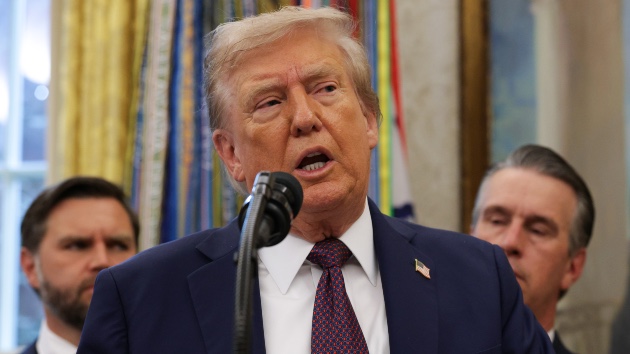
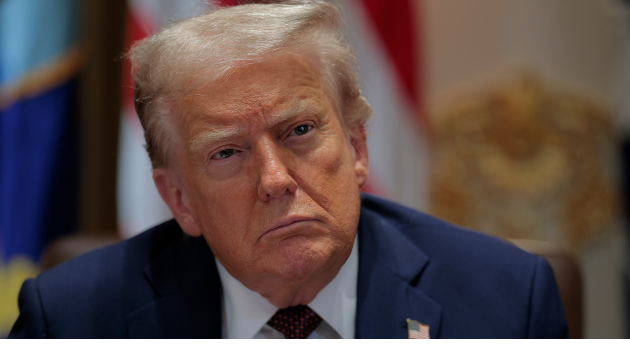
U.S. President Donald Trump speaks to the media in the Oval Office at the White House on September 2, 2025 in Washington, DC. (Photo by Alex Wong/Getty Images)
(WASHINGTON) — President Donald Trump is expected to sign an executive order Friday renaming the Department of Defense the Department of War, a White House official and sources familiar with a draft of the executive order told ABC News.
The formal renaming of the department would require Congress to act, but the order is expected to say the new name can be used in official correspondence and ceremonial contexts and non-statutory documents.
The Secretary of Defense may also use the title of Secretary of War, the White House confirmed.
Trump has teased the renaming for months and last month told reporters he didn’t think he needed congressional approval to change the name.
“We’re just going to do it. I’m sure Congress will go along if we need that. I don’t think we even need that,” Trump said last month.
Trump has said multiple times he doesn’t believe the name “Department of Defense” is strong enough.
“It used to be called the Department of War. And it had a stronger sound … We have a Department of Defense. We’re defenders,” Trump said during an executive order signing in the Oval Office last week, surrounded by a number of his Cabinet officials, including Defense Secretary Pete Hegseth.
In 1789, the Department of War was created by Congress to oversee the Army, Navy and Marine Corps. The Navy was later separated into its own department.
After World War II, President Harry Truman put all armed forces under one organization that was renamed the Department of Defense.
“It was clear from World War II that warfare was going to be joint and combined, so it was just necessary … It was clear to some as early as the 1930s that you would have to integrate military affairs and war and preparations for war, the Treasury Department” with “intelligence, allied policy issues and domestic industrial policy,” said Richard Kohn, a professor of military history at the University of North Carolina at Chapel Hill.
In other words, fighting a war became about more than just war, Kohn said, and the Truman administration wanted a broader agency to encompass all of that.
Additionally, “defense was what was talked about in the 1940s, not just war-making,” Kohn said.
ABC News’ Benjamin Siegel contributed to this report.
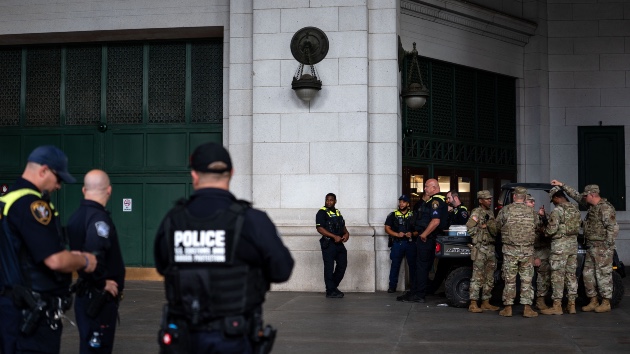
Members of the National Guard and members of Federal Law Enforcement Agencies stand outside the main hall of Union Station, on September 04, 2025 in Washington, DC. (Photo by Kent Nishimura/Getty Images)
(WASHINGTON) — Some Washington, D.C. residents fanned out across the halls of Congress on Thursday, urging lawmakers to end President Donald Trump’s federal law enforcement surge in the nation’s capital.
The demonstrations came the same day the U.S. Army extended orders for the Washington, D.C., National Guard to remain on active duty in the nation’s capital through Nov. 30, two U.S. officials told ABC News.
In small groups of five, demonstrators carried a letter from advocacy group “Free DC” to congressional offices calling on lawmakers to “do everything in your power to end the occupation of Washington, D.C., as swiftly as possible.”
The letter, obtained by ABC News, described Trump’s declaration as “an ongoing and increasing danger to D.C. residents” and a “direct threat to democracy in the United States and the governing power of the U.S. Congress.”
“This is an active military takeover of the capital. It is a textbook indicator of backsliding democracy and intensifying authoritarianism,” the letter stated. “This might come off as alarmist, but in the last 100 years of history, the pattern is clear and we are witnessing it in real time.”
White House Spokesperson Abigail Jackson said in a statement to ABC News on Thursday, “Cracking down on crime should not be a partisan issue, but some Democrats and activists are trying to make it one.”
“It’s bizarre that these liberal activists would protest the significant drops in violent crime in DC thanks to President Trump’s historic effort to Make DC Safe Again,” Jackson said.
The activists also pressed lawmakers to reject nearly a dozen Republican-backed bills that would expand federal power in the District. Some D.C. residents paired up with seasoned organizers to knock on doors and meet congressional staffers.
“I just feel like our democracy is slipping away,” said Michelle Castro, who has lived in D.C. for 24 years but said she stepped inside the Capitol for the first time Thursday.
Castro, the daughter of an Air Force veteran, joined the advocacy group Free D.C. after the deployment of armed troops. “As a military family, seeing the troops in the streets is very upsetting,” she told ABC News. “To see our military being used as political tools is just wrong. It’s not American. It’s not why they signed up.”
Castro said she had attended rallies before but never lobbied lawmakers. For many D.C. residents, the nation’s capital can feel like two separate cities, one for politics and federal workers, and another where locals live without voting representation in Congress beyond Del. Eleanor Holmes Norton.
“As a D.C. resident, just feeling like there’s no one, I don’t have a person to go to their office or to call,” Castro said. “Whenever they’re like, ‘Call your reps,’ I’m like, who do I call?”
For others, the deployment stirred painful family memories. Julie Cruz, who said her great-grandparents were murdered by the Nazis, said she grew up visiting relatives in East Germany and seeing Russian soldiers with machine guns on the streets.
“I personally find it very traumatizing to see troops occupying our city,” she said. “They should be going home to their families and their communities.”
Not everyone is protesting the law enforcement surge in the District.
“D.C. became one of America’s most dangerous cities because of failed, soft-on-crime policies that devastated innocent families while coddling the very criminals terrorizing our states and it made our capitol unsafe for residents, for visitors, for members of Congress, and unfortunately, even for our interns and our staff,” said Republican Rep. Ron Estes.
In June, one of Estes’ interns, 21-year-old Eric Tarpinian-Jachym of Granby, Massachusetts, was fatally shot.
“We’re having to turn our attention in Congress on doing what the District of Columbia, its mayor and their leadership should have done long ago, and that’s to keep the city safe,” the congressman said.
Tarpinian-Jachym’s killing remains unsolved. Authorities have offered a $40,000 reward for information leading to the arrest and conviction of those responsible.
“President Trump has rightfully exercised his authority to restore law and order here over the last few weeks, and what a tremendous job our federal law enforcement officers have done for this city,” he said. “This is what happens when you have leadership that actually cares about public safety,” he added.
The D.C. Police Union, which represents the members of the Metropolitan Police Department, welcomed Trump’s move, saying the department hit a 50-year low in staffing and needed the federal help.
Union chairman Gregg Pemberton said the federal surge has made D.C. officers’ jobs “easier.”
“You have more law enforcement officers, you have less work, you have less crime,” he said.
He added, “We want to get back to a place where MPD is doing 100% of this job.”
Washington, D.C. Mayor Muriel Bowser, whose careful rhetoric has drawn both Trump’s praise and activists’ scorn, has been negotiating with the administration as she tries to protect the city’s limited autonomy.
On Tuesday, Bowser released a new order, which she called a plan for exiting the crime emergency declared by Trump. The mayor’s plan calls for continuing the work of the “Safe and Beautiful Emergency Operations Center,” which Bowser’s office says will manage the city’s response after the initial 30-day lapses.
“My 100% focus is on exiting the emergency and that’s where all of our energies are,” Bowser said. “I think in creating the EOC, we mean to demonstrate … that we are organized to best use our own public safety resources and any additional public safety resources, and I think that’s the message for the Congress.”
Still, tensions are high. Several residents have circulated a “no confidence” letter targeting Bowser’s leadership, while local activists and even some councilmembers blasted her for thanking Trump for the surge of federal law enforcement, which brought down crime.
On Wednesday, D.C.-based politicians met privately with House Minority Leader Hakeem Jeffries, who pledged to help with their efforts in the Senate. Maryland Democratic Rep. Glenn Ivey, recalling Washington’s violent crack epidemic in the 1990s, said federal intervention was not the answer.
“When I first became a prosecutor here in Washington, D.C., it was 1990, that was the height of the crack fight, 450 to 500 homicides per year,” Ivey said. “They called it Dodge City. We fought against that, and under home rule, the leadership turned it around. Now we’ve got some of the lowest crime rates in 30 years.”
Councilmember Robert White called D.C. “ground zero for saving democracy.”
“It is clear the president has said he is doing this in Maryland and New York and California, now in Louisiana,” White said. “So democracy will be stripped away everywhere, not just in D.C. We just happen to be ground zero. That is why we must stop it now.”
Councilmember Janeese Lewis George urged unity: “We need to be strong, and we need to be united. Home rule in the District is what we are fighting for. That is all of our North Star.”
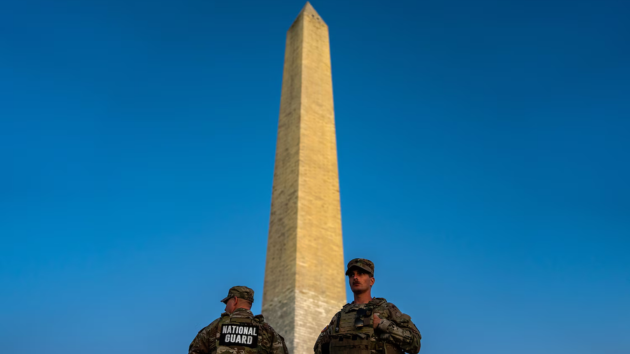
Members of the National Guard are seen standing near the Washington Monument, on September 02, 2025 in Washington, DC. Kent Nishimura/Getty Images
(WASHINGTON) — The Army is extending orders for the Washington, D.C., National Guard to remain on active duty in the nation’s capital through Nov. 30, two U.S. officials told ABC News Thursday.
President Donald Trump could still cut the mission shorter than Nov. 30 if desired — or extend the deployment past that date, the officials noted. That essentially leaves the deployment open-ended for now.
Army Secretary Dan Driscoll signed off on the plan on Wednesday, enabling Brig. Gen. Leland D. Blanchard II, commanding general of the D.C. National Guard, to update the initial orders.
The Nov. 30 plan for the estimated 950 members of the D.C. Guard, which has not been previously reported, does not apply to the other 1,300 troops deployed to D.C. from other states, including Louisiana, Mississippi, Ohio, Tennessee, South Carolina, and West Virginia. Those troops remain under the control of their governors with many of them already under orders to remain through the end of December, one of the officials said.
Blanchard alluded to the plan in a video message on X released Thursday.
“Our mission is not complete,” he said. “I’ve made the decision to extend the encampment as we continue to work to ensure everyone that walks these city streets is safe.”
Trump mobilized the D.C. National Guard last month to address what he insisted was “out of control” crime.
Since then, troops have been seen hanging out around the National Mall and other low-crime areas, often posing with tourists or spreading mulch as part of Trump’s “beautification” project.
According to the latest update provided by the Guard, troops have cleaned roadways, collected more than 677 bags of trash and disposed of five truckloads of plant waste in coordination with the U.S. National Park Service.
The decision to extend the Guard through Nov. 30 was a practical one, sources told ABC News. Instead of reupping orders every 14 to 29 days as is typical, the troops can plan on the extended stay.
National Guard troops typically leave other full-time civilian jobs during the deployment, and this would allow their employers to make other arrangements, officials say.
The plan also ensures there would be no gap in pay or benefits, which can happen when tours of duty need to be reapproved several times.
A spokesperson for Joint Task Force-DC told ABC News that all Guards members who are deployed to D.C. have already been extended beyond initial orders — some which would have lapsed on Sept.10 — in order to secure their eligibility for benefits including pay and health care.
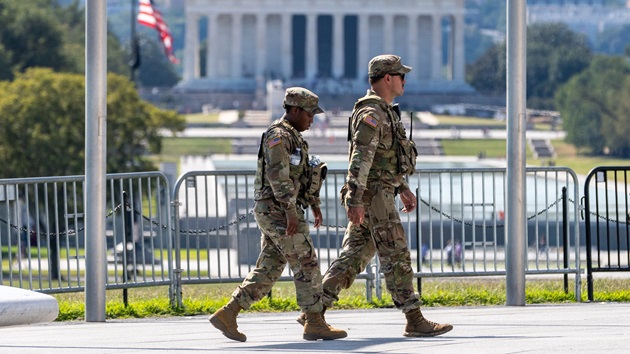
Members of the National Guard patrol the National Mall in Washington, DC, on September 3, 2025. (Austin DeSisto/NurPhoto via Getty Images)
(WASHINGTON) — Washington, D.C., Attorney General Brian L. Schwalb filed a lawsuit on Thursday to end the Trump administration’s deployment of National Guard troops to the city, calling it an unlawful “military occupation.”
Nearly 2,300 troops from seven states have been stationed in the district since Aug. 11, a move Schwalb says goes beyond the president’s authority and violates local autonomy under the Home Rule Act.
The lawsuit argues the troops were placed under Defense Department command and later deputized by the U.S. Marshals Service to perform law enforcement, which Schwalb’s office says is “in violation of the foundational prohibition on military involvement in local law.”
By law, the president’s emergency deployment can last only 30 days unless extended by Congress, meaning the surge is set to expire Sept. 10.
Schwalb also alleges the federal government is unlawfully asserting command over state militias without formally bringing them into federal service, which he says is a violation of the Constitution and federal law.
The complaint says the deployments threaten to erode trust between residents and police, inflame tensions and damage the city’s economy — particularly in the restaurant and hospitality industries as, just last month, the Restaurant Association Metropolitan Washington extended summer restaurant week in an effort to draw customers during the surge.
The attorney general’s office further argues that the deployments violate the Home Rule Act by overriding local autonomy and undermining public safety “by inflaming tensions and eroding trust between District residents and law enforcement.”
Still, Gregg Pemberton, the D.C. union chairman said the long-term goal is for the Metropolitan Police Department to resume full responsibility.
This is a developing story. Please check back for updates.
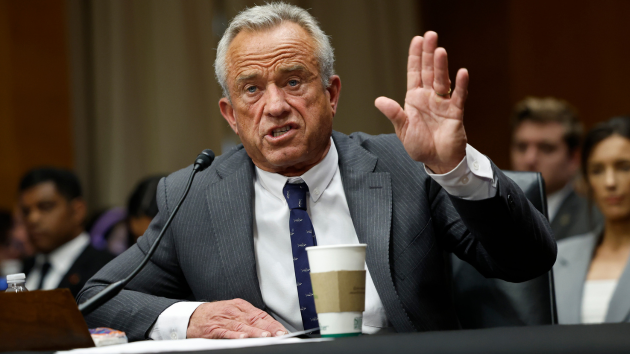
(WASHINGTON) — After a week of fast-moving shakeups at the nation’s health agency, Health and Human Services Secretary Robert F. Kennedy Jr. is testifying before the Senate Finance Committee, which has oversight over his department, on Thursday for hours of questioning sure to center on his vaccine policy.
The new FDA approval for COVID shots allows for people who are aged 65 and older to get the vaccine, or younger Americans who have an underlying condition that puts them at a higher risk of severe illness from the virus.
Public health officials and pharmacist groups have said the change will make it harder for young and healthy people to get the vaccine — should they still choose to — and raises questions about where they can get it or whether insurance will cover it.
Kennedy is expected to tout the overhauls at HHS so far, which he has said are aimed at eliminating bloated bureaucracy and conflicts of interest at public health agencies that get in the way of “gold-standard science.”
In a statement, HHS spokesperson Andrew Nixon said Kennedy will use the hearing to “reaffirm his commitment to Make America Healthy Again: restoring gold-standard science at HHS, empowering patients with more transparency, choices and access to care, and reestablishing trust in public health.”
While Republicans like Finance Committee Chairman Mike Crapo will attempt to keep the focus on chronic disease and Kennedy’s “Make America Healthy Again” agenda, Democrats and even some Republicans are expected to push Kennedy for answers on the FDA’s latest change as well as an upcoming CDC meeting on vaccines, which could lead to more changes to the nation’s vaccine policy.
The CDC’s Advisory Committee on Immunization Practices (ACIP), which discusses vaccine data and makes recommendations for which vaccines Americans should get and when, is going to weigh in on the FDA’s latest change, further informing insurance companies and pharmacies of how to carry out the policy.
But ACIP is also going to discuss a slate of different vaccines, including the COVID vaccine; hepatitis B vaccines; the measles, mumps, rubella, varicella (MMRV) vaccine; and the Respiratory Syncytial Virus (RSV) vaccine.
Speaking to reporters on Tuesday, Republican Sen. Bill Cassidy of Louisiana, who sits on the Senate Finance Committee, said he had spoken to other members of his caucus who agreed that they needed to investigate what potential changes Kennedy and the CDC committee were weighing to the childhood vaccine recommendations.
“The issue is about children’s health, and there are rumors, allegations, that children’s health, which is at issue here, might be endangered by some of the decisions that are purported to be made. I don’t know what’s true,” Cassidy said. “I know that we need to get there. And I’ve talked to members of my Republican Caucus, several of them. They’ve agreed with me that we need to get at it.”
Cassidy, who pushed Kennedy during his confirmation hearings to issue support for vaccines and publicly struggled over his vote for him, has tasked the committee he chairs, the Senate Committee on Health, Education, Labor and Pensions (HELP), to do “oversight” of Monarez’ ousting, he wrote on X last week.
Cassidy maintained that he isn’t “presupposing someone is right or wrong.” “I just know we’ve got to figure it out,” Cassidy said.
Cassidy has also called for the CDC meeting to be postponed until “significant oversight has been conducted,” citing “serious allegations” about the “meeting agenda, membership and lack of scientific process.”
Republican Sen. Susan Collins of Maine, who is on the HELP committee with Cassidy, told reporters on Wednesday that she is “concerned” and “alarmed” by Monarez’s firing.
“I know that the president has the right to fire whomever he wishes when it comes to that kind of appointment, but I don’t see any justification for it,” Collins said.
Monarez, who was in the job for only a month, was pushed out after she declined to fire top officials and support Kennedy’s vaccine policy changes in a meeting with the secretary early last week, a source familiar with her conversations with the secretary told ABC News.
“When CDC Director Susan Monarez refused to rubber-stamp unscientific, reckless directives and fire dedicated health experts, she chose protecting the public over serving a political agenda. For that, she has been targeted,” Monarez’s attorneys Mark Zaid and Abbe Lowell said in a statement late last week.
White House press secretary Karoline Leavitt told reporters President Donald Trump had fired Monarez because she “was not aligned with the president’s mission to make America healthy again.”
“It was President Trump who was overwhelmingly reelected on November 5,” Leavitt said. “This woman has never received a vote in her life, and the president has the authority to fire those who are not aligned with his mission.”
Other CDC officials who followed Monarez out the door included:
Deb Houry, Chief Medical Officer and Deputy Director for Program and Science
Dr. Dan Jernigan, Director of the National Center for Emerging and Zoonotic Infectious Diseases
Dr. Demetre Daskalakis, Director of the National Center for Immunization and Respiratory Diseases
Dr. Jennifer Layden, Director for the Office of Public Health Data, Surveillance, and Technology.
The officials cited the political climate and a refusal to accept science that didn’t align with Kennedy’s beliefs.
In addition to the recent FDA changes for the COVID vaccine, Kennedy has also canceled up to $500 million in research and development for mRNA vaccines and changed the COVID vaccine recommendations for children and pregnant women.
“I mean, from my vantage point as a doctor who’s taken the Hippocratic oath, I only see harm coming. I may be wrong. But based on what I’m seeing, based on what I’ve heard with the new members of the Advisory Committee for Immunization Practices, or ACIP, they’re really moving in an ideological direction where they want to see the undoing of vaccination,” Daskalakis said.
Kennedy, when he testified in his confirmation hearings to be health secretary in January, denied that he was anti-vaccine and said he supports “the childhood schedule” for vaccinations.
“I am pro-vaccine. I am going to support the vaccine program. I want kids to be healthy, and I’m coming in here to get rid of the conflicts of interest within the agency, make sure that we have gold standard, evidence-based science,” Kennedy said.
When pressed by Democratic Sen. Ron Wyden of Oregon, Kennedy committed to supporting the measles and polio vaccines.
“Senator, I support the measles vaccine, I support the polio vaccine. I will do nothing as HHS secretary that makes it difficult or discourages people from taking either of those vaccines,” Kennedy said.
(NEW YORK) — Many parents, school districts and the federal government alike have embraced artificial intelligence this back-to-school season, but some experts warn artificial intelligence could widen the teacher shortage by eliminating jobs.
In a Pew Research Center study released last spring, 31% of AI experts, whose work or research focuses on the topic, said they expected artificial intelligence to lead to fewer jobs for teachers. Nearly a third of the experts surveyed predicted that AI will place teaching jobs “at risk” over the next 20 years, according to they Pew Research study.
The warning comes after the Learning Policy Institute — an organization that conducts independent research to improve education and policy practices — in July issued an overview of teacher shortages, which estimated that about one in eight teaching positions in 2025 are either unfilled or filled by teachers not fully certified for their assignments.
Indiana’s 2024 Teacher of the Year Eric Jenkins suggested AI could end up replacing “some parts” of teaching, but as a tool — not a replacement.
Idaho Superintendent of Public Instruction Debbie Critchfield emphasized that using AI to address the long-standing staffing shortage shouldn’t be considered.
“In no universe do I think that AI is going to replace a teacher,” Critchfield told ABC News.
“The teacher is the most important part and component of the classroom, but [AI] is a very useful tool in helping them provide the best educational environment that they can in the classroom,” she said.
The White House encourages K-12 students to use AI. While the Trump administration hasn’t directly addressed whether AI could replace teachers, the administration has launched its own action plan on the technology, which says “AI will improve the lives of Americans by complementing their work — not replacing it.”
Last week, first lady Melania Trump launched an AI contest challenging students to develop projects that use AI to address community challenges. Education Secretary Linda McMahon endorsed the challenge.
“AI has the potential to revolutionize education, drive meaningful learning outcomes, and prepare students for tomorrow’s challenges,” McMahon wrote in a post on X.
Teachers say they offer what AI can’t: connection Nearly three years after the launch of ChatGPT, which stands for Chat Generative Pre-Trained Transformer, most of the United States has developed guidance on AI use in schools.
Many districts tell ABC News that they are embracing the technology so long as it is used appropriately — by adhering to local education agency guidance — with academic integrity. Critchfield even downplayed concerns that AI use in schools encourages cheating.
“Teachers can tell if you were writing like a seventh grader on Wednesday and then, all of a sudden, your paper you turn in on a Friday sounds like your post-doctorate in philosophy,” she said. “They know how to tell those differences.”
But in the wake of the pandemic, Thomas Toch, the director of FutureEd — an education policy center at Georgetown University, argued students need connection — to their peers, family and education tools such as AI chatbots — more than ever. Still, Toch rejected the full-time use of AI in place of humans.
“The loss of that connection during the pandemic, when kids were learning virtually, created widespread mental-health challenges,” Toch told ABC News. “The notion that, you know, a machine will be the only entity that interacts with kids is problematic in that regard.”
Education experts, such as Toch, contend K-12 education has “perpetual” teacher shortages with about a half-dozen areas in need, such as science, technology, engineering and mathematics (STEM), and special education instructors. The shortages have plagued the workforce for many years now, educators have told ABC News, with many of them citing strict time demands, persistent behavioral issues and lack of administrative support, among other obstacles.
Toch and Jenkins told ABC News they both appreciate AI for the powerful tool it can be in assisting teachers. It helps teachers plan lessons, grade students’ essays and is used as a “time saver” that helps them do their jobs better, according to Toch.
Preparing educators to work with AI tools Jenkins said AI is inevitable and that he believes teachers need to lean in and embrace its capabilities.
“I don’t think we can put our head in the sand about it,” Jenkins told ABC News. “I don’t think that it’s necessarily going to replace teachers because teachers can offer something that AI can’t, which is a connection, like authentic connection and community.”
Jenkins argued the chatbots lack the human element of what teachers do: making sure that students feel seen and heard. He said that is not going away.
With AI’s presence in education, Jenkins added, “it’s going to make those moments even more important.”
In Idaho, Critchfield said she has been excited about students and educators using the technology, but suggested the challenge ahead focuses on making AI be seen as a tool and not a negative. According to Critchfield, using AI wisely can aid in the shortage by increasing teacher retention and reducing educators’ workloads.
“How are we preparing and training our teachers to use [AI] so that we don’t add new problems as we’re trying to solve some other problems?” Critchfield said.
Ultimately, Critchfield said she doesn’t see AI as a boogeyman that is going to eliminate jobs, but she stressed that teachers who know AI could replace those who are less familiar with the technology.
After teachers in his district suggested banning ChatGPT just a few years ago, School District of Philadelphia Superintendent Tony Watlington told ABC News that instead of removing AI, Philadelphia is now learning from it together. The school district is implementing AI 101 Training for its teachers, school leaders, and superintendent through a partnership with the University of Pennsylvania’s Graduate School of Education.
Watlington said it’s about “getting people around the table, and we are learning together.”
“We’re not hiding from AI,” Watlington said. “We’re also thinking about its implications and we’re really paying attention to what the prospective unintended consequences could be as well.”
Watlington added: “I think that’s the responsible way to think about artificial intelligence.”
(WASHINGTON) — After a week of fast-moving shakeups at the nation’s health agency, Health and Human Services Secretary Robert F. Kennedy Jr. will come before the powerful Senate Finance Committee, which has oversight over his department, on Thursday for hours of questioning that is sure to center on his vaccine policy.
It comes a week after the Food and Drug Administration (FDA) significantly narrowed access to the COVID-19 vaccine, a move that precipitated a public fallout and ousting of the newly installed director of the Centers for Disease Control and Prevention (CDC) Susan Monarez. Four top CDC officials also resigned in protest.
The new FDA approval for COVID shots allows for people who are aged 65 and older to get the vaccine, or younger Americans who have an underlying condition that puts them at a higher risk of severe illness from the virus.
Public health officials and pharmacist groups have said the change will make it harder for young and healthy people to get the vaccine — should they still choose to — and raises questions about where they can get it or whether insurance will cover it.
Thursday will be the first time Kennedy has faced questions from senators since May, when he testified before a Senate committee and a House committee, defending the massive cuts to the department’s workforce carried out in April.
Kennedy is expected to tout the overhauls at HHS so far, which he has said are aimed at eliminating bloated bureaucracy and conflicts of interest at public health agencies that get in the way of “gold-standard science.”
In a statement, HHS spokesperson Andrew Nixon said Kennedy will use the hearing to “reaffirm his commitment to Make America Healthy Again: restoring gold-standard science at HHS, empowering patients with more transparency, choices and access to care, and reestablishing trust in public health.”
While Republicans like Finance Committee Chairman Mike Crapo will attempt to keep the focus on chronic disease and Kennedy’s “Make America Healthy Again” agenda, Democrats and even some Republicans are expected to push Kennedy for answers on the FDA’s latest change as well as an upcoming CDC meeting on vaccines, which could lead to more changes to the nation’s vaccine policy.
The CDC’s Advisory Committee on Immunization Practices (ACIP), which discusses vaccine data and makes recommendations for which vaccines Americans should get and when, is going to weigh in on the FDA’s latest change, further informing insurance companies and pharmacies of how to carry out the policy.
But ACIP is also going to discuss a slate of different vaccines, including the COVID vaccine; hepatitis B vaccines; the measles, mumps, rubella, varicella (MMRV) vaccine; and the Respiratory Syncytial Virus (RSV) vaccine.
In June, Kennedy replaced all 17 sitting members of the committee with his own hand-selected members, including some who have expressed vaccine-skeptic views fervently sought to discredit the safety and efficacy of mRNA COVID vaccines.
Speaking to reporters on Tuesday, Republican Sen. Bill Cassidy of Louisiana, who sits on the Senate Finance Committee, said he had spoken to other members of his caucus who agreed that they needed to investigate what potential changes Kennedy and the CDC committee were weighing to the childhood vaccine recommendations.
“The issue is about children’s health, and there are rumors, allegations, that children’s health, which is at issue here, might be endangered by some of the decisions that are purported to be made. I don’t know what’s true,” Cassidy said. “I know that we need to get there. And I’ve talked to members of my Republican Caucus, several of them. They’ve agreed with me that we need to get at it.”
Cassidy, who pushed Kennedy during his confirmation hearings to issue support for vaccines and publicly struggled over his vote for him, has tasked the committee he chairs, the Senate Committee on Health, Education, Labor and Pensions (HELP), to do “oversight” of Monarez’ ousting, he wrote on X last week.
Cassidy maintained that he isn’t “presupposing someone is right or wrong.” “I just know we’ve got to figure it out,” Cassidy said.
Cassidy has also called for the CDC meeting to be postponed until “significant oversight has been conducted,” citing “serious allegations” about the “meeting agenda, membership and lack of scientific process.”
Republican Sen. Susan Collins of Maine, who is on the HELP committee with Cassidy, told reporters on Wednesday that she is “concerned” and “alarmed” by Monarez’s firing.
“I know that the president has the right to fire whomever he wishes when it comes to that kind of appointment, but I don’t see any justification for it,” Collins said.
Monarez, who was in the job for only a month, was pushed out after she declined to fire top officials and support Kennedy’s vaccine policy changes in a meeting with the secretary early last week, a source familiar with her conversations with the secretary told ABC News.
“When CDC Director Susan Monarez refused to rubber-stamp unscientific, reckless directives and fire dedicated health experts, she chose protecting the public over serving a political agenda. For that, she has been targeted,” Monarez’s attorneys Mark Zaid and Abbe Lowell said in a statement late last week.
White House press secretary Karoline Leavitt told reporters President Donald Trump had fired Monarez because she “was not aligned with the president’s mission to make America healthy again.”
“It was President Trump who was overwhelmingly reelected on November 5,” Leavitt said. “This woman has never received a vote in her life, and the president has the authority to fire those who are not aligned with his mission.”
Other CDC officials who followed Monarez out the door included:
Deb Houry, Chief Medical Officer and Deputy Director for Program and Science Dr. Dan Jernigan, Director of the National Center for Emerging and Zoonotic Infectious Diseases Dr. Demetre Daskalakis, Director of the National Center for Immunization and Respiratory Diseases Dr. Jennifer Layden, Director for the Office of Public Health Data, Surveillance, and Technology. The officials cited the political climate and a refusal to accept science that didn’t align with Kennedy’s beliefs.
Daskalakis, in an interview on ABC News’ “This Week”, said he thought the changes Kennedy has so far made are “the tip of the iceberg.”
In addition to the recent FDA changes for the COVID vaccine, Kennedy has also canceled up to $500 million in research and development for mRNA vaccines and changed the COVID vaccine recommendations for children and pregnant women.
“I mean, from my vantage point as a doctor who’s taken the Hippocratic oath, I only see harm coming. I may be wrong. But based on what I’m seeing, based on what I’ve heard with the new members of the Advisory Committee for Immunization Practices, or ACIP, they’re really moving in an ideological direction where they want to see the undoing of vaccination,” Daskalakis said.
Kennedy, when he testified in his confirmation hearings to be health secretary in January, denied that he was anti-vaccine and said he supports “the childhood schedule” for vaccinations.
“I am pro-vaccine. I am going to support the vaccine program. I want kids to be healthy, and I’m coming in here to get rid of the conflicts of interest within the agency, make sure that we have gold standard, evidence-based science,” Kennedy said.
When pressed by Democratic Sen. Ron Wyden of Oregon, Kennedy committed to supporting the measles and polio vaccines.
“Senator, I support the measles vaccine, I support the polio vaccine. I will do nothing as HHS secretary that makes it difficult or discourages people from taking either of those vaccines,” Kennedy said.
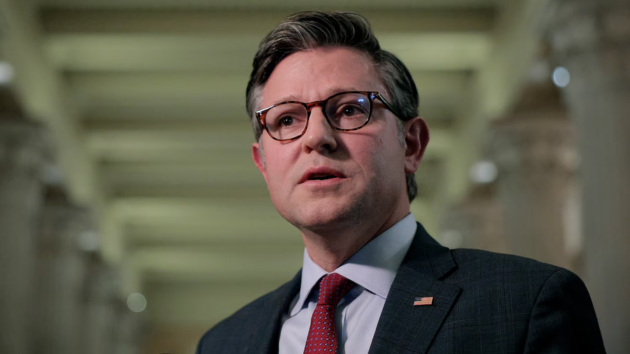
House Speaker Mike Johnson speaks to the media after meeting with victims of Jeffrey Epstein, at the US Capitol, Washington September 2, 2025. Chip Somodevilla/Getty Images
(WASHINGTON) — President Donald Trump on Wednesday cast the Jeffrey Epstein controversy as “irrelevant” amid an effort on Capitol Hill to force a vote to release all files related to the deceased sex offender.
“This is a Democrat hoax that never ends,” Trump told reporters in the Oval Office when asked about the push for more transparency in the Epstein matter.
“From what I understand, I could check, but from what I understand, thousands of pages of documents have been given,” the president said. “But it’s really a Democrat hoax because they’re trying to get people to talk about something that’s totally irrelevant to the success that we’ve had as a nation since I’ve been president.”
The comments came as a group of survivors joined House members in a push to compel the Justice Department to release records so far withheld from Congress.
ABC News Capitol Hill Correspondent Jay O’Brien asked the victims for their reaction to Trump’s characterization that it is a “hoax.”
One survivor, Haley Robson, said it felt like “being gutted from the inside out.”
“Mr. President Donald J. Trump, I am a registered Republican — not that that matters because this is not political — however, I cordially invite you to meet me in the Capitol in person so you can understand this is not a hoax. We are real human beings. This is real trauma,” she responded.
Republican Rep. Thomas Massie and Democratic Rep. Ro Khanna’s effort to force a vote on the files has led to a showdown with House Republican leadership and the White House.
Massie’s discharge petition had 206 signatures as of Wednesday afternoon. It needs 218 to compel a vote on the House floor.
So far, four Republicans have signed on to the Massie and Khanna discharge petition — a procedural tool to bypass GOP leadership and force a vote. Those signers include Massie, Reps. Nancy Mace, Marjorie Taylor Greene and Lauren Boebert. If all 212 Democrats sign the petition, only two more Republicans are needed.
Speaker Mike Johnson urged Republicans to not support Massie’s discharge petition during a closed conference meeting Wednesday morning, according to multiple sources. Johnson instead argued the ongoing investigation by the House Oversight Committee is the better path forward.
The House on Wednesday adopted a resolution by a vote of 212-208-1 that instructs the Oversight Committee to continue its Epstein investigation that began weeks ago.
The measure was Johnson’s preferred vote on the Epstein controversy. Massie has called it a “placebo.”
Johnson said he spoke to Trump about the Epstein files on Tuesday night, and Trump instructed him to “get it out there” and “put it all out there.”
“This is going to be an ongoing effort. It will be bipartisan, which is great and the Oversight Committee’s effort, this is really important to point out, goes further than the discharge petition,” Johnson argued. “It requests more information than the discharge even encompasses. For example, the Epstein estate documents, which is a treasure trove of information not referenced in the discharge. And it has the force of law because we have subpoena authorities.”
U.S. President Donald Trump attends a cabinet meeting with members of his administration in the Cabinet Room of the White House on August 26, 2025 in Washington, DC. This is the seventh cabinet meeting of Trump’s second term. (Photo by Chip Somodevilla/Getty Images)
(WASHINGTON) — During an Oval Office event, President Donald Trump was asked about a video that began circulating online this past weekend of what appears to be a bag being thrown out of a second-story window at the White House.
Trump said on Tuesday that it was “probably AI-generated” and said that you can’t open the windows at the White House. It’s not clear when the alleged incident occurred.
A reporter asked if Trump was aware of the video, saying, “There is a video that is circulating online now of the White House where a window is open to the residence upstairs, and somebody is throwing a big bag out the window. Have you seen this?”
To which Trump suggested it was made with artificial intelligence and said, “You can’t open the windows. You know why? They’re all heavily armored and bulletproof.”
“I know every window up there,” Trump continued. “The last place I’d be doing it is that because there’s cameras all over the place, right? Including yours?” the president asked the reporter.
Earlier on Tuesday, however, a White House official implied in a statement to TIME magazine that the video was real and showed a contractor doing “regular maintenance.”
ABC News has reached out to the White House about the discrepancies between the two different answers.
ABC News has not independently verified the video’s authenticity. But one expert said it appeared unlikely the video is an AI fake. Hany Farid, chief science officer at GetReal Labs and an expert on synthetic media, told ABC News that he does not see any evidence that indicates the video is AI-generated.
“I’m not seeing any evidence that this video is AI-generated or manipulated,” Farid said. “We do not detect any digital watermarks that are sometimes inserted at the point of AI-generation. The shadows in the scene, including the shadow cast by the tossed bag, are all physically consistent. The motion of the waving flags has none of the tell-tale signs that you often see in AI-generated videos. The overall structure of the White House appears to be consistent, including the flying of the American and POW/MIA flag.”
Farid noted that AI-based video generation models today typically produce videos no more than eight to 10 seconds long, a limitation that can be circumvented by stitching two clips together by generating a new video based on the final frame of the last one.
“Having said that, the length of this video does add some evidence that it is unlikely to be AI-generated,” Farid said.
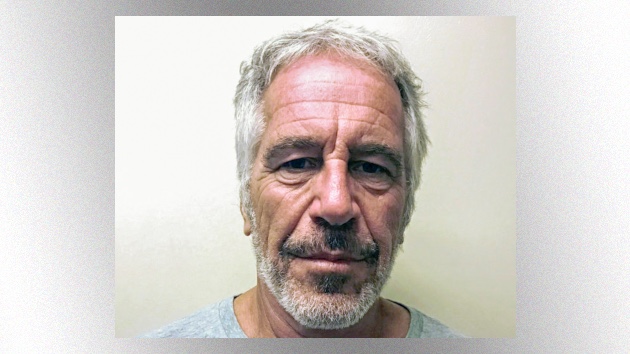
In this handout, the mug shot of Jeffrey Epstein, 2019. (Photo by Kypros/Getty Images)
(WASHINGTON) — A group of Jeffrey Epstein survivors spoke out on Capitol Hill on Wednesday as part of a push to have all files related to the accused sex trafficker released.
“This is not a hoax. It’s not going to go away,” said Marina Lacerda, a central witness in Epstein’s 2019 indictment who spoke with ABC News.
Anouska De Georgiou, the first survivor of Epstein and his longtime associate Ghislaine Maxwell to step to the podium, said the victims are coming together to have their voices be heard.
“The days of sweeping this under the rug are over. We the survivors say ‘no more,'” she said.
“I’m no longer weak, I am no longer powerless and I’m no longer alone. And with your vote, neither will the next generation,” she said. “President Trump, you have so much influence and power in this situation. Please use that influence and power to help us, because we need it now, and this country needs it now.”
Survivor after survivor implored lawmakers to back a bipartisan push from Republican Rep. Thomas Massie and Democratic Rep. Ro Khanna to compel the Justice Department to publicly release the Epstein files.
At times growing emotional, some survivors also detailed the abuse they said they suffered at the hands of Epstein.
“I hope my colleagues are watching this press conference. I want them to think, what if this was your sister? What if this was your daughter?” Massie said.
“Today we stand with survivors, we stand against big money, we stand to protect America’s children. That is really what this is about,” Khanna said on Wednesday.
So far, four Republicans have signed on to the Massie and Khanna discharge petition — a procedural tool to bypass GOP leadership and force a vote. Those signers include Massie, Reps. Nancy Mace, Marjorie Taylor Greene and Lauren Boebert.
If all 212 Democrats sign the petition, only two Republicans are needed to reach the 218 needed to compel a vote on the House floor.
Attorney Bradley Edwards, who has represented more than 200 of the Epstein survivors, said the push should “pass with flying colors.”
“While we have seen the documents, you haven’t and when you see the documents, you’re going to be appalled,” Edwards said.
House Republican leadership, however, is opposed to the Massie and Khanna effort — as is the White House.
Speaker Mike Johnson urged Republicans to not support Massie’s discharge petition during a closed conference meeting Wednesday morning, according to multiple sources.
“It does not adequately protect the innocent victims, and that is a critical component,” Johnson said on Tuesday of the discharge petition.
Johnson instead argued the ongoing investigation by the House Oversight Committee, which has subpoenaed records from the Justice Department and the Epstein estate, is the better path because committee investigators will pour over the files and redact any identifying or otherwise confidential information.
The House Oversight Committee on Tuesday evening released tens of thousands of pages related to Epstein, much of which was already publicly known.
“To the American people — don’t let this fool you,” Rep. Robert Garcia, the top Democrat on the House Oversight Committee, said after the release. “After careful review, Oversight Democrats have found that 97% of the documents received from the Department of Justice were already public. There is no mention of any client list or anything that improves transparency or justice for victims.”
Epstein was arrested in July 2019 and charged in a federal indictment with conspiracy and child sex trafficking. He died in custody a month later, while awaiting trial. His death was ruled a suicide by hanging.
Maxwell was convicted in 2021 by a federal jury on sex trafficking and other charges. She is currently serving a 20-year prison sentence for aiding and participating in Epstein’s trafficking of underage girls, which involved a scheme to recruit young women and girls for massages of Epstein that turned sexual.
Ahead of the news conference with lawmakers, several of the survivors and their families held a rally outside the Capitol.
“It’s the voices of survivors of these crimes that are important, so we are here together to stand united,” said survivor Liz Stein.