(NEW YORK) — Sen. Elizabeth Warren, D-Mass., joined “The View” Friday to reiterate what she says will be the devastating effects on women’s health if Roe v. Wade is overturned.
Since the leak of Justice Samuel Alito’s draft opinion that would repeal Roe v. Wade was released Monday, Warren has been vocal about her opposition to the court and Republican leaders who have been pushing laws in states to ban legal abortion.
Warren told “The View” that if the Supreme Court moves forward with the decision, it will be hardest on women who can’t afford to travel to locations that permit abortion, including those living in poverty and minorities.
“Who is this going to fall on? This is going to fall on the most vulnerable women in the country,” the senator told the View.
In the leaked draft regarding the Supreme Court’s case on Mississippi’s 15-week abortion ban, Alito contended the Constitution “does not prohibit the citizens of each state from regulating or prohibiting abortion.”
The leaked draft indicated that four other Supreme Court justices have sided with Alito. The document is not final and opinions can change before the final ruling.
Senate Democrats have introduced the “Women’s Health Protection Act” which would codify Roe v. Wade at the federal level; however, it is unlikely that the bill will get the 60 votes needed to pass.
Warren said it is important that the American people see which of their leaders supported abortion rights under oath.
“The plan gets everyone on the record,” she said. “If we don’t have enough people to get this done right, this is the time to get into the fight.”
Sen. Susan Collins, R-Maine, told ABC News that she would vote no on the bill. However, she and Sen. Lisa Murkowski, D-Alaska, have proposed another bill dubbed “Reproductive Choice Act,” which would prohibit states from imposing an “undue burden” on the ability of a woman to choose to terminate a pregnancy before the fetus is viable.
The bill would allow states to keep other restrictions in place.
Warren told “The View” that she doesn’t support the alternate bill because there are too many loopholes that allow for abortion access to be restricted.
“What this is really about is about making sure there is full protection,” she said.
Warren also warned that Alito’s leaked draft could open up future legal challenges to fundamental American rights such as marriage for same-sex couples, the right to contraception and interracial marriage.
“When you read Justice Alito’s opinion, he focuses on history,” she said. “We don’t have a long history of protecting same-sex marriage, we don’t have a long history of interracial marriage.”
(WASHINGTON) — With a leaked draft opinion revealing this week that the U.S. Supreme Court appears poised to overturn nearly 50 years of abortion rights precedent, Democrats and activists are sounding alarms that other rights not explicitly listed in the Constitution — but long-considered protected as implied rights of privacy — could be threatened next.
“If the rationale of the decision — as released — were to be sustained, a whole range of rights are in question — a whole range of rights,” President Joe Biden told reporters on Tuesday, offering his first public reaction to the document as the court confirmed its authenticity.
“If the right to privacy is weakened,” said Vice President Kamala Harris, “every person could face a future in which the government can potentially interfere in the personal decisions you make about your life.”
Their anxiety, legal experts told ABC News, is not only with Roe being overturned but in how it would be overturned — and whether the final opinion’s language and reasoning could set the stage for other unenumerated rights — those not directly listed in the Constitution — to be similarly sent back to be decided by the states.
While Justice Samuel Alito writes in the draft opinion that the court’s decision on Dobbs v. Jackson Women’s Health Organization concerns only abortion and does not extend to other rights, experts say his current justification for overturning Roe opens the door to imperil other long-standing liberties the court has upheld for decades.
Here’s what legal experts are saying about the draft text:
Alito’s ‘originalist’ approach
The Supreme Court grounded its 1973 decision in Roe v. Wade on the Fourteenth Amendment’s due process clause, which the court has said guarantees Americans an implicit “right to privacy,” though that phrase is not used in the Constitution.
Justice Harry Blackmun described the constitutional underpinnings of that right when authoring the opinion: “This right of privacy, whether it be founded in the Fourteenth Amendment’s concept of personal liberty and restrictions upon state action, as we feel it is, or, as the District Court determined, in the Ninth Amendment’s reservation of rights to the people, is broad enough to encompass a woman’s decision whether or not to terminate her pregnancy,” the 1973 decision read.
But Alito — rejecting stare decisis, the legal doctrine intended to bind courts to abide by past rulings, as it relates to abortion — called the court’s decision on Roe “egregiously wrong from the start.” Taking an originalist approach, he argues in the draft opinion obtained by Politico that there’s no explicit right to privacy, let alone the right to an abortion, in the Constitution.
“It held that the abortion right, which is not mentioned in the Constitution, is part of a right to privacy, which is also not mentioned,” Alito writes, calling the Roe decision “remarkably loose in its treatment of the constitutional text,” and arguing that stare decisis “does not compel unending adherence to Roe’s abuse of judicial authority.”
Taking issue with Alito’s reasoning, Biden said Wednesday he believes the court’s current conservative majority would agree with failed Supreme Court nominee Robert Bork’s view that the right to privacy should not have been guaranteed with the court’s ruling in 1965 in Griswold v. Connecticut, which overturned a ban on married couples’ access to contraception.
“Griswold was thought to be a bad decision by Bork, and my guess is, the guys on the Supreme Court now,” Biden said.
Marc Spindelman, a professor at The Ohio State University Moritz College of Law, said it’s because of Alito’s reasoning — appearing to reject court precedent and the right to privacy in favor of an originalist interpretation of the Constitution — that puts other precedents, like the right to same-sex intimacy in Lawrence v. Texas in 2003 and same-sex marriage in Obergefell v. Hodges in 2015, at-risk, since those rights were also bound to the Fourteenth Amendment.
“From the point of view of originalist reasoning, it’s difficult to see what is distinctive about abortion compared to other rights that are now constitutionally protected but that originalist methodology, in principle, threatens,” Spindelman said.
Kate Shaw, a professor at Cardozo School of Law and an ABC News contributor, echoed that view.
“The whole method that the Roe Court used, which is basically to say what are the kind of key attributes of liberty that the Constitution has to protect, whether or not they’re written in the document, Alito says that method is totally illegitimate,” she said. “And instead, what the Constitution should be read to protect is the explicitly enumerated rights and a small, a small list of unenumerated rights, but only rights that are deeply rooted in history and tradition.”
Spillover concern
Alito wrote in the draft opinion, “Nothing in this opinion should be understood to cast doubt on precedents that do not concern abortion.”
“What sharply distinguishes the abortion right,” he said, is that it destroys “potential life,” and that “none of the other decisions cited by Roe and Casey involved the critical moral question posed by abortion.”
In deciding whether a right is protected, Alito said the court “has long asked whether the right is ‘deeply rooted in [our] history and tradition’ and whether it is essential to our Nation’s ‘scheme of ordered Liberty.'” In Alito’s view, abortion does not meet that standard.
“What Alito says is, don’t worry. Our decision today is only about abortion, not about anything else,” Spindelman said. “But if an originalist approach is the touchstone for judgment in the case, then it’s hard to see how or why the decision should not apply to other kinds of individual rights that the Court has said are protected by the Fourteenth Amendment.”
That approach, in principle, could doom any right that didn’t exist since the country’s founding, Spindelman said.
“It’s difficult to see why if once you pull row up from the roots, why decisions of more recent vintage ought to stay in the ground to be counted by the court as part of its respect for its own precedent,” he added.
So, could the court find a way to pull abortion from the right to privacy without unraveling other precedents? Former Justice Antonin Scalia clerk and vice-dean at the NYU School of Law, Rachel Barkow, doesn’t think so.
“I think that you can’t coherently do it,” she said. “Unfortunately, that is actually what erodes the legitimacy of the court as an institution because it’s not the leak that’s going to damage the court’s legitimacy, it’s not upholding rationales and being consistent over time.”
The problem for the court, she said, is that the Roe decision is part of a line of cases bound to recognizing the right to privacy, “and the draft opinion shows no respect for the right to privacy, and in light of that, all the cases that rely on that right to privacy would also find themselves falling under the same rationale.”
“I think the bigger thing that the public sees is no precedent is safe,” Barkow said “The court’s willingness to just cast aside a 50-year-old precedent, not just any precedent, but one that has been the subject of these confirmation hearings, and it’s a reason that they’re sitting there is they gave assurances to senators that they weren’t going to overrule it, and then they did.”
“I don’t think anyone can really take that group of people’s word if they say, ‘Oh, no, the other precedents are safe,'” she added. “I think they cried wolf one time too many.”
The opinion could change
When the court confirmed the document’s authenticity on Tuesday, it stressed in a statement that it “does not represent a decision by the Court or the final position of any member on the issues in the case.”
Experts stressed to ABC News that court opinions can change throughout their drafting. The leaked decision could potentially emerge with a different decision entirely — or completely unchanged.
“We don’t know exactly what this final opinion is going to look like when it is issued,” Shaw said. “But I would say absent something truly extraordinary and unexpected happening inside the court, some version of this opinion will be issued as the opinion of the court in a matter of weeks that will be the law of the land, and Roe versus Wade will be no more.”
And if so, the question becomes how soon the fate of other privacy rights will come before the court — from states and others challenging their constitutionality, using the conservative justices’ own arguments.
(WASHINGTON) — Reproductive rights were top of mind for Hillary Clinton and others at the grand opening of the new Global Embassy for Women in Washington, D.C., on Thursday — just days after an unprecedented Supreme Court leak revealed a draft opinion overturning Roe v. Wade.
“I know this is quite an ironic week for us to be opening the headquarters, but in a way, it’s probably appropriate because no advance is ever permanent,” said Clinton, former first lady and secretary of state, before hosting a panel on the state of women’s rights. “There are always forces at work to turn the clock back, particularly on women and we know there still is a double standard about what is or is not expected and appropriate for how women make the choices in our own lives.”
The headquarters was established by Vital Voices, an international nonprofit that invests in women’s leadership and empowerment. It was founded in 1997 by the late former Secretary of State Madeleine Albright, Clinton and Melanne Verveer, former U.S. ambassador for global women’s issues.
Clinton described the recent Supreme Court revelation and state-level abortion restrictions as hurdles to progress while touting the embassy as a call to action and a place for women leaders to gather, plan and mobilize.
“We’re not going back and we are not giving in,” Clinton said. “We’re going to do everything we can to organize and agitate and motivate everyone we can reach [to ensure] the forward movement of progress that has been the hallmark of this great country of ours.”
The Center for Reproductive Rights estimates that up to 25 states could outlaw abortion entirely if the draft opinion holds.
In an exclusive interview with CBS News on Thursday, Clinton called the prospect “incredibly dangerous,” and said Americans should take action at the ballot box in November’s midterm elections.
“It is not just about a woman’s right to choose, it is about much more than that. And I hope people now are fully aware of what we’re up against, because the only answer is at the ballot box, to elect people who will stand up for every American’s rights,” she said. “
“And any American who says, ‘Look, I’m not a woman, this doesn’t affect me. I’m not Black, that doesn’t affect me. I’m not gay, that doesn’t affect me.’ Once you allow this kind of extreme power to take hold, you have no idea who they will come for next,” she added.
(WASHINGTON) — Homeland Security Secretary Alejandro Mayorkas has spent much of this week defending the department’s newly established Disinformation Governance Board in response to Republican lawmakers’ concerns about partisan influence in federal law enforcement.
The board, according to DHS, was actually created to address privacy concerns that arise with disinformation campaigns when information is shared between departments as well as to ensure it’s done appropriately. But the Orwellian name and an admittedly clumsy rollout immediately raised eyebrows as well as ignited a pre-existing debate about free speech and partisanship — especially given the person tasked with leading the board’s activities.
“Given the complete lack of information about this new initiative and the potential serious consequences of a government entity identifying and responding to ‘disinformation,’ we have serious concerns about the activities of this new Board, particularly under Ms. Jankowicz’s leadership,” Mike Turner and John Katko, Republican leaders of the House Committee on Homeland Security, wrote in a letter to Mayorkas last week.
In a fact sheet released Monday, the department admits that “there has been confusion about the working group, its role, and its activities” and vows to work on building greater public trust.
That confusion over the board’s work stemmed from a comment Mayorkas made to Congress last week that it would be used to “more effectively combat” the threat of false information. DHS has now said the body will not be involved in managing department operations and Mayorkas said the group would “bring together the experts throughout our department to ensure that our ongoing work in combating disinformation is done in a way that does not infringe on free speech, a fundamental constitutional right embedded in the First Amendment, nor on the right of privacy or other civil rights and civil liberties.”
The White House on Friday pledged the board will operate in a “nonpartisan and apolitical manner.”
But Sen. Rand Paul, a Kentucky Republican, was not sold.
“I think you’ve got no idea what disinformation is, and I don’t think the government is capable of it,” he said during a Senate Homeland Security Committee hearing.
The secretary pushed back on the assertion from Sen. John Kennedy, R-La., that the board will be the “truth police.”
“The Department of Homeland Security is not going to be the truth police,” Mayorkas said. “That is the farthest thing from the truth. We protect the security of the homeland.”
The GOP criticisms also center on Nina Jankowicz, the former Wilson Center fellow tapped to lead the board. Jankowicz, who is routinely outspoken on Twitter, has publicly criticized Republicans and sowed doubt about the accuracy of press reports critical of President Joe Biden’s son Hunter.
Jankowicz was quoted by the Associated Press in 2020 refuting a story about the discovery of new emails that reportedly linked Hunter Biden and a Ukrainian energy executive with the president.
“We should view it as a Trump campaign product,” Jankowicz told the AP that October.
She later suggested on Twitter that the emails were “part of an influence campaign.”
“Voters deserve that context, not a fairy tale about a laptop repair shop,” Jankowicz wrote.
The New York Times and Washington Post confirmed the authenticity of the emails related to Hunter Biden with the help of security experts in March. ABC News has not independently confirmed the veracity of the emails, which were first reported by the New York Post in an article that was flagged as disinformation on Twitter. The social media company demanded the tabloid delete the posts but eventually backed down when it refused.
The debate over the new board takes place against the backdrop of a long-standing divide over regulating speech, especially online. Fueled by libertarian beliefs in an unregulated public sphere, leaders on the right have championed figures like Elon Musk, whose recent acquisition of Twitter was met with skepticism and concern from those who believe social media companies have a duty to remove vitriolic harassment, disinformation and misinformation on their platforms.
“Your priority is setting up a board and hiring someone who has gone to TikTok to talk about stopping speech she doesn’t like, who has mocked voters of the last president, that has been your priority, and to say your priorities are misplaced is a dramatic understatement, and the time I think has come, Mr. Secretary, for you to resign,” Sen. Josh Hawley, R-Mo., told Mayorkas.
Sen. James Lankford, R-Okla., said Jankowicz has made “political statements” in the past that would disqualify her from holding the position on the board.
“I think it’s a terrible idea,” Sen. Mitt Romney, R-Utah, said.
Mayorkas, for his part, pushed back, saying he didn’t know about the TikTok posts and, as secretary, he is ultimately responsible for what occurs at DHS. He also declined to say who hired Jankowicz but stressed she must do her job in a nonpartisan way.
John Cohen, the former acting intelligence chief at DHS who helped stand up the disinformation board and left the department last month, said the board simply addresses a communication issue within the department.
“It didn’t coordinate operational activities, it wasn’t governing intelligence operations, it had no input on how organizations collect intelligence or information,” Cohen, now an ABC News contributor, said. “It was simply intended to be a working group that would gather on an ad hoc basis to address matters of policy.”
(WASHINGTON) — U.S. officials on Thursday pushed back on a New York Times report that said the U.S. provided Ukraine intelligence that helped it target and kill Russian generals and other senior officers.
National Security Council spokesperson Adrienne Watson took exception to the story’s headline: “U.S. Intelligence Is Helping Ukraine Kill Russian Generals, Officials Say.”
“The headline of this story is misleading and the way it is framed is irresponsible. The United States provides battlefield intelligence to help the Ukrainians defend their country. We do not provide intelligence with the intent to kill Russian generals,” Watson said, drawing a semantic distinction, appearing to want to distance the U.S. from any direct involvement in an attack on Russian commanders.
A second U.S. official with knowledge of U.S. intelligence-sharing with Ukraine confirmed that the U.S. provides intelligence on movements of Russian units and command posts, but not on individual Russian military leaders.
“The U.S. is not providing intelligence on Russian generals,” the official told ABC News Wednesday evening.
A third official told ABC News the same: “That is not how we operate.”
Pentagon press secretary John Kirby offered clarifying remarks during a press briefing Thursday.
“The United States provides battlefield intelligence to help Ukrainians defend their country,” Kirby said. “We do not provide intelligence on the location of senior military leaders on the battlefield or participate in the targeting decisions of the Ukrainian military.”
The New York Times story originally cited American officials claiming U.S. intelligence “has helped Ukrainians target and kill many of the Russian generals who have died in action in the Ukraine war.”
Officials say it is correct, as reported by the Times, that the Ukrainians are able to combine what they learn from the U.S. with their own intelligence to then target Russian leaders. But they emphasized that the U.S. does not play a direct role in targeting individuals on the battlefield.
Other nations are also sharing intelligence with Ukraine, which has its own “robust” capabilities, according to Kirby.
“Ukraine combines information that we and other partners provide with the intelligence that they themselves are gathering on the battlefield, and then they make their own decisions, and they take their own actions,” Kirby said.
The Kremlin also responded to the article, saying its troops are aware of intelligence-assistance for Ukraine coming from the West.
“Our servicemen are well aware that the United States, the United Kingdom and NATO in general are providing intelligence and information about other parameters to the Ukrainian Armed Forces on a permanent basis. This is well known and, of course, together with the arms supply to Ukraine by the same countries and the alliance, all of those actions are not helping rapidly finalize the operation, although they cannot hinder the achievement of objectives set for the special military operation,” Kremlin spokesman Dmitry Peskov said at a press briefing Thursday.
Ukraine’s Ministry of Defense has claimed 12 Russian generals have been killed since the invasion, though U.S. officials have not confirmed this when asked.
One reason senior officers might be particularly vulnerable is due to the structure of Russia’s military.
“They do not delegate authority,” said Mick Mulroy, former deputy assistant secretary of defense for the Middle East and ABC News contributor. “So, they are out giving orders directly to their forces.”
Unlike the U.S. military, Russia does not empower its non-commissioned and junior officers with the authority to make decisions on their own, according to Mulroy.
“It’s the only way to effectively fight in modern combined arms maneuver warfare,” he said. “The lack of delegation is another reason the Russian military is performing so poorly.”
Top American military leaders have publicly stated the U.S. is sharing intelligence to help Ukrainians in their fight against Russia’s invading forces.
“We have opened up the pipes,” Gen. Mark Milley, chairman of the Joint Chiefs of Staff, told senators Tuesday. “There is a significant amount of intelligence flowing to the Ukraine from the United States.”
The officials ABC News spoke to could not say whether the U.S. has any hard rules in place against giving Ukraine intelligence on high-level leaders, including top Russian general Valery Gerasimov, who spent multiple days in the contested Donbas region last week. But according to Mulroy, there is nothing wrong in principle with helping Ukraine kill Russian generals.
“Targeting generals is fully lawful, targeting non-combatant civilians is not,” Mulroy said. “If Russian generals don’t want to be targeted, they should withdraw their forces and return to Russia.”
(WASHINGTON) — Attorney Kathryn Kolbert has spent a majority of her career thinking about the after-effects on reproductive rights if the Supreme Court was to overturn Roe v. Wade. She believes prohibiting abortions will force some women to turn to unsafe practices to terminate pregnancies that will put their lives in danger.
“Women are crafty,” said Kolbert. “I’m not advocating that they break the law, but the reality is, as in the days before Roe, the underground market will operate.”
Kolbert is best known as one of the lawyers who argued and helped win the landmark 1992 abortion case Planned Parenthood vs. Casey. Now, a leaked draft opinion for the Supreme Court appears to indicate that the court is poised to fully overturn Roe v. Wade and Planned Parenthood v. Casey.
Kolbert told ABC News’ podcast Start Here that if the ruling is overturned, so-called “trigger laws” will immediately go into effect to ban or prohibit abortions across half the country.
“The reality is that women in those 25 or 26 states will not be able to obtain the reproductive health care that they need,” said Kolbert. “The bottom line: Women will have to travel hundreds of miles, sometimes thousands of miles, to obtain reproductive health care. That’s what they did in the 1970s.”
If women cannot afford to travel to obtain proper reproductive care, Kolbert said that some women will take dangerous measures, either through unsafe surgical abortions or medical abortions, that could result in serious consequences.
“They’ll figure it out and there’s all kinds of ways they can do that. Internet access from doctors around the world, getting drugs from their friends… traveling across the border, and picking up the drugs, all kinds of ways,” said Kolbert.
Kolbert said that, although medical abortions, which is the use of different medications to terminate a pregnancy, are safe under medical supervision, there are still always risks that women can bleed more than expected. For those who obtain the drugs illegally, they’ll often be deterred from seeking follow up medical care when they need it.
“[A woman in Texas] was prosecuted for self-managing her abortion. They dropped those charges eventually, but [she] was dragged into court,” said Kolbert. “[Authorities] found out because she went to a hospital, because she was bleeding and wanted appropriate health care.”
Kolbert said another risk is women receiving “bad drugs.”
“For the most part, [medication is] safe when you get the right drug, but there’s unscrupulous people out in the world and that’s a risk,” said Kolbert. “But the reality is, even with the risks of medication… [For some women] being forced by the government to carry your pregnancy to term is unthinkable and they will do, as they did in the days before Roe, just about anything to terminate a pregnancy.”
The World Health Organization estimates that nearly 13% of annual maternal deaths can be attributed to unsafe abortions. The same study states that in developed regions, it is estimated that 30 women die for every 100,000 unsafe abortions.
For now, abortions are legal while the final Supreme Court decision remains pending. Kolbert said that there are three things people can do to help: donate money to abortion rights causes, get political and build “a badass social justice movement” because “change has never happened until there has been a cry for change.”
“The young people in our country really need to demand that their rights, their liberties that they’ve enjoyed their entire lifetimes, be respected,” said Kolbert. “It is not appropriate to tell women that they can’t make decisions about their lives. It is not appropriate to tell women that their bodies do not belong to themselves. We need to stand up and say, ‘No way.’”
(WASHINGTON) — After a year and a half at the podium, White House press secretary Jen Psaki is planning to leave the White House on May 13, and her current deputy, Karine Jean-Pierre, will be her replacement, President Joe Biden announced Thursday.
In a historic pick, Jean-Pierre will be the first Black, and first openly gay person to hold the position of White House press secretary.
“Karine not only brings the experience, talent and integrity needed for this difficult job, but she will continue to lead the way in communicating about the work of the Biden-Harris Administration on behalf of the American people. Jill and I have known and respected Karine a long time and she will be a strong voice speaking for me and this Administration,” Biden said in a statement.
Almost one year ago to the day, Jean-Pierre anchored her first White House briefing, where ABC News Senior White House Correspondent Mary Bruce asked her about making history at the podium.
“It’s a real honor to be standing here today,” Jean-Pierre said. “I appreciate the historic nature, I really do, but I believe that being behind this podium, being in this room, being in this building, is not about one person. It’s about what we do on behalf of the American people.”
“Clearly the president believes that representation matters, and I appreciate him giving me this opportunity, and it’s another reason why I think we are all so proud that this is the most diverse administration in history,” she added.
Psaki has long said she would leave the White House press office sometime this year, and Biden thanked her for “raising the bar” during in her tenure.
“Jen Psaki has set the standard for returning decency, respect and decorum to the White House Briefing Room. I want to say thank you to Jen for raising the bar, communicating directly and truthfully to the American people, and keeping her sense of humor while doing so. I thank Jen her service to the country, and wish her the very best as she moves forward,” Biden said in Thursday’s statement.
Psaki also offered kind words about her replacement as Jean-Pierre prepares to become the new face of the White House.
“She is passionate. She is smart and she has a moral core that makes her not just a great colleague, but an amazing Mom and human. Plus, she has a great sense of humor,” Psaki tweeted. “I can’t wait to see her shine as she brings her own style, brilliance and grace to the podium.”
Psaki didn’t comment on her plans, but if Psaki lands at NBC News next, as Axios has reported, it would follow a similar path to former Biden-Harris administration adviser Symone Sanders, who left last year to start a show on MSNBC.
(WASHINGTON) — The Senate will take a procedural vote to start debate on codifying abortion rights next week, Majority Leader Chuck Schumer announced Thursday.
Democrats have pledged to take swift action on the issue after a leaked draft opinion showed the Supreme Court could overturn Roe v. Wade, the landmark decision legalizing abortion in the U.S. The draft is not the final ruling, though the court confirmed its authenticity.
“I intend to file cloture on this vital legislation on Monday which will set up a vote for Wednesday,” Schumer, D-N.Y., said on the Senate floor.
Any effort to protect abortion access nationwide is likely to face an uphill battle in the 50-50 divided chamber, where Democrats don’t have the 60 votes needed to overcome an expected filibuster.
The party has already experienced this problem with the Women’s Health and Protection Act. The bill cleared the House of Representatives in September 2021, but in the Senate Schumer failed to get even the entire Democratic caucus on board when he tried to start debate on the bill back in February.
The legislation would codify Roe while also banning requirements some states have put into place related to abortion care, such as waiting periods and mandatory doctor’s visits before the procedure.
Republicans have taken issue with how broad the Women’s Health and Protection Act is, prompting Democrats to draft a modified version. Sen. Richard Blumenthal, D-Conn., changed some of the bill’s language but it still may not be enough to sway the GOP members.
GOP Sen. Susan Collins of Maine told ABC News’ Trish Turner that she would vote “no” on the proposal.
“My goal is to codify what is essentially existing law,” Collins said. “That means Roe v. Wade, it means Casey v. Planned Parenthood, which established the undue burden test, and it means keeping the “conscience” protections which appear to be wiped out by the Democrats’ version. So, I’m not trying to go beyond current law or, but rather to codify those Supreme Court decisions.”
Collins is one of the Democratic Party’s best chances of gaining a Republican vote on any potential bill. She and Sen. Lisa Murkowski of Alaska are the sole Senate Republicans who support abortion rights.
Collins and Murkowski have their own proposal to codify Roe. Their bill — dubbed the Reproductive Choice Act — would prohibit states from imposing an “undue burden” on the ability of a woman to choose to terminate a pregnancy pre-viability but also allows states to keep other restrictions in place.
Senate Democrats held a news conference on Thursday afternoon to discuss next week’s vote.
“This is a life or death moment and we need to fight,” Sen. Kirsten Gillibrand, D-N.Y., told reporters.
Schumer said next week’s vote is intended to put on the record exactly where lawmakers stand on abortion rights.
“You will hear plenty from us,” Schumer said. “This is not just one vote and then this issue goes away. You will hear a lot from us through the next month all the way through November.”
(WASHINGTON) — A new, imposing eight-foot-high fence was erected overnight at the U.S. Supreme Court in the wake of protests over a bombshell draft opinion on abortion.
The leaked ruling, not yet final but confirmed to be authentic by the court, indicated its conservative majority is poised to overturn Roe v. Wade — the landmark decision that has guaranteed a woman’s right to abortion for almost the past 50 years.
Abortion rights activists — and some anti-abortion protesters — have rallied at the Supreme Court each day since Politico reported the draft document on Monday, including the preliminary votes of the majority.
More protests were expected on Thursday.
Neither the Supreme Court nor Capitol Police have said anything publicly about possible threats to the court or the justices.
The protests outside the court’s marble front steps have been largely peaceful, prompting some to question why the new security barrier — reminiscent of the unscalable fencing placed around the U.S. Capitol after the violence of Jan. 6, 2021 — is necessary.
John Becker, a spokesperson at Catholics For Choice, said the measures appear “ominous and disproportionate to what has actually been transpiring on that plaza.”
But the court has often been a magnet for threats and security concerns. Just two weeks ago, a man reportedly described as an environmental activist died after setting himself on fire on the court’s front plaza, possibly related to his views on climate change.
A Supreme Court spokeswoman declined to comment on the fencing, citing a longstanding policy of not discussing security operations.
The justices are scheduled to next meet in person for a private conference on May 12. A final decision in the abortion case, which centers on a Mississippi law banning the procedure after 15 weeks of pregnancy, is expected by the end of June or early July.
In the draft opinion, dated Feb. 10, Justice Samuel Alito wrote, “Roe was egregiously wrong from the start,” adding, “We hold that Roe and Casey must be overruled.”
If the draft document written by Alito were to hold as written, access to abortion across the country could be upended. Thirteen states have so-called “trigger laws” in place to swiftly ban abortion if Roe v. Wade is repealed.
Democrats on Capitol Hill are working to bring forward legislation to codify abortion rights at the federal level. Senate Majority Leader Chuck Schumer said he plans to hold a vote as soon as next week.
The House of Representatives passed the Women’s Health Protection Act to codify Roe last fall but the bill has stalled in the Senate. Any other legislation would likely meet a similar fate in the evenly divided chamber.
The Supreme Court’s leaked opinion draft’s language has sparked concern that other unenumerated rights may be at stake, including gay marriage and contraception.
“This is about a lot more than abortion,” President Joe Biden said while giving remarks at the White House on Wednesday.
“What are the next things that are going to be attacked?” Biden asked. “Because this MAGA crowd is really the most extreme political organization that’s existed in American history — in recent American history.”
Roberts confirmed the draft was authentic on Tuesday, stating he’s directed the start of an investigation into the leak. Supreme Court Marshall Gail Curley, a career Army lawyer, will lead the probe.
“We at the Court are blessed to have a workforce — permanent employees and law clerks alike — intensely loyal to the institution and dedicated to the rule of law. Court employees have an exemplary and important tradition of respecting the confidentiality of the judicial process and upholding the trust of the Court,” Roberts said in a statement. “This was a singular and egregious breach of that trust that is an affront to the Court and the community of public servants who work here.”
ABC News’ Devin Dwyer and Luke Barr contributed to this report.
(WASHINGTON) — State governments across the country are taking steps to firm up abortion rights if the Supreme Court decides to overturn Roe v. Wade, the landmark decision that granted protections for a woman’s right to an abortion.
A leaked Supreme Court draft opinion published by Politico on Monday apparently shows that the court will overturn Roe. Chief Justice John Roberts confirmed the authenticity of the draft and ordered an investigation into its release.
More than half of Americans oppose abortion bans. A new ABC News-Washington Post poll found that 57% of Americans oppose a ban after 15 weeks. Fifty-eight percent said abortion should be legal in all or most cases and 54% said the court should uphold Roe.
State legislatures have introduced a range of legislation to end existing restrictions, protect the right to abortion and increase access to abortion care, according data from the Guttmacher Institute, which studies sexual and reproductive health and rights.
While overturning Roe would not criminalize abortion at the federal level, experts said it would be left to states to regulate abortions.
“In the absence of a federal right to abortion, then each state could determine for itself whether to protect and expand abortion rights and access or whether to prohibit abortion entirely,” said Elisabeth Smith, the director for state policy and advocacy at the Center for Reproductive Rights.
Smith added, “Roe, for the last almost 50 years, has provided essentially a federal floor and states are not allowed to go beneath the protections of Roe, but states were always free to create more protections and more access than Roe affords. If Roe is overruled, essentially that federal floor would be removed and all abortion policy would be up to each state.”
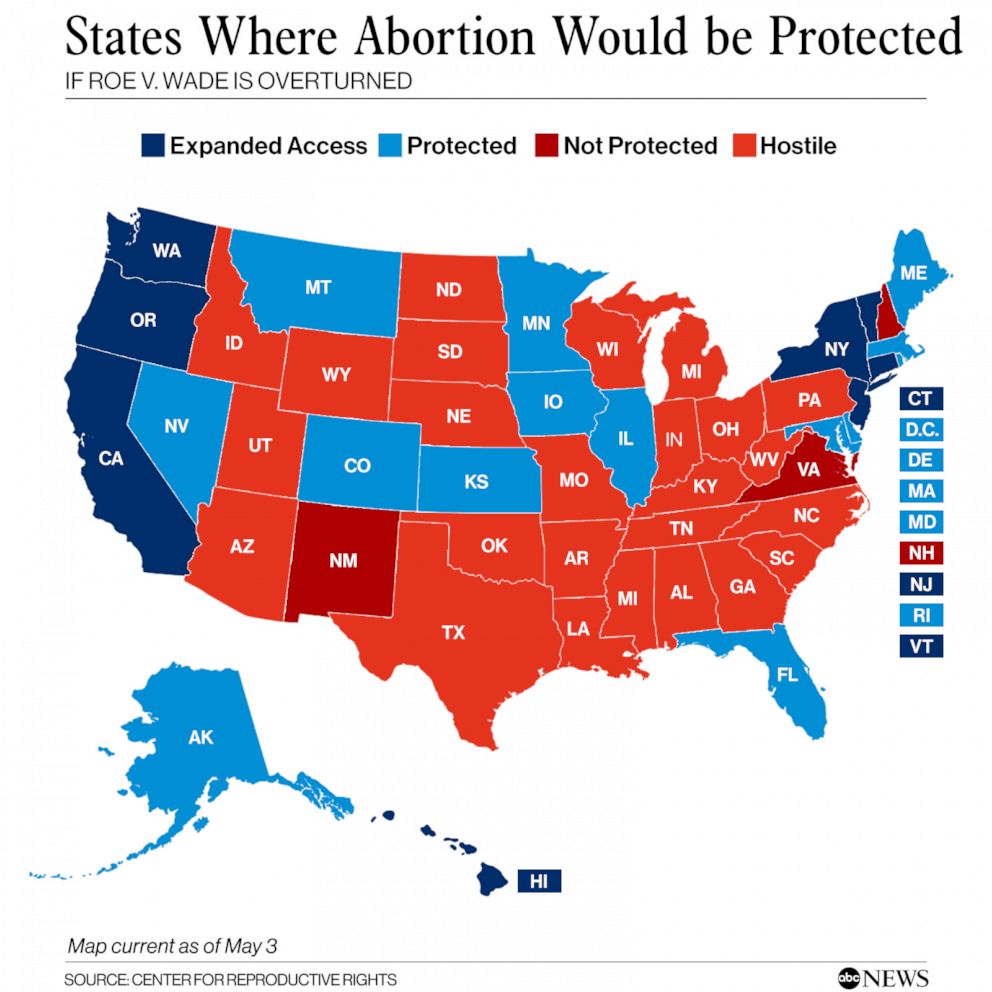
This map shows where abortion will remain legal in the U.S. if Roe is indeed overturned.
ABC News
The Center for Reproductive Rights estimates that up to 25 states could outlaw abortion entirely. Of the remaining, 22 states have a state right to abortion established in a state constitution or state statute, while three do not have state protections for abortion.
“So regardless of the Supreme Court’s decision, abortion will remain legal in at least 22 states,” Smith said.
Abortion is not protected in New Mexico, Virginia and New Hampshire. Smith said women in these states will still likely have access to abortion in the future.
“In New Mexico, they very recently repealed their pre-Roe ban. Virginia, two years ago, repealed many medically unnecessary abortion restrictions that had been in statute for a long time. New Hampshire does not have many of the abortion bans and restrictions that we see in the states that we term ‘hostile’ to abortion rights,” Smith said.
Live Action, a nonprofit anti-abortion group, told ABC News that 22 states already have anti-abortion laws that would kick in if Roe falls.
“Nine states in this group have pre-Roe abortion restrictions still on the books; 13 states have a so-called ‘trigger ban’ that is tied to Roe being overturned and five states have laws passed after Roe restricting nearly all abortions,” Live Action told ABC News.
Another dozen states have six- or eight-week restrictions there are not currently in effect, while Texas’ six-week restriction is in effect. Four states have constitutions that ban the right to abortion, according to Live Action.
While several states have moved to limit or ban access to abortions, many states have also moved to expand access and increase protections for them.
Progressive states are expanding access for their residents and enacting measures to support people from other states who may need to cross state borders to receive access to abortion services due to new restrictions or bans in their home state, according to the Guttmacher Institute.
State legislatures have introduced 231 protective measures in 29 states and the District of Columbia between Jan. 1 and April 14, according to Guttmacher.
Only 11 protective measures have been enacted in seven states in that time frame, according to Guttmacher.
The governor in Colorado signed a bill in April codifying the right to abortion. A Connecticut bill passed in April that protects women who get abortions, those who assist them and abortion providers, and prevents state agencies from assisting interstate investigators seeking to hold people liable. Vermont passed a constitutional amendment guaranteeing the right to abortion which will be on the ballot in November, according to Live Action.
Despite efforts by Maryland’s governor to veto a bill that expands who can provide abortions, state lawmakers were able to override his veto in April.
Efforts to protect access to abortion include provisions expanding the types of health care professionals who can provide abortion care; legislation to assist patients with paying for an abortion; and earmarking state funds for abortion services.
Three states — Colorado, New Jersey and Washington — have enacted rules that establish or expand statutory protections for the right to abortion. Two states, Maryland and Washington, have authorized advanced practice clinicians to provide abortion care, according to Guttmacher.
California, Maryland, New York and Oregon have enacted legislation that requires health plans to cover abortion or establish a state fund to assist with abortion costs, according to Guttmacher.